
What Is a Suspension Customization Factory?
A suspension customization factory develops and manufactures suspension products according to a customer's vehicle, geometry, load, performance, branding, and production requirements instead of supplying only fixed catalog configurations.
For B2B buyers, the word “customization” can describe very different levels of work.
Basic customization may include:
- Product color
- Spring color
- Logo
- Labels
- Packaging
Engineering customization may involve:
- Shock absorber dimensions
- Extended and compressed length
- Stroke
- Mounting interfaces
- Spring rate
- Preload
- Compression damping
- Rebound damping
- Reservoir configuration
- Vehicle-specific fitment
- Prototype validation
A capable factory should make this distinction clear before quoting a project.
Changing the color of a spring is not the same engineering task as developing a new shock absorber for a high-payload UTV or specialty vehicle.
For buyers comparing different development routes, Bedo Auto's Shock Absorber Customization Guide provides additional context on sample-based customization, while its Suspension Design Partner Guide covers broader engineering support.
When Do You Need a Custom Suspension Factory?
A standard suspension product may be sufficient when:
- The vehicle application is already validated
- Mounting dimensions match
- Vehicle load remains unchanged
- Existing spring and damping characteristics are acceptable
Customization becomes more valuable when the project introduces variables that existing products cannot satisfy.
Typical situations include:
- New ATV or UTV development
- Motorcycle or electric motorcycle platforms
- Golf cart suspension upgrades
- Utility vehicle development
- Specialty vehicle projects
- Increased passenger or cargo load
- Different mounting geometry
- Longer or shorter suspension travel
- New spring requirements
- Customized damping
- Private-label suspension products
- Replacement of discontinued components
- Small-batch vehicle programs
The objective is not to customize as many features as possible.
The objective is to customize the right variables for the intended application.
What Can a Suspension Customization Factory Develop?
OEM buyers should ask suppliers to define their actual engineering and manufacturing scope.
Shock Absorber Dimensions
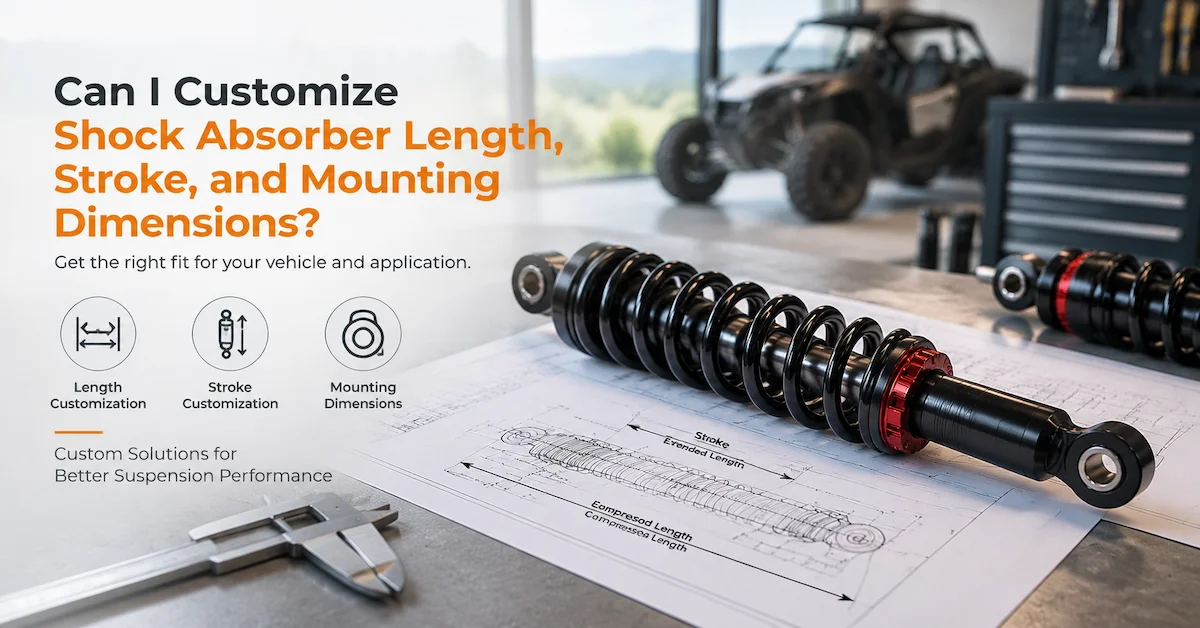
Dimensional customization can include:
- Extended length
- Compressed length
- Shock stroke
- Body diameter
- Rod dimensions
- Upper mount
- Lower mount
- Mounting-hole diameter
- Bushing width
- Fork or clevis dimensions
Incorrect geometry can prevent installation before spring or damping performance is even evaluated.
Projects starting with incomplete technical information can first use a Shock Absorber Drawing Service to organize dimensions, interfaces, and engineering requirements.
Spring Development
A factory with suspension engineering capability may support changes to:
- Spring rate
- Free length
- Outside diameter
- Preload range
- Spring color
- Vehicle-specific load support
Spring selection should consider:
- Vehicle weight
- Payload
- Front/rear axle load
- Suspension geometry
- Shock mounting position
- Available travel
- Desired ride height
A stronger spring is not automatically a better spring.
The correct specification depends on the vehicle and its operating conditions.
Damping Customization
Depending on the shock absorber design, customization may involve:
- Compression damping
- Rebound damping
- Internal valving
- Adjustment range
- Damping-force targets
Damping should be developed around the vehicle, spring, terrain, and required behavior.
For example, a utility UTV carrying cargo may require different suspension priorities from a recreational ATV or road motorcycle.
Reservoir Configuration
Custom projects may also involve:
- Internal reservoir
- External reservoir
- Remote reservoir
- Hose routing
- Reservoir position
- Mounting brackets
Remote reservoirs can be useful in certain demanding applications, but they increase cost and packaging complexity.
A professional factory should evaluate whether the vehicle actually benefits from the configuration rather than recommending it for every project.
Mounting and Packaging
Customization may be required because the suspension must fit within a limited vehicle envelope.
Engineering review can include:
- Chassis clearance
- Control-arm clearance
- Tire clearance
- Spring clearance
- Reservoir clearance
- Hose routing
- Service accessibility
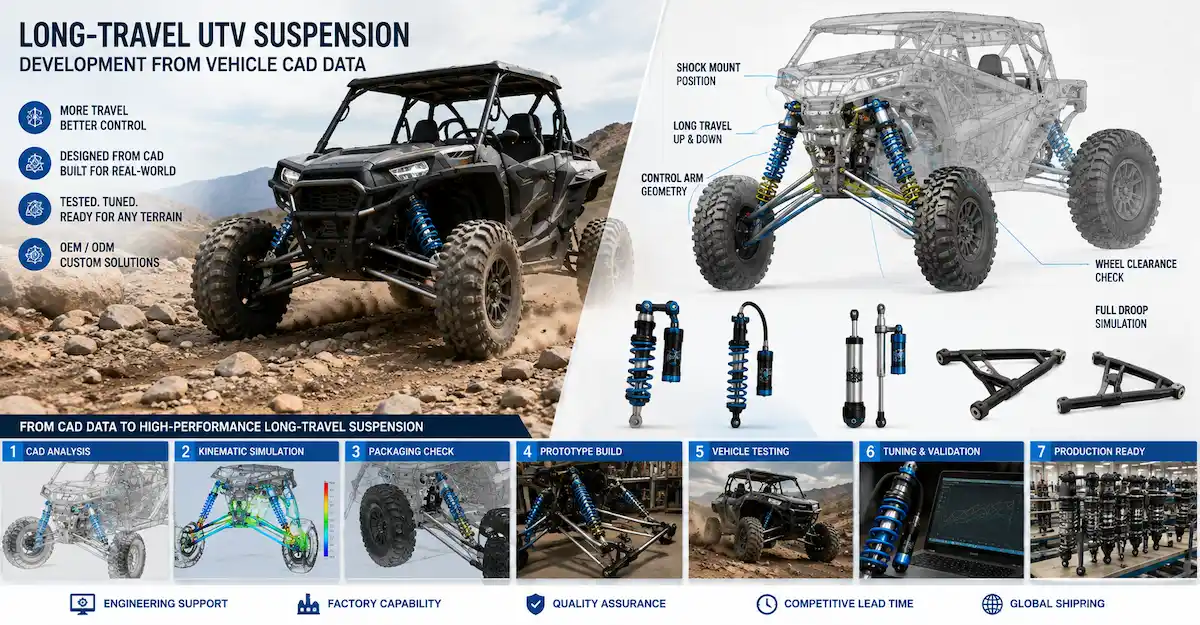
For projects based on vehicle CAD, see Bedo's CAD-Based Suspension Development.
Product Customization vs Suspension Engineering
These terms are often treated as if they mean the same thing.
They do not.
| Project Type | Typical Changes | Engineering Depth |
|---|---|---|
| Cosmetic customization | Color, logo, packaging | Low |
| Fitment customization | Length, mounts, stroke | Medium |
| Spring customization | Rate, preload, dimensions | Medium–High |
| Damping customization | Compression, rebound | High |
| Vehicle-specific suspension | Geometry + spring + damping | High |
| New OEM suspension platform | CAD + prototype + validation + production | Highest |
This distinction also affects:
- Development cost
- Lead time
- Prototype requirements
- Testing
- MOQ
- Engineering revisions
A buyer should therefore define project scope before asking multiple factories to quote.
Otherwise, one supplier may quote only cosmetic customization while another includes engineering development, making the prices impossible to compare fairly.
What Information Should You Send to a Suspension Customization Factory?
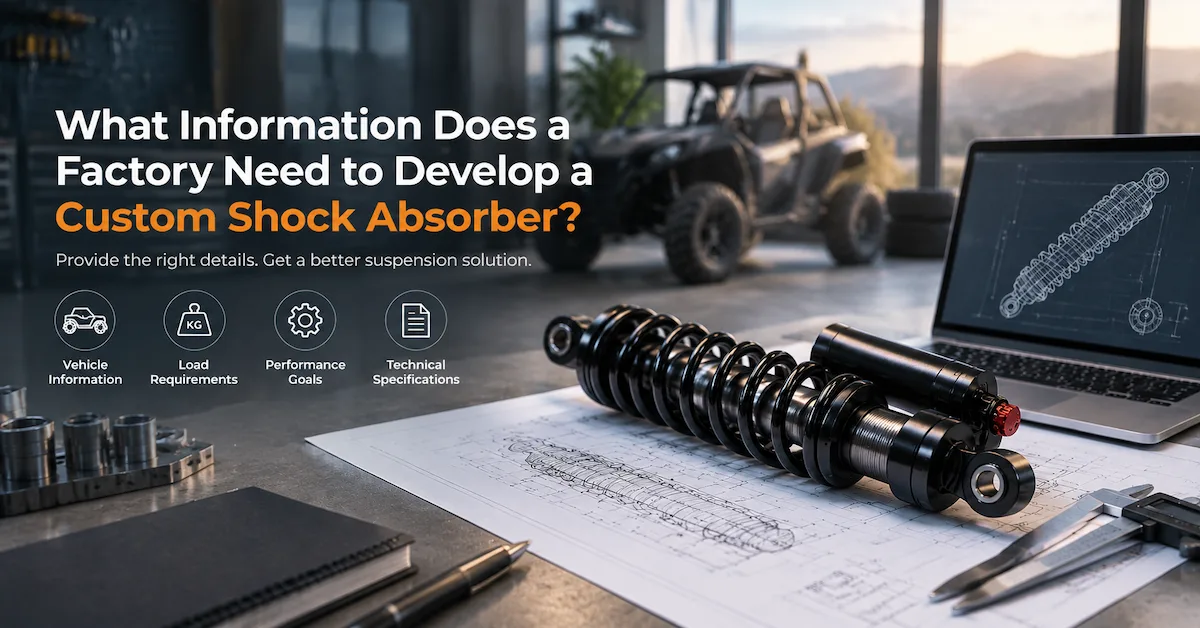
A strong RFQ should explain the vehicle and engineering objective.
| Information | What to Provide | Why It Matters |
| Vehicle type | ATV, UTV, motorcycle, EV, etc. | Defines application |
| Suspension position | Front or rear | Identifies operating role |
| Vehicle weight | Empty and loaded | Supports spring development |
| Payload | Rider, passengers, cargo | Defines load range |
| Extended length | Current or required | Controls fitment |
| Compressed length | Current or required | Controls compression |
| Shock stroke | Required movement | Supports travel |
| Mounting details | Eye, fork, bush, hole dimensions | Ensures installation |
| Spring specification | Existing data if available | Provides baseline |
| Damping information | Existing curve/spec if available | Supports tuning |
| Vehicle CAD | If available | Supports packaging review |
| Reference sample | Existing shock | Helps analysis |
| Application | Utility, trail, road, racing, etc. | Defines target behavior |
| Main problem | Sag, harshness, bottoming, fitment, etc. | Clarifies objective |
| Prototype quantity | Initial development quantity | Supports planning |
| Future volume | Estimated production demand | Supports manufacturing plan |
If exact technical values are unknown, describe the vehicle problem rather than inventing numbers.
For example:
“The rear suspension sags excessively when the cargo bed is fully loaded.”
is more useful than arbitrarily requesting:
“Increase spring rate by 40%.”
Can Custom Suspension Be Developed From Existing Samples?
Yes.
Existing shock absorbers can provide useful dimensional and structural references.
A factory may review:
- Overall length
- Stroke
- Mount dimensions
- Spring dimensions
- Shock body
- Reservoir
- Adjustment mechanism
However, sample copying and engineering customization are different.
Sample Copying
The objective is:
Produce something close to the reference shock.
Engineering Customization
The objective is:
Modify or develop the suspension for a specific vehicle requirement.
If vehicle weight, payload, mounting geometry, terrain, or performance target changes, the original shock specification may no longer be appropriate.
Bedo's Shock Absorber Sample Supplier Guide and Suspension Sample Development explain how physical samples can become part of a larger prototype-validation process.
How Does a Suspension Customization Project Work?
A structured project reduces uncertainty step by step.
1. Requirement Analysis
The factory should first understand:
- Vehicle application
- Load range
- Suspension position
- Geometry
- Terrain
- Existing problem
- Target improvement
- Production plan
2. Drawing, CAD, or Sample Review
Development can begin from:
- 2D drawings
- 3D CAD
- Physical samples
- Vehicle specifications
- Mounting measurements
Missing information should be identified before the first sample is manufactured.
3. Define Fitment
The engineering team confirms:
- Extended length
- Compressed length
- Stroke
- Upper mount
- Lower mount
- Available installation space
Fitment should be established before performance tuning.
4. Develop Spring Requirements
Spring design can then consider:
- Vehicle load
- Suspension leverage
- Available travel
- Ride-height target
- Payload
- Application
5. Develop Initial Damping
The initial compression and rebound configuration should reflect intended vehicle behavior.
This specification is normally a starting point for prototype validation rather than guaranteed final tuning.
6. Produce Prototype Samples
The prototype converts engineering assumptions into something that can be physically installed and evaluated.
Bedo's Prototype Shock Absorber Factory Guide explains why dimensions, mounting, spring characteristics, damping, and production feasibility should be verified before scaling.
7. Vehicle Fitment Review
Check:
- Mount alignment
- Clearance
- Ride height
- Suspension travel
- Reservoir placement
- Hose routing
8. Performance Validation
The development team may evaluate:
- Load support
- Spring behavior
- Compression response
- Rebound response
- Bottoming resistance
- Leakage
- General vehicle response
9. Engineering Revision
Prototype results may require changes to:
- Spring rate
- Preload
- Damping
- Stroke
- Mount geometry
- Reservoir location
These revisions are a normal part of development.
10. Pilot or Small-Batch Production
After the prototype is approved, a small batch can help verify:
- Manufacturing consistency
- Assembly repeatability
- Appearance
- Dimensions
- Performance consistency
- Packaging
11. OEM Production
The approved design can then transition toward commercial manufacturing based on project demand.
Why Prototype-to-Production Capability Matters
One of the most important questions when selecting a suspension customization factory is:
Can this factory manufacture the same approved suspension repeatedly?
Prototype capability alone is not enough.
The factory should be able to transfer the approved specification into:
- Controlled drawings
- Material requirements
- Component specifications
- Assembly instructions
- Inspection criteria
- Production records
Otherwise, buyers may experience a common problem:
Prototype performance ≠ Production batch performance
A factory should therefore demonstrate continuity between engineering and manufacturing.
What Should Be Controlled During Production?
Production quality requires more than final visual inspection.
Incoming Components
Relevant materials and components should match approved requirements.
Dimensional Inspection
Important dimensions may include:
- Length
- Stroke
- Mount dimensions
- Bush dimensions
- Spring dimensions
Assembly Control
Assembly methods should remain consistent with the validated product.
Functional Verification
The appropriate inspection depends on the product and agreed specification.
Buyers should ask what is actually checked instead of accepting generic phrases such as:
“100% quality inspection.”
Revision Control
Production must use the latest approved:
- Drawing
- Specification
- BOM
- Spring configuration
- Damping configuration
This is especially important after multiple prototype revisions.
For buyers sourcing components directly from technical documentation, Bedo's Suspension Parts From Drawings covers drawing and revision control in more detail.
How to Evaluate a Suspension Customization Factory
A factory audit should cover both engineering and manufacturing capability.
Engineering Communication
Does the supplier ask about:
- Vehicle weight?
- Payload?
- Geometry?
- Stroke?
- Terrain?
- Performance targets?
If the discussion focuses only on price, quantity, and color, engineering customization may be limited.
CAD and Drawing Support
Confirm whether the supplier can review:
- 2D drawings
- 3D CAD
- Physical samples
- Vehicle dimensions
Prototype Capability
Ask:
- Can prototypes be produced?
- Can specifications be revised?
- How are revisions documented?
Spring Capability
Confirm whether spring specifications can be selected or changed according to the application.
Damping Capability
Ask whether compression and rebound characteristics can be adjusted during development.
Testing Capability
Clarify:
- What tests are available?
- Which parameters are measured?
- What evidence can be provided?
Small-Batch Capability
A low-volume pilot stage can be useful before large orders.
Production Scalability
Ask how an approved sample is transferred into repeat manufacturing.
What Determines Custom Suspension Cost?
There is no single meaningful price for “custom suspension.”
Cost depends on project scope.
Important variables include:
- Existing vs new design
- Number of customized dimensions
- New components
- Spring development
- Damping development
- Reservoir configuration
- Prototype quantity
- Testing requirements
- Surface treatment
- Branding
- Revision rounds
- Production quantity
A cosmetic branding project and a new vehicle-specific suspension project should not have the same development cost.
This is why a factory should review technical requirements before providing a final quotation.
What Determines MOQ?
MOQ can depend on:
- Existing components
- New custom components
- Material sourcing
- Spring requirements
- Machining
- Surface treatment
- Assembly process
- Packaging
For early OEM programs, a factory that supports prototypes and small batches can reduce the buyer's initial inventory risk.
Bedo's Low-Volume Shock Absorber OEM Guide explains the value of moving through prototype and small-batch stages before larger-scale production.
Suspension Customization for Different Vehicle Applications
| Application | Common Customization Focus |
| ATV | Travel, damping, terrain response |
| UTV | Payload, spring support, long travel |
| Motorcycle | Ride control, damping, packaging |
| Electric motorcycle | Weight distribution, packaging |
| Golf cart | Comfort, load support |
| Utility vehicle | Payload and durability |
| Specialty vehicle | Non-standard geometry and duty cycle |
These are general project directions rather than fixed specifications.
Actual development should use vehicle-specific data.
Common Risks When Selecting a Custom Suspension Factory
Risk 1: “Customization” Means Only Logo and Color
Some suppliers use custom manufacturing primarily to describe private labeling.
Better approach: ask separately about geometry, spring, and damping customization.
Risk 2: No Engineering Review Before Quotation
A price without project understanding may later change substantially.
Better approach: compare quotations based on the same development scope.
Risk 3: Copying a Shock for a Different Vehicle
The sample may fit physically but perform poorly.
Better approach: supply vehicle and load information together with the sample.
Risk 4: First Prototype Treated as Final Design
Complex custom projects may require tuning.
Better approach: include revision stages in the development plan.
Risk 5: Weak Revision Control
Production can accidentally use an old specification.
Better approach: establish controlled drawings and approval status.
Risk 6: Prototype Factory Cannot Scale
A one-off sample may not represent repeatable production.
Better approach: evaluate manufacturing capability before prototype approval.
How Bedo Auto Supports Suspension Customization Projects
Bedo Auto supports suspension development for applications including ATV, UTV, motorcycles, electric vehicles, golf carts, utility vehicles, and specialty vehicles.
Depending on the project, the development workflow can include:
- Technical consultation
- Sample analysis
- Drawing review
- CAD-based development
- Shock absorber customization
- Spring development
- Damping adjustment
- Prototype manufacturing
- Testing and validation
- Engineering revision
- Small-batch production
- OEM manufacturing
Buyers can review Bedo's existing shock absorber products before deciding whether a standard configuration or fully customized solution is more appropriate.
For supplier-level customization requirements, the related Shock Absorber Customization Company Guide focuses more specifically on customized shock absorber development.
For a broader vehicle engineering project, continue to the Suspension Design Partner Guide.
What Should You Include in a Suspension Customization RFQ?
Prepare:
- Vehicle type
- Suspension position
- Empty vehicle weight
- Maximum loaded weight
- Passenger/cargo information
- Extended shock length
- Compressed length
- Stroke
- Mount dimensions
- Spring information
- Existing damping information
- Drawings or CAD
- Reference shock absorber
- Installation photos
- Terrain
- Main problem to improve
- Branding requirements
- Prototype quantity
- Pilot-batch requirement
- Expected production volume
A clear RFQ allows the factory to distinguish whether your project needs:
Private label customization
or
Vehicle-specific suspension engineering
before development starts.
OEM buyers can send drawings, samples, vehicle information, and project requirements through the Bedo Auto Contact Page.
FAQ
What is a suspension customization factory?
A suspension customization factory develops and manufactures suspension products according to vehicle-specific dimensions, load, spring, damping, mounting, appearance, and production requirements rather than supplying only catalog products.
What suspension components can be customized?
Depending on factory capability, customization may include shock absorber dimensions, mounts, springs, damping, reservoirs, bushings, surface finishes, branding, and packaging.
Can a custom suspension be developed from my existing sample?
Yes. A reference sample can provide dimensional and structural data. Vehicle and performance information should also be supplied when the new application differs from the original.
Can spring rate be customized?
Yes, when the factory supports spring development. Spring rate should be selected according to load, suspension geometry, travel, and application rather than simply requested as “harder” or “softer.”
Can compression and rebound damping be customized?
They can be adjusted on suitable shock designs. Final damping should be developed around the vehicle and validated through physical testing.
Does every custom suspension require a new prototype?
Not necessarily for cosmetic-only customization. New geometry, spring, damping, mounting, or vehicle applications generally justify prototype verification before larger orders.
Can a customization factory support small batches?
Some factories support prototype and pilot quantities before larger OEM production. The actual MOQ depends on design, materials, components, and manufacturing processes.
How do I compare two suspension customization factories?
Compare engineering support, CAD/drawing capability, spring and damping development, prototype capability, testing, revision control, quality management, low-volume production, and scalability—not just unit price.
What is the difference between a suspension factory and a shock absorber supplier?
A shock absorber supplier may mainly sell existing products. A suspension customization factory serving OEM projects should ideally support engineering changes, prototypes, validation, and repeat manufacturing according to customer-specific requirements.
How do I start a custom suspension project with Bedo Auto?
Prepare available vehicle data, drawings, CAD files, reference shocks, load information, mounting dimensions, performance objectives, prototype quantity, and production plans, then submit them through the Bedo Auto Contact Page.
Conclusion
Choosing a suspension customization factory should be treated as both an engineering and manufacturing decision.
The strongest supplier is not necessarily the one offering the largest list of customizable colors or the lowest unit price.
For OEM buyers, the more important question is whether the factory can connect:
Vehicle Requirements → Engineering Review → CAD/Drawings → Spring & Damping Development → Prototype → Testing → Revision → Small Batch → OEM Production
This process reduces the risk of approving a product that looks correct but does not fit, perform, or reproduce consistently in production.
A professional customization factory should also be transparent about what can be confirmed through drawings and prototypes, what still requires testing, and which specifications depend on vehicle-specific information.
Bedo Auto supports custom suspension projects from sample and drawing review through shock and spring development, prototype validation, small-batch manufacturing, and production preparation.
If your ATV, UTV, motorcycle, EV, golf cart, utility vehicle, or specialty vehicle requires a suspension configuration beyond standard catalog products, submit the available engineering information through the Bedo Auto Contact Page for project review.