
How should an OEM scope custom suspension design services?
Direct answer: an OEM should scope custom suspension design services by defining the vehicle problem, available inputs, system boundary, design authority, required deliverables, review gates, prototype and validation responsibility, acceptance evidence, design-freeze conditions, intellectual-property treatment, and change process. The service should state who decides the geometry, shock interfaces, spring targets, damping targets, materials, tests, and production controls. “Design a suspension” is not a complete statement of work.
A useful scope separates confirmed vehicle facts from targets and supplier proposals. It also distinguishes a concept from a production-released specification. The output of each stage should be named, reviewed, and linked to a revision so that a promising sample does not become an uncontrolled production part.
This article addresses a procurement problem rather than repeating a general description of suspension engineering: what exactly is the buyer purchasing when it requests custom suspension design services, and what evidence shows that the work is complete? It is written for vehicle OEMs, electric-vehicle developers, powersports brands, specialty-vehicle builders, modification companies, and private-label suspension businesses preparing an engineering RFQ.
Why a service name cannot define the engineering scope
Two suppliers may both offer custom suspension design services while proposing very different work. One may review a drawing and recommend an existing shock. Another may develop a spring and damping configuration around fixed vehicle hard points. A third may help evaluate suspension geometry, packaging, prototypes, tests, and production release. Their prices and schedules cannot be compared until the buyer knows which tasks and outputs are included.
The problem becomes more serious when the buyer assumes that design responsibility has transferred to the supplier. If vehicle masses, hard points, motion ratios, tire envelopes, or legal load limits are wrong, a component that meets its drawing may still fail at vehicle level. Conversely, the supplier cannot be held to a performance target that was never defined or tested under an agreed condition.
| Service level | Typical boundary | Representative output | What it does not automatically include |
|---|---|---|---|
| Application review | Compare a known vehicle and requirement with existing component options. | Fitment questions, preliminary selection, open-issue list. | New suspension geometry or production validation. |
| Component adaptation | Modify an existing shock/spring platform for defined interfaces and use. | Revised drawing, spring/damping proposal, prototype specification. | Complete chassis or vehicle dynamics responsibility. |
| Component design | Develop a shock, spring, mount or assembly to controlled requirements. | Design records, drawings/BOM, prototype and validation plan. | Approval of vehicle structure, brakes, steering or legal capacity. |
| Vehicle-integrated support | Work with buyer hard points, loads, travel, packaging and target behavior. | Interface review, component design, prototypes, test iterations and release package. | Any task not expressly assigned, including certification or homologation. |
| Production transition | Convert the approved design into a repeatable manufacturing definition. | Released drawings/BOM, inspection, pilot evidence, labels and change control. | Ongoing redesign outside the agreed change process. |
A buyer can select one level or combine them. The important point is that the contract names the boundary. BEDO's existing suspension design partner guide gives a broad view of engineering collaboration; the framework here is for turning that collaboration into a comparable, auditable scope.
Write the vehicle problem before the component solution
The statement of work should begin with the vehicle, user, duty, and business objective. If the first requirement is “use a reservoir shock with a red spring,” the team may be optimizing an appearance choice before understanding the load, travel, temperature, package, and performance problem.
Describe the vehicle category, current design state, intended market, suspension architecture, front/rear position, curb and operating mass states, payload and passenger cases, weight distribution where known, tires, wheel travel, speed range, route or terrain, temperature and contamination exposure, daily duty, service expectation, and target behavior. Identify which values are measured, calculated, estimated, or still unknown.
Turn subjective objectives into observable conditions
Terms such as comfortable, stable, sporty, heavy duty, smooth, and premium are useful market language but incomplete engineering requirements. Connect them to situations: excessive rear sag with the normal cargo package, repeated rebound after a defined bump, harsh response over closely spaced surface joints, reduced control after extended duty, insufficient droop, or interference at a known steering and bump condition.
Not every target needs a universal numerical limit at the first inquiry. The buyer and supplier can agree how the target will be measured during development. What matters is that acceptance can eventually distinguish pass, revise, and fail.
State the commercial purpose
Is the project a replacement component, load-support option, performance upgrade, new OEM platform, cost-reduction exercise, electric conversion, private-label range, or service replacement for an obsolete part? The purpose changes the design freedom, validation depth, documentation, service-life expectation, and production plan. A cost-reduction project may require strict interchangeability, while a new platform may permit hard-point changes before design freeze.
Audit the inputs before promising a design schedule
Custom suspension design services depend on inputs controlled by several parties. Before a final plan is issued, create an input register with owner, source, revision, due date, confidence, and effect if missing. This prevents an estimated axle load or outdated CAD file from silently becoming a production assumption.
| Input group | Examples | Likely owner | Risk if uncontrolled |
|---|---|---|---|
| Vehicle definition | Platform, variant, market, curb/operating mass, payload, passengers, accessories. | Vehicle OEM or buyer. | Spring and damping are developed for the wrong vehicle state. |
| Geometry and interfaces | Hard points, control arms/linkage, wheel travel, shock angle, mount widths/holes, envelopes. | Buyer, with supplier review. | Incorrect motion relationship, stroke, clearance or load path. |
| Operating cases | Terrain, route, speeds, impacts, duty duration, temperature, water, dust, storage. | Buyer/end-user evidence. | Component is validated under irrelevant conditions. |
| Performance targets | Ride-height window, support, comfort/control priorities, adjustability, benchmark. | Buyer and supplier jointly clarify. | Technically functional prototype cannot be accepted objectively. |
| Reference evidence | Samples, drawings, CAD, current spring, damping curves, test results, failure parts. | Buyer and prior suppliers as permitted. | Wear or undocumented history is mistaken for nominal design. |
| Commercial plan | Prototype, pilot and annual quantity; launch; cost target; packaging; service parts. | Buyer purchasing/product team. | Engineering route is incompatible with volume, timing or supply model. |
| Compliance requirements | Applicable buyer standards, destination requirements, documentation and approvals. | Responsible OEM with appropriate specialists. | Late redesign or unsupported compliance claims. |
If a value is unknown, state how it will be obtained. Options may include vehicle measurement, weighing, CAD review, sample inspection, test instrumentation, buyer decision, or supplier proposal followed by validation. Unknowns are manageable; hidden assumptions are not.
Define design authority with a responsibility matrix
A responsibility matrix identifies who provides information, who designs, who reviews, who approves, and who owns the result. It should cover both technical and commercial outputs. The exact legal allocation needs project-specific advice, but the engineering team still needs a practical working map.
| Decision | Buyer/OEM role | Design supplier role | Approval evidence |
|---|---|---|---|
| Vehicle hard points and allowed envelope | Provide controlled vehicle data and change limits. | Review feasibility and identify conflicts. | Approved interface drawing or CAD revision. |
| Vehicle loads and use cases | Define or obtain valid operating conditions. | Translate them into component requirements and identify gaps. | Signed requirement and load-case register. |
| Shock dimensions and mounts | Approve fit and vehicle interface. | Propose/design manufacturable component geometry. | Released drawing and fitment record. |
| Spring and damping targets | Define vehicle objective and provide validation access. | Develop candidate specifications and revisions. | Controlled spring/damping identity and test result. |
| Materials and processes | State required standards or restrictions. | Propose suitable manufacturable specifications. | Approved drawing/BOM and qualification evidence. |
| Vehicle validation | Own vehicle, route, operators and final vehicle decision unless contracted otherwise. | Support plan, instrumentation, prototypes and analysis as agreed. | Vehicle test report and issue closure. |
| Production release | Approve commercial and vehicle readiness. | Demonstrate component repeatability and documentation. | Release authorization tied to revision. |
The matrix also prevents duplicate work. If the buyer owns system kinematics, the supplier should receive controlled outputs rather than recreate unknown geometry. If the supplier is expected to review motion ratio or packaging, that analysis and its required data should appear as an explicit deliverable.
Specify deliverables by decision, not by file count
A large folder does not prove that a design service is complete. Each deliverable should support a decision: requirements approved, concept selected, interfaces frozen, prototype authorized, validation passed, or production released. Define file format, content, revision, reviewer, and acceptance.
Requirement and risk deliverables
- Vehicle and application requirement specification.
- Input/assumption/open-issue register.
- System boundary and responsibility matrix.
- Load-case and operating-condition matrix.
- Benchmark or current-problem record.
- Technical risk register with owner and closure plan.
Design deliverables
- Concept options and selection rationale where more than one route exists.
- Interface-control drawing or agreed hard-point/envelope record.
- Shock assembly and component drawings appropriate to the project.
- Bill of materials with controlled spring, mount, hardware and internal configuration identity.
- Spring proposal, installed condition, adjustment and retention requirements.
- Damping target or controlled setting definition and evaluation context.
- Relevant CAD files, drawing standards, tolerances, finishes and critical characteristics.
- Design review record, decisions and action closure.
Verification and production deliverables
- Prototype build record and serialized sample matrix.
- Dimensional/functional inspection results.
- Fitment, full-motion and clearance report.
- Bench and vehicle validation results required by the project.
- Issue, deviation and engineering-change log.
- Released drawing/BOM revision and production inspection plan.
- Pilot-build evidence, packaging/label approval, and production release record.
Some projects do not need every item. A controlled adaptation can use a lighter package than a clean-sheet vehicle. The statement of work should remove unnecessary outputs deliberately rather than leave both parties to assume.
Use review gates to prevent premature prototype and tooling decisions
Review gates create explicit decisions between stages. The names can be simple; the quality of the evidence matters more than adopting a particular corporate acronym. A practical sequence might include requirement review, concept review, detailed design review, prototype readiness review, validation review, and production release review.
| Gate | Decision | Minimum questions | Possible result |
|---|---|---|---|
| Requirement review | Is the problem sufficiently defined to start? | Vehicle, loads, use, targets, interfaces, unknowns, responsibility, commercial plan. | Proceed, proceed with actions, or return for data. |
| Concept review | Which architecture should be developed? | Fit, travel, spring/damping route, adjustment, package, risks, manufacturability. | Select, compare further, or revise requirement. |
| Detailed design review | Is the design ready for prototype manufacture? | Drawings, BOM, tolerances, interfaces, open issues, prototype configuration and tests. | Authorize build or close actions first. |
| Prototype readiness | Can the prototype answer the intended questions? | Sample IDs, variants, test conditions, instruments, vehicle, acceptance, safety. | Begin validation or correct the plan. |
| Validation review | Do results support the target and release scope? | Pass/fail, anomalies, repeatability, vehicle feedback, unresolved risk, changes. | Revise, add evidence, approve pilot or stop. |
| Production release | Can the approved result be manufactured and identified repeatedly? | Final revision, inspection, pilot, packaging, traceability and change rules. | Release defined SKU/market scope or hold. |
Every gate should record attendees, source files, decisions, actions, owners, due dates, and approved revision. Email agreement that does not identify the drawing or prototype can create disputes later. The current shock absorber drawing service guide explains why dimensions and interface records must be controlled before prototype manufacture.
Control the shock, spring, and vehicle as one design problem
A suspension design service should not treat the shock absorber, spring, linkage, tire, and vehicle mass as independent. The spring supports load and establishes working position; the damper controls motion; the geometry transforms wheel movement and force at the component. A correct eye-to-eye dimension does not prove suitable stroke, spring support, damping, or vehicle behavior.
Geometry and packaging
Review extended and compressed conditions, required shock stroke, wheel travel, motion ratio through travel where relevant, mount alignment, articulation, tire and body envelope, spring clearance, reservoir or hose routing, adjuster access, service access, and chassis stops. CAD can reveal packaging conflicts but should be checked against tolerances, deflection, assembly, and physical vehicles.
Spring definition
Define the load cases and intended working range before choosing spring rate. Control spring characteristic, free and installed conditions, preload or seat position, outside diameter, travel/clearance, retention at droop, and identification. Do not publish material grade, fatigue result, or corrosion performance without approved evidence.
Damping definition
State the desired vehicle response and test context. Compression and rebound decisions depend on spring, geometry, mass, speed, terrain, tire, and duty. If curves or force windows are required, define test condition, equipment, speed points, temperature or conditioning, tolerance, and acceptance. If approval is vehicle-based, control the configuration and route so the result can be connected to production settings.
BEDO's shock absorber engineering service guide gives additional background on component-level variables. In an actual statement of work, convert relevant variables into named inputs, decisions, and deliverables rather than leaving them as educational topics.
Plan validation while the design is still flexible
Validation should be written before final design because acceptance affects the design, prototype count, instrumentation, schedule, and budget. Identify what must be verified by document review, analysis, dimensional inspection, bench test, fitment, full-motion check, vehicle test, durability exposure, environmental condition, or pilot production.
Use a requirements-to-evidence matrix. Each requirement receives an ID, owner, verification method, condition, sample/revision, acceptance, and result. This prevents a project from collecting attractive test data while leaving the main buyer question unanswered.
| Requirement type | Possible evidence | Control needed |
|---|---|---|
| Interface and fit | Drawing inspection, vehicle installation, full bump/droop and steering/articulation review. | Vehicle/CAD revision, load state, sample ID and documented clearances. |
| Static support | Ride height, sag or travel-position observations under defined loads. | Measurement points, surface, tire condition, load arrangement and acceptance window. |
| Dynamic behavior | Bench data and/or vehicle route evaluation. | Spring/damping revision, settings, speed/surface, operators and acceptance method. |
| Functional integrity | Movement, leakage, adjustment, noise and post-test inspection. | Conditioning, duration/cycles where agreed, pass/fail and anomaly handling. |
| Production repeatability | Pilot measurements, functional results, component identity and process records. | Released BOM/drawing, sample plan, equipment/method and deviation rule. |
Do not assume every possible test is necessary. Select evidence based on risk, application, buyer standards, and legal requirements. Where the website or supplier cannot substantiate a specific capability, keep it as an RFQ question rather than writing it as fact.
Define design freeze as a controlled decision
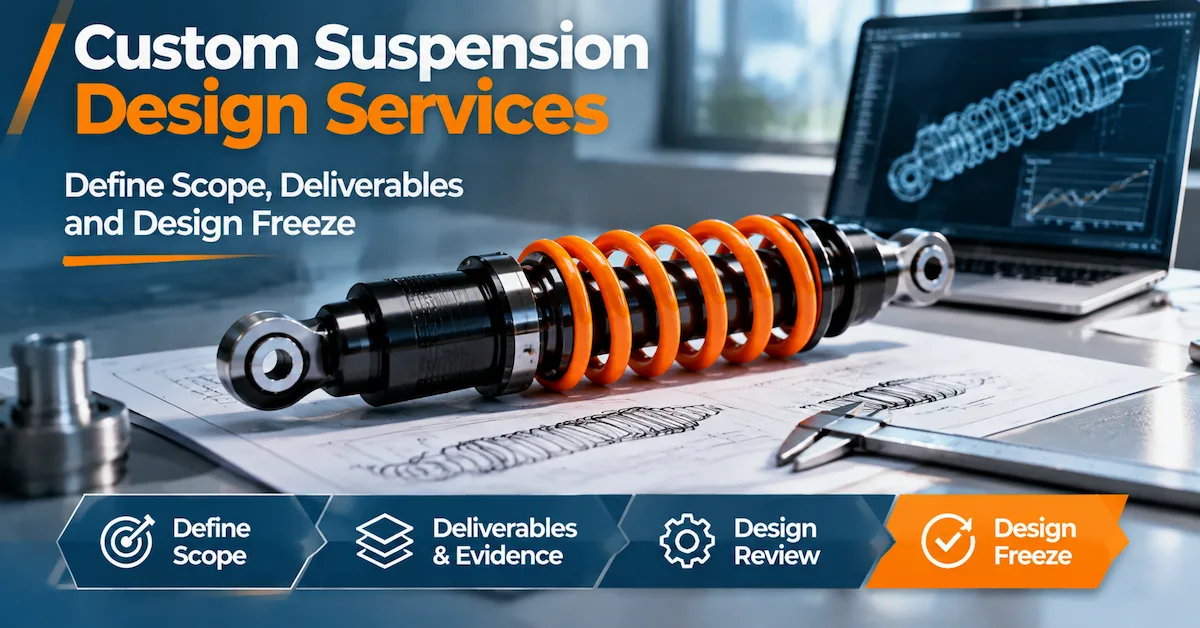
Design freeze does not mean the product can never change. It means the specified baseline is complete enough that manufacturing, purchasing, validation, packaging, and commercial teams can proceed without uncontrolled technical movement. The freeze should identify exactly what is frozen and what remains open.
A component-level freeze normally includes released interfaces, dimensions and tolerances, BOM, spring identity, damping/internal configuration, materials and finishes, hardware, critical characteristics, inspection and required validation. A market-release freeze may additionally include application list, settings, instructions, label, packaging, service parts, and claims.
Conditions that should block freeze
- Unapproved vehicle or interface data controls fitment.
- The prototype that passed a test cannot be traced to the drawing and BOM.
- Spring or damping was adjusted without updating the specification.
- A fitment or vehicle anomaly has no owner or disposition.
- Critical test conditions or acceptance criteria were changed after results were known.
- Production inspection cannot distinguish the approved revision.
- Buyer and supplier disagree about design authority, IP, or change approval.
If commercial timing requires an interim release, identify it as such, limit the quantity and use, state open risks, and define the next approval. Do not relabel an engineering sample as production-frozen simply to meet a date.
Use change control after the freeze
Changes can originate from field information, material availability, manufacturing improvement, cost, supplier source, vehicle revision, warranty findings, or regulation. The change process should record the reason, affected parts and applications, risk, required validation, inventory treatment, effective date, and approvals.
Classify changes by effect rather than appearance. A new color may be low risk if the process and performance remain equivalent and approved. A new spring, valve, seal, mount, body length, material, heat treatment, or source may affect fit, load support, damping, durability, or traceability. The project team should decide the evidence required before implementation.
Keep prototype, pilot, and production revision histories connected. When a field issue arrives, the team must identify which vehicle, part, spring, setting, batch, and package were involved. Without that chain, custom suspension design services have produced a drawing but not a controllable product.
Address intellectual property and data use early
Design files, samples, supplier background know-how, newly created geometry, tooling, test data, software or settings, and production process knowledge may have different ownership and use rights. The parties should obtain appropriate legal advice and state the commercial arrangement in writing. A blog cannot decide those rights.
From an engineering perspective, the team at least needs permission to use the input data for the project, a rule for sharing files with approved subcontractors, document security expectations, the deliverables the buyer will receive, and access needed for future production or service. Clarify what happens if development stops before validation or if production moves to another source.
Price and schedule the service by stage
A single total can hide assumptions. Ask suppliers to separate requirement review, engineering/design, tooling, prototype components, assembly, testing, vehicle support, revisions, pilot production, documentation, and production unit pricing where applicable. Identify included revision cycles and what triggers additional work.
Use milestone timing with start conditions. For example, detailed design timing begins only after the required CAD and loads are approved; prototype timing begins after drawings and open tooling decisions are released; vehicle validation depends on vehicle and operator availability. A quoted lead time without these dependencies is not a reliable schedule.
MOQ and production price belong to the final configuration and volume plan. Custom suspension design services may begin before those values are fixed, but the commercial model should be reviewed at each gate. A technically valid design can still fail as a product if specialized components, inspection, or low demand make repeat supply impractical.
Build a comparable RFQ for custom suspension design services
- Company, vehicle program, target market, buyers/users and business objective.
- Requested service boundary: application review, adaptation, component design, integrated support and/or production transition.
- Vehicle architecture, hard points, geometry, mass/load cases, tires, travel and available envelope.
- Operating conditions, duty, environment, speed/terrain and service expectation.
- Current problem, benchmark, target behavior and priority trade-offs.
- Available samples, drawings, CAD, measurements, test data, failure evidence and their revisions.
- Expected shock, spring, mount, adjustment, finish and package scope.
- Responsibility matrix and vehicle-level decisions retained by the buyer.
- Required deliverables, file formats, review gates and approval authority.
- Prototype variants and quantities, test responsibility, vehicles, acceptance and issue process.
- Design-freeze and production-release evidence.
- IP, confidentiality, data return, tooling, change notification and service requirements.
- Prototype, pilot and annual forecast; target milestones; destination and packaging needs.
Ask each supplier to return assumptions, exclusions, missing inputs, deliverables, schedule dependencies, price by stage, and proposed evidence. Buyers can compare answers against BEDO's public engineering and manufacturing scope and submit a controlled project brief through the BEDO contact page for feasibility review.
Common scope failures and how to prevent them
The buyer orders “design” but receives only a sample
Prevent this by listing the required requirement record, drawings, BOM, settings, validation, and production documents. A sample is one deliverable, not the definition of the service.
The supplier receives CAD but no load or behavior target
CAD can define space and interfaces but not the complete spring and damping requirement. Add vehicle mass states, use cases, geometry, current behavior, and acceptance.
A good prototype cannot be reproduced
Record its component identities, spring, internal configuration, settings, build changes, inspection and test condition. Incorporate every approved adjustment into the released documents before pilot production.
Vehicle and component responsibility is confused
Use the responsibility matrix to separate vehicle limits, chassis/geometry, component design, test execution and final vehicle approval. Revisit it whenever the vehicle changes.
Design freeze occurs while assumptions are open
Freeze only a defined baseline. Unresolved items need an owner, risk statement, quantity/use limit, and next approval rather than an invisible exception.
Frequently asked questions about custom suspension design services
What do custom suspension design services normally include?
They can include requirements, interface review, shock and spring design or adaptation, drawings/BOM, prototypes, validation support, production transition and change control. The actual inclusion must be stated because service names are not standardized.
Who should own the vehicle hard points?
The responsible vehicle organization normally provides and approves controlled hard points unless the contract assigns geometry development to another qualified party. The component supplier should identify conflicts and use the approved revision.
Can a suspension be designed from a sample alone?
A sample can reveal geometry and construction clues, but wear, material, internal settings, vehicle loads, motion ratio, duty and target behavior may remain unknown. Combine sample evidence with vehicle requirements and validation.
What is the difference between a concept and a production design?
A concept shows a proposed route. A production design requires controlled interfaces, drawings, BOM, spring/damping identity, materials/process requirements, verification evidence, inspection, pilot repeatability and release approval appropriate to the project.
When should design freeze happen?
After the agreed requirements and interfaces are controlled, validation changes are incorporated, open risks are dispositioned, the approved prototype is traceable to documents, and manufacturing can reproduce and inspect the baseline.
Does design freeze prevent later improvement?
No. It creates a baseline. Later improvements pass through documented impact review, validation and approval so that inventory, vehicles, service parts and customers receive the intended revision.
Should a buyer request CAD files?
Request the files needed for integration, approval and future support, and define formats and ownership/use rights in the agreement. Not every supplier process file is automatically a buyer deliverable.
How should spring and damping acceptance be written?
Connect them to defined vehicle/load conditions and controlled test methods. Use approved spring identity, installed condition, damping setting or force criteria where available, and vehicle behavior acceptance. Avoid unsupported “soft” or “sport” labels alone.
How many design reviews are required?
There is no universal number. Use enough gates to control requirements, concept, detailed design, prototype, validation and production release according to project risk and complexity.
What should be sent for an initial quotation?
Send the vehicle and business objective, available geometry and loads, use cases, current problem, expected service boundary, deliverables, prototype/validation needs, timing, quantities and known commercial requirements. Mark unknowns openly.
Conclusion
Custom suspension design services deliver value when they convert an uncertain vehicle problem into controlled decisions and reproducible evidence. Define the service boundary, audit inputs, assign design authority, specify deliverables, review the design at meaningful gates, plan validation before building prototypes, and freeze a traceable baseline before production. Keep vehicle responsibility, shock and spring decisions, validation, IP, commercial terms and change control visible throughout the project.
A good RFQ does not demand every document by default. It asks for the right evidence at the right decision. OEMs and specialty-vehicle developers can use the matrices above to identify what they know, what requires supplier engineering, and what remains a vehicle-level responsibility. Buyers with a new platform, controlled CAD, a reference sample, or a documented suspension problem can review the BEDO shock absorber portfolio and submit the scope, input register, responsibility matrix, target deliverables, prototype plan, and forecast through the official technical inquiry channel.