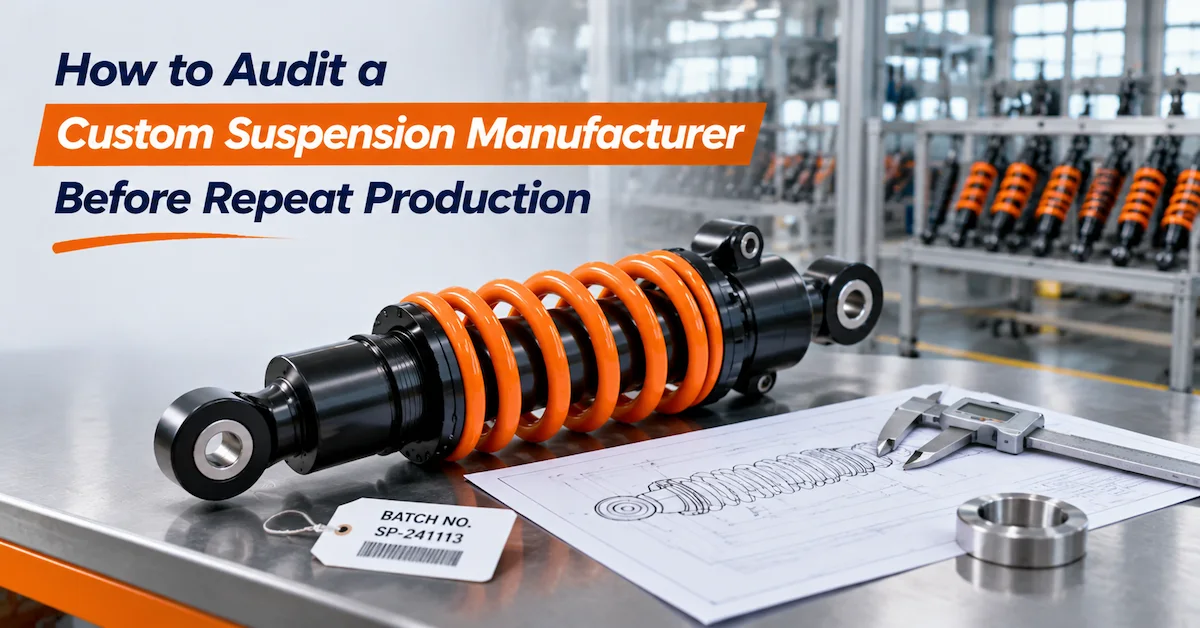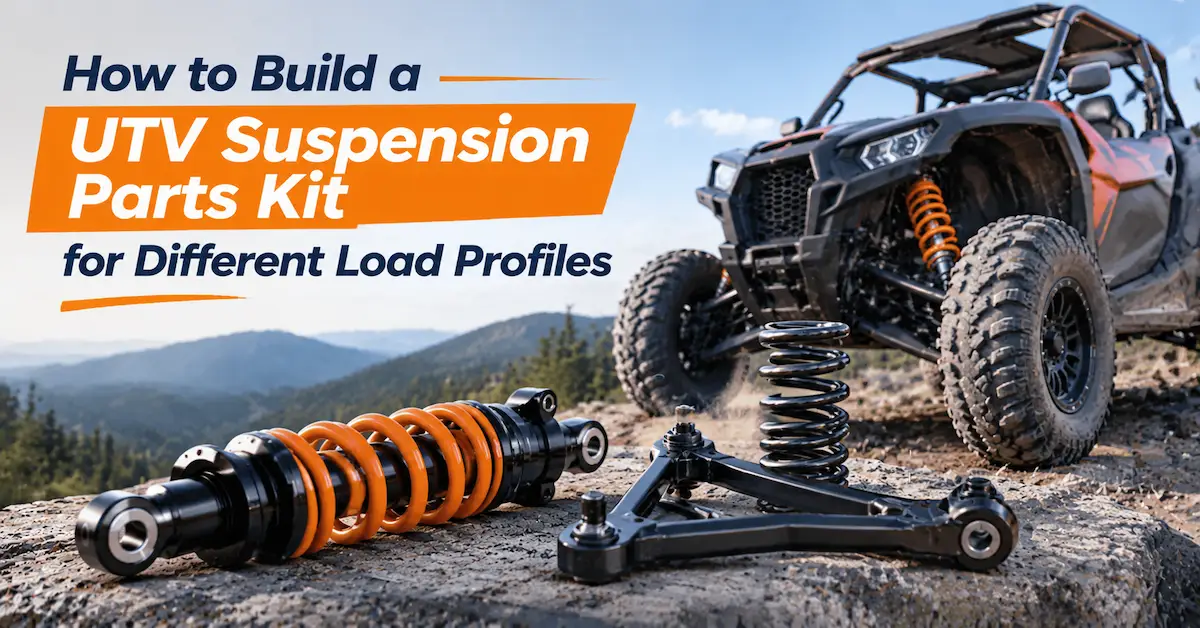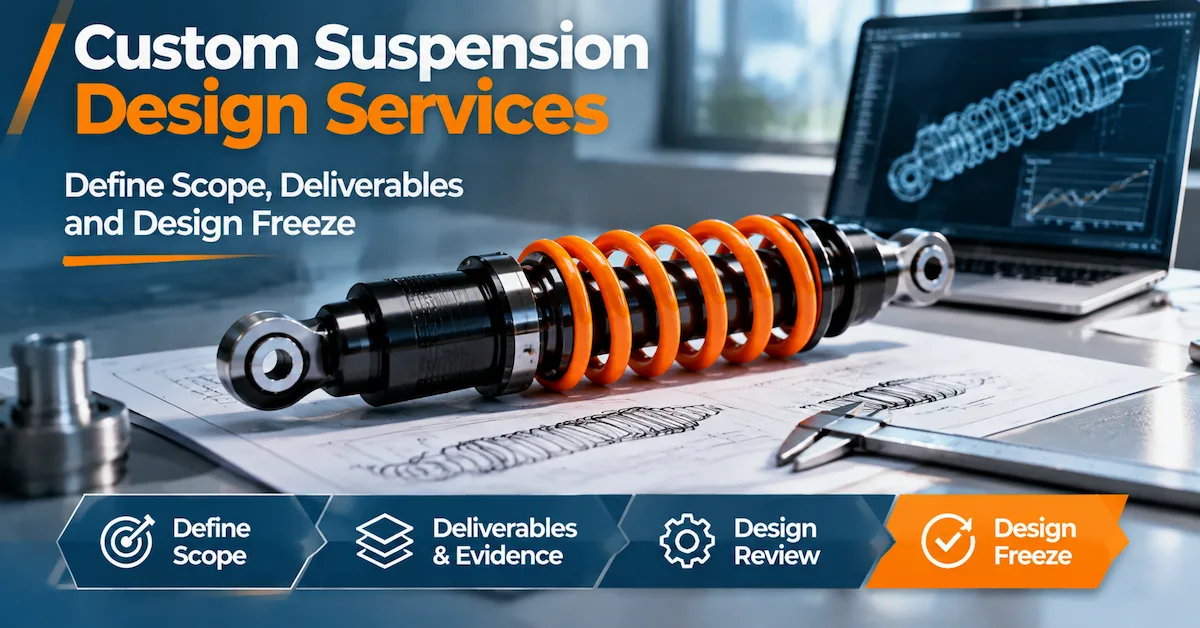

Direct answer: approve a shock absorber assembly supplier only after the supplier can connect the vehicle application to one controlled assembly definition, including the damper, spring, mounts, bushings, sleeves, hardware, settings, label, packaging, inspection plan, and revision history. The approval should include document review, sample inspection, fitment and functional validation, pilot-batch evidence, nonconformance rules, and written change notification. A supplier that can ship a visually similar damper is not automatically a complete assembly supplier.
The buyer's decision should be based on evidence for the exact configuration and stage of supply. Separate public company information, a supplier proposal, a sample observation, a validated prototype, and a released production record. This prevents a common procurement error: accepting a prototype or catalog image as proof that every future assembly will have the same spring, damping behavior, interfaces, hardware, and package contents.
Complete shock absorber assemblies are bought by vehicle manufacturers, aftermarket brands, distributors, repair networks, and engineering teams. They are also used in ATV, UTV, motorcycle, electric motorcycle, golf cart, and other off-road or specialty applications. The commercial question is usually not only “Can this supplier make a shock?” It is “Who owns the complete product definition, how is the spring matched to the damper, how is the assembly inspected, and what happens when a component or process changes?”
First decide whether you need a component supplier or an assembly supplier
A component supplier may provide a damper body, spring, mount, bushing, or hardware. An assembly supplier takes responsibility for combining those items into an identified product that can be installed, tested, packed, ordered, and supported as one configuration. The distinction affects price comparison, quality ownership, warranty investigation, and the risk of hidden substitutions.
| Supplier scope | What the supplier may deliver | What the buyer must still control | Approval risk |
|---|---|---|---|
| Component supplier | One or more shock or spring components to a drawing. | Pairing, assembly, hardware, fitment, complete-product validation. | Components meet their own specifications but fail as a system. |
| Assembly service | Buyer-owned components assembled to supplied instructions. | Component compatibility, settings, final inspection, packaging, release. | Responsibility is unclear when the assembled unit fails. |
| Catalog assembly supplier | Existing complete shock or spring-damper combination. | Application, revision, configuration, market and fitment limits. | Catalog identity is mistaken for a custom validated solution. |
| Custom assembly supplier | Developed and produced complete assembly with defined interfaces and options. | Requirement approval, prototype acceptance, pilot release, changes. | Development assumptions remain hidden in repeat orders. |
| System development partner | Requirement review, engineering, prototyping, testing, production and support. | Vehicle targets, acceptance criteria, commercial stage gates. | Scope expands without clear ownership or evidence gates. |
Ask the supplier to draw a boundary around its scope. Does the quotation include the spring? Does it include mounting hardware and bushings? Are left and right units different? Are shocks supplied individually, in pairs, or in vehicle kits? Does the supplier install the final settings, or does the buyer receive loose components? These questions should be answered before comparing unit prices.
For a related view of how components become an assembly definition, review the shock absorber parts BOM guide. The BOM page is a supporting resource; this article focuses on approving the supplier that owns the finished assembly and its production release.
Define the complete assembly before requesting approval
Use a parent assembly number and a controlled revision. The parent identity should point to the components and settings that affect the vehicle application. A simple product name such as “rear heavy-duty shock” is not enough for repeat supply because it does not identify length, mount, spring, damping setting, hardware, or package.
Vehicle and application definition
Record vehicle make, model, year or generation, market, front or rear position, stock or modified condition, tire and wheel package, accessories, payload, passengers, cargo, terrain, speed, duty cycle, temperature, water, mud, dust, and storage environment. For an electric vehicle, include battery position and mass if they alter axle load or motion. For modified vehicles, record lift, tire, frame, control-arm, or bracket changes.
Mechanical interface definition
Define extended and compressed length, effective stroke, mount type, hole or thread, installation width, sleeve and bushing stack, offset, angle, articulation, fastener engagement, body diameter, spring envelope, reservoir clearance, adjuster access, and bump-stop condition. Use named datums and measurement conditions. “Length” without a datum can describe several different dimensions.
Spring and damper relationship
Record whether the assembly uses a fixed spring, interchangeable spring, preload collar, threaded body, separate seat, or a customer-selected rate. Identify spring free length, installed height, load points or rate where required, outer diameter, end form, seat angle, preload, and retention at full droop. For damping, identify compression and rebound direction, setting, adjustment range, temperature, test speed, target behavior, and whether a reservoir or special valve is included.
| Assembly field | Minimum buyer definition | Why it matters to approval |
|---|---|---|
| Position | Front/rear, left/right, or common part rule. | Controls fitment, load, orientation, and packaging. |
| Mounts | Type, hole/thread, width, offset, bushing and sleeve stack. | Controls installation and side-load risk. |
| Travel | Extended length, compressed length, stroke, bump and droop limits. | Controls clearance and available wheel movement. |
| Spring | Identity, load/rate basis, seat, preload, retention and finish. | Controls support, ride height and spring-damper pairing. |
| Damping | Compression/rebound baseline, setting, test condition and revision. | Controls motion response and product comparison. |
| Hardware | Fasteners, spacers, bushings, washers, collars and torque basis. | Controls installation completeness and serviceability. |
| Identity | Part number, revision, position, label, barcode and package unit. | Controls ordering, warehouse accuracy and complaint tracing. |
Audit the supplier's assembly engineering process
An assembly supplier should be able to show how it turns requirements into a controlled baseline. Start with the engineering intake. A serious review asks for vehicle data, load cases, clearances, environment, sample or drawing, desired ride or handling behavior, quantities by stage, and the buyer's validation responsibility. A weak review asks only for a vehicle name and a target price.
Check the assembly BOM and configuration matrix
Request a BOM that lists the parent assembly and every item supplied with it. Include body, rod, seals, piston or damping hardware where the supplier owns them, spring, spring seat, mount, bushing, sleeve, fastener, adjuster, reservoir, protection parts, label, instruction sheet, and carton. If the same assembly has several spring rates or mount options, request a configuration matrix rather than one generic description.
Check who controls changes
Ask how the supplier handles a new spring source, seal, coating, mount, valve, machining process, hardware source, packaging material, or assembly method. The change record should identify the old and new revision, reason, affected applications, risk review, validation needed, buyer approval, and effective order. Silent substitutions are especially dangerous when a product is sold as a complete vehicle-specific assembly.
Check assembly instructions and poka-yoke controls
Review the order of components, orientation, torque or tightening rules where applicable, spring seat position, preload setting, adjuster baseline, label application, and final inspection. Ask how the line prevents a left-hand part from entering a right-hand package, a wrong spring from being paired with a damper, or a missing spacer from being overlooked. The exact method may vary, but the risk should be visible and controlled.
The suspension drawing approval guide is useful when the assembly is based on buyer drawings. If a supplier proposes the configuration, ask the supplier to distinguish the proposal from the buyer-approved requirement.
Validate fitment and function at assembly level
Approval should test the completed product in the way the buyer will sell and install it. Inspecting a loose damper and a loose spring separately does not prove that the combined assembly has the correct ride height, travel, clearance, adjustment, or hardware stack.
Static fitment checks
Install the complete assembly on the target vehicle or a representative fixture. Record ride height, spring preload, extended and compressed length, stroke, bump and droop, mount alignment, fastener engagement, bushing compression or sleeve position, body and tire clearance, reservoir routing, adjuster access, steering clearance, and contact marks. Repeat left and right checks where the application is paired.
Functional checks
Define the function check before the sample arrives. Depending on the product, it may include movement, leakage, pressure retention, spring load points, damping force, adjustment action, ride-height repeatability, or assembly torque verification. A functional test is meaningful only when the condition, method, sample identity, and acceptance criterion are recorded.
Vehicle or rig validation
Use representative load, tire, terrain, speed, temperature, and settings. Record small-bump response, larger impacts, repeated inputs, braking, acceleration, turns, slopes, cargo or passenger conditions, and any noise or interference. Separate measured facts from subjective descriptions such as “firm” or “comfortable.” A route test is evidence for a defined configuration, not a universal fitment claim.
Post-test inspection
Inspect seals, rod surface, mounts, bushings, spring seats, lock rings, coatings, fasteners, protection parts, and package contents. Compare the post-test assembly to the pre-test identity. Record leakage, marks, looseness, height change, noise, and any deviation. Link the result to the sample number and revision so a later pilot can be compared correctly.
| Approval evidence | What it demonstrates | What it does not demonstrate by itself |
|---|---|---|
| Dimensional inspection | Measured interfaces and envelope under a stated condition. | Vehicle comfort, durability, or damping performance. |
| Spring load report | Spring behavior at defined load points and method. | Complete assembly handling or damper consistency. |
| Damping result | Force behavior at stated speed, temperature, setting and revision. | Universal road performance or all applications. |
| Installed fit check | Physical fitment on a defined vehicle or fixture. | Repeat production capability without pilot evidence. |
| Vehicle route test | Observed behavior in a defined use condition. | All load, temperature, market, or model-year conditions. |
| Pilot inspection | Variation within the sampled pilot against the released definition. | Every future batch without continuing controls. |
For a deeper look at force behavior, buyers can review the compression and rebound damping testing article. Use it to frame questions for the supplier; do not treat a general testing explanation as proof that a particular assembly has already passed a particular test.
Review pilot production before production release
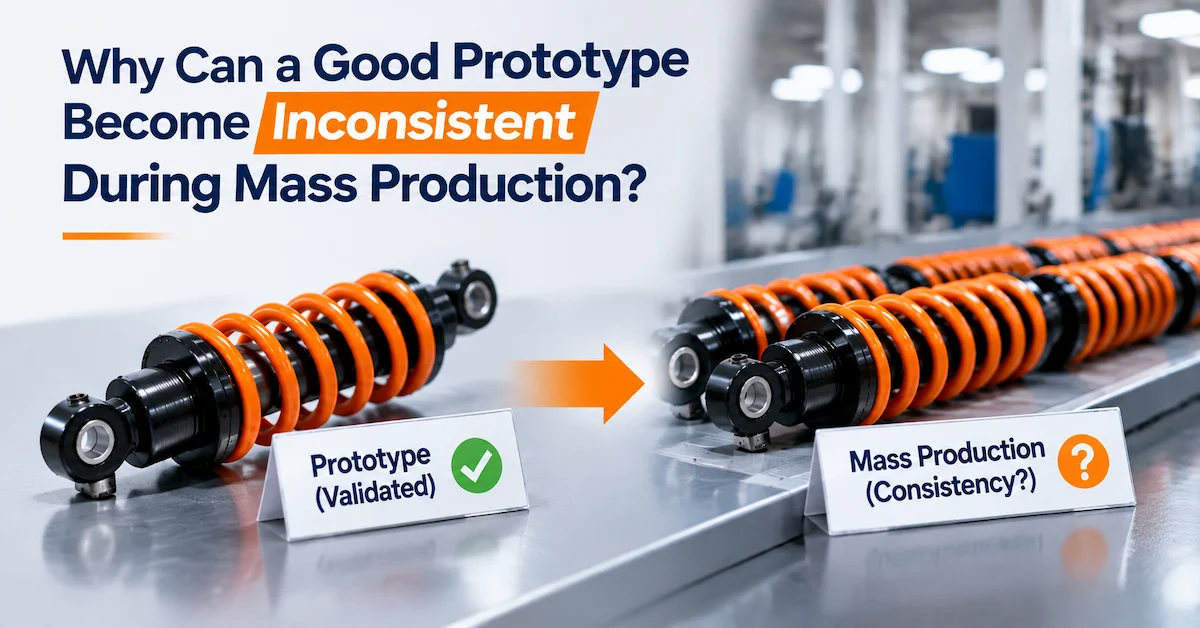
A prototype shows that a concept can be made. A pilot batch shows whether the released assembly definition can be followed by more than one unit. Define the pilot quantity and inspection scope before the supplier builds it. If the pilot is too small for the risk, explain what additional evidence will be used instead.
| Pilot gate | Buyer approval question | Evidence to keep | Release concern |
|---|---|---|---|
| Configuration freeze | Are application, drawing, BOM, spring, damping and hardware identities aligned? | Signed or acknowledged revision package and open-item list. | Different departments use different definitions. |
| Incoming control | Are springs, mounts, seals and hardware identified before assembly? | Supplier or incoming inspection record and lot identity. | Uncontrolled components enter the pilot. |
| Assembly control | Are orientation, settings, torque, preload and package contents controlled? | Assembly record, setup sheet, first-piece or in-process checks. | Prototype workmanship is not transferable. |
| Final inspection | Are critical dimensions and functional checks recorded? | Unit or sample records linked to batch and revision. | Only appearance is checked. |
| Application validation | Does the assembly meet the defined vehicle acceptance criteria? | Fitment, route or rig report, observations and approval. | Sample performance is generalized beyond its condition. |
| Packaging release | Can the warehouse and installer identify and receive a complete set? | Label, barcode, carton, contents and protection check. | Correct unit arrives with wrong or incomplete package. |
| Production release | Can purchasing reorder against the same revision? | Released PO basis, change rule, retained records and contacts. | Reorder is treated as a new informal sample. |
Do not allow a pilot to contain undocumented hand adjustments, temporary spacers, unapproved springs, or a tuning setting known only to one technician. If a temporary item is necessary for development, mark it as prototype-only and define the decision needed before production.
Check packaging, labels, and after-sales traceability
Assembly approval continues after the shock leaves the workbench. The product must be recognized by purchasing, logistics, warehouse staff, installers, and service teams. Each carton should make the application and configuration clear without relying on memory or a photograph.
Packaging contents
Define whether the shipment contains one shock, a pair, a vehicle set, springs, hardware, installation instructions, adjustment tools, or service parts. List the contents in the BOM and packaging check. State whether left and right units are packed together and how different rates or positions are separated.
Label and revision identity
Use the approved part number, position, revision, quantity, and any required barcode or market information. Where appropriate, include the production or batch reference needed for complaint investigation. Do not add a certification mark, fitment statement, or performance claim unless it is authorized and supported.
Protection and handling
Review rod protection, coating protection, spring retention, movement inside the carton, moisture control, stacking, and shipping orientation. The exact packaging depends on the product and route, but the buyer should verify that the assembly reaches installation in the approved condition.
When requesting a quotation from a Shock Absorber Assembly Supplier, ask for packaging, label, MOQ, lead-time basis, and change-control information as separate response fields. This keeps a low unit price from hiding missing assembly work or unpriced package requirements.
Compare shock absorber assembly suppliers with an evidence matrix
Use the same controlled RFQ and score the supplier responses against the same decision areas. Keep “not provided” separate from “not capable.” A missing record needs clarification; a failed fitment or functional result needs technical disposition.
| Decision area | Question to ask | Strong response | Risk signal |
|---|---|---|---|
| Entity and scope | Who contracts, manufactures, assembles, tests and supports the product? | Clear responsibility and public company scope. | Broker, factory and support entity are unclear. |
| Assembly definition | Can the supplier identify the complete configuration? | Parent number, BOM, drawing, spring and damping revision. | Generic model name or photo is the only identity. |
| Fitment | Can the supplier validate the exact application? | Vehicle data, interface inspection, clear limits, approved report. | Universal fitment language without conditions. |
| Function | Can the supplier define and record relevant checks? | Method, condition, acceptance range, sample identity and reaction. | “100% tested” without a test definition. |
| Pilot transfer | Can several assemblies be built from the released definition? | Pilot records, component identity, inspection and package approval. | One hand-built prototype is treated as production proof. |
| Change control | Will the buyer be notified before relevant changes? | Written change categories, approval owner and effective revision. | Substitution is described as normal improvement. |
| Commercial clarity | Is the quotation complete? | Sample, pilot, assembly, test, packaging, MOQ and timing separated. | Low price excludes spring, hardware, package or validation. |
For international sourcing, also evaluate communication, drawing language, response time, document revision, packing, shipping protection, and service replacement rules. A technically strong supplier may still be a poor fit if the buyer cannot maintain product identity across markets and reorder cycles.
Prepare an RFQ that lets the supplier prove assembly capability
Send one controlled package to each candidate. Include vehicle and market, position, stock or modified state, loads, terrain, environment, hard points, length and stroke, spring target, damping target, sample or drawing, quantity stages, forecast, destination, packaging, validation responsibility, and required records.
Ask the supplier to return: existing, adaptable, or new-development status; missing data; assumptions; assembly BOM; spring and damper pairing; proposed materials or processes; sample scope; pilot scope; critical inspection; functional test; packaging; MOQ; lead-time basis; change-control terms; and quotation exclusions. A line-by-line answer reveals whether the supplier is responding to your actual product or simply matching a catalog description.
Use the OEM suspension RFQ guide to prepare the application information, then review the public BEDO shock absorber range as a reference point. Send the technical package through the official BEDO contact page so the project can be evaluated as an existing, adaptable, or new-development assembly.
Frequently asked questions
What is a shock absorber assembly supplier?
A Shock Absorber Assembly Supplier provides a defined complete unit or set, not only a loose damper component. The scope should state whether it includes spring, mounts, bushings, sleeves, hardware, settings, labels, packaging, testing, and technical support.
How is an assembly supplier different from a shock absorber manufacturer?
A shock absorber manufacturer may make the damper body or complete shock. An assembly supplier is approved for the complete configuration and its relationship to the vehicle application. The two scopes may be performed by one company, but they should not be assumed to be the same.
Should springs and dampers have separate part numbers?
They should have separate identities when their rates, dimensions, sources, or approvals can change independently. The parent assembly should link the approved spring and damper revisions so a repeat order cannot silently mix configurations.
What should be inspected on a complete assembly?
Inspect the defined interfaces, extended and compressed length, travel, mounts, spring position or load points, damping or movement where specified, leakage or pressure where specified, adjustment, hardware, label, and package contents. The exact plan is project-specific.
Does a vehicle fitment photo prove the assembly is ready for production?
No. It proves that one sample was installed in one condition. Production approval also needs a controlled configuration, validation criteria, pilot evidence, inspection, packaging, and change control.
What does “100% tested” mean?
It should identify the characteristic tested, method, condition, acceptance criterion, equipment or record, and reaction to failure. Without those fields, the phrase is not a useful comparison between suppliers.
Can a supplier change a spring or seal after approval?
Only under the agreed change-control process. A change that can affect fitment, performance, sealing, service, or product identity should be evaluated, documented, validated where required, and approved before it becomes effective.
How should an OEM compare assembly quotations?
Compare the same parent assembly scope, component list, test and inspection, packaging, quantity stage, MOQ, timing basis, tooling, engineering, and change terms. A lower unit price may exclude the spring, hardware, pilot work, or package.
Can BEDO review a custom assembly request?
The public BEDO website presents shock absorbers, suspension springs, products, and B2B customization content. Buyers should provide the vehicle, dimensions, application, sample or drawing, quantities, and acceptance criteria so BEDO can confirm the appropriate project scope.
What is the first approval step?
Freeze the application and assembly definition before judging the supplier. Then request a line-by-line response that distinguishes existing products, proposed changes, prototype evidence, pilot evidence, and production controls.
Conclusion
Approving a Shock Absorber Assembly Supplier is a complete-product decision. The buyer should verify that the supplier can define the parent assembly, pair the spring and damper, control interfaces and settings, validate the application, inspect the pilot, identify the package, and notify the buyer before relevant changes. The most reliable supplier response is not the one with the broadest claim; it is the one that makes responsibilities, evidence, open items, and release gates easy to inspect.
Review the public BEDO product scope, prepare the vehicle and assembly RFQ, and request a project-specific discussion of samples, drawings, pilot production, packaging, and repeat supply through the contact route below.