
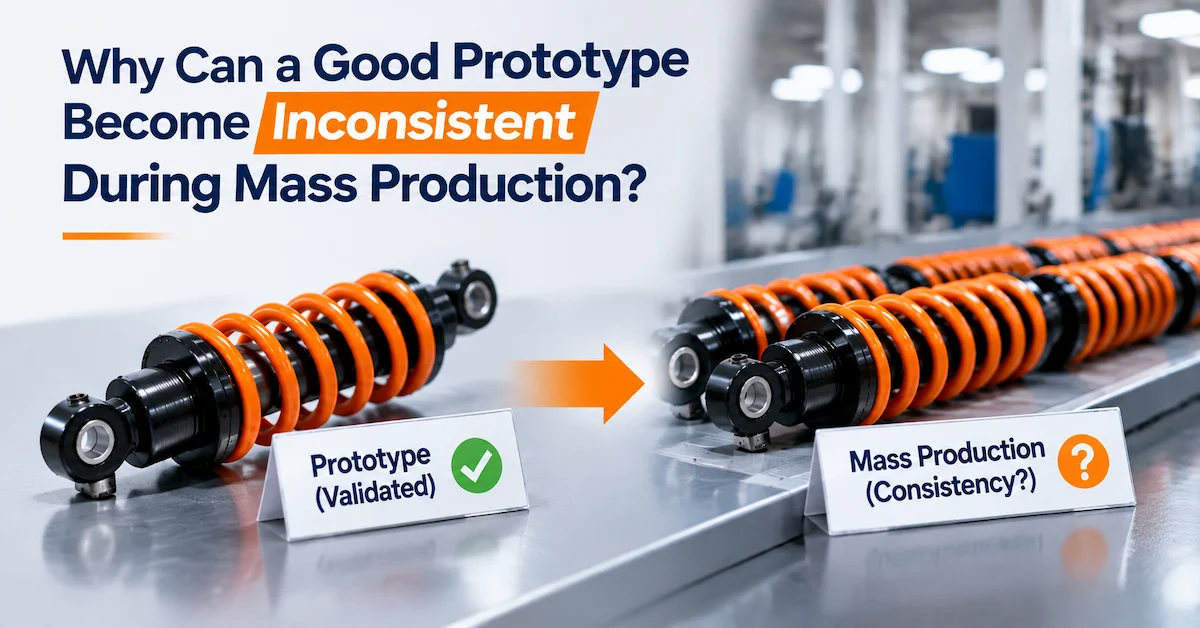
Direct answer: a good prototype can become inconsistent during mass production because the prototype proves that one configuration can work, while mass production must prove that the same result can be created repeatedly by a defined process, with controlled materials, dimensions, assembly conditions, inspection methods, suppliers, and engineering revisions. Prototypes often contain expert adjustments, hand-selected components, extra attention, and undocumented decisions. When those hidden controls are not converted into a drawing, BOM, work instruction, control plan, and production-release record, the first production units may not be equivalent to the prototype.
The problem is not automatically a sign of bad engineering or bad intent. It is a production-transfer gap. The right response is to compare the approved prototype with the production definition and process evidence, then isolate where the variation entered. A buyer should ask what was frozen, what was measured, what was validated at pilot scale, and what changes require approval before shipment.
This article answers a supplier-comparison and commercial-investigation question for OEM engineers, aftermarket brands, distributors, vehicle builders, and purchasing teams: why does a shock absorber, spring, or suspension component that performed well in development become different across a production batch, and how can the risk be controlled before a launch? It focuses on production transfer rather than repeating a general prototype-development guide.
Evidence boundary: no responsible factory should claim that a prototype guarantees mass-production consistency. Consistency is demonstrated through a controlled technical baseline, pilot production, inspection and functional records, traceability, change control, and an agreed release decision. Exact acceptance limits are application-specific.
A prototype and a production process answer different questions
A prototype asks, “Can this design solve the intended problem under the tested condition?” Mass production asks, “Can the released design be made within the agreed limits, by the normal process, across the planned quantity and supply chain?” The questions overlap, but the evidence is different.
| Development evidence | Production-transfer evidence | Risk if the second evidence is missing |
|---|---|---|
| One or several prototype units perform acceptably. | Defined critical characteristics, process controls, pilot results and release criteria. | Later units may differ even though the original sample was good. |
| Engineer or technician adjusts a component until the result is satisfactory. | Adjustment is converted into a controlled configuration and repeatable work instruction. | Operators may reproduce different settings or rely on personal judgment. |
| Selected spring, seal, bushing, rod or hardware works in the sample. | Part identity, supplier, lot, specification and incoming controls are frozen. | Substitution or batch variation changes the behavior. |
| Prototype is measured with careful attention. | Production measurement method, fixture, frequency and reaction are defined. | Critical variation may escape or be measured differently by each operator. |
| Development drawing or CAD is used for discussion. | Released drawing, BOM, labels and revision history are linked to the order. | Production may build from an old or incomplete definition. |
| Performance is confirmed on one vehicle or bench setup. | Pilot and production checks use the same agreed configuration and conditions. | Field behavior cannot be linked to a stable baseline. |
The transition is successful when the approved prototype is no longer a unique object. Its important decisions become identifiable product characteristics and process controls that another trained operator can follow and an auditor can verify.
Hidden hand adjustment is the first production-transfer risk
Prototype work is often interactive. An engineer may compare a spring, change a preload, adjust damping, polish a fit, select a different bushing, correct a mount, or tune the assembly by feel and test result. That flexibility is valuable during development. It becomes a risk when the final choice is not recorded.
For example, a prototype may work because a technician selected one spring from several visually similar parts, set a collar to a position that was not recorded, used a particular oil or internal setting, or oriented an assembly in a way that was obvious to the development team. The production team receives a photograph and a sample, but not the reasoned configuration behind it. The result is a family of parts that look similar while responding differently.
Convert the last successful adjustment into evidence
Before pilot production, record the final configuration at the level needed to reproduce it. This can include drawing and BOM revision, spring identity, installed condition, mounting interfaces, adjustment positions, hardware, component lots, assembly sequence, functional test condition, and any approved deviation. The exact fields depend on the product. If a field affects the result, it should not live only in an engineer's memory.
A useful question is: if the original prototype engineer were unavailable tomorrow, could a qualified production team build the approved configuration from the released documents? If the answer is no, the project is still in development even if the sample looks finished.
Unfrozen drawings and BOMs allow silent product drift
Production inconsistency often begins before the line starts. A drawing may omit a critical dimension, use a reference value as if it were a tolerance, or show a component without its revision. The BOM may identify a spring family but not the selected rate, list a bushing without a material or size, or fail to distinguish prototype hardware from production hardware.
Mass production exposes these gaps because purchasing, warehouse, assembly, inspection, packaging, and service teams all need the same answer. When the technical baseline is incomplete, each function creates a local interpretation. The factory may still produce parts on time, but the parts no longer share one unambiguous definition.
| Unfrozen item | How inconsistency can appear | Control needed before pilot release |
|---|---|---|
| Drawing revision | Production uses an earlier mount, length, hole, thread, or seat definition. | One released revision linked to work orders, inspection and labels. |
| Spring specification | Different free length, rate, wire, end form, or supplier lot changes installed behavior. | Controlled spring identity and acceptance criteria. |
| Internal shock configuration | Damping, oil, gas, valve, seal, or adjustment details vary between builds. | Defined production configuration and functional verification appropriate to the project. |
| Hardware and bushing stack | Mount width, alignment, torque, and clearance change after assembly. | Controlled part numbers, dimensions, orientation and assembly condition. |
| Packaging and labels | Correct component is assigned to the wrong application or revision. | Approved labels, barcode or lot identity, and packaging review. |
| Deviation status | A temporary fix becomes the normal build without engineering approval. | Time-limited deviation, owner, affected quantity and closure decision. |
Buyers can review BEDO's public suspension spring range as a product-category reference, but a production program still needs a project-specific spring and assembly identity. Public catalog language should not be treated as a substitute for the approved BOM.
Critical dimensions may be correct on the prototype and wrong in production
One prototype can be manually fitted until the interfaces work. A production batch must hold those interfaces without relying on the same individual. If critical dimensions and tolerances are not defined, the factory may measure a different reference, use a different fixture, or rely on a visual comparison.
Common transfer-sensitive features include mount width, hole or bore location, compressed and extended length, stroke, spring-seat position, threaded collar, sleeve, bushing, rod, tube, and clearance-related features. A small change in a dimension chain can change installed alignment or available travel. The buyer should ask how the characteristic moved from vehicle requirement to drawing, from drawing to process, and from process to release record.
The article on shock absorber drawing services is a useful adjacent reference for why a drawing matters, but the production-transfer issue is broader. The drawing must also be connected to the BOM, work instructions, inspection plan, fixtures, approved samples, and change records.
Do not solve a stack-up problem with a cosmetic check
A part may pass a visible comparison and still create an assembly problem. Mount hardware can add width, a bushing can shift a centerline, a spring seat can alter preload, or an angle can create side load. Production release should include the functional interfaces that determine whether the component can be installed and move through the intended range, not only the appearance of the part.
Materials and supplier lots can change a successful prototype
Prototype builds often use a known material, selected purchased component, or small lot that receives close attention. The mass-production supply chain introduces routine variation. A spring source may change, a seal may be substituted, a coating may have a different thickness, or a bushing may come from a new lot. None of these changes should be assumed harmless simply because the component name is the same.
Material and supplier control does not require a factory to freeze every commercial decision forever. It requires the change to be visible, risk-assessed, and verified at the level appropriate to the affected characteristic. A substitute that changes a mount interface may need dimensional and fitment confirmation. A seal change may need functional or durability review. A spring change may need a characteristic check under the approved test condition.
Ask for part identity, not only a supplier name
The relevant identity may include manufacturer part number, drawing, revision, material or performance specification, lot, surface treatment, and approved alternative. “Equivalent” is not a complete engineering definition. The buyer and supplier should agree what equivalence means and who approves it.
Separate cost reduction from uncontrolled substitution
Cost reduction can be a legitimate production objective, but it should be treated as an engineering change. The team should define the reason, affected parts, risks, validation, inventory disposition, customer communication, and effective serial or lot. This protects the buyer from receiving a different product without a clear release decision.
Assembly conditions can make identical components behave differently
Mass-production inconsistency is not always caused by raw materials. Assembly variation can change the finished part. Torque, orientation, seating, cleanliness, lubrication, seal installation, thread engagement, adjustment position, bleeding, filling, gas or pressure condition, and cure or waiting time may all matter depending on the design.
A work instruction should describe the steps that affect the result in a way that trained operators can repeat. It should identify the correct component, tool, sequence, condition, torque or setting where applicable, and reaction when an assembly step fails. An instruction such as “assemble carefully” does not control a critical process.
| Assembly variable | Possible production effect | Transfer control |
|---|---|---|
| Part orientation | Changes mount direction, adjustment access, seal relationship or movement. | Visual standard, keyed fixture, work instruction and first-piece check. |
| Torque and fastening | Changes bushing compression, stack-up, thread engagement or joint security. | Defined tool, setting, sequence, verification and record where required. |
| Spring seating and preload | Changes installed height, support, retention and initial response. | Controlled spring identity, seat position, setting and inspection condition. |
| Cleanliness and lubrication | Can affect friction, seal behavior, contamination and service life. | Specified materials, work standard and reaction to contamination. |
| Internal configuration | Changes damping or functional response even when external dimensions match. | Controlled internal BOM/process and appropriate functional check. |
| Adjustment position | Creates different behavior across units or between prototype and shipment. | Defined default setting, marking, test condition and label where relevant. |
Production operators should not be expected to infer a setting from the prototype's color, photograph, or feel. If an adjustment is essential, it needs an unambiguous definition and a way to verify it.
Prototype testing may not represent pilot or mass-production variation
A prototype validation result is meaningful only for the configuration and conditions tested. It does not automatically represent every unit made later. The gap can arise from a different spring, different assembled length, a different adjustment, a changed vehicle, a changed test route, a different temperature, or an unrecorded measurement condition.
Production transfer should therefore use a validation matrix that identifies the sample or lot, configuration revision, test condition, acceptance basis, and result. The exact tests are project-specific. Depending on the application, the buyer may require dimensional inspection, fitment and full-motion checks, bench or functional testing, vehicle validation, environmental exposure, endurance work, or other evidence. The article should not invent a universal test cycle for every suspension product.
Use a golden sample carefully
A retained approved sample can help people compare appearance, assembly, orientation, and some physical characteristics. It should not replace a drawing or process specification. A sample can age, be damaged, or be interpreted differently by different people. Its identity, storage, revision, and purpose should be recorded.
Make pilot production a real test of the process
A pilot should use normal materials, normal equipment, normal operators or training, normal inspection, and the intended packaging where practical. A pilot built by the development engineer with hand-selected components may confirm the design but not the production system. The objective is to discover transfer problems before the first large shipment.
Inspection methods can hide inconsistency
Different inspectors can produce different answers when the method is not controlled. One person measures a shock at full extension, another at a fixture stop. One checks a mount against a worn sample, another uses a drawing datum. One accepts an adjustment by visual position, another counts turns. Records may look complete while the underlying conditions are not comparable.
A production control plan should state the characteristic, nominal and limit or acceptance basis, datum, condition, instrument or fixture, frequency, record, and reaction. It should also identify the link to the product and drawing revision. The goal is not paperwork for its own sake. It is to make a pass result mean the same thing across shifts and batches.
Buyers can use the shock absorber safety and manufacturing control discussion as an adjacent reading, while keeping the present question in view: what changes between the sample and the normal production process, and how is that change verified?
Engineering changes are a major source of post-approval drift
Production rarely stops evolving. Tools wear, suppliers change, materials become unavailable, costs move, packaging is redesigned, and customers request new applications. The risk appears when a change is treated as an administrative substitution rather than a technical decision.
| Change type | Why it may affect consistency | Minimum review question |
|---|---|---|
| Drawing or tolerance change | Changes fit, stack-up, clearance, strength, or inspection acceptance. | Which units and customers are affected, and what validation is needed? |
| Spring source or specification | Changes support, ride height, preload, rate, or fatigue behavior. | Is the replacement equivalent under the application condition? |
| Seal, bushing, rod, tube or coating change | Changes friction, leakage risk, wear, fit, or surface relationship. | Which functional and dimensional evidence supports approval? |
| Assembly process change | Changes torque, orientation, internal state, cleanliness, or setting. | Was the process requalified and were work instructions updated? |
| Inspection method change | Changes what is detected or what a pass means. | Is the new method equivalent, and was the measurement system verified? |
| Packaging or label change | Can cause wrong application, mix-up, shipping damage, or traceability loss. | Are labels, cartons, service information and lot records still aligned? |
A change record should identify the reason, affected documents, risk, validation, approval, effective date or lot, inventory disposition, and customer notice where required. The buyer should agree which changes require prior written approval. “No change without notice” is useful only when the scope and method of notice are clear.
Build a production-transfer gate before the first large order
A practical transfer gate checks whether the project has moved from “a successful sample” to “a controlled production item.” It should be a decision with evidence, not only a meeting date.
| Transfer gate | Evidence to review | Decision |
|---|---|---|
| Configuration freeze | Approved drawing, BOM, sample identity, spring, hardware, settings, open deviations. | Is the product definition complete enough to quote and build? |
| Process readiness | Work instructions, fixtures, tools, operators, suppliers, incoming controls, assembly and inspection plan. | Can normal production reproduce the configuration? |
| Pilot build | Normal process units, dimensional records, functional checks, traceability and nonconformity log. | Did production variation stay within agreed limits? |
| Validation confirmation | Fitment, motion, performance or other project-specific evidence tied to the pilot revision. | Does the production configuration still meet the application target? |
| Release review | Closed critical issues, packaging, labels, service records, change rules and buyer approval. | Is the first mass-production order authorized? |
| Ongoing monitoring | Lot records, complaints, returns, process trends, supplier changes and corrective actions. | Can drift be detected and corrected after launch? |
Not every program needs the same number of documents or test stages. A replacement part for a known application may use a lighter route than a new OEM platform. The principle is constant: the release decision should match the risk and should be traceable to a stable configuration.
What buyers should request when moving from prototype to production
Buyers can reduce misunderstandings by requesting production-transfer evidence in the RFQ or development plan. The request should be clear about what is mandatory, what is a proposal, and what will be confirmed after sample review.
- Approved prototype identity, revision, sample quantity, photographs, drawing, CAD, BOM, and open issue list.
- Critical dimensions, tolerances, interfaces, spring characteristics, settings, and functional acceptance conditions.
- Production process flow, assembly work instructions, fixtures, tooling, and operator training status as appropriate.
- Incoming controls for springs, seals, bushings, rods, tubes, hardware, coatings, and other critical components.
- Pilot quantity, normal-material requirement, inspection frequency, traceability, and planned disposition of nonconforming units.
- Validation matrix linking test results to the exact production revision and sample or lot.
- Packaging, labels, service parts, warranty route, and identification of shipped batches.
- Engineering-change process and list of changes requiring buyer approval.
- Commercial assumptions such as planned quantity, MOQ, lead-time basis, forecast, and launch timing, subject to project confirmation.
Send the supplier enough information to distinguish the approved prototype from a general reference product. Include the vehicle or machine, model and position, payload and use conditions, fitment data, sample or drawing revision, performance objective, target market, expected production quantity, and required records. The BEDO contact page can be used to start a project-specific production-transfer discussion.
Frequently asked questions about prototype mass production consistency
Does a successful prototype mean the design is ready for mass production?
No. It means the tested configuration showed promise or met the agreed development objective under defined conditions. Production readiness requires a frozen definition, controlled materials and process, pilot evidence, inspection, traceability, and an authorized release decision.
Why do prototypes often perform better than production samples?
Prototypes may receive expert assembly, hand selection, extra adjustment, close inspection, or undocumented rework. Those actions can make the sample work without becoming a repeatable production method.
Can a golden sample guarantee production consistency?
No. It can help compare physical identity and appearance, but it does not replace a drawing, BOM, control plan, functional acceptance, or process evidence. The sample itself must be identified and protected.
What is the most important production-transfer document?
There is no single document that replaces the system. The released drawing and BOM define the product, while the control plan, work instructions, pilot records, validation evidence, and change process show how it will be made and maintained.
How do spring changes affect prototype consistency?
A spring change can alter free length, installed height, preload, rate, support, and ride height. The replacement should be identified and evaluated against the approved application condition rather than accepted only because it looks similar.
Why can dimensions pass while vehicle performance changes?
Dimensions are only one part of the result. Internal shock configuration, spring behavior, friction, assembly setting, material, temperature, test condition, and vehicle state can also change performance. The validation must cover the characteristics that matter to the application.
Should every production unit receive a full vehicle test?
Usually the testing plan is risk-based and may combine unit-level inspection, functional checks, lot sampling, pilot validation, and vehicle testing. The required level depends on the product, market, volume, risk, and buyer agreement.
What should happen when a supplier changes a component?
The change should be identified, risk-assessed, approved, validated as appropriate, and linked to an effective revision or lot. The buyer should define which changes require prior notice or approval.
How can a buyer distinguish production control from marketing language?
Ask for the controlled revision, critical-characteristic list, process and inspection method, pilot records, traceability, change controls, and a clear release decision. Specific evidence is more useful than general claims such as “stable quality” or “strict testing.”
What should I send BEDO for a prototype-to-production review?
Send the approved or current sample, drawings and revisions, vehicle application, load and use conditions, target quantity, critical interfaces, known problems, prototype test results, packaging needs, and the production timing. Unknowns should be marked for technical review.
Conclusion
A good prototype can become inconsistent during mass production when the successful result depends on hidden decisions instead of a controlled production definition. The main risks are hand adjustment, incomplete drawings and BOMs, undefined critical dimensions, material or supplier variation, assembly differences, inconsistent inspection, incomplete pilot validation, and uncontrolled engineering changes.
The practical solution is a disciplined production transfer: freeze the configuration, translate it into drawings and process controls, use normal production inputs in a pilot, link inspection and validation to the same revision, record deviations, and require approval for changes that can affect fit or performance. Review the BEDO shock absorber range, prepare the prototype and vehicle information, and use the official contact route to request a technical review before the first large production release.