
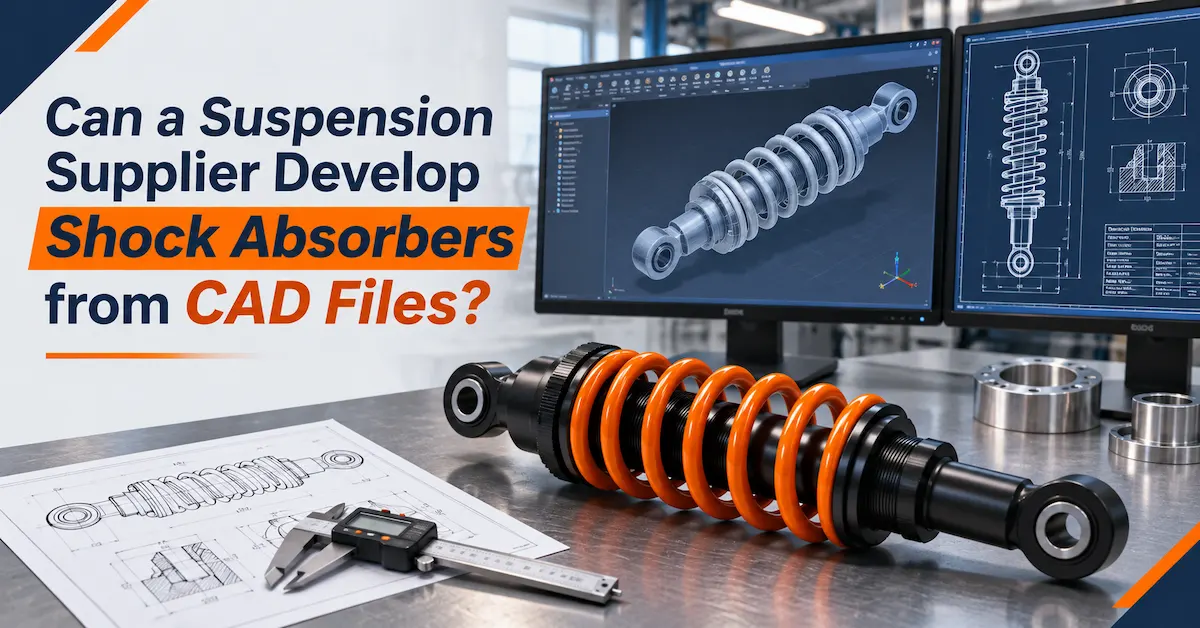
A capable suspension supplier can develop a shock absorber from 3D CAD files, but the CAD model is only the geometric starting point. It normally defines an envelope and relationships; it does not automatically define spring behavior, damping force, movement limits, materials, inspection conditions, or the evidence required for production release. The useful question is therefore not whether a supplier can open a STEP file. It is whether the supplier can turn that file into a controlled engineering package, identify what is missing, build a representative prototype, and prove that the approved configuration can be reproduced.
For an OEM, aftermarket brand, vehicle developer, or custom builder, the development path should connect vehicle data, CAD review, drawing control, spring and damping targets, prototype inspection, fitment, functional validation, pilot production, and repeat-order control. If any of these links is missing, a visually accurate model can still result in the wrong ride height, insufficient travel, poor damping, or an assembly that fits only one vehicle in one condition.
This article addresses a practical procurement problem: what should a buyer expect when reviewing suspension supplier CAD files, and what information must be supplied beyond the 3D model? It focuses on shock absorber development for ATVs, UTVs, motorcycles, electric vehicles, golf carts, off-road platforms, and other specialty vehicles where mounting geometry and operating conditions vary by application. The guidance is written for teams comparing an existing product adaptation with a genuinely new OEM suspension design.
What a CAD file gives the supplier, and what it leaves open
CAD is valuable because it can communicate geometry more precisely than a photograph or a short list of measurements. A supplier can inspect the available envelope, mounting concept, neighboring parts, wheel or control-arm movement, and service access before making a prototype. That reduces avoidable machining and fitment errors. It does not mean that the supplier already knows the product requirement.
| CAD content | Useful development evidence | Still requires buyer or supplier confirmation |
|---|---|---|
| Shock envelope | Available body diameter, spring space, reservoir space, and access area. | Travel limits, heat exposure, clearance through motion, and maintenance access. |
| Mount geometry | Eye, clevis, bracket, hole, thread, offset, and orientation concept. | Datums, tolerances, bushing stack, articulation angle, and load direction. |
| Vehicle assembly | Hard points, nearby components, tire envelope, and possible interference. | Actual vehicle condition, payload, tire variation, modifications, and motion ratio. |
| Spring model | Approximate free length, outside diameter, seat location, and visual assembly. | Rate, load points, preload, retention at droop, and batch acceptance limits. |
| Surface scan | Shape of an existing sample or space captured from a vehicle. | Hidden interfaces, internal construction, material, process, and performance target. |
| Drawing-linked model | Geometry connected to dimensions, datums, tolerances, and revision control. | Validation conditions, inspection records, deviations, and production change rules. |
Ask the supplier to classify every file before quoting. A model may be a packaging reference, a reverse-engineered sample, a concept, a released design, or a vehicle assembly with simplified components. Those are different inputs. If the supplier treats a concept model as a production drawing, the quotation may appear precise while the technical scope remains undefined.
Confirm units, orientation, and coordinate system
The first review should confirm whether the model uses millimeters or inches, which direction is up, and which axis represents vehicle longitudinal direction. A model without a coordinate reference can still be opened, but its dimensions may be interpreted incorrectly or measured from the wrong plane. Define whether the shock is shown at design ride height, full extension, full compression, or an arbitrary CAD position.
Identify simplified or suppressed features
Lightweight CAD exports often omit threads, fillets, seals, fasteners, spring ends, retaining features, internal valves, or small clearances. That is acceptable for a packaging review, but it is not enough for machining, inspection, or assembly planning. The supplier should list suppressed features that influence fitment, service, strength, sealing, or manufacturing.
Separate measured geometry from proposed geometry
If the model was created from a physical shock, identify which surfaces were measured and which were reconstructed. If it is a new concept, identify which dimensions are buyer-owned targets and which are supplier proposals. This distinction matters when a prototype differs from the model. A difference may be a correction to the input, a manufacturability change, or a functional redesign; each needs a different approval route.
How suspension supplier CAD files become a quotation-ready package
A high-quality RFQ does not send only a 3D file and a request for price. It gives the supplier enough context to determine feasibility, scope, sample content, and production assumptions. The package can be small, but it must identify what the shock is expected to do on the vehicle.
| Handoff item | What to include | Why it changes the development decision |
|---|---|---|
| Application identity | Vehicle type, model or platform, year or generation, front or rear position, and stock or modified condition. | Prevents a generic vehicle name from hiding different interfaces or loads. |
| Vehicle and load data | Curb and operating mass, axle distribution where known, passengers, cargo, battery, accessories, and duty cycle. | Spring and damping targets depend on the load state, not only the mount. |
| Geometry references | Extended length, compressed length, usable stroke, hard points, mounting width, hole or thread, and clearance conditions. | Defines the dimensions that must be inspected and validated. |
| Operating environment | Road or terrain, speed range, water, mud, dust, salt, temperature, cleaning, and storage conditions. | Influences seals, finish, protection, testing, and service expectations. |
| Spring requirement | Load points or target rate, free and installed length, preload range, seat, retention, and identification. | Prevents a shock body that fits from producing the wrong ride height or sag. |
| Damping requirement | Compression and rebound objectives, adjustment concept, test speed, temperature, and vehicle behavior target. | Allows a supplier to quote tuning and validation rather than only hardware. |
| Commercial stage | Prototype quantity, pilot quantity, expected annual demand, package, branding, and required records. | Separates a one-off sample from a repeatable production program. |
Use a controlled OEM suspension RFQ structure to separate confirmed data, open questions, and supplier proposals. The objective is not to make the RFQ longer. It is to make the quotation comparable. A supplier should be able to return a missing-data list, assumptions, proposed development stages, inspection scope, validation scope, and exclusions.
Review the suspension interfaces, not only the outer shape
Most CAD-related fitment failures occur at interfaces or movement limits. A body that fits inside the available space can still have the wrong eye width, bolt engagement, bushing compression, spring seat position, or articulation angle. The buyer should mark critical interfaces in the model and drawing before the supplier builds the first sample.
Mounting datums and stack-up
Define the measurement surfaces for upper and lower mounts. For an eye mount, document hole diameter, sleeve length, bushing width, outside width, centerline, and any offset. For a clevis or bracket, document inner width, plate thickness, hole position, thread engagement, and orientation. If spacers or washers are part of the assembly, show them in the BOM and in the installation condition.
Extended length, compressed length, and usable stroke
Do not treat eye-to-eye length as one universal dimension. State how it is measured, whether the spring is installed, and whether bump stops or internal limits are engaged. Define the intended full-bump and full-droop conditions for the vehicle. The shock must not become the unintended suspension stop unless the design deliberately uses it for that purpose and the validation plan covers the resulting loads.
Motion ratio and load path
Wheel movement and shock movement are not always equal. A control arm, rocker, trailing arm, or linkage can change the motion ratio through the stroke. The CAD assembly can help calculate this relationship when the hard points and movement definition are complete. The result still needs a physical check because bushing compliance, tire deflection, assembly tolerance, and vehicle modifications can change the real condition.
Clearance through the whole movement envelope
Review design ride height, full bump, full droop, articulation, steering lock where relevant, and representative tire movement. Check body-to-spring clearance, rod-to-bracket clearance, reservoir routing, adjuster access, hose movement, and fastener access. Static clearance at one position does not prove that the shock is safe through the full motion.
| Interface review | Buyer question | Evidence to retain |
|---|---|---|
| Upper and lower mount | Can the assembly be installed without forcing alignment or changing the hardware stack? | Datum definition, dimensions, hardware, and installation record. |
| Spring seat | Does the spring remain seated at full droop and clear neighboring parts at full bump? | Seat dimensions, retention condition, preload, and motion images. |
| Body and rod clearance | Does the shock avoid hard contact while the suspension articulates? | CAD positions, physical marks, and agreed clearance limits. |
| Service access | Can the installer reach collars, adjusters, fasteners, and reservoirs with normal tools? | Tool access review and installation instructions. |
| Load path | Are brackets, sleeves, and mounts loaded in the intended direction? | Vehicle hard points, angles, and engineering assumptions. |
CAD does not define spring rate or damping behavior
The most important performance fields are often absent from a geometric model. A spring can have the correct free length and outside diameter but the wrong rate, installed load, or available travel. A damper can fit the envelope but provide a different force response because of valve design, oil condition, adjustment position, temperature, or test speed.
Define spring behavior as a testable requirement
State the load points or target rate that matter for the application. Include spring free length, installed height, preload, wire or outside diameter where relevant, seat design, retention at droop, and pairing rules. A single spring-rate number may be insufficient if the program uses progressive behavior, dual-rate sections, or multiple load states. The test method must identify fixture orientation, measurement points, conditioning, temperature, and acceptance limits.
Define damping by condition, not by a marketing label
Terms such as soft, firm, performance, or heavy duty do not give a supplier a reproducible target. State whether the project requires fixed or adjustable damping, compression and rebound direction, test speed, temperature, adjustment position, and the vehicle symptoms the setup must control. A force value without speed and temperature is difficult to compare with another result.
Link component behavior to vehicle behavior
Bench data is useful for comparing samples under controlled conditions. Vehicle testing is needed to understand ride height, traction, bottoming, topping out, wallow, harshness, steering behavior, and comfort under the actual suspension geometry. A supplier should explain which questions the bench test can answer and which questions require the target vehicle or a representative rig.
Buyers can use the public compression and rebound damping testing reference to organize questions about force data. It should be treated as an engineering framework, not as proof that every application uses the same test speed, setting, or acceptance range.
Ask the supplier for a feasibility and manufacturability review
Before approving a prototype, request a written feasibility review. A useful review does not simply say “CAD accepted.” It identifies manufacturing risks, measurement risks, unresolved assumptions, and changes required to make the design producible. This is where a supplier's engineering value becomes visible.
Dimensional feasibility
Ask which critical dimensions can be produced and inspected with normal process capability and which require a dedicated fixture or special measurement. Confirm whether the proposed tolerances are functional requirements or inherited from a legacy drawing. Tight tolerances that do not control fitment add cost; loose tolerances at an interface can create installation variation.
Assembly feasibility
Review the order of assembly, access for tools, spring installation, bushing insertion, fastener engagement, adjustment access, and any orientation-sensitive components. A CAD model may show that parts occupy the same space without showing that a tool cannot reach the fastener or that the spring cannot be installed after the mount is welded.
Inspection feasibility
Every critical characteristic should have a measurement method. Decide whether the feature is inspected on the component, on the subassembly, or on the complete shock. For example, mounting width may be controlled by a sleeve and bushing stack rather than by one machined part. The inspection plan should match the functional assembly condition.
Change feasibility
Ask which changes are likely after the first prototype. Common examples include mount offsets, spring seats, collars, reservoir position, finish, hardware, and damping settings. Identify which changes can be made without new tooling and which require a new sample or revalidation. This makes the quotation and schedule more realistic without promising a fixed lead time that the project data does not support.
Define what the first CAD-based prototype must prove
A prototype should be built to answer named questions. The buyer should not approve it only because the outside appearance resembles the CAD model. Record the sample identity, CAD revision, drawing revision, BOM, spring identity, damping setting, hardware, and test condition.
| Prototype gate | Question to answer | Minimum record |
|---|---|---|
| File and drawing review | Are units, datums, revisions, interfaces, and critical features understood? | File register, missing-data list, and approved assumptions. |
| Dimensional inspection | Does the sample match the released geometry at functional interfaces? | Inspection report linked to sample and drawing revision. |
| Static fitment | Can it be installed and adjusted without force, interference, or undocumented spacers? | Vehicle condition, hardware, photos, measurements, and deviations. |
| Movement review | Does the assembly remain clear at bump, droop, articulation, and steering conditions? | Positions checked, clearance evidence, and open issues. |
| Functional validation | Does the spring and damping configuration support the defined use condition? | Bench or vehicle method, settings, observations, and result. |
| Production definition | Can another unit be made from the same drawing, BOM, and inspection plan? | Release package, pilot plan, and change route. |
Record deviations instead of silently correcting the model
If the vehicle fits even though a dimension is outside the proposed tolerance, record the deviation and decide whether the drawing, tolerance, or part must change. A successful fitment result does not automatically prove that the out-of-tolerance condition is acceptable for every unit or every vehicle.
Distinguish temporary prototype content
List trial spacers, hand-selected springs, temporary brackets, substitute bushings, manual damping adjustments, and non-production finishes. For each item, decide whether it will be released, replaced and rechecked, or removed. A prototype that depends on undocumented temporary content cannot become a reliable purchase reference.
Compare quotations by scope, not only by unit price
The same CAD file can produce very different quotations. One supplier may quote a damper body only; another may include springs, mounts, hardware, engineering review, prototypes, vehicle validation, packaging, and production inspection. Ask each supplier to separate the stages so the lowest unit price does not hide missing work.
| Quotation line | What the buyer should request | Risk if it is vague |
|---|---|---|
| Engineering review | File register, missing inputs, feasibility comments, assumptions, and proposed revisions. | Unresolved design work appears after the order is placed. |
| Prototype | Complete assembly scope, spring, damping setting, hardware, finish, and inspection. | The sample does not represent the intended product. |
| Validation | Fitment, movement, bench, vehicle, or environmental checks with conditions. | “Tested” cannot be compared or repeated. |
| Tooling and fixtures | Unique tooling, gauges, spring fixtures, ownership, maintenance, and approval. | Future production depends on an unpriced or uncontrolled tool. |
| Pilot production | Quantity, production-intent components, process, inspection, label, and package. | One prototype is mistaken for evidence of repeatability. |
| Repeat supply | Part number, revision, purchase basis, change notice, and records. | Later orders cannot be tied to the approved configuration. |
Ask the supplier to list exclusions such as detailed drawings, spring selection, damping tuning, vehicle access, inspection gauges, packaging artwork, unique hardware, or freight. An exclusion can be negotiated. A hidden exclusion becomes a commercial dispute when the prototype is already due.
Control CAD revisions, ownership, and production release
CAD files often contain customer-owned design information and future product plans. The development process should control both technical revision and file handling. Agree how files are named, stored, returned, replaced, and referenced in the purchase order. Do not circulate several attachments with nearly identical names such as “final,” “final2,” and “final-new.”
Create a file register
Record file name, format, revision, date, source, units, coordinate system, intended use, and approval status. Link the 3D model to the 2D drawing, BOM, inspection plan, and sample number. The file register is especially valuable when the buyer has separate vehicle, packaging, and component models.
Define change triggers
Changes to mounting geometry, spring, damping setting, valve, seal, rod, material, coating, process, supplier, tooling, inspection method, label, or packaging may affect fitment, performance, service, or traceability. Define which changes need prior buyer approval and which require a new prototype or validation check.
Build a purchase-ready release package
Before repeat production, purchasing should have a part number, approved drawing and CAD revision, BOM, spring definition, damping setting, inspection plan, packaging and label, quantity stage, and change-control contact. The package should allow a buyer who was not present during the prototype review to understand exactly what is being ordered.
The suspension drawing approval guide is a useful companion for reviewing datums, critical dimensions, and revision decisions. Buyers can also review BEDO's product center to distinguish an existing reference from a new CAD-based development request.
What a buyer should send to a CAD-capable suspension supplier
A supplier can work more efficiently when the first message answers the commercial and engineering questions together. The following checklist is enough to start a serious review without pretending that every unknown must be solved before contact.
- 3D CAD files in the available native or neutral format, plus the intended revision and units.
- 2D drawings or a marked-up interface list for mounts, lengths, stroke, spring seats, and critical clearances.
- Vehicle identity, suspension position, hard points, load conditions, and stock or modified status.
- Spring requirements, ride-height or sag target, and the load points that matter.
- Damping objective, adjustment concept, test conditions, and vehicle symptoms to control.
- Operating environment, quantity stages, branding, packaging, inspection records, and target release date.
- A list of known unknowns, such as missing motion ratio, unavailable vehicle, or uncertain component ownership.
For a new project, BEDO's public site provides shock absorber product references and an official contact page for a project-specific discussion. The final feasibility, spring, damping, timing, quantity, materials, tests, and packaging scope should be confirmed for the actual application rather than inferred from a catalog page.
Frequently asked questions
Can a supplier quote from suspension supplier CAD files alone?
A supplier can often provide an initial feasibility response, but a reliable production quotation usually needs application, load, spring, damping, validation, quantity, and packaging information. A STEP file alone may support an envelope review, not a complete performance and production scope.
Does a 3D CAD model replace a technical drawing?
No. A 3D model is useful for shape, assembly, and packaging. A controlled 2D drawing or equivalent specification is normally needed for datums, critical dimensions, tolerances, threads, finishes, inspection, and revision approval.
Can CAD determine the correct spring rate?
CAD can show spring space, seat geometry, and vehicle relationships, but it does not by itself determine the correct spring rate. The rate must be selected from vehicle mass, load cases, motion ratio, usable travel, ride-height targets, and validation evidence.
Can CAD determine damping force?
No. Damping must be defined and compared under stated speed, direction, temperature, setting, and sample conditions. Vehicle testing is also needed when the target concerns ride, control, bottoming, topping out, or handling.
What should happen if the prototype fits but does not match the drawing?
Record the deviation, identify its cause, assess whether it affects function or repeatability, and formally approve a drawing or part change if needed. Do not silently accept the prototype as the new standard.
Should the supplier receive the complete vehicle CAD assembly?
Send the data needed for fitment and movement review, subject to the buyer's confidentiality and file-sharing rules. If the full vehicle model is unavailable, provide hard points, envelopes, movement conditions, and critical neighboring geometry instead.
How can a buyer compare two suppliers using the same CAD?
Ask both suppliers to return the same missing-data list, assumptions, development stages, prototype scope, validation conditions, inspection plan, exclusions, and repeat-order controls. Compare the completeness and evidence of the response, not only the sample price.
Can BEDO develop a custom shock from customer CAD?
BEDO's public product and engineering content supports discussion of shock absorbers, suspension springs, CAD, samples, and custom development. Send the CAD package, vehicle data, application position, quantities, and acceptance requirements through the official contact page so the specific project can be assessed.
Conclusion
A suspension supplier can develop shock absorbers from CAD files, but the 3D model should be treated as the beginning of engineering control rather than the complete specification. The buyer and supplier still need to agree on datums, mounting interfaces, extended and compressed conditions, stroke, motion ratio, spring behavior, damping targets, operating environment, validation evidence, and production revisions.
The strongest CAD-based programs use a clear chain: controlled files, feasibility review, drawing and BOM, prototype inspection, fitment and movement checks, functional validation, pilot production, and repeat-order control. If you are preparing a CAD-based shock absorber project, review the relevant shock absorber references and send the complete application package for technical review.