
What Is a Shock Absorber Customization Company?
A shock absorber customization company develops suspension products around a buyer's vehicle, technical requirements, target performance, and production plan rather than supplying only fixed catalog models.
For an OEM buyer, customization can involve several very different levels of engineering.
At the simplest level, a project may require changes to:
- Product color
- Spring color
- Logo
- Packaging
- Labeling
At a deeper engineering level, customization may involve:
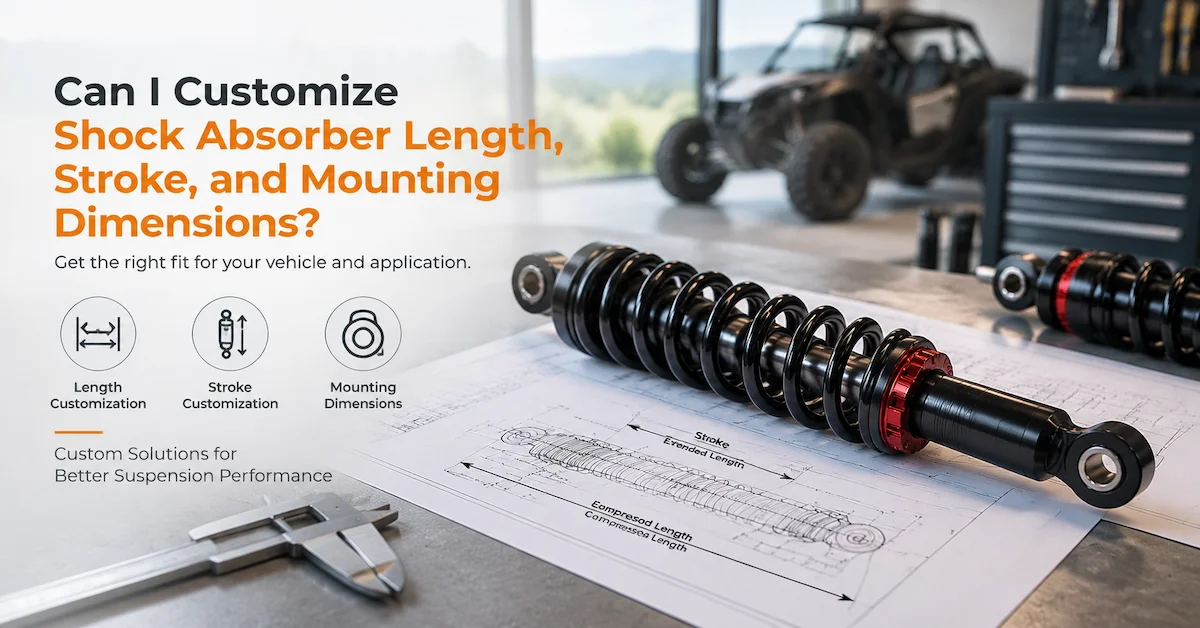
- Extended and compressed length
- Shock stroke
- Upper and lower mounting interfaces
- Spring rate
- Preload
- Compression damping
- Rebound damping
- Reservoir configuration
- Surface treatment
- Component materials
- Prototype validation
These two types of customization should not be confused.
Changing a spring color is primarily a branding decision. Changing spring rate, damping, stroke, or mounting geometry can affect how the suspension interacts with the vehicle and therefore requires technical review and, where appropriate, physical validation.
Bedo Auto currently describes its custom suspension workflow as including sample analysis, shock absorber customization, spring matching, prototype production, performance testing, small-batch manufacturing, and OEM production support.
Who Needs Custom Shock Absorber Development?
Customization is most valuable when an existing production shock cannot fully satisfy the project.
Typical buyers include:
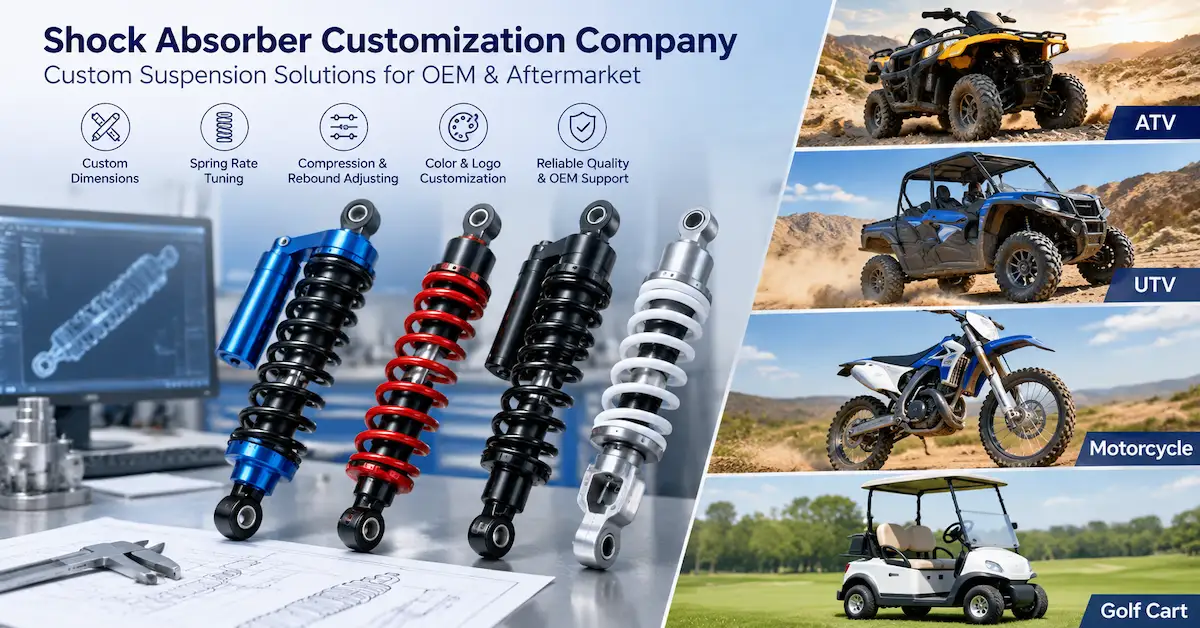
- ATV manufacturers
- UTV manufacturers
- Motorcycle brands
- Electric motorcycle developers
- Golf cart manufacturers
- Utility vehicle manufacturers
- Specialty vehicle companies
- Off-road aftermarket brands
- Importers and distributors
- Private-label suspension brands
- Vehicle startups
Common reasons for requesting customization include:
- A new vehicle platform
- Different mounting dimensions
- Increased vehicle weight
- Higher cargo or passenger load
- Different suspension travel
- Improved ride comfort
- Better off-road control
- New spring requirements
- Different damping characteristics
- A discontinued original shock absorber
- Product differentiation for a private-label brand
- Small-batch validation before larger production
Bedo's existing sample-based customization guidance also identifies replacement, competitor-sample improvement, discontinued-part reproduction, spring or damping changes, private labeling, and small-batch testing as common B2B use cases.
What Can a Shock Absorber Customization Company Customize?
The word custom is often used too broadly in supplier marketing.
OEM buyers should therefore ask exactly which variables can be changed.
Dimensional Customization
Dimensions determine whether the shock absorber can physically fit the vehicle.
Possible custom parameters include:
- Extended length
- Compressed length
- Stroke
- Body diameter
- Rod dimensions
- Spring envelope
- Upper mounting type
- Lower mounting type
- Mounting-hole diameter
- Bushing width
- Fork or clevis dimensions
These parameters should normally be defined through drawings, samples, or verified vehicle data.
If your project begins with incomplete documentation, Bedo's Shock Absorber Drawing Service explains how dimensional and application information can be organized before prototype development.
Spring Customization
Spring development can involve:
- Spring rate
- Free length
- Outside diameter
- Preload range
- Spring color
- Application-specific load support
Spring rate should not be selected only because a buyer wants a "harder shock."
The appropriate spring depends on factors such as:
- Vehicle weight
- Payload
- Suspension geometry
- Available travel
- Ride-height target
- Intended application
A spring that provides stronger load support may also change ride quality and available suspension movement.
Damping Customization
Shock absorber damping controls suspension movement.
Depending on the shock design, development may involve:
- Compression damping
- Rebound damping
- Valve configuration
- Adjustment range
- Force characteristics
SAE technical research has shown that damper configuration and damping characteristics materially affect suspension and vehicle dynamic behavior, which is why damping should be treated as an engineering variable rather than a cosmetic specification.
A professional customization company should therefore ask:
What vehicle and performance problem are we trying to solve?
rather than simply:
Do you want harder or softer damping?
Reservoir Configuration
Depending on application, the buyer may consider:
- Internal reservoir
- External reservoir
- Remote reservoir
- Hose routing
- Reservoir mounting position
More complex reservoir systems are not automatically better.
Their suitability depends on performance requirements, available packaging space, duty cycle, and cost targets.
Appearance and Private Label
Commercial customization can include:
- Shock body finish
- Spring color
- Adjuster color
- Logo
- Product labels
- Packaging
- Private-label branding
These features can help aftermarket brands differentiate products, but they should be handled separately from engineering performance requirements.
Fitment Customization vs Performance Customization
This distinction is one of the most important questions for an OEM buyer.
| Customization Type | Main Objective | Examples |
|---|---|---|
| Fitment customization | Make the shock physically match the vehicle | Length, mount, stroke, bush |
| Load customization | Support vehicle and payload | Spring rate, preload |
| Performance customization | Change suspension response | Compression, rebound |
| Packaging customization | Fit available chassis space | Reservoir, hose, spring envelope |
| Durability customization | Match environment/duty cycle | Materials, seals, finish |
| Branding customization | Create commercial differentiation | Logo, color, packaging |
A project can require one category or several.
For example, an importer developing a private-label replacement shock may already have validated geometry and only require branding plus minor performance changes.
A vehicle OEM developing a new UTV may require geometry, spring, damping, reservoir packaging, prototypes, and vehicle validation.
The quotation, lead time, development risk, and testing requirements will be very different.
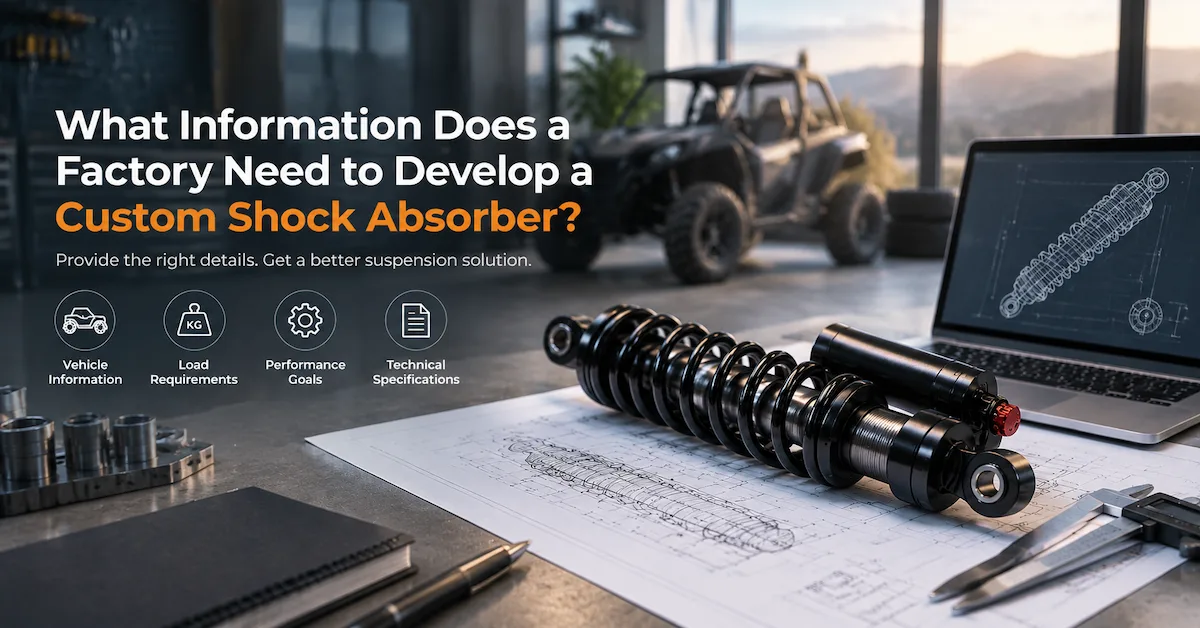
What Information Should Buyers Provide Before Customization?
A serious shock absorber customization company should ask for application data before finalizing technical recommendations.
| Project Input | Useful Information | Why It Matters |
| Vehicle type | ATV, UTV, motorcycle, EV, utility vehicle | Defines application |
| Installation position | Front or rear | Identifies suspension role |
| Vehicle weight | Empty and loaded | Supports spring review |
| Payload | Passenger, cargo, tools, battery | Defines operating load |
| Extended length | Mount-center measurement | Controls fitment |
| Compressed length | Minimum shock length | Protects travel limits |
| Stroke | Damper movement | Supports suspension travel |
| Upper mount | Eye, fork, clevis, etc. | Defines interface |
| Lower mount | Eye, fork, clevis, etc. | Defines interface |
| Spring data | Rate, length, OD if known | Provides baseline |
| Damping data | Curve or reference if available | Provides performance target |
| Reference sample | Existing or competitor shock | Helps technical review |
| CAD/drawing | Current engineering data | Reduces ambiguity |
| Terrain | Road, trail, farm, rock, sand, etc. | Supports tuning |
| Target improvement | Comfort, load, control, durability | Defines project objective |
| Quantity plan | Prototype, small batch, production | Supports manufacturing planning |
If exact damping or spring requirements are unknown, describe the vehicle behavior you want to improve rather than inventing engineering numbers.
Can a Custom Shock Absorber Be Developed From a Physical Sample?
Yes.
A physical sample is often a practical starting point when the buyer does not have complete technical drawings.
A supplier can review measurable features such as:
- Extended length
- Compressed length
- Stroke
- Mounting-hole diameter
- Mounting width
- Spring dimensions
- Rod diameter
- Shock body dimensions
Bedo's published Sample-Based Shock Absorber Customization Guide describes this approach for ATV, UTV, motorcycles, electric motorcycles, snowmobiles, and other off-road applications.
However, sample-based customization should not automatically mean exact copying.
If the buyer wants to change:
- Load capacity
- Ride comfort
- Spring rate
- Damping
- Surface treatment
- Branding
- Application
the supplier needs additional project information.
Sample Copying vs Engineering Customization
There is a major difference between reproducing a shock absorber and developing one.
Sample Copying
Typical objective:
Make another shock that matches the reference unit.
Main focus:
- Dimensions
- Mounting
- Appearance
- Basic structure
Engineering Customization
Typical objective:
Develop a shock for a new or improved vehicle requirement.
Main focus:
- Vehicle application
- Geometry
- Load
- Spring specification
- Damping
- Prototype testing
- Engineering revision
Product Branding
Typical objective:
Create a differentiated private-label product.
Main focus:
- Colors
- Logo
- Packaging
- Product identification
A capable supplier should understand which of these projects the buyer actually needs before preparing the development plan.
How Does a Custom Shock Absorber Project Work?
A practical process should progressively reduce engineering and purchasing uncertainty.
1. Define the Vehicle Application
The supplier first needs to understand:
- Vehicle type
- Vehicle weight
- Payload
- Suspension position
- Terrain
- Target improvement
- Expected production plan
2. Review Existing Samples or Drawings
Engineering inputs may include:
- Physical sample
- Customer drawing
- CAD file
- Vehicle specification
- Installation photograph
- Existing test data
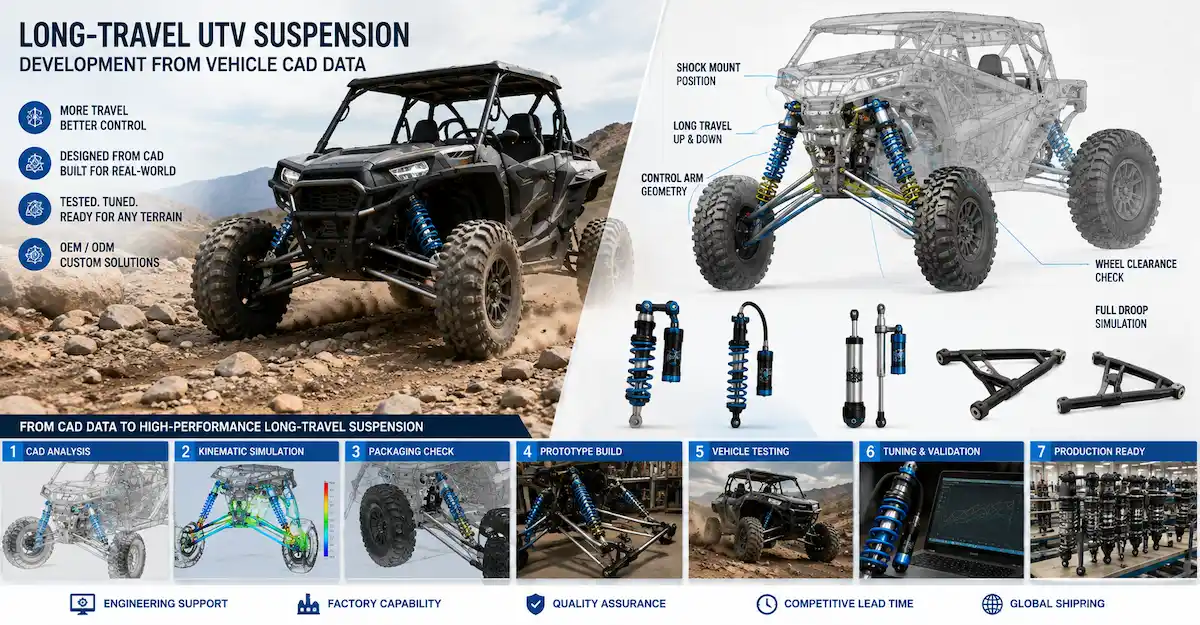
For projects starting from technical documentation, see Bedo's CAD-Based Suspension Development.
3. Confirm Fitment Parameters
Before performance tuning, confirm basic geometry:
- Extended length
- Compressed length
- Stroke
- Mounting interfaces
- Spring envelope
- Reservoir packaging
Incorrect fitment cannot be repaired by damping tuning.
4. Define the Spring Requirement
The development team reviews:
- Vehicle load
- Suspension geometry
- Available travel
- Target ride height
- Intended application
An initial spring specification can then be selected for prototype evaluation.
5. Define Initial Damping Targets
Compression and rebound targets should reflect the application.
Different priorities may apply to:
- Utility vehicles
- Recreational ATV
- High-speed UTV
- Road motorcycles
- Electric motorcycles
- Golf carts
- Specialty vehicles
6. Manufacture Prototype Samples
The first physical shock allows the design to move from engineering assumptions to actual validation.
Bedo's current Prototype Shock Absorber Factory Guide describes prototype development as a stage for verifying dimensions, fitment, spring characteristics, damping, testing requirements, and production preparation.
7. Test Fitment and Performance
The buyer and supplier can evaluate:
- Installation
- Clearance
- Ride height
- Available travel
- Spring behavior
- Compression response
- Rebound response
- Leakage
- General vehicle behavior
8. Optimize the Specification
Prototype feedback may result in changes to:
- Spring rate
- Preload
- Damping
- Stroke
- Mounting dimensions
- Reservoir position
- Other component details
9. Update Drawings and Specifications
Approved changes should be reflected in controlled documents.
The production supplier should not continue using an earlier prototype specification after the design has changed.
10. Validate a Small Batch
A small production run can help confirm:
- Assembly repeatability
- Appearance
- Dimensional consistency
- Performance consistency
- Packaging
- Customer approval process
11. Move Into OEM Production
After the design and manufacturing process are sufficiently validated, the project can scale according to actual commercial demand.
Bedo currently supports prototype and low-volume development before larger OEM production, rather than stating one fixed MOQ for every customized project.
What Should Be Tested Before Approving a Custom Shock Absorber?
Appearance alone is not enough.
The validation plan should reflect the project.
Dimensional Inspection
Check:
- Extended length
- Compressed length
- Stroke
- Mount dimensions
- Interfaces
Installation Review
Confirm:
- Vehicle fit
- Bolt alignment
- Spring clearance
- Reservoir clearance
- Hose routing
Spring Evaluation
Verify whether the selected spring provides acceptable:
- Ride height
- Sag
- Load support
- Available suspension movement
Damping Evaluation
Evaluate how the damper behaves in compression and rebound under the intended operating conditions.
The specific test method should be agreed based on project requirements rather than described vaguely as "performance testing."
Leakage and Durability
For production projects, the validation plan may also need to consider sealing and durability requirements appropriate to the product and duty cycle.
Customization Does Not Mean “Maximum Performance”
A common misconception is that customization should always produce a stiffer, stronger, or more aggressive shock absorber.
That is not necessarily correct.
A customized shock should be appropriate for the target vehicle.
For example:
- A utility UTV may need stronger load support.
- A recreational ATV may prioritize compliant wheel movement.
- A motorcycle may prioritize a different balance between stability and comfort.
- A golf cart may require controlled ride quality rather than extreme off-road damping.
- A specialty vehicle may prioritize durability under a narrow operating condition.
The purpose of customization is therefore not maximum specification.
It is better matching between the shock absorber and its application.
How to Evaluate a Shock Absorber Customization Company
Do not evaluate suppliers only by unit price.
Does the Company Ask Engineering Questions?
A capable supplier should ask about more than quantity and color.
Look for questions about:
- Vehicle type
- Weight
- Payload
- Mounting
- Stroke
- Terrain
- Spring
- Damping
- Target improvement
Can the Supplier Work From Different Inputs?
Useful capabilities include working from:
- Drawings
- CAD
- Physical samples
- Vehicle information
- Existing specifications
Can the Company Customize Spring and Damping?
Some suppliers only modify dimensions and branding.
If your project requires performance development, confirm whether the supplier can support:
- Spring matching
- Compression development
- Rebound development
- Prototype revision
Can It Manufacture Prototypes?
An integrated development partner should ideally be able to turn the agreed design into physical prototypes.
Can It Support Testing?
Ask:
- What is tested?
- How is it tested?
- What output can be reviewed?
- Which tests are standard and which require special agreement?
Avoid accepting vague claims without knowing the actual verification criteria.
Can It Handle Engineering Revisions?
Customization normally involves revisions.
Ask how the supplier controls:
- Drawing versions
- Prototype specifications
- Sample approvals
- Production revisions
Can the Design Scale Into Production?
The best prototype in the world has limited commercial value if the supplier cannot reproduce it consistently.
Ask how the project moves from:
Prototype → Pilot Batch → Repeat Production
Common Risks When Choosing a Custom Shock Absorber Company
Risk 1: Supplier Only Customizes Appearance
The website may advertise customization, but the factory may only provide:
- Color changes
- Labels
- Packaging
Better approach: ask specifically about dimensional, spring, and damping customization.
Risk 2: Quotation Before Technical Review
A fixed quotation provided before basic technical requirements are understood may not reflect the actual project.
Better approach: clarify project scope before comparing prices.
Risk 3: Copying a Reference Shock for a Different Vehicle
An existing sample may not suit a new vehicle weight or geometry.
Better approach: combine sample analysis with new application information.
Risk 4: No Prototype Revision Process
The first sample may reveal problems.
Better approach: confirm how technical feedback is converted into a revised specification.
Risk 5: No Link Between Prototype and Production
A supplier may make a one-off prototype but lack a controlled process for repeated manufacturing.
Better approach: evaluate production transition before committing to the project.
Risk 6: Overpromising Performance
Statements such as "best damping" or "maximum comfort" are meaningless without a target vehicle and test condition.
Better approach: define measurable application requirements.
How Bedo Auto Supports Shock Absorber Customization
Bedo Auto's current published customization content covers suspension products for ATV, UTV, motorcycles, electric motorcycles, golf carts, utility vehicles, and specialty applications. Its workflow includes sample analysis, shock absorber customization, spring matching, prototype production, small-batch manufacturing, testing, and OEM production support.
Depending on project requirements, buyers can begin from:
- A reference shock absorber
- Existing drawings
- CAD files
- Vehicle specifications
- Mounting dimensions
- Required improvements
If the project begins with a physical sample, review Sample-Based Shock Absorber Customization.
If the project needs custom engineering before physical sampling, see the Shock Absorber Drawing Service.
For prototype-stage development, review Prototype Shock Absorber Factory.
For projects where initial production quantities need to remain flexible, Bedo's Custom Suspension Low MOQ Guide explains its current small-batch development approach.
What Should You Include in a Custom Shock Absorber RFQ?
A stronger RFQ leads to a more useful supplier response.
Prepare as much of the following as possible:
- Vehicle type
- Front or rear suspension position
- Vehicle curb weight
- Maximum loaded weight
- Passenger or cargo information
- Extended shock length
- Compressed shock length
- Required stroke
- Upper mounting dimensions
- Lower mounting dimensions
- Existing spring specification
- Existing damping information
- Reference sample
- Drawings or CAD
- Installation photographs
- Intended terrain
- Performance problems to improve
- Branding requirements
- Prototype quantity
- Expected future production volume
A useful request sounds like:
We are developing a utility UTV rear shock. The vehicle carries additional cargo, and the current suspension sags excessively when loaded. We can provide the existing shock, vehicle weight data, mounting dimensions, and target production quantity.
That gives a supplier much more engineering context than:
Please quote your best custom UTV shock.
OEM buyers can submit available project information through the Bedo Auto Contact Page.
FAQ
What is a shock absorber customization company?
A shock absorber customization company develops shock absorbers according to customer-specific vehicle, dimensional, spring, damping, appearance, and production requirements rather than supplying only standard catalog configurations.
What parts of a shock absorber can be customized?
Depending on manufacturing and engineering capability, customization may include length, stroke, mounts, spring specifications, damping, reservoir configuration, surface finish, color, logo, labels, and packaging.
Can a shock absorber be customized from an existing sample?
Yes. A reference sample can provide dimensional and structural information. Additional vehicle and performance data are useful when the customer wants to improve or modify the original specification.
Can shock absorber spring rate be customized?
Yes, where the supplier supports spring development. Spring rate should be selected according to vehicle load, suspension geometry, available travel, ride-height target, and application rather than appearance alone.
Can compression and rebound damping be customized?
They can be modified on appropriate shock designs. Damping requirements should be developed around the target vehicle and verified through physical testing.
Can I customize only the logo and color?
Yes, for projects where the underlying shock specification has already been validated. Branding-only customization is different from technical suspension development.
Do custom shock absorbers require prototypes?
Not every cosmetic customization requires a completely new engineering prototype. However, new dimensions, spring rates, damping configurations, mounts, or vehicle applications generally justify physical validation before larger production commitments.
Can custom shock absorbers be ordered in small quantities?
Bedo currently states that custom and low-volume suspension projects can begin with prototypes or small batches, with MOQ depending on design, customization, materials, and manufacturing requirements rather than one universal quantity.
How long does custom shock absorber development take?
There is no reliable universal lead time. Development time depends on project complexity, available engineering data, new components, prototype requirements, testing, revisions, and manufacturing preparation.
How do I choose a reliable shock absorber customization company?
Evaluate engineering communication, customization scope, sample and CAD capability, spring and damping development, prototype support, testing, revision control, quality processes, and the ability to move an approved design into repeat production.
Conclusion
Choosing a shock absorber customization company is fundamentally different from buying a standard shock absorber from a catalog.
OEM buyers should first define what “custom” means for their project.
It may mean:
Branding only
or:
Fitment + Spring + Damping + Prototype + Testing + Production
The second type of project requires much deeper engineering and manufacturing support.
A reliable development process should connect:
Vehicle Requirement → Sample/CAD Review → Fitment Definition → Spring & Damping Development → Prototype → Testing → Revision → Pilot Batch → OEM Production
SAE technical research on dampers reinforces that damping characteristics affect suspension and vehicle behavior, supporting the need to treat damping configuration as an engineering variable rather than simply a marketing specification.
Bedo Auto currently supports sample analysis, shock customization, spring matching, prototype development, testing, small-batch manufacturing, and OEM production for off-road and specialty suspension projects.
If you are developing a custom ATV, UTV, motorcycle, electric vehicle, golf cart, utility vehicle, or specialty suspension product, prepare your reference sample, drawings, vehicle data, mounting dimensions, target improvement, and quantity plan, then send them through the Bedo Auto Contact Page for project-specific review.