
When is shock absorber prototype development ready for pilot production?
Direct answer: shock absorber prototype development is ready for pilot production when the approved prototype is uniquely identified, traceable to a released drawing and BOM, verified against its intended vehicle interfaces, spring and damping definition, and accepted under agreed bench and vehicle conditions. All significant anomalies must be closed or formally accepted, every successful adjustment must be documented, and production inspection must be able to distinguish the approved configuration from an incorrect one.
A prototype that fits, looks correct, or receives positive driver feedback is not automatically production-ready. Pilot release requires an evidence chain: requirement, prototype ID, build record, test condition, result, engineering change, final revision, inspection method, and approval. The purpose is to learn at small scale without carrying hidden prototype decisions into repeated manufacturing.
This guide addresses a narrow OEM and RFQ problem: what acceptance gates should buyers use after the first shock prototypes exist and before authorizing a pilot batch? BEDO's current shock absorber prototype supplier guide discusses supplier selection, while the prototype shock absorber factory guide explains the general development route. The present article focuses on release evidence, failure learning, revision control, and handoff to repeatable production.
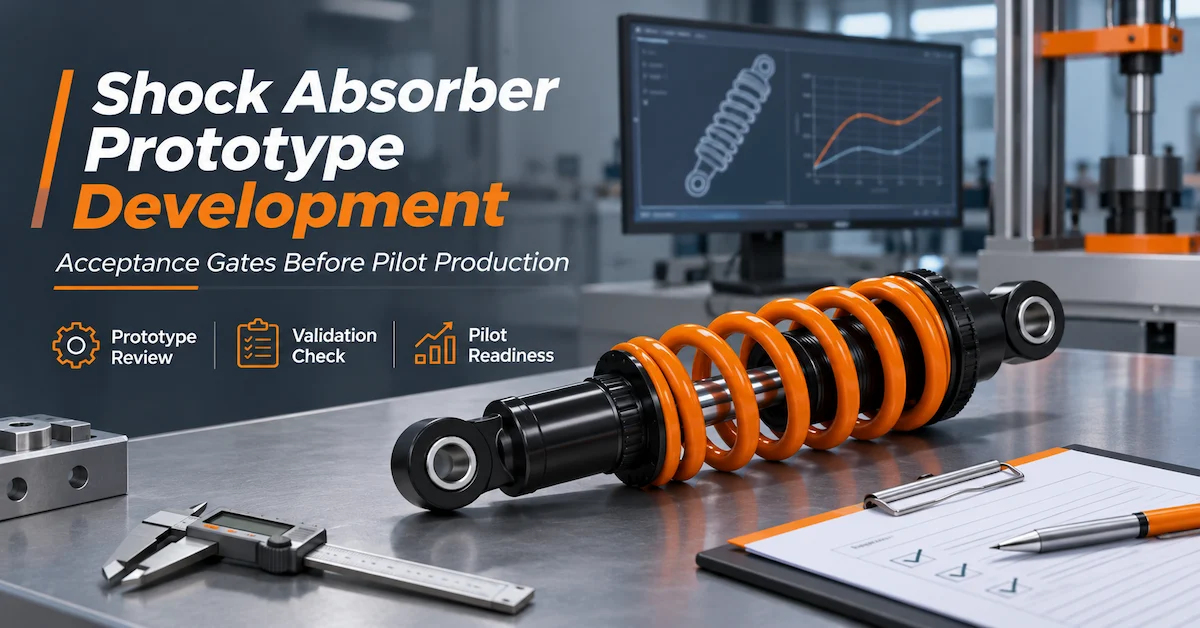
Define what question each prototype must answer
Prototype programs lose time when every sample is expected to answer every question. A packaging sample may be sufficient to check mounts and clearance but may not contain the final spring, damping, seals, finish, or production process. A tuning sample may represent the intended internal configuration but use temporary appearance parts. A durability sample may need a frozen build and pre-test measurements. Name the purpose before the unit is built.
| Prototype type | Primary question | Possible limitations to record | Approval it can support |
|---|---|---|---|
| Interface mock-up | Do lengths, mounts and envelopes fit the vehicle? | May not be functional or production-material representative. | Packaging direction, not performance or production. |
| Functional prototype | Does the shock move, seal, adjust and support basic fitment? | Internal settings, finish or process may remain preliminary. | Functional learning and next test configuration. |
| Spring/damping development unit | Which controlled configuration meets target vehicle behavior? | May be repeatedly rebuilt and is not automatically a production master. | Selection of spring, damping and setting revision. |
| Design-validation unit | Does the frozen-intent design meet specified requirements? | Manufacturing may still use prototype processes. | Design acceptance when evidence is complete. |
| Production-intent prototype | Can intended materials, processes and controls reproduce the design? | Volume and process stability still require pilot evidence. | Authorization for a controlled pilot batch. |
Label each sample physically and in records. A simple prototype ID should connect to drawing revision, BOM revision, spring part/revision, damping or internal setting identity, assembly date, builder, deviations, finish, test history, and current status. If a shock is rebuilt, create a new configuration record even when the outer serial number remains.
Establish the controlled baseline before testing
Testing without a baseline produces observations that cannot guide production. Before the first acceptance test, confirm the requirement set, source data, prototype build definition, vehicle configuration, load cases, test methods, and decision authority. Record known gaps as open items.
Vehicle baseline
Identify the vehicle or test fixture, platform revision, front/rear position, tires, suspension geometry, mounts, accessories, battery or powertrain configuration, curb and operating mass states, passenger or cargo arrangement, and any prior modifications. Record current shock and spring data where available. If multiple vehicles are used, explain why they are representative.
Component baseline
Control extended and compressed length, effective stroke, upper and lower mounts, widths and holes, body/rod/spring envelope, spring identity and installed condition, damping/internal configuration, adjuster baseline, reservoir arrangement where applicable, hardware, materials/process requirements, and critical deviations. A photograph alone is not a baseline.
Acceptance baseline
For each requirement, define verification method, condition, sample quantity, equipment, measurement points, pass/fail, result owner, and required report. If a vehicle evaluation is partly subjective, use consistent drivers, route segments, loads, settings, rating questions, and comments. Subjective evidence can support a decision when its context is controlled; it should not be disguised as a universal numeric result.
Use staged gates instead of one final sample approval
A staged gate sequence prevents expensive vehicle or durability work on a prototype that already fails a basic interface or build check. The exact gates depend on project risk, but each should result in proceed, revise, add evidence, hold, or stop.
| Gate | Main decision | Typical evidence | What blocks release |
|---|---|---|---|
| Gate 0: requirement readiness | Can the planned prototype answer a defined question? | Requirement, vehicle/input register, risks, sample matrix and acceptance plan. | Unknown interfaces, loads, target or responsibility that makes results ambiguous. |
| Gate 1: build and dimensional acceptance | Was the intended prototype manufactured and identified correctly? | Build record, material/component identity as required, dimensional and visual inspection. | Wrong revision, undocumented substitution, critical dimension outside acceptance. |
| Gate 2: fit and functional acceptance | Can it operate through the intended installation safely enough for further testing? | Installation, full-motion clearance, retention, leakage/function and adjuster checks. | Interference, travel conflict, mount issue, abnormal movement or unresolved leakage. |
| Gate 3: performance acceptance | Does the spring-damper configuration meet agreed bench/vehicle targets? | Controlled bench data, load-state and route tests, driver/engineer observations. | Target missed, unstable result, test condition mismatch or undocumented tuning. |
| Gate 4: design validation | Does the frozen-intent design meet the required risk-based evidence? | Agreed durability/environmental/functional tests and post-test inspection. | Failure, unexplained degradation, incomplete evidence or change not revalidated. |
| Gate 5: pilot readiness | Can manufacturing reproduce and inspect the approved configuration? | Released drawing/BOM, critical checks, pilot plan, labels, packaging and change control. | Prototype cannot be traced, process relies on hidden rework, inspection cannot detect error. |
Gate approval applies to a named revision and scope. If Gate 3 approves vehicle behavior but a later seal, material, mount, or process change occurs, the team must review which evidence remains valid. A general statement that “the prototype passed” is not enough.
Gate 0: make the prototype plan testable
Before parts are ordered, create a prototype matrix. List each unit or set, configuration, purpose, vehicle, planned tests, whether the test is destructive, and final disposition. This prevents the only approved fitment sample from being consumed in a destructive test or a rebuilt tuning shock from being presented as an untouched durability unit.
| Matrix field | Why it matters | Example control question |
|---|---|---|
| Prototype ID | Connects physical sample to all records. | Can the team identify this exact unit after shipment and rebuild? |
| Configuration code | Separates spring, damping, mount, finish and setting variants. | Which variables differ from the baseline? |
| Purpose | Prevents inappropriate approval from limited samples. | Is this unit for fit, tuning, validation, demonstration or process trial? |
| Test sequence | Prior testing may change later results. | What conditioning, rebuild or damage occurred before this test? |
| Vehicle/load | Defines application context. | Which vehicle revision and operating state were used? |
| Disposition | Preserves evidence and controls reuse. | Retain, rebuild, section, return, archive or scrap? |
Estimate quantity from the matrix, not a generic MOQ. The number may depend on front/rear pairs, variants, repeated tests, destructive validation, retained samples, vehicle availability, and pilot needs. Ask the supplier to explain constraints from custom springs, tooling, purchased components, setup, and test resources.
Gate 1: verify that the intended design was actually built
Dimensional inspection is necessary but not sufficient. Confirm the prototype uses the correct drawing/BOM revision and document every deviation, substitution, temporary process, or hand adjustment. A development unit may legitimately contain temporary parts; those differences must be visible when interpreting results.
Inspect interfaces and travel-related dimensions first
Measure extended and compressed length under a defined condition, available stroke, mount type, holes/threads, installation widths, bushing/sleeve arrangement, body and spring envelope, reservoir/hose geometry, adjuster access, and relevant orientation. Confirm the measurement datums and method. Two teams can report different “lengths” if they use different references or preload/force conditions.
Confirm spring and internal identities
The build record should identify the spring and its approved characteristic, free length and relevant dimensions, installed/preload condition, seats and retention. It should also identify the damping or internal configuration at a level that manufacturing can reproduce. Do not rely on paint color, handwritten labels, or the memory of the tuner.
Record deviations before test results influence judgment
If a machinist adjusted a spacer, technician changed oil, assembler substituted a seal, or engineer changed shim/valve elements, record it immediately. An undocumented improvement can make the prototype succeed while leaving the released drawing unable to reproduce it.
Gate 2: separate fitment from performance approval
A shock can fit at static ride height and still create a full-bump or full-droop conflict. Install the identified prototype on the correct vehicle position and review the entire intended motion. Check mount alignment, bushing articulation, fastener engagement, body/spring/reservoir clearance, tire and control-arm envelope, brake/cable routing, steering lock, chassis stops, spring retention, adjuster access, and serviceability.
Confirm whether the shock or vehicle stop limits compression and droop. If the damper reaches an internal limit before the intended chassis mechanism, loads may be transferred in an unintended way. Do not perform a high-risk vehicle test until significant interface and motion issues are closed by the responsible engineers.
Fitment approval should produce a report with vehicle ID/revision, prototype ID/configuration, position, photographs, measurement points, load state, full-motion method, findings, required changes, and approver. An installation that required undocumented grinding, forced alignment, uncontrolled spacers, or different hardware is a design issue, not a pass.
Gate 3: build a performance acceptance matrix
Performance acceptance should connect spring support, damping, settings, loads, route or bench conditions, and target behavior. The team may use bench data, vehicle data, structured observations, or a combination. The method should match the maturity and risk of the project.
Static and load-state evidence
Record vehicle attitude or agreed ride-height/sag indicators under unloaded, normal, and upper intended loads as relevant. Use consistent surfaces, tire condition, measurement points, and load placement. A spring that meets the upper load target may still create unacceptable light-load behavior; the accepted window must reflect actual use.
Bench evidence
Where force-velocity or other damper bench data is required, define test equipment, mounting, conditioning, speed points, temperature or timing, adjustment setting, direction, units, tolerance, and pass/fail. Compare identified units and repetitions according to the project plan. A graph without sample identity and test condition cannot control production.
Vehicle evidence
Define route segments and maneuvers that expose the target problem: repeated small disturbances, a larger compression event, cornering transition, braking attitude, loaded utility operation, or rough terrain. Control vehicle, loads, tires, settings, operators, speeds, weather/surface where relevant, and sequence. Note safety limits and stop conditions.
| Target | Evidence example | Context that must be recorded | Common misleading shortcut |
|---|---|---|---|
| Load support | Working position under defined vehicle load states. | Vehicle, load placement, spring and preload/seat revision. | Evaluating only maximum load or only empty vehicle. |
| Compression behavior | Bench response and/or vehicle response over defined inputs. | Setting, speed/input, temperature/conditioning and spring. | Calling higher force automatically better. |
| Rebound control | Recovery after controlled compression or route feature. | Spring energy, load, setting, repeated events and driver comments. | Changing spring without reassessing rebound. |
| Consistency | Repeated runs or multiple identified samples. | Equipment, method, sample history and allowable variation. | Publishing one best curve. |
| Adjustability | Defined response across usable settings. | Click/count convention, baseline, end stops and direction. | Assuming every setting is safe or useful. |
| Thermal/duty behavior | Relevant extended or repeated operating sequence. | Duration, route/cycle, temperature observation and post-test result. | Making universal fade claims from a short demonstration. |
When a project lacks instrumentation, improve the quality of structured observations rather than inventing precision. Use repeated conditions, defined scales, specific comments, videos where appropriate, and more than one stakeholder. Explain the evidence limitation in the approval.
Manage tuning changes as controlled experiments
Shock absorber prototype development often requires iteration. Change one interpretable group of variables at a time where practical. If spring, preload, compression, rebound, tire pressure, load, and route all change together, the team may like the result but cannot explain it or reproduce it.
Use a tuning sheet that records prototype ID, configuration revision, date, technician, spring, installed condition, internal setting, adjuster position, vehicle/load, route or bench method, result, interpretation, and next action. Assign a new configuration identity after every rebuild or setting change that affects approval.
Distinguish a tuning unit from an approval unit
A tuning shock may be repeatedly disassembled and assembled, which can influence condition and makes its history complex. After choosing the candidate specification, build or prepare production-intent units to the controlled revision for formal validation. This checks that the result is not unique to one heavily worked development unit.
The suspension prototype development guide provides background on the broader engineering cycle. The critical release discipline is that every successful prototype change becomes a controlled requirement, drawing, BOM, setting, or process before the next gate.
Gate 4: validate the frozen-intent design by risk
Design validation should challenge the requirements most likely to fail in real use. The plan may include dimensional retention, leakage/function, damping consistency, adjustment, structural or fatigue evidence, corrosion/environmental exposure, temperature, contamination, repeated cycling, and vehicle duty. The responsible team must select suitable methods and standards for the actual product and market.
Do not list tests merely to make the project appear rigorous. State which requirement each test verifies, why the sample and severity are representative, what constitutes failure, and what post-test inspection is required. A part can complete a cycle count yet show unacceptable leakage, wear, looseness, deformation, performance shift, or damage during inspection.
Control pre-test and post-test condition
Record dimensions, leakage/function, spring/setting identity, relevant bench result, appearance, and any known marks before validation. Repeat the defined checks afterward. Preserve failed parts for analysis. Photographs and measurements should be linked to the exact unit and revision.
Do not average away a failure
If one sample fails and others pass, investigate the failure. Determine whether it is design, component, process, assembly, test, vehicle, misuse, or unknown. Averages can hide a critical mode. The disposition should state root-cause confidence, affected population, corrective action, and required revalidation.
Revalidate the effect of changes
A corrective change can affect other requirements. A seal or surface change may alter friction; a mount change may alter alignment; a spring change affects rebound demand; a damping change can affect heat and vehicle behavior. Use an impact review to decide which earlier evidence can be retained and which tests must be repeated.
Use an anomaly process that protects learning
Prototypes are built to reveal uncertainty, so an anomaly is not automatically a project failure. The failure is losing the information. Every leak, noise, interference, loosened fastener, unexpected force curve, ride complaint, dimensional discrepancy, or damaged component should receive an ID and disposition.
| Anomaly field | Required content | Why it matters |
|---|---|---|
| Identification | Prototype, vehicle, date, test, configuration and observer. | Links the event to the correct baseline. |
| Observation | What happened, when, where and under which condition. | Separates evidence from assumptions. |
| Immediate action | Stop, inspect, quarantine, repair, continue under limit or other decision. | Protects safety and evidence. |
| Investigation | Measurements, disassembly, images, data, comparison and possible causes. | Builds a defensible technical explanation. |
| Root cause/disposition | Confirmed, probable or unknown cause; use-as-is, rework, redesign or reject. | Prevents premature certainty. |
| Corrective change | Affected drawing/BOM/process/vehicle/instruction and new revision. | Transfers learning into the product definition. |
| Verification | Evidence that the action resolved the issue without unacceptable effects. | Closes the loop before release. |
A buyer should resist the pressure to hide prototype problems from commercial stakeholders. Early discovery is less expensive than pilot or field discovery. Report the problem accurately, limit claims to the evidence, and use it to improve the release package.
Gate 5: create the pilot-production handoff package
Pilot production tests whether the organization can reproduce the design, not whether the original engineer can build another good sample by hand. The handoff package should allow purchasing, manufacturing, quality, packaging, and the buyer to identify the approved result and detect meaningful deviations.
- Released assembly and component drawings with effective revisions.
- Released BOM, approved sources or source-control requirements where needed.
- Controlled spring part, characteristic, dimensions, finish and identification.
- Controlled damping/internal configuration and assembly setting identity.
- Approved materials, finishes, special processes and critical characteristics.
- Assembly instructions or process controls needed to reproduce performance.
- Inspection and functional test plan with methods, equipment, condition and acceptance.
- Prototype and design-validation reports linked to the released revision.
- Approved reference/master samples where useful, with storage and replacement rules.
- Pilot quantity, sampling, traceability, deviation, quarantine and release plan.
- Labels, package contents, instructions, carton protection and revision.
- Engineering-change and supplier-change notification requirements.
Define critical characteristics from failure consequences
Critical or significant checks may include interfaces, compressed/extended condition, stroke, spring identity, damping/function, sealing, mount integrity, adjustment, and application-specific features. The actual list depends on the design and risk. Do not mark every dimension critical; prioritize characteristics whose variation can affect fit, performance, safety, service, or compliance.
Use pilot data to test the control plan
Inspect pilot units according to the proposed production method. Compare units with the released prototype evidence and investigate variation. Verify labels and cartons as well as parts. Confirm that operators can follow the documented process without hidden prototype-era adjustments. Pilot deviations should be approved and traceable, not quietly accepted to protect schedule.
Decide what becomes the master reference
A physical master sample can be useful for appearance, assembly and comparison, but it should not replace controlled drawings, BOM, spring, damping definition, inspection and test methods. Physical parts age, can be damaged or modified, and may contain characteristics that are difficult to observe.
If a master is retained, record its ID, configuration, approval status, storage, permitted use, inspection, access, and replacement. Do not use a failed or repeatedly rebuilt tuning unit as the production master unless its final state is fully verified and documented.
Separate design acceptance from commercial readiness
A technically accepted prototype may still lack production price, MOQ, material availability, packaging, service parts, warranty process, forecast, or launch support. Conversely, a favorable quotation does not prove design acceptance. Use separate checklists and combine them only at pilot release.
| Readiness area | Questions before pilot authorization |
|---|---|
| Technical | Is the approved revision complete, traceable and supported by required evidence? |
| Manufacturing | Are process, tooling, components, settings, inspection and deviations controlled? |
| Supply | Are sources, MOQ, forecast, lead-time basis and change notification agreed? |
| Quality | Can the pilot detect fit, spring, damping, leakage, assembly and identification errors? |
| Vehicle/application | Is the release limited to validated vehicles, positions, loads and conditions? |
| Market | Do claims, instructions, labels, packaging and service match the approved scope? |
Project-specific MOQ and timing should be confirmed after the production-intent design and pilot plan are understood. New tooling, custom springs, purchased components, specialized processes, tests, revisions, and volume can all affect commercial terms. Avoid applying a universal number to all prototypes.
Build a prototype-development RFQ around acceptance
An RFQ should tell the supplier not only what to build but what the buyer intends to decide. This allows the quotation to include the correct engineering, sample variants, tests, reports, rebuilds, and production-transition work.
- Vehicle/platform, target market, suspension position and business objective.
- Vehicle revision, hard points/interfaces, masses/load states, geometry, tires and available envelope.
- Use cases, terrain/route, speed, duty, environment, storage and service expectation.
- Current shock/spring, samples, drawings, CAD, measurements, curves, test or failure evidence.
- Target fit, support, damping, adjustment, behavior and unacceptable conditions.
- Prototype types, configuration matrix, quantities and purpose of each unit.
- Required inspection, bench, fitment, vehicle and risk-based validation.
- Vehicle/test resources, responsibility, acceptance criteria and approval authority.
- Required drawings, BOM, reports, settings, issue log and production handoff.
- Expected prototype iterations, rebuild support, retained samples and failed-part handling.
- Pilot quantity, annual forecast, packaging, branding, service parts and market timing.
- IP/confidentiality, tooling, change control, traceability and supplier notification.
Request separate prices and schedules for requirement review, design preparation, prototypes, tooling, tests, revision cycles, vehicle support, pilot and production. Ask the supplier to list assumptions, exclusions, missing information, and which evidence is buyer-provided. Buyers can submit the controlled application and acceptance package through the BEDO project inquiry page for a project-specific review.
Common prototype-release mistakes
Approving a result without identifying the exact build
If the team cannot state the spring, damping configuration, setting, drawing/BOM revision and deviations, the successful result cannot reliably become a production specification.
Testing only the easiest vehicle condition
Empty or lightly loaded testing may miss bottoming and support problems; maximum-load testing may miss harsh normal operation. Use the operating cases that define the product claim.
Changing multiple variables without a record
The final vehicle may feel better, but the team will not know why. Control experiments and document each configuration so the result can be reproduced and rationally adjusted.
Confusing fitment with performance
A bolt-on part may still use the wrong travel, spring or damping. Separate interface, functional, performance, validation and production gates.
Passing validation but failing production handoff
A prototype built by specialists with undocumented rework is not production-ready. Pilot release requires drawings, BOM, process controls and inspection that ordinary production can follow.
Frequently asked questions about shock absorber prototype development
What is shock absorber prototype development?
It is the controlled creation and evaluation of pre-production shocks used to resolve fitment, spring, damping, function, durability, manufacturing and vehicle questions before repeat production.
How is this guide different from choosing a prototype supplier?
Supplier selection asks who can perform the work. This guide asks what evidence must exist after prototypes are built before the buyer authorizes pilot production.
Does a prototype pass when it fits the vehicle?
No. Fit is one gate. The project may also require spring support, damping, full-motion clearance, leakage/function, adjustment, vehicle behavior, durability/environmental evidence and production repeatability.
How many prototype shocks are needed?
There is no universal quantity. Create a matrix for positions, variants, tuning, vehicle sets, repeated or destructive tests, retained references and pilot needs. The quantity should support the decisions without reusing compromised samples unknowingly.
Can the same unit be used for tuning and validation?
Sometimes, but its complete rebuild and test history must be known. A production-intent unit built to the chosen revision often provides stronger evidence that the result is reproducible.
What should be recorded after a damping change?
Prototype/configuration ID, internal or setting revision, spring, technician, date, vehicle/load, route or bench condition, result, interpretation, affected documents and next action.
What happens when one prototype fails?
Quarantine or control the unit, document the condition, investigate root cause, assess affected units, issue a controlled correction, and verify it. Do not average the failure away because other units passed.
What is required before design freeze?
The approved prototype must be traceable to controlled drawings/BOM, required evidence must pass, all successful changes must be documented, significant anomalies must be closed or formally accepted, and production controls must be defined.
Is a golden sample enough for production?
No. A master sample can support comparison, but production also needs controlled specifications, component identities, inspection/test methods, traceability and change control.
When should pilot production begin?
After pilot readiness approval confirms the production-intent design, evidence, documents, process controls, inspection, labels/packaging, deviations, quantities and responsible approvers.
Conclusion
Shock absorber prototype development should end with a controlled release decision, not a favorable impression of one sample. Define the question for every prototype, establish the vehicle and component baseline, use staged gates, control tuning changes, validate by risk, investigate anomalies, and connect the successful configuration to a released drawing, BOM, spring, damping definition, inspection and pilot plan.
The best pilot candidate is not necessarily the prototype with the longest test history. It is the production-intent revision whose evidence, changes and remaining risks are understood and whose manufacturing definition can be repeated. OEMs, private-label brands and specialty-vehicle developers preparing a prototype program can review BEDO's related suspension sample development resource, organize the acceptance matrix above, and submit vehicle data, drawings or samples, target conditions, prototype variants, validation responsibilities and forecast through the official BEDO contact channel.