
What does a suspension calibration service deliver?
Direct answer: a suspension calibration service should convert vehicle geometry, axle loads, spring support, shock force measurements, temperature, speed, and driving targets into a documented baseline that can be tested, approved, and repeated in production. The deliverable is not a generic "soft" or "hard" setting. It is a defined shock and spring configuration, a vehicle test record, and a revision-controlled setup that engineering, purchasing, and after-sales teams can identify.
For an OEM or aftermarket program, the service should show what was measured, what was proposed, what changed after the vehicle test, and which conditions the setting is intended to cover. If a supplier only sends a damper photograph or a nominal length, the buyer still does not know whether the part supports the platform, load state, travel, or target behavior.
This article is for vehicle brands, powersports companies, electric motorcycle makers, ATV and UTV importers, suspension distributors, retrofit companies, and procurement engineers deciding whether to buy a catalogue shock or request engineering support. The unique purchasing question is how to select a Suspension calibration service partner whose work can survive the transition from prototype to repeat supply.
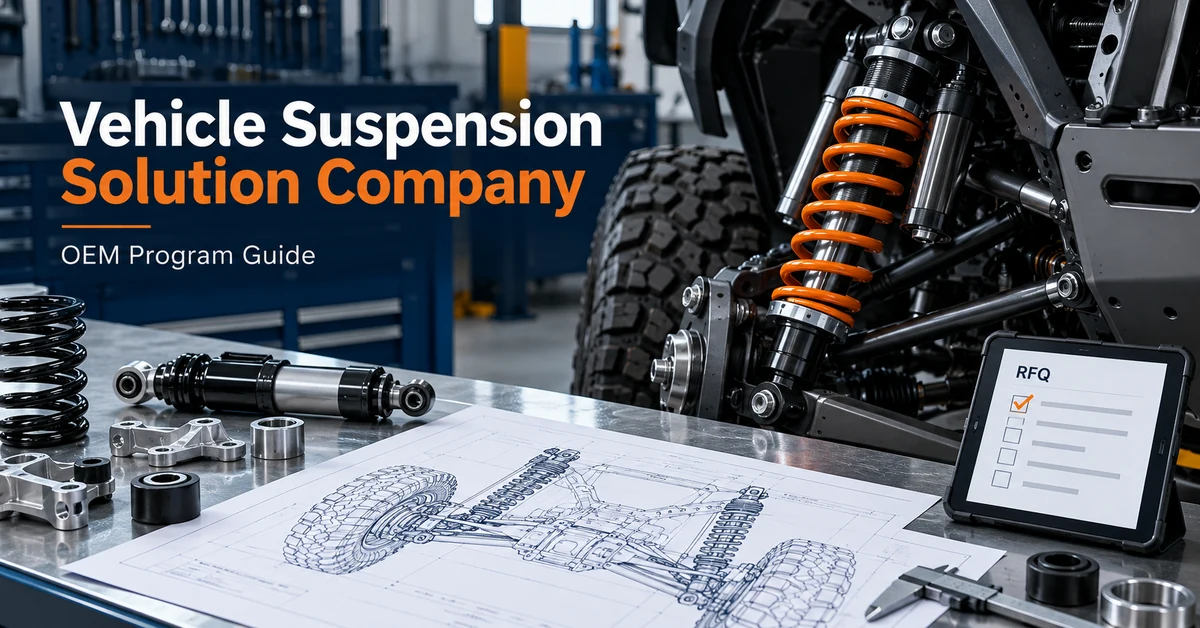
Ningbo Bedo Auto Parts Co., Ltd. publicly identifies itself as a shock absorber and suspension spring manufacturer in Ningbo, Zhejiang, China. The official website presents shock absorbers, suspension springs, ball joints, custom solutions, design support, and small-batch ordering. The public company page also states a 2009 establishment, ISO9001 certification history, exports to more than 45 countries, and monthly production information. These are useful supplier-qualification facts, but the exact calibration equipment, test method, project capacity, MOQ, lead time, packaging, and vehicle results must be confirmed for each program.
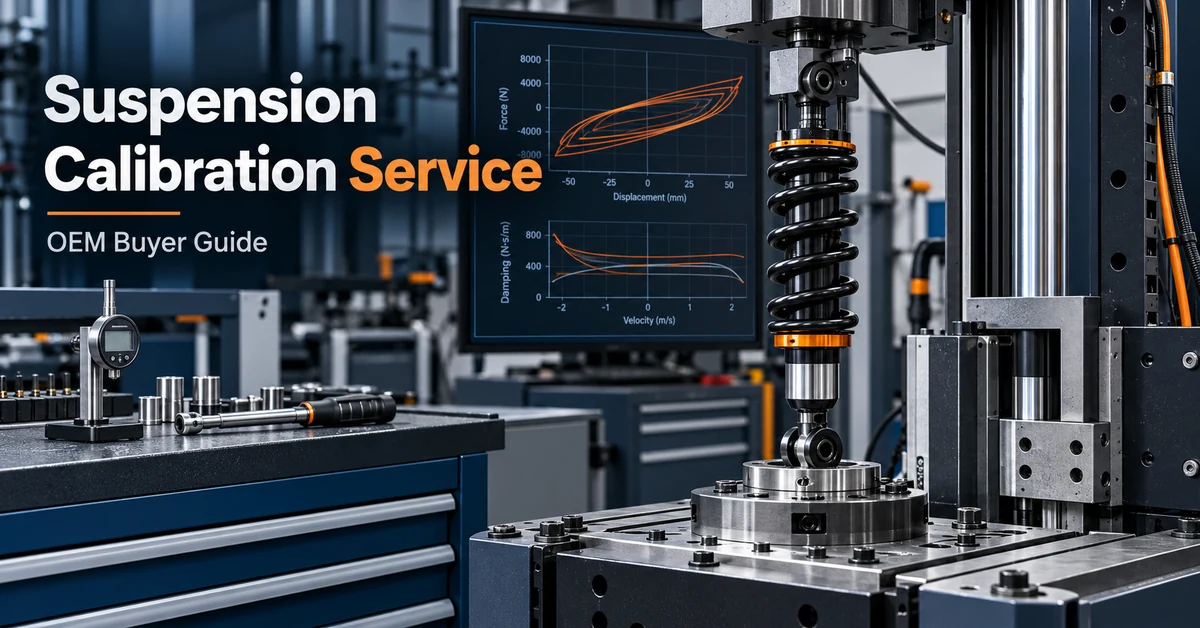
When should a buyer order calibration instead of a replacement shock?
Calibration is justified when the buyer is responsible for vehicle behavior rather than simply replacing a worn part with a known fitment. Typical triggers include a new vehicle platform, a battery or cargo change, a new wheel and tire package, a modified suspension geometry, a heavier passenger condition, a fleet route with repeated loading, or an aftermarket kit that must work across a defined range of users. In each case, the same shock body may produce a very different vehicle result because motion ratio, unsprung mass, spring rate, tire stiffness, and load distribution have changed.
| Buyer situation | Why calibration is relevant | Minimum evidence to collect |
|---|---|---|
| New OEM vehicle | There is no approved spring, damping curve, or production baseline. | CAD or measured geometry, axle loads, travel, target ride height, and test vehicle. |
| Electric vehicle update | Battery mass and packaging can change static load and clearance. | Battery state, front/rear distribution, mounting clearance, and loaded conditions. |
| Aftermarket upgrade | A kit may be installed on vehicles with different riders, tires, or accessories. | Fitment range, intended user, adjustment range, and installation baseline. |
| Fleet or utility use | Repeated cargo, speed, terrain, and heat can expose a poor damping match. | Duty cycle, payload states, route, service interval, and failure history. |
| Quality complaint | Noise, bounce, leakage, sag, or instability must be separated from geometry and installation. | Part revision, vehicle measurements, symptoms, photos, and test conditions. |
Calibration is not a substitute for correcting a bent mount, worn bushing, damaged tire, incorrect ride height, or unsafe installation. A responsible supplier begins with a boundary review. The result may be a new damper setting, a different spring, a revised mount, a fitment correction, or a recommendation that the vehicle hardware must be repaired before testing.
Start with a controlled vehicle data sheet
The first failure in many suspension projects is not a poor damper. It is an incomplete input sheet. A model name does not tell a supplier the model year, market, battery size, accessories, motion ratio, or actual axle load. Before asking for a quotation, create one controlled data sheet and label every field as measured, calculated, estimated, or missing. This prevents a provisional value from silently becoming a production requirement.
Record platform and installation identity
Write the vehicle type, platform code, model year, market, front or rear position, left or right side, drive layout, wheel and tire specification, and mounting direction. Add photographs of both mounting points and a drawing showing the shock axis at ride height, full bump, and full droop. Record bushing or eyelet dimensions, bolt diameter, spacer width, mounting angle, thread location, spring seat position, and nearby clearance. A calibration file that cannot identify the installed position is difficult to reproduce in the field.
Measure loads and operating states
Static curb load is only one state. List driver or rider, passenger, cargo, tool kit, battery state, fuel or other consumables, accessories, and axle distribution. For an ATV or UTV, include utility and recreational conditions separately. For an electric motorcycle, include battery mass and the intended rider range. If a vehicle will be sold in several markets, document the maximum expected load for each market rather than averaging the values into a condition that no customer actually uses.
| Input group | Useful fields | Why the calibration team needs it |
|---|---|---|
| Vehicle identity | Platform, year, market, position, side, drive, tire, wheel, accessory package. | Prevents a setting from being attached to the wrong configuration. |
| Geometry | Extended length, compressed length, stroke, mount width, hole, angle, linkage, motion ratio. | Defines fitment, available travel, and wheel-to-shock movement. |
| Loads | Axle loads, rider, passenger, cargo, battery, fuel, front/rear distribution. | Supports spring selection, sag, ride height, and load-state testing. |
| Target behavior | Comfort, control, bottoming resistance, rebound recovery, roll, pitch, noise, durability. | Turns subjective language into measurable test questions. |
| Environment | Dust, mud, water, salt, temperature, wash-down, storage, route, speed, duty cycle. | Defines seal, finish, heat, corrosion, and test-risk discussion. |
Separate spring selection from shock damping
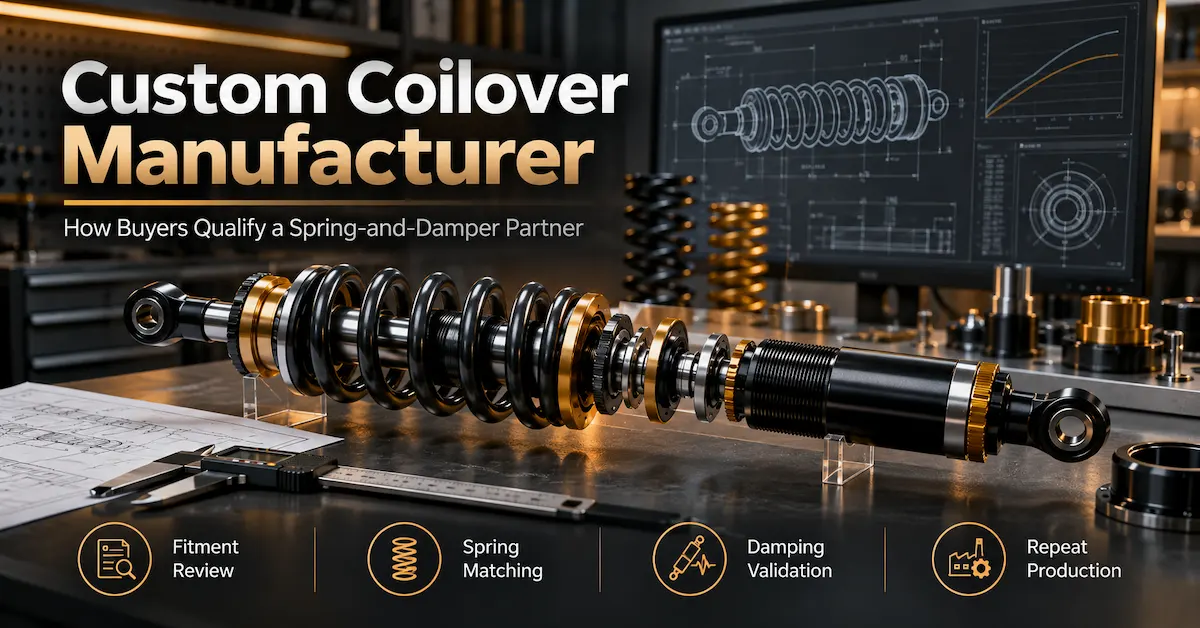
A shock absorber controls motion; the spring supports load and establishes much of the ride height and sag. A calibration plan must therefore treat spring rate, installed length, preload, free length, and coil clearance as separate but connected variables. If the spring is too soft, increasing damping may slow the symptom without supporting the platform. If the spring is too stiff, reducing damping may not restore compliance. The buyer should ask for the spring proposal and damper proposal as two linked records, not one unexplained setting.
Use preload for a defined purpose
Preload can establish installed spring position and ride height within a defined range. It is not an unlimited way to increase payload capacity. Excessive preload can reduce droop travel, change the working point, and cause a buyer to lose the very compliance the calibration was meant to improve. The RFQ should state the adjustment range, starting point, lock method, measurement points, and the condition under which a spring change is required.
Define damping in conditions, not adjectives
Words such as soft, firm, sporty, and comfortable are useful starting language, but they are not sufficient release criteria. Ask for direction, speed, stroke or velocity, temperature, adjustment position, oil condition, and measurement repeatability. Rebound and compression should be named separately when the application requires it. A force-versus-velocity record is more useful than a single maximum-force number because it shows how the shock behaves across a motion range.
Evidence rule: the public BEDO product pages show the type of fields a buyer can use in an engineering response, including total length, effective stroke, spring rate, rebound and compression values, mounting holes, mounting widths, adjustment levels, material descriptions, and application category. Those published values are reference configurations, not universal calibration targets. A project team should request the current revision, tolerances, test conditions, and vehicle validation for the exact application.
Build a calibration test matrix before the first sample
A useful matrix connects the engineering question to a repeatable condition. "Test the shock" is too broad. Instead, specify which component is being measured, which vehicle state is being driven, what result is being observed, and what evidence releases the next stage. The matrix should include component bench checks and vehicle-level checks because a force curve alone cannot confirm clearance, ride height, steering feel, tire contact, passenger comfort, or cargo control.
| Test stage | Question | Record | Release decision |
|---|---|---|---|
| Dimensional inspection | Does the sample match the intended interface? | Lengths, stroke, holes, widths, bushings, spring, thread, and revision. | Fitment risk acceptable for installation. |
| Spring check | Does the spring support the defined load state? | Rate, free length, installed length, preload, sag, ride height, and coil gap. | Spring condition is approved or revised. |
| Bench damping | Is the force response repeatable at named conditions? | Velocity, direction, temperature, setting, cycle, and calibration record. | Baseline setting and tolerance are defined. |
| Vehicle static check | Is the installed ride height and clearance correct? | Axle loads, sag, bump, droop, full-lock or full-steer clearance. | No interference and target static position confirmed. |
| Vehicle dynamic test | Does the platform control motion in intended use? | Route, speed, load, tire, rider, symptom, setting, and result. | Target behavior accepted or next iteration defined. |
| Repeatability check | Can the approved configuration be reproduced? | Part number, revision, force band, spring record, inspection, and sample trace. | Pilot or production release. |
When the buyer cannot provide a proving ground, the supplier can still help define a bench and vehicle plan, but the limitations should be written down. A bench result may verify damper behavior under named conditions; it does not prove complete vehicle handling under every terrain, tire, or load state. This distinction makes the final article and RFQ more credible to engineers and purchasing teams.
Choose fixed or adjustable damping by application
Fixed damping can be the right choice for a defined vehicle, load, and duty cycle. It simplifies installation, user instructions, and replacement control. Adjustable damping can support a wider range of riders, passengers, terrain, or cargo, but it adds responsibilities: a usable range must be calibrated, detents or clicks must be repeatable, the adjustment direction must be marked, and a baseline must be supplied. A large number of positions has no value if adjacent positions feel identical or the user cannot return to the approved starting point.
| Configuration | Best fit | Buyer must confirm |
|---|---|---|
| Fixed damping | One controlled platform with a narrow approved load and use range. | Vehicle state, spring, target curve, production tolerance, and replacement identity. |
| Rebound adjustment | Applications where recovery speed changes with load or terrain. | Adjustment range, baseline, direction, clicks, and validation conditions. |
| Compression adjustment | Applications where impact support and compliance need separate control. | Low- and high-speed meaning, setting map, access, and user instructions. |
| Combined adjustment | Professional or multi-condition programs with a documented tuning process. | Interaction between circuits, service responsibility, and calibration evidence. |
Make factory evidence part of the calibration review
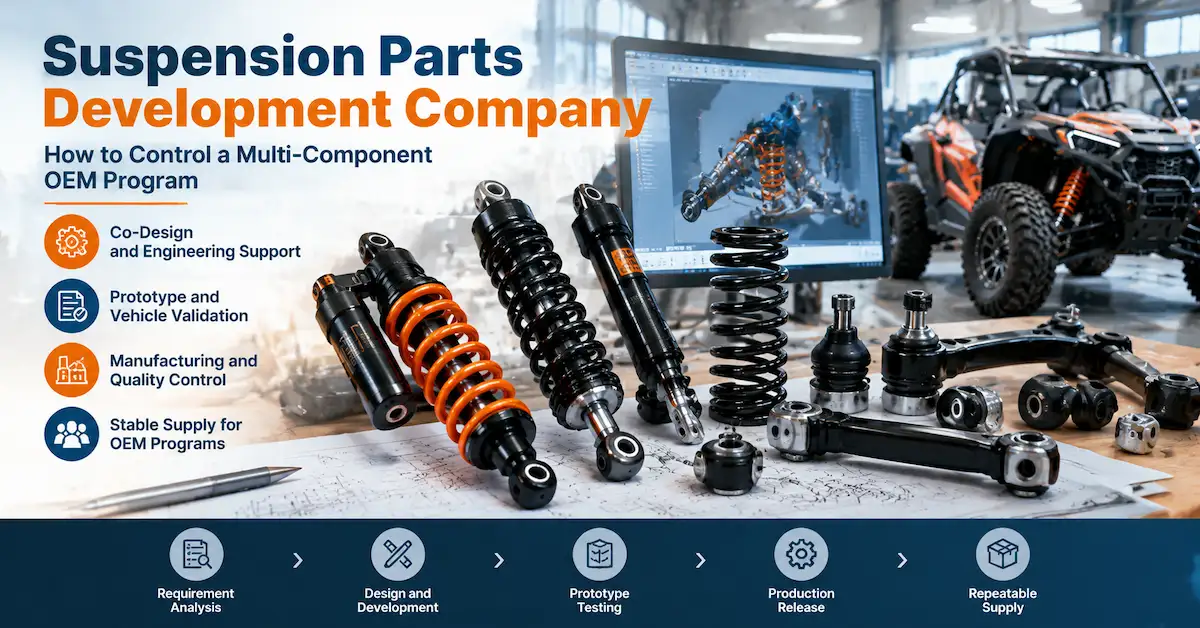
A calibration partner is also a production partner. The sample may perform well while the supply chain remains unable to hold the spring, damping, finish, seals, mounts, or label definition. Ask how the approved sample becomes a controlled production specification. The answer should include an engineering drawing or controlled measurement sheet, component identification, incoming material or component checks, assembly inspection, leakage or movement checks where applicable, final packaging, and a change-notification process.
The buyer should distinguish what is made in the factory, what is purchased, and what is tested by an outside laboratory. This is not a criticism of a sourcing model. It is a traceability requirement. If a spring, bushing, coating, or adjustment part changes source, the buyer needs to know whether the change affects fitment, corrosion, spring force, damping, or service instructions.
| Evidence category | Request | Why it protects the program |
|---|---|---|
| Factory identity | Legal company name, address, contact, product scope, and responsible engineer. | Connects the quotation to the real manufacturer and decision owner. |
| Engineering | Drawing, BOM, spring record, damping baseline, revision, and open-point list. | Prevents an approved sample from remaining a one-off object. |
| Quality | Inspection plan, calibration status, acceptance limits, nonconformance process. | Defines how repeat parts are judged. |
| Production | Process boundary, pilot plan, capacity assumption, packaging, and label control. | Reduces launch and replenishment surprises. |
| Field support | Installation instructions, replacement identity, warranty basis, and issue route. | Lets distributors and service teams handle the correct revision. |
BEDO's public site positions the company around shock absorbers, suspension springs, custom solutions, design support, and small-batch orders. It also presents factory and company information. The public pages do not establish one universal test capacity, MOQ, lead time, warranty, or calibration result for every vehicle. Request those details in writing for the exact project instead of copying a number from a different product page.
Prepare a quotation request that an engineer can answer
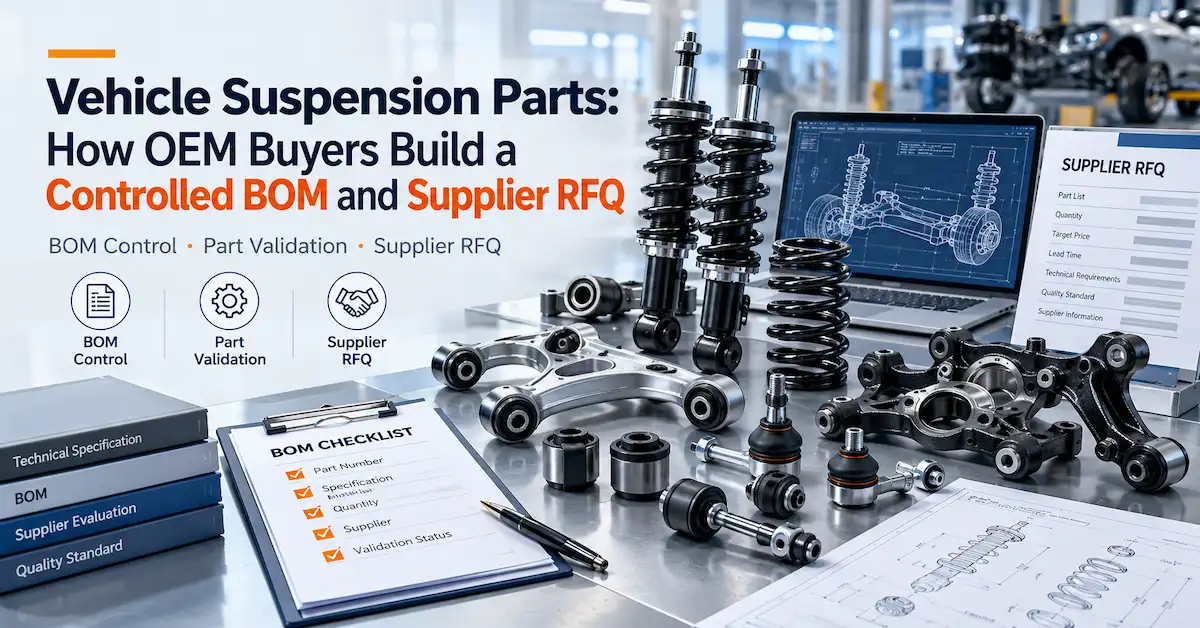
A high-quality RFQ makes the supplier's first response more useful and reduces back-and-forth. Attach a measured sample or drawing where possible, but do not assume a sample reveals internal damping or material. Include photographs with a ruler, vehicle loading photographs, full-bump and full-droop images, and a short description of the customer complaint or performance target. Identify which information is mandatory and which may be proposed by the supplier.
| RFQ section | Buyer input | Supplier response requested |
|---|---|---|
| Application | Vehicle, model year, market, position, quantity, and intended sales channel. | Fitment review, missing data, and responsibility boundary. |
| Interface | Extended and compressed length, stroke, mounts, holes, widths, angle, and clearance. | Drawing, tolerance, prototype plan, and dimensional checks. |
| Load and spring | Axle loads, rider, passenger, cargo, battery, sag, ride height, and spring target. | Spring proposal, preload range, load-deflection basis, and open points. |
| Damping | Fixed or adjustable, comfort/control target, route, speed, temperature, and setting. | Bench conditions, force map, baseline, adjustment definition, and test plan. |
| Commercial | Sample, pilot, forecast, MOQ, lead time, label, packaging, and launch date. | Price assumptions, production stages, inspection, change control, and shipping terms. |
Ask for three separate answers: what the supplier can confirm now, what it proposes after engineering review, and what the buyer must provide or approve. This simple format improves answer extractability for internal teams and makes supplier comparisons fair. It also prevents a marketing description from being mistaken for a project commitment.
Control revisions from sample to production
The calibration record should have a part number, revision, vehicle identity, spring identity, damping baseline, adjustment position, mounting hardware, and test conditions. Save the drawing, bench data, vehicle observations, photographs, and approval decision against the same revision. When a spring rate, piston, seal, mount, coating, adjustment part, or packaging label changes, the supplier should state whether remeasurement or vehicle revalidation is required.
For distributors, revision control is also a sales tool. A replacement order can be matched to the correct vehicle, side, spring, and setting. For a vehicle brand, it protects the launch because a repeat order does not accidentally use an early sample. For quality teams, it creates a traceable answer when a field complaint arrives without a full technical description.
Use a release gate instead of a verbal approval
Release a configuration only after fitment, static load, spring, damping, dynamic behavior, appearance, packaging, and documentation have named owners. A short approval form can list the accepted vehicle states, excluded conditions, open issues, and next review date. "Looks good" is not enough when several vehicle models or markets share a shock family.
Keep the buyer, factory, and vehicle team aligned
Calibration projects often slow down because three groups use different definitions of approval. Purchasing may approve a price, engineering may approve fitment, and a test rider may approve feel, while quality still lacks a final inspection record. Put all three decisions in one project file. The commercial approval should identify the exact part and revision; the engineering approval should identify the measured vehicle state; and the test approval should identify the route, load, setting, and acceptance notes.
Use a short stage-based review to close open points. Record whether the next action belongs to the vehicle team, the supplier, or the buyer. The buyer may need to provide a maximum cargo value, the vehicle team may need to measure motion ratio, and the supplier may need to repeat a force test at a controlled temperature. Ownership prevents the factory from guessing and prevents an unverified setting from being released because a deadline is approaching.
For an aftermarket program, keep the same discipline even when the volume is small. A small-batch order still needs a part number, installation baseline, spring identity, adjustment direction, and replacement rule. The service record protects the eventual vehicle owner because it connects a field question to the same configuration that was tested. It also gives a distributor a clear answer when a similar-looking shock is requested for a different model or load condition.
Suspension calibration service FAQ
Is calibration the same as choosing a shock absorber?
No. Choosing a shock may mean selecting an existing fitment. Calibration connects a damper and spring configuration to a vehicle, load state, geometry, target behavior, and repeatable evidence. The scope should be defined in the RFQ.
Can a supplier calibrate from dimensions only?
Dimensions can establish an interface proposal, but they do not define spring support, motion ratio, damping target, tire behavior, rider load, or clearance under full travel. Send vehicle and load information whenever possible.
Does a higher damping force mean better control?
Not automatically. Too much force can reduce compliance, increase tire load variation, or slow recovery. The correct response depends on speed, direction, load, spring, geometry, and the vehicle result.
Does an adjustable shock always need calibration?
Yes, if the buyer expects the adjustment to be useful. The range, baseline, direction, clicks, temperature conditions, and vehicle result should be recorded. More positions do not automatically mean more performance.
What does a buyer need to send for a quote?
Send vehicle identity, position, drawings or measurements, loads, battery or cargo information, tire and wheel data, travel, clearance, target behavior, environment, quantity, market, label, packaging, and timeline. Mark unknown fields clearly.
Does BEDO publish one universal calibration price or lead time?
No universal term should be assumed. Request project-specific sample, engineering, pilot, production, MOQ, lead-time, packaging, and validation terms from BEDO for the exact configuration.
What should be verified before publishing a case study?
Confirm the customer authorization, vehicle identity, test condition, measured result, product revision, date, author, reviewer, and supporting photographs or records. Do not turn a reference configuration into an unnamed performance claim.
Conclusion
A reliable suspension calibration service is a controlled engineering process: define the vehicle and loads, measure geometry, separate spring support from damping, name test conditions, validate the vehicle, and carry the approved result into production and service records. This is how a buyer avoids paying for a sample that cannot be repeated.
BEDO Auto's public information provides a factual starting point through its Ningbo manufacturer identity, shock absorber and spring product scope, custom-support positioning, and published company information. The next step is to send a vehicle-specific brief and ask BEDO to confirm the current configuration, calibration method, evidence package, MOQ, lead time, packaging, and release gates for the project.