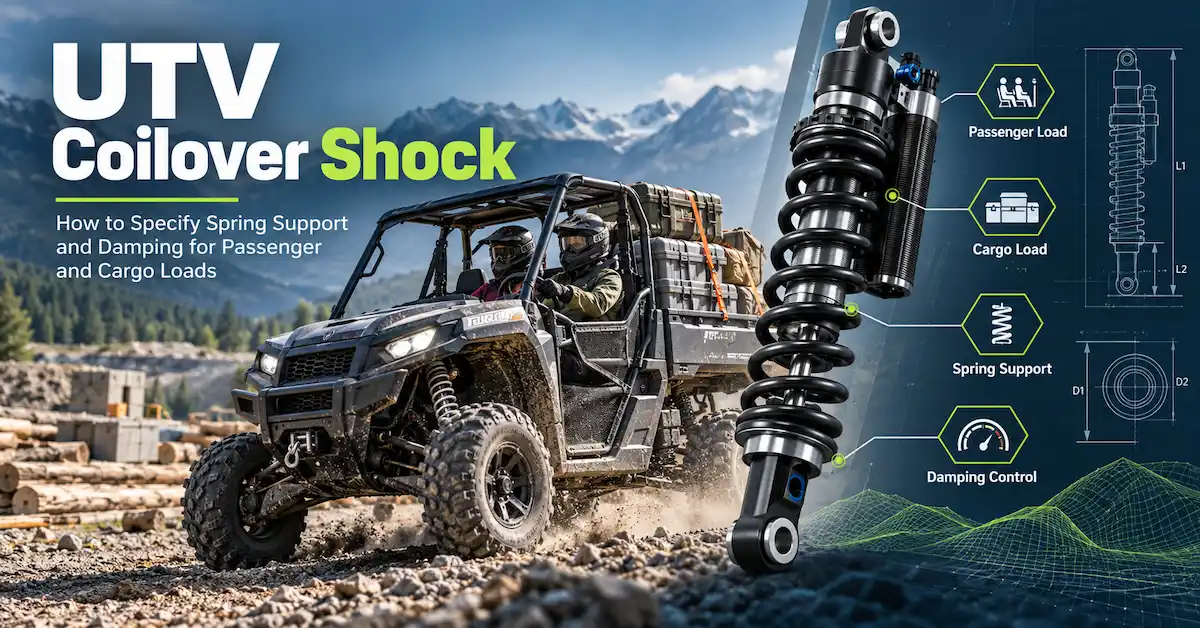

What should ATV and UTV suspension engineering solutions include?
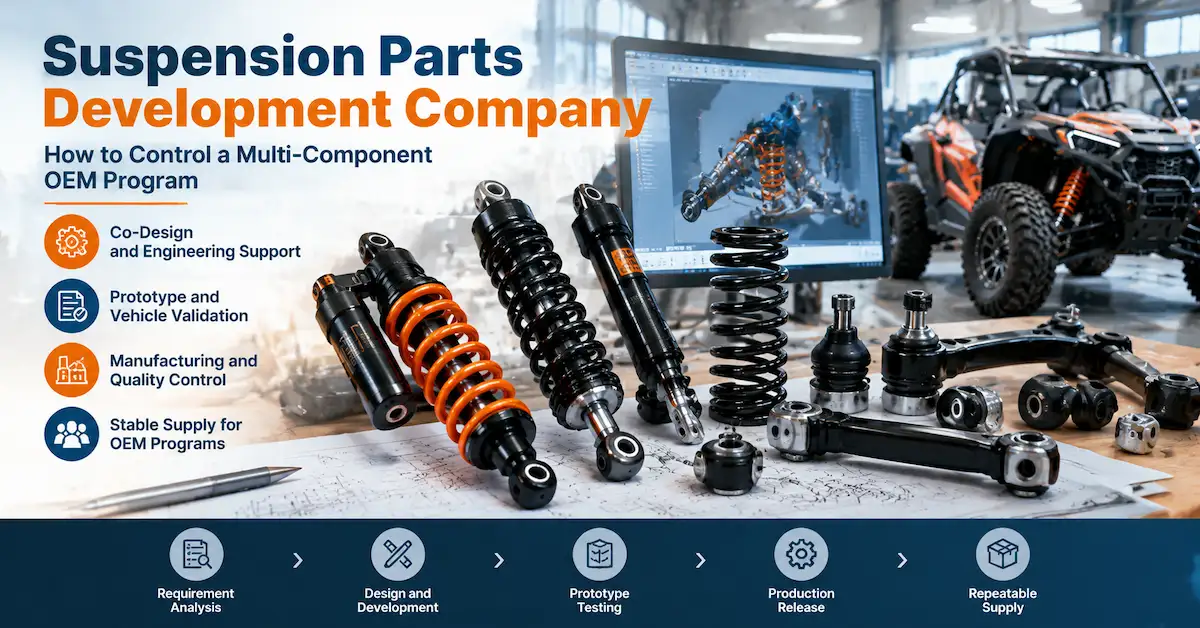
Direct answer: ATV UTV suspension engineering solutions should connect vehicle identity, load states, suspension geometry, spring support, damping, environment, validation, production control, and service identification. A useful solution is not just a replacement shock. It is a defined configuration that can be fitted, tested, approved, reproduced, and supported for the intended vehicle and market.
For a multi-model program, the supplier must also show which dimensions and settings are shared, which are vehicle-specific, which parts are common, and how revisions are controlled. The buyer should receive an interface matrix, spring and damping proposal, prototype plan, evidence package, and commercial response rather than a catalog list with no application boundary. In practical terms, ATV UTV suspension engineering solutions should give purchasing a clear answer to three questions: what is being bought, which vehicle it fits, and what evidence releases it.
This article is for ATV and UTV OEMs, utility vehicle brands, farm and resort fleets, aftermarket suspension companies, distributors, and procurement engineers comparing ATV UTV suspension engineering solutions. Its unique procurement problem is how to build one controlled engineering and sourcing plan across different ATV and UTV platforms. It does not repeat a single ATV fitment guide or a general UTV payload article.
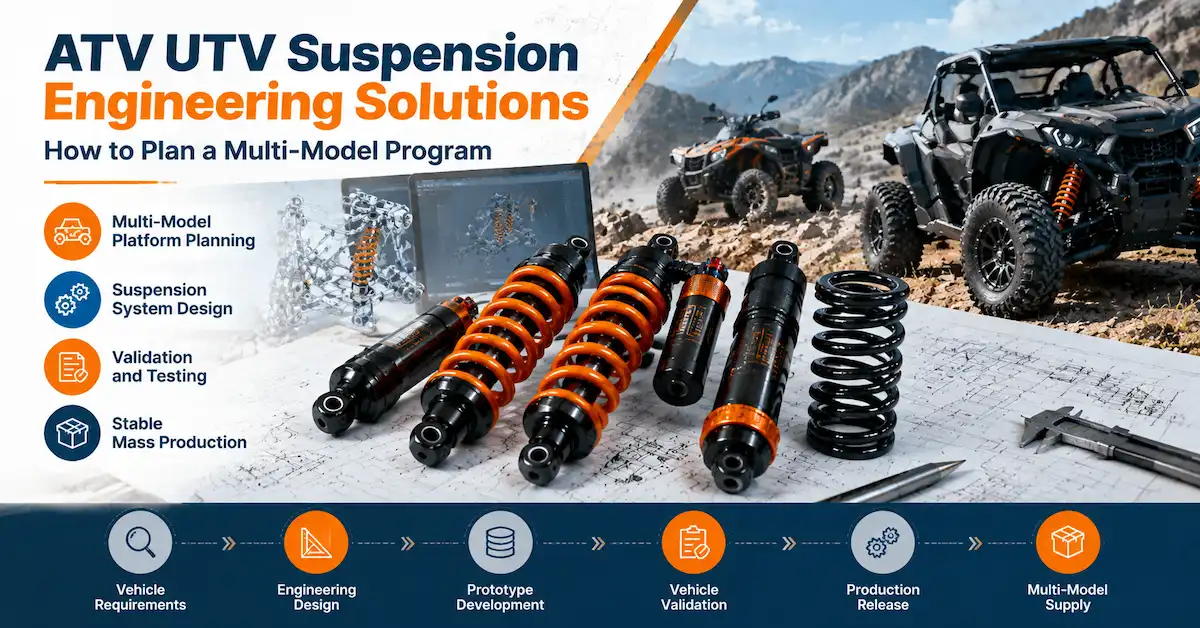
Why ATV and UTV programs need a vehicle-level engineering brief
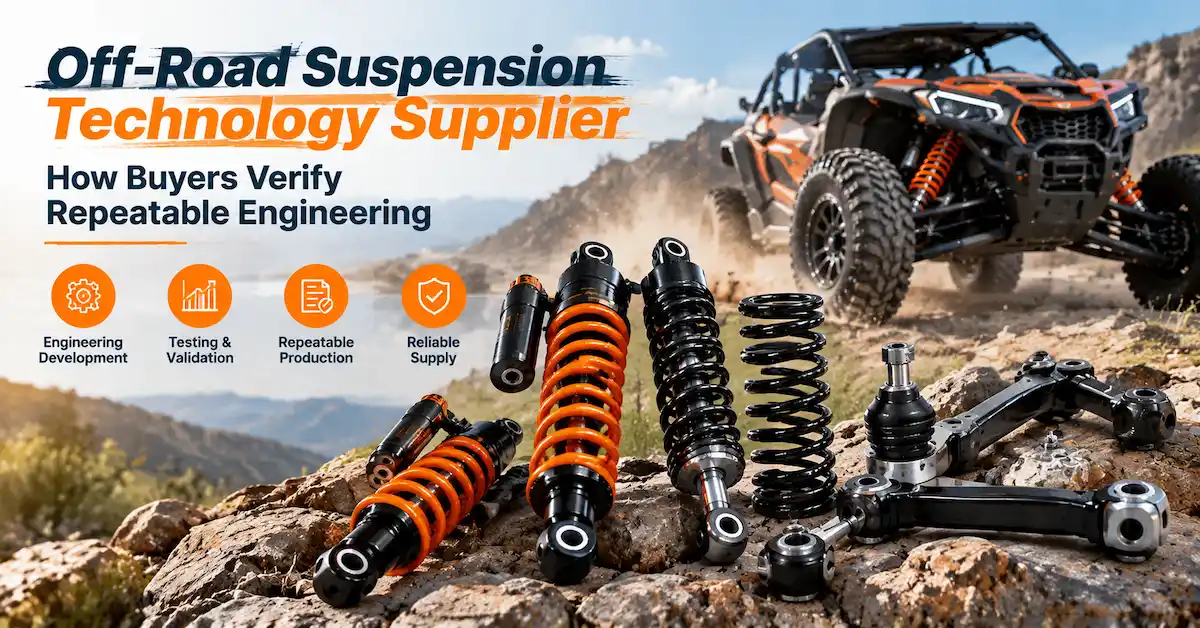
ATVs and UTVs can share an off-road product family while using different suspension geometry, load distribution, operating speeds, and user expectations. An ATV may be rider-sensitive and narrow, with tools or a rear rack. A UTV may carry passengers, a cargo bed, a roof, a winch, or towing equipment. A farm vehicle, recreational vehicle, and resort shuttle can have different duty cycles even when the shock mounting looks similar.
Start with vehicle and market data rather than a product name. Record platform code, model year, front or rear position, left and right differences, wheel and tire package, wheelbase, curb mass, axle loads, passengers, cargo, accessories, battery or fuel state, market, and sales channel. State whether the part is OEM, aftermarket replacement, performance upgrade, private label, or fleet service.
| Engineering input | ATV question | UTV question |
|---|---|---|
| Vehicle identity | Which rider, rack, tire, wheel, and model-year configuration is covered? | Which cabin, bed, passenger, roof, tire, and accessory configuration is covered? |
| Load states | What are rider, cargo-rack, tool, and maximum routine conditions? | What are driver-only, passenger, cargo, accessory, and maximum routine conditions? |
| Geometry | What are shock lengths, stroke, mounts, motion ratio, and clearances? | What are front/rear interfaces, wheel travel, bump, droop, and linkage conditions? |
| Duty cycle | What terrain, speed, impact frequency, temperature, mud, and water are expected? | What route, speed, passenger cycle, cargo work, towing, wash-down, and storage are expected? |
| Market | Which replacement part numbers, labels, and installation instructions are needed? | Which fleet, OEM, distributor, carton, service, and private-label requirements apply? |
Mark each input as confirmed, estimated, or missing. A supplier can propose a starting configuration, but an estimate should not silently become a released specification. The same discipline applies when the buyer sends a used sample: the sample may define visible geometry while hiding wear, tolerance, internal damping, material, and process information. Good ATV UTV suspension engineering solutions make these evidence gaps visible before a quotation becomes a purchase order.
Build the shared and vehicle-specific parts matrix
Multi-model programs become expensive when a supplier treats every vehicle as a separate project or, at the other extreme, forces one configuration across incompatible platforms. Create a parts matrix that identifies common parts, adapted parts, and unique parts. Include the shock, spring, spring seat, mount, sleeve, bushing, bracket, hardware, label, carton, and service kit.
| Part or attribute | Can be common? | What must be checked before sharing |
|---|---|---|
| Shock body | Possibly, if travel, load, package, and damping envelope are compatible. | Length, stroke, body diameter, temperature, force range, and clearance. |
| Coil spring | Often vehicle-specific when axle load or installed height changes. | Rate, free length, seat, preload, sag, coil clearance, and finish. |
| Mounting eye or clevis | Only where geometry and articulation are the same. | Hole, width, sleeve, bushing, angle, hardware, and full travel. |
| Damping calibration | May be common only for controlled load and motion conditions. | Motion ratio, unsprung mass, tire, speed, terrain, and vehicle result. |
| Labels and packaging | May share a brand system but not fitment identity. | Position, side, model, revision, barcode, instructions, and service part number. |
A shared component is not automatically a shared specification. Record the reason for standardization, the limits of reuse, and the revalidation trigger. If a tire, battery, accessory, spring, linkage, or chassis changes, define whether the affected configuration requires a new sample or vehicle test.
Control geometry and travel before choosing shock performance
Measure extended length, compressed length, effective stroke, mounting-hole diameter, mounting width, sleeve or bushing, body and rod clearance, spring seat, installation angle, motion ratio, bump-stop engagement, and droop limit. Inspect full bump and full droop against tires, brakes, drive shafts, control arms, body panels, reservoirs, adjusters, and wiring.
The shock should not become an unintended structural stop unless the design explicitly controls that condition. A longer shock can increase droop while interfering at full bump. A shorter shock can remove wheel travel. An oversized spring can touch the chassis or coil-bind before the suspension reaches its intended limit. An apparently correct eye-to-eye length is not enough.
| Travel review | Required question | Record |
|---|---|---|
| Ride height | What condition defines the baseline: empty, rider, driver, or normal operating load? | Vehicle condition, measurement points, target window, and result. |
| Compression | What stops the movement: bump stop, linkage, tire, body, or shock? | Full-bump inspection, clearance, stop location, and photographs. |
| Extension | What controls droop and prevents the shock or mount from overextending? | Full-droop inspection, articulation, and mechanical limit. |
| Motion ratio | How much wheel movement occurs for a given shock movement? | Measurement or calculation basis and validation condition. |
| Adjustment access | Can the user reach the collar, adjuster, or reservoir without interference? | Vehicle access check, baseline marking, and instruction requirement. |
Match springs to load states and damping to movement
Spring selection
The spring supports static and changing loads. Rate, free length, installed length, seat geometry, preload, motion ratio, and available travel must be considered together. For a farm ATV, tools and a rear rack may shift the working load. For a UTV, passengers and cargo can move the axle load significantly. A spring that is acceptable when empty may have insufficient reserve when loaded, while a spring selected only for maximum load may be harsh in normal use.
Request spring free length, outer diameter, wire or section information where relevant, installed height, rate or load-deflection points, material and finish description, seat compatibility, and lot identity. If a supplier publishes a nominal spring rate, ask how and under what conditions it is measured. Do not treat a nominal number as a universal payload approval.
Damping selection
Damping controls compression and rebound movement. Compression behavior affects impact response and bottoming; rebound behavior affects recovery, oscillation, and tire contact. The correct target depends on spring energy, wheel and tire, unsprung mass, motion ratio, vehicle speed, obstacle shape, load, and temperature.
Ask for test speed, direction, temperature, adjustment position, part revision, and tolerance with every force result. Fixed damping can be appropriate for a defined configuration. Adjustable damping can cover more operating conditions, but it requires a baseline, setting map, click or position definition, user instructions, and repeatability checks.
| Application state | Typical engineering question | Validation signal |
|---|---|---|
| Empty or rider-only | Does the spring maintain usable ride height without excessive harshness? | Sag, ride height, small-bump response, rebound, and comfort observation. |
| Normal work or passenger load | Does the assembly control repeated movement without excessive oscillation? | Route result, temperature, bottoming reserve, and recovery behavior. |
| Maximum intended routine load | Is travel reserve maintained without coil bind or unsafe interference? | Full travel, spring compression, clearance, damping, and issue log. |
| Changed accessory or tire | Does the new mass or geometry invalidate the approved setting? | Impact review, remeasurement, and revalidation decision. |
Use public BEDO references without overextending the evidence
BEDO's public product pages provide concrete reference fields for an ATV/UTV engineering discussion. AU_HSA_01 lists 465 mm total length, 130 mm effective stroke, 75 LBS spring rate, 2000 N rebound, 650 N compression, 10 mm upper and lower mounting holes, and 32 mm upper and lower mounting widths. The public page also describes an internal gas chamber, oil-gas separation, fixed damping, aluminum alloy and steel pipe, and a 0.1 m/s inspection speed.
AU_HSA_02 lists 395 mm total length, 80 mm effective stroke, 250 LBS spring rate, 3000 N rebound, 550 N compression, 12 mm upper and lower holes, and 40 mm upper and 32 mm lower mounting widths. These published values show how a supplier can structure a technical response. They do not prove that either reference fits an unidentified ATV or UTV, that the values apply to every production unit, or that the product is a complete custom engineering solution.
BEDO's public company page identifies Ningbo Bedo Auto Parts Co., Ltd. in Ningbo, Zhejiang, China, with shock absorbers, suspension springs, and ball joints in its public product scope. The home page presents custom solutions, design support, and small-batch ordering. The buyer should request a project-specific responsibility matrix, current revision, test evidence, and commercial terms before approving a multi-model program.
| Official BEDO source | Useful public evidence | Project fields still requiring confirmation |
|---|---|---|
| AU_HSA_01 product reference | ATV/UTV dimensions, stroke, spring, damping, mounting, structure, and material descriptions. | Current revision, fitment, tolerances, vehicle result, MOQ, lead time, and packaging. |
| AU_HSA_02 product reference | Second ATV/UTV reference for comparing length, stroke, spring, damping, and mounting fields. | Interchangeability, complete assembly scope, fitment, production inspection, and validation. |
| Shock absorber category | Public shock absorber product direction and application route. | Model coverage, engineering ownership, material/process records, and launch conditions. |
| About BEDO Auto | Company identity, location, and public manufacturer/custom-support positioning. | Named engineers, internal process scope, capability audit, capacity, and authorized case evidence. |
Stage the development and validation plan
Stage 1: platform and interface review
Review each vehicle's drawings, samples, loads, travel, mounting, spring seat, environment, and target. Return a matrix of common and unique fields. Identify missing measurements and changes that may require a separate configuration.
Stage 2: concept and BOM proposal
Return proposed shocks, springs, mounts, sleeves, bushings, hardware, labels, and packaging. Mark material and process fields as confirmed, proposed, or pending. Assign part numbers and revisions before prototypes are made.
Stage 3: prototype inspection
Measure dimensions, stroke, spring, mounting, finish, hardware, and adjustment operation. Install the assembly and check ride height, sag, full bump, full droop, articulation, clearance, torque, and access. Record the vehicle configuration and all deviations.
Stage 4: vehicle validation
Test the intended empty, normal, and maximum routine states. Record route, speed, tire pressure, temperature, load, driver or rider, settings, noise, bottoming, rebound, comfort, control, and issues. Do not change spring, damping, tire pressure, and preload at the same time unless the project is intentionally resetting the concept.
Stage 5: pilot and production release
Compare multiple units for fit, spring identity, damping or movement result, leakage, finish, labels, packaging, and traceability. Freeze the BOM, inspection plan, acceptance limits, service identity, packaging, and change-control route only after pilot evidence is reviewed.
Control material, environment, and service evidence
ATV and UTV operating environments can include mud, dust, water crossings, salt air, wash-down, temperature changes, and long storage. Connect each risk to a material, finish, seal, assembly, inspection, or test decision. “Corrosion resistant” is a description, not a complete test result. “Waterproof” should not be published without an agreed method and application boundary.
Ask for the body and rod material or finish specification when relevant, spring finish, seal package, oil or gas condition where controlled, bushing or sleeve material, fastener treatment, and incoming inspection responsibility. If a component is sourced externally, identify who approves the supplier, checks the lot, handles nonconformance, and notifies changes.
Service identification is part of engineering. A replacement shock that looks similar may have a different spring, mount, damping setting, or revision. Use a part number, position, side, revision, batch or lot identity, label, instruction, and packaging record that allow the distributor, fleet, or service technician to identify the approved configuration.
Make the commercial scope comparable
| Commercial item | Request by project stage | Why it matters |
|---|---|---|
| Development scope | Vehicle review, measurement, drawing, CAD, DFM, spring/damping proposal, sample revisions, and test support. | Prevents a multi-model engineering need from being hidden inside a unit price. |
| MOQ | Prototype, pilot, production, repeat order, spring, label, carton, and service component quantities. | Shows the inventory commitment for each part of the program. |
| Lead time | Input approval, sample, revision, pilot, production, inspection, packaging, and shipping. | Separates buyer dependencies from manufacturing time. |
| Packaging | Individual protection, hardware, labels, barcodes, cartons, pallets, and instructions. | Protects fitment identity and reduces mixed-model service risk. |
| Change control | Notification, approval, revalidation, affected stock, and record retention. | Controls changes to common parts and model-specific parts. |
| After-sales | Replacement identity, technical contact, warranty basis, and nonconformance route. | Connects field issues to the correct vehicle and revision. |
BEDO's public site states custom solutions, design support, and small-batch ordering, but it does not publish one universal commercial rule for every ATV/UTV program. Request stage-specific terms for each vehicle, quantity, destination, label, packaging, and revision.
Use a platform release checklist
Before a multi-model program moves from engineering to purchasing, review each platform with the same release checklist. A common checklist makes gaps visible when one model has a drawing while another has only a photograph, or when a common shock has been assumed without a common load case.
| Release item | Required status | Escalation question |
|---|---|---|
| Vehicle identity | Model, year, position, market, and modification list are recorded. | Which exact vehicle is represented by the sample? |
| Interface | Dimensions, travel, mounting, hardware, and full-travel clearance are checked. | What mechanical limit controls bump and droop? |
| Spring and damping | Load states, spring record, damping condition, and baseline are approved. | Which change would require a new vehicle test? |
| Environment | Mud, dust, water, salt, temperature, storage, and cleaning risks are addressed. | Which evidence supports the intended operating boundary? |
| Production | BOM, revision, inspection, label, packaging, MOQ, lead time, and change route are agreed. | How will the service channel identify the approved part? |
Use the same checklist for the prototype, pilot, and repeat order. This prevents a project from being technically approved while commercial identity, packaging, or replacement control remains undefined. It also gives the supplier a practical way to explain which ATV UTV suspension engineering solutions are ready for production and which remain development-only. The result is a release decision that engineering, quality, and purchasing can all audit.
Prepare an ATV UTV engineering RFQ
Send one controlled brief for every platform and a summary matrix for the whole program. The supplier should be able to return a responsibility matrix, common-parts proposal, unique-parts list, open-point register, prototype schedule, validation plan, and price assumptions. This is the practical RFQ format for ATV UTV suspension engineering solutions when purchasing needs a comparable response from several suppliers.
| RFQ section | Buyer input | Expected supplier response |
|---|---|---|
| Platforms | ATV/UTV model, year, position, market, tire, accessories, and target volume. | Platform coverage, common/unique part matrix, and missing data. |
| Geometry | Lengths, stroke, holes, widths, sleeves, angles, motion ratio, bump, droop, and clearance. | Interface drawing, tolerance proposal, and installation risk. |
| Loads | Axle loads, rider/passengers, cargo, tools, accessories, towing, sag, and ride height. | Spring proposal, load-deflection basis, preload, and reserve-travel review. |
| Performance | Comfort, control, repeated route, bottoming, rebound, adjustment preference, and acceptance method. | Damping proposal, bench conditions, vehicle test plan, and issue closure. |
| Launch | Samples, pilot, forecast, MOQ, lead time, packaging, label, service, and target date. | Quotation assumptions, stage terms, inspection, and change-control response. |
ATV UTV suspension engineering solutions FAQ
What are ATV UTV suspension engineering solutions?
They are a vehicle-specific engineering and supply process covering geometry, spring support, damping, materials, testing, production control, and service identity for ATV and UTV applications. The output should be a controlled configuration, not only a product recommendation.
Can one shock absorber cover several ATV and UTV models?
Only when geometry, load, motion ratio, travel, package, and performance targets are compatible. A shared part still needs a defined reuse boundary and revalidation trigger.
Are AU_HSA_01 and AU_HSA_02 interchangeable?
No interchangeability should be assumed. Their public dimensions, strokes, spring rates, damping values, and mounting widths differ. Confirm vehicle interfaces, loads, and current product revisions before comparing or ordering them.
Should a buyer specify a spring rate or only an ATV/UTV model?
Provide the vehicle model and load states, then ask the supplier to propose or confirm the spring. A spring rate without installed length, motion ratio, sag, and axle load is incomplete.
What test evidence should an engineering supplier provide?
Request dimensional, spring, damping, leakage or movement, full-travel clearance, vehicle validation, and pilot evidence as appropriate to the risk. Each record should identify the part, revision, condition, method, result, and disposition.
Does a stronger spring increase legal payload capacity?
No. A spring can change support and ride height, but legal payload, chassis, brakes, tires, axles, and vehicle certification remain separate constraints. Do not market an engineering change as a payload approval without authorized vehicle evidence.
Does BEDO publish universal MOQ and lead time for ATV/UTV projects?
No universal terms should be assumed. Ask for prototype, pilot, production, spring, label, carton, inspection, and shipping conditions for the exact program.
What must BEDO confirm before publication?
BEDO should confirm the current product revision, applicable model coverage, materials, process ownership, test data, MOQ, lead time, packaging, warranty, named reviewer, and any customer case. Public pages alone do not prove every multi-model engineering claim.
Conclusion
ATV UTV suspension engineering solutions should be built around vehicle identity, load states, geometry, spring and damping behavior, environmental risk, validation, and repeat-production control. A multi-model program needs a clear matrix showing what is shared, what is unique, and what change would trigger a new test or revision.
BEDO Auto's public information provides a factual starting point through its Ningbo manufacturer identity, shock absorber and suspension spring categories, selected AU_HSA reference parameters, product images, and custom-support positioning. The next step is to send a platform-by-platform engineering brief and ask BEDO to confirm the common-parts plan, project evidence, MOQ, lead time, packaging, validation gates, and change-control terms for the proposed ATV UTV suspension engineering solutions.