
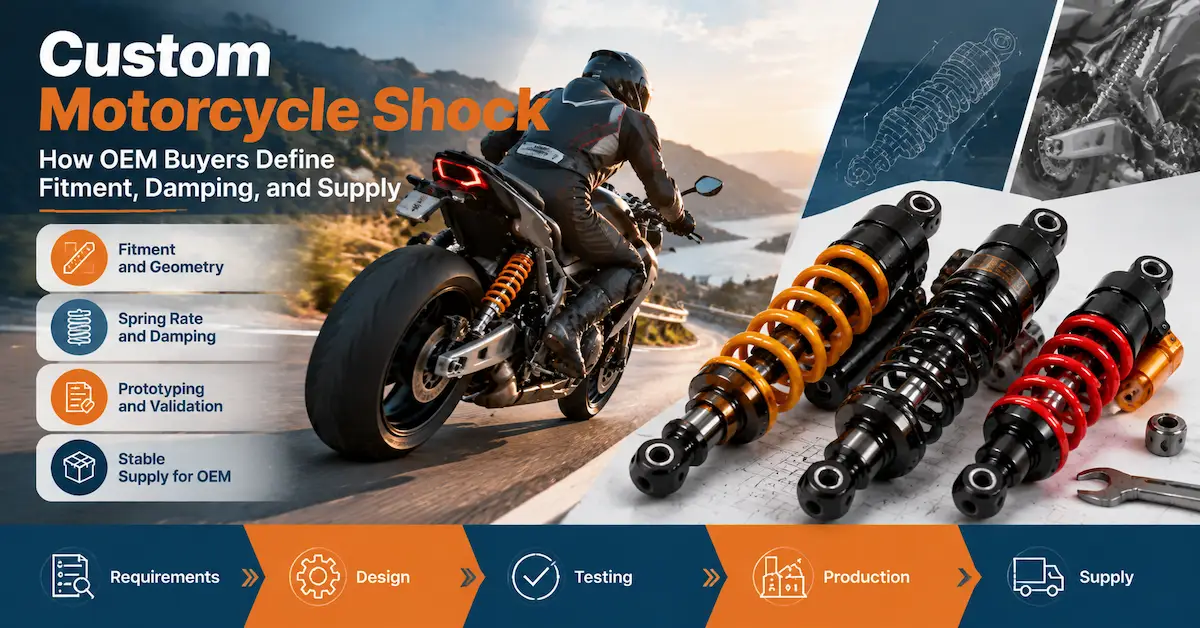
How should buyers define a custom motorcycle shock?
Direct answer: define a Custom Motorcycle Shock by the motorcycle platform, rider and passenger load, installation geometry, wheel travel, spring support, damping target, environment, adjustment requirement, validation method, and production revision. A suitable custom shock is a controlled vehicle configuration, not a universal length with a decorative spring.
The RFQ should make clear whether the buyer needs a direct replacement, a rear shock for a new electric motorcycle, a private-label upgrade, a racing or off-road setting, or a small-batch prototype. The supplier should return a fitment review, spring and damping proposal, sample configuration, test plan, and commercial assumptions.
This article is for motorcycle OEMs, electric motorcycle brands, powersports companies, aftermarket suspension brands, distributors, retrofitters, and procurement engineers sourcing a Custom Motorcycle Shock. Its unique procurement problem is how to turn a motorcycle platform and rider-use brief into a controlled shock specification before ordering samples or production.
Separate motorcycle shock types before requesting a quote
“Motorcycle shock” can describe several different assemblies. A rear monoshock, twin-shock replacement, electric motorcycle rear damper, ATV-compatible unit, and off-road performance shock may have different mounting, spring, travel, packaging, and adjustment requirements. Use the application and interface to define the scope.
| Project type | Primary engineering question | RFQ evidence |
|---|---|---|
| Direct replacement | Does the new unit match the released interface and intended ride-height window? | Original sample or drawing, dimensions, mount, spring, and fitment check. |
| Custom OEM shock | What motorcycle platform, load states, ride target, and production revision are approved? | Vehicle brief, BOM, spring/damping proposal, prototype and validation gates. |
| Electric motorcycle shock | How do battery mass, frame packaging, rider load, and rear geometry affect the setup? | Battery and axle loads, clearance, stroke, spring, damping, and test conditions. |
| Aftermarket upgrade | Which fitment range and user setup can be supported without unsafe assumptions? | Vehicle list, adjustment baseline, installation instructions, and service identity. |
| Private-label program | How are labels, colors, packaging, replacement identity, and revisions controlled? | Approved sample, artwork, packaging specification, barcode, and change process. |
A supplier should not accept a motorcycle model name as a complete specification. Model years, markets, wheel packages, linkage ratios, subframes, battery packs, passenger seats, luggage systems, and aftermarket modifications can change the load and geometry. State the exact configuration that the shock must support.
Build the motorcycle application brief
Identify the motorcycle and market
Record brand or platform, model year, market, engine or electric drive type, wheelbase, rear suspension layout, rear shock position, rider and passenger use, wheel and tire package, luggage, accessories, and intended sales channel. State whether the part is for assembly-line use, replacement, upgrade, fleet, rental, delivery, urban commuting, touring, or off-road riding.
For electric motorcycles, include battery mass, battery location, battery state if relevant, motor placement, frame and swingarm layout, wiring, protective covers, and charger or cargo equipment. The battery can affect sprung mass, axle distribution, packaging, and the operating cycle. Do not transfer a gasoline motorcycle shock specification without reviewing these differences.
Describe rider and load states
Provide rider mass range, passenger condition, luggage, cargo, accessories, and intended maximum routine use. Record front and rear axle loads if available. Define empty, rider-only, normal, and loaded conditions. If the bike is used for delivery or rental, describe the repeated daily route and load variation rather than only the nominal vehicle weight.
Describe the riding environment
State road surface, potholes, speed, repeated impacts, braking, acceleration, cornering, slopes, gravel, mud, water, salt, wash-down, temperature, storage, and service access. An urban commuter, a touring motorcycle, a delivery platform, and a trail motorcycle may need different spring and damping targets even when the shock mount appears similar.
Measure fitment and travel accurately
Record extended length, compressed length, effective stroke, upper and lower mounting-hole diameter, mounting width, sleeve or bushing, thread, body diameter, spring seat, spring outer diameter, installation angle, reservoir or adjuster clearance, and hardware stack. Measure the motorcycle at ride height, full compression, and full extension where safe and possible.
| Fitment field | Why it matters | What the buyer should send |
|---|---|---|
| Total length | Controls ride height and the installation envelope. | Datum-to-datum measurement, position, condition, and tolerance. |
| Effective stroke | Controls wheel travel and bottoming or topping reserve. | Stroke definition, stop location, and vehicle travel relationship. |
| Mounting interface | Controls fit, clamping, articulation, and hardware strength. | Hole, width, sleeve, bushing, thread, angle, and hardware drawing. |
| Spring seat | Controls spring retention, preload, and coil clearance. | Seat diameter, spring dimensions, installed height, and adjustment range. |
| Full-travel clearance | Protects tire, frame, swingarm, chain, brake line, wiring, and body parts. | Photos or CAD at bump and droop with interference notes. |
| Adjustment access | Determines whether preload, compression, rebound, or reservoir controls can be used. | Access photographs, user position, baseline, and instruction need. |
Check whether the shock or the motorcycle's bump stop controls compression. Check whether the shock, linkage, belt, chain, tire, or another component controls extension. A shock that bolts in place but reaches its mechanical limit too early is not an approved fitment.
Specify spring support and damping separately
Spring rate, sag, and preload
The spring supports the motorcycle and rider. The correct rate depends on rear axle load, rider and passenger mass, linkage ratio, installed length, ride-height target, desired sag, wheel travel, luggage, and available reserve. Request free length, outer diameter, rate or load-deflection points, installed length, seat compatibility, finish, and lot identity.
Preload changes the initial compression and ride height but does not change the fundamental spring rate. Excessive preload can reduce compression travel; insufficient preload can reduce extension reserve or spring seating. The RFQ should state the baseline position, adjustment range, lock method, and the rider or load condition used to establish it.
Compression and rebound damping
Compression damping controls resistance while the suspension compresses. Rebound damping controls recovery after compression. Both should be discussed with speed, direction, temperature, adjustment setting, part revision, and tolerance. A force value without test conditions is not enough to compare two motorcycle shocks.
Fixed damping can suit a defined motorcycle and load range. Adjustable damping can support different riders or terrain, but it creates additional requirements for adjustment direction, click or detent definition, baseline setting, setting map, user instructions, and repeatability. Define whether an adjustment changes compression, rebound, or a combined response.
| Configuration choice | Potential use | Evidence required |
|---|---|---|
| Fixed damping | Controlled motorcycle platform with a defined rider and use range. | Force condition, spring configuration, vehicle result, and revision. |
| Adjustable damping | Several rider, load, or terrain conditions with a supported tuning process. | Adjustment range, baseline, setting map, detent consistency, and instructions. |
| External gas chamber | Packaging and target behavior justify an external architecture. | Clearance, mounting, pressure or service requirements, and validation. |
| Internal gas chamber | Compact package with internal gas and oil separation appropriate to the design. | Structure, inspection condition, leakage control, and vehicle evidence. |
Use the public BEDO electric motorcycle reference correctly
BEDO's public electric motorcycle reference describes a rear hydraulic shock with 290 mm total length, 70 mm effective stroke, 65 LBS spring rate, 25 adjustable damping levels, 10 mm upper and lower mounting holes, 20 mm upper and lower installation widths, and an external gas chamber with oil-gas separation. The public product description also lists maximum rebound and compression ranges and aluminum alloy and steel pipe materials.
These published fields show the type of data a buyer can use to structure a Custom Motorcycle Shock RFQ. They do not establish fitment for every electric motorcycle, nor do they define the current revision, manufacturing tolerance, durability result, or calibration suitable for an unknown rider and vehicle. Confirm the platform, battery mass, linkage, load state, current drawing, and vehicle validation before ordering.
BEDO's public company page identifies Ningbo Bedo Auto Parts Co., Ltd. in Ningbo, Zhejiang, China, and the public site presents shock absorbers, suspension springs, ball joints, custom solutions, design support, and small-batch ordering. Use the public pages to start supplier qualification, then request project-specific evidence and commercial terms.
| Official BEDO source | Public evidence | Confirmation still required |
|---|---|---|
| Electric motorcycle shock reference | Published total length, stroke, spring, adjustment levels, mounting, structure, material, and damping fields. | Current revision, fitment, tolerances, calibration, test report, MOQ, lead time, and packaging. |
| Shock absorber category | Public shock absorber direction and route for application comparison. | Exact custom motorcycle scope, design responsibility, and production terms. |
| Suspension spring category | Public spring product direction for a matched spring discussion. | Vehicle-specific rate, material, finish, tolerance, and load-deflection evidence. |
| About BEDO Auto | Company identity, Ningbo location, and public custom-support positioning. | Named engineer, process ownership, test capability, capacity, and authorized project evidence. |
Use a controlled sample-to-production workflow
Gate 1: application and interface review
Confirm platform, position, load states, geometry, travel, environment, rider use, market, and target. The supplier should return missing fields, assumptions, proposed values, and the design responsibility matrix.
Gate 2: spring and damping proposal
Review the spring, preload, damping type, adjustment, mount, body, rod, seals, gas or oil condition where controlled, finish, hardware, and packaging. Identify which values are copied from a reference and which are proposed for vehicle testing.
Gate 3: dimensional and configured sample
Assign a part number and revision. Measure lengths, stroke, mounts, spring, installed height, adjustment, hardware, finish, and packaging. Photograph the complete assembly before installation and record any deviation.
Gate 4: static and vehicle validation
Check ride height, sag, full bump, full droop, clearance, spring seating, adjustment access, torque, and chain or belt clearance. Then test rider-only, normal, passenger or luggage, and other intended states. Record route, speed, tire pressure, temperature, settings, noise, bottoming, rebound, comfort, handling, and observations.
Gate 5: pilot and production release
Compare pilot units for dimensions, spring, damping or movement, leakage, finish, hardware, labels, packaging, and traceability. Freeze the BOM, drawing, inspection plan, setting baseline, packaging, service identity, and change-control route only after the pilot evidence is accepted.
Review materials, sealing, and motorcycle environment
Motorcycle shocks face water, dust, mud, salt, wash-down, temperature changes, vibration, long storage, and contact with adjacent parts. The buyer should ask how rod protection, seals, oil containment, body finish, spring finish, fasteners, bushings, and mounting hardware are specified and checked.
For electric motorcycles, review the shock against battery housing, wiring, covers, frame, swingarm, motor, chain or belt, and rider contact zones. A product can have the correct nominal length and still interfere under full travel or with a new battery enclosure. The vehicle-level clearance review should be recorded at the prototype gate.
Do not convert “waterproof,” “rust-proof,” or “corrosion resistant” into an unverified rating. Request the defined test method, exposure, acceptance limit, and application boundary. If the buyer needs certification, cycle life, or environmental evidence, add it to the RFQ and confirm whether the supplier can provide an approved record.
Make MOQ, lead time, and packaging part of the RFQ
| Commercial field | Request by stage | Risk if unclear |
|---|---|---|
| MOQ | Prototype, pilot, production, repeat, spring, label, carton, and service parts. | A low sample price hides a later component-level minimum. |
| Lead time | Drawing review, sample, revision, pilot, production, inspection, packaging, and shipping. | The launch date depends on unlisted approvals or material arrival. |
| Packaging | Individual protection, hardware, label, barcode, carton, pallet, and instructions. | Fitment and revision identity can be lost in distribution. |
| After-sales | Replacement identity, technical contact, warranty basis, and issue process. | Field issues cannot be tied to the correct revision. |
| Change control | Notice, approval, revalidation, affected stock, and retained records. | Spring, damping, seal, finish, or mount changes occur without approval. |
BEDO's public website describes custom solutions, design support, and small-batch ordering, but it does not publish one universal MOQ, lead time, packaging standard, development fee, or warranty term for every Custom Motorcycle Shock project. Request project-specific terms for the vehicle, quantity, market, label, packaging, and revision.
Prepare a Custom Motorcycle Shock RFQ
A supplier-ready RFQ should include drawings or measured samples, photographs, rider and load data, vehicle modifications, use environment, target behavior, expected volume, market, and required documentation. Ask the supplier to identify confirmed facts, proposed values, missing information, and buyer approvals.
| RFQ section | Buyer input | Requested supplier response |
|---|---|---|
| Platform | Motorcycle, model year, market, drive type, position, rider/passenger use, and target volume. | Application review, missing fields, and fitment risk. |
| Interface | Lengths, stroke, holes, widths, sleeves, angle, linkage, bump, droop, and clearance. | Interface drawing, tolerances, and prototype measurement plan. |
| Load | Rider, passenger, luggage, cargo, battery, accessories, axle loads, sag, and ride height. | Spring proposal, preload, load-deflection basis, and reserve review. |
| Damping | Fixed or adjustable, compression/rebound preference, route, speed, temperature, and settings. | Force conditions, calibration map, baseline, and validation plan. |
| Production | Sample, pilot, forecast, MOQ, lead time, label, packaging, service, and launch date. | Quotation assumptions, inspection, records, and change-control terms. |
Build the motorcycle service and revision record
A motorcycle shock can be correctly tuned and still create field problems if its service identity is unclear. Give the approved Custom Motorcycle Shock a part number, position, side where relevant, revision, spring identity, damping baseline, adjustment direction, label, packaging reference, and replacement rule. Store the drawing, inspection record, sample photographs, and validation result against the same revision.
When the shock is sold through a distributor or installed by a dealer, the installation document should state the approved vehicle, starting preload or damping setting, torque assumptions, ride-height measurement, and conditions that require technical review. Do not use a generic instruction sheet when the spring, mount, or adjustment range differs between models.
| Service field | Why it matters | Record to request |
|---|---|---|
| Fitment identity | Prevents a similar-looking shock from being installed on the wrong model. | Model, year, position, side, part number, and revision. |
| Setup baseline | Gives the rider or installer a repeatable starting point. | Preload, damping setting, rider/load condition, and measurement points. |
| Hardware and torque | Controls mounting and service consistency. | Sleeve, bushing, fastener, torque instruction, and access note. |
| Replacement route | Connects a field issue to the correct configuration. | Label, barcode, carton, warranty basis, and technical contact. |
| Change control | Prevents an unreviewed spring, seal, mount, or setting change. | Notice, new revision, affected stock, and revalidation decision. |
Ask the Custom Motorcycle Shock supplier to include these fields in the quotation or development plan. Service identity is not a marketing add-on; it is part of protecting fitment, rider setup, and future replenishment. It also lets a distributor trace a field question back to the approved spring, setting, and drawing.
Custom Motorcycle Shock FAQ
What is a Custom Motorcycle Shock?
It is a motorcycle-specific shock configuration developed or selected for defined geometry, load states, spring support, damping, environment, and production requirements. It is not automatically any shock with a custom color or a different length.
Can a supplier quote from a motorcycle model name?
A model name can start a review, but it does not define model year, market, linkage, mount, spring, rider load, tire, battery, luggage, or modification. Send measurements, drawings, or an original sample with vehicle data.
Can the BEDO electric motorcycle reference fit every electric motorcycle?
No. The reference publishes useful fields such as 290 mm total length, 70 mm stroke, 65 LBS spring rate, 25 adjustment levels, and 10 mm mounts with 20 mm widths. Confirm platform geometry, load, clearance, calibration, and current revision before ordering.
Does a stiffer spring solve a heavier rider or battery?
Not automatically. The spring, preload, installed length, motion ratio, damping, ride height, and available travel must be reviewed together. A stiffer spring can create harshness or reduce usable travel if the rest of the setup is not changed appropriately.
Are 25 damping levels automatically better?
No. More settings add flexibility only when the range is calibrated, marked, repeatable, and supported by a baseline and instructions. A fixed configuration can be appropriate for a defined vehicle and use case.
What should be tested before production?
Check dimensions, spring, damping or movement, leakage, full-travel clearance, ride height, sag, adjustment, hardware, and vehicle behavior under intended rider and load states. Retain the part revision and test conditions.
Does BEDO publish universal MOQ and lead time?
No universal term should be assumed. Request prototype, pilot, production, spring, label, carton, inspection, packaging, and shipping conditions for the exact Custom Motorcycle Shock program.
What must BEDO confirm before publication?
BEDO should confirm the current product revision, application scope, materials, process ownership, test records, MOQ, lead time, packaging, warranty, named author and reviewer, and any authorized customer case. Public pages alone do not prove those project-specific claims.
Conclusion
A Custom Motorcycle Shock should be defined by vehicle fitment, rider and load states, spring support, damping conditions, environment, validation, and production control. The most useful supplier is the one that makes assumptions visible and can carry the approved configuration from sample to repeat production.
BEDO Auto's public information provides a factual starting point through its Ningbo manufacturer identity, shock absorber and suspension spring categories, electric motorcycle reference data, product images, and public custom-support positioning. The next step is to send a complete motorcycle RFQ and ask BEDO to confirm the exact fitment, spring and damping configuration, evidence package, MOQ, lead time, packaging, and validation gates.