
A prototype shock absorber factory should do more than manufacture a one-off sample. For an OEM vehicle project, the real purpose of prototyping is to verify whether the shock absorber can meet the required dimensions, suspension travel, spring characteristics, damping behavior, installation conditions, and production requirements before the buyer commits to larger-volume manufacturing.
This is especially important for ATV, UTV, motorcycles, electric motorcycles, utility vehicles, off-road vehicles, and specialty platforms where vehicle weight, suspension geometry, terrain, payload, and operating speed may differ significantly from standard road applications.
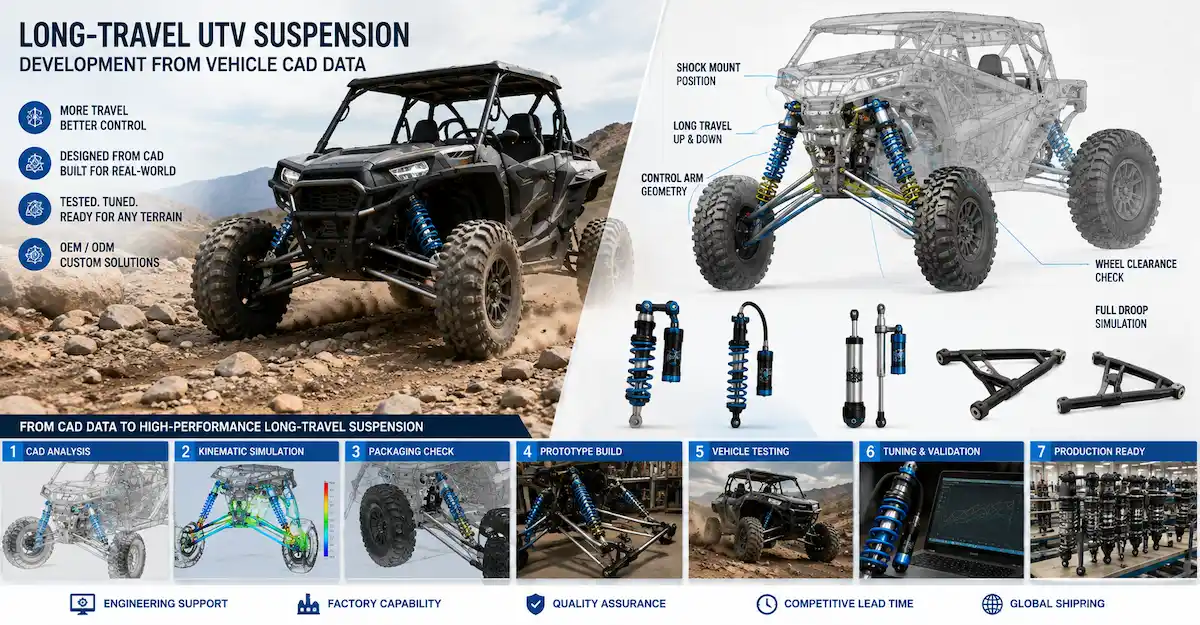
A competent factory should therefore connect engineering, prototype manufacturing, testing, revision, and production preparation into one development process. SAE technical literature on shock absorber prototype development similarly treats design, construction, and testing as connected stages rather than isolated activities.
For buyers developing a new suspension system, Bedo Auto's existing shock absorber prototype development process provides a useful example of how sample analysis, drawing review, suspension design support, prototype manufacturing, spring development, damping adjustment, validation, small-batch production, and OEM manufacturing can be connected.
When Do You Need a Shock Absorber Prototype?
Not every suspension project requires a completely new prototype.
If you are sourcing a proven replacement shock with confirmed dimensions, mounting points, spring characteristics, and performance requirements, an existing production model may be more practical.
A prototype becomes more valuable when the suspension requirement is not yet fully validated.
Typical situations include:
- A new ATV, UTV, motorcycle, or electric vehicle platform
- A vehicle with non-standard mounting dimensions
- Significant changes in vehicle weight or payload
- A new suspension geometry
- Off-road or extreme-terrain applications
- A different target ride height or suspension travel
- Customized spring rate requirements
- Customized compression or rebound damping
- Private-label suspension products with differentiated performance
- Low-volume specialty vehicle projects
- A buyer moving from a reference sample to a proprietary OEM design
For these projects, the prototype is not simply a purchasing sample. It is an engineering checkpoint used to discover problems before tooling, inventory, and production costs become much larger.
What Information Should You Send to a Prototype Shock Absorber Factory?
The quality of the prototype depends heavily on the quality of the input data.
Sending only a photograph and asking a supplier to "make the same shock" is rarely enough for a serious custom suspension project.
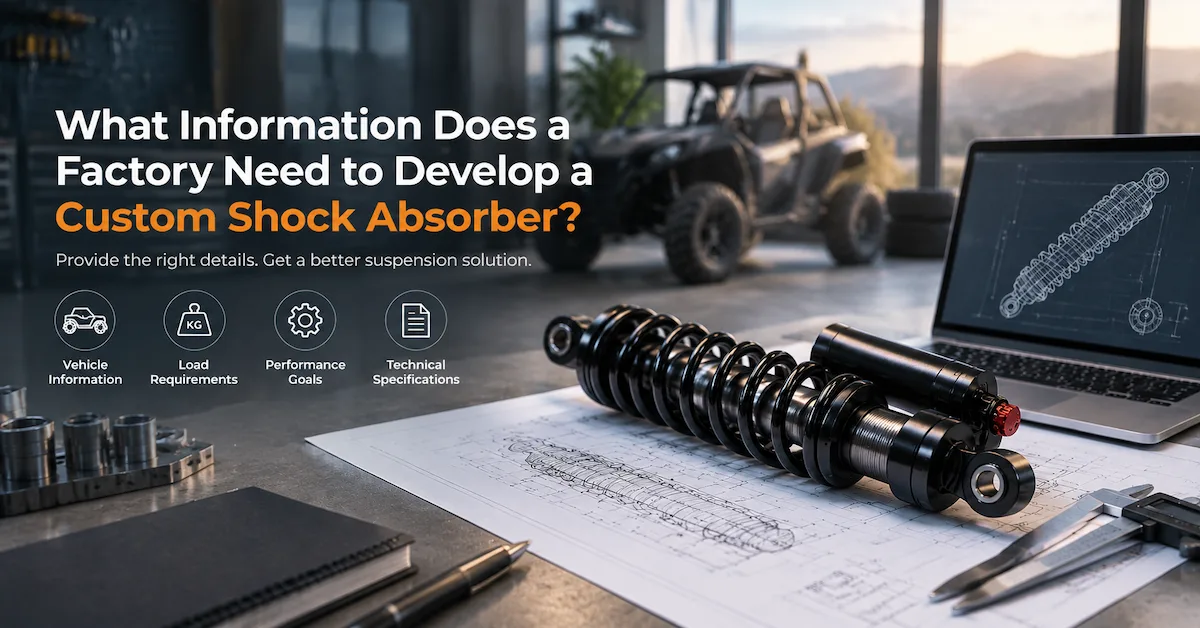
A more useful RFQ package should contain the following information.
| Engineering Input | Information to Provide | Why It Matters |
|---|---|---|
| Vehicle type | ATV, UTV, motorcycle, EV, utility vehicle, etc. | Defines the basic operating environment |
| Vehicle weight | Empty and loaded condition | Influences spring and damping requirements |
| Payload | Rider, passenger, cargo or equipment load | Helps prevent under- or over-springing |
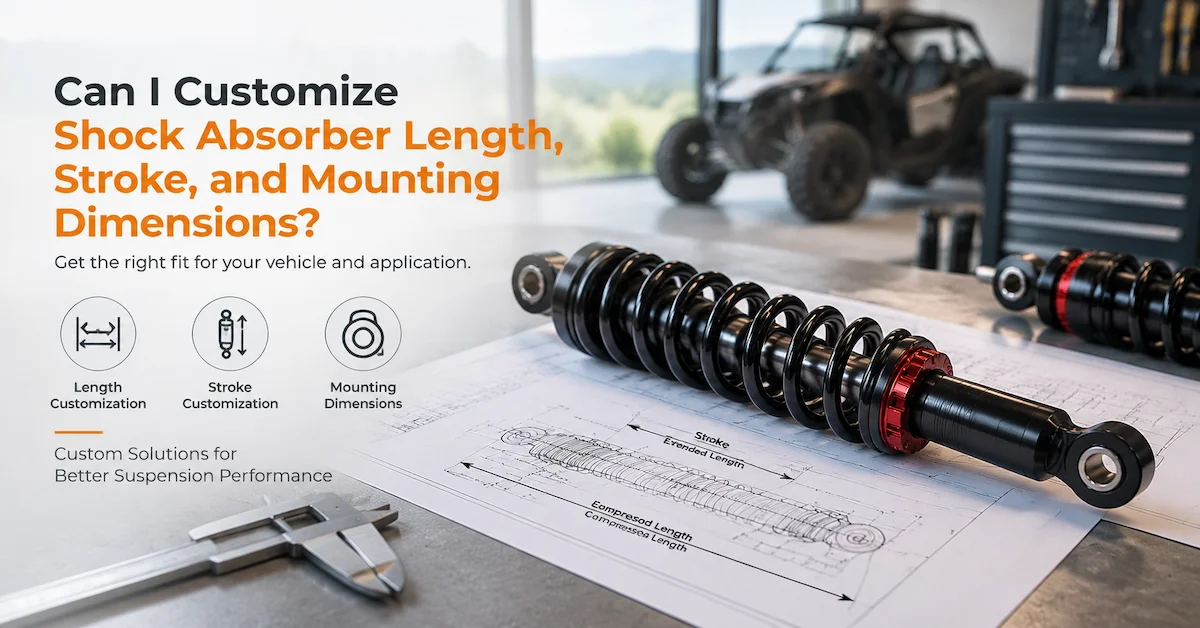
| Extended length | Eye-to-eye or specified mounting reference | Determines installation compatibility |
| Compressed length | Minimum allowable installation length | Helps avoid mechanical interference |
| Required stroke | Target shock travel | Affects usable suspension movement |
| Mounting dimensions | Hole diameter, bush width, eye/fork type | Determines physical fitment |
| Mounting angle | Installed shock angle if available | Influences effective wheel rate |
| Spring information | Spring rate, preload, free length, OD | Determines load support |
| Damping target | Compression/rebound target or reference curve | Defines dynamic behavior |
| Terrain | Road, trail, sand, rock, agriculture, racing, etc. | Influences tuning strategy |
| Reference sample | Existing shock if available | Helps dimensional and construction analysis |
| Drawings / CAD | 2D or 3D data when available | Reduces interpretation errors |
| Planned quantity | Prototype, pilot batch, expected production | Helps production planning |
If some values are not yet known, that does not necessarily prevent development. However, the supplier should identify which missing variables must be defined before final validation.
How Does a Prototype Shock Absorber Factory Develop a New Shock?
A professional development process should progressively reduce technical and commercial risk.
1. Requirement and Application Analysis
The first stage is understanding the vehicle rather than immediately choosing a shock body.
The engineering discussion should cover:
- Vehicle configuration
- Loaded and unloaded weight
- Front or rear position
- Suspension layout
- Installation space
- Suspension travel
- Terrain
- Expected riding characteristics
- Target production volume
For custom suspension, fitment is only the starting point. Two shocks with similar mounting lengths can behave very differently when spring rate, damping force, vehicle load, mounting angle, and suspension geometry change.
2. Sample and Drawing Review
If the buyer already has an existing shock absorber, the factory can use it as a reference for dimensional and structural evaluation.
Typical review points include:
- Extended length
- Compressed length
- Effective stroke
- Cylinder diameter
- Piston rod dimensions
- Mounting structure
- Bush or bearing dimensions
- Spring dimensions
- Reservoir arrangement
- Adjustment mechanism
Bedo Auto states that its prototype support includes both sample analysis and drawing review before prototype manufacturing.
3. Spring and Damping Development
This is one of the areas where a prototype shock absorber factory should provide more value than a basic machine shop.
Spring Rate and Preload
The spring carries the static and dynamic load of the vehicle. Choosing a spring only by physical dimensions can produce poor ride height, insufficient support, excessive stiffness, or premature bottoming.
Important variables include:
- Vehicle mass
- Payload
- Suspension leverage ratio
- Spring rate
- Spring preload
- Available stroke
- Target ride height
Compression and Rebound Damping
The damper controls the speed of suspension movement.
Compression damping affects how the shock responds when the suspension compresses, while rebound damping controls its return movement.
The objective is not simply to create the largest possible damping force. The damping characteristics need to suit the vehicle, spring, suspension geometry, speed, and terrain.
SAE research on damper development and testing shows that shock behavior is commonly evaluated through force and velocity relationships and experimental testing, reinforcing why damping characteristics need to be validated rather than selected only from nominal dimensions.
4. Prototype Manufacturing
Once the initial engineering parameters are defined, the factory can produce the first functional prototype.
Depending on the project, customization may involve:
- Shock body dimensions
- Stroke
- Mounting eyes or forks
- Spring dimensions
- Spring rate
- Internal valving
- Compression characteristics
- Rebound characteristics
- Reservoir configuration
- Surface finish
- Appearance
- Branding
Bedo's existing shock absorber product range shows both fixed-damping ATV/UTV shocks and adjustable motorcycle designs, illustrating that construction and damping configurations can differ substantially according to application.
5. Prototype Testing and Validation
A prototype should not automatically become a production specification just because it can be installed on the vehicle.
Testing should determine whether the design actually performs as intended.
Depending on the project, validation may include:
- Dimensional inspection
- Installation verification
- Compression and rebound evaluation
- Leakage inspection
- Load evaluation
- Adjustment verification
- Durability evaluation
- Temperature-related performance checks
- Vehicle-level testing
Bedo describes prototype validation and shock performance evaluation as parts of its shock absorber testing support.
6. Engineering Revision
The first prototype does not always need to be the final prototype.
Testing may reveal that the project requires changes to:
- Spring rate
- Preload
- Damping characteristics
- Stroke
- Mounting dimensions
- Seal arrangement
- Structural components
- Surface treatment
This revision loop is one of the main reasons to prototype before committing to mass production.
7. Pilot or Small-Batch Production
After the technical design is validated, a small batch can help confirm whether the product can be manufactured consistently.
This stage is particularly useful for startups, new vehicle programs, specialty vehicle manufacturers, and niche aftermarket brands.
Bedo currently supports prototype development followed by small-batch and OEM production, rather than requiring every new project to move directly from prototype to high-volume manufacturing.
Which Shock Absorber Parameters Should Be Validated?
A buyer should not approve a prototype based on appearance alone.
| Parameter | What to Check | Potential Risk if Incorrect |
| Extended length | Full extension dimension | Incorrect droop or installation |
| Compressed length | Minimum shock length | Mechanical interference |
| Stroke | Available piston movement | Insufficient suspension travel |
| Mounting dimensions | Hole, eye, fork and bush sizes | Poor fitment |
| Spring rate | Load support | Excessive sag or harshness |
| Preload | Initial spring compression | Incorrect ride height |
| Rebound damping | Extension control | Unstable recovery or poor traction |
| Compression damping | Compression control | Harsh ride or excessive bottoming |
| Reservoir design | Internal/external configuration | Packaging or thermal limitations |
| Sealing | Oil/gas retention | Leakage and performance loss |
| Corrosion protection | Surface and materials | Reduced durability outdoors |
| Batch consistency | Repeated performance | Production variation |
For example, Bedo's ATV/UTV products use different combinations of length, stroke, spring rate, and rebound/compression force rather than one universal specification. The AU_HSA_01 is listed with a 465 mm total length, 130 mm stroke, and 75 lb spring rate, while AU_HSA_03 is listed at 445 mm, 130 mm stroke, and 135 lb spring rate. This illustrates why vehicle-specific selection and validation matter.
How Should You Evaluate a Prototype Shock Absorber Factory?
Price should not be the first or only qualification criterion.
For an engineering-led project, buyers should evaluate whether the supplier can support the complete development path.
Engineering Capability
Ask whether the factory can work from:
- Drawings
- CAD data
- Physical samples
- Vehicle specifications
- Performance targets
A supplier that only copies dimensions may not be suitable when spring and damping development are required.
Prototype-to-Production Capability
A strong supplier should be able to answer:
- Who reviews the prototype?
- How are design revisions documented?
- Can spring specifications be modified?
- Can damping be adjusted?
- Can the prototype move into a pilot batch?
- Can the same design transition into OEM production?
This reduces the risk of validating a prototype with one company and then rebuilding the entire manufacturing process with another.
Testing Capability
Ask what tests are actually performed and what results can be provided.
Do not assume that phrases such as "tested" or "quality checked" mean the same thing at every factory.
Specify the required inspection or validation criteria in the RFQ whenever possible.
Quality Management
For production projects, buyers should also evaluate incoming material control, production inspection, final inspection, traceability, corrective action, and documentation.
The official ISO 9001 quality management framework emphasizes controlled processes, performance evaluation, continual improvement, and the ability to consistently meet customer requirements.
Certification alone does not replace product-specific validation, but a structured quality system is an important supplier-evaluation factor.
Prototype Shock Absorber vs Stock Shock vs Direct Mass Production
| Option | Best For | Customization | Development Risk | Initial Commitment |
| Stock shock absorber | Proven replacement applications | Low | Lower if fitment is verified | Low |
| Custom prototype | New or modified vehicle platforms | High | Reduced through validation | Moderate |
| Direct custom mass production | Fully validated mature designs | High | Higher if design is unproven | High |
| Prototype + pilot batch | New OEM and specialty projects | High | Controlled progressively | Moderate |
For a new vehicle or suspension design, the prototype-plus-pilot approach usually provides more opportunities to identify fitment, tuning, and production issues before larger orders are placed.
What Determines Prototype Cost, MOQ, and Lead Time?
There is no responsible universal answer to the question, "How much does a custom shock absorber prototype cost?"
Prototype cost depends on the engineering work and product configuration.
Important cost drivers can include:
- Number of prototype units
- Degree of customization
- New machining requirements
- Spring development
- Custom mounting structures
- Damping development
- Adjustable vs fixed damping
- Reservoir configuration
- Materials
- Surface finish
- Testing requirements
- Number of revision rounds
MOQ and lead time can also vary according to design complexity, materials, processes, testing, and whether the project uses existing components or requires new development.
Bedo's current small-quantity guidance likewise states that MOQ depends on product design, customization requirements, materials, and production processes rather than giving one fixed quantity for all custom projects.
For that reason, buyers should be cautious when a prototype shock absorber factory gives a final price or production deadline before reviewing the basic technical requirements.
Why Work With Bedo Auto for Prototype Shock Absorber Development?
Ningbo Bedo Auto Parts Co., Ltd. focuses on shock absorbers and suspension components for off-road and specialty vehicle applications.
Its current prototype support includes:
- Technical consultation
- Sample analysis
- Drawing review
- Suspension design support
- Prototype manufacturing
- Spring development
- Damping adjustment
- Testing validation
- Small-batch production
- OEM manufacturing
Applications currently described by Bedo include ATV, UTV, motorcycles, golf carts, utility vehicles, electric vehicles, and specialty vehicles.
Buyers can also review Bedo's shock absorber products to understand existing hydraulic shock configurations or explore its broader suspension engineering approach before starting a new prototype project.
For projects that need validation before scaling, the development path can continue from prototype into low-volume OEM shock absorber production.
What Should You Include in Your Prototype RFQ?
Before contacting a prototype shock absorber factory, prepare as much technical information as possible.
A practical RFQ can include:
- Vehicle type and application
- Front or rear shock position
- Vehicle empty weight
- Maximum loaded weight
- Extended and compressed length
- Required stroke
- Mounting type and dimensions
- Existing spring specification
- Desired spring rate if known
- Compression/rebound targets if available
- Terrain and operating conditions
- Photos, drawings, CAD data or reference samples
- Required prototype quantity
- Estimated future production volume
- Branding or appearance requirements
If some parameters are unknown, explain the vehicle and performance objective instead of inventing technical values.
A capable engineering supplier should help identify which parameters need to be confirmed before manufacturing begins.
FAQ
What is a prototype shock absorber factory?
A prototype shock absorber factory develops functional shock absorber samples before mass production. Depending on its engineering capability, it may also support sample analysis, drawings, spring development, damping tuning, testing, revision, pilot production, and OEM manufacturing.
How many shock absorbers are needed for a prototype project?
There is no universal quantity. The required number depends on the vehicle, development stage, testing plan, number of configurations, and whether destructive or durability testing is required.
Can a factory develop a prototype from an existing shock absorber?
Yes. A reference sample can be useful for dimensional and structural analysis. However, buyers should also provide vehicle load, application, terrain, and target performance when the new product is expected to perform differently from the reference part.
Can spring rate be customized during prototype development?
Yes, when the supplier supports spring development. Spring rate should be evaluated together with vehicle load, suspension geometry, preload, available travel, and damping characteristics.
Can compression and rebound damping be customized?
They can be customized on suitable shock designs. The required damping characteristics should be based on the vehicle and intended application rather than simply copied from another vehicle.
Why is shock absorber prototype testing important?
Testing helps verify dimensions, installation, damping behavior, leakage, durability, adjustment function, and overall suspension performance before larger production investment. Bedo provides additional information in its shock absorber testing guide.
Is a prototype necessary for every OEM shock absorber?
No. If an existing, validated design already meets the required fitment and performance specification, a completely new prototype may not be necessary. New platforms, unusual loads, special terrain, or custom performance targets are stronger reasons to prototype.
Can prototype shocks be produced in small batches?
Yes, if the manufacturer supports pilot or low-volume manufacturing. Bedo describes a development route from prototypes to small-batch and OEM production.
What is the MOQ for custom prototype shock absorbers?
MOQ is project-specific. It can depend on the shock design, materials, customized components, spring requirements, manufacturing processes, and future production plan. A technical review should normally occur before confirming MOQ.
What should I send Bedo Auto to start a prototype project?
Send available drawings, dimensions, reference samples, vehicle information, loaded weight, suspension travel, mounting details, terrain, performance targets, prototype quantity, and expected future production volume. For project-specific evaluation, buyers can contact Bedo Auto directly.
Conclusion
Choosing a prototype shock absorber factory is ultimately an engineering and risk-management decision, not simply a search for the lowest sample price.
A strong supplier should be able to understand the vehicle application, review drawings or samples, define critical dimensions, coordinate spring and damping development, manufacture functional prototypes, support validation, make engineering revisions, and prepare the design for repeatable production.
For ATV, UTV, motorcycles, electric vehicles, utility vehicles, and specialty platforms, validating these factors before mass production can reduce the risk of incorrect fitment, poor suspension behavior, repeated redesigns, and unnecessary production investment.
If you are developing a new vehicle platform or custom suspension product, send Bedo Auto your vehicle information, drawings, reference samples, mounting dimensions, target load, terrain, and performance requirements through the Bedo Auto contact page to begin a technical review.