
What Should Be Included in an OEM Suspension RFQ?
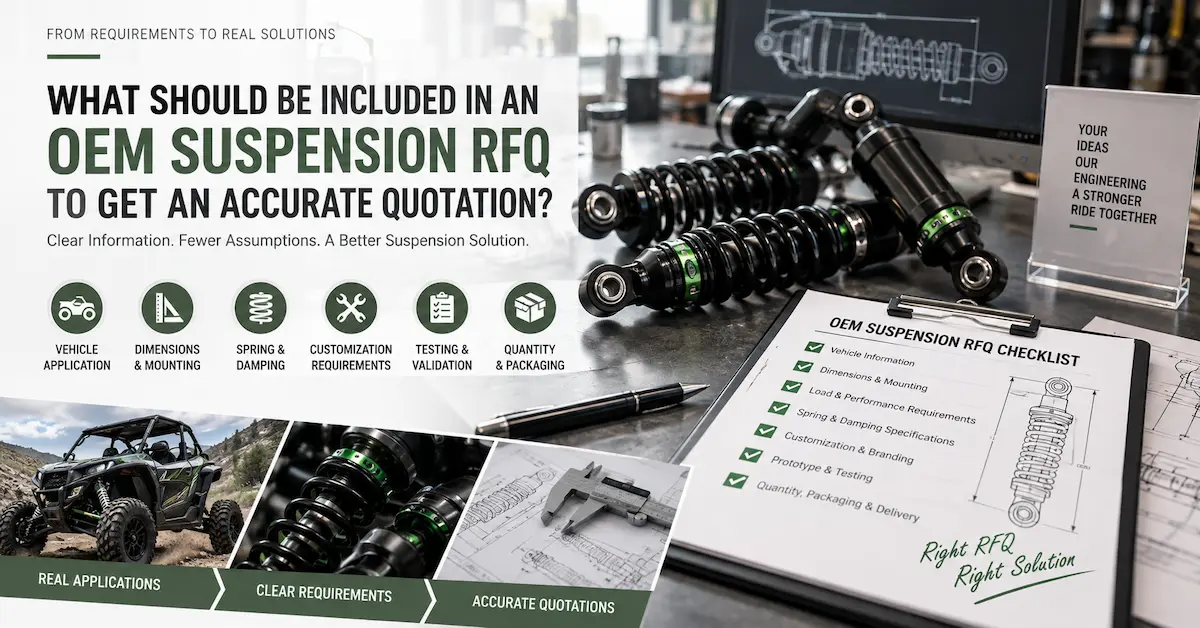
A complete OEM suspension RFQ should tell the manufacturer exactly what vehicle the suspension is for, how the shock must fit, what load it must support, what performance is expected, which parts require customization, how the product will be validated, and what commercial scope should be quoted. Sending only a product photo, target price, and estimated quantity may be enough for an initial conversation, but it is rarely enough for an accurate custom suspension quotation.
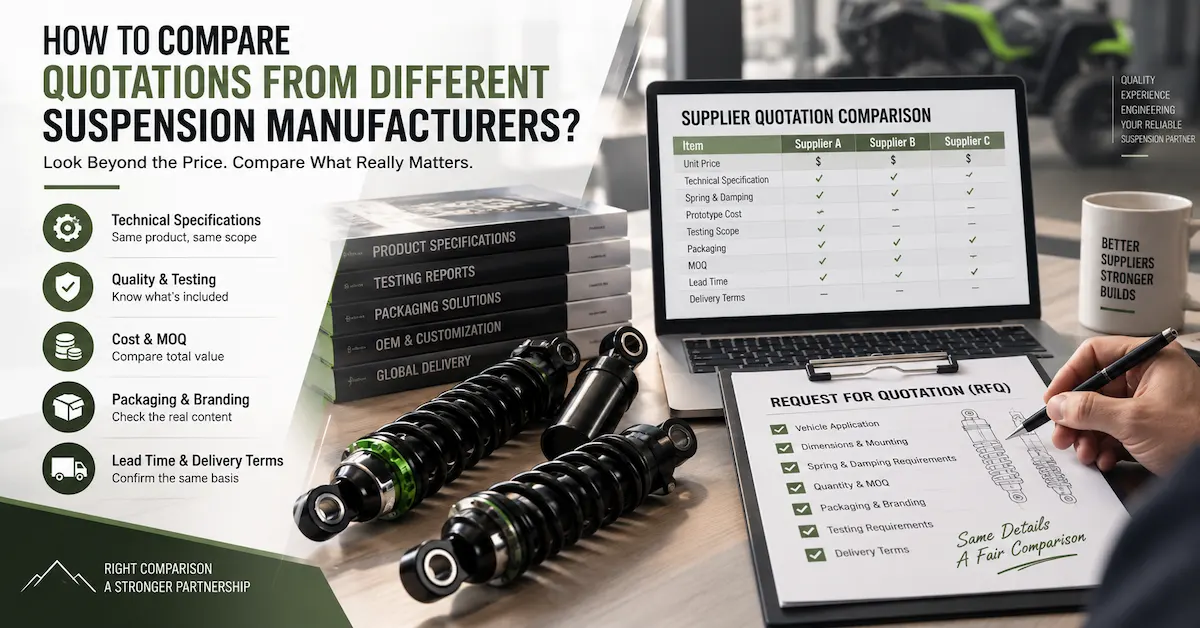
For most ATV, UTV, off-road, and specialty-vehicle projects, an effective RFQ should cover six groups of information:
Vehicle and application → Shock geometry → Spring and damping → Customization → Validation → Commercial requirements
The purpose is not to make the RFQ unnecessarily complicated. It is to remove the assumptions that cause suppliers to quote different products under apparently similar prices.
BEDO's existing ATV suspension RFQ guide provides a useful starting point for organizing vehicle and suspension information before requesting a quotation.
Why an Accurate RFQ Matters More Than Asking for the Lowest Price
A suspension manufacturer can only price what has been defined.
Consider an inquiry that says:
“Please quote rear UTV shocks, 500 pieces.”
The supplier still does not know:
- which vehicle the shocks fit;
- required extended and compressed length;
- stroke;
- mounting dimensions;
- vehicle load;
- spring requirement;
- damping requirement;
- fixed or adjustable configuration;
- reservoir requirement;
- required finish;
- prototype scope;
- testing requirements;
- private-label packaging.
One manufacturer may assume an existing catalog shock. Another may assume a fully customized design. A third may include new springs and prototype work.
The resulting quotations cannot be compared fairly.
A strong RFQ therefore reduces two risks at the same time: quotation uncertainty and product-definition uncertainty.
Start the OEM Suspension RFQ With the Vehicle Application
The supplier first needs to understand where the shock absorber will be used.
Include:
| Application Information | What to Provide |
|---|---|
| Vehicle type | ATV, UTV, golf cart, utility vehicle, specialty vehicle |
| Vehicle make/model | Exact model where available |
| Model year | When relevant to fitment |
| Position | Front, rear, left/right if different |
| Vehicle use | Utility, trail, recreation, performance, cargo |
| Terrain | Road, gravel, trail, rough terrain, mixed use |
| Vehicle configuration | Standard or modified |
| Target market | OEM vehicle, replacement, aftermarket, private label |
This information gives the manufacturer the context needed to interpret every later dimension or performance requirement.
For example, the same shock length does not automatically mean the same shock is suitable for a utility UTV carrying tools and a lighter recreational vehicle.
State Whether the Project Is Replacement or Performance Development
This is one of the most important lines in an RFQ.
Tell the supplier whether the objective is:
Replacement
Maintain approximately the intended original application and restore normal suspension function.
Heavy-Duty
Support higher loads or more demanding operating conditions.
Performance
Change suspension behavior for a defined terrain or driving objective.
Modified Vehicle
Adapt suspension to larger tires, accessories, geometry changes, or other modifications.
New Vehicle Development
Develop suspension where no approved reference configuration exists.
These projects should not automatically use the same spring, damping, or validation assumptions.
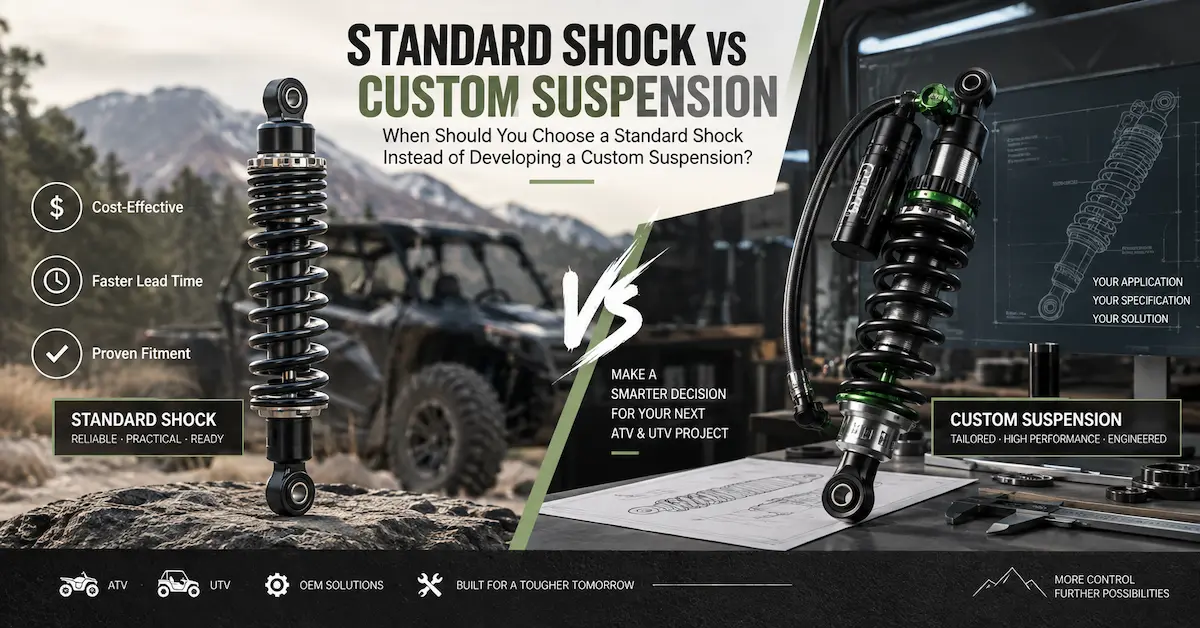
If an existing shock already matches the application, review whether a standard shock or custom suspension is the more appropriate sourcing route before requesting unnecessary development.
Provide Extended Length, Compressed Length, and Stroke
Shock dimensions should be defined clearly rather than described as “approximately the same as the sample.”
Important measurements can include:
- extended length;
- compressed length;
- effective stroke;
- body diameter;
- spring outside diameter where clearance matters;
- reservoir dimensions if applicable.
Also define where the length is measured from.
For eye-to-eye mounting, for example, the measurement reference should be clearly indicated on a drawing. Do not assume all suppliers use the same interpretation of “total length.”
BEDO's custom shock absorber length and stroke guide explains why shock length and usable stroke should be reviewed together rather than treating one dimension as sufficient.
Define Both Upper and Lower Mounting Interfaces
Mounting details are a common source of inaccurate quotations and prototype problems.
For each end, provide:
- mount type;
- hole diameter;
- mounting width;
- sleeve dimensions;
- bushing requirement;
- thread or stud details where applicable;
- mounting orientation.
A useful RFQ table may look like this:
| Mounting Item | Upper Mount | Lower Mount |
|---|---|---|
| Type | Eye / Clevis / Stud | Eye / Clevis / Stud |
| Hole diameter | ___ mm | ___ mm |
| Mounting width | ___ mm | ___ mm |
| Sleeve | Required / Not required | Required / Not required |
| Bushing | Specification or sample | Specification or sample |
Photos can help explain mounting orientation, but controlled dimensions should remain the main reference for quotation and development.
Attach a Drawing Whenever Possible
A drawing makes the RFQ significantly easier to interpret.
It can define:
- measurement reference points;
- mounting geometry;
- hole sizes;
- widths;
- threads;
- tolerances;
- stroke;
- reservoir orientation;
- interfaces with surrounding components.
If no drawing is available, a physical sample can be used as an engineering reference. BEDO discusses this route in its shock absorber drawing service guide.
For more developed OEM programs, include both controlled 2D information and available CAD data when they add useful geometric context.
The goal is not to send more files for the sake of it. Send the files that remove ambiguity.
Provide Vehicle Weight and Actual Operating Load
Suspension load information should not be limited to the empty vehicle weight.
Depending on the application, provide:
- curb or base vehicle weight;
- front/rear weight distribution if known;
- typical rider or passenger load;
- maximum intended cargo;
- permanently installed accessories;
- additional batteries or equipment;
- operating load range.
This information becomes especially important for utility ATVs and UTVs.
A vehicle used with a winch, storage system, tools, cargo rack, or other equipment may require a different suspension approach from the same vehicle in standard configuration.
If the project targets heavier operating loads, related issues are discussed in BEDO's heavy-duty ATV suspension guide.
Explain the Current Suspension Problem
An accurate quotation becomes easier when the supplier understands what the buyer is trying to improve.
Useful problem descriptions include:
- excessive sag under cargo;
- frequent bottoming;
- harsh response over small bumps;
- excessive bouncing;
- rebound that feels too slow;
- instability over repeated terrain;
- inadequate clearance;
- poor fitment;
- leakage in the current product;
- insufficient suspension travel.
Avoid vague statements such as:
“Make it better.”
“Make it premium.”
“Make it more comfortable.”
Those descriptions do not give the engineering team a clear target.
A better RFQ explains the current behavior, operating condition, and desired change.
Include Spring Information When It Is Available
If the current suspension spring is known, provide:
- free length;
- inside or outside diameter;
- wire diameter;
- coil configuration;
- spring markings;
- installed preload information;
- known rate or load-deflection data.
If these values are not available, say so instead of estimating.
For a new design, describe what the spring must accomplish:
- support standard rider load;
- support additional cargo;
- accommodate multiple rider weights;
- maintain desired ride height;
- reduce bottoming;
- provide a particular preload adjustment range.
BEDO's custom spring rate guide explains why spring selection should be tied to vehicle load, geometry, and the intended suspension behavior.
Define Damping Requirements by Performance Goal
Damping is another area where RFQs often become too vague.
Do not write only:
“Custom damping required.”
Instead, specify whether you need:
- existing fixed damping;
- revised fixed damping;
- adjustable compression;
- adjustable rebound;
- both compression and rebound adjustment;
- supplier recommendation based on the application.
Also describe the reason for changing damping.
For example:
“We need more control under repeated rough-terrain impacts while retaining suitable rebound recovery.”
This gives the supplier more useful information than simply requesting “stronger damping.”
BEDO's compression and rebound damping customization guide provides additional context for defining these requirements.
State Whether a Reservoir Is Required
If the project requires a reservoir shock, identify the intended configuration:
- piggyback reservoir;
- remote reservoir;
- supplier-recommended configuration.
For a remote reservoir, also consider:
- hose routing;
- mounting location;
- clearance;
- bracket requirements.
Do not add a reservoir only because it appears more premium. It should support the hydraulic, thermal, packaging, or performance requirements of the intended application.
Include Wheel, Tire, and Vehicle Modification Data
Modified vehicles may change the assumptions behind a standard suspension specification.
Tell the supplier about:
- larger tires;
- different wheel offset;
- lift kits;
- extended control arms;
- changed ride height;
- aftermarket bumpers;
- winches;
- cargo accessories;
- battery changes;
- other permanent equipment.
These changes can influence:
- unsprung mass;
- clearance;
- suspension travel;
- load;
- shock angle;
- damping requirements.
A technically complete OEM suspension RFQ should describe the actual production vehicle, not an idealized stock vehicle that the finished shock will never be installed on.
Specify the Desired Customization Level
Separate cosmetic customization from engineering customization.
Commercial or Branding Customization
Examples include:
- logo;
- spring color;
- shock-body finish;
- labels;
- packaging;
- instruction sheets.
Engineering Customization
Examples include:
- shock length;
- stroke;
- mount design;
- spring rate;
- damping;
- reservoir;
- adjustability;
- application-specific components.
This distinction helps the supplier determine whether the RFQ is primarily a private-label project or a new suspension-development program.
BEDO's shock absorber customization guide provides more detail on different levels of customization.
List the Files and References Included With the RFQ
A professional RFQ should contain a simple document register.
For example:
| File | Purpose | Revision |
|---|---|---|
| 2D shock drawing | Critical dimensions | Rev. A |
| 3D CAD | Packaging/clearance reference | Rev. B |
| Vehicle photo | Installation reference | Current |
| Existing shock photos | Benchmark | Current |
| Physical sample | Reverse-engineering reference | Sample 01 |
| Test requirement | Acceptance criteria | Rev. A |
This avoids a common problem: suppliers quoting from an old drawing while the buyer assumes the latest file is being used.
BEDO's custom suspension development files guide explains how drawings, CAD, samples, vehicle information, and performance requirements can be combined during project evaluation.
Define Prototype Requirements Before Asking for Production Pricing
Tell the manufacturer whether you need:
- one engineering sample;
- a pair or vehicle set;
- multiple damping variants;
- multiple spring options;
- pilot-production units.
Also explain what will happen after the prototype arrives.
Will you check:
- physical fitment;
- static sag;
- ride height;
- wheel travel;
- damping behavior;
- clearance;
- leakage;
- road or terrain performance?
A supplier cannot accurately estimate development scope if the RFQ simply says “sample needed” without explaining what the sample is intended to validate.
State the Testing and Inspection Scope
Testing should be defined rather than represented by one generic line saying “quality must be good.”
Depending on the project, buyers may ask the supplier to clarify the proposed scope for:
- dimensional inspection;
- fitment verification;
- leakage inspection;
- damping verification;
- spring checks;
- prototype validation;
- production inspection.
Not every project needs exactly the same validation program.
The RFQ should therefore distinguish between:
Required by Buyer
Proposed by Supplier
To Be Confirmed After Prototype
BEDO's shock absorber testing before mass production guide provides a useful framework for discussing validation before production approval.
Define the Approval Process
The supplier should understand when the design becomes approved for production.
A practical sequence may be:
Technical Requirement → Drawing Review → Prototype → Buyer Test → Revision → Approved Sample → Production Release
Define who approves:
- drawing;
- dimensions;
- spring;
- damping;
- finish;
- logo;
- label;
- packaging.
If a prototype changes after testing, identify the approved revision rather than continuing to refer to all samples as the same product.
This becomes particularly important during repeat orders.
Separate Prototype Quantity From Production Quantity
Do not put a single quantity in the RFQ if the project has several phases.
Specify separately:
- engineering sample quantity;
- pilot order quantity;
- initial production quantity;
- expected repeat-order quantity;
- estimated annual demand if useful for planning.
This allows suppliers to distinguish development economics from normal production economics.
BEDO's custom shock absorber MOQ guide explains why MOQ can depend on the configuration, customized components, and project stage rather than one universal number.
Ask Suppliers to Break Out One-Time and Recurring Costs
For a custom OEM suspension project, request separate quotation lines where applicable.
| Cost Area | One-Time or Recurring? |
|---|---|
| Engineering | Usually project-specific |
| Prototype | Development stage |
| Tooling/fixtures | Project-specific if required |
| Testing | Depends on agreed scope |
| Shock absorber | Recurring production cost |
| Custom spring | Recurring product cost |
| Branding | May be recurring |
| Retail packaging | Recurring |
| Freight | Shipment-specific |
This makes future production economics easier to understand and makes supplier comparisons much more useful.
Define the Packaging Configuration
Do not leave packaging until after the unit price has been agreed.
State whether you require:
- bulk packaging;
- one shock per box;
- one pair per box;
- complete vehicle sets;
- retail cartons;
- printed inserts;
- labels;
- barcodes;
- mounting hardware.
The quoted product quantity should also make clear whether “1 unit” means:
- one shock absorber;
- one pair;
- one kit;
- one vehicle set.
This prevents major quotation misunderstandings.
Specify the Required Branding
For private-label programs, include:
- brand/logo file;
- logo location;
- printing or marking requirement;
- shock-body color;
- spring color;
- label information;
- carton artwork;
- instruction requirements.
If branding has not yet been finalized, identify it as a separate pending item so the supplier does not assume standard packaging.
Clarify Target Market and Documentation Requirements
Tell the supplier where the finished product will be sold and what documentation your business expects.
Do not assume that a company-level certificate, report, or factory statement automatically applies to every custom shock.
For custom products, the safest RFQ language is to ask the supplier to identify:
- applicable existing documentation;
- project-specific documents;
- items requiring separate confirmation.
This avoids treating unsupported compliance assumptions as part of the quoted product.
Define Your Required Quotation Format
You can improve quotation quality simply by telling manufacturers how to respond.
Ask each supplier to identify:
- product specification;
- standard or custom platform;
- prototype cost;
- tooling or fixture cost if applicable;
- testing cost if separate;
- unit price;
- MOQ;
- branding cost;
- packaging cost;
- production lead-time basis;
- quotation validity;
- delivery basis;
- exclusions;
- unconfirmed items.
This makes it much easier to compare suspension manufacturer quotations later without reconstructing every supplier's assumptions manually.
Use an Included / Excluded / Optional / Unconfirmed Matrix
For every important RFQ item, ask the supplier to classify it as:
Included – covered by the quotation.
Excluded – not covered.
Optional – available at additional cost.
Unconfirmed – requires further engineering or commercial review.
This method is particularly useful for:
- prototype testing;
- new springs;
- damping development;
- packaging;
- logos;
- special finishes;
- mounting hardware;
- tooling.
An unconfirmed item should never be silently treated as included.
Avoid These Common OEM Suspension RFQ Mistakes
The following problems frequently create weak quotations:
Sending Only a Product Photo
A photo cannot reliably define internal damping, spring characteristics, precise dimensions, or all mounting interfaces.
Giving Only Extended Length
Shock stroke, compressed length, and mount geometry also matter.
Providing Vehicle Weight but Ignoring Cargo
The actual operating load may be significantly different.
Requesting “Heavy-Duty” Without a Load Target
Heavy-duty should correspond to an application requirement, not simply a marketing term.
Asking for “Adjustable” Without Defining What Should Adjust
Clarify compression, rebound, preload, or another requested function.
Giving a Quantity Without Defining the SKU Mix
500 pieces across five configurations is commercially different from 500 identical units.
Requesting a Final Price Before the Technical Scope Is Frozen
An early quotation should be treated as preliminary if key engineering requirements remain unresolved.
A Practical OEM Suspension RFQ Checklist
Before sending your RFQ, verify that it answers the following:
| RFQ Section | Required Information |
|---|---|
| Application | Vehicle, position, use, terrain |
| Objective | Replacement, heavy-duty, performance, new development |
| Dimensions | Extended, compressed, stroke |
| Mounting | Upper/lower interfaces |
| Load | Vehicle, rider, cargo, accessories |
| Spring | Existing data or required behavior |
| Damping | Fixed/adjustable and performance target |
| Reservoir | None, piggyback, remote |
| Modifications | Tires, lift, equipment |
| Files | Drawing, CAD, photos, sample |
| Prototype | Quantity and evaluation plan |
| Testing | Required validation |
| Branding | Logo, color, labels |
| Packaging | Bulk, retail, pair, kit |
| Quantity | Sample, pilot, production |
| Commercial | MOQ, lead-time basis, delivery scope |
| Documentation | Required project documents |
If several fields are unknown, do not invent values. Mark them TBC and ask the manufacturer which information must be confirmed before final quotation.
Frequently Asked Questions
1. What Is the Most Important Information in an OEM Suspension RFQ?
The application and technical definition are the foundation. Vehicle type, shock dimensions, mounting interfaces, load, spring requirements, damping requirements, and intended use should be clear before a final quotation is expected.
2. Can I Request a Suspension Quotation With Only a Physical Sample?
Yes, a sample can provide useful dimensional and construction information, but the supplier should also know the target vehicle, load, application, and any required changes. A sample alone does not define the engineering objective.
3. Do I Need a CAD File for Every OEM Shock Project?
Not necessarily. A controlled 2D drawing, physical sample, or verified dimensions may be sufficient for some projects. CAD becomes especially useful when packaging, geometry, interfaces, or vehicle integration require additional review.
4. Should I Include My Target Price in the RFQ?
It can be useful when the project has a genuine commercial target, but the technical specification should still be defined. A target price should not replace information about fitment, performance, materials, testing, or required customization.
5. Should Spring Rate Be Included in the RFQ?
If you know the required spring specification, include it. If not, provide the vehicle and load data and explain the desired suspension behavior so the manufacturer can evaluate an appropriate development route.
6. What If I Do Not Know the Required Damping Force?
Describe the application, current suspension behavior, load, terrain, spring configuration, and performance problem. The manufacturer can then determine what additional information or prototype development is needed instead of relying on an invented target.
7. Should Prototype Cost Be Listed Separately?
Yes. Separating engineering and prototype expenses from recurring production costs makes future order economics and supplier comparisons easier to understand.
8. How Should I State MOQ in an RFQ?
Provide your desired prototype, pilot, initial production, and repeat-order quantities, then ask the manufacturer to identify the applicable MOQ per model, configuration, or customized component.
9. Should Testing Requirements Be Included Before Quotation?
Yes, where they are known. Testing can influence development scope, sample requirements, time, and cost. If the exact validation plan is not yet defined, ask the supplier to propose it separately.
10. How Can I Get More Comparable Quotations From Multiple Suspension Manufacturers?
Send every supplier the same controlled RFQ package and ask them to quote using the same response structure. Clearly identify included, excluded, optional, and unconfirmed items so differences in scope become visible before you compare prices.
Conclusion
A well-prepared OEM suspension RFQ does more than ask a manufacturer for a price. It creates a shared technical and commercial definition of the product before purchasing decisions are made. Include the vehicle application, shock dimensions, mounting interfaces, operating load, spring and damping requirements, vehicle modifications, drawings or samples, prototype plan, testing scope, customization, packaging, order quantities, and commercial assumptions. Just as importantly, identify what is still unknown instead of forcing suppliers to make hidden assumptions. When every manufacturer receives the same controlled information, quotations become easier to compare and the risk of developing the wrong suspension is reduced. For an ATV, UTV, off-road, or specialty-vehicle project, contact BEDO with your OEM suspension RFQ, drawings, samples, vehicle information, load conditions, performance targets, and expected quantities so the appropriate standard or custom suspension route can be evaluated before final pricing.