
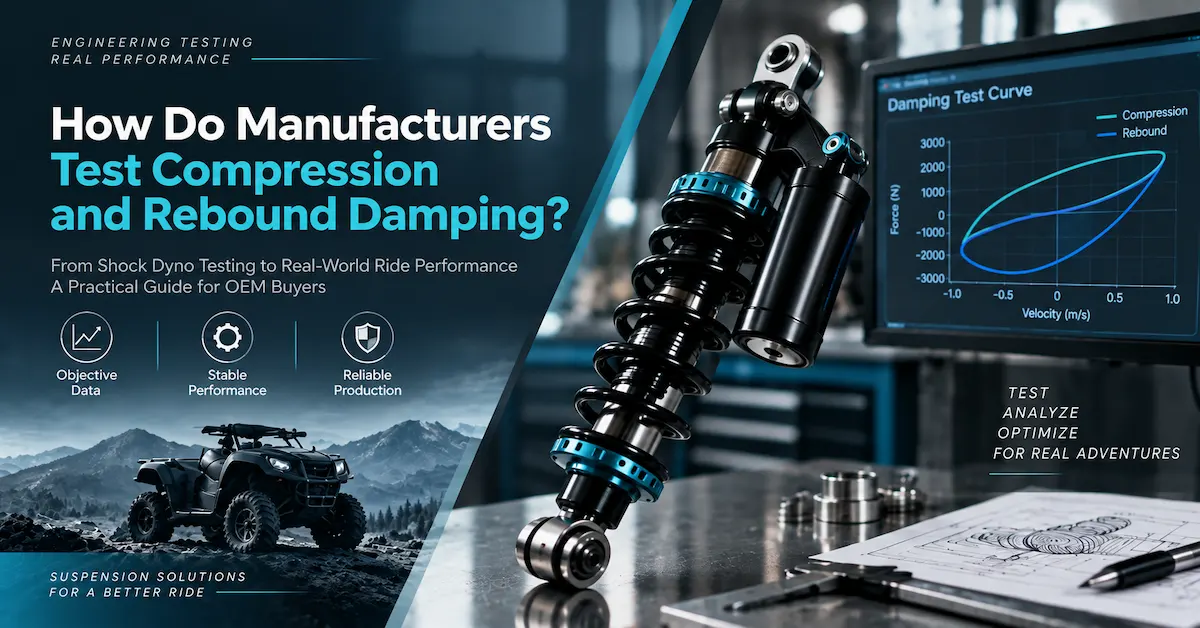
How Do Manufacturers Test Compression and Rebound Damping?
Manufacturers typically evaluate compression and rebound behavior by testing a defined shock absorber configuration under controlled movement and recording the damping force produced as the damper compresses and extends. For OEM development, compression and rebound damping testing should identify the exact shock revision, adjustment position, test condition, and acceptance range so engineers can compare prototypes and later production units on the same basis. BEDO’s shock absorber testing guidance treats damping evaluation as one part of a broader validation program that also considers dimensions, leakage, load, durability, temperature-related behavior, and vehicle testing.
The key purchasing point is that one maximum force number does not describe the complete shock. Buyers should ask how compression and rebound were measured, at what condition, on which technical configuration, and whether the result represents one operating point or a broader force–velocity assessment.
What Is Compression Damping?
Compression damping controls resistance while the shock absorber shortens. It influences how the suspension responds when the wheel encounters bumps, rocks, holes, landings, braking load transfer, cargo movement, and other inputs.
Too little compression control can contribute to excessive suspension movement or frequent bottoming. Too much can make the suspension harsh and reduce its ability to move over repeated irregularities. BEDO’s performance shock absorber guide emphasizes that the objective is appropriate control for the vehicle and application—not maximum resistance.
For buyers, “increase compression damping” should therefore be treated as an engineering target only when the current problem and operating condition have been defined.
What Is Rebound Damping?
Rebound damping controls the shock as it extends after being compressed. Its job is to manage suspension recovery.
If rebound control is insufficient, the suspension may return too quickly and continue oscillating. If rebound resistance is excessive, the suspension may recover too slowly between consecutive terrain inputs and progressively lose available travel.
BEDO’s adjustable off-road shock guidance describes the target as controlled recovery, rather than the strongest possible rebound force.
Spring rate and rebound damping also interact. If an OEM project changes the spring significantly, rebound behavior should normally be reviewed again instead of assuming the original damping specification remains appropriate.
Use a Shock Dyno to Create Objective Damping Data
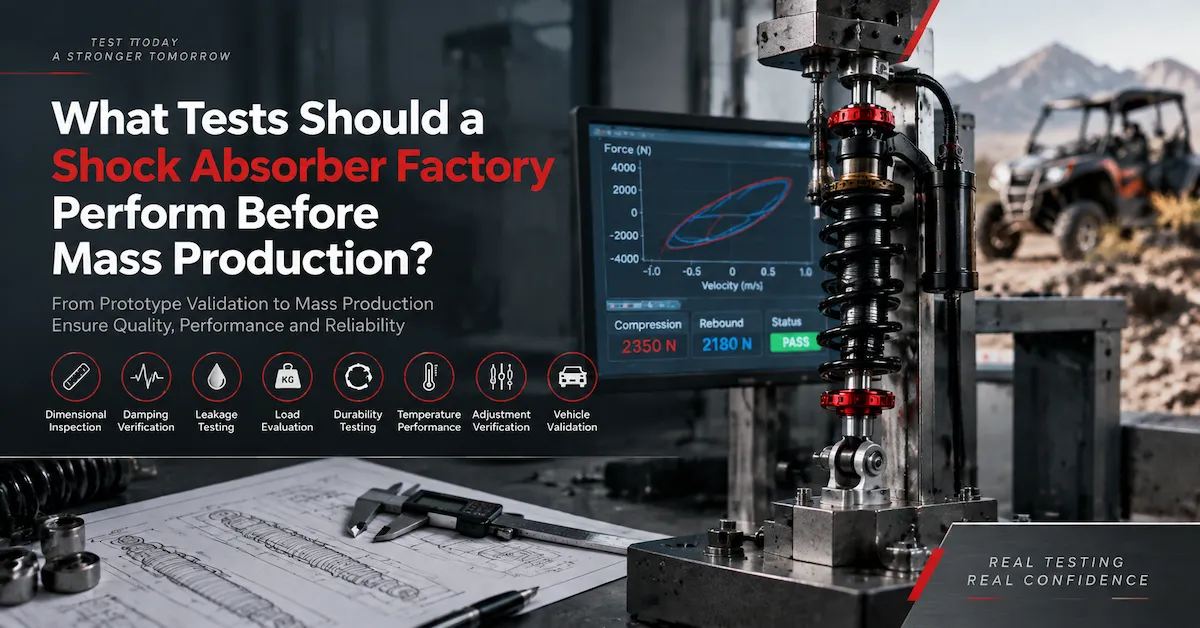
A damper dynamometer provides a controlled way to evaluate shock behavior rather than relying only on subjective ride comments. In general industry use, the test machine cycles the damper through controlled movement while measuring the force generated. BEDO’s published suspension content uses force–velocity information as a key damping-development reference and recommends linking test results to the actual product configuration. BEDO’s premium ATV damping guide also distinguishes dyno measurements from final vehicle validation.
Useful damping data can include:
| Test information | Buyer value |
|---|---|
| Compression force | Shows resistance during compression |
| Rebound force | Shows resistance during extension |
| Test speed/condition | Makes comparisons meaningful |
| Force–velocity graph | Shows behavior across tested movement speeds |
| Adjustment position | Required for adjustable shock comparisons |
| Shock revision | Links data to the correct prototype |
| Temperature where relevant | Helps interpret changing damping behavior |
| Acceptance range | Defines pass/fail or engineering target |
The test report should make clear which of these fields actually apply to the project.
Why Is a Force–Velocity Curve More Useful Than One Maximum Number?
A single damping-force value tells buyers what the shock produced at one specified operating point. A force–velocity curve provides more information about how resistance changes as damper movement speed changes.
BEDO’s existing product pages demonstrate why the distinction matters. For example, the AU_HSA_02 publishes an inspection speed of 0.1 m/s, rebound force of 3000 N, and compression force of 550 N. The AU_HSA_03 publishes the same 0.1 m/s inspection-speed field but rebound force of 2700 N and compression force of 350 N.
| Published specification | AU_HSA_02 | AU_HSA_03 |
|---|---|---|
| Inspection speed | 0.1 m/s | 0.1 m/s |
| Rebound force | 3000 N | 2700 N |
| Compression force | 550 N | 350 N |
| Effective stroke | 80 mm | 130 mm |
| External damping adjustment | None | None |
These figures do not establish that AU_HSA_02 is universally better because its published rebound and compression numbers are higher. The models also differ in stroke, dimensions, spring specification, and intended installation geometry. A single force reading should therefore be interpreted within the complete application. (bedoauto.com)
Compression and Rebound Should Be Recorded Separately
A damping test report should clearly distinguish the compression portion of the test from the rebound portion. Combining both into one unexplained “maximum damping force” field makes technical comparison difficult.
A practical OEM report may identify:
Compression: measured result and target range.
Rebound: measured result and target range.
Test condition: defined movement speed or test profile.
Configuration: spring, valving, reservoir, and adjuster version.
Status: development reference or production acceptance.
This becomes particularly important when the buyer is comparing multiple prototypes. If Prototype A improves rebound but simultaneously changes compression too far from the target, the engineering team needs separate data to see that trade-off.
Test the Same Shock Configuration Before Comparing Results
Two dyno reports cannot be compared fairly if the shocks differ in configuration.
Record at least the relevant:
- prototype or product ID;
- drawing revision;
- spring version where it forms part of the tested assembly;
- damping/valving configuration;
- reservoir configuration;
- adjustment position;
- relevant test condition.
BEDO’s custom suspension development files guide recommends including force–velocity graphs, test conditions, adjuster positions, shock configuration, and temperature where relevant when existing damping data is supplied.
This matters because an attractive test chart has little purchasing value when nobody can identify which product produced it.
Preconditioning and Temperature Should Be Controlled When They Matter
Shock damping is hydraulic, so operating condition can affect measured behavior. When a development program is sensitive to temperature or repeated suspension work, the testing procedure should identify the relevant condition so Prototype A and Prototype B are compared consistently.
BEDO’s testing framework treats temperature-related performance as a separate validation area for demanding applications rather than assuming one short laboratory test represents every operating condition.
For OEM buyers, the appropriate question is:
“Under what condition was this damping result measured?”
rather than:
“Was the shock tested?”
Do not impose an arbitrary temperature or warm-up procedure copied from another product. The relevant condition should be defined for the actual design and application.
Low-Speed and High-Speed Compression Refer to Damper Movement
Some performance shocks separate compression control into low-speed and high-speed circuits. These terms refer to the speed of shock movement, not simply the road speed of the ATV.
BEDO’s performance shock absorber guide explains that gradual suspension movements associated with body movement and weight transfer differ from rapid damper movements generated by sharp rocks, holes, or impacts.
This distinction matters in both development and testing. A low-speed farm vehicle can still generate a rapid damper event when it hits a sharp obstacle.
If your product does not use separate circuits, do not add “high-speed/low-speed compression” terminology simply to make the specification appear more advanced.
Adjustable Shocks Should Be Tested at More Than One Setting
For an adjustable damper, testing only one position does not establish the useful adjustment range.
BEDO’s premium ATV adjustable-damping guide recommends reviewing representative positions such as minimum, baseline, and maximum during development instead of relying only on the number of adjustment clicks.
A buyer may request a test matrix such as:
| Adjustment position | Compression | Rebound | Purpose |
|---|---|---|---|
| Minimum | Measure applicable response | Measure applicable response | Lower end of validated range |
| Baseline | Compare with approved target | Compare with approved target | Factory/reference setup |
| Maximum | Measure applicable response | Measure applicable response | Upper end of validated range |
| Intermediate position | Optional where technically relevant | Optional | Check progression/repeatability |
The actual positions and test scope depend on the architecture.
What matters is whether adjustment creates controlled, measurable, repeatable change—not whether the product has the largest possible number of clicks.
Check Adjustment Repeatability
An adjustable suspension product may be tested repeatedly to determine whether returning to the same setting produces comparable damping behavior.
This matters to private-label and performance brands because customers expect a setting to mean something. If “10 clicks” produces substantially different behavior after repeated adjustment, the marketing value of the feature exceeds its engineering control.
During production planning, the buyer should also define:
- adjustment direction;
- counting method;
- baseline setting;
- shipping position;
- labeling;
- inspection requirement.
These controls reduce setup differences between factory testing, buyer validation, and end-user use.
Fixed-Damping Shocks Still Need Damping Verification
A fixed shock does not need external adjustment to require careful testing.
In fact, fixed damping places greater responsibility on the factory-set specification because the end user cannot compensate for an unsuitable calibration after installation.
BEDO’s AU_HSA series includes fixed-damping ATV/UTV products, while its replacement vs performance suspension guide explains that fixed-damping suspension can still be appropriate for both replacement and carefully defined performance applications.
For production, the question becomes:
Does each batch remain within the approved damping specification?
rather than:
Can the rider adjust the shock afterward?
Compression and Rebound Damping Must Be Matched to the Spring
The spring supports load; the damper controls movement. Compression and rebound damping testing should therefore be interpreted together with the spring and vehicle requirements.
Two shocks can share identical external dimensions and still behave very differently because of:
- spring rate;
- preload;
- valve design;
- hydraulic configuration;
- oil specification;
- gas pressure;
- internal friction;
- temperature.
BEDO’s shock absorber measurement guide explicitly states that dimensions alone cannot define performance.
For a custom project, provide the spring configuration used during vehicle evaluation so engineering can reproduce the relevant test setup.
Do Not Use Damping to Hide an Incorrect Spring Rate
A common development error is trying to compensate for inadequate spring support with much stronger compression damping.
If the ATV sags excessively under cargo, first review vehicle load, spring rate, preload, and available travel. Damping affects movement but is not a substitute for correct static load support.
Similarly, a much stiffer spring may require damping reassessment, particularly rebound, because the spring can store and release more force during suspension movement.
BEDO’s heavy-duty ATV suspension guide treats spring and damping development as connected stages for this reason.
Prototype Damping Testing Should Solve a Defined Vehicle Problem
Before testing begins, state the problem being addressed.
Examples can include:
| Vehicle problem | Damping question |
|---|---|
| Repeated bouncing after a bump | Is rebound control appropriate? |
| Slow recovery over consecutive obstacles | Is rebound resistance excessive? |
| Rapid suspension collapse | Does compression control need review? |
| Harsh sharp-impact response | Is compression damping excessive for the application? |
| Bottoming with cargo | Is the issue spring support, available travel, compression damping, or a combination? |
| Behavior changes during long rough operation | Should temperature-related damping stability be investigated? |
This makes the test program application-driven rather than a competition for the largest force value.
Use Vehicle Testing After the Dyno
A damper dyno provides objective component-level data, but it cannot reproduce the complete interaction between shock, spring, tire, suspension geometry, rider, vehicle load, and terrain.
BEDO’s testing guidance therefore includes vehicle validation alongside laboratory testing.
A useful development route is:
Engineering Target → Dyno Baseline → Prototype → Vehicle Test → Engineering Feedback → Damping Revision → Dyno Confirmation → Vehicle Approval
The vehicle test should represent the intended use. A cargo shock should be evaluated under the appropriate load; a trail performance shock should encounter representative terrain; rider-weight-specific suspension should be evaluated across its intended range.
Prototype Testing and Production Damping QC Serve Different Purposes
Development testing can explore several damping configurations to identify the correct solution. Production QC asks whether manufactured units remain within the approved specification.
These are different tasks.
| Stage | Main damping question |
|---|---|
| Baseline/reference test | How does the existing shock behave? |
| Prototype development | Which compression/rebound configuration solves the target problem? |
| Prototype approval | Does the selected configuration meet the accepted target? |
| Pilot batch | Can the factory reproduce that damping consistently? |
| Mass-production QC | Do production units remain within controlled requirements? |
| Change validation | Does a component/process change alter damping? |
BEDO’s shock absorber testing before mass production guide uses the same distinction between development validation, pilot-batch verification, and routine production quality control.
Use a Pilot Batch to Measure Damping Variation
One successful prototype does not prove that the production process can reproduce the same damping behavior.
A pilot batch can reveal variation associated with component selection, valve assembly, oil filling, gas charging, seals, internal friction, adjuster assembly, or other production factors relevant to the design.
BEDO’s performance-shock guidance describes damping verification, valve assembly, oil filling, gas charging, spring preload, and adjustment components among production controls for performance suspension. (bedoauto.com)
Before a large order, buyers should establish how production results will be compared with the approved prototype.
What Should a Damping Test Report Show?
A useful B2B test report should make the technical evidence traceable.
At minimum, ask what information will identify:
- product number;
- prototype/batch number;
- drawing revision;
- damping configuration;
- adjustment setting;
- test condition;
- compression result;
- rebound result;
- acceptance requirement;
- engineering disposition.
A graph without a product identifier can be visually impressive but difficult to use in purchasing approval.
For private-label programs with several versions, this becomes even more important because products may look identical while their internal damping specifications differ.
How Should Buyers Compare Two Shock Suppliers?
Give shortlisted manufacturers the same product definition and ask each to explain its damping test approach.
Useful supplier questions include:
- How do you distinguish compression and rebound results?
- Which test conditions will be recorded?
- Can you provide force–velocity data where appropriate?
- How are adjustable positions identified?
- How is the approved prototype converted into a production damping specification?
- How do you check damping variation during pilot production?
- What changes require retesting?
- How are reports linked to the product revision?
A supplier that returns a structured engineering answer gives buyers more decision value than one that only states “we have professional testing equipment.”
How Does Testing Affect Cost and Development Time?
More test points, prototype versions, adjustment positions, vehicle tests, and repeated validation can add engineering time and cost.
That does not mean testing should be minimized indiscriminately. Instead, define what decision each test is meant to support.
A standard fixed-damping replacement product may require a simpler development program than a separately adjustable performance shock intended for several rider and terrain conditions.
Ask the supplier to distinguish:
development testing from routine production inspection.
This helps procurement understand which cost occurs once and which cost may recur with future orders.
What Should You Send BEDO for a Damping Development Project?
BEDO supports customized shock absorber development from vehicle requirements, drawings, technical parameters, and samples. Its sample-and-specification customization guide identifies rebound control, compression response, load response, heat stability, and fixed/adjustable damping among the performance topics buyers can discuss.
For a useful damping review, prepare:
- vehicle model/application;
- front/rear position;
- existing shock or drawing;
- spring specification;
- vehicle and rider load;
- cargo/accessories;
- suspension geometry where relevant;
- terrain;
- current suspension problem;
- existing damping data where available;
- target behavior;
- required adjustment functions;
- prototype quantity;
- expected production quantity.
If an existing shock has already been tested, include its force–velocity graph, test conditions, and configuration so the reference can be compared with the new prototype.
Frequently Asked Questions
1. What Is the Difference Between Compression and Rebound Damping?
Compression damping controls resistance as the shock shortens; rebound damping controls resistance as it extends after compression. Both need to work with the spring and vehicle application.
2. What Does a Shock Dyno Measure?
A damper dynamometer is used to evaluate damping force under controlled shock movement. Relevant outputs can include compression, rebound, and force–velocity behavior, depending on the test setup and project.
3. Is a Higher Rebound Force Always Better?
No. Excessive rebound resistance can slow suspension recovery and reduce usable travel over consecutive bumps. The correct target depends on spring, load, terrain, and vehicle geometry.
4. Is a Higher Compression Force Always Better?
No. Excessive compression resistance can create harshness and reduce necessary suspension movement. Damping should solve the target vehicle problem rather than maximize force.
5. Can One Damping Number Describe a Shock?
Not completely. A single reading represents a particular test condition. Broader force–velocity data can provide more information about damping behavior across tested movement speeds.
6. Should Adjustable Shocks Be Tested at Several Positions?
Yes when the project needs to validate the adjustment range. BEDO recommends reviewing representative settings such as minimum, baseline, and maximum during development. See BEDO’s premium ATV damping guide.
7. Does Damping Testing Replace Vehicle Testing?
No. Dyno testing provides controlled component data, while vehicle testing validates how the shock interacts with the spring, geometry, tire, rider, load, and terrain.
8. Should Damping Be Retested After a Spring Change?
A significant spring change can justify damping reassessment, particularly rebound behavior. Spring and damping should be developed as a system.
9. What Should Be Tested During a Pilot Batch?
The project may need to check whether production shocks reproduce approved compression and rebound behavior consistently, alongside dimensional, leakage, assembly, and other quality requirements.
10. What Should I Send BEDO Before Requesting Compression and Rebound Testing?
Provide the target vehicle, current shock/sample or drawing, spring specification, loads, terrain, suspension problem, existing test data, target behavior, adjustment requirements, and planned order quantity.
Conclusion
Compression and rebound damping testing should turn subjective descriptions such as “hard,” “soft,” “bouncy,” or “slow” into controlled engineering data that can guide prototype development and production approval.Manufacturers should identify the tested shock configuration, separate compression from rebound results, record the relevant conditions, compare force–velocity behavior where appropriate, and verify adjustable products across representative settings. The dyno result should then be connected to spring selection, vehicle load, geometry, and real application testing rather than treated as a standalone proof of performance. BEDO supports custom shock absorber development, damping adjustment, prototype testing, and small-batch/OEM suspension projects. To evaluate your project, contact BEDO with your shock drawing or sample, spring information, vehicle/load data, current suspension problem, existing damping test information, and expected quantity so the appropriate compression and rebound damping testing plan can be defined before prototype and production approval.