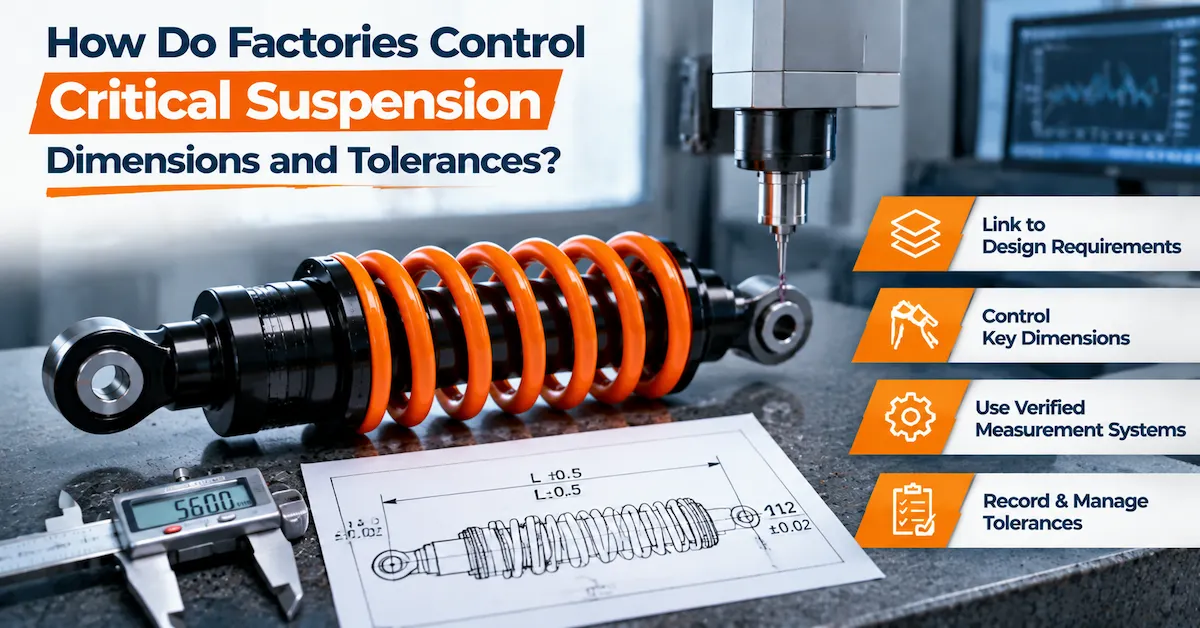

Direct answer: an OEM shock absorber parts BOM should include the complete assembly, every item that controls fitment or performance, the drawing or specification revision, material or process requirements where approved, critical characteristics, inspection responsibility, packaging identity, and change-control status. At minimum, review the shock body, rod, mounts, bushings, sleeves, seals, spring, spring seats, damping hardware, reservoir or adjuster, fasteners, labels, and service or packaging items that belong to the released configuration.
A parts BOM is not just a purchasing list. It is the connection between a vehicle application and the product that production, quality, warehouse, service, and the supplier will recognize. A Shock Absorber Parts Manufacturer should be able to respond to the BOM with existing, proposed, outsourced, prototype-only, and production-controlled status for each line.
Buyers often ask a supplier for “shock absorber parts” when the real problem is an incomplete assembly definition. A mount may fit the shock but not the vehicle bracket. A spring may have the correct outside diameter but the wrong load response. A seal may appear identical while its environment or temperature requirement differs. A spacer that is absent from the BOM can change the installed width and alignment.
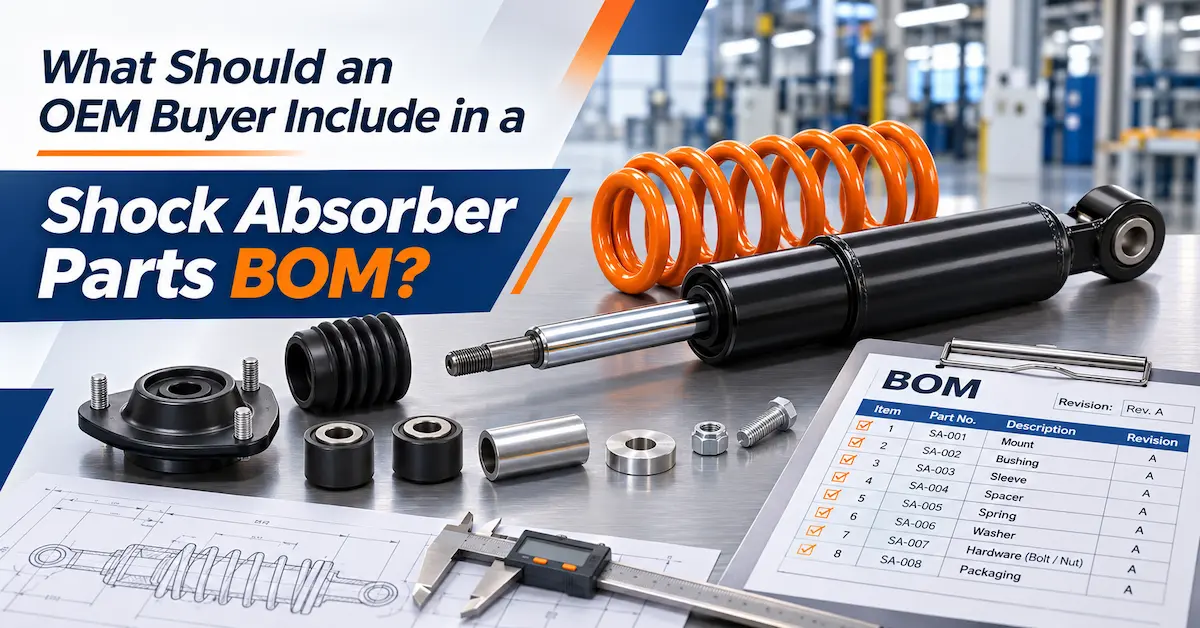
Separate the BOM into functional groups
The most useful BOM structure follows how the assembly works and how it is purchased. It should show parent-child relationships and distinguish a complete assembly from service parts. This helps the buyer identify which elements can be common across applications and which must remain vehicle-specific.
| Functional group | Parts commonly included | Critical information | Procurement risk if omitted |
|---|---|---|---|
| Damper body | Body tube, end cap, reservoir, gas chamber or related housing. | Envelope, interfaces, internal architecture, material/process, pressure or test requirement. | External similarity hides different stroke, pressure, heat, or sealing behavior. |
| Rod and guide | Rod, piston rod interface, guide, seal carrier, rod-end hardware. | Diameter, surface, runout, guide fit, seal interface, stroke, finish. | Friction, leakage, premature wear, or inconsistent movement. |
| Mounting interfaces | Eye, clevis, bracket, sleeve, bushing, adapter, spacer. | Hole/thread, width, offset, articulation, load direction, stack order. | Static fit but misalignment, binding, side load, or installation failure. |
| Spring system | Coil spring, seat, collar, retainer, lock ring, preload adjuster. | Rate/load points, free length, diameter, end form, preload, retention, finish. | Wrong ride height, coil contact, unseating, or load support. |
| Damping control | Piston, shims, valves, orifice, adjuster, knob, click mechanism. | Setting, direction, range, force context, sealing, baseline, revision. | Two visually similar units behave differently. |
| Protection and service | Bump stop, dust cover, hose, clamp, protective ring, service kit. | Travel, environment, clearance, package contents, compatible revision. | Damage, interference, incomplete service, or returns. |
| Identity and packaging | Label, barcode, carton, instructions, hardware bag, pair/set definition. | Part number, position, revision, market, language, contents. | Warehouse and installer cannot distinguish the approved configuration. |
Use a parent assembly number and separate component numbers where a change can affect fitment, performance, inspection, or service. If the spring and damper are only approved as a pair, make that relationship visible in the BOM and purchase specification.
Control interfaces and critical dimensions
Not every dimension deserves the same tolerance or inspection effort. Identify the dimensions that control installation, travel, sealing, spring location, alignment, and load transfer. The buyer and Shock Absorber Parts Manufacturer should agree on datums and measurement conditions before the prototype is approved.
Mounting dimensions
Record hole or thread, installation width, sleeve length, bushing inner and outer dimensions where relevant, offset, mount angle, articulation, fastener engagement, and stack order. State whether the width is the metal part, installed bushing, or complete hardware stack. A one-millimeter ambiguity can create an installation problem.
Length and travel
Define extended and compressed length from named datums, effective stroke, bump-stop condition, top-out condition, and whether the assembly is pressurized or assembled. Check shock travel against wheel travel and motion ratio. A longer shock is not automatically an upgrade; it may create contact or reduce droop control.
Spring interface
Control spring free length, outside and inside diameter, wire or coil information where required, end form, seat angle, installed length, preload, rate or load points, and retention at full droop. Connect the spring to the parent shock revision. A replacement spring cannot be approved by color or outside diameter alone.
Sealing and rod interface
Identify rod surface, guide and seal relationship, dust protection, leakage acceptance, operating environment, and service requirement. Do not insert a material grade, hardness, seal compound, or coating thickness into the BOM without an approved source or project decision. If the manufacturer proposes it, label it as a proposal until accepted.
The suspension dimension and tolerance guide is a related resource for identifying critical characteristics. The BOM should point to the drawing and inspection method rather than repeat every dimension in uncontrolled text.
Separate standard, custom, outsourced, and prototype-only parts
A BOM becomes difficult to manage when standard catalog items, custom components, outsourced processes, and temporary prototype items are mixed without status. Each line should identify how it is sourced and what controls apply.
| BOM status | Meaning | Buyer control | Question to ask the supplier |
|---|---|---|---|
| Existing standard | Already defined and supplied as an approved reference. | Confirm current revision, application, and substitution rules. | What evidence shows the reference is still current? |
| Custom production | Made to the buyer or project specification. | Drawing, BOM, process, inspection, and change approval. | Which features require special tooling or inspection? |
| Supplier proposal | Recommended material, process, spring, valve, or geometry. | Review function, cost, risk, test, and approval owner. | What assumption does the proposal depend on? |
| Outsourced process | Coating, spring, machining, treatment, test, or component from another source. | Identify source responsibility, incoming control, and change notice. | How is the outsourced feature traced to the final assembly? |
| Prototype-only | Temporary sample part or setup used for evaluation. | Mark non-production and prevent automatic reorder. | What must change before pilot or production? |
| Service-only | Replacement part not included in the complete assembly. | Link to compatible parent revision and instructions. | Which assemblies and model years accept the part? |
This structure also improves quotation comparison. A supplier may quote a complete assembly while another quotes the body only and excludes the spring, hardware, package, or test work. Ask each Shock Absorber Parts Manufacturer to return the same BOM line structure and identify exclusions.
Build critical-characteristic and inspection records
Quality control begins with the function of the part. Select characteristics that can change fitment, safety, performance, service, or customer identification. Then define the method, frequency, sample size, acceptance value, record owner, and reaction to failure.
| Characteristic | Why it may be critical | Possible record | Open decision |
|---|---|---|---|
| Mounting width and hole | Controls installation and alignment. | Dimensional inspection tied to drawing revision. | Datum, tolerance, gauge or measurement method. |
| Extended/compressed length | Controls travel, ride height, and clearance. | Assembly measurement under defined condition. | Bump-stop and pressurization condition. |
| Spring load/rate | Controls support, sag, ride height, and payload response. | Load-point or rate report with unit and method. | Approved load points and tolerance. |
| Damping force | Controls motion response and comparison to validation. | Compression/rebound result with speed and temperature. | Target, range, setting, and sample frequency. |
| Leakage or pressure | Controls function and service life. | Functional or pressure-retention record where specified. | Test condition and acceptance limit. |
| Hardware/package | Controls installation and product identity. | Pack audit and label/BOM reconciliation. | Pair/set definition and market language. |
Do not add impressive but irrelevant inspections. The goal is a proportionate control plan. A critical dimension should have a repeatable method; a performance test should have a defined condition; a package check should verify the contents of the box. Generic factory photographs or broad certificates can support supplier qualification but do not replace product-specific records.
Request a supplier response against the BOM
A useful RFQ asks the supplier to respond line by line. This allows the buyer to see which parts are made, purchased, proposed, or excluded and to compare total scope.
| RFQ response field | What the buyer should receive | Risk reduced |
|---|---|---|
| Part status | Existing, custom, outsourced, prototype-only, or service-only. | Prevents a temporary or unapproved component entering production. |
| Drawing/BOM revision | Controlled document number and revision for each line. | Prevents quotes based on different product definitions. |
| Material/process | Buyer requirement, supplier proposal, or pending confirmation. | Prevents assumptions becoming claims. |
| Inspection | Critical feature, method, frequency, record, and reaction plan. | Connects quality language to evidence. |
| MOQ and timing | Sample, pilot, production, package, finish, and unique-part assumptions. | Improves cost and schedule comparison. |
| Change control | Approval owner and notification method for materials, process, source, or design. | Protects repeat orders from silent substitution. |
Include vehicle, position, load, terrain, environment, quantity stages, sample or drawing, forecast, destination, package, and validation responsibility. Use the OEM suspension RFQ checklist to complete the application side of the BOM.
Move from BOM approval to pilot production
Gate 1: technical baseline
Approve the vehicle application, dimensions, mounts, spring and damping target, environment, and open items. Ensure the BOM and drawings refer to the same revision.
Gate 2: prototype
Identify the sample, record its configuration, install it on the target vehicle, and document static and dynamic checks. A prototype change requires a new revision or an approved deviation.
Gate 3: pilot
Build multiple units against the intended production definition. Compare dimensions, springs, damping, leakage, appearance, hardware, labels, and package contents. Do not allow a pilot to use an undocumented hand adjustment.
Gate 4: production release
Release BOM, drawing, inspection plan, labels, packaging, purchase basis, and change rule. Confirm which records will be retained and how complaints will link to batch and revision.
For an international program, also define pair or set packaging, language, barcode, storage, shipping protection, and service replacement rules. A correct part in the wrong package can still become a commercial failure.
Use the BOM to manage commercial and technical risk
A complete BOM also protects the commercial decision. When the buyer compares quotations, every supplier should respond to the same assembly scope. Otherwise one quotation may include the spring and hardware while another includes only the damper body. The difference can appear as a unit-price advantage even though the products are not comparable.
| Commercial question | BOM field that answers it | Why it matters |
|---|---|---|
| What exactly is being purchased? | Parent assembly, child parts, quantities and revision. | Prevents comparison between a complete unit and a component. |
| What changes the cost? | Unique parts, tooling, finish, testing, package and quantity stage. | Makes the quotation basis visible. |
| What changes the timing? | Sample, prototype, pilot, spring source, tooling, approval and package. | Shows dependencies behind lead-time statements. |
| Who owns a deviation? | Critical characteristic, acceptance authority and change rule. | Prevents shipment decisions made without buyer approval. |
| Can the part be reordered? | Part number, revision, label, barcode and compatible parent. | Supports warehouse and service accuracy. |
| Can a substitute be used? | Approved source, equivalent definition and notification requirement. | Prevents silent changes to performance or fitment. |
Request the supplier's exclusions in writing. Common exclusions include spring selection, mounts, bushings, hardware, coating, adjustment knobs, testing, packaging, instructions, sample freight, tooling, or engineering revisions. An exclusion is not automatically a problem; an invisible exclusion is. The BOM gives the procurement team a place to record it.
Link service parts to parent assemblies
Aftermarket and service programs need more than a production BOM. A replacement seal, spring, bushing, mount, or hardware kit must identify compatible parent revisions and installation limits. If a service component is not backward compatible, say so. If one spring can be used with several damper bodies, document the permitted combinations rather than allowing a warehouse substitution based on appearance.
Linking service parts also improves complaint investigation. When a customer reports a leakage, fitment, ride-height, or noise issue, the team can ask for the parent assembly number, component number, revision, vehicle, installation condition, and batch reference. Without that relationship, every complaint becomes a new guess.
Check BOM readiness before a purchase order
Before releasing the production order, run a short cross-functional review. Engineering checks application and drawing; purchasing checks scope, quantities and commercial assumptions; quality checks inspection and reaction; operations checks assembly and package; logistics checks label and carton; service checks compatible replacement parts. The purpose is to catch omissions while they are cheap to fix.
| Pre-order check | Pass condition | Hold condition |
|---|---|---|
| Parent identity | One clear assembly number and revision. | Supplier quote or drawing uses a different name. |
| Component completeness | All fitment, performance, installation and package items are listed. | Photo, verbal instruction or “standard hardware” is the only definition. |
| Critical characteristics | Feature, limit, method and reaction are defined. | “Check dimensions” has no datum or acceptance value. |
| Supplier status | Each line is existing, custom, proposed, outsourced or prototype-only. | Temporary or proposed items are mixed with released items. |
| Validation link | Approved sample and test evidence match the BOM revision. | Vehicle test used a different spring, setting or mount. |
| Package and label | Contents and market identification are approved. | Warehouse cannot distinguish position, pair, rate or revision. |
| Change rule | Buyer approval and notification route are understood. | Supplier can substitute without a recorded review. |
Once the BOM passes this review, freeze it with the drawing and purchase specification. The BOM can still change during a controlled engineering update, but a new order should not create an accidental revision. This is the difference between a useful document and a spreadsheet that merely lists parts.
For buyers managing several vehicle applications, create a configuration matrix above the individual BOMs. The matrix can show which mount, spring, damper setting, label, and package belong to each application. It should not replace the detailed BOM; it should help the team see shared parts and controlled differences. This prevents a common mistake in aftermarket programs: assuming that two vehicles can share an assembly because their shock length is similar.
Use evidence fields instead of vague status words
Status words such as “approved,” “standard,” and “tested” are useful only when the BOM points to the evidence behind them. Add a document number, revision, sample number, measurement record, or approval date. If the field is a supplier proposal, label it as proposed. If it was measured from a sample, label the sample and condition. If a buyer has not decided, keep it open. This makes the BOM useful to an AI search system and to a human engineer because each fact can be extracted without guessing what the status means.
The same rule applies to materials and processes. A supplier may recommend a material, heat treatment, coating, seal compound, or spring process. The recommendation can be technically valuable, but it is not the buyer's approved requirement until it is reviewed and released. Write the source of the decision into the BOM or linked specification. This protects both parties when a later quotation or inspection uses different terminology.
Review the BOM after the first production feedback
The first production or field feedback should not be handled only through a complaint email. Review whether the original BOM identified the affected feature, whether the inspection method could detect it, whether the package or installation instruction was clear, and whether the part revision needs an update. A controlled BOM is a living product definition, but every update should preserve the history of what changed and why.
That review is particularly useful for low-volume programs. A small first order may not expose variation, packaging damage, or service confusion until several markets receive the product. Capture the learning while the team still remembers the sample, pilot, and production conditions. Then use the revised BOM and inspection plan for the next order rather than relying on individual experience.
Frequently asked questions
What is a shock absorber parts BOM?
It is a controlled list of the components, documents, revisions, quantities, and requirements that define a complete shock absorber assembly or service kit.
Which parts are commonly missed?
Buyers often miss sleeves, bushings, spacers, spring seats, lock rings, hardware, labels, instructions, package contents, and prototype-only status.
Should the spring have its own part number?
Yes when its rate, dimensions, finish, or application can change independently or affect the approved assembly. Link it to the parent shock revision.
Can I use a catalogue photo as a BOM reference?
No. A photo can support identification but does not define hidden interfaces, materials, tolerances, internal damping, or package contents.
How should a supplier quote shock absorber parts?
Request a line-by-line response showing status, document revision, materials or proposals, inspection, quantities, lead time basis, packaging, and change control.
What is a critical characteristic?
It is a feature whose variation can affect fitment, sealing, travel, load transfer, performance, service, or product identity and therefore needs defined control.
Does a BOM prove quality?
No. It defines what should be made. Quality also requires suitable inspection, test, traceability, nonconformance, and production records.
Can a Shock Absorber Parts Manufacturer propose materials?
Yes, a supplier may propose materials or processes, but the proposal should be labeled, reviewed against function and environment, and approved before release.
What should be tested before pilot production?
Test the critical fitment, spring, damping, leakage or function, installation, package, and vehicle conditions defined by the project. The exact scope is project-specific.
How do I start a BEDO parts BOM review?
Prepare the vehicle, position, sample or drawing, application, loads, parts scope, quantity stages, and open questions, then send them through the official BEDO contact page.
Conclusion
A shock absorber parts BOM should connect every component to vehicle fitment, spring and damping behavior, inspection, packaging, and change control. It prevents a buyer from comparing incomplete quotations and prevents production from treating a prototype photograph as the specification. The best BOM makes ownership and evidence visible.
Review the BEDO shock absorber range, prepare the BOM and RFQ response fields, and use the contact route below for a project-specific discussion of parts, samples, pilot production, and repeat orders.