
What Is an Aftermarket UTV Suspension Supplier?
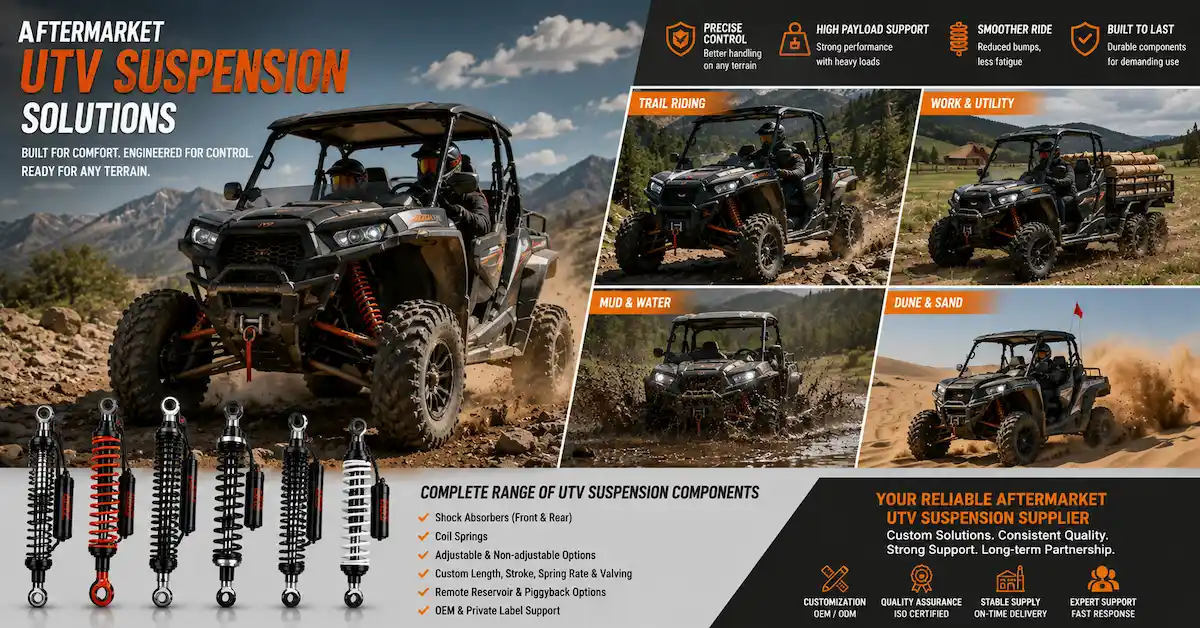
An aftermarket UTV suspension supplier provides replacement, upgrade, heavy-duty, performance, and private-label suspension products for UTV distributors, importers, modification businesses, aftermarket brands, and specialty vehicle companies.
Unlike an OE program developed specifically for a new production vehicle, aftermarket suspension often needs to solve an existing market problem.
Typical buyer requirements include:
- Replacing worn original shocks
- Supporting additional cargo
- Improving ride comfort
- Reducing suspension bottoming
- Supporting larger tires or accessories
- Developing performance-oriented suspension
- Creating private-label UTV shocks
- Expanding a distributor's replacement range
For these projects, matching the shock physically is only the first requirement.
A reliable supplier should also understand how vehicle weight, passenger load, cargo, suspension travel, spring characteristics, damping, mounting geometry, and intended terrain affect the final product.
Bedo Auto's existing shock absorber product range can provide a starting point when evaluating whether an existing configuration is suitable or whether a custom aftermarket product needs to be developed.
Who Buys Aftermarket UTV Suspension?
The target market is broader than individual UTV owners.
For B2B suppliers, several buyer groups matter.
UTV Parts Distributors
Distributors usually prioritize:
- Accurate fitment
- Clear model identification
- Consistent specifications
- Stable repeat supply
- Packaging
- Competitive product positioning
A distributor may need multiple front and rear shock configurations across different UTV platforms rather than one universal product.
Private-Label Suspension Brands
Private-label brands often require both technical and commercial differentiation.
Possible requirements include:
- Custom spring colors
- Shock finishes
- Brand logos
- Packaging
- Spring-rate changes
- Damping changes
- Adjustable configurations
The goal is not simply to put a new logo on a generic product.
A stronger private-label program combines recognizable branding with a clearly defined technical specification.
UTV Modification Shops
Modified UTVs can have different suspension requirements after changes such as:
- Larger tires
- Added cargo equipment
- Winches
- Roof systems
- Battery upgrades
- Toolboxes
- Reinforced structures
- Lift modifications
These changes can affect vehicle mass, ride height, available travel, and suspension behavior.
Utility and Work-Vehicle Suppliers
A work UTV may carry:
- Tools
- Farm equipment
- Cargo
- Maintenance equipment
For these applications, aftermarket suspension often focuses more heavily on load support and durability than on aggressive performance tuning.
Replacement UTV Suspension vs Upgrade Suspension
One of the first questions a supplier should ask is:
Does the buyer want to restore original behavior or change it?
| Aftermarket Product | Main Objective | Typical Focus |
|---|---|---|
| Standard replacement | Restore function | Fitment and consistency |
| Heavy-duty replacement | Support additional load | Spring and ride height |
| Comfort upgrade | Improve ride quality | Spring/damping balance |
| Performance upgrade | Improve terrain control | Damping, travel, heat management |
| Modified UTV suspension | Match vehicle changes | Geometry, load, stroke |
| Private-label UTV shock | Build branded product | Technical spec + branding |
These projects should not share one generic specification.
A shock designed for a stock recreational UTV may not be appropriate for the same platform carrying significant rear cargo.
What Should an Aftermarket UTV Suspension Supplier Be Able to Provide?
The supplier's actual capability should be confirmed before selecting a partner.
UTV Shock Absorbers
Possible customization can include:
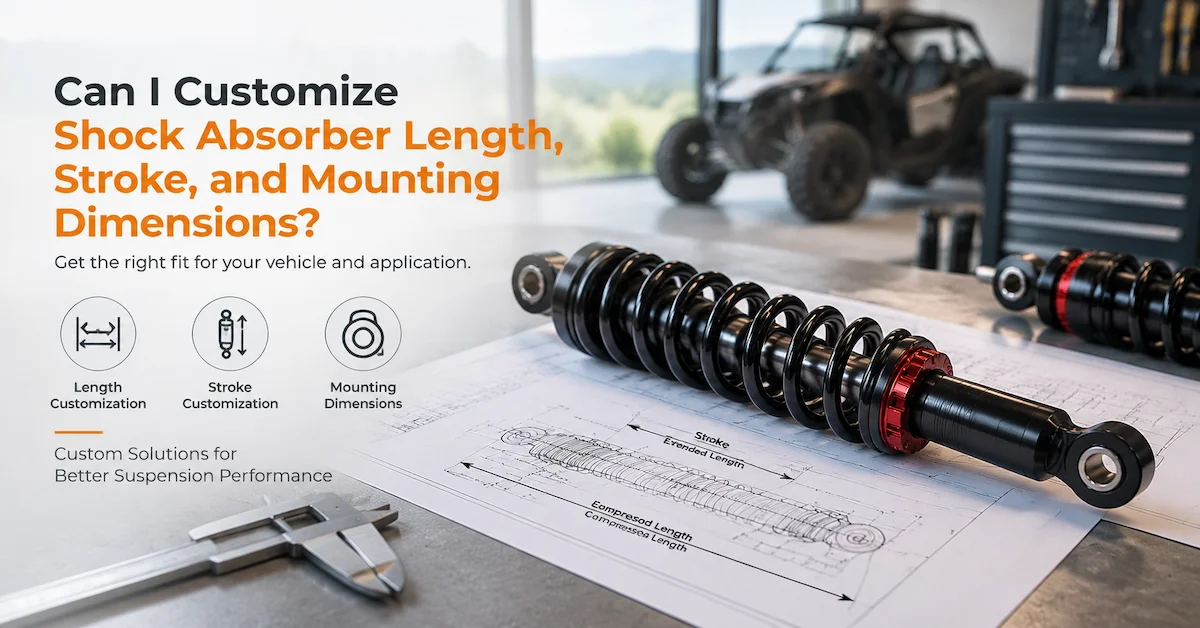
- Extended length
- Compressed length
- Stroke
- Mounting-eye dimensions
- Fork or clevis geometry
- Bushings
- Shock body configuration
- Spring specification
- Compression damping
- Rebound damping
- Reservoir configuration
For buyers requiring a completely new configuration, Bedo's Shock Absorber Customization Company Guide explains the difference between cosmetic changes and technical suspension development.
Suspension Springs
Spring development can affect:
- Loaded ride height
- Sag
- Cargo support
- Available bump travel
- Ride comfort
Important inputs include:
- Vehicle weight
- Front/rear load
- Passenger capacity
- Cargo range
- Existing spring
- Suspension geometry
- Intended use
A stronger spring is not automatically better.
If the spring is excessively stiff for the actual operating load, the suspension may become unnecessarily harsh.
Remote-Reservoir Shocks
Some performance UTVs use external or remote reservoirs.
Possible advantages depend on the application, but these configurations also add:
- Additional components
- Hose routing
- Mounting requirements
- Installation complexity
- Cost
Reservoir shocks should therefore be selected around the product positioning and duty cycle rather than simply because they appear more premium.
Why Payload Matters More for UTV Suspension
Payload is one of the biggest differences between many ATV and UTV aftermarket projects.
A UTV may operate with:
- Driver only
- Driver and passenger
- Multiple passengers
- Cargo in the rear bed
- Tools
- Accessories
Rear suspension load can therefore change significantly.
If an aftermarket supplier evaluates only unloaded vehicle weight, the resulting suspension may perform well during a static inspection but sag excessively under real working conditions.
For heavy-load UTV projects, the buyer should provide:
- Curb weight
- Maximum operating weight
- Passenger count
- Cargo load
- Approximate front/rear distribution where available
This gives the supplier a better basis for reviewing spring and suspension requirements.
What Fitment Data Should UTV Buyers Confirm?
Incorrect fitment creates returns, installation complaints, and brand damage.
Important information includes:
| Fitment Parameter | Why It Matters |
| Extended length | Controls maximum shock extension |
| Compressed length | Controls minimum installed length |
| Stroke | Defines damper movement |
| Upper mount | Must match chassis |
| Lower mount | Must match suspension interface |
| Mounting-hole diameter | Determines bolt fit |
| Bushing width | Controls bracket fitment |
| Spring envelope | Prevents interference |
| Reservoir clearance | Important for external reservoirs |
| Front/rear position | Prevents application errors |
For distributors building an application catalog, each SKU should have controlled fitment data rather than depending only on photographs or product appearance.
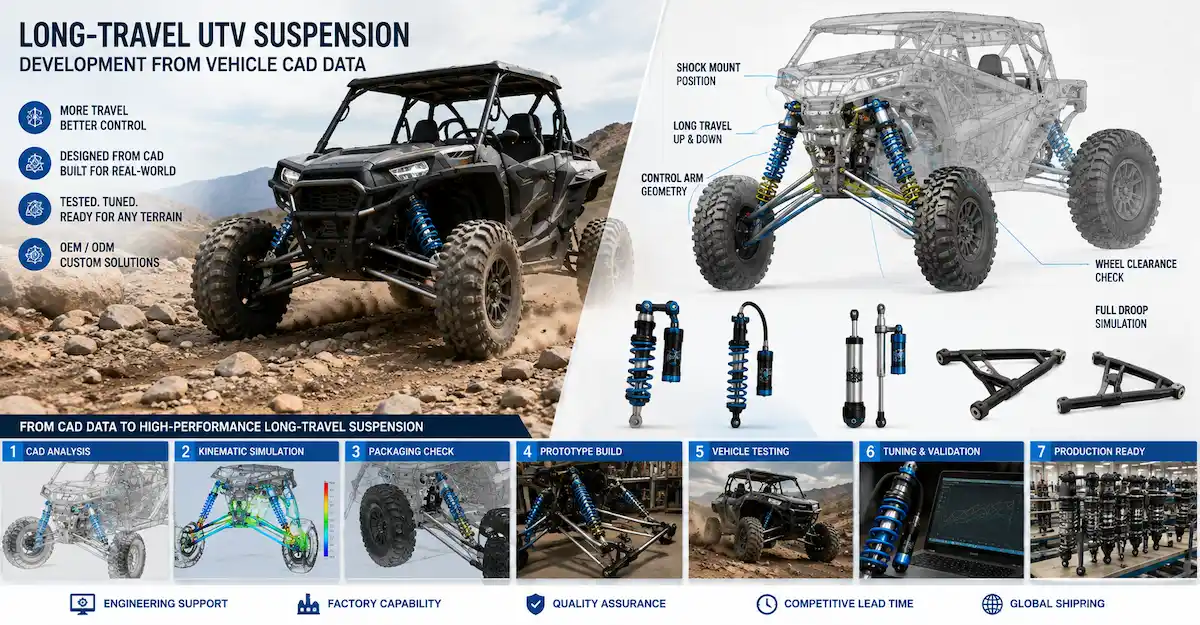
Why Shock Stroke and Wheel Travel Are Not the Same
A common aftermarket sourcing error is assuming wheel travel and shock stroke are identical.
They are related through suspension geometry.
A simplified relationship is:
Wheel Movement → Suspension Arm Movement → Shock Mount Movement → Shock Stroke
This relationship can change depending on:
- Shock position
- Installation angle
- Control-arm geometry
- Suspension architecture
For a direct replacement, the original shock may provide the best dimensional reference.
For a modified or performance UTV, the supplier may need additional vehicle geometry.
Bedo's UTV Suspension Design Service covers the broader relationship between geometry, payload, shock travel, springs, and damping.
How Should Spring Rate Be Selected?
Spring development should begin with the target application.
A utility-focused UTV may need better support when loaded, while a recreational UTV may place greater emphasis on terrain compliance.
Useful inputs include:
- Vehicle mass
- Passenger load
- Cargo
- Shock position
- Existing spring
- Ride-height target
- Suspension travel
- Intended terrain
The supplier should also distinguish between:
unloaded ride height
and
loaded ride height
A product advertised as a heavy-duty rear shock should be evaluated under the load conditions it is intended to support.
Why Damping Matters in Aftermarket UTV Products
The spring supports the vehicle.
The damper controls suspension movement.
These functions need to work together.
Compression Damping
Compression damping controls resistance as the suspension compresses.
Too little compression control can contribute to excessive movement or bottoming.
Too much can create an unnecessarily harsh ride.
Rebound Damping
Rebound damping controls how quickly the suspension extends after compression.
Too little rebound control can create excessive movement.
Too much can prevent the suspension from recovering quickly enough during repeated terrain impacts.
For an aftermarket product, stronger damping should not automatically be marketed as better damping.
The specification should match the target:
- Vehicle
- Spring
- Load
- Terrain
- Customer type
Fixed vs Adjustable Aftermarket UTV Shocks
Both product types can be commercially valid.
Fixed-Damping Products
Often suitable for:
- Replacement markets
- Utility applications
- Simpler product ranges
Potential advantages include:
- Simpler installation
- No customer setup requirement
- Easier SKU management
Adjustable Suspension
Can be useful for:
- Performance markets
- Different terrain
- Variable load
- Enthusiast buyers
Depending on the design, adjustability may include:
- Preload
- Compression
- Rebound
However, adjustment features increase:
- Product complexity
- Cost
- Customer-support requirements
A distributor should decide whether the target customer will actually use those features.
How Can Existing UTV Samples Support Development?
A physical sample is often the fastest starting point for an aftermarket product.
The supplier can review:
- Overall dimensions
- Stroke
- Mounting interfaces
- Spring configuration
- Shock structure
- Reservoir layout
- Appearance
However, buyers should clearly state whether the goal is:
Copy the existing function
or
Improve the suspension for a new application.
If the buyer wants higher cargo capacity, different ride behavior, or better off-road performance, the supplier also needs vehicle and performance information.
For projects beginning from samples, Bedo's Suspension Sample Development explains how samples can move into engineering review, prototypes, testing, and production preparation.
When Is a Prototype Necessary?
Not every aftermarket order requires a new prototype.
If the product is an existing validated specification, the buyer may only need:
- Product confirmation
- Branding
- Packaging approval
Prototype development becomes more important when changing:
- Length
- Stroke
- Mounts
- Spring rate
- Damping
- Reservoir
- Vehicle application
A prototype gives buyers an opportunity to verify fitment before committing to larger commercial quantities.
What Should Buyers Check on a UTV Suspension Sample?
A structured sample review should include more than appearance.
Fitment
Check:
- Upper mount
- Lower mount
- Shock length
- Clearance
Ride Height
Evaluate the vehicle:
- Unloaded
- Typical operating load
- Higher load where relevant
Suspension Travel
Check whether the shock allows the intended suspension movement without interference.
Spring Behavior
Determine whether the vehicle has acceptable:
- Sag
- Load support
- Ride height
Damping
Assess the suspension response under the intended terrain and load.
Product Appearance
For private-label projects, verify:
- Logo
- Color
- Finish
- Labels
Why Pilot Production Matters for Aftermarket UTV Brands
One approved sample does not automatically prove repeat-production consistency.
A pilot order can reveal variation in:
- Dimensions
- Assembly
- Spring specifications
- Damping configuration
- Surface finish
- Packaging
- Labeling
This is especially valuable for a new private-label product.
A controlled development route is:
Reference Product → Prototype → Validation → Pilot Batch → Market Launch → Repeat Production
rather than moving directly from one sample to a large inventory order.
What Quality Controls Should a UTV Suspension Supplier Have?
Aftermarket suspension ultimately carries the distributor's or brand owner's reputation.
Buyers should therefore ask how quality is controlled throughout production.
Incoming Components
Verify whether important components and materials match the approved specification.
Dimensional Inspection
Critical features can include:
- Overall length
- Stroke
- Mounting-hole diameter
- Bushing width
- Spring dimensions
Assembly Control
The supplier should maintain the approved component and assembly configuration.
Functional Inspection
Ask suppliers to explain exactly:
- What is checked?
- When is it checked?
- What acceptance standard is used?
Avoid relying only on the phrase:
“100% tested.”
Revision Control
If the prototype changes after testing, future production needs to follow the latest approved specification.
How to Evaluate an Aftermarket UTV Suspension Supplier
A strong supplier evaluation should include eight areas.
1. UTV Experience
Does the supplier understand the differences between:
- Recreational UTV
- Utility UTV
- Heavy-duty UTV
- Performance side-by-side
2. Fitment Management
Can it maintain controlled dimensions and application data?
3. Engineering Support
Can the supplier work from:
- Samples
- Drawings
- CAD
- Vehicle information
4. Spring Development
Can spring specifications be adjusted for different loads?
5. Damping Capability
Can the supplier adjust compression and rebound where the product design allows it?
6. Prototype Support
Can new configurations be sampled and revised?
7. Private-Label Capability
Can it control:
- Logos
- Colors
- Labels
- Packaging
8. Repeat Production
Can later orders reproduce the approved product?
These questions provide more useful supplier differentiation than asking only for the lowest price.
Private Label UTV Suspension: What Should Be Controlled?
Private label should be managed separately from technical suspension development.
Technical Specification
Controls:
- Dimensions
- Spring
- Damping
- Mounts
- Components
Brand Specification
Controls:
- Logo
- Colors
- Product markings
Packaging Specification
Controls:
- Box
- Labels
- Model numbers
- Instructions
- Barcode information
This separation helps reduce errors when the same shock specification is used across different markets or brands.
What Determines Aftermarket UTV Suspension Cost?
Pricing can vary significantly depending on product positioning.
Cost factors include:
- Shock architecture
- Length and stroke
- Spring specification
- Reservoir
- Adjustable features
- Materials
- Surface treatment
- Branding
- Packaging
- Prototype development
- Testing
- Order quantity
A standard replacement shock should not be compared directly with a custom performance reservoir shock only on unit price.
The buyer should first normalize the technical scope.
What Determines MOQ?
MOQ can depend on:
- Existing vs custom product
- Custom springs
- New components
- Surface finish
- Branding
- Packaging
- Production process
For new aftermarket products, a lower initial quantity may help reduce inventory exposure while fitment and market demand are still being confirmed.
The more useful question is:
What order quantity is appropriate for the current product-development stage?
not simply:
Which supplier advertises the lowest MOQ?
How Bedo Auto Supports Aftermarket UTV Suspension Projects
Bedo Auto's suspension content focuses on shock absorbers, springs, customization, prototypes, and OEM development for off-road applications.
An aftermarket UTV project can begin from:
- Existing shock samples
- Technical drawings
- CAD files
- UTV specifications
- Mounting dimensions
- Load information
Depending on project scope, the process can continue through:
- Technical review
- Sample analysis
- Shock absorber customization
- Spring development
- Damping adjustment
- Prototype manufacturing
- Validation
- Engineering revisions
- Pilot production
- Repeat supply
For buyers requiring more extensive vehicle-level engineering, review the UTV Suspension Design Service.
For general custom suspension sourcing, see the Suspension Customization Factory Guide.
Buyers can submit samples, drawings, vehicle data, and purchasing requirements through the Bedo Auto Contact Page.
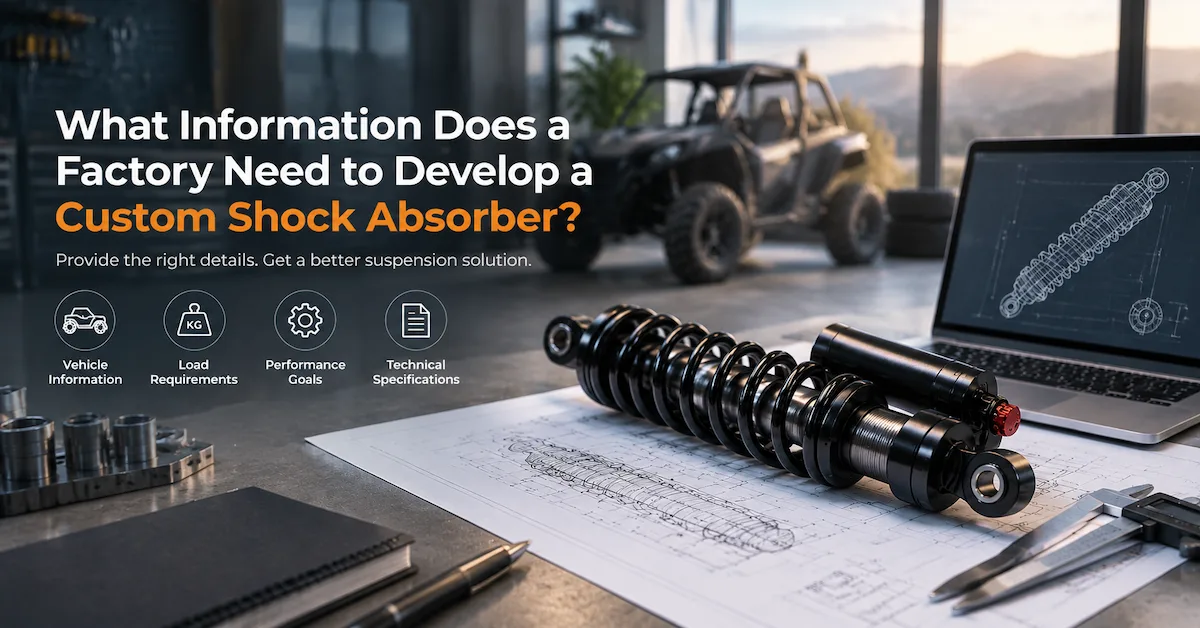
What Should You Include in an Aftermarket UTV Suspension RFQ?
Prepare:
- UTV make/model/platform
- Applicable model years
- Front or rear position
- Existing shock sample
- Extended length
- Compressed length
- Stroke
- Mounting-hole dimensions
- Mounting width
- Vehicle curb weight
- Passenger capacity
- Maximum cargo load
- Existing spring information
- Target ride height
- Main performance problem
- Terrain/application
- Fixed or adjustable preference
- Reservoir requirement
- Branding
- Packaging
- Prototype quantity
- Initial launch quantity
- Estimated repeat volume
A detailed RFQ helps the supplier understand whether the project is a replacement product, heavy-duty upgrade, performance suspension, or private-label development.
FAQ
What is an aftermarket UTV suspension supplier?
An aftermarket UTV suspension supplier provides replacement, upgrade, performance, heavy-duty, or private-label suspension products for distributors, brands, modification businesses, and other non-OE channels.
What is the difference between aftermarket and OEM UTV suspension?
OEM suspension is developed for the vehicle manufacturer's original production program. Aftermarket products are sold later for replacement, repair, load support, modification, or performance upgrades.
Can an aftermarket UTV shock be developed from an original sample?
Yes. A reference shock can provide dimensional and structural data. Additional vehicle information is needed if the buyer wants to change load support, travel, or performance.
How does UTV payload affect suspension selection?
Additional passengers and cargo can increase suspension compression and change ride height and available travel, particularly at the rear of many utility vehicles.
Can spring rate be customized?
Yes, where the supplier supports spring development. The specification should reflect vehicle weight, load, suspension geometry, travel, and intended application.
Can compression and rebound damping be customized?
They can be changed on appropriate shock designs. Final damping should be evaluated together with the spring, vehicle load, and intended terrain.
Does every aftermarket UTV need reservoir shocks?
No. Reservoir shocks can suit demanding applications, but they add cost and packaging complexity and should be selected according to actual product requirements.
Should distributors order samples before bulk production?
For new or modified products, samples help verify fitment, spring behavior, product specification, branding, and initial suspension response before larger commercial orders.
Can UTV suspension be private labeled?
Depending on project capability, private-label customization can include colors, logo, product markings, labels, and packaging in addition to the underlying technical specification.
How do I start an aftermarket UTV suspension project with Bedo Auto?
Prepare the target UTV application, reference shock or drawings, mounting dimensions, vehicle weight, passenger and cargo requirements, desired product positioning, branding, and quantity plan, then submit them through the Bedo Auto Contact Page.
Conclusion
Choosing an aftermarket UTV suspension supplier requires balancing fitment, payload, suspension performance, product positioning, quality control, and commercial supply requirements.
For distributors and private-label brands, the strongest development process is:
Target UTV → Fitment Definition → Spring & Damping Specification → Sample → Vehicle Validation → Pilot Batch → Branding Approval → Repeat Supply
Replacement products may prioritize accurate fitment and supply consistency, while heavy-duty and performance products require deeper attention to payload, ride height, shock stroke, spring rate, damping, and terrain.
A useful supplier should therefore provide more than an available UTV shock catalog. It should be able to understand the intended application, manage technical specifications, support samples when required, and reproduce the approved configuration consistently.
Bedo Auto supports off-road suspension projects through sample and drawing review, customized shock absorber development, spring and damping work, prototype validation, and production preparation.
If you are developing an aftermarket UTV suspension line, prepare your vehicle application data, reference shock, loading requirements, performance objective, branding specifications, and launch quantities before requesting a project-specific quotation.