
What Is a UTV Suspension Design Service?
A UTV suspension design service helps vehicle manufacturers develop a suspension system around the actual requirements of a utility task vehicle rather than selecting shock absorbers only by length or appearance.
For an OEM project, suspension design can involve much more than choosing front and rear shocks. The engineering team may need to consider vehicle mass, payload, passenger capacity, chassis hard points, control-arm geometry, wheel travel, shock stroke, spring characteristics, damping targets, reservoir packaging, tire clearance, terrain, and intended duty cycle.
These variables interact with each other.
A shock absorber that fits one UTV may not be appropriate for another vehicle with different payload, suspension leverage, travel, or operating conditions.
Bedo Auto currently provides suspension engineering and prototype-development support for UTV and other off-road applications, including drawing review, spring development, damping adjustment, prototype production, testing, and OEM production preparation.
For buyers starting with an incomplete vehicle concept or existing CAD, Bedo's Suspension Design Partner Guide provides a useful overview of the broader engineering workflow.
Why UTV Suspension Design Is Different From Simply Selecting a Shock Absorber
A catalog shock absorber is a component.
A suspension system is a vehicle-level combination of geometry, springs, dampers, tires, masses, linkages, and operating conditions.
That distinction is especially important for UTV applications because one platform may be designed primarily for recreational use, while another may carry tools, cargo, passengers, or equipment over rough terrain.
Load Changes the Design Problem
UTV suspension may need to operate under more than one load condition:
- Driver only
- Driver and passenger
- Full passenger load
- Cargo in the rear bed
- Towing or accessory loads
- Added battery mass on electric UTVs
- Working equipment or aftermarket accessories
The suspension must therefore be reviewed against the expected operating range rather than only the unloaded vehicle.
Bedo's heavy-duty UTV guidance similarly emphasizes payload, suspension geometry, terrain, speed, and duty cycle as core inputs when developing UTV suspension components.
Geometry Changes Shock Behavior
Shock absorber movement depends on where and how the damper is installed.
Important geometric variables can include:
- Upper shock hard point
- Lower shock hard point
- Control-arm length
- Shock inclination
- Wheel center location
- Suspension travel
- Motion ratio through the travel range
SAE research on off-road suspension design has likewise treated suspension geometry, dimensions, and installation position as central design variables when defining expected vehicle behavior.
Terrain Changes the Performance Target
A utility vehicle used on a farm does not necessarily need the same suspension calibration as a recreational UTV driven at higher speed over whoops, rocks, or desert terrain.
The development target may prioritize different combinations of:
- Load support
- Ride comfort
- Wheel control
- Bottoming resistance
- Traction
- Heat management
- Stability
- Durability
This is why a professional UTV design service should begin with the application rather than a predetermined shock specification.
Who Needs a Custom UTV Suspension Design Service?
A custom engineering service is most valuable when an existing production suspension cannot directly meet the new project requirement.
Typical buyers include:
- UTV manufacturers
- Side-by-side vehicle brands
- Electric UTV developers
- Utility vehicle OEMs
- Agricultural vehicle manufacturers
- Recreational off-road brands
- Performance UTV companies
- Specialty vehicle developers
- Suspension aftermarket brands
- Startups developing new off-road platforms
Common project situations include:
- New vehicle development
- Increased payload
- Longer suspension travel
- New chassis geometry
- Electric powertrain conversion
- Different tire size
- New front or rear control-arm design
- Reservoir shock conversion
- Ride-comfort improvement
- Heavy-duty commercial application
- Performance-oriented suspension upgrade
If an existing Bedo configuration already meets the application, buyers can first review the current shock absorber product range. Bedo currently offers ATV/UTV shock configurations with different lengths, strokes, spring rates, and damping specifications, illustrating why suspension products cannot be treated as one universal configuration.
What Information Should You Provide for UTV Suspension Design?
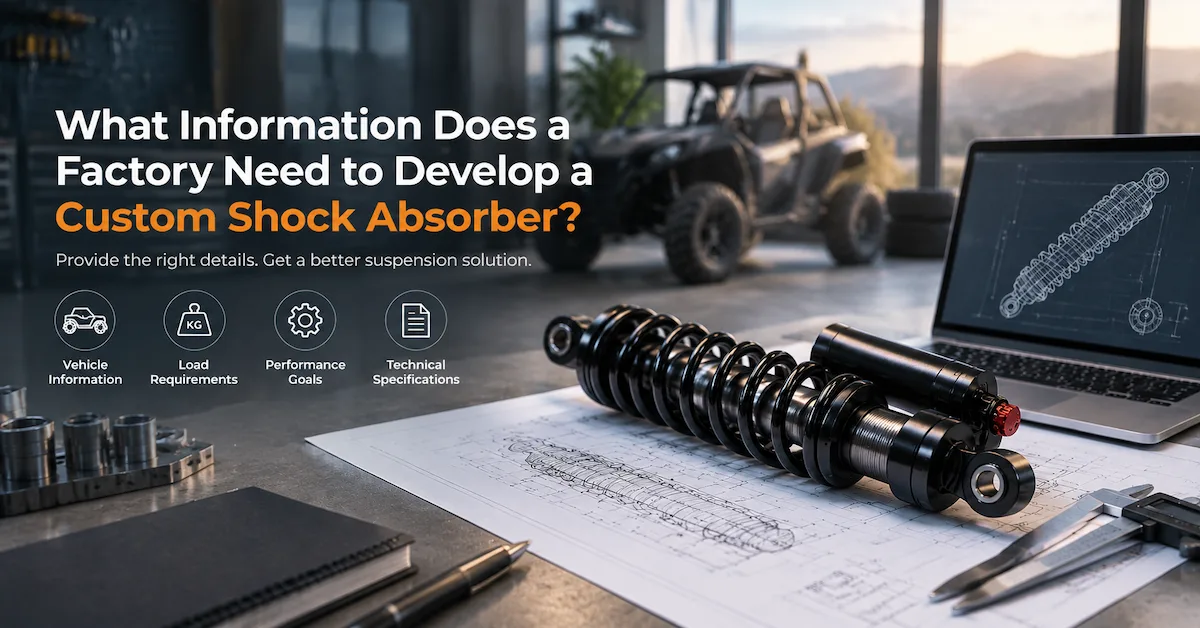
The quality of engineering output depends on the quality of the vehicle input.
A supplier should not finalize a suspension design based only on a photograph or a requested eye-to-eye length.
| Engineering Input | Information to Provide | Why It Matters |
|---|---|---|
| UTV application | Utility, recreational, racing, agricultural, EV | Defines design priority |
| Vehicle curb weight | Unloaded vehicle mass | Establishes baseline |
| Maximum operating weight | Loaded vehicle mass | Defines upper load case |
| Passenger capacity | Expected occupants | Changes sprung load |
| Cargo load | Maximum bed/equipment load | Often affects rear suspension strongly |
| Weight distribution | Front/rear if available | Supports axle-specific development |
| Wheel travel | Target front and rear travel | Defines suspension requirement |
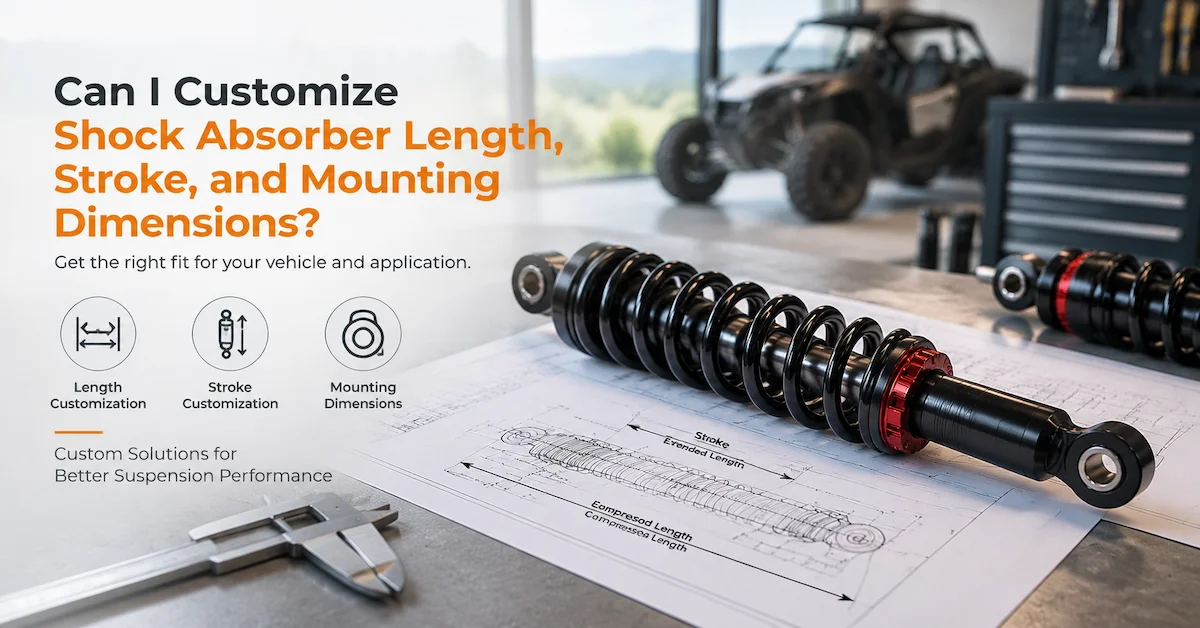
| Shock stroke | Required or current stroke | Connects damper to wheel movement |
| Chassis hard points | CAD or measured coordinates | Defines geometry |
| Control-arm geometry | CAD or dimensions | Supports motion review |
| Shock angle | Installed orientation | Influences effective wheel response |
| Tire dimensions | OD and width | Supports packaging review |
| Ground clearance | Current/target | Affects ride-height targets |
| Spring data | Existing rate, preload, dimensions | Provides baseline |
| Damping data | Existing or target curves if known | Supports tuning |
| Terrain | Farm, trail, rock, sand, desert, mixed use | Defines operating inputs |
| Reference vehicle | Existing benchmark if available | Helps communicate target behavior |
If some values are unknown, the engineering team should identify them as open items rather than silently assume them.
Which UTV Suspension Geometry Parameters Matter Most?
UTV suspension design should begin with the geometry that controls how the wheel and shock move relative to the chassis.
Suspension Hard Points
Hard points define the positions where major suspension components connect.
Depending on the UTV layout, useful coordinates may include:
- Upper control-arm chassis mounts
- Lower control-arm chassis mounts
- Ball-joint positions
- Upper shock mount
- Lower shock mount
- Wheel center
- Tie-rod points
- Rear trailing-arm or H-arm points
The exact information depends on the suspension architecture.
Wheel Travel
Wheel travel describes how far the wheel can move through bump and droop.
It must not automatically be treated as equal to shock stroke.
A suspension linkage can produce a different amount of damper movement for a given amount of wheel movement.
Shock Stroke
Shock stroke must be sufficient for the intended suspension movement without creating:
- Internal bottoming
- Excessive extension
- Chassis interference
- Incorrect droop
- Unused suspension travel
The shock also needs enough packaging space at both full compression and full extension.
Shock Installation Angle
The shock's mounting orientation influences the relationship between wheel motion and damper motion.
An angled shock generally experiences a different effective movement than a vertically mounted shock for the same wheel displacement.
The geometry should therefore be reviewed over the suspension's travel rather than at only one static position.
Why Motion Ratio Matters in UTV Suspension Development
The motion ratio describes the relationship between wheel movement and shock or spring movement.
For OEM buyers, the key point is simple:
The spring rate printed on the coil spring is not automatically the effective spring rate experienced at the wheel.
The actual wheel response depends partly on suspension leverage and installation geometry.
This means two UTVs using the same nominal spring rate may behave differently.
When developing a new suspension, engineers should therefore consider:
- Wheel movement
- Damper movement
- Spring movement
- Control-arm geometry
- Shock mounting position
A CAD model can help visualize these relationships before prototype production.
For projects beginning with digital vehicle data, see Bedo's CAD-Based Suspension Development. Bedo currently describes CAD review as part of a larger process that continues into prototype and physical validation.
How Does Vehicle Load Affect UTV Spring Design?
A UTV spring has to support the vehicle while maintaining suitable ride height and usable suspension travel.
The correct solution depends on more than maximum vehicle weight.
Important Spring Inputs
Engineering teams may need to review:
- Corner weight or axle load
- Passenger load
- Cargo load
- Suspension motion ratio
- Available shock travel
- Desired ride height
- Required sag
- Terrain
- Intended ride characteristic
Front and Rear Springs Usually Have Different Jobs
The front suspension may be strongly influenced by:
- Steering
- Braking
- Front-end impact inputs
- Tire control
The rear suspension may experience larger changes from:
- Cargo
- Passengers
- Bed load
- Towing-related load transfer
This is why using identical front and rear spring settings simply for convenience is rarely an appropriate engineering assumption.
Bedo's current UTV suspension guidance also notes that front and rear positions normally carry different loads and perform different handling functions.
How Should Damping Be Developed for a UTV?
The spring supports the load.
The damper controls suspension movement.
Both need to work together.
Compression Damping
Compression damping controls the shock as the suspension compresses.
Depending on the application, engineers may need to balance:
- Impact absorption
- Body control
- Bottoming resistance
- Ride comfort
- Tire contact
Too much damping is not automatically better.
Excessive compression control can make the vehicle harsh and prevent the suspension from using its available travel effectively.
Rebound Damping
Rebound damping controls suspension extension after compression.
Insufficient rebound control can allow the vehicle to recover too rapidly, while excessive rebound can prevent the suspension from returning quickly enough during repeated terrain inputs.
Damping Must Match the Operating Scenario
An SAE study on off-road shock absorber optimization demonstrates why damping needs to be developed around specific terrain inputs, wheel travel, vehicle response, and performance criteria rather than selected as one universal value.
For OEM projects, this means the development process may need to include:
Initial damping target → Prototype → Test → Feedback → Valve/damping revision → Retest
rather than treating the first specification as final.
Does Every UTV Need Reservoir Shock Absorbers?
No.
A remote reservoir can provide packaging and thermal-management advantages for some demanding applications, but it also adds:
- Components
- Hose routing
- Mounting requirements
- Packaging complexity
- Cost
Reservoir shocks may be more valuable in applications involving longer or more severe duty cycles, but their suitability should be evaluated against actual operating conditions and available space. Bedo's current heavy-duty UTV guidance makes the same distinction: reservoir shocks are not necessary for every application.
A design service should therefore answer:
Does this UTV benefit from a reservoir?
rather than:
How can we add a reservoir to every design?
How Does CAD Support UTV Suspension Design?
CAD is particularly useful during early geometry and packaging development.
Chassis Packaging
Engineers can review whether the shock, spring, reservoir, and nearby components fit within the chassis.
Wheel and Tire Clearance
UTV tires may move through substantial vertical travel while steering.
Potential interference should be reviewed across relevant suspension positions.
Control-Arm Clearance
The shock body, coil spring, mounts, and reservoir must maintain sufficient clearance from moving arms and joints.
Reservoir and Hose Routing
For external-reservoir designs, CAD can support:
- Reservoir placement
- Hose length planning
- Hose routing
- Mounting bracket position
- Service access
Full-Bump and Full-Droop Conditions
A static CAD screenshot is not enough.
Where vehicle data allows it, the design should be reviewed through relevant suspension positions to identify potential interference and travel limitations.
CAD Simulation vs Physical UTV Testing
Digital development can reduce obvious geometry mistakes, but it cannot replace physical validation.
| Digital Design Can Help With | Physical Validation Is Needed For |
| Hard-point geometry | Actual ride response |
| Shock packaging | Compression damping behavior |
| Wheel travel estimation | Rebound behavior |
| Component interference | Shock temperature |
| Reservoir placement | Leakage performance |
| Mounting orientation | Durability |
| Spring envelope | Noise and friction |
| Revision control | Real terrain performance |
SAE literature on vehicle suspension development similarly highlights that geometry, kinematics, damping, and vehicle-level evaluation all contribute to ride and handling performance.
This is why Bedo's development workflow continues from engineering review into Suspension Prototype Development and Suspension Validation. Bedo currently lists prototype verification, shock testing, spring validation, vehicle application verification, engineering optimization, and production quality control within its validation support.
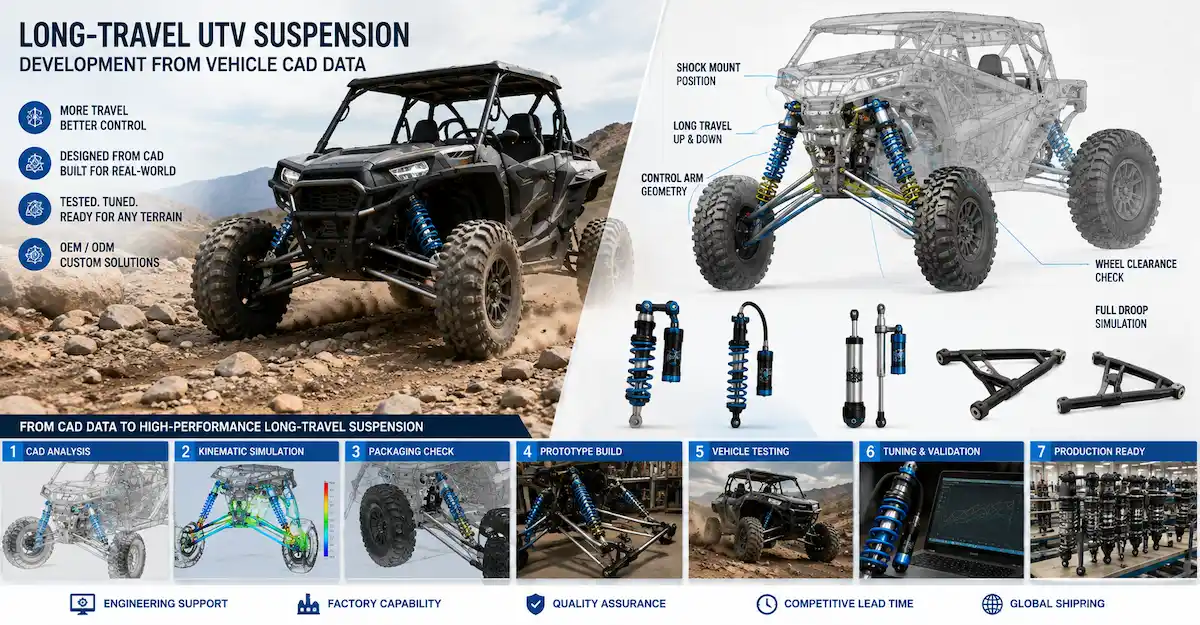
A Practical UTV Suspension Design Process
A professional OEM project can be organized into connected stages.
1. Define the Vehicle and Buyer Requirement
The engineering team identifies:
- UTV type
- Target user
- Payload
- Passenger capacity
- Terrain
- Desired ride characteristics
- Expected production volume
2. Collect Vehicle Geometry
Available data may include:
- Vehicle CAD
- Chassis drawings
- Control-arm CAD
- Existing suspension drawings
- Physical reference vehicle
- Existing shock samples
3. Define the Suspension Package
The design team establishes preliminary targets for:
- Wheel travel
- Shock travel
- Mounting positions
- Spring package
- Shock body
- Reservoir configuration
4. Review Kinematics and Packaging
Engineers check:
- Motion relationship
- Full bump
- Full droop
- Tire clearance
- Chassis clearance
- Control-arm clearance
- Reservoir packaging
5. Develop the Shock and Spring Specification
The design can then progress toward:
- Extended length
- Compressed length
- Stroke
- Spring rate target
- Preload range
- Damping target
- Mounting structure
- Adjustment features
6. Manufacture the Prototype
The digital design becomes a physical suspension component.
Prototype manufacturing verifies whether the proposed design can actually be produced and assembled.
7. Install on the UTV
The prototype should be checked for:
- Fitment
- Ride height
- Travel
- Clearances
- Mount alignment
- Hose routing
8. Test Suspension Performance
Testing may reveal the need to change:
- Spring rate
- Preload
- Compression damping
- Rebound damping
- Shock travel
- Mount location
- Reservoir setup
9. Update the Engineering Specification
Approved changes should be reflected in drawings, CAD, specifications, and revision records.
10. Validate Pilot Production
Before larger OEM orders, a pilot or small batch can help verify production repeatability.
This connected prototype-to-production workflow is consistent with Bedo's current engineering and suspension sample-development support.
UTV Suspension Design for Different Applications
A good supplier should not tune every UTV to the same target.
| Application | Key Design Priority | Important Variables |
| Utility/work UTV | Load support and durability | Payload, rear load, spring support |
| Recreational UTV | Comfort and terrain adaptability | Travel, damping balance, traction |
| High-speed off-road UTV | Wheel control and heat management | Damping, travel, reservoir, repeated impacts |
| Agricultural UTV | Load variation and rough low-speed terrain | Cargo, durability, ride comfort |
| Electric UTV | Added mass and packaging | Battery weight, weight distribution, chassis space |
| Specialty UTV | Application-specific performance | Custom geometry and duty cycle |
This table should be used as an engineering starting point rather than a universal specification.
Actual suspension development needs project-specific vehicle data.
Common UTV Suspension Design Mistakes
Selecting Shocks Only by Eye-to-Eye Length
Two shocks with the same overall length can have different stroke, damping, spring, reservoir, and mounting characteristics.
Better approach: evaluate the complete application.
Assuming More Spring Rate Is Always Better for Heavy Loads
A stiffer spring may improve load support but can also change ride quality and available suspension movement.
Better approach: evaluate the vehicle's actual load range and geometry.
Treating Wheel Travel as Shock Stroke
They are related but not necessarily equal.
Better approach: evaluate suspension motion and leverage.
Ignoring Loaded Ride Height
A UTV may look correct unloaded but sag excessively after passengers or cargo are added.
Better approach: define relevant loaded conditions during development.
Ignoring Rear Cargo Distribution
Cargo position can significantly change the load carried by the rear axle.
Better approach: provide realistic maximum payload information.
Copying an ATV Suspension Specification
ATV and UTV applications can differ substantially in vehicle size, passenger arrangement, payload, chassis layout, and duty cycle.
Better approach: develop the UTV around its own vehicle data.
Finalizing Damping Before Vehicle Testing
Real terrain feedback may identify behavior not predicted by the initial specification.
Better approach: allow for prototype tuning.
How to Evaluate a UTV Suspension Design Service Supplier
The supplier should be evaluated as an engineering partner, not only as a shock absorber vendor.
Vehicle-Level Engineering Understanding
Ask whether the supplier requests information about:
- Vehicle mass
- Payload
- Wheel travel
- Geometry
- Terrain
- Suspension position
CAD and Drawing Capability
The supplier should be able to work with relevant customer data and manage technical revisions.
Spring Development
Ask how spring specifications are selected and revised.
Damping Development
Confirm whether compression and rebound characteristics can be adjusted during prototype work.
Prototype Manufacturing
A supplier that can manufacture its own development samples can reduce handoffs between engineering and manufacturing.
Testing and Validation
Ask what can actually be tested rather than accepting generic statements such as "100% tested."
Prototype-to-Production Transition
The approved engineering specification should be transferable into repeat manufacturing.
Bedo currently positions its UTV and off-road suspension support around drawing review, custom development, prototype testing, spring and damping development, and batch production.
How Bedo Auto Supports UTV Suspension Design Projects
Bedo Auto focuses on shock absorbers, suspension springs, and customized suspension solutions for off-road and specialty vehicles. Its current product and engineering pages describe OEM customization, suspension engineering, prototype development, testing validation, and manufacturing support.
A UTV project can begin from:
- Existing shock samples
- Drawings
- CAD files
- Vehicle specifications
- Mounting dimensions
- Payload information
- Suspension requirements
The development process can then include:
- Engineering review
- CAD/drawing review
- Shock absorber development
- Spring development
- Damping tuning
- Prototype manufacturing
- Installation validation
- Performance testing
- Engineering revision
- Pilot production
- OEM manufacturing
For high-payload projects, buyers can also review Bedo's Heavy Duty UTV Suspension Parts Guide.
What Should You Include in a UTV Suspension Design RFQ?
A detailed RFQ helps the supplier evaluate the project before quoting development work.
Include as much of the following as possible:
- UTV type and intended application
- Front and rear suspension configuration
- Vehicle curb weight
- Maximum operating weight
- Number of passengers
- Maximum cargo load
- Front/rear weight distribution if available
- Target wheel travel
- Current shock stroke
- Extended and compressed shock lengths
- Upper and lower mounting geometry
- Shock installation angle
- Control-arm drawings or CAD
- Chassis CAD if available
- Wheel and tire dimensions
- Desired ride height
- Existing spring data
- Existing damping data
- Current shock absorber sample
- Terrain and duty cycle
- Prototype quantity
- Estimated future OEM volume
If some engineering inputs are unknown, clearly identify them rather than inventing values.
Buyers can send drawings, samples, vehicle specifications, and UTV project requirements through the Bedo Auto Contact Page.
FAQ
What is a UTV suspension design service?
A UTV suspension design service helps OEM teams develop suspension geometry, shock absorber specifications, springs, damping, packaging, prototypes, and validation plans around a specific utility vehicle application.
What information is needed to design a custom UTV suspension?
Important inputs can include vehicle weight, payload, wheel travel, shock mounting positions, suspension geometry, tire dimensions, ride-height targets, terrain, spring data, and existing shock specifications.
Is UTV wheel travel the same as shock absorber stroke?
Not necessarily. Their relationship depends on suspension geometry, shock mounting position, and leverage through the travel range.
Can a UTV suspension be designed from CAD files?
CAD files can provide chassis, control-arm, hard-point, and packaging data that support suspension development. Physical prototype and vehicle testing are still required to validate actual performance.
How does payload affect UTV suspension design?
Payload can change ride height, spring compression, available bump travel, and the load handled by the shock absorber. Rear cargo can be particularly important for utility UTV applications.
Can the spring rate be customized for a UTV?
Yes. Spring development can be based on vehicle load, suspension geometry, available travel, ride-height target, and application requirements rather than simply copying an existing spring.
Can compression and rebound damping be customized?
Yes, where the shock design supports it. Final damping should be developed around the vehicle, spring, terrain, and performance target and then verified through testing.
Does every performance UTV need remote-reservoir shocks?
No. Reservoir shocks can offer benefits in demanding applications, but suitability depends on duty cycle, heat-management needs, packaging, performance target, and budget.
What happens after the first UTV suspension prototype is built?
The prototype can be installed and evaluated for fitment, ride height, clearance, spring behavior, damping, and performance. Engineering revisions may then be made before final approval.
How do I start a UTV suspension design project with Bedo Auto?
Prepare available vehicle CAD, suspension drawings, weight and payload information, wheel travel, mounting dimensions, reference shock absorbers, terrain requirements, and production plans, then submit them through the Bedo Auto Contact Page for project review.
Conclusion
A professional UTV suspension design service should connect vehicle geometry, payload, wheel travel, shock stroke, spring behavior, damping, packaging, prototype development, and real-world validation into one engineering process.
The most important mistake to avoid is treating the shock absorber as an isolated component.
For a UTV, suspension performance depends on how the shock and spring interact with the chassis, control arms, wheel movement, vehicle mass, cargo, passengers, terrain, and duty cycle.
The strongest development workflow is therefore:
Vehicle Requirements → Geometry/CAD → Suspension Targets → Shock & Spring Design → Prototype → UTV Installation → Testing → Engineering Revision → Pilot Production → OEM Manufacturing
SAE technical work on off-road suspension geometry and shock optimization reinforces the importance of geometry, available suspension travel, damping characteristics, and application-specific validation in off-road vehicle development.
Bedo Auto currently supports UTV suspension projects through engineering review, drawing and CAD analysis, shock absorber and spring development, prototype production, validation testing, and OEM manufacturing preparation.
If you are developing a utility, recreational, electric, high-payload, or specialty UTV platform, submit your vehicle geometry, payload information, CAD data, reference shocks, target wheel travel, and performance requirements through the Bedo Auto Contact Page for engineering review.