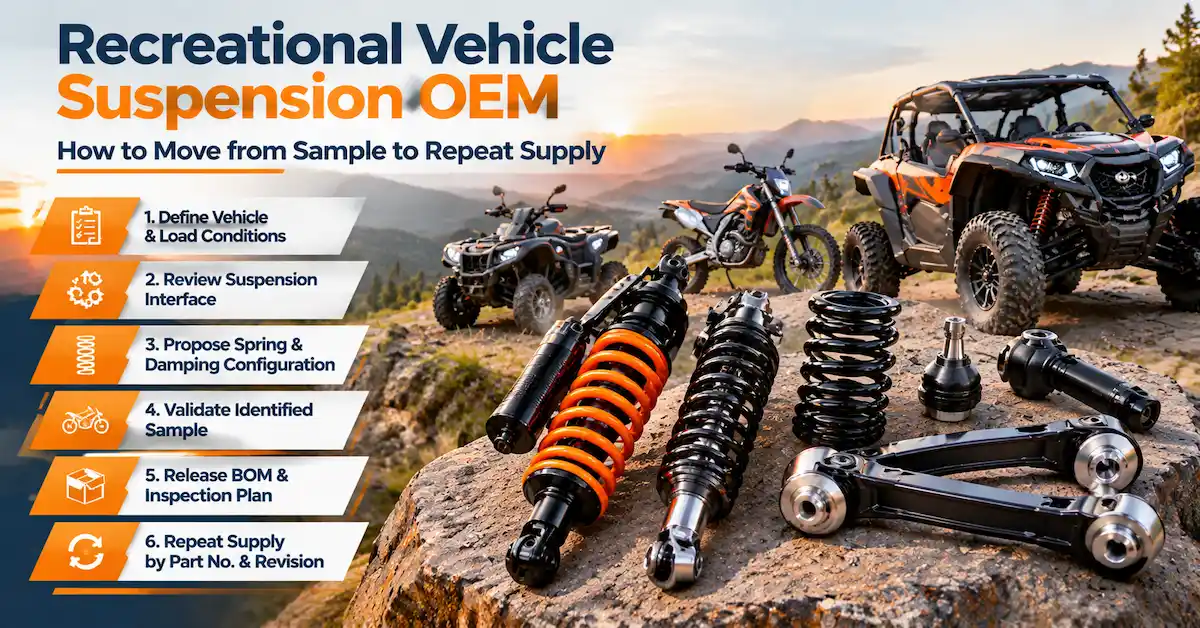

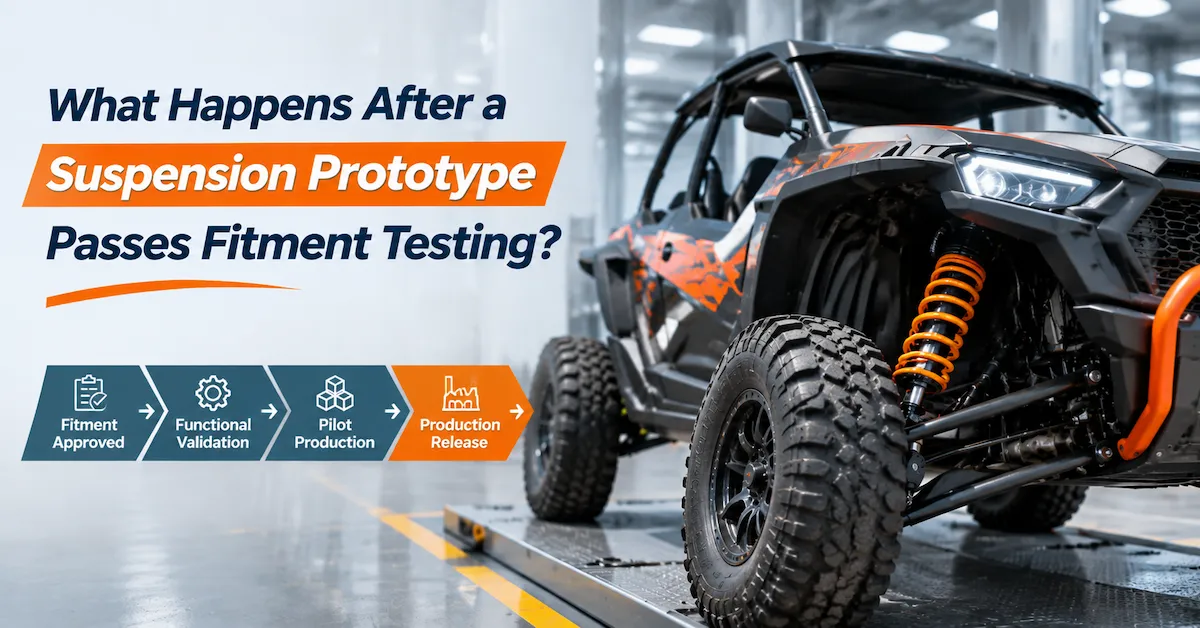
Fitment approval is the handoff from “can it be installed?” to “can this exact configuration be validated, released, and reproduced?” After a suspension prototype fits, the buyer and supplier should close the fitment record, resolve temporary parts and open issues, freeze the approved configuration, complete functional validation, run a pilot batch using production-intent parts and methods, approve inspection and packaging, and define change control before repeat production.
A prototype that bolts onto the vehicle is not automatically a production-ready shock absorber. Fitment may confirm mounting, clearance, and basic movement under one defined condition. It may not confirm spring support across the load range, damping behavior, leakage, durability, assembly variation, packaging, service identity, or the ability to reproduce the same result in the next order.
This article focuses on the stage after fitment testing. It is written for OEM engineers, aftermarket brands, distributors, specialty-vehicle builders, and purchasing teams that need to turn a successful sample into a controlled production release. It is intentionally different from a general prototype-development article: the central question here is how to prevent a passed fitment sample from becoming an undocumented reference that the production line cannot reliably reproduce.
Close the fitment test as an engineering record
The first action after a successful fitment test is to close the test record while the vehicle condition and sample identity are still clear. Do not rely on a message saying “it fits.” Record what was installed, on which vehicle, under what load, with which hardware, and at which revision.
| Fitment record field | What to capture | Why it matters after approval |
|---|---|---|
| Vehicle condition | Model or platform, year or generation, position, stock or modified state, tire and accessory condition. | Defines the application that was actually tested. |
| Sample identity | Part number, sample number, drawing revision, CAD revision, BOM, spring, damping setting, and finish. | Prevents a different sample becoming the production reference. |
| Installation state | Mounts, bushings, sleeves, spacers, hardware, torque or assembly condition, and preload. | Shows whether the result depended on temporary installation content. |
| Movement checks | Ride height, full bump, full droop, articulation, steering or tire clearance where relevant. | Shows which motion conditions were actually checked. |
| Result and deviations | Pass decision, measurements, photos, interference, noise, access issue, and open action. | Separates a clean approval from a conditional approval. |
Define what “pass” means
Fitment should have an acceptance definition before testing begins. It may include mounting alignment, fastener engagement, spring seating, installation width, ride height, travel, clearance, adjuster access, or a limited installation time. If the test was exploratory rather than formal, label it that way. An informal installation can support the next engineering step, but it should not be described as a full release gate.
Photograph the condition that matters
Photos should show mounting interfaces, clearances, spring seats, hardware stacks, bump and droop positions, and any temporary spacer or bracket. A single installed photo cannot prove movement or identify the configuration. Link the images to the sample number and test date.
Record conditional approvals explicitly
A buyer may approve fitment subject to a spring change, a spacer correction, a coating update, a clearance check, or a functional test. Write the condition, owner, required evidence, and decision date. Do not let a conditional approval be copied into a purchase order as an unconditional production release.
Resolve temporary parts and open issues before design freeze
Prototype vehicles often use temporary parts because the team is trying to answer a fitment question quickly. That is normal. The risk appears when temporary parts are not listed and the production team assumes that every item on the vehicle is part of the approved assembly.
| Temporary item | Possible effect | Required decision |
|---|---|---|
| Spacer or washer stack | Mounting width, alignment, side load, travel, and hardware engagement. | Release with a defined part and quantity, replace and recheck, or remove. |
| Hand-selected spring | Ride height, sag, load support, full-droop retention, and spring-damper pairing. | Define spring identity and acceptance or repeat the test with production spring. |
| Manual damping adjustment | Vehicle response, comfort, bottoming, rebound, and repeat settings. | Record the setting and define how production units will reproduce it. |
| Substitute bushing or sleeve | Fit, articulation, friction, noise, and load path. | Replace with production-intent parts and inspect the assembly again. |
| Temporary bracket or mount | Strength, alignment, clearance, and installation method. | Release, redesign, or repeat the fitment gate after the change. |
| Prototype coating or label | Corrosion expectation, appearance, product identity, and packaging. | Define the production finish and label before pilot shipment. |
Classify open issues by risk
Separate issues that affect safety or fitment from issues that affect appearance, service, or documentation. A missing logo position does not have the same release impact as a mount that contacts the frame at full bump. The classification helps the team decide whether a pilot can proceed with a controlled deviation or must wait for a design change and revalidation.
Do not close a problem with a verbal agreement
Verbal agreements are difficult to transfer from engineering to purchasing, production, quality, and service. Use an action list with an owner, due condition, affected document, evidence required, and closure status. A short record is enough if it is unambiguous.
Freeze the approved configuration, not just the outside dimensions
Design freeze means that the buyer and supplier agree which product definition the next validation and pilot will use. It is more than freezing eye-to-eye length. The spring, damper setting, mounting hardware, seats, bushings, labels, package, and inspection method can all affect the product that the customer receives.
| Release element | Minimum content | Typical failure if it is not frozen |
|---|---|---|
| Application record | Vehicle, position, load, terrain, environment, and modifications included in the approval. | A later order is used on a different vehicle condition. |
| 2D drawing | Datums, critical dimensions, tolerances, threads, mounts, finishes, and revision. | Prototype dimensions are copied without a controlled inspection basis. |
| 3D CAD | Envelope, orientation, hard points, movement, clearance, and linked revision. | Packaging or service teams use an obsolete geometry. |
| Assembly BOM | Damper, spring, seats, collars, bushings, sleeves, hardware, adjuster, label, and package. | Substitutes enter production without approval. |
| Setting record | Spring preload, installed condition, damping baseline, and adjustment range. | Units leave the line with different initial behavior. |
| Inspection plan | Critical features, method, sampling, limits, records, and failure reaction. | Only appearance is checked after the pilot. |
| Change route | Notice, approval owner, affected parts, and revalidation trigger. | A silent process or component change breaks repeatability. |
The suspension drawing approval guide can help organize this gate. The key question is whether purchasing can place a repeat order from the released package without needing the original prototype engineer to explain what the product means.
Freeze the sample's configuration identity
Assign a clear sample or prototype identity and keep it linked to the drawing, BOM, test report, and photographs. If the sample was adjusted during testing, record the before and after condition. Do not call a tuned result “the same sample” if the spring, setting, mount, or hardware changed.
Decide whether a changed part needs a new validation
Changes to mounts, spacers, spring rate, seat, damping setting, seal, rod, coating, material, process, source, or inspection method can have different effects. A cosmetic label change may need document approval only; a spring or mount change may require repeat fitment, load-deflection, or vehicle validation. Define the trigger before production starts.
Complete functional validation after fitment
Fitment answers whether the assembly can be installed and move through a defined space. Functional validation answers whether the complete configuration behaves as required under the defined load, terrain, speed, temperature, and service conditions. The scope depends on the project, but it should be explicit.
Validate spring support and ride height
Measure ride height, sag, installed length, spring load at relevant positions, preload, and available bump and droop. Record passenger, cargo, battery, accessory, and front/rear conditions that matter to the platform. If the vehicle uses different loads by position, do not assume one successful corner represents the whole vehicle.
Validate damping under stated conditions
For bench work, record compression or rebound direction, speed, temperature, adjustment position, and sample identity. For vehicle work, record terrain, route, speed, tires, load, settings, and observable criteria. Words such as comfortable or controlled may be useful observations, but they should be linked to measurable conditions and specific symptoms such as bottoming, wallow, harshness, or topping out.
Use the public compression and rebound testing reference to structure the test record. Do not present general test guidance as a project-specific test result.
Inspect the post-test condition
After testing, inspect leakage, rod surface, seals, spring seats, bushings, mounts, fasteners, coating, noise, and contact marks. Compare measurements with the pre-test state. A prototype can fit before the test and still reveal a seating, clearance, or assembly issue after repeated inputs.
| Validation gate | Question | Evidence to retain |
|---|---|---|
| Static application | Does the assembly support the agreed ride height and installed condition? | Load, vehicle state, spring, preload, and measurements. |
| Movement | Does it remain clear at bump, droop, articulation, and steering conditions? | Positions, clearances, photos, and deviation record. |
| Bench function | Does the sample meet the defined spring, damping, movement, leakage, or pressure checks? | Method, settings, machine, limits, and raw or traceable data. |
| Vehicle behavior | Does the vehicle response meet the agreed use criteria? | Route, load, speed, tires, settings, observations, and decision. |
| Post-test inspection | Did the assembly remain in the approved configuration? | Leakage, marks, looseness, height change, and inspection record. |
Run a pilot batch using production-intent methods
The pilot is the bridge between one approved prototype and repeat production. It should use the intended components, assembly sequence, settings, inspection, labeling, and packaging. A pilot made by the same informal method as the prototype does not prove that the released product can be reproduced.
| Pilot stage | What to verify | Release concern |
|---|---|---|
| Incoming components | Spring, damper, mounts, seats, bushings, sleeves, hardware, labels, and packaging match the BOM. | A substitute enters without a traceable deviation. |
| First-piece setup | Orientation, assembly order, preload, damping baseline, torque or fixture condition. | Technician memory replaces a controlled instruction. |
| In-process checks | Critical dimensions, seating, hardware stack, adjustment, and appearance. | Errors are discovered only after packing. |
| Final inspection | Length, stroke, spring load or rate, damping or movement check, leakage, and identity where specified. | The pilot is accepted from photographs only. |
| Application sample | Selected pilot units are compared with the approved prototype on the target vehicle or representative fixture. | The pilot uses a different spring or setting. |
| Packaging audit | Unit, pair, or kit contents, label, barcode, instructions, and protection. | Correct hardware is shipped with the wrong identity. |
| Deviation review | Out-of-limit, temporary, and substituted conditions are contained and dispositioned. | A verbal exception becomes the next standard. |
Use multiple pilot units to check repeatability
The pilot should answer whether the process can create more than one acceptable unit. Compare critical dimensions, spring identity, preload, damping setting, mounting condition, appearance, and package. The quantity and sampling should be agreed in advance; the correct number depends on process risk, application, customer requirement, and production plan.
Compare the pilot with the approved prototype
Use measurements and records, not only photographs. If the pilot differs, classify the difference as an approved design update, process variation, measurement issue, packaging issue, or nonconformance. Update the drawing, BOM, inspection, or validation record before purchasing treats the pilot as released.
Approve packaging, labels, and traceability
A suspension production release is incomplete if the warehouse and installer cannot identify the approved configuration. Decide whether the product is shipped individually, as a left-right pair, or as a vehicle set. List every spring, damper, mount, spacer, fastener, tool, instruction, label, and protective item included.
Make the label match the released identity
Use the released part number, position, revision or batch reference, quantity, and authorized market information. The label should let purchasing, warehouse, installer, and service teams distinguish the approved configuration. Do not add a universal fitment or performance claim that the validation did not establish.
Protect the approved condition in transit
Check rod protection, coating protection, spring retention, movement inside the carton, moisture, stacking, and shipping orientation. Packaging is part of product quality because a bent bracket, damaged rod, missing spacer, or mixed spring rate can turn a correct production unit into a field complaint.
Keep complaint traceability
Connect product number, revision, batch, component identity, inspection record, and package contents. When a customer reports fitment, ride height, damping, leakage, noise, or installation difficulty, the team can investigate the actual unit instead of a generic product family.
Release the first commercial lot with a focused review
Production release is a gate, not the end of the program. The first commercial lot should receive a focused review against the approved prototype and pilot. Confirm that the supplier used the released drawing, BOM, spring, damper setting, hardware, inspection plan, label, and package.
| First-lot review | What to compare | Evidence to retain |
|---|---|---|
| Revision | Purchase order, drawing, CAD, BOM, traveler, and supplier production record. | Revision check and signed release package. |
| Component identity | Spring, damper, mount, bushing, sleeve, hardware, and settings. | Lot records and incoming or final checks. |
| Critical dimensions | Mounts, lengths, stroke, spring seat, clearance, and hardware stack. | Inspection report linked to the lot. |
| Function | Leakage, movement, spring load, damping, or other agreed checks. | Method, limits, result, and sample identity. |
| Package | Unit, pair, or kit contents, label, barcode, instructions, and protection. | Packaging audit and photographs. |
| Field feedback | Fitment, installation, ride height, noise, handling, and returns. | Complaint log linked to part and batch. |
Use a controlled deviation when shipment must proceed
Some programs need a temporary deviation to support a limited launch or a controlled fleet. If so, state the affected part, condition, quantity, risk, expiration, approval owner, and corrective action. Do not allow repeated orders to turn a temporary deviation into an undocumented permanent standard.
Keep the approved baseline visible during improvements
Later changes are normal: a buyer may request a different spring, mount, coating, reservoir position, or package. Keep the original approved revision visible for service and complaint investigation. The next revision should state what changed, why it changed, which vehicles are affected, and which validation must be repeated.
What the production-release request should contain
Ask the supplier for a line-by-line release response rather than a general statement that the project is ready. The response should expose remaining assumptions and show who controls each item.
| Release request | Expected response | Why it protects the buyer |
|---|---|---|
| Prototype identity | Sample number, configuration, revision, and fitment decision. | Prevents a different sample becoming the reference. |
| Design package | Drawing, CAD, BOM, spring, damping setting, and hardware aligned to one revision. | Creates a reproducible product definition. |
| Validation closure | Fitment, functional, route, or rig evidence with open issues closed or assigned. | Separates passed evidence from pending work. |
| Pilot result | Multiple units, critical inspection, deviations, function, package, and identity. | Shows transfer beyond one hand-built sample. |
| Commercial basis | Sample, pilot, production quantity, tooling, timing, packaging, and exclusions. | Prevents a purchase order from hiding development dependencies. |
| Change control | Notice, approval owner, affected parts, and revalidation trigger. | Protects repeat orders from silent substitutions. |
| Service support | Replacement identity, compatible revisions, and complaint record route. | Connects production release to the product lifecycle. |
For a new project, review the BEDO product center, prepare the approved prototype and pilot information, and use the official contact page for a project-specific engineering and supply discussion. Public product pages establish available product directions; the exact fitment, spring, damping, quantity, timing, test, packaging, and service scope must be confirmed for the program.
Frequently asked questions
Does fitment approval mean the shock absorber is ready for mass production?
No. Fitment confirms installation under a defined condition. Production readiness also requires a controlled drawing and BOM, spring and damping definition, functional validation, pilot evidence, inspection, packaging, traceability, and change control.
What should be frozen after the prototype passes fitment?
Freeze the application, part number, drawing and CAD revision, BOM, spring, damping setting, hardware, critical dimensions, validation condition, label, package, and change route. Resolve or clearly identify every temporary prototype item.
How many units should be in a pilot batch?
The quantity depends on application risk, process variation, component supply, customer requirements, and the production plan. Agree the quantity and inspection scope before the pilot starts rather than choosing it after a problem appears.
What is the difference between a prototype and a pilot?
A prototype explores or proves a design. A pilot checks whether the intended production definition and process can create multiple units with controlled variation, inspection, packaging, and traceability.
What if the pilot differs from the approved sample?
Contain the difference, identify the affected component or process, decide whether it is a design or production issue, update the relevant document, and repeat validation when the change can affect fitment, safety, performance, service, or product identity.
Should packaging be approved before production release?
Packaging can be developed in parallel, but it should be approved before repeat shipment. The package must identify the configuration and protect the shock, spring, hardware, labels, and instructions through handling and transport.
Can a supplier change the spring after fitment approval?
Only through the agreed change-control process. A different spring can change ride height, sag, load support, travel, and the relationship between the spring and damper even if the shock body and mounts remain the same.
What if the first production lot passes but field complaints appear later?
Link the complaint to the part number, revision, batch, vehicle condition, load, tire, settings, and installation record. Then separate product variation from vehicle, installation, usage, or measurement effects before changing the released design.
Can BEDO help move a suspension prototype into production?
BEDO's public website presents shock absorbers, suspension springs, product categories, and custom-development content. Provide the prototype record, vehicle application, drawings, BOM, quantity stages, validation requirements, and package scope so the specific production path can be assessed.
Conclusion
After a suspension prototype passes fitment testing, the project should move through controlled release gates rather than directly into a production order. Close the fitment record, resolve temporary items, freeze the complete configuration, complete functional validation, run a production-intent pilot, approve inspection and packaging, and define how future changes and complaints will be managed.
That evidence chain turns one successful installation into a product that purchasing can order, quality can inspect, logistics can identify, service can support, and the supplier can reproduce. Start with the shock absorber product category, then prepare the prototype and pilot release package for technical review.