
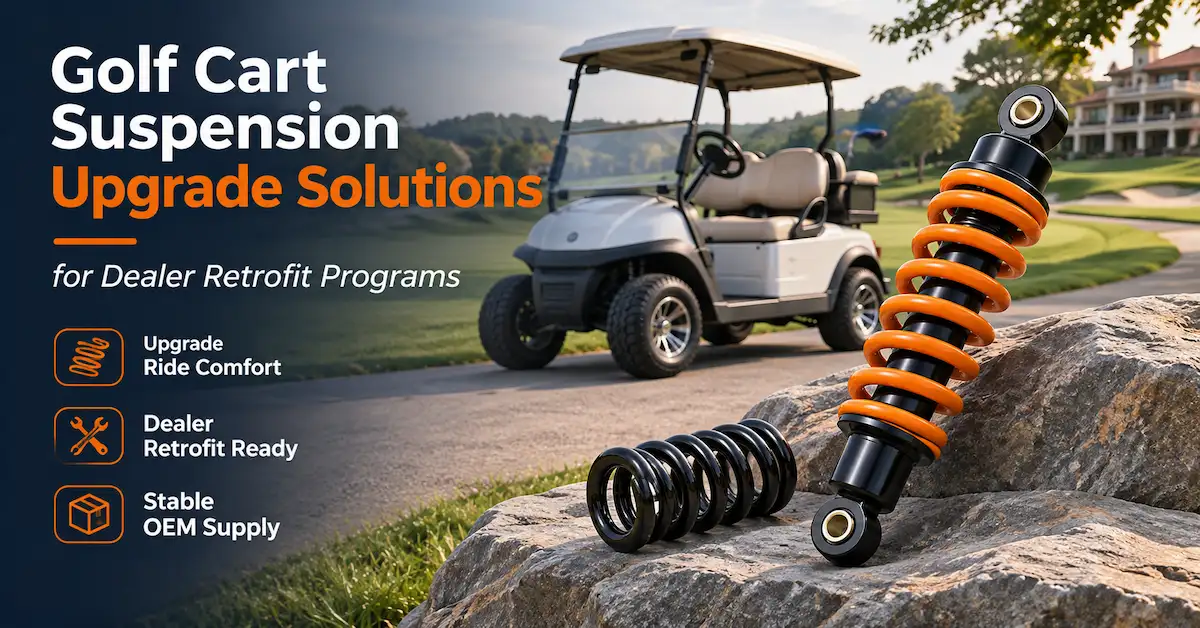
What makes golf cart suspension upgrade solutions ready for a dealer program?
Direct answer: golf cart suspension upgrade solutions become dealer-ready when each kit is tied to a defined vehicle family, suspension position, modification state, load class, fitment envelope, spring and damping specification, included hardware, validation record, label, and revision. A dealer should be able to identify who the kit is for, install it without interpreting vague instructions, explain the expected result, and reorder the same approved configuration.
The purpose is not to create the stiffest shock or claim one heavy-duty kit fits every cart. It is to turn vehicle evidence into a controlled retrofit product. That requires a narrow application claim, representative vehicles, light and loaded test conditions, installation checks through full suspension movement, structured feedback, and a production record that connects the approved sample to later orders.
This article answers a commercial-investigation and RFQ question for golf cart dealers, modification shops, private-label brands, resort-vehicle suppliers, and fleet integrators: how can a buyer develop a range of upgrade kits without creating fitment returns, harsh empty-vehicle ride, uncontrolled loaded behavior, or confusing SKUs? It focuses on program architecture and release evidence. BEDO's existing golf cart shock upgrade guide explains how individual modifications change a vehicle; the present guide starts after that diagnosis and shows how to make a repeatable dealer offer.
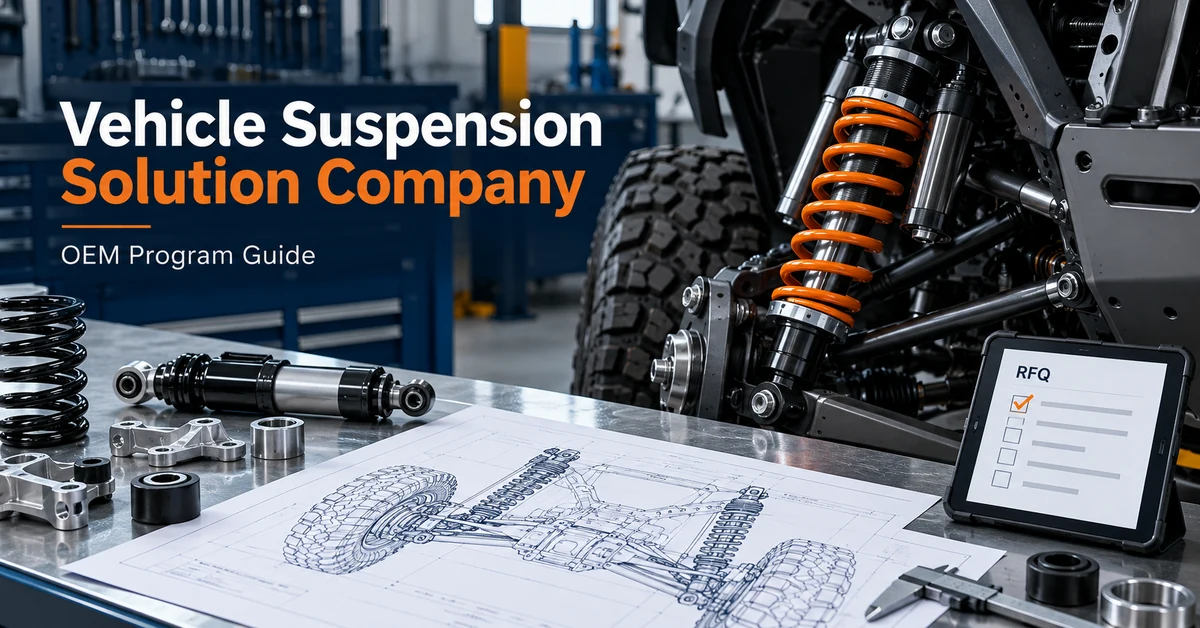
Why a dealer kit is different from a one-vehicle upgrade
A skilled workshop can solve a problem on one cart through measurement, installation, and repeated adjustment. A dealer product must work after the original developer is no longer beside the vehicle. The carton, label, application data, instructions, hardware, and technical-support record must carry the decisions that were previously held by one technician.
This changes the risk. A one-off build can tolerate a handwritten spacer change or a technician who knows that a certain model year needs a different sleeve. A distributed kit cannot. If that information is absent from the part number and installation record, the same product may be sold to an incompatible vehicle. A dealer program therefore needs both engineering control and market control.
| Development setting | What may be acceptable | What a dealer program additionally requires |
|---|---|---|
| One workshop vehicle | Direct measurements, local installation, technician observation, manual adjustment. | Documented nominal dimensions, tolerances, application identity, installation notes, approval record. |
| Small fleet trial | Several vehicles on one route with known operators. | Representative vehicle selection, controlled load cases, issue log, repeatable inspection method. |
| Dealer retrofit kit | Approved components and hardware for a narrow vehicle group. | SKU, fitment matrix, exclusions, packaging, revision, traceability, support and reorder specification. |
| Private-label range | Dealer kit plus buyer branding. | Artwork approval, market claims boundary, language, barcode, warranty channel and change approval. |
The best starting point is one defensible upgrade problem, not a long catalog. For example, a dealer may first address a rear-seat conversion on a named cart family, or a utility body with a measured working-load range. Once that configuration is validated, adjacent applications can be reviewed. They should not inherit the first approval merely because the mounting eye looks similar.
Define the customer and job before selecting hardware
The phrase “golf cart” covers court vehicles, neighborhood carts, resort shuttles, campus transport, industrial maintenance vehicles, security carts, hospitality fleets, and utility platforms. Their speeds, passenger counts, route surfaces, daily cycles, storage environments, and payload patterns differ. Golf cart suspension upgrade solutions should therefore begin with a job statement.
A useful job statement identifies the base vehicle, current configuration, intended modification, normal load, upper load case, route, priority, and unacceptable behavior. “Improve a 4-seat resort shuttle that repeatedly crosses speed ramps while preserving acceptable 1-driver ride” is more useful than “make the rear suspension heavy duty.” The first statement makes the trade-off visible: the vehicle needs added load support but cannot become excessively harsh when empty.
Separate the buyer from the vehicle user
The dealer buys and supports the kit, but the user may be a passenger, maintenance technician, resort operator, or private owner. Their acceptance criteria differ. A modification shop may value installation time and adjustment range. A fleet manager values repeatability, downtime, and replacement availability. A passenger notices vibration, pitch, noise, and harsh transitions. Record all three perspectives before deciding what “better” means.
State the primary upgrade reason
Assign one primary reason to each kit: restore worn suspension, support an added passenger row, support cargo or equipment, adapt to a battery conversion, operate with a lift and tire package, improve control at a defined operating speed, or address a documented ride complaint. Several changes may coexist, but one must drive the application claim. Otherwise, marketing tends to describe the same part as comfort, performance, lift, and heavy-duty solution without evidence for any condition.
Create load classes that a salesperson can use correctly
A dealer should not need to calculate suspension forces at the counter, but the sales process still needs more precision than “standard” and “heavy duty.” Build load classes from real vehicle configurations and present them in plain language. Each class should state what is included, what is excluded, and which evidence controls selection.
| Illustrative class | Vehicle condition to define | Information needed | Release caution |
|---|---|---|---|
| Class A: standard replacement | Original seating, battery type, wheels, ride height and normal court or community use. | Model/year, front or rear position, reference part, dimensions and symptom. | Do not call it an upgrade unless a measurable result differs from the approved baseline. |
| Class B: passenger conversion | Added rear seat or multi-row body and actual occupied conditions. | Seat structure, passenger assumptions, rear axle or corner load where available, route and speed. | Evaluate light-load ride as well as occupied support. |
| Class C: utility load | Cargo box, tools, service equipment or recurring payload. | Empty, normal and upper working loads; load location; daily cycle; surface. | A maximum-load spring may be unsuitable for frequent empty travel. |
| Class D: geometry package | Lift kit, control-arm change, larger wheel/tire or changed shock location. | Hard-point and clearance data, full-bump/full-droop condition, steering and tire envelope. | A longer shock is not automatically compatible with the altered geometry. |
| Class E: battery conversion | Changed battery mass, location or enclosure, possibly combined with other accessories. | Before/after battery mass and position, vehicle attitude, front/rear loads where available. | Both heavier and lighter conversions can move the spring away from its intended range. |
These names are examples, not BEDO product ratings. A real program should use the buyer's verified models and load windows. Avoid publishing one kilogram or passenger limit unless the complete vehicle, legal requirements, chassis capacity, tires, brakes, steering, and suspension have been considered by the responsible parties. A suspension kit cannot increase the vehicle manufacturer's permitted gross weight by itself.
Where load data is limited, begin with measured vehicle conditions instead of estimates. Record ride height, axle or corner loads if appropriate equipment is available, and the exact passenger or cargo arrangement. Photographs should show the vehicle from consistent positions. This makes the prototype comparison more useful and reduces disagreement about whether the load was placed the same way.
Build a fitment envelope, not a single length
Dealers often begin with an eye-to-eye measurement because it is easy to communicate. It is only one part of fitment. The release package should also control compressed length, extended length, usable stroke, upper and lower mount type, hole diameter, sleeve or bushing width, body and spring envelope, adjuster access, orientation, and included hardware.
Evaluate the shock inside the vehicle's complete motion. At full droop, confirm that hoses, brake cables, steering elements, joints, and springs are not being used as unintended travel stops. At full bump, confirm that the shock does not reach internal compression before the designed chassis stop and that the tire, spring, body, reservoir, and surrounding structure remain clear. At steering lock and articulation, check conditions that static ride-height photographs cannot reveal.
Use a fitment matrix with revision identity
| Field | Dealer-facing purpose | Engineering control |
|---|---|---|
| Vehicle family and model years | Prevents selection by appearance alone. | Supported by measured, drawing, sample or verified installation evidence. |
| Front/rear and left/right | Ensures the correct carton reaches the correct position. | Linked to part, spring, damping, mount and hardware revision. |
| Modification package | Distinguishes rear-seat, cargo, lift, tire and battery configurations. | Separate row when geometry or load changes the accepted specification. |
| Load class | Lets sales staff choose a defined use window. | Linked to the validation conditions and exclusions. |
| Technical revision | Supports correct reorder and complaint investigation. | Identifies drawing, BOM, spring, damping and hardware. |
| Market package | Controls label, barcode, language and included instructions. | Package revision remains traceable to the technical SKU. |
The current BEDO article on golf cart suspension parts and fleet control provides a related maintenance and inventory perspective. Use it for replacement planning; use the matrix above when a dealer is deliberately releasing a new upgrade configuration.
Match spring support and damping across the load window
The spring supports vehicle load and influences ride height, sag, remaining bump travel, and the energy returned after compression. Damping controls how quickly the suspension moves. A spring change can improve loaded ride height while introducing bounce if rebound control is insufficient. Increased damping can reduce movement but cannot correct a spring that is fundamentally outside the required support range.
Do not use preload as a universal load upgrade
Preload can position the spring and adjust static condition within the intended design range. It does not change the spring rate of a linear spring. Excessive preload may reduce available droop or create a harsh initial condition while still failing to provide the desired behavior across the full load window. Define spring rate, free length, installed length, seat arrangement, adjustment range, and retention condition as a system.
Use more than one test condition
A passenger or utility cart commonly operates empty, normally loaded, and near its intended upper working condition. Test the prototype in each relevant state. Observe ride height, available travel, body movement, response over representative route features, recovery after a bump, steering and braking attitude, noise, heat or fade concerns where applicable, and passenger feedback. The upper condition should not be the only approval point.
For dealer programs with adjustable shocks, define a baseline setting, permitted adjustment range, direction labels, and an adjustment method. An adjuster does not remove the need for a suitable base spring and damping configuration. Too broad a promise transfers development work to the installer and makes warranty diagnosis difficult.
Define the kit BOM and installation boundary
A suspension kit is more than the shock body. It may include springs, sleeves, bushings, spacers, washers, fasteners, brackets, protectors, adjustment tools, labels, and instructions. The bill of materials should state exactly what ships and what the installer reuses. Hardware should be identified by controlled dimensions or specifications, not only by a photograph.
| BOM element | Control question | Common field risk |
|---|---|---|
| Shock assembly | Which application, position and revision does it represent? | Externally similar revisions are mixed. |
| Spring | What part identity, rate/characteristic, free length, finish and orientation are approved? | Wrong spring is assembled or supplied as a replacement. |
| Bushing and sleeve | What width, hole, material requirement and retention arrangement apply? | Loose fit, clamp-up problem, noise or restricted articulation. |
| Spacers and brackets | Which vehicle and side use each item? | Installer reverses or omits a visually similar component. |
| Fasteners | Are they supplied or reused, and who defines installation requirements? | Uncontrolled substitutes or inappropriate installation practice. |
| Instructions | What vehicle checks, orientation, clearances and post-install inspection are required? | Technically correct part is installed in the wrong configuration. |
| Carton and label | Do SKU, application, load class and revision agree with the contents? | Warehouse and technical records point to different products. |
The responsible vehicle or kit business should define installation torque, safety procedures, legal claims, and any post-install alignment or inspection. A component supplier should not invent vehicle-level requirements without the necessary evidence. Where the installation changes steering, braking, ride height, or chassis geometry, the buyer must evaluate those vehicle effects rather than treating the shock as an isolated replacement.
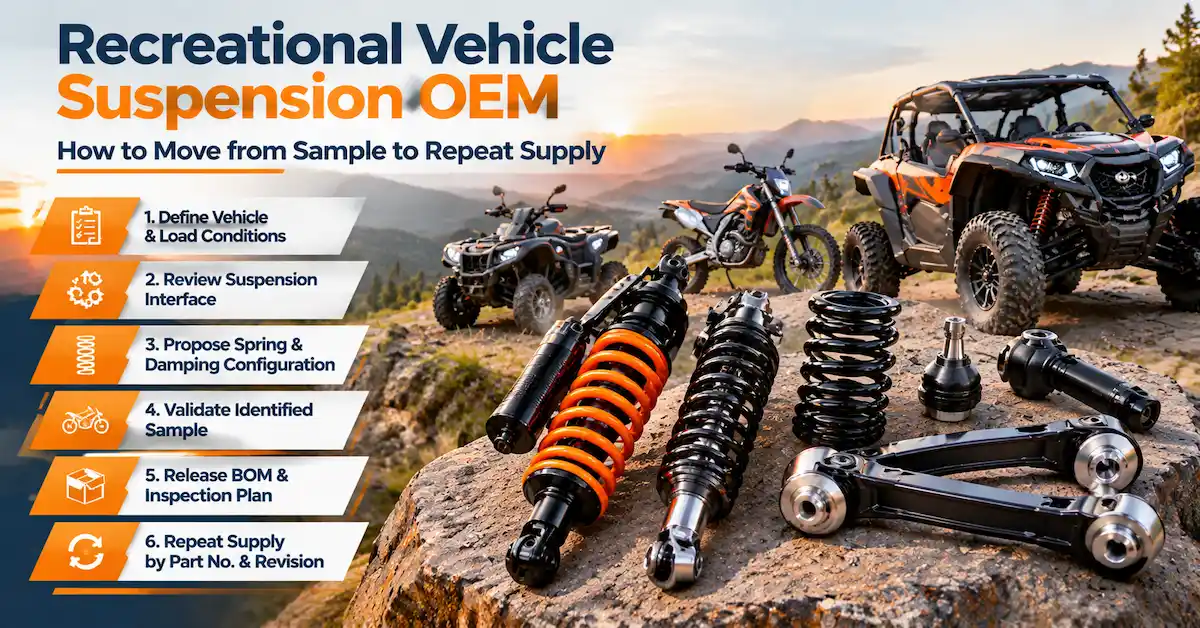
Run a dealer pilot before catalog release
A pilot should answer two questions: does the configuration work on the intended vehicles, and can ordinary dealer operations identify, install, and support it correctly? Engineering approval alone does not prove that the application table and packaging are usable. Conversely, easy installation does not prove suitable suspension behavior.
- Select representative vehicles: include the model years, modifications, load states, and operating routes that define the initial claim. Do not select only the best-condition cart.
- Record the baseline: photograph the vehicle, identify current components, measure relevant ride heights and dimensions, note symptoms, and document load arrangement.
- Control the prototype: assign an ID to every shock, spring, setting, and hardware set. Record which vehicle receives which revision.
- Inspect installation: note fit, hardware, orientation, access, clearance, tools, installation time, and any undocumented adjustment.
- Check static and full-motion conditions: review ride height, retention, bump/droop clearances, steering lock, brake or cable routing, and interference.
- Test the use cases: repeat defined route features under light, normal, and upper intended loads as applicable.
- Collect structured feedback: use consistent questions and measurable observations rather than “feels better.”
- Inspect after use: check leakage, loosening, contact marks, spring seating, noise, fastener condition, and vehicle attitude.
- Close issues: classify every observation as product, installation, vehicle, application-data, packaging, or training issue.
- Release one revision: update drawings, BOM, settings, fitment, instructions, labels, and pilot evidence together.
Use a before-and-after scorecard
| Observation | Baseline record | Prototype record | Acceptance approach |
|---|---|---|---|
| Ride height by load state | Consistent measurement points and load arrangement. | Same points, surface, tire condition and load. | Buyer-defined window; avoid unsupported universal targets. |
| Remaining travel or contact evidence | Known bottoming/contact symptoms and route. | Observation under the same relevant route and load. | No unsafe interference; project target is met. |
| Recovery after a disturbance | Video or defined subjective scale where instruments are unavailable. | Same speed, feature and load where practical. | Agreed control without unacceptable harshness. |
| Passenger feedback | Specific location and condition of complaint. | Same seating and route, with repeat observations. | Defined rating questions, not an open marketing claim. |
| Installation result | Original interfaces and known variations. | Fit, clearance, hardware and time. | No undocumented rework; instructions match reality. |
| Post-use condition | Original leaks, wear, looseness or damage. | Inspection after the agreed duty. | No unclosed anomaly before release. |
If the pilot exposes an issue, preserve the failed or questioned configuration and the conditions in which it occurred. A change to the spring, valve, mount, bushing, finish, or hardware must receive a new revision. Do not quietly adjust one unit and call the original design approved.
Convert the approved pilot into a sellable SKU
After technical approval, the dealer still needs a product definition. Write the application statement narrowly: vehicle family and years, suspension position, required modifications, intended load class, package contents, exclusions, installation responsibility, and any settings. Avoid claims such as “fits all golf carts” or “supports any lift” unless evidence genuinely supports them.
Assign separate identities where a change affects fitment, load support, damping, hardware, or vehicle behavior. Color or branding changes may be managed as package or appearance revisions only if they do not hide a technical change. Keep an approved sample or controlled reference where appropriate, but do not rely on a master sample without drawings, BOM, and inspection criteria.
Plan service parts before launch
Define whether springs, bushings, sleeves, hardware, and complete shocks can be ordered separately. Each service part needs an application link to the parent kit. A dealer should not substitute a visually similar spring or bushing after launch. Service availability, replacement method, warranty evaluation, and obsolete-revision handling should be agreed before the installed base grows.
Make packaging part of fitment control
Use labels that distinguish front/rear, vehicle family, load class, kit number, and revision. Include a contents check and installation-reference identifier. Protect rods, finishes, threads, adjusters, and springs during transport according to the agreed route and handling. Packaging claims and methods require project confirmation; the article cannot prescribe one universal carton or corrosion solution.
Compare suppliers using evidence, not catalog language
A supplier may be able to manufacture a shock yet lack the application process required for golf cart suspension upgrade solutions. Compare how each candidate handles vehicle data, load classes, spring and damping decisions, prototypes, pilot feedback, production revisions, and repeat orders. Ask for the output of the process, not only a list of capabilities.
| Capability | Buyer question | Useful project evidence |
|---|---|---|
| Application review | How will different cart models, modifications and load states be separated? | Completed requirement sheet, fitment matrix and open-issue list. |
| Fitment engineering | Which compressed/extended dimensions, mounts and envelopes are controlled? | Drawing, measurement record, sample identity and vehicle check. |
| Spring and damping | How are light and loaded conditions balanced? | Controlled spring/damping revisions and stated evaluation conditions. |
| Prototype support | How will dealer feedback become a measurable change? | Prototype IDs, issue log, change record and approval result. |
| Repeat production | How will the approved configuration be reproduced? | Released BOM/drawing, inspection plan, setting identity and traceability. |
| Kit fulfillment | How are hardware, instructions, labels and cartons controlled? | Approved contents list and package artwork/revision. |
| After-sales response | How is a fitment or performance complaint investigated? | Vehicle/configuration data form, batch identity and corrective-action route. |
BEDO's golf cart suspension supplier guide provides broader supplier-qualification questions, while the golf cart shock OEM development guide explains the path from vehicle information to production. Use those resources as background, then require a kit-specific proposal for the dealer program.
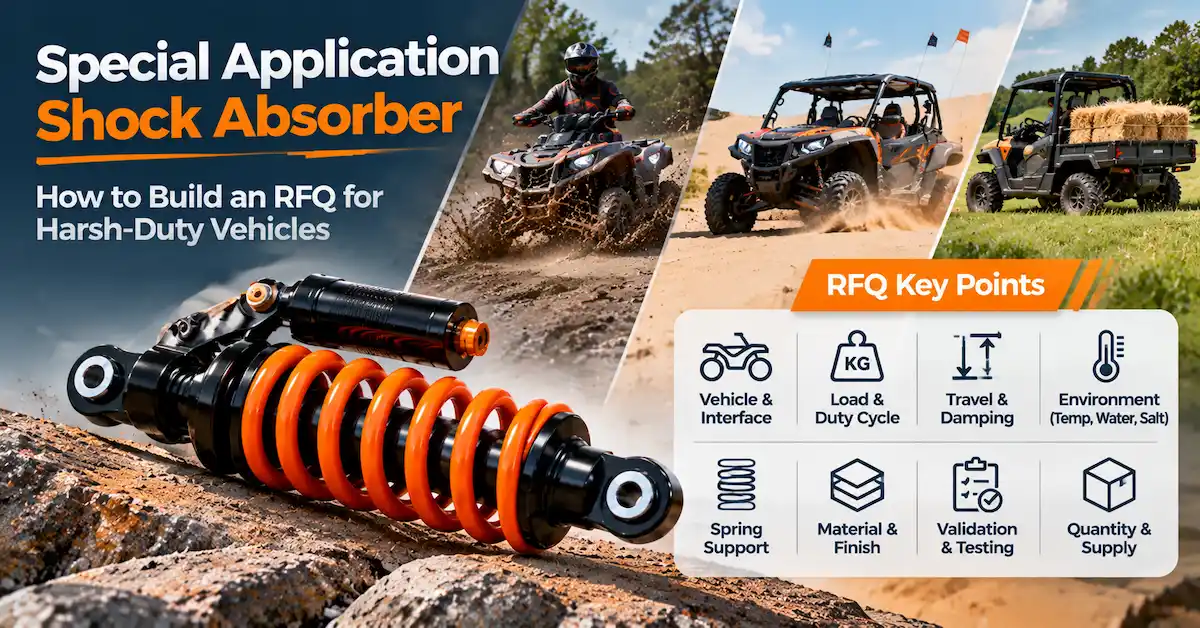
Prepare an RFQ that can produce a comparable proposal
An RFQ should distinguish confirmed information, proposed targets, and open questions. Sending the same structured package to suppliers improves comparison and reduces the chance that one quotation includes engineering, prototypes, and testing while another covers only a visually similar component.
- Buyer, market, sales channel, installation channel, and target launch scope.
- Vehicle make/family, model years, front or rear position, and current part identity.
- Modification packages: battery, seating, cargo, lift, tires, body, speed or accessories.
- Empty, normal, and upper intended load conditions, including load location.
- Available front/rear axle or corner loads, ride heights, and vehicle photographs.
- Extended/compressed length, stroke, mounts, widths, holes, body/spring envelope, and clearances.
- Current spring, preload, damping, adjuster and observed behavior where known.
- Target result, priority, unacceptable behavior, route, surface, speed range, and duty cycle.
- Proposed load classes, application matrix, initial SKU count, and expansion plan.
- Required kit contents, branding, colors, labels, instructions, barcode, and destination markets.
- Prototype and pilot quantity, representative vehicles, test responsibility, evidence and acceptance.
- Forecast by SKU, launch batch, repeat-order pattern, service parts, documentation and change control.
MOQ, tooling, prototype price, testing cost, and lead time should be quoted against this scope. Request development, prototype, pilot, and production timing separately, with clear start conditions and buyer approval dependencies. Buyers ready to discuss a controlled program can submit the available matrix through the BEDO technical and commercial contact page; missing values should be marked for review rather than guessed.
Common dealer-program mistakes
Publishing broad fitment after one installation
One successful vehicle proves only that vehicle and configuration under the observed conditions. Model year, body, battery, seat, lift, and tire differences can change the result. Expand fitment only after reviewing the relevant variation.
Using a stiffer spring as the whole solution
A spring can improve load support but may reduce empty comfort and require different rebound control. Treat spring, preload, damping, travel, and load window together.
Mixing technical revisions under one SKU
If spring or damping changes but the carton number remains unchanged, dealers cannot know what they installed. Complaints become impossible to trace and repeat orders may not match the approved pilot.
Letting instructions carry an engineering workaround
Instructions should explain a validated installation, not normalize grinding, uncontrolled spacers, forced alignment, or other undocumented rework. Unexpected modification is an engineering issue that must be reviewed.
Claiming vehicle capacity from the suspension kit
A kit does not independently approve additional passengers, payload, speed, or road legality. Vehicle-level capacity and compliance remain the responsibility of the appropriate vehicle parties and authorities.
Frequently asked questions about golf cart suspension upgrade solutions
How are dealer-ready golf cart suspension upgrade solutions different from replacement shocks?
A replacement shock restores a verified original-type application. A dealer upgrade solution defines a changed load, geometry, use, or performance target and connects the approved shock, spring, hardware, fitment, validation, packaging, and revision to one sellable kit.
Can one upgrade kit cover 2-seat, 4-seat, and utility carts?
Only if the vehicles, geometry, loads, and acceptance evidence support the same configuration. Passenger and utility carts often have different rear load windows. Separate springs, damping, or SKUs may be required.
Does a rear-seat conversion always require new shocks?
No universal answer applies. Record the added structure and occupied load, inspect ride height and remaining travel, and evaluate the current spring and damping behavior. The solution may involve a spring, shock, complete assembly, or another vehicle issue.
Does a lithium battery conversion always need a suspension upgrade?
No. The relevant questions are how battery mass and location changed, how vehicle attitude and axle loads changed, and whether the current suspension remains inside the intended operating range.
Can a dealer sell one “heavy-duty” spring for every payload?
That is poor application control unless evidence supports it. A spring selected for a high load can create harsh light-load behavior. Define the intended load class and evaluate the complete spring-damper system.
What should a golf cart suspension pilot measure?
Measure or record the vehicle identity, configuration, loads, ride heights, fitment, clearances, installation observations, full-motion checks, route behavior, passenger feedback, post-use condition, and every prototype revision.
How many pilot vehicles are required?
There is no universal number. It depends on model-year variation, modification packages, load classes, route diversity, test scope, and the risk of the application claim. The pilot plan should justify its coverage.
Should an adjustable shock be used for a dealer program?
Use adjustment only when it serves a defined operating range and the dealer can control the baseline, instructions, limits, and support. Adjustment should not compensate for an unsuitable base spring or unvalidated fitment.
What information should be printed on the carton?
At minimum, the buyer should consider kit number, application, position, load class or configuration, revision, included contents, and installation-reference identity. Exact label and regulatory requirements depend on the target market.
Can BEDO quote from a photograph?
A photograph may support an initial discussion, but a reliable prototype or production quotation normally requires vehicle identity, dimensions or sample/drawing evidence, load and use information, target result, quantities, validation scope, and commercial requirements.
Conclusion
Golf cart suspension upgrade solutions create B2B value when they convert a real vehicle problem into a controlled dealer product. Define the vehicle and modification, establish useful load classes, measure the full fitment envelope, coordinate spring support with damping, control the kit BOM, and validate both technical behavior and dealer usability. Release only the applications proven by the pilot, and keep every later order tied to the approved drawing, spring, damping, hardware, label, and revision.
The strongest first program is usually a narrow one: one vehicle family, one clear modification, representative load states, and a measurable acceptance plan. That foundation can expand into additional kits without turning similar-looking carts into unsupported fitment claims. Dealers, private-label brands, and fleet suppliers preparing a retrofit range can review BEDO's current suspension product references and send the vehicle matrix, samples or drawings, intended load classes, pilot plan, and forecast through the official inquiry channel for project-specific review.