
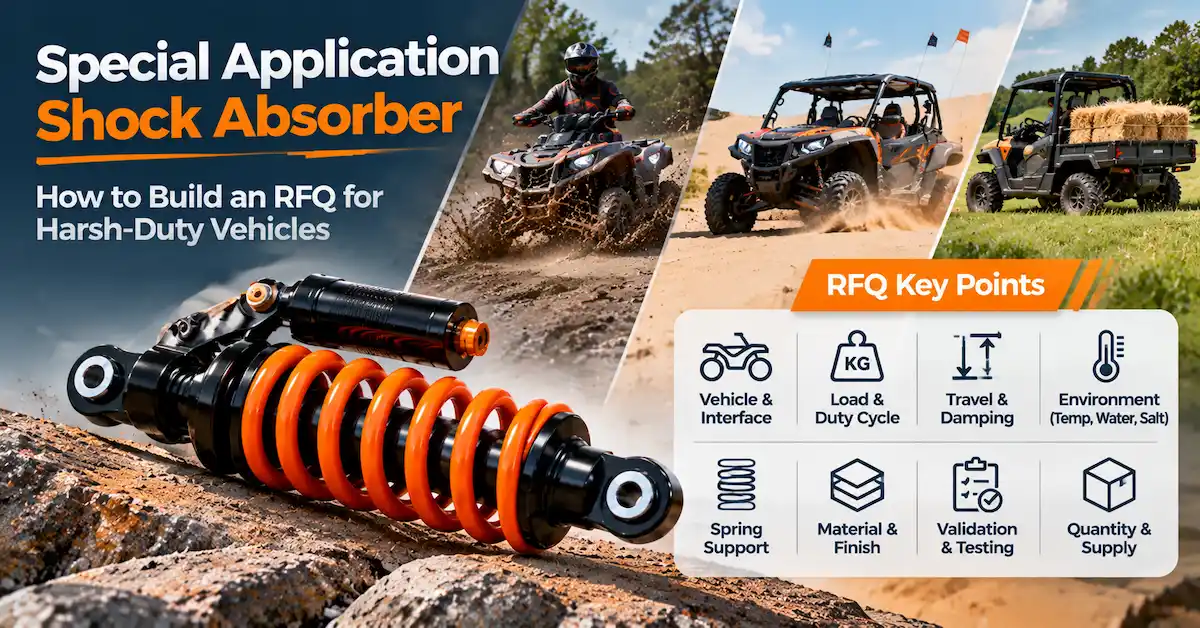
Direct answer: a special application shock absorber RFQ should define the vehicle, installation interface, load spectrum, travel, speed, temperature, contamination, water and salt exposure, duty cycle, service interval, spring support, damping target, finish, sealing, mounting hardware, validation method, production quantity, packaging, and change-control expectations. “Heavy duty,” “off-road,” and “all weather” are not engineering specifications by themselves.
The supplier should respond with confirmed facts, proposed design choices, missing inputs, test boundaries, and a staged sample plan. This lets an OEM or equipment buyer separate a real application review from a catalogue match and avoids publishing durability claims that have not been verified for the intended environment.
This guide addresses an RFQ intent: how should a buyer prepare a quote request for a Special application shock absorber used in a harsh or unusual vehicle? The application may involve beach vehicles, farm ATVs, muddy utility UTVs, resort transport, modified vehicles, electric platforms, industrial mobility equipment, or other vehicles outside a simple road replacement scenario.
Ningbo Bedo Auto Parts Co., Ltd. publicly presents itself as a shock absorber and suspension spring manufacturer in Ningbo, Zhejiang, China. Its public ATV/UTV product range includes an AU_HSA_04 rear hydraulic shock reference for beach applications. The published page lists an internal gas chamber, oil-gas separation, aluminum alloy and steel pipe, 345 mm total length, 80 mm effective stroke, 225 LBS spring rate, 3000 N rebound, 350 N compression, and defined mounting dimensions. These values are a real public configuration example, not a universal prescription for every harsh-duty vehicle.
Replace “heavy duty” with a measurable duty profile
Heavy duty can mean a high static load, frequent impacts, long continuous use, abrasive dust, salt spray, wash-down, low temperature, high temperature, severe vibration, a long service interval, or a combination of these conditions. Each condition stresses different elements of the shock assembly. A high-load farm vehicle may need a spring and mount decision. A beach vehicle may create corrosion and contamination risk. A high-speed recreational vehicle may create heat and repeated velocity demands. The RFQ must state which risks actually exist.
| Duty factor | Buyer description | Engineering question |
|---|---|---|
| Static load | Curb, rider, passenger, cargo, tools, battery, attachments. | What spring, preload, ride height, and reserve travel are required? |
| Dynamic input | Surface, obstacle size, speed, frequency, jump or drop, route length. | What damping and thermal behavior must be evaluated? |
| Contamination | Dust, sand, mud, fine abrasive material, cleaning process. | What protection, inspection, and service assumptions are needed? |
| Water and salt | Fresh water, salt water, humidity, immersion, spray, wash-down. | What finish, material, seal, and evidence boundary apply? |
| Temperature | Operating, storage, start-up, and repeated-cycle range. | How may fluid, seals, damping, and materials change? |
| Duty cycle | Minutes or hours per shift, rest time, cycles, annual use. | What component and vehicle validation should represent real use? |
A useful duty profile includes normal, maximum, and occasional conditions. Do not combine every extreme into an impossible single state unless the vehicle will actually experience it. The supplier needs to know which condition controls design and which condition only needs a safety review. This helps avoid unnecessary cost and prevents the buyer from approving a design against an unrealistically light test.
Define the vehicle and mechanical interface
A special application often begins with incomplete geometry because the vehicle is new, modified, or built in low volume. Record what is known and identify who will measure the missing fields. The interface must cover more than eye-to-eye length. Include full droop, ride height, full bump, wheel travel, motion ratio, mounting angle, body and spring clearance, hole or thread, mounting width, bushing, sleeve, hardware, and neighboring components.
Measure all operating positions
Photograph the assembly at full droop, normal ride height, and full bump. For steerable or articulated vehicles, check full steering lock and articulation. For electric platforms, check battery enclosure, cable, controller, motor, and thermal component clearance. For farm or utility platforms, include attachment movement, cargo bed travel, and loaded tire clearance. The shock must not become the unintended travel stop unless the design explicitly uses a controlled stop.
Record mount load and alignment risks
A wider spring or body can create interference even when the eye spacing is correct. Misaligned mounts can side-load bushings or the rod. Incorrect sleeve width can force brackets inward. The RFQ should show bracket thickness, bolt, sleeve, bushing, and mounting angle. Ask whether the supplier expects spherical, rubber, polyurethane, or another mount type, and define the service and noise trade-offs.
| Interface field | Measurement | Risk when missing |
|---|---|---|
| Lengths | Extended, ride-height, compressed, body, rod, and stroke. | Lost travel, bottoming, topping, or contact. |
| Mounts | Hole or thread, width, sleeve, bushing, bolt, angle, bracket. | Loose fit, side load, hardware damage, or incorrect installation. |
| Spring space | Outer diameter, seat, free length, installed length, coil clearance. | Frame or tire contact and coil bind. |
| Body space | Body, reservoir, hose, adjustment, shield, and service access. | Interference or inaccessible adjustment and maintenance. |
| Wheel relationship | Wheel travel, motion ratio, tire size, articulation, steering lock. | Wrong damping or load assumption at the shock. |
Build a load spectrum instead of quoting one weight
One vehicle weight is not enough for a special application. Separate curb mass, front and rear axle loads, rider or driver, passengers, cargo, battery, fuel, tools, attachments, towing force, and dynamic events. Identify the normal load state used for comfort evaluation and the maximum load state used for support and clearance. If the platform changes between empty travel and loaded work, both states need an approval strategy.
For a beach or resort UTV, the normal condition may include passengers but little cargo. For a farm ATV, the normal condition may include front and rear rack loads, while the maximum condition includes an attachment or trailer tongue load. For an electric utility vehicle, battery size and state may alter mass distribution. A supplier can propose a spring only when the actual shock load or the geometry needed to estimate it is available.
| Load state | Buyer records | Release question |
|---|---|---|
| Curb | Vehicle ready to operate, axle loads, tire pressure, accessories. | Does the spring maintain minimum preload and ride position? |
| Normal | Typical operator, passenger, cargo, battery or fuel condition. | Is comfort, control, sag, and reserve acceptable? |
| Maximum | Rated people, cargo, tools, attachment, and distribution. | Is there enough support, travel, clearance, and control? |
| Transient | Obstacle, drop, braking, acceleration, tow, articulation. | What dynamic evidence and safety margin are required? |
| Transport and storage | Tie-down, pallet, long storage, temperature, vehicle restraints. | Can the shock and mounts be damaged outside normal driving? |
Select spring, preload, and travel together
A special application spring should be selected from load and geometry, not from color or a broad vehicle class. Request rate, free length, installed length, installed load, preload range, coil diameter, end form, material or process requirement, finish, and coil clearance. Record the target ride height and sag under each approved condition. If the vehicle spans a very wide load range, the buyer may need different springs, an adjustment method, or a clearly limited operating envelope.
Preload changes the installed spring position and ride height within a defined range. It does not create a new spring rate. Excessive preload can reduce droop travel or create an unacceptable unloaded condition. Ask for the minimum and maximum approved setting, lock method, measurement reference, and rule for changing the spring instead of adding more preload.
Travel must account for the bump stop, top-out control, spring coil clearance, body clearance, tire or track movement, and any chassis stop. If the shock is longer or shorter than the original, check how wheel travel and drive or steering geometry change. A supplier proposal should show the relationship between shock stroke and usable vehicle travel rather than assume the shock can use every millimeter of its physical stroke.
Public reference boundary: the BEDO AU_HSA_04 page publishes an 80 mm effective stroke, 225 LBS spring, 345 mm total length, and specific upper and lower mounting dimensions for its beach ATV/UTV reference. Those values demonstrate a real product data structure. They should not be copied into another vehicle RFQ without checking geometry, load, motion ratio, clearance, and current revision.
Specify damping with speed, direction, and temperature
A special application can generate both low-speed chassis movement and high-speed shock movement. The words low speed and high speed in damping refer to shock shaft velocity, not simply vehicle road speed. Ask the supplier to state the force conditions, direction, temperature, stroke or velocity, cycle, adjustment position, and tolerance. A maximum-force number without conditions cannot be compared reliably.
Rebound controls extension response; compression controls closing response. The required balance depends on spring, motion ratio, unsprung mass, tire, load, terrain, and target behavior. Too little control can allow repeated oscillation or bottoming. Too much force can reduce compliance, increase tire load variation, or slow recovery. The correct target is a vehicle-specific compromise supported by named test conditions.
| Damping RFQ field | What to state | Supplier evidence |
|---|---|---|
| Direction | Rebound, compression, or both. | Separate force records and test convention. |
| Velocity or speed | Relevant shaft velocities or agreed test points. | Force-velocity data with units and conditions. |
| Temperature | Start, operating, hot, cold, and ambient range. | Temperature condition and any repeatability statement. |
| Adjustment | Fixed, rebound, compression, combined, and intended user. | Baseline, direction, detents, range, and setting map. |
| Tolerance | Required variation and lot acceptance concept. | Production control and measurement method. |
| Vehicle result | Comfort, recovery, bottoming, traction, pitch, roll, noise. | Defined vehicle test and approval notes. |
Connect materials, finish, and sealing to the environment
Material and finish choices should be tied to an environmental requirement. Aluminum alloy and steel pipe descriptions identify a material family but do not prove corrosion life or suitability for a specific salt, chemical, temperature, or wash process. A claim such as corrosion resistant needs a named construction or finish and, when the buyer requires it, an agreed test method and acceptance criterion.
Define whether exposure is occasional spray, continuous humidity, road salt, sea salt, mud, abrasive dust, pressure wash, cleaning chemical, immersion, or long outdoor storage. Identify which surfaces are cosmetic and which are functional. A rod, seal contact, thread, spring, mount, body, reservoir, fastener, label, and carton can each require a different protection strategy.
| Environmental risk | RFQ detail | Evidence to request |
|---|---|---|
| Salt and humidity | Source, frequency, duration, storage, cleaning, cosmetic expectation. | Finish description, material boundary, inspection, and agreed test. |
| Mud and abrasive dust | Particle type, route, exposure, wash interval, service access. | Protection concept, cleaning guidance, and inspection points. |
| Water and wash-down | Spray, pressure, immersion, detergent, frequency, drying. | Seal and surface proposal, installation limits, and service notes. |
| Temperature | Operating and storage range, start-up, duty duration. | Material and fluid compatibility boundary and validation plan. |
| Impact and debris | Stone, branch, cargo, underbody strike, shield location. | Guard or placement proposal and vehicle clearance check. |
Do not ask the supplier to “make it waterproof” without defining the exposure. Waterproof can refer to surface finish, seals, labels, connectors on an active system, or complete submersion. For a passive hydraulic shock, the buyer should describe the actual water event and the inspection, performance, and cosmetic outcome expected afterward.
Create an application-specific validation plan
Validation should reproduce the important risks from the duty profile. Start with dimensional and material confirmation, then spring and damping checks, static vehicle fitment, dynamic route evaluation, environmental evidence where required, pilot repeatability, and packaging verification. The plan should name the owner of each test and the boundary of each conclusion.
| Validation layer | Question | Record |
|---|---|---|
| Dimensional | Does the sample match the intended interface and travel? | Drawing, measured dimensions, spring, mount, hardware, revision. |
| Functional bench | Does spring and damping behavior match the proposal? | Rate or load-deflection, direction, velocity, temperature, setting. |
| Static vehicle | Is ride height, sag, clearance, bump, droop, and alignment acceptable? | Load state, tire, measurements, photographs, and correction list. |
| Dynamic vehicle | Does the vehicle meet comfort and control targets on the intended route? | Route, surface, speed, operator, load, setting, result, and limits. |
| Environmental | Does the agreed finish, seal, and protection meet the named exposure? | Method, condition, duration, acceptance, photos, and result. |
| Pilot production | Can the approved design be repeated and packaged correctly? | Multiple units, inspection, labels, package, corrective action. |
A public product description can support entity and product understanding, but project claims should come from current evidence. If the buyer requires a particular durability, corrosion, ingress, or temperature standard, specify it before quotation. The supplier should state whether it can test internally, uses an outside laboratory, or needs the buyer to arrange vehicle-level validation.
Define failure and acceptance before testing
Write what constitutes a failure: leakage, loss of function, force change, noise, mount damage, corrosion beyond a named area, label loss, spring settlement, hardware loosening, or vehicle behavior outside the target. State how measurements are taken and whether cosmetic and functional acceptance are separate. Without this definition, the same result can be called acceptable by one team and unacceptable by another.
Record any deviation from the planned test. A different tire, reduced load, lower speed, shorter duration, or warmer temperature may still produce useful development information, but it cannot be presented as proof of the original condition. This discipline improves trust and protects both buyer and supplier.
Control production for a low-volume special application
Low volume does not remove the need for production control. It makes traceability more important because a supplier may build parts intermittently or share components with another product family. Release a drawing, BOM, part number, revision, spring identity, damping baseline, mounting hardware, finish, label, package, and inspection plan. Keep the approved sample record with the production documents.
| Production control | Record to approve | Risk controlled |
|---|---|---|
| Material and components | Body, rod, spring, seals, mount, bushing, sleeve, hardware, finish. | Uncontrolled substitution changes function or environment resistance. |
| Assembly | Work instruction, setting identity, torque or process checks. | One-off sample quality is not repeated. |
| Inspection | Dimensions, spring, movement or damping, leakage, appearance, label. | Wrong configuration reaches the buyer. |
| Traceability | Part number, revision, lot, date, supplier or process identity. | Field questions cannot be tied to a production record. |
| Change control | Notice, reason, affected stock, evidence, approval, new revision. | Later batches differ from the validated configuration. |
| Packaging | Protection, caps, hardware bag, label, carton, pallet, instruction. | Damage or mixed parts during storage and transport. |
Ask which components and processes are internal and which are sourced. Sourcing can be acceptable when the supplier controls identity, incoming inspection, and changes. A special application buyer needs to know whether a new seal, spring source, coating, mount, or oil changes the evidence used to approve the product.
For low annual volume, discuss economic constraints openly. MOQ may come from a unique spring, machined mount, label, carton, finish batch, or assembly, not only from the complete shock. Ask for MOQ and lead time by prototype, pilot, initial production, and repeat order. This allows the buyer to decide whether to hold service inventory or use a more common component architecture.
Prepare a complete special application RFQ
A strong RFQ is concise but specific. Begin with the vehicle entity, market, and application. Add drawings, measured geometry, load states, duty profile, environmental exposure, performance targets, quantity, service expectation, package, and timeline. Ask the supplier to identify assumptions and missing data before offering a final configuration.
| RFQ section | Buyer information | Supplier response |
|---|---|---|
| Application | Vehicle, use, market, duty cycle, route, speed, operator, service. | Scope confirmation, risk review, missing fields, responsible engineer. |
| Interface | Lengths, stroke, mounts, angle, motion ratio, clearance, hardware. | Drawing, tolerance, fitment proposal, sample plan. |
| Loads and spring | Axle loads, normal and maximum states, sag, ride height, reserve. | Spring rate, preload, length, installed condition, variants. |
| Damping | Target behavior, fixed or adjustable, speed, temperature, setting. | Force proposal, test conditions, tolerance, vehicle plan. |
| Environment | Dust, sand, mud, water, salt, chemical, temperature, storage. | Material, finish, seal, protection, evidence boundary. |
| Quality and commercial | Inspection, traceability, sample, forecast, MOQ, lead time, package. | Control plan, stage quotation, schedule, change and service terms. |
Use an open-point register. Each open point should have an owner, due date, source, and effect on quotation or design. Examples include missing axle load, unknown motion ratio, unconfirmed salt exposure, pending tire selection, unclear maximum speed, or packaging artwork. The register keeps the project moving without pretending that missing information is already known.
Claims that require written evidence
- Specific corrosion, salt-spray, ingress, temperature, or durability performance.
- Exact material grade, coating system, seal design, fluid, or process.
- Universal fitment across model years or vehicle families.
- Guaranteed service life under an undefined duty cycle.
- Customer cases, certification, or test results not publicly authorized.
- MOQ, lead time, capacity, warranty, and packaging for the exact configuration.
Keep these items as RFQ confirmation fields until the supplier provides current evidence. This protects GEO and SEO trust because the article remains useful without inventing factory claims.
Special application shock absorber FAQ
What makes a shock absorber a special application?
It serves a vehicle, load, interface, environment, duty cycle, or commercial program that cannot be approved through a standard fitment alone. The difference should be documented in measurable requirements, not just a heavy-duty label.
Can a beach ATV shock be used on another UTV?
Not without review. A beach reference may help discuss corrosion, water, sand, dimensions, spring, and damping, but another vehicle may have different geometry, loads, travel, mounts, motion ratio, tire, and duty cycle.
Which environmental details matter most?
State dust or sand type, water source, salt exposure, pressure wash, cleaning chemical, operating and storage temperature, duration, frequency, route, and service interval. Then define the expected functional and cosmetic outcome.
How should damping be specified?
Specify direction, relevant shaft velocity or test points, temperature, stroke or cycle, adjustment position, tolerance, spring and vehicle condition, and the behavior that needs improvement. Do not compare maximum-force numbers without conditions.
What should be validated before production?
Validate dimensions, mounts, travel, spring, preload, ride height, damping, fitment clearance, vehicle behavior, relevant environmental requirements, repeatability, label, packaging, and change control. Record limitations and open conditions.
Does BEDO publish universal harsh-duty test results?
No. Public product pages contain configuration descriptions and product claims, but the exact test method, acceptance, MOQ, lead time, and suitability must be confirmed for each application. Request current project evidence.
Conclusion
A special application shock absorber begins with a defined operating problem, not a catalogue feature. The RFQ must connect vehicle geometry, load spectrum, travel, spring support, damping, environment, duty cycle, materials, finish, sealing, validation, production control, packaging, and service. This gives the supplier enough information to propose a real configuration and gives purchasing a reliable basis for evaluating cost and risk.
BEDO Auto's public AU_HSA_04 beach ATV/UTV reference offers a factual example of how an application-specific shock can be described through dimensions, spring, damping, materials, mounts, and environment-oriented features. Send BEDO the exact vehicle and duty profile, then request confirmation of the current design, evidence, MOQ, lead time, packaging, and change-control terms before production approval.