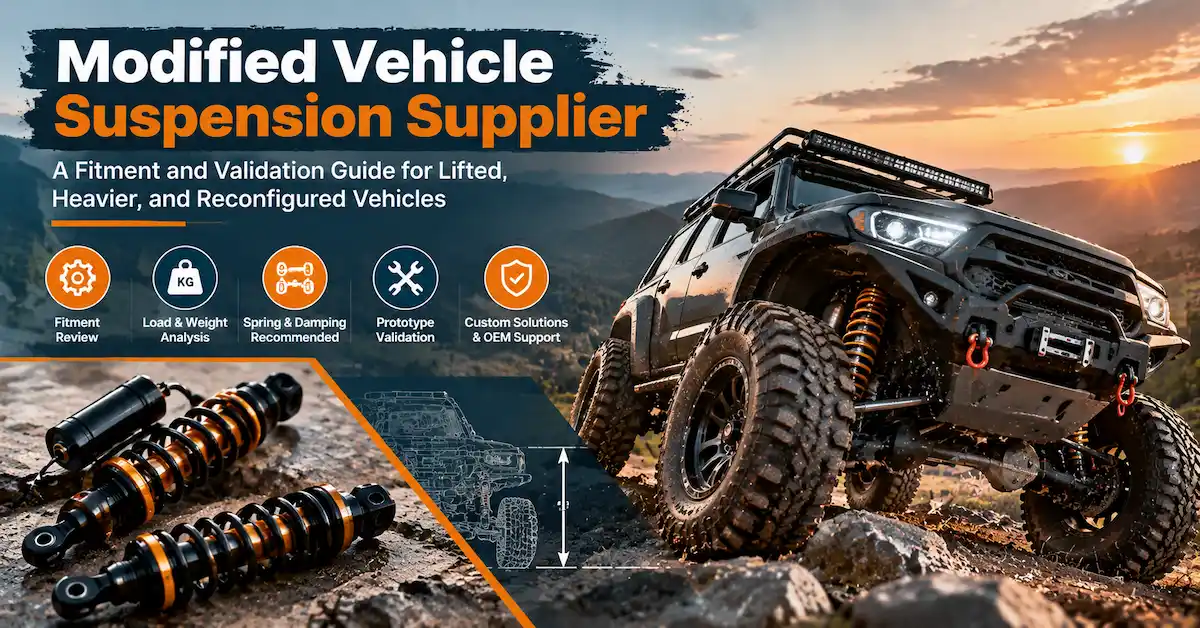

How does a recreational vehicle suspension OEM project reach repeat supply?
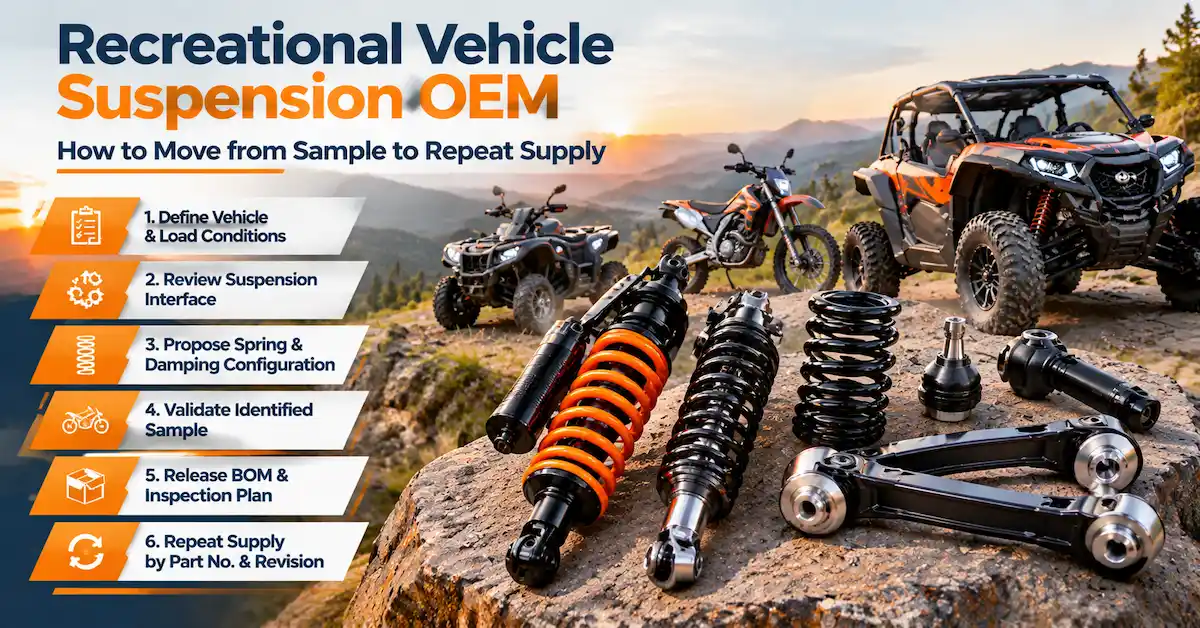
Direct answer: a recreational vehicle suspension OEM project reaches repeat supply through six controlled stages: define the vehicle and load conditions, review the suspension interface, propose spring and damping configuration, validate an identified sample, release a controlled BOM and inspection plan, and manage future orders by part number and revision. The sample is not the end of development. It is the physical reference used to close fitment, performance, quality, packaging, and service questions before production.
This process applies to ATV, UTV, electric motorcycle, recreational motorcycle, resort vehicle, utility recreational vehicle, and related powersports platforms. It is especially important when the product must carry a buyer's label, support several model years, or be replenished by a distributor that cannot inspect every part before shipment.
The unique purchasing question in this guide is whether an OEM supplier can move a suspension project from a vehicle brief to a repeatable configuration, rather than simply sell a visually similar shock. Buyers need a shared language for the scope, evidence, approval gates, and commercial assumptions. This is why the core topic, Recreational vehicle suspension OEM, should be treated as a program decision rather than a single component search.
Define the OEM scope before selecting a supplier
OEM is used broadly in the suspension market. A buyer may mean a direct replacement manufactured to an existing drawing, a private-label aftermarket part, a custom part developed from a vehicle, a component supplied to a vehicle assembler, or a family of parts that shares a body but uses different springs and mounts. These scopes require different evidence and different commercial planning.
| OEM scope | What is normally fixed | What still needs confirmation |
|---|---|---|
| Drawing-based production | Drawing, BOM, materials, dimensions, inspection, and label. | Source approval, capacity, packaging, change control, and lead time. |
| Direct replacement | Vehicle, position, interface, and replacement identity. | Model-year range, spring, damping, hardware, and service terms. |
| Private-label aftermarket | Brand, appearance, part number, package, and sales channel. | Fitment validation, adjustment instructions, warranty, and replenishment. |
| New platform development | Target vehicle, load cases, interface, and desired behavior. | Spring, damper, test plan, iteration, acceptance, and final BOM. |
| Family program | Shared components and common quality process. | Unique rows, model years, label, carton, spring, setting, and forecast. |
Put the scope in the first page of the RFQ. State whether the supplier is responsible for design, detailed engineering, sample manufacture, vehicle testing, tooling, packaging, documentation, and field support. A quotation that does not separate these responsibilities will create disagreement later, especially when the first sample fits but does not achieve the expected ride or load behavior.
Start with vehicle evidence, not a product photograph
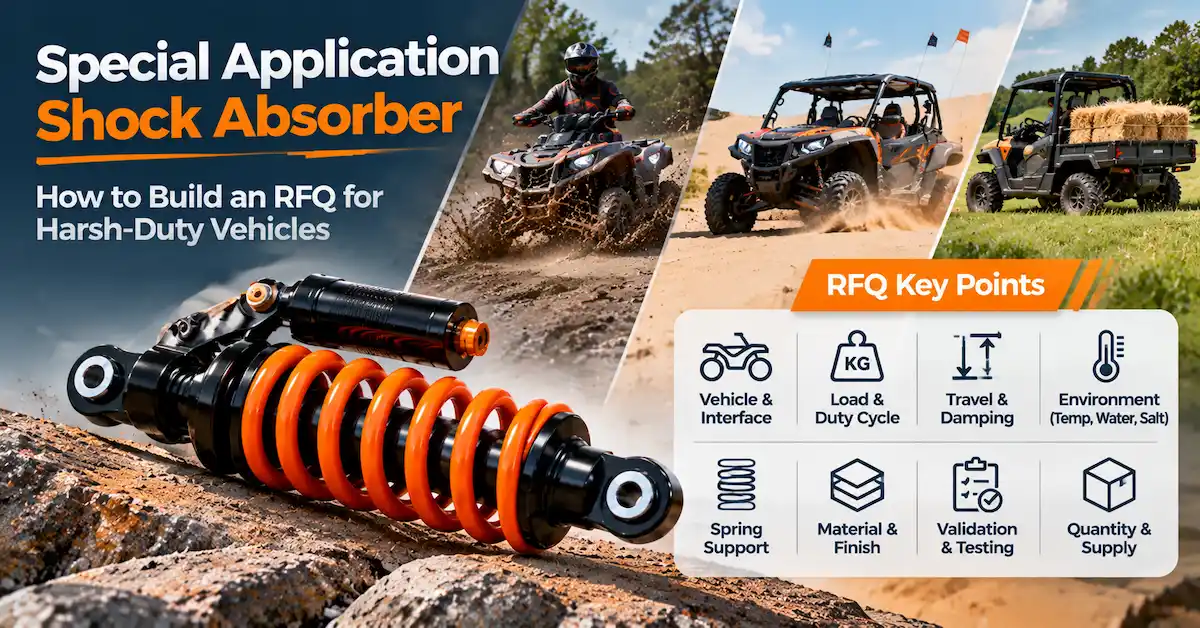
A recreational vehicle suspension OEM supplier needs enough information to understand the platform. A model name is only an index. It does not show the model year, market equipment, rider load, passenger condition, battery size, accessory package, motion ratio, or actual shock position. Send a vehicle data pack before asking for a final configuration.
Record the complete application identity
State vehicle category, brand, model, model year, market, front or rear position, left or right side, drive layout, tire and wheel specification, battery or engine configuration, and accessories. For a UTV, identify seating, cargo bed, roof, doors, winch, spare tire, and utility equipment. For a motorcycle, record rider range, passenger use, luggage, battery, and road or trail use. For an ATV, identify racks, plow, sprayer, trailer, or other load-bearing equipment.
Measure the installed interface
Measure extended length, ride-height length, compressed length, physical stroke, body diameter, spring seat, upper and lower mounting hole or thread, mounting width, bushing or sleeve, bolt size, and angle. Photograph the shock position at full droop, normal ride height, full bump, and steering or articulation limits. Check body, spring, reservoir, adjustment knob, rod, and hardware clearance against the frame, tire, drive shaft, brake line, battery, body, and exhaust or motor area.
| Vehicle data group | Required fields | Why OEM engineering needs it |
|---|---|---|
| Platform | Model, year, market, trim, position, side, drive, tire, wheel. | Controls fitment identity and prevents wrong-row approval. |
| Loads | Axle load, rider, passenger, cargo, battery, accessories, maximum case. | Supports spring rate, preload, ride height, and validation states. |
| Geometry | Lengths, stroke, mount, angle, motion ratio, bump, droop, clearance. | Defines physical fit and usable wheel travel. |
| Target | Comfort, control, traction, bottoming, pitch, roll, noise, service life. | Turns subjective feedback into test questions. |
| Environment | Dust, mud, water, salt, temperature, wash-down, route, speed, duty cycle. | Connects the design to sealing, finish, heat, and service risks. |
| Commercial | Quantity, forecast, market, label, package, launch, warranty, service. | Allows engineering and purchasing to plan the same program. |
Mark each field as confirmed, measured, estimated, calculated, or missing. This simple status makes the supplier's first response more honest. It also shows whether a request can be quoted immediately or needs a sample, drawing, vehicle, or additional measurement.
Match spring support to the recreational vehicle use case
Spring selection establishes much of the static support, ride height, sag, and reserve travel. The damper controls motion but cannot replace a spring that is wrong for the load. An OEM program should therefore release spring information separately from damper information while keeping both in the same configuration record.
Define spring information
Request spring rate, free length, coil diameter, end form, installed length, installed load, preload range, material or treatment requirement, finish, and coil clearance. State whether the spring is intended for a single load condition or a range. If the vehicle will use several springs for different trims, each rate needs a unique part number or a controlled selection rule.
Use sag and ride height as approval evidence
Record the measurement points and the load state used to calculate sag. Include rider, passenger, cargo, battery, and accessory conditions where they matter. A spring that gives a good unloaded ride height may lose reserve travel under cargo. A spring that supports maximum load may be unnecessarily harsh in a light recreational condition. The OEM buyer should define which states are approved and which are outside the scope.
| Spring decision | Buyer should define | Supplier should return |
|---|---|---|
| Rate | Load states, target sag, ride height, motion ratio, and reserve. | Rate proposal, basis, tolerance, and test condition. |
| Length | Free length, installed length, preload, coil clearance, travel. | Spring drawing, seat compatibility, and adjustment range. |
| Material and finish | Environment, appearance, corrosion expectation, and market requirement. | Material or finish proposal and evidence boundary. |
| Variants | Trim, rider, passenger, cargo, battery, and accessory differences. | Part-number rule and selection matrix. |
| Service | Replacement rate, dealer handling, and package identity. | Service part identity, label, and installation information. |
Define damping as a repeatable configuration
Damping should be described with conditions and behavior, not only with “high performance.” State whether the product is fixed or adjustable, whether rebound and compression are separated, which velocities and temperatures are relevant, and how the setting is identified. If a published product shows a maximum rebound or compression force, ask for the measurement speed, direction, temperature, adjustment position, and tolerance before comparing it to another supplier's number.
Fixed damping can simplify a defined OEM platform. It reduces user setting errors and makes a replacement part easier to control. Adjustable damping can support more variation, but the range must be meaningful and the baseline must be documented. The buyer needs to know the direction of adjustment, number of detents, setting map, access, lock or seal, and instructions. An adjustment feature without a validated baseline creates service confusion.
| Damping choice | Good fit | Questions before release |
|---|---|---|
| Fixed | One platform, controlled load, defined route, simple service. | Force condition, tolerance, spring match, and replacement identity. |
| Rebound adjustable | Rider, cargo, or terrain range changes recovery behavior. | Baseline, direction, detent repeatability, range, and instructions. |
| Compression adjustable | Impact support and compliance need separate control. | Circuit definition, speed range, access, and vehicle validation. |
| Multi-adjustable | Professional or wide-condition programs with trained users. | Interaction, setting map, service process, and approval responsibility. |
Public product evidence: BEDO's public motorcycle and ATV/UTV pages show example configuration fields, including aluminum alloy and steel pipe materials, total length, effective stroke, spring rate, rebound and compression values, mounting dimensions, and adjustment levels. One public MAU_HSA_01 reference lists a 355 mm total length, 70 mm effective stroke, 70 LBS spring rate, and 25 adjustment levels. Those values are reference-product data, not a universal specification for every recreational vehicle OEM project. Confirm the current revision and conditions for the requested platform.
Move from prototype to vehicle validation
The first sample should be planned as a decision gate. Before installation, inspect the dimensions, spring, mounts, hardware, finish, adjustment, label, and package. During static installation, record ride height, sag, clearance, bump, droop, articulation, steering or handlebar clearance, and hardware torque. During dynamic validation, keep the route, speed, tire, load, rider, weather, and setting stable enough to compare revisions.
| Stage | Question | Release record |
|---|---|---|
| Requirements | Are the platform, loads, target, environment, and commercial scope clear? | Approved brief, assumptions, missing data, and responsibility matrix. |
| Design review | Does the proposed spring, shock, mount, and hardware fit the platform? | Drawing, BOM, risk list, and proposal revision. |
| Sample inspection | Does the physical sample match the approved proposal? | Measured lengths, spring, mount, setting, finish, and photos. |
| Static fitment | Does it install and retain clearance across travel? | Load state, ride height, sag, clearance, torque, and correction list. |
| Dynamic test | Does it achieve the intended comfort and control? | Route, speed, tire, load, setting, symptom, result, and approval. |
| Pilot | Can production repeat the approved configuration? | Multiple units, inspection, packaging, label, and final revision. |
Do not collapse all test layers into the word “tested.” A bench measurement can describe damper behavior under a named condition. A static vehicle check can confirm installation and clearance. A dynamic test can reveal comfort, traction, control, and bottoming behavior. A pilot run can show whether the approved configuration is reproducible. Each layer answers a different question.
If the buyer cannot provide a formal proving ground, define a practical vehicle plan and record its limits. The report should state what was tested, what was not tested, and which claims remain open. This is more credible for procurement and prevents a short demonstration ride from being presented as proof of durability in every market.
Release the OEM BOM, inspection plan, and change rules
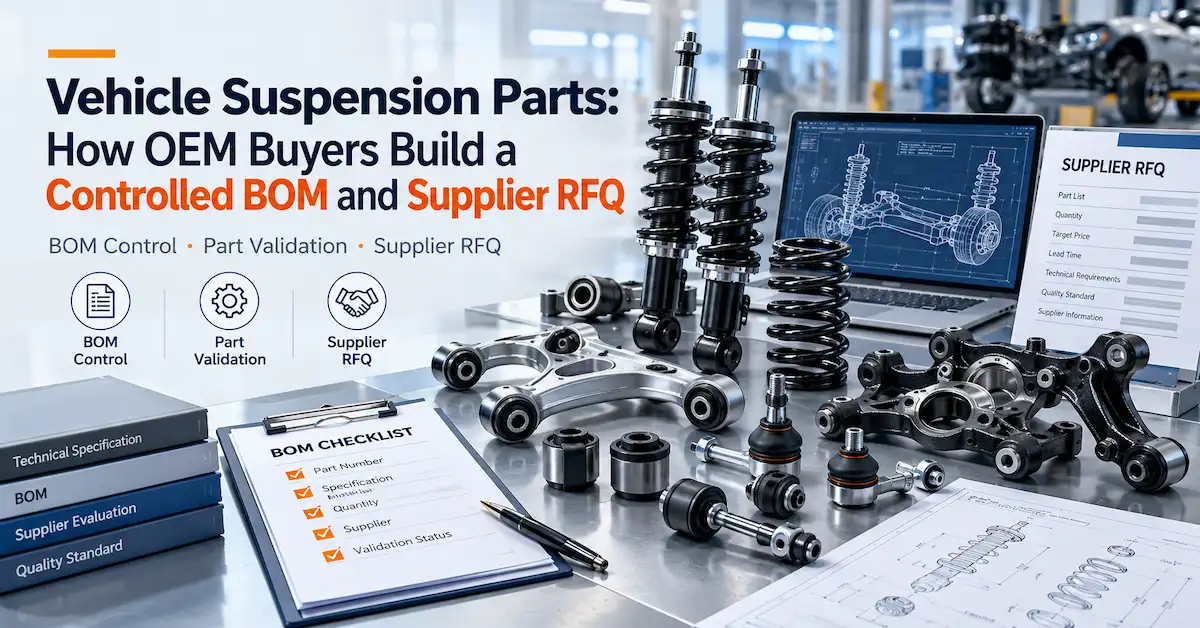
Production begins when the approved configuration is made unambiguous. Release a drawing, BOM, part number, revision, inspection plan, packaging specification, label proof, and installation or service information. Include the spring, collars, bushings, sleeves, spacers, fasteners, adjustment parts, and carton, not just the headline shock absorber. State which dimensions and functions are critical and how they are checked.
| Release document | Required content | Why it matters |
|---|---|---|
| Drawing | Interface, lengths, stroke, tolerances, spring seat, mount, revision. | Defines the physical product that purchasing is ordering. |
| BOM | Shock, spring, mount, bushing, hardware, label, carton, instructions. | Prevents a partial or substituted assembly. |
| Inspection plan | Dimensions, spring, damping or movement, appearance, leak, label, package. | Connects engineering requirements to production checks. |
| Change rule | Source, material, process, setting, component, label, and approval triggers. | Protects behavior and fitment after launch. |
| Service record | Replacement number, installation, baseline setting, complaint fields. | Lets dealers and users receive the correct part and advice. |
Ask the supplier to distinguish a manufacturing change from a customer-visible change. A new coating supplier may need an incoming or appearance check. A new spring source or damper setting may require force or vehicle revalidation. A new mount or bushing may require fitment confirmation. The change notice should say what evidence is required before the new revision ships.
Use traceability for repeat orders
Every production unit should be connected to the approved part number and revision through a label, lot record, or other agreed identity. For small batches, a simple controlled record is still valuable. It allows the buyer to ask which spring, setting, packaging, and inspection record were used when a field question arrives. Traceability also helps distinguish a product issue from incorrect installation, vehicle modification, overloaded use, or a later change.
For private-label programs, coordinate product identity across web pages, cartons, labels, instructions, dealer systems, and replacement listings. A different name on a product page can create a support problem even when the physical part is unchanged. An approved identity map keeps the commercial and technical records aligned.
Plan packaging, service, and commercial terms
Packaging is part of an OEM release because it protects the component and communicates its identity. Define individual protection for rods, bodies, springs, and finishes. Bag hardware separately and label the bag. Show the part number, vehicle row, position, revision, quantity, and barcode where required. Approve carton and pallet configuration for the actual distribution route.
Service planning should include installation direction, torque or hardware notes, baseline adjustment, replacement part number, and the fields needed for a complaint. A dealer or fleet technician should be able to identify the vehicle, part, revision, load condition, and symptom. Without that information, a warranty or quality discussion becomes guesswork.
| Commercial topic | Buyer question | Supplier response needed |
|---|---|---|
| Development | What is included in review, drawing, samples, fixtures, and test support? | Stage scope, assumptions, iteration limit, and responsibility matrix. |
| MOQ | Does the minimum apply to prototype, pilot, production, label, or carton? | Project-specific quantity by configuration and variant. |
| Lead time | When does it start and which approvals are prerequisites? | Stage schedule from inputs to sample, pilot, and replenishment. |
| Packaging | Are label, barcode, carton, pallet, and instructions included? | Packaging drawing or photos, counts, and cost assumptions. |
| Warranty | What evidence starts a field investigation? | Complaint template, responsibility boundary, and response route. |
| Change | Which changes need customer approval or retest? | Written notification and revalidation rule. |
BEDO's public website describes custom solutions and small-batch ordering, but it does not publish one universal MOQ, lead time, warranty, package, or development price for every recreational vehicle suspension program. Treat these as RFQ fields. The final quotation should state quantity, model count, customization, market, label, packaging, approval stage, and shipping assumption.
Prepare an OEM suspension RFQ that gets an engineering answer
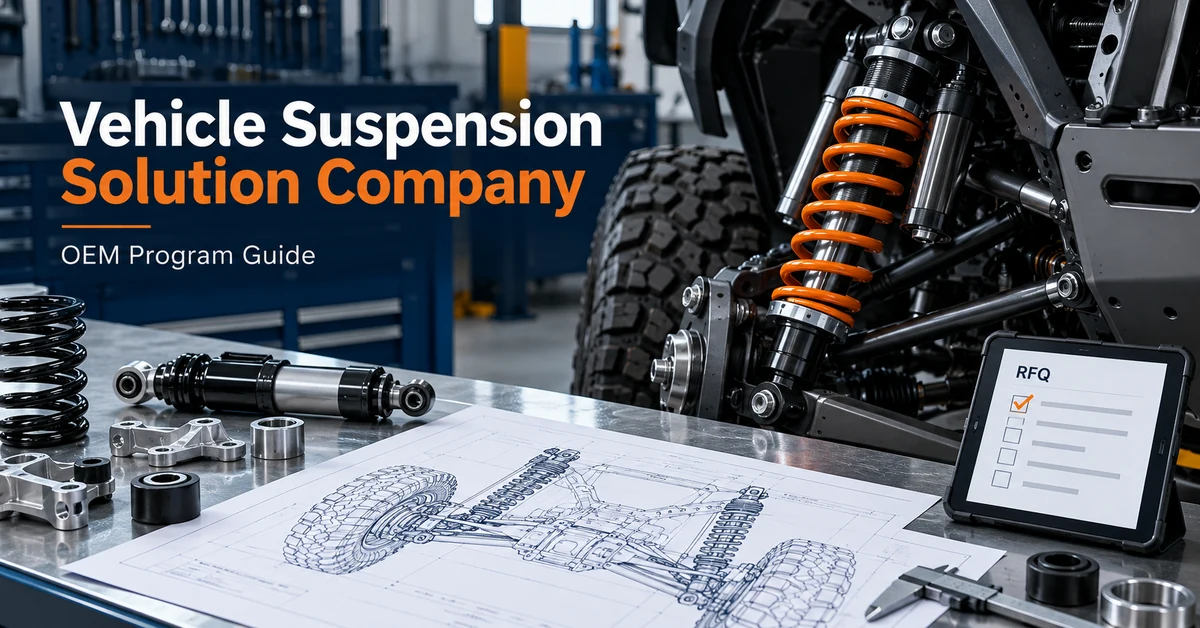
A useful RFQ combines technical, commercial, and evidence requirements. Attach drawings or measured samples, vehicle photographs, loading photographs, tire and wheel details, target ride height, use route, environmental risks, annual forecast, market, label, packaging, and launch date. Tell the supplier which fields are mandatory and which can be proposed.
| RFQ section | Buyer information | Supplier response requested |
|---|---|---|
| Entity and program | Company, vehicle brand, model family, market, channel, quantity. | Factory identity, scope, responsible engineer, and quotation basis. |
| Vehicle interface | Model, year, position, dimensions, mount, travel, clearance, photos. | Fitment review, drawing, commonality proposal, missing data. |
| Performance | Loads, spring target, sag, ride height, comfort, control, bottoming. | Spring and damping proposal, test conditions, acceptance plan. |
| Quality | Inspection, traceability, documents, certifications, change control. | Control plan, records, process boundary, revision method. |
| Commercial | Sample, pilot, forecast, MOQ, lead time, package, warranty. | Stage price, schedule, shipping, service, and open-point list. |
Ask the supplier to return three categories: confirmed now, proposed after review, and required from the buyer. This format makes the first response easy to compare and prevents the word “OEM” from hiding a lack of engineering definition.
Buyer checklist before sample approval
- Is the exact vehicle, year, market, position, and side identified?
- Are full-droop, ride-height, and full-bump dimensions recorded?
- Are spring rate, preload, sag, ride height, and load cases agreed?
- Are damping settings tied to speed, temperature, direction, and revision?
- Are the sample, hardware, label, package, and instruction sheet identified?
- Are the vehicle and bench test limitations written down?
- Are MOQ, lead time, packaging, warranty, and change terms tied to the same revision?
Recreational vehicle suspension OEM FAQ
What does an OEM suspension supplier do beyond manufacturing?
Depending on scope, the supplier may review vehicle data, propose spring and damper configuration, manufacture samples, support fitment, define inspection, control packaging, and manage repeat production. The buyer should state which responsibilities are included rather than assuming the word OEM covers everything.
Can a public ATV or motorcycle shock specification be used directly?
It can be used as a reference for the type of data to discuss, but not as proof of fitment for another platform. Confirm model, year, geometry, loads, spring, damping conditions, hardware, and revision for the requested vehicle.
Should a recreational vehicle use fixed or adjustable damping?
Fixed damping can be appropriate for a defined platform and simple service. Adjustable damping can help with rider, passenger, cargo, or terrain variation when the range and baseline are validated. The correct choice depends on the use case and service capability.
What evidence should a buyer request before production?
Request an approved drawing and BOM, sample inspection, spring and damping records, fitment photos, vehicle test conditions, pilot evidence, packaging proof, label identity, change control, and project-specific commercial terms. Do not treat generic marketing claims as production evidence.
Does BEDO confirm MOQ and lead time on the public site?
No. Project terms depend on configuration, quantity, model count, customization, packaging, market, and approval stage. Request a written quotation for the exact OEM program.
How should a buyer handle a multi-model family?
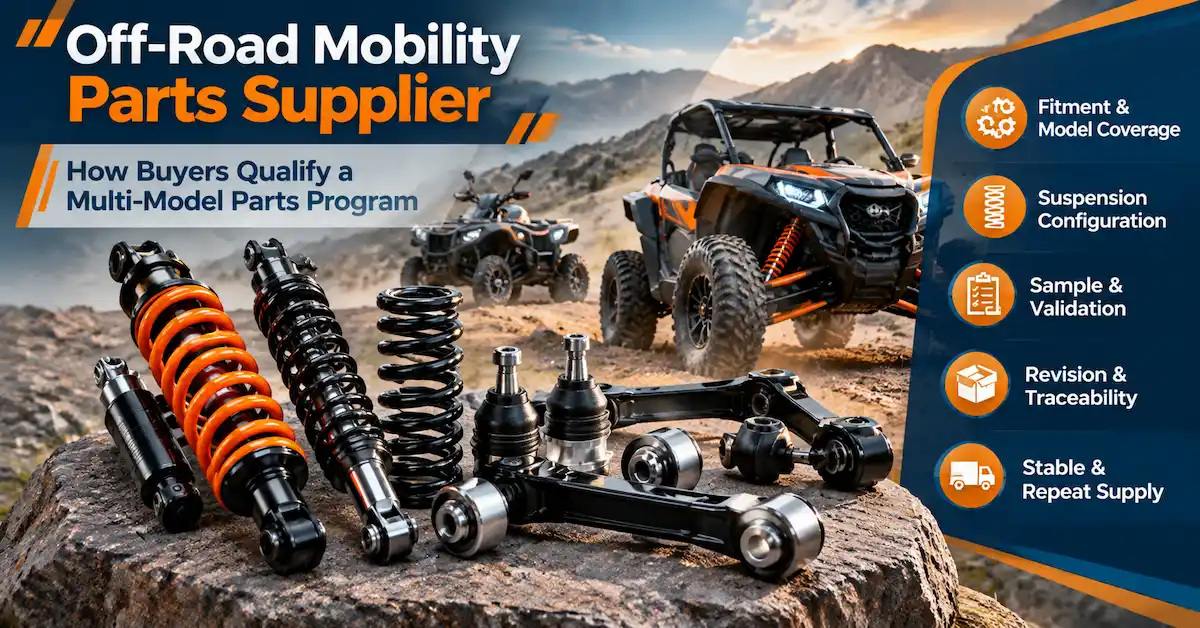
Use one row per model and year, identify common and unique components, create a part-number rule, and connect spring, damping, mount, hardware, label, package, and service identity to each row. Review changes against the full family matrix.
Conclusion
A recreational vehicle suspension OEM project succeeds when the supplier and buyer share a controlled definition of the vehicle, loads, geometry, spring, damping, validation, production, packaging, and service identity. The sample is only one stage. Repeat supply depends on the released BOM, inspection plan, revision rule, and commercial terms being as clear as the physical component.
BEDO Auto's public product information provides a useful starting point for an ATV, UTV, or motorcycle suspension RFQ, including application categories and technical field examples. Send the exact platform and ask BEDO to confirm the current configuration, engineering scope, validation evidence, MOQ, lead time, packaging, and change-control conditions before approving a production revision.