
What Makes ATV Suspension Parts “Premium”?
Premium ATV suspension parts are not defined by color, reservoir size, or price alone.
For B2B buyers, a premium suspension product should demonstrate measurable value in several areas:
- Correct vehicle fitment
- Appropriate spring characteristics
- Controlled compression and rebound damping
- Reliable sealing
- Consistent manufacturing
- Suitable materials and surface treatment
- Useful adjustability where required
- Repeatable production quality
- Clear technical documentation
- Application-specific validation
A visually impressive shock absorber can still be unsuitable if its spring rate, damping, stroke, or mounting dimensions do not match the target ATV.
For distributors and ATV brands, “premium” should therefore describe the complete engineering and manufacturing package, not simply the appearance of the product.
Buyers can first review Bedo Auto's shock absorber range before deciding whether an existing configuration or a customized premium ATV suspension solution is more appropriate.
Who Buys Premium ATV Suspension Parts?
Premium ATV suspension products typically target customers who expect more than basic replacement functionality.
ATV Aftermarket Brands
Aftermarket brands may develop premium product lines to differentiate themselves from low-cost replacement shocks.
Their priorities can include:
- Better product positioning
- Adjustable suspension
- Customized springs
- Reservoir configurations
- Private-label appearance
- More detailed technical specifications
ATV Distributors and Importers
Distributors need products that combine premium positioning with repeatable commercial supply.
Key concerns include:
- Application coverage
- Fitment accuracy
- Product consistency
- Packaging
- Branding
- Repeat order stability
ATV Manufacturers
Vehicle manufacturers may require premium suspension for:
- Higher-spec ATV models
- Performance editions
- Utility models
- Specialty applications
These projects typically require deeper vehicle-level engineering.
ATV Modification Companies
Modified ATVs may need suspension changes after adding:
- Larger tires
- Cargo systems
- Winches
- Protection equipment
- Battery systems
- Other accessories
The increased vehicle mass or altered geometry can affect suspension requirements.
Premium ATV Suspension vs Standard Replacement Parts
A premium product should provide meaningful technical or commercial advantages.
| Evaluation Area | Standard Replacement | Premium ATV Suspension |
|---|---|---|
| Fitment | OE-style dimensions | Application-specific review |
| Spring | Standard specification | Load/application matching |
| Damping | Fixed/basic | Tuned or adjustable options |
| Reservoir | Usually basic | Available when justified |
| Adjustability | Limited | Preload/damping options |
| Finish | Standard | Higher-end customization |
| Prototype validation | Limited | Recommended for new specs |
| Branding | Basic | Private-label differentiation |
| Technical support | Product-based | Engineering-based |
| Target market | Replacement | Upgrade/performance |
Premium does not always mean every feature must be added.
A high-quality fixed-damping shock designed correctly for a specific ATV can be a better product than an overly complicated adjustable shock that is poorly matched to the vehicle.
Which Premium ATV Suspension Parts Matter Most?
Premium ATV Shock Absorbers
Shock absorbers are usually the most visible and technically complex part of an ATV suspension upgrade.
Important specifications include:
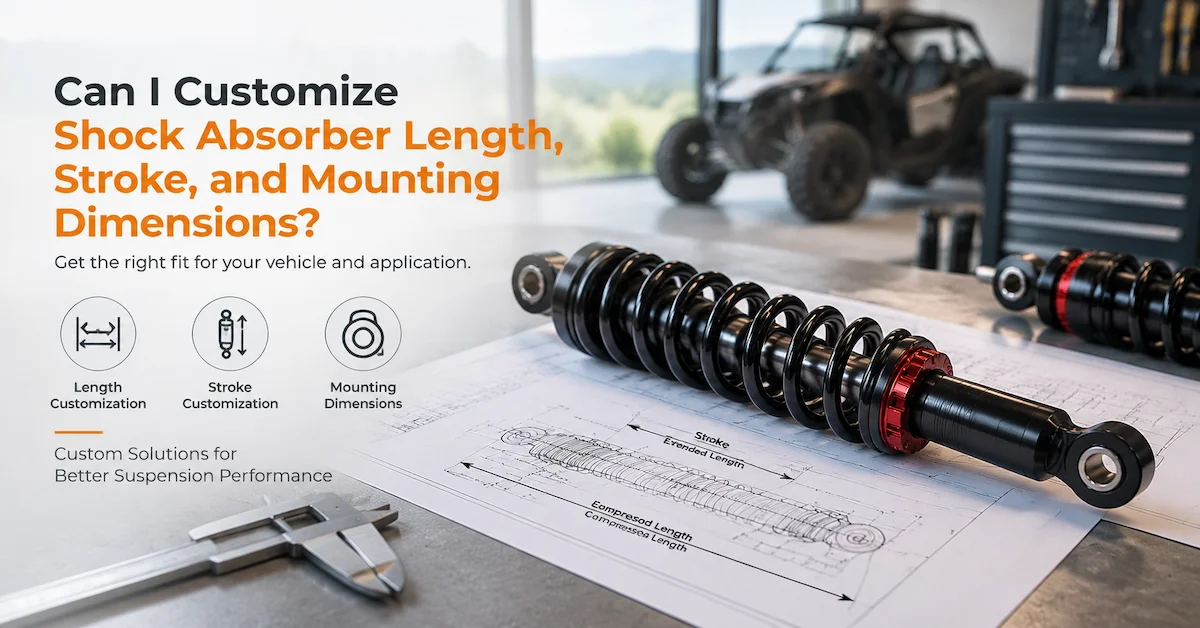
- Extended length
- Compressed length
- Stroke
- Body design
- Piston rod
- Mounting interfaces
- Spring specification
- Damping configuration
- Reservoir design
- Adjustment options
If these values are incorrect, the shock may not provide the intended performance even if the materials and finish appear premium.
Performance Coil Springs
The spring supports the vehicle and influences:
- Ride height
- Sag
- Load capacity
- Available suspension travel
- Ride response
Premium spring selection should be based on vehicle and application data rather than simply using a stiffer coil.
Mounting and Interface Components
Supporting components may include:
- Bushings
- Sleeves
- Mounting eyes
- Forks
- Spring seats
- Brackets
These parts require accurate dimensions and suitable material selection because they directly affect fitment and mechanical interfaces.
How Should Buyers Evaluate Premium ATV Shock Absorbers?
Several areas deserve particular attention.
Fitment Accuracy
Before evaluating performance, confirm that the shock fits the ATV correctly.
Important dimensions include:
- Eye-to-eye length
- Compressed length
- Stroke
- Mounting-hole diameter
- Mount width
- Spring diameter
- Reservoir clearance
Fitment data should be controlled by drawing or verified sample measurements.
If your project begins without complete documentation, Bedo's ATV Suspension Drawing Service Guide explains how mounting and geometry information can be organized before prototype development.
Spring Specification
A premium suspension product should use a spring appropriate for its intended load range.
The supplier may need information about:
- ATV weight
- Rider weight
- Cargo
- Accessories
- Suspension position
- Existing spring
- Intended terrain
A spring that is too stiff may reduce compliance.
A spring that is too soft may create excessive sag or bottoming.
The goal is not maximum stiffness—it is appropriate support.
Why Damping Is Critical to Premium ATV Suspension
Damping controls how quickly suspension movement occurs.
Compression Damping
Compression damping influences how the suspension responds when the wheel moves upward.
The correct level depends on:
- Terrain
- Vehicle load
- Spring rate
- Suspension travel
- Target ride behavior
Rebound Damping
Rebound damping controls how quickly the suspension extends after compression.
Poor rebound matching can reduce wheel control during repeated bumps.
For premium products, the supplier should be able to explain the intended damping configuration rather than relying only on marketing terms such as:
- Racing damping
- Heavy-duty damping
- Extreme performance
Those descriptions are not engineering specifications.
Fixed or Adjustable Premium ATV Suspension?
Adjustability can add value, but only when it serves the target customer.
Preload Adjustment
Preload adjustment can help accommodate:
- Rider weight
- Cargo
- Ride-height preferences
Compression Adjustment
Compression adjustment can provide additional control for different terrain or riding conditions.
Rebound Adjustment
Rebound adjustment allows users to change suspension recovery characteristics.
When Fixed Damping Is Better
Fixed damping may still be appropriate when the buyer wants:
- Simple installation
- Predictable setup
- Lower complexity
- Replacement-focused products
A premium product does not need maximum adjustability.
It needs the right level of adjustability for the market.
Are Reservoir Shocks Always Premium?
No.
External and remote reservoirs can support demanding suspension applications, but their value depends on the project.
Possible considerations include:
- Heat management
- Fluid volume
- Packaging
- Damping architecture
- Riding duration
- Terrain
Reservoir designs also introduce:
- Additional components
- Hose routing
- Mounting brackets
- Higher cost
For this reason, reservoir shocks should not automatically be selected only to create a premium appearance.
The supplier should first determine whether the application benefits from the additional design complexity.
What Materials and Construction Details Should Buyers Review?
Premium positioning should be supported by reliable construction.
Depending on the shock design, buyers may review:
- Shock body material
- Piston rod
- Sealing system
- Bushings
- Spring material
- Mounting components
- Surface treatment
- Fasteners
The important point is not to create a marketing list of “premium materials.”
Instead, the supplier should be able to explain why the selected materials and processes are suitable for:
- Outdoor exposure
- Mud
- Water
- Dust
- Repeated suspension movement
- Off-road loads
What Information Should Buyers Provide for Premium ATV Suspension Development?
A clear technical RFQ improves supplier recommendations.
| Project Information | Why It Matters |
| ATV model/platform | Defines target application |
| Model year | Helps control fitment |
| Front/rear position | Identifies suspension role |
| Vehicle weight | Supports spring review |
| Rider/cargo range | Defines load condition |
| Extended length | Controls fitment |
| Compressed length | Defines compression limit |
| Stroke | Controls shock travel |
| Mount dimensions | Ensures installation |
| Existing spring | Provides baseline |
| Reference shock | Supports comparison |
| Terrain | Defines operating conditions |
| Performance target | Clarifies product positioning |
| Target retail segment | Defines premium features |
| Prototype quantity | Supports development |
| Production quantity | Supports sourcing plan |
The buyer should explain the real performance objective.
For example:
The target product is a premium rear shock for recreational ATV riders who regularly carry additional equipment and ride rough trails.
This is more useful than:
We need your highest-performance shock.
Can Premium ATV Suspension Be Developed From Existing Samples?
Yes.
An original ATV shock can provide a useful reference for:
- Dimensions
- Stroke
- Mounting
- Spring size
- Shock structure
- Reservoir configuration
However, the supplier needs to understand whether the new product should:
match the original
or
improve the original.
If the objective is improvement, additional engineering information is required.
The project may include changes to:
- Spring rate
- Damping
- Adjustability
- Reservoir
- Materials
- Finish
- Branding
For sample-based development, buyers can review Bedo's Suspension Sample Development Guide.
Why Prototype Validation Matters for Premium Products
Premium positioning creates higher customer expectations.
A new specification should therefore be verified before larger production quantities are approved.
Prototype evaluation may include:
Dimensional Check
Confirm:
- Length
- Stroke
- Mounting interfaces
ATV Installation
Check:
- Fitment
- Clearance
- Ride height
- Available travel
Spring Evaluation
Review behavior under:
- Rider load
- Cargo where relevant
- Intended riding conditions
Damping Evaluation
Assess:
- Compression response
- Rebound recovery
- General suspension control
Appearance Review
For private-label projects, approve:
- Colors
- Finish
- Logo
- Markings
Prototype feedback can then be incorporated into the final production specification.
Premium Product Quality Requires Production Consistency
One excellent sample is not enough.
For distributors and brands, a premium suspension program succeeds only if repeat orders maintain the approved specification.
Important controls include:
- Approved drawings
- Material specifications
- Spring specifications
- Damping configuration
- Assembly procedures
- Dimensional inspection
- Product identification
- Packaging standards
If a prototype is revised, the factory must clearly control which revision moves into production.
This is particularly important for product lines with multiple front/rear or vehicle-specific variants.
Why a Pilot Batch Helps Premium ATV Brands
A pilot batch creates another validation stage between prototypes and commercial scale.
It can help identify:
- Dimensional variation
- Finish inconsistency
- Spring differences
- Assembly variation
- Branding errors
- Packaging issues
A practical route is:
Sample → Prototype Approval → Pilot Batch → Market Launch → Repeat Production
For private-label brands, this can significantly reduce the risk of discovering production problems after building a large inventory.
What Does “Premium” Mean for Private-Label ATV Suspension?
Private-label premium products usually need both technical and visual differentiation.
Technical Differentiation
Possible features include:
- Application-specific spring
- Revised damping
- Adjustable preload
- Compression/rebound adjustment
- Reservoir configuration
- Custom dimensions
Visual Differentiation
Possible features include:
- Spring color
- Shock finish
- Adjuster color
- Logo
- Laser marking
- Packaging
The two areas should be controlled separately.
Technical Specification controls vehicle function.
Brand Specification controls appearance.
Packaging Specification controls commercial presentation.
This makes repeat orders easier to manage.
How to Compare Premium ATV Suspension Suppliers
A B2B buyer should evaluate more than product images.
Application Experience
Does the supplier understand ATV suspension rather than only generic automotive shocks?
Engineering Support
Can the supplier review:
- Samples
- Drawings
- CAD
- Vehicle data?
Spring Capability
Can spring specifications be customized according to the application?
Damping Capability
Can the supplier support compression and rebound development where required?
Prototype Capability
Can new configurations be physically manufactured and revised?
Testing Support
Ask what is actually tested and what acceptance criteria are used.
Branding Capability
Can the factory control appearance and packaging across repeat orders?
Manufacturing Consistency
Can production reliably reproduce the approved premium sample?
These factors can be more important than a small difference in unit price.
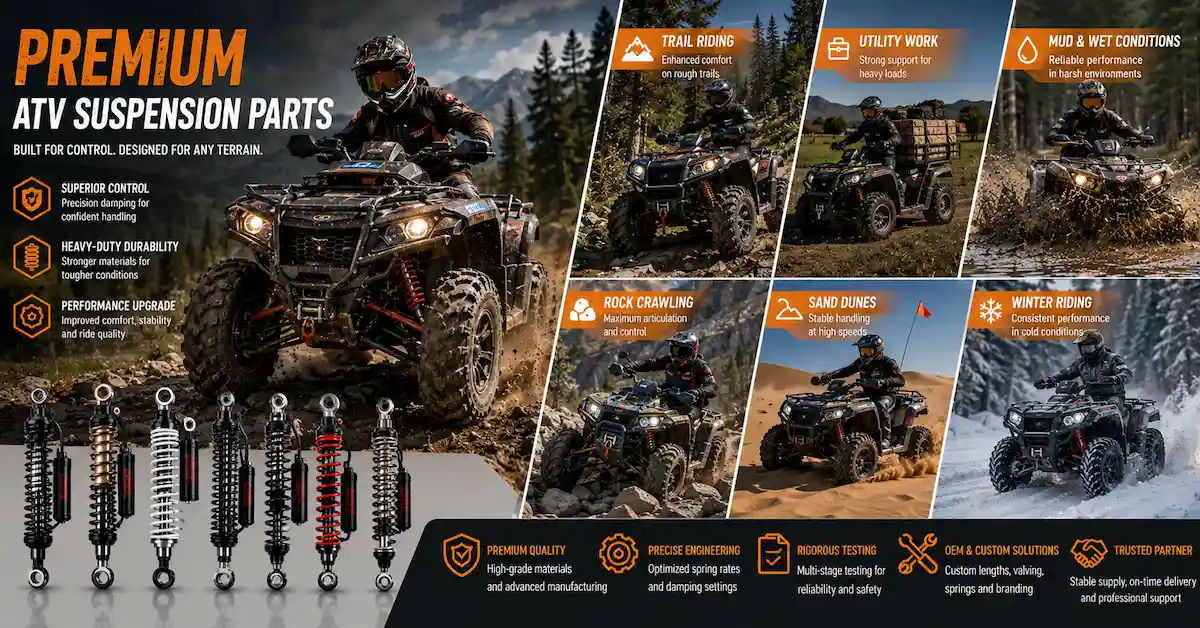
Premium ATV Suspension for Different Applications
| ATV Application | Typical Premium Focus |
| Trail riding | Comfort and wheel control |
| Utility ATV | Load support and durability |
| Mud riding | Durability and suspension control |
| Rock terrain | Wheel articulation and damping |
| High-speed off-road | Damping and heat control |
| Modified ATV | Vehicle-specific fitment and load |
| Private-label replacement | Fitment, quality and branding |
These are positioning directions, not universal specifications.
Every new premium ATV suspension product should still be evaluated against the actual vehicle and customer use case.
How Bedo Auto Supports Premium ATV Suspension Projects
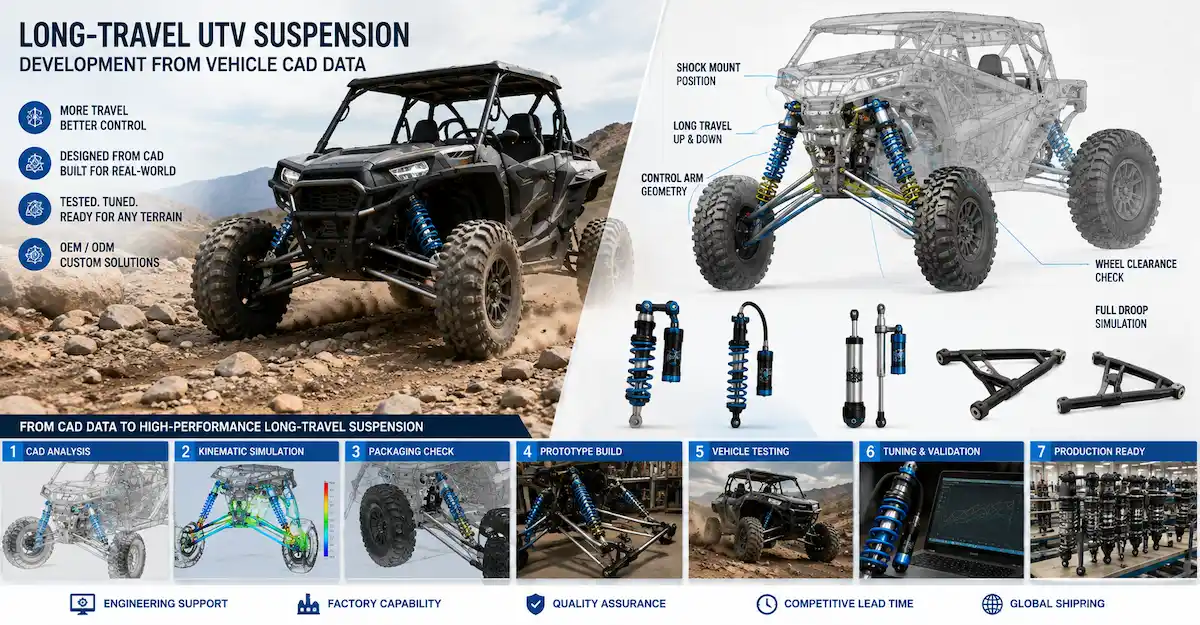
Bedo Auto supports suspension development for off-road applications including ATV and UTV products.
Depending on project requirements, support can include:
- Existing shock analysis
- Drawing review
- CAD-based development
- Custom shock absorber dimensions
- Spring development
- Damping adjustment
- Prototype manufacturing
- Sample validation
- Engineering revisions
- Small-batch production
- OEM/private-label preparation
Buyers looking for an aftermarket supplier can also review the related Aftermarket ATV Suspension Supplier Guide.
For deeper custom-development requirements, see Suspension Customization Factory.
To discuss a specific premium ATV suspension program, submit available technical information through the Bedo Auto Contact Page.
What Should You Include in a Premium ATV Suspension RFQ?
Prepare:
- ATV make/model/platform
- Model year
- Front or rear position
- Existing shock sample
- Extended length
- Compressed length
- Stroke
- Upper and lower mount dimensions
- Vehicle weight
- Typical rider load
- Cargo/accessory load
- Existing spring information
- Target terrain
- Desired improvement
- Fixed or adjustable preference
- Reservoir requirement
- Branding requirements
- Target market positioning
- Prototype quantity
- Initial production quantity
- Estimated repeat volume
This allows the supplier to understand what “premium” needs to mean for your specific ATV product.
FAQ
What are premium ATV suspension parts?
Premium ATV suspension parts are suspension components designed to provide higher technical, quality, customization, or performance value than basic replacement products. They may include upgraded shocks, springs, adjustable systems, or vehicle-specific configurations.
Are premium ATV shocks always adjustable?
No. Adjustable shocks can add tuning flexibility, but a properly engineered fixed-damping shock can also be a premium product if it matches the application and is manufactured consistently.
Do premium ATV shocks need remote reservoirs?
No. Reservoir shocks are useful for some demanding applications, but they add cost and packaging complexity and are not necessary for every ATV.
Can spring rate be customized?
Yes. Spring specifications can be developed according to vehicle weight, rider load, suspension travel, geometry, and intended use.
Can compression and rebound damping be customized?
Depending on the shock design, both can be adjusted during development. The final specification should match the spring, vehicle, load, and terrain.
Can premium ATV suspension be developed from an OE sample?
Yes. An existing shock can provide dimensional and structural reference data. Additional application information is required if the new product is intended to improve performance rather than simply replace the original.
Should distributors test premium ATV suspension before bulk ordering?
For a new or modified specification, prototype and pilot-batch validation can help verify fitment, suspension behavior, appearance, and production consistency before larger commercial orders.
Can premium ATV suspension be private labeled?
Yes, depending on supplier capability. Private-label projects may include custom colors, finishes, logos, labels, packaging, and technical differentiation.
What should I compare when choosing a premium ATV suspension supplier?
Compare application experience, engineering support, spring and damping capability, prototype development, quality control, branding support, revision management, and repeat-production consistency.
How do I start a premium ATV suspension project with Bedo Auto?
Prepare the target ATV application, reference shock or drawings, vehicle and load data, desired suspension improvement, branding requirements, prototype quantity, and production plan, then submit them through the Bedo Auto Contact Page.
Conclusion
Premium ATV suspension parts should provide meaningful technical and commercial value rather than simply look more expensive than standard replacement products.
For ATV brands, distributors, and private-label buyers, premium product development should connect:
Verified Fitment → Spring Matching → Damping Specification → Useful Features → Prototype Validation → Production Consistency → Brand Differentiation
The correct product may be a sophisticated adjustable reservoir shock, or it may be a carefully engineered fixed-damping shock with excellent fitment and repeatability.
What matters is whether the suspension matches the ATV, target customer, terrain, load condition, and market positioning.
Bedo Auto supports ATV suspension projects through sample and drawing analysis, shock absorber customization, spring development, damping adjustment, prototype validation, small-batch manufacturing, and OEM/private-label production preparation.
If you are developing a premium ATV suspension product line, define the vehicle, customer use case, fitment requirements, performance target, branding, and production plan before requesting a project-specific quotation.