
What Is an Aftermarket ATV Suspension Supplier?
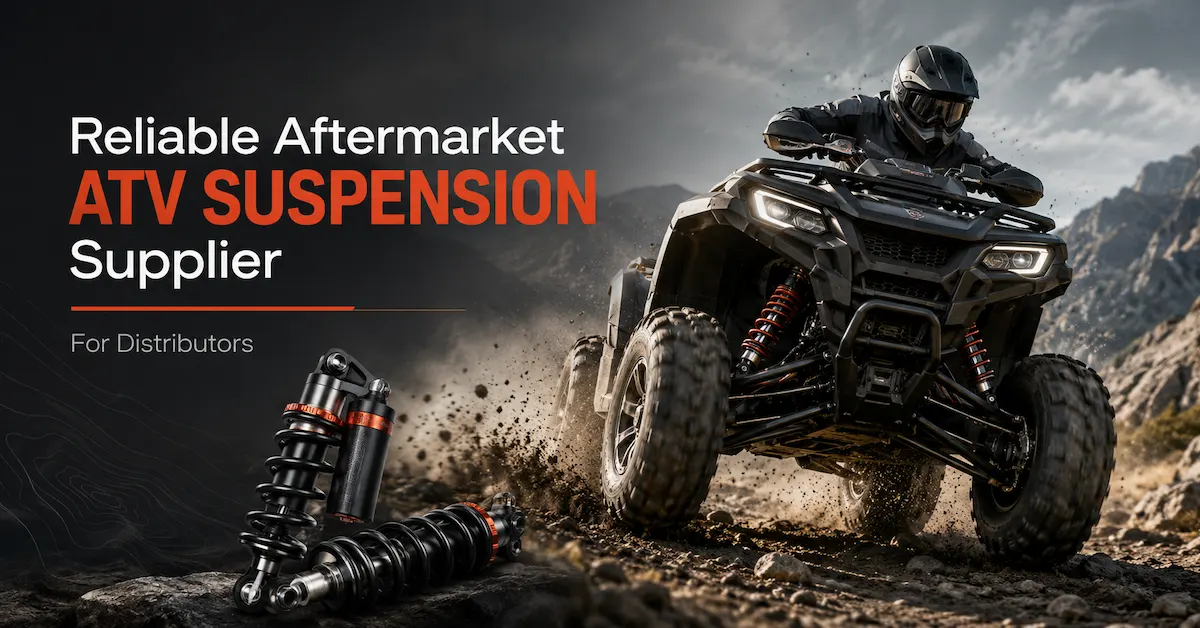
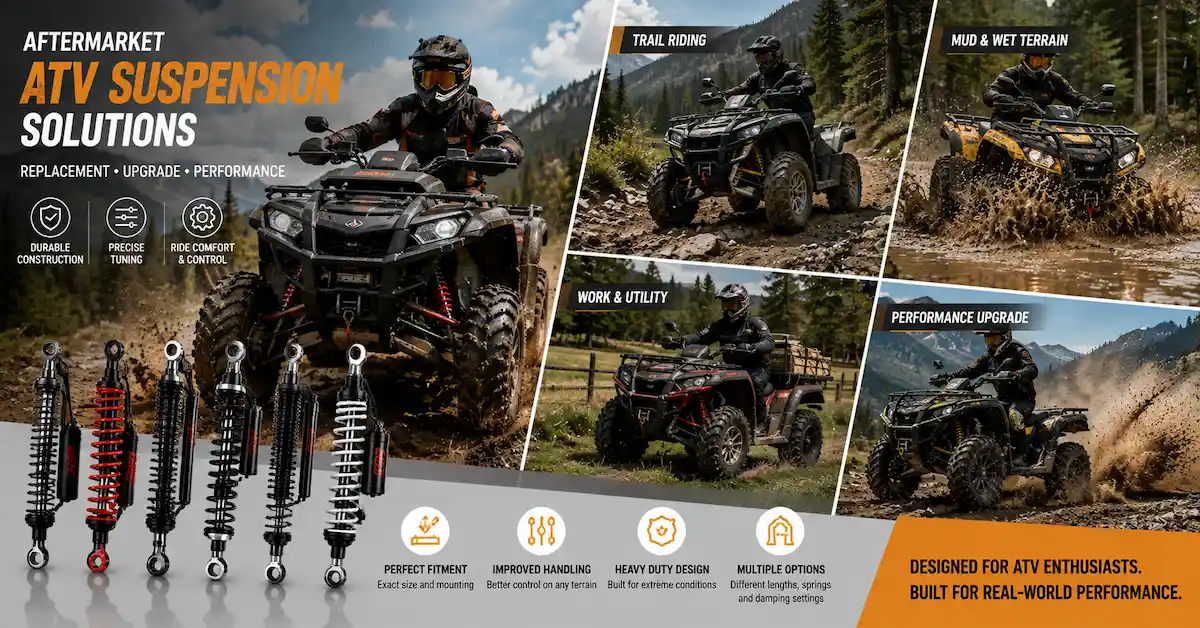
An aftermarket ATV suspension supplier provides shock absorbers, springs, and related suspension products for brands, wholesalers, distributors, importers, modification companies, and replacement-parts businesses rather than supplying only a vehicle manufacturer's original assembly line.
The supplier's role can range from supplying an existing replacement shock to developing differentiated suspension products for a private-label brand.
Typical requirements include:
- Replacement ATV shocks
- Suspension upgrade products
- Custom spring specifications
- Different shock dimensions
- Compression and rebound tuning
- Reservoir configurations
- Private-label colors
- Brand logos
- Custom packaging
- Low-volume market validation
- Repeat production
Bedo Auto's current product range includes shock absorbers and suspension springs for off-road applications, while its development workflow supports sample analysis, drawing review, prototype manufacturing, spring development, damping adjustment, validation, and small-batch production.
Buyers can first review Bedo's ATV and UTV shock absorber products before deciding whether an existing configuration or a customized aftermarket product is more appropriate.
Who Buys Aftermarket ATV Suspension Products?
Aftermarket ATV suspension serves several different B2B customer groups.
Distributors and Importers
Distributors commonly need products that can be stocked and resold across a defined range of ATV applications.
Their priorities may include:
- Verified fitment
- Repeatable specifications
- Stable quality
- Packaging
- Product identification
- Reliable repeat supply
Private-Label Suspension Brands
A private-label brand may want more differentiation than a distributor selling generic replacement products.
Possible requirements include:
- Custom spring colors
- Shock body finishes
- Brand logos
- Packaging
- Different damping targets
- Application-specific specifications
ATV Modification Shops
Modification companies may need shocks for vehicles that have changed from their factory configuration.
Changes such as larger tires, cargo equipment, battery packs, lift modifications, or reinforced structures can change suspension requirements, so modified vehicles should not automatically be treated as stock fitment applications.
Performance and Off-Road Brands
Performance-oriented buyers may prioritize:
- Better wheel control
- Increased travel
- More suitable damping
- Adjustable suspension
- Heat management
- Terrain-specific performance
Suspension performance depends on more than physical shock dimensions. Compression damping controls resistance during suspension compression, while rebound damping controls suspension extension after compression. Can-Am's official ATV suspension guidance makes this same distinction when explaining ATV shock adjustment.
Replacement Suspension vs Upgrade Suspension
One of the first questions an aftermarket buyer should answer is:
Are we replacing the original suspension, or deliberately changing vehicle behavior?
These are different sourcing projects.
| Project Type | Main Goal | Typical Development Requirement |
|---|---|---|
| OE-style replacement | Restore original function | Accurate fitment and consistent specification |
| Heavy-duty replacement | Support higher loads | Spring/load review |
| Comfort upgrade | Improve ride characteristics | Spring and damping evaluation |
| Performance upgrade | Improve terrain response | Damping, travel and geometry review |
| Lifted/modified ATV | Match altered vehicle setup | Fitment, stroke and geometry validation |
| Private-label shock | Create differentiated product | Branding + technical specification |
| New aftermarket SKU | Develop a new market product | Sample, validation and repeat production |
A supplier should understand which category the buyer is targeting before recommending a product.
What ATV Suspension Products Can an Aftermarket Supplier Provide?
ATV Shock Absorbers
ATV shock absorber specifications can vary considerably between applications.
Bedo's current ATV/UTV range includes models with different overall lengths, strokes, spring rates, mounting dimensions, and damping specifications. For example, Bedo's AU_HSA_02 and AU_HSA_03 use different shock dimensions and spring specifications, demonstrating why ATV shocks should not be treated as universal parts.
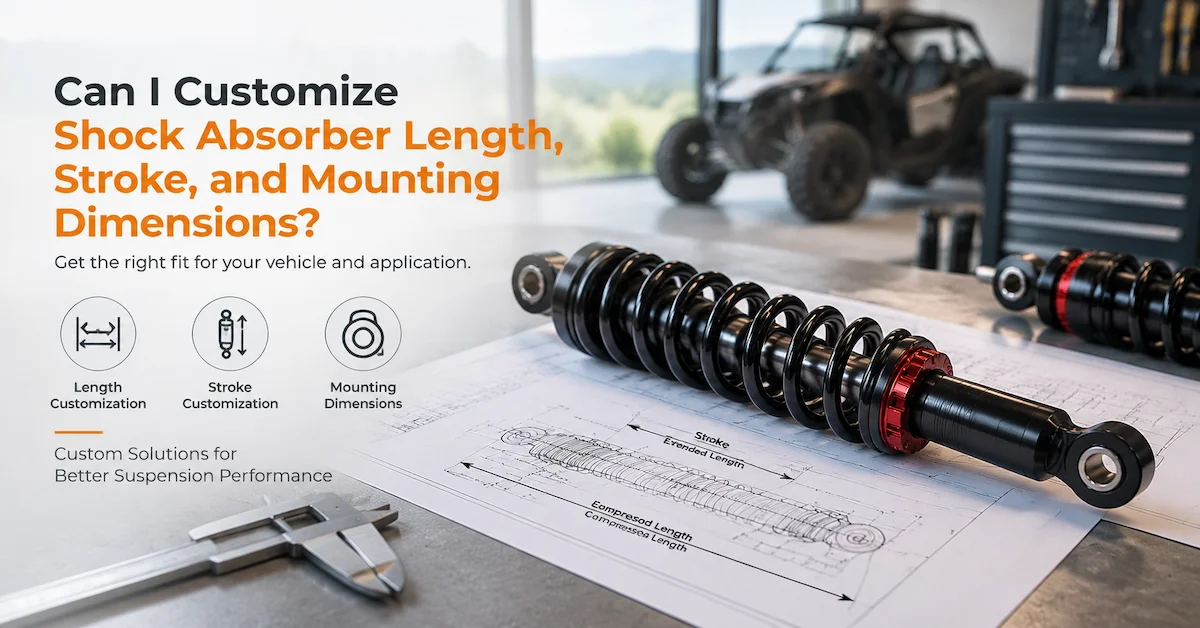
Depending on the project, shock customization can involve:
- Extended length
- Compressed length
- Stroke
- Mount type
- Mounting-hole diameter
- Mounting width
- Shock body dimensions
- Spring rate
- Compression damping
- Rebound damping
- Reservoir
- Appearance
ATV Suspension Springs
Springs affect vehicle support, ride height, and available suspension movement.
Bedo currently lists suspension springs as one of its main product categories alongside shock absorbers.
For aftermarket sourcing, spring development should consider:
- Vehicle weight
- Rider weight
- Cargo
- Accessories
- Suspension leverage
- Shock travel
- Desired ride height
- Intended terrain
Related Suspension Components
Depending on the program, buyers may also need mounting or interface components.
The exact component scope should always be verified with the supplier rather than assuming that a company selling shocks manufactures every ATV chassis or suspension component internally.
Why Fitment Data Matters for Aftermarket ATV Suspension
Fitment is one of the biggest commercial risks in aftermarket products.
If a distributor launches an ATV shock under the wrong application, problems can include:
- Shock cannot be installed
- Incorrect ride height
- Insufficient suspension travel
- Premature bottoming
- Excessive droop
- Tire or chassis interference
- Customer returns
For this reason, an aftermarket ATV suspension supplier should work from verified fitment information rather than vehicle names alone.
Important dimensions include:
- Extended shock length
- Compressed length
- Effective stroke
- Upper mount
- Lower mount
- Hole diameter
- Mounting width
- Spring outside diameter
- Reservoir clearance
Bedo's ATV/UTV product pages publish model-specific measurements such as overall length, stroke, spring rate, and mounting dimensions, reinforcing the importance of treating fitment as a specification rather than a visual match.
What Information Should an Aftermarket Buyer Provide?
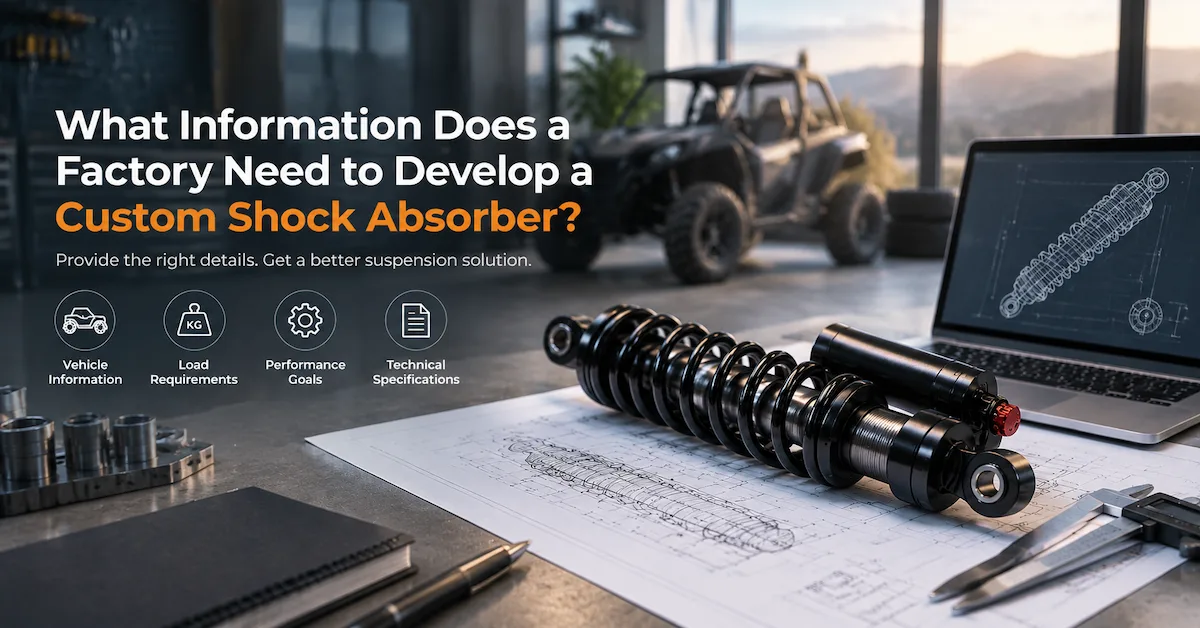
A good RFQ should explain both the existing vehicle and the intended aftermarket product.
| Information | Why It Matters |
| ATV make/model/platform | Establishes fitment target |
| Model year range | Helps control application coverage |
| Front or rear position | Defines suspension role |
| Existing shock sample | Provides physical reference |
| Extended length | Controls fitment |
| Compressed length | Controls suspension limits |
| Stroke | Defines damper travel |
| Mount dimensions | Prevents installation problems |
| Vehicle weight | Supports spring review |
| Rider/cargo range | Defines expected load |
| Existing spring rate | Provides baseline |
| Target improvement | Defines aftermarket value |
| Terrain | Supports tuning decisions |
| Expected sales volume | Supports sourcing planning |
| Branding requirements | Defines private-label scope |
If the aftermarket buyer does not know the target spring or damping value, it is better to explain the performance problem.
For example:
The stock rear suspension sags excessively when the ATV carries cargo.
is more useful than:
Make the shock 30% harder.
How Should Spring Rate Be Selected for an Aftermarket ATV?
Spring rate should match the intended load and suspension system.
A heavier spring can improve load support, but excessive spring stiffness can also make the vehicle feel harsh or prevent the suspension from using its travel effectively.
The supplier therefore needs to understand:
- ATV mass
- Rider weight
- Cargo
- Suspension position
- Available travel
- Existing spring
- Target use
The same aftermarket shock should not automatically be marketed as ideal for every rider and every load condition.
For a broad replacement program, the objective may be a balanced specification covering the expected customer range.
For a performance product, the buyer may choose different spring options for different rider or application groups.
How Should Compression and Rebound Damping Be Evaluated?
Spring rate and damping perform different jobs.
The spring supports the vehicle and stores energy.
The damper controls how quickly suspension movement occurs.
Compression Damping
Compression damping resists suspension movement as the shock compresses. Increasing compression resistance generally creates firmer control, but excessive compression damping can also make the ATV feel harsh over uneven terrain.
Rebound Damping
Rebound damping controls how quickly the suspension extends after compression. Too little rebound control can allow excessive movement, while too much can prevent the suspension from recovering quickly between repeated bumps.
This is why an aftermarket ATV supplier should avoid generic claims such as:
“Our shock has stronger damping, therefore it performs better.”
The better question is:
Does the damping match the vehicle, spring, load, and intended terrain?
Standard Fixed Damping or Adjustable ATV Shocks?
Both can have a place in the aftermarket.
Fixed-Damping Shocks
Advantages can include:
- Simpler customer use
- Lower complexity
- Easier repeatability
- Suitable for replacement-oriented products
Bedo currently offers fixed-damping ATV/UTV shock configurations in its product range.
Adjustable Shocks
Adjustability can help performance-oriented customers change suspension behavior for:
- Different terrain
- Rider preferences
- Load conditions
However, adjustability adds product complexity and customer-education requirements.
A distributor should not choose an adjustable product only because it appears more premium.
The specification should match the target market.
Does an Aftermarket ATV Shock Need a Reservoir?
Not necessarily.
Reservoir shocks can be valuable in demanding off-road applications where additional fluid capacity, heat management, or advanced damping configurations are useful.
But reservoirs also introduce:
- Additional components
- Installation space
- Hose routing
- Brackets
- Higher cost
Bedo's current ATV/UTV range includes multiple shock configurations, including oil-gas-separated designs and different dimensional specifications.
For aftermarket product planning, reservoir configuration should be treated as an application decision rather than automatically marketed as better.
Private-Label ATV Suspension: What Can Be Customized?
For aftermarket brands, commercial differentiation is often as important as engineering.
Possible private-label options can include:
- Logo
- Spring color
- Shock body finish
- Adjuster color
- Product labeling
- Packaging
- Model numbers
Bedo's official site describes customized suspension solutions and support for customer-specific requirements, while individual ATV/UTV product pages also identify customizable appearance options.
However, private-label approval should be separated into three different documents:
Technical Specification
Controls dimensions and performance.
Brand Artwork
Controls logo, colors, and appearance.
Packaging Specification
Controls carton, labels, instructions, and identification.
Separating these items reduces errors during repeat orders.
Why Samples Matter Before Launching a New Aftermarket SKU
For an existing proven replacement part, a buyer may already have sufficient validation data.
For a new or modified aftermarket product, samples provide much more value.
A sample can be used to check:
- Fitment
- Appearance
- Mounting
- Spring characteristics
- Product finish
- Packaging
- Initial suspension response
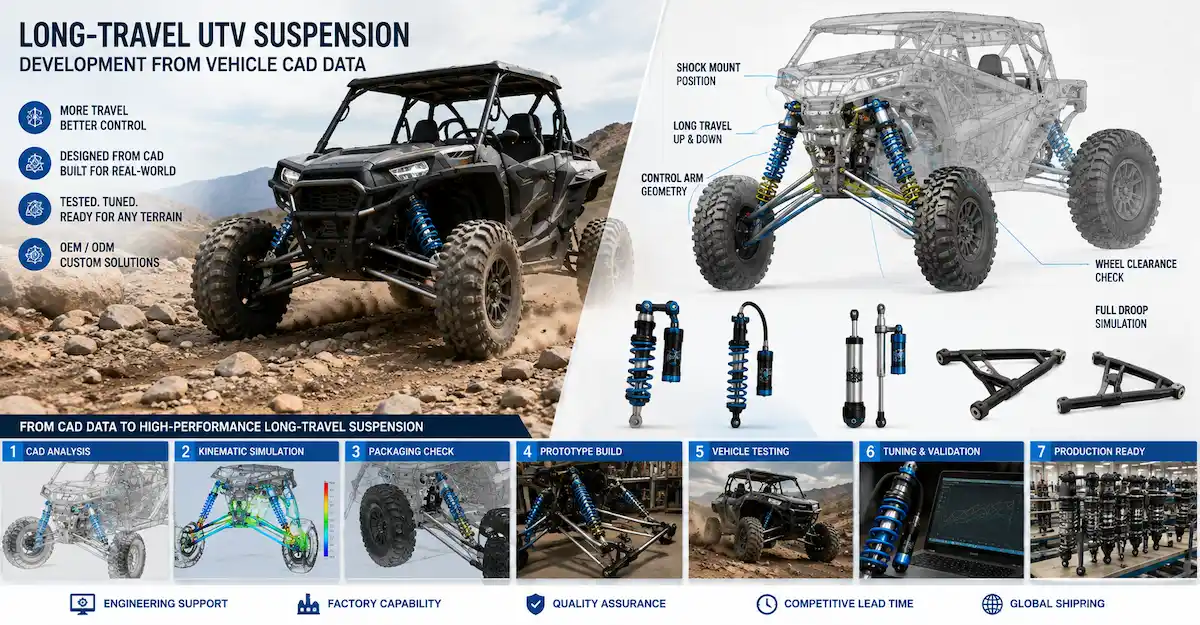
Bedo's current suspension sample-development workflow includes technical consultation, sample analysis, drawing review, prototype manufacturing, spring development, damping adjustment, testing validation, and small-batch production.
For buyers developing a new aftermarket shock rather than simply purchasing an existing model, see the Suspension Sample Development Guide.
Why a Pilot Batch Can Reduce Aftermarket Risk
A successful prototype proves only that one development sample is acceptable.
A distributor eventually needs to know whether the approved specification can be reproduced consistently.
A pilot or small batch can reveal:
- Dimension variation
- Assembly variation
- Spring inconsistency
- Finish differences
- Packaging problems
- Identification mistakes
Bedo's About page and current sample-development content both describe support for small-batch ordering or production alongside customized suspension development.
For a new aftermarket product, this can reduce the risk of creating large inventories before the buyer has validated both the product and the supply process.
What Quality Controls Should an ATV Suspension Buyer Check?
Aftermarket customers ultimately see the reseller's brand, not the upstream factory.
Quality control therefore directly affects brand reputation.
Important areas include:
Incoming Component Control
Check whether the supplier controls the materials and purchased components used in the approved product.
Dimensional Inspection
Critical dimensions can include:
- Shock length
- Stroke
- Mounting holes
- Mount widths
- Spring dimensions
Assembly Control
The production process should reproduce the approved assembly configuration.
Functional Verification
Ask specifically:
- What is tested?
- At what stage?
- Against what acceptance criterion?
- What records are available?
Revision Control
If the shock specification changes after testing, repeat orders must use the newest approved revision.
ISO 9001 provides an internationally recognized framework for establishing, maintaining, and continually improving quality-management systems and consistent processes. It is useful when evaluating a supplier's quality-management structure, although certification alone does not replace product-specific validation.
How to Evaluate an Aftermarket ATV Suspension Supplier
A useful supplier audit should cover more than price.
1. ATV Product Experience
Ask which ATV and off-road vehicle applications the supplier currently supports.
2. Fitment Control
Confirm how dimensions and application data are managed.
3. Sample Capability
Can the supplier analyze an existing ATV shock or develop a new sample?
4. Spring Development
Can spring specifications be reviewed for different vehicle loads?
5. Damping Capability
Can compression and rebound characteristics be revised for the application?
6. Branding Support
Can the supplier consistently manage approved colors, logos, labels, and packaging?
7. Small-Batch Capability
Can a new SKU be validated before a larger commercial order?
8. Repeat Production
How does the supplier ensure that later batches match the approved sample?
These questions help distinguish a genuine development partner from a seller simply offering available catalog shocks.
Supplier vs Manufacturer: Does It Matter for the Aftermarket?
It depends on the project.
A trading company can be useful when a distributor needs many unrelated product categories from several factories.
A suspension-focused manufacturer can be more valuable when the product needs:
- Dimensional changes
- Spring development
- Damping tuning
- Prototype revisions
- Technical troubleshooting
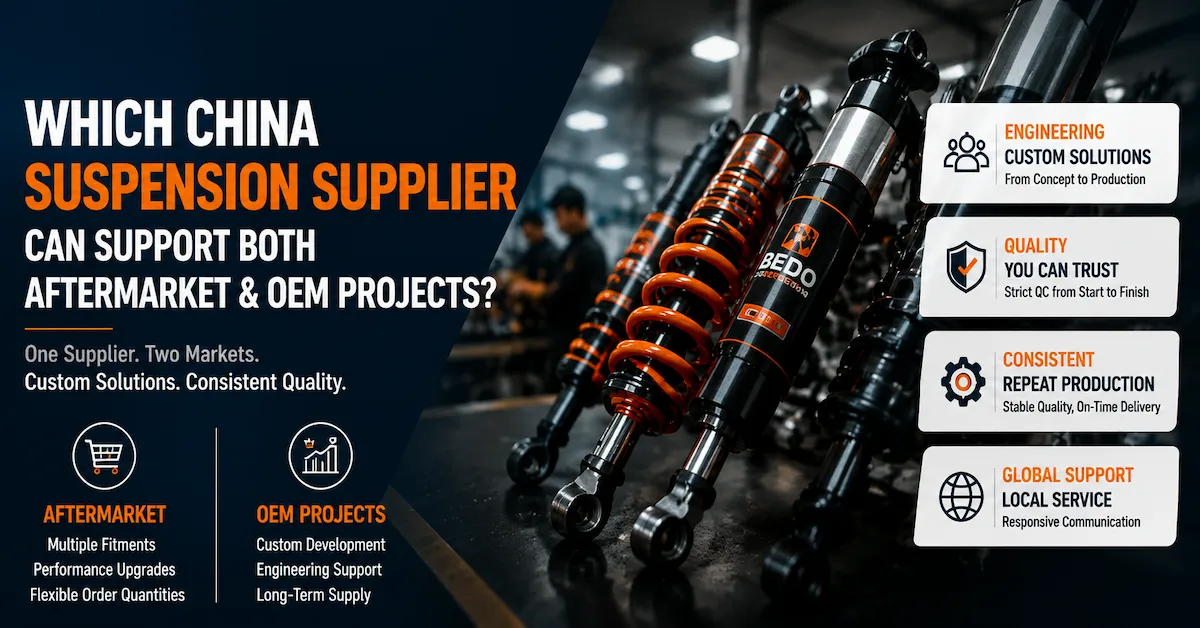
Bedo Auto describes itself as a manufacturer specializing in shock absorbers and springs, with customized design support and small-batch capabilities.
For technically differentiated aftermarket ATV suspension products, direct engineering access can reduce communication layers.
What Determines Aftermarket ATV Suspension Cost?
There is no useful universal price for an aftermarket ATV shock.
Cost can depend on:
- Shock construction
- Dimensions
- Spring
- Reservoir configuration
- Adjustable features
- Materials
- Surface treatment
- Branding
- Packaging
- Prototype development
- Testing
- Order volume
A standard existing shock and a new performance-developed private-label shock should not be expected to have the same development or production cost.
Buyers should therefore compare quotations based on equivalent specifications.
What Determines MOQ?
MOQ can depend on:
- Whether the product already exists
- Custom spring requirements
- New components
- Finish
- Branding
- Packaging
- Manufacturing processes
Bedo states that it supports small-batch ordering, but the appropriate quantity for a specific ATV suspension project needs to be reviewed according to the product and customization scope.
Avoid choosing a supplier only because it advertises the lowest generic MOQ.
The more useful question is:
What quantity is appropriate for the current development and market-validation stage?
How Bedo Auto Supports Aftermarket ATV Suspension Projects
Bedo Auto's current website identifies shock absorbers and suspension springs as core product categories and describes customized suspension support for off-road applications.
For aftermarket ATV projects, its published development workflow can include:
- Technical consultation
- Existing sample analysis
- Drawing review
- Prototype manufacturing
- Spring development
- Damping adjustment
- Testing validation
- Small-batch production
- OEM production preparation
This gives aftermarket buyers several possible starting points:
Existing validated ATV shock
→ source an appropriate existing configuration.
Existing sample that needs modification
→ analyze and customize.
New private-label suspension product
→ develop sample, branding, and production specification.
New performance application
→ connect fitment with spring and damping validation.
Buyers can explore Bedo's Shock Absorber Product Range or submit technical requirements through the Bedo Auto Contact Page.
What Should You Include in an Aftermarket ATV Suspension RFQ?
Before requesting a quotation, prepare:
- ATV make/model/platform
- Applicable model years
- Front or rear position
- Existing shock sample
- Extended length
- Compressed length
- Stroke
- Upper mounting dimensions
- Lower mounting dimensions
- Existing spring information
- Vehicle weight
- Typical rider/cargo load
- Target use
- Terrain
- Performance issue to improve
- Fixed or adjustable damping preference
- Reservoir requirement
- Logo and branding requirements
- Packaging requirement
- Sample quantity
- Initial market-launch quantity
- Expected repeat volume
A clear RFQ allows the supplier to distinguish a simple replacement program from a genuine performance-development project.
FAQ
What is an aftermarket ATV suspension supplier?
An aftermarket ATV suspension supplier provides replacement, upgrade, private-label, or customized ATV shock absorbers, springs, and related suspension products for distributors, brands, modification companies, and other non-OE sales channels.
What is the difference between OEM and aftermarket ATV suspension?
OEM suspension is developed for a vehicle manufacturer's original production program. Aftermarket suspension is sold after vehicle production for replacement, repair, upgrade, customization, or performance applications.
Can an aftermarket ATV shock be customized from an original sample?
Yes. An existing shock can provide fitment and construction reference information. If the buyer wants different load support or suspension behavior, vehicle and performance requirements should also be reviewed.
Can spring rate be customized for aftermarket ATV shocks?
Yes, where the supplier supports spring development. The appropriate specification depends on vehicle weight, load, suspension geometry, travel, and intended use.
Can compression and rebound damping be customized?
They can be adjusted on suitable shock designs. Compression and rebound have different effects on suspension movement and should be developed around the target ATV application.
Should an aftermarket ATV product use fixed or adjustable damping?
It depends on the customer and product positioning. Fixed damping can suit straightforward replacement products, while adjustable suspension may provide more tuning flexibility for performance-oriented users.
Does every aftermarket ATV need reservoir shocks?
No. Reservoir configurations can be valuable for certain demanding applications, but they increase cost and packaging complexity and should be selected according to the intended duty.
Can a supplier provide private-label ATV suspension?
Suppliers with customization capability may support color, appearance, logos, and packaging. Bedo's website currently describes customized suspension support and customizable product appearance.
Should distributors test ATV shock samples before bulk ordering?
New or modified specifications benefit from sample validation because it allows the buyer to review fitment, specification, appearance, and initial performance before scaling the order.
How can I start an aftermarket ATV suspension project with Bedo Auto?
Prepare the target ATV application, existing sample or drawing, mounting dimensions, load information, desired product positioning, branding requirements, and expected quantities, then submit the project through the Bedo Auto Contact Page.
Conclusion
Choosing an aftermarket ATV suspension supplier is ultimately a product-development and supply-chain decision, not simply a comparison of shock absorber prices.
For distributors and private-label brands, a commercially successful aftermarket suspension program needs to control:
Fitment → Spring & Damping Specification → Sample Validation → Branding → Quality Control → Pilot Production → Repeat Supply
Replacement-oriented buyers may prioritize verified dimensions and consistent production, while performance brands may require deeper development around spring rate, compression and rebound damping, suspension travel, and terrain.
Bedo Auto currently supplies off-road shock absorbers and suspension springs and supports customized projects through sample analysis, drawing review, spring and damping development, prototype validation, small-batch production, and OEM production preparation.
For a new ATV aftermarket product, start by defining the target vehicle, customer use case, fitment dimensions, performance objective, branding requirements, and launch quantity. You can then submit those requirements through Bedo Auto for project-specific review.