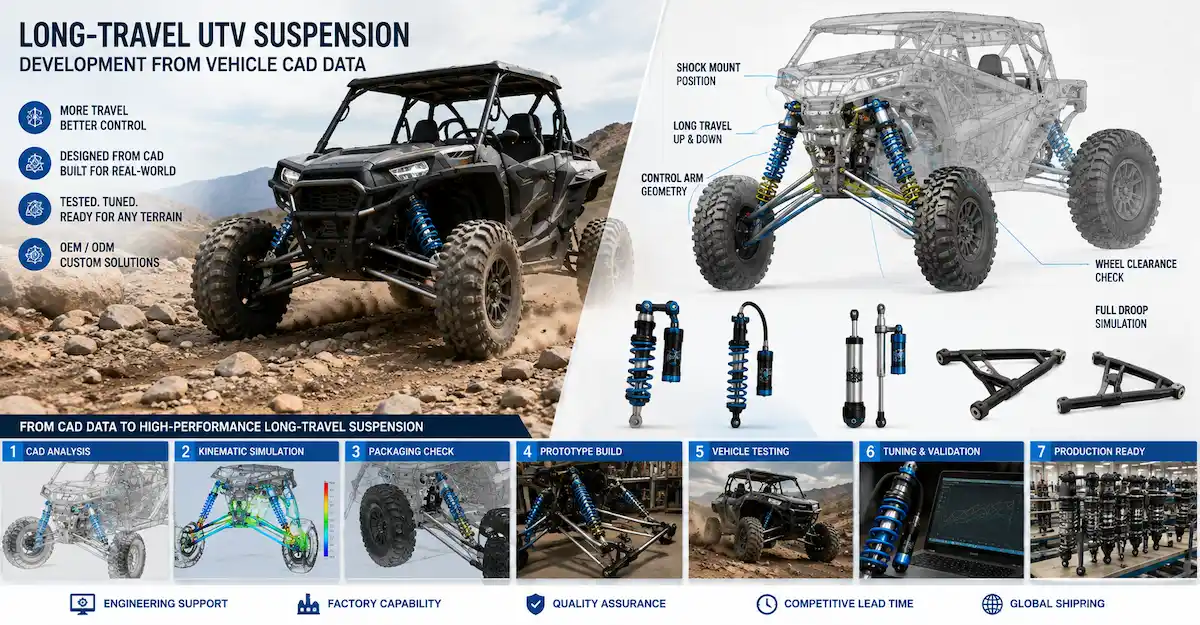

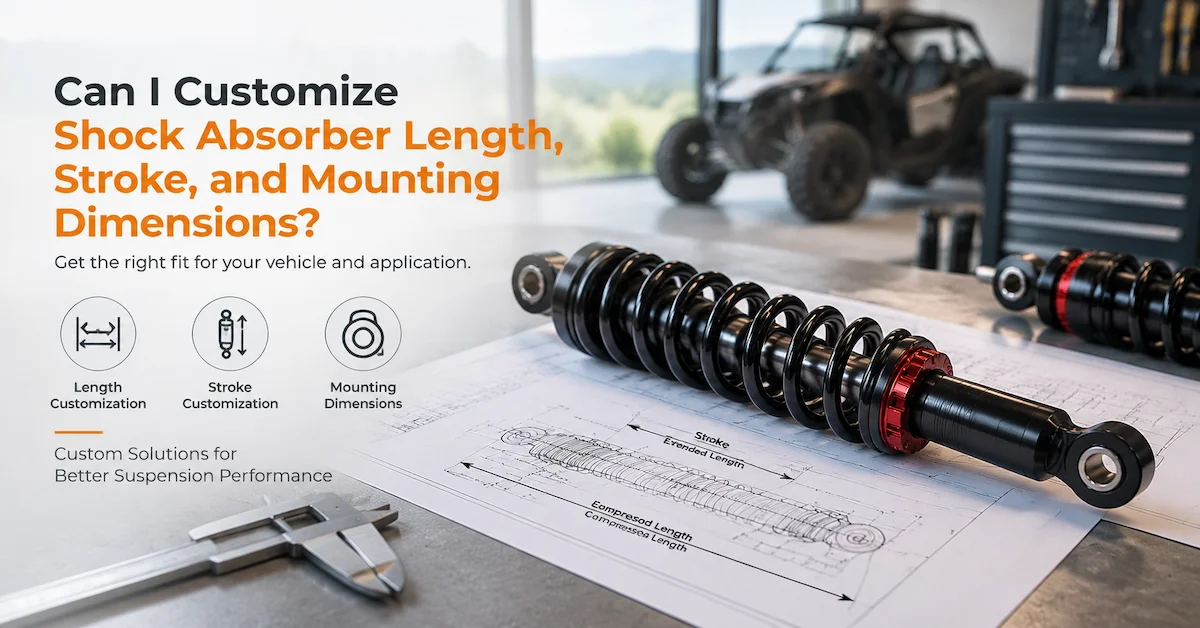
Can I Customize Shock Absorber Length, Stroke, and Mounting Dimensions?
Yes, shock absorber length, stroke, and mounting dimensions can be customized for many OEM, aftermarket, and specialized vehicle applications.
However, customization is not simply making a shock absorber longer or shorter.
The dimensions of a shock absorber directly affect:
- Suspension travel
- Ride height
- Compression clearance
- Vehicle handling
- Load support
- Installation compatibility
- Overall suspension performance
A professional factory needs to understand the complete suspension system before recommending changes.
For example:
Increasing shock stroke may improve suspension travel, but it also requires checking:
- Control arm movement
- Tire clearance
- Bump stop position
- Extended and compressed limits
Changing mounting dimensions may improve installation compatibility, but incorrect geometry can affect suspension behavior.
That is why successful customization starts with engineering information, not only dimensional requests.
Why Do Buyers Customize Shock Absorber Dimensions?
Different vehicles and applications have different suspension requirements.
A standard shock absorber may not always meet specific needs.
Common reasons for customization include:
Vehicle Modification
Aftermarket brands often develop upgraded suspension kits for:
- UTVs
- Off-road vehicles
- Utility vehicles
- Recreational vehicles
The goal may be:
- More suspension travel
- Better comfort
- Increased durability
- Higher load support
OEM Vehicle Development
OEM customers may require a shock absorber designed around:
- Specific chassis design
- Vehicle weight
- Suspension geometry
- Driving conditions
Special Applications
Some vehicles operate under unique conditions:
- Heavy cargo
- Rough terrain
- Fleet operation
- Commercial use
In these situations, customized dimensions can create a better match.
Can Shock Absorber Length Be Customized?
Yes.
Shock absorber length is one of the most common customization requirements.
Important length measurements include:
- Extended length
- Compressed length
- Overall body length
- Installation length
These dimensions influence:
- Vehicle ride height
- Suspension movement
- Available travel
- Clearance
For example:
A longer shock absorber may increase available suspension movement.
However, the factory must verify:
- Whether the suspension geometry allows it
- Whether the CV axle angle changes
- Whether tires contact surrounding components
- Whether the shock reaches mechanical limits
A professional supplier will evaluate the complete system before recommending a length change.
Can Shock Stroke Be Customized?
Yes, shock stroke can also be customized.
Shock stroke refers to the distance the shock absorber shaft can move between fully extended and fully compressed positions.
A different stroke length can influence:
- Wheel travel
- Suspension response
- Off-road capability
- Bottoming resistance
However, more stroke is not always better.
The correct stroke depends on:
- Suspension design
- Available space
- Vehicle usage
- Spring characteristics
- Damping requirements
A factory developing a custom shock absorber should evaluate stroke together with the complete suspension movement.
What Is the Relationship Between Shock Stroke and Wheel Travel?
Shock stroke and wheel travel are related but not identical.
The final wheel movement depends on suspension geometry.
Factors include:
- Control arm design
- Mounting position
- Motion ratio
- Shock installation angle
For example:
Two vehicles may use the same shock stroke but achieve different wheel travel because their suspension geometry is different.
This is why engineers should not select stroke only based on another vehicle's specification.
Can Mounting Dimensions Be Customized?
Yes.
Mounting dimensions are commonly adjusted during custom shock absorber development.
Possible customization areas include:
- Upper mount size
- Lower mount size
- Eye-to-eye distance
- Bushing dimensions
- Bolt diameter
- Mount width
- Bracket design
This is especially important when developing:
- Replacement shocks
- Private-label products
- Vehicle-specific upgrade kits
Correct mounting dimensions ensure:
- Proper installation
- Secure connection
- Correct suspension movement
What Information Does a Factory Need for Dimension Customization?
Before developing a customized shock absorber, a factory usually needs:
Vehicle Information
Including:
- Vehicle model
- Year
- Application
- Passenger capacity
- Cargo requirements
Existing Shock Information
Including:
- Current shock length
- Stroke
- Mount dimensions
- Spring specifications
Suspension Data
Including:
- Suspension layout
- Mounting position
- Available clearance
- Wheel movement information
Performance Requirements
Including:
- Comfort target
- Load requirements
- Terrain conditions
- Expected usage
For a complete preparation checklist, buyers can review:
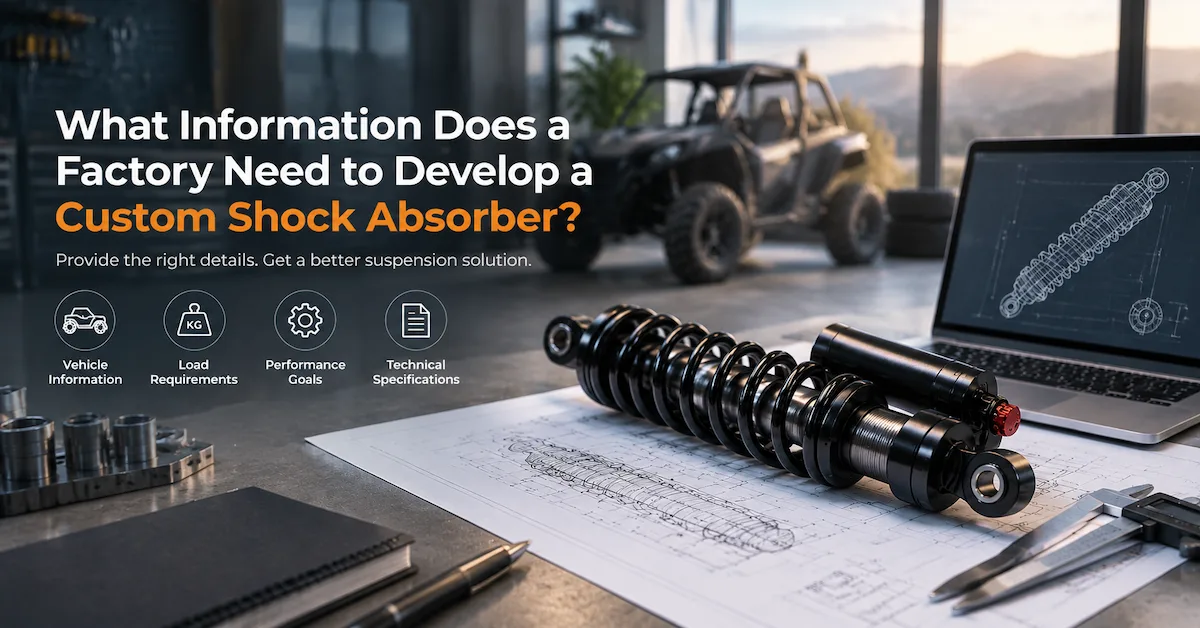
What Information Does a Factory Need to Develop a Custom Shock Absorber?
Do I Need CAD Data for Shock Dimension Customization?
CAD data is highly recommended for complex projects.
It helps engineers evaluate:
- Shock installation space
- Suspension movement
- Component interference
- Maximum compression position
- Maximum extension position
Useful CAD information may include:
- Vehicle chassis model
- Suspension assembly
- Control arms
- Wheel position
For OEM and advanced aftermarket projects, CAD data can significantly reduce prototype revisions.
What Happens If Shock Dimensions Are Incorrect?
Incorrect dimensions can create several problems.
Shock Too Long
Possible issues:
- Reduced compression clearance
- Suspension damage
- Component interference
Shock Too Short
Possible issues:
- Reduced suspension travel
- Limited performance
- Incorrect ride height
Incorrect Mounting Dimensions
Possible issues:
- Installation difficulty
- Poor alignment
- Additional modification requirements
This is why dimension customization should always include engineering validation.
How Does a Factory Develop a Customized Shock Absorber?
A professional development process usually includes:
Requirement Review
The factory analyzes:
- Vehicle data
- Existing suspension information
- Performance goals
Engineering Evaluation
Engineers review:
- Length requirements
- Stroke requirements
- Mounting dimensions
- Manufacturing feasibility
Prototype Development
A sample is created according to approved specifications.
Vehicle Testing
Testing may include:
- Installation verification
- Suspension movement
- Clearance checks
- Ride evaluation
Final Approval
The approved design becomes the production specification.
For buyers moving toward production, prototype validation is critical.
Learn more:
How Do I Test a UTV Suspension Prototype Before Production?
Can a Factory Customize Shock Absorbers for Aftermarket Brands?
Yes.
Many aftermarket brands customize shock absorbers to create vehicle-specific upgrade products.
Common requirements include:
- Different vehicle fitments
- Custom lengths
- Specific mounting solutions
- Branding
- Packaging
A capable supplier should support both engineering customization and commercial requirements.
Can OEM Customers Customize Shock Dimensions?
Yes.
OEM projects often require deeper customization because the shock absorber becomes part of the vehicle design.
OEM development may include:
- Vehicle-specific dimensions
- Performance tuning
- Testing requirements
- Production documentation
- Long-term supply planning
Choosing an experienced OEM shock absorber supplier helps reduce development risks.
How Should Buyers Evaluate a Custom Shock Absorber Supplier?
Look beyond whether the supplier can change dimensions.
Evaluate:
Engineering Capability
Can they analyze your suspension requirements?
Manufacturing Capability
Can they produce the same specification repeatedly?
Testing Capability
Can they validate prototypes?
Communication
Can they manage technical changes?
Production Support
Can they support future orders?
For long-term supply evaluation, see:
How Do I Find a UTV Suspension Supplier That Can Maintain Consistent Repeat Production?
What Mistakes Should Buyers Avoid?
Providing Only Target Dimensions
Dimensions alone may not explain the actual performance requirement.
Ignoring Suspension Geometry
Shock dimensions must match the vehicle system.
Increasing Stroke Without Testing
More travel does not automatically mean better performance.
Changing Requirements During Development
Frequent changes increase development time and cost.
Choosing Only Based on Price
Engineering support and production consistency are equally important.
How Can Bedo Auto Support Custom Shock Absorber Projects?
For OEM customers, aftermarket brands, and distributors, Bedo Auto supports customized shock absorber development based on real vehicle requirements.
Whether you need:
- Customized shock length
- Different stroke specifications
- New mounting dimensions
- Vehicle-specific suspension upgrades
- Private-label shock absorber solutions
our engineering team can evaluate your project requirements and recommend a suitable development approach.
Before starting your project, prepare:
- Vehicle model
- Current suspension specifications
- CAD data (if available)
- Load requirements
- Performance goals
- Expected production quantity
For buyers comparing customization options, you can also review:
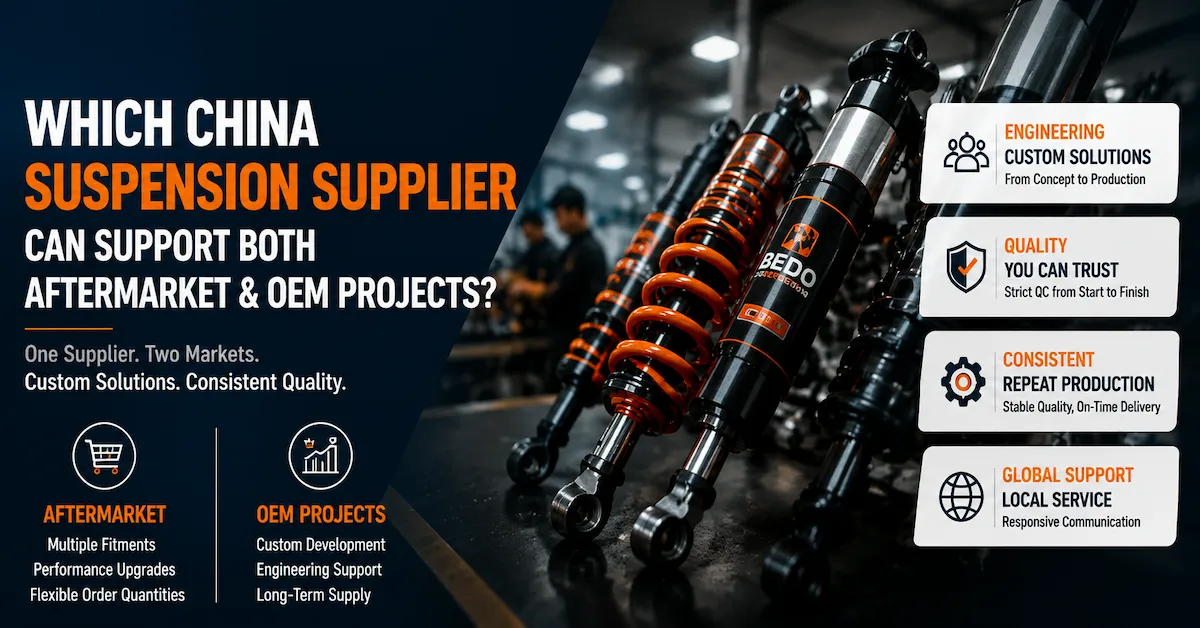
Which China Suspension Supplier Can Support Both Aftermarket and OEM Projects?
To discuss your project:
Our team can review your requirements and help develop a production-ready suspension solution.
FAQ
Can I customize shock absorber length?
Yes. Shock absorber length can be customized based on vehicle requirements, suspension geometry, and installation conditions.
Can shock stroke be increased?
Yes, but the factory must evaluate suspension travel, clearance, and geometry before increasing stroke.
Can mounting dimensions be changed?
Yes. Mounting width, bushing size, bolt dimensions, and installation points can often be customized.
What information does a factory need for shock customization?
Factories usually need vehicle data, current shock dimensions, suspension information, load requirements, and performance goals.
Is CAD data necessary for custom shock absorbers?
It is not always required, but CAD data helps improve accuracy and reduce prototype revisions.
Can aftermarket brands customize shock absorbers?
Yes. Many aftermarket brands develop customized shocks for specific vehicles and applications.
How long does custom shock absorber development take?
The timeline depends on project complexity, testing requirements, prototype revisions, and information completeness.
Can OEM customers customize shock dimensions?
Yes. OEM projects often require customized dimensions, performance tuning, and long-term production support.
Why should shock dimensions be tested before production?
Testing confirms fitment, suspension movement, clearance, and real vehicle performance before scaling production.
What makes a good custom shock absorber supplier?
A good supplier combines engineering experience, manufacturing capability, testing support, and stable production control.
Conclusion
Customizing shock absorber length, stroke, and mounting dimensions is not only a dimensional adjustment. It requires understanding the relationship between the shock absorber, vehicle structure, suspension geometry, and operating conditions.
A reliable suspension partner should support every stage:
- Requirement analysis
- Engineering evaluation
- Prototype development
- Vehicle testing
- Production optimization
- Repeat manufacturing
At Bedo Auto, we work with OEM customers, aftermarket brands, and distributors to develop customized shock absorber solutions based on real application requirements.
Whether you need:
- A custom UTV shock absorber
- A replacement suspension upgrade
- A private-label aftermarket product
- A vehicle-specific shock absorber design
- A customized solution for different load or terrain conditions
our engineering team can help evaluate your project and recommend a suitable development path.
Send us:
- Vehicle model and application
- Existing shock specifications or drawings
- CAD data (if available)
- Required length, stroke, or mounting dimensions
- Load requirements
- Performance goals
- Expected order quantity
Our team will review your requirements and provide feedback on feasibility, development direction, and production options.
Contact Bedo Auto today to discuss your custom shock absorber project and turn your suspension requirements into a production-ready solution.