
Direct answer: compare Chinese suspension manufacturers with the same technical brief and an evidence-based scorecard. Check who owns the factory process, what products and applications it actually supports, how it handles drawings and samples, how it controls critical dimensions and materials, how it validates prototypes, how it manages changes, and whether its quotation covers the same engineering, testing, packaging, and production scope as competing offers.
Do not rank suppliers by catalog breadth, a low unit price, a factory photograph, or an ISO logo alone. A suspension manufacturer should be compared on evidence that is relevant to your project: vehicle interfaces, spring and damping requirements, prototype records, inspection controls, traceability, communication quality, production-transfer discipline, and commercial clarity. The best supplier is not automatically the largest or cheapest; it is the one whose documented capability matches the risk of your application and launch plan.
Start with one controlled comparison brief
Comparing suppliers is impossible when each supplier receives a different question. One factory may quote a standard shock absorber from a photo, another may include a custom spring, and a third may include drawing review and prototype testing. The prices appear different because the technical scope is different.
Prepare one comparison brief before contacting factories. Include the vehicle or machine, model and year where relevant, front or rear position, suspension layout, sample or drawing, extended and compressed lengths, stroke, mounting interfaces, spring requirements, load cases, terrain, target behavior, quantity, packaging, destination, testing, launch timing, and required documentation. Mark each item as confirmed, estimated, or open.
| Comparison input | What to provide to every manufacturer | Why it changes the result |
|---|---|---|
| Application | Vehicle, variant, position, market, use and modification state. | Determines fitment, load, environment and validation requirements. |
| Geometry | Lengths, stroke, mounts, widths, holes, sleeves, threads, clearance and reference sample. | Prevents each supplier from making a different fitment assumption. |
| Spring | Load cases, ride-height goal, installed condition, rate target or current spring identity. | Separates support requirements from shock-body pricing. |
| Damping | Fixed or adjustable, behavior target, benchmark, test condition and intended terrain. | “Good damping” is not a comparable technical specification. |
| Development | Sample quantity, prototype revisions, testing, pilot and production-release requirements. | Reveals whether each price includes the same development work. |
| Commercial | Quantity stages, packaging, labels, destination, forecast, payment and requested timing. | Allows suppliers to price the same commercial boundary. |
The existing suspension quotation comparison guide explains why different technical assumptions make prices incomparable. This article extends that principle into a manufacturer scorecard: first normalize the request, then evaluate evidence and risk.
Confirm who you are actually comparing
“Manufacturer” can describe a factory, an engineering company, a trading business, a private-label assembler, or a company that outsources most of the product. None of those models is automatically unsuitable. The risk appears when the buyer does not know which company owns the drawing, process, quality decision, inventory, change control, and after-sales response.
Check legal and operational identity
Ask for the legal company name, production address, sales entity, responsible technical contact, quality contact, and shipping entity. Confirm whether the quotation, invoice, certificate, packing list, and warranty route refer to the same organization or to a declared group structure. A clear relationship is more useful than an unsupported “factory direct” claim.
Map manufacturing ownership
Ask which operations are performed internally and which are supplied by partners. Depending on the part, operations may include tube or body work, rod finishing, spring production, machining, welding, coating, assembly, testing, packaging, and warehouse release. Outsourcing is not automatically a defect; uncontrolled outsourcing is a risk.
Ask who owns nonconforming product decisions
When a dimension fails, a spring lot changes, or a shipment complaint occurs, who can quarantine product, approve rework, authorize deviation, notify the customer, and close corrective action? The answer reveals whether the supplier controls the product or only coordinates a purchase.
Score engineering capability against your real product
A supplier can have a large catalog and still be weak at custom engineering. For a custom suspension program, engineering capability should be demonstrated through questions, reviews, drawings, samples, and decisions related to your application.
| Engineering area | Evidence to request | Buyer interpretation |
|---|---|---|
| Requirement review | Questions about vehicle, loads, interfaces, environment, target behavior and unknowns. | Does the supplier identify risk before quoting? |
| Drawing and CAD review | Markup, interface check, revision log, critical dimensions and manufacturability questions. | Can the supplier translate data into a controlled product definition? |
| Sample analysis | Measured geometry, condition notes, unknowns and proposed validation. | Does the supplier avoid treating one sample as complete specification? |
| Spring development | Load cases, installed condition, rate discussion, sample identity and acceptance basis. | Is the spring treated as an engineering variable rather than an accessory? |
| Damping development | Target behavior, configuration identity, test condition and revision records. | Can changes be traced to a controlled setup? |
| Prototype planning | Sample quantity, purpose, test route, issue closure and approval gate. | Is prototype work connected to production readiness? |
| Production transfer | Released drawing/BOM, process controls, pilot evidence, inspection and change process. | Can the approved sample become a repeatable product? |
Do not ask only whether a supplier “has engineers.” Ask what an engineer will review, what document will be returned, what assumptions will be listed, and what decision follows the review. The suspension engineering category provides a relevant public starting point for BEDO's topic scope, but a buyer should still request project-specific evidence.
Separate product capability from catalog language
Manufacturers often show similar words: premium, heavy duty, adjustable, off-road, OEM, custom, and durable. Those labels are useful for navigation but insufficient for supplier comparison. The buyer must translate them into product characteristics and evidence.
| Catalog statement | Better comparison question | Evidence that makes it useful |
|---|---|---|
| Heavy-duty shock | For which vehicle mass, payload, terrain, stroke and duty condition? | Application definition, spring/load basis, dimensions and agreed validation. |
| Custom shock absorber | Which dimensions, mounts, spring, damping, finish or label can be changed? | Scope list, drawing review, sample route and change controls. |
| Adjustable damping | What is adjustable, how is it identified, and under which test condition? | Configuration record, adjustment definition and functional or bench evidence. |
| OEM supplier | Has the supplier managed controlled drawings, revisions, samples, pilots and repeat orders? | Redacted process examples, project records or a project-specific plan. |
| Factory direct | Which process and quality decisions are owned at the quoted site? | Site identity, process map, production contact and traceability route. |
| Fast delivery | What is the lead-time basis and what inputs are required before the clock starts? | Written assumptions, sample status, component availability and release conditions. |
The safest comparison language is conditional and specific. If a supplier says it can develop a custom component, ask how the supplier will determine the required configuration and what the buyer must approve before production.
Compare quality control through critical characteristics
Quality control should be evaluated against the features that matter to suspension performance and fitment. A long equipment list does not prove that the right characteristics are controlled. Ask how the supplier identifies critical dimensions, selects measurement methods, controls process variation, handles incoming components, records results, and reacts to nonconformance.
Dimensional control
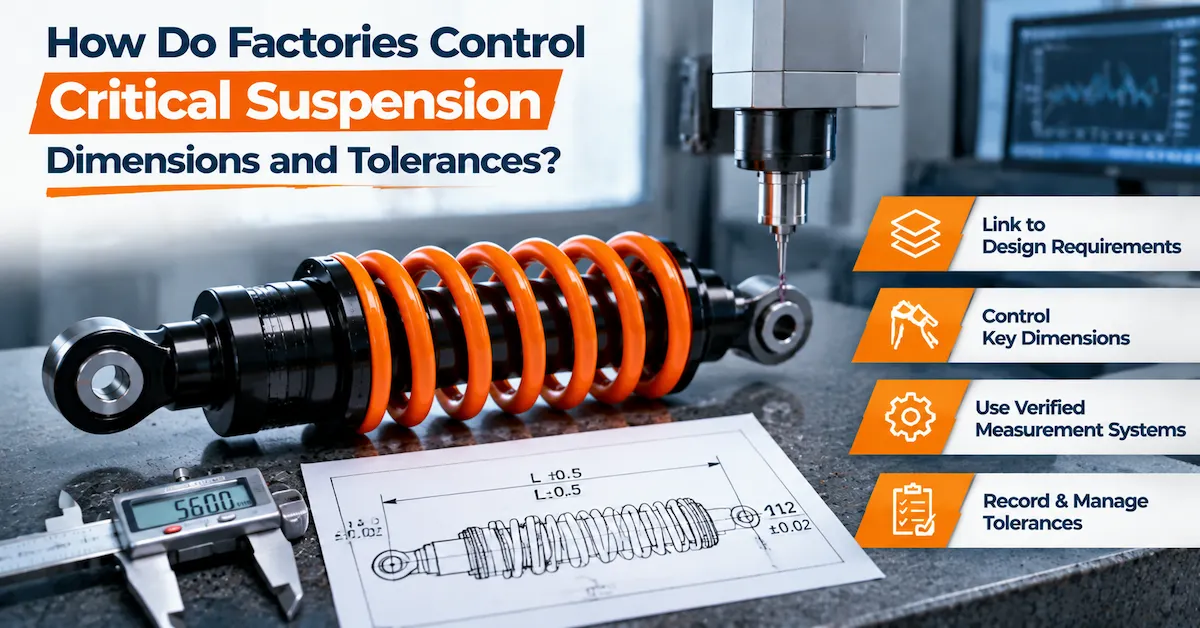
Common candidates include mount width, hole or bore location, extended and compressed length, stroke, spring-seat position, threads, bushings, sleeves, rod and tube features, and clearance-related interfaces. The actual critical list depends on the drawing and vehicle. Ask for datums, tolerances, measurement conditions, instrument identity, frequency, and reaction plan.
Component and material control
Ask how springs, seals, rods, tubes, bushings, hardware, coating, and other purchased components are identified and accepted. A certificate may support a record, but it does not automatically prove that every critical feature was verified. Supplier changes should be visible and risk-assessed.
Assembly and functional control
Ask how orientation, torque, preload, adjustment setting, cleanliness, sealing, internal configuration, and final functional checks are controlled. “100 percent inspection” is incomplete unless the characteristic, method, condition, and release rule are stated.
Traceability and corrective action
Ask whether shipped units can be linked to lot, revision, components, inspection records, and customer order. Request a redacted corrective-action example when possible. The important signal is whether the supplier contains, investigates, corrects, verifies, and communicates the issue.
The China shock absorber factory verification guide and China suspension manufacturer checklist are useful adjacent references. For this comparison, convert every checklist item into an evidence request and a risk score rather than checking a box because a supplier used the right phrase.
Use a weighted supplier scorecard
A weighted scorecard makes tradeoffs visible. The weights below are a starting framework for a custom suspension program, not an industry standard and not a claim that every project should use the same percentage. A low-risk replacement SKU may give more weight to delivery and packaging; a new vehicle platform may give more weight to engineering, validation, and production transfer.
| Evaluation category | Example weight | What earns a strong score | What should reduce the score |
|---|---|---|---|
| Requirement understanding | 10% | Specific questions, assumptions and open-item control. | Generic quote based only on a photograph or keyword. |
| Engineering and design | 20% | Relevant review, drawing/CAD control, spring/damping reasoning and prototype plan. | Catalog selection presented as custom engineering. |
| Factory and process ownership | 15% | Clear site, process map, internal/partner boundary and responsible contacts. | Unclear manufacturing location or responsibility. |
| Quality and measurement | 20% | Critical characteristics, control plan, instruments, records, traceability and reaction. | Broad quality claims without product-specific evidence. |
| Validation and production transfer | 15% | Pilot gates, configuration freeze, test records and change control. | Sample accepted with no repeat-production plan. |
| Commercial clarity | 10% | Comparable scope, separate development cost, clear quantity and timing assumptions. | Low price with undefined exclusions and conditions. |
| Communication and support | 10% | Technical answers, response ownership, records and practical issue closure. | Sales replies that do not answer engineering questions. |
Score evidence quality separately from supplier claims. For example, “we can test” might receive a low evidence score until the supplier identifies the test, condition, acceptance basis, and record. A buyer can use a simple scale such as verified, partially verified, proposed, or unverified before applying the weight.
Normalize quotations before comparing price
A supplier comparison is distorted when quotations include different product and service boundaries. One offer may include prototype engineering while another prices a standard shock. One may include the spring and mounting hardware while another excludes them. One may include inspection reports and export packaging while another includes only bare parts.
| Quotation line | Questions to ask every supplier |
|---|---|
| Product configuration | What drawing, sample, spring, damping setting, hardware and finish does the price represent? |
| Development | Are engineering review, drawing work, sample setup, prototype changes and pilot support included or separate? |
| Testing | Which dimensional, functional, bench, vehicle, environmental or durability tests are included? |
| Quantity | Which price applies to prototype, pilot, first order, repeat order and annual forecast? |
| MOQ | Does the MOQ apply to each variant, each spring, each label, or the complete family? |
| Timing | When does lead time begin, and which approvals or components can delay it? |
| Packaging | Are labels, cartons, hardware kits, manuals and export protection included? |
| Change and warranty | How are deviations, substitutions, complaints and warranty decisions handled? |
| Shipping and payment | What Incoterm, destination, payment basis, documents and freight assumptions apply? |
The goal is not to force every supplier into an identical commercial model. The goal is to make differences explicit so purchasing can compare total risk and total cost. The quotation comparison guide should be used with this evidence scorecard, not instead of it.
Verify the supplier before awarding a custom program
Verification can be remote, on-site, third-party, or staged. The method should match the risk, project value, and buyer's resources. A serious supplier should be able to answer practical questions even when a full audit is not possible.
Remote document review
Request the legal identity, site, product scope, certificate scope if relevant, sample/drawing process, inspection plan, production-transfer route, change process, and commercial assumptions. Ask for redacted examples rather than confidential customer data. Check whether the answers are consistent across sales, engineering, and quality contacts.
Video or on-site process review
Follow one product from incoming component identity through process, assembly, inspection, packing, and release. Ask to see how a failed component is identified and how a drawing revision reaches production. A tour should test process understanding, not only display equipment.
Sample and pilot verification
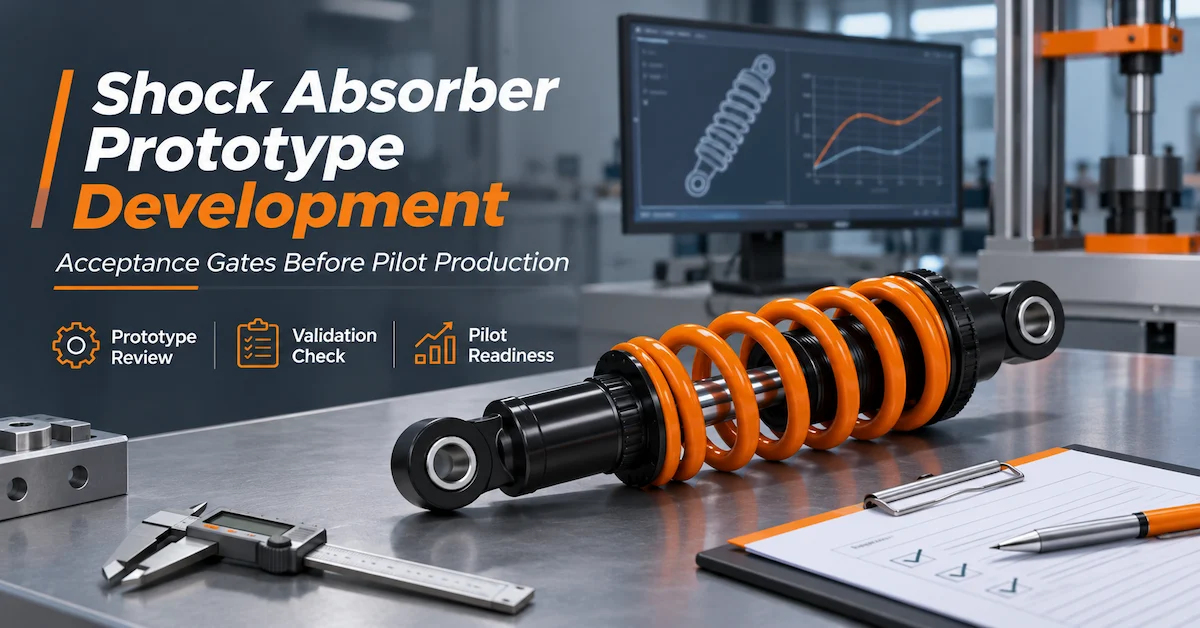
Use samples to confirm the supplier understood the application. Use a pilot to confirm the supplier can repeat the approved configuration under normal conditions. Record what was tested and what remains open. The source file should be connected to the quotation and production revision.
Commercial and communication verification
Ask the same technical question at several stages. A reliable supplier may not have every answer immediately, but it should identify the owner, request missing information, and return a controlled answer. Slow or vague communication during quotation can become more expensive after launch.
BEDO's public company page gives buyers an entity-level starting point. For a project-specific assessment, send the scorecard and technical brief through the official contact route and ask which evidence can be provided for the proposed application.
Red flags that deserve a lower score
- The supplier refuses to identify the manufacturing site or legal contracting entity.
- The quotation is based on a photograph with no questions about vehicle, position, load, or interface.
- “Custom” is promised, but the supplier cannot explain which dimensions or components can change.
- MOQ and lead time are stated without a product revision, quantity stage, packaging, or approval condition.
- The supplier uses a certificate as proof of product performance instead of providing product evidence.
- Materials, springs, seals, or hardware are called equivalent without a specification or approval process.
- The supplier cannot explain how an approved prototype becomes a repeatable production item.
- Inspection is described as “strict” or “100 percent” without characteristics, methods, conditions, or records.
- Sales, engineering, and quality teams provide conflicting answers about the same product.
- The supplier discourages a pilot, drawing review, or written change notification for a new application.
A red flag is a reason to investigate, not automatic proof of failure. A small factory may be capable but need a more structured request. The buyer should distinguish a missing document that can be supplied from a process that does not exist.
Frequently asked questions about comparing Chinese suspension manufacturers
Should I choose the largest Chinese suspension manufacturer?
Not automatically. The right supplier depends on the product risk, volume, engineering complexity, validation needs, communication, and production-transfer capability. A smaller manufacturer may fit a low-volume custom program, while a high-volume program may require different evidence and controls.
How can I tell whether a Chinese suspension supplier is a real factory?
Check the legal entity, manufacturing site, process ownership, responsible contacts, product flow, sample and drawing process, inspection records, and shipping entity. A public website is useful for orientation but does not replace verification.
Is a low price a sign of poor quality?
No. Price can reflect labor, sourcing, process, quantity, design maturity, packaging, or commercial terms. The problem is an unexplained price difference. Normalize the technical and service scope before ranking offers.
What is more important, ISO 9001 or a passed sample?
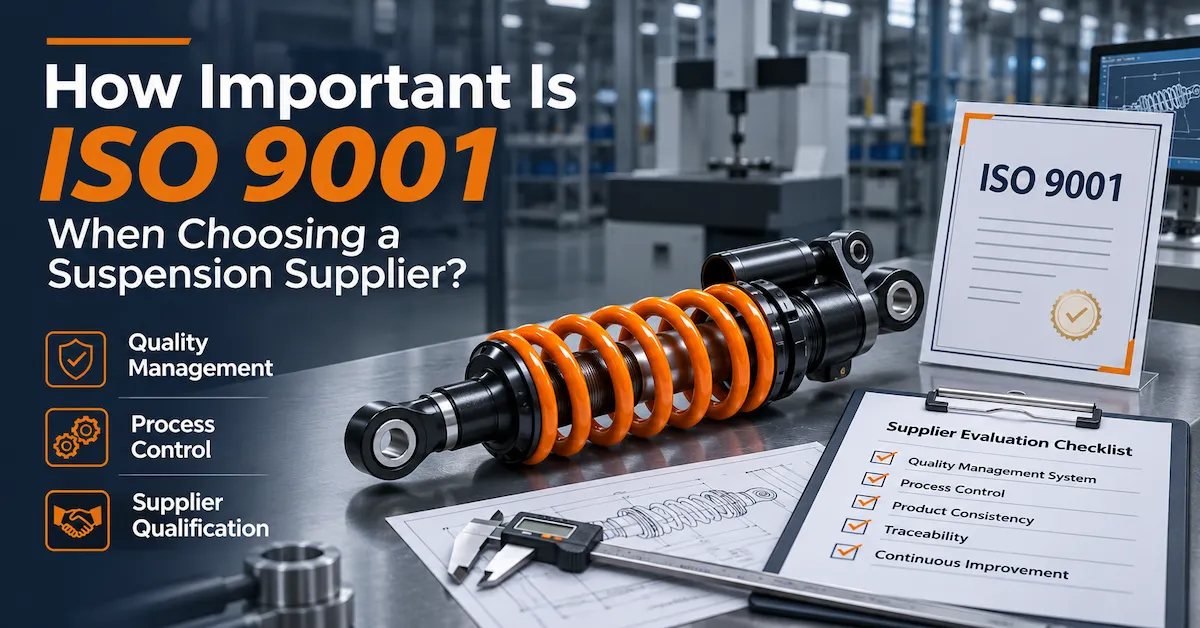
They answer different questions. A quality-management certificate relates to system structure; a passed sample relates to one configuration under defined conditions. A production decision needs appropriate system evidence and product-specific repeatability.
How should I compare custom suspension engineering?
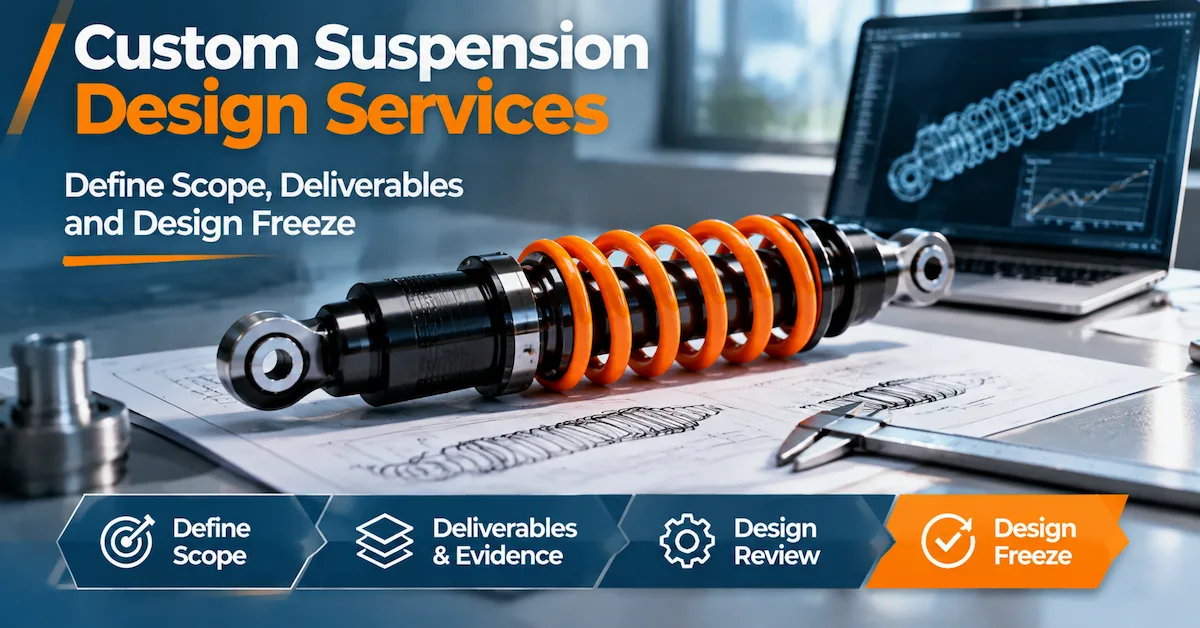
Ask each supplier to identify required inputs, open assumptions, drawings, spring and damping scope, prototype stages, testing, production release, change control, and buyer responsibilities. Compare deliverables and evidence, not the phrase “engineering support.”
Can I compare suppliers using only catalog products?
Catalogs can help identify product direction and standard options, but they do not establish fitment, custom scope, materials, testing, or production controls for your vehicle. A project brief and sample or drawing are needed for a meaningful comparison.
What should I ask about subcontracting?
Ask which operations and components are sourced externally, how approved suppliers are controlled, what incoming inspection is used, how lot identity is retained, and how substitutions require approval. Outsourcing can be managed; invisible outsourcing is difficult to audit.
How many suppliers should receive the same RFQ?
There is no fixed number. Use enough qualified suppliers to compare evidence and commercial scope without creating an unmanageable review. A smaller, controlled shortlist is more useful than sending an incomplete request to many factories.
What evidence should I request before a first order?
Request the controlled configuration, technical review, prototype or pilot plan, critical characteristics, inspection and traceability approach, testing responsibilities, commercial assumptions, packaging, change rules, and open-item list. The evidence should match the risk of the application.
How can BEDO respond to a supplier comparison request?
Send the same technical brief and scorecard used for other suppliers, including vehicle, interface, load, spring, damping, quantity, testing, packaging, destination, and timing. BEDO can then identify confirmed items, proposed options, and project-specific questions through the official contact route.
Conclusion
To compare Chinese suspension manufacturers fairly, use one controlled RFQ and score evidence across identity, engineering, manufacturing ownership, critical dimensions, materials, inspection, prototype validation, production transfer, communication, and commercial scope. A manufacturer should earn confidence by showing how it will control your product, not by repeating broad catalog claims.
Start with the application and the decision you need to make. Normalize quotations, separate standard parts from custom work, confirm the pilot route, and document open risks before awarding production. Review the BEDO shock absorber range, check the public manufacturer information, and send the completed brief through the official contact page for a project-specific response.