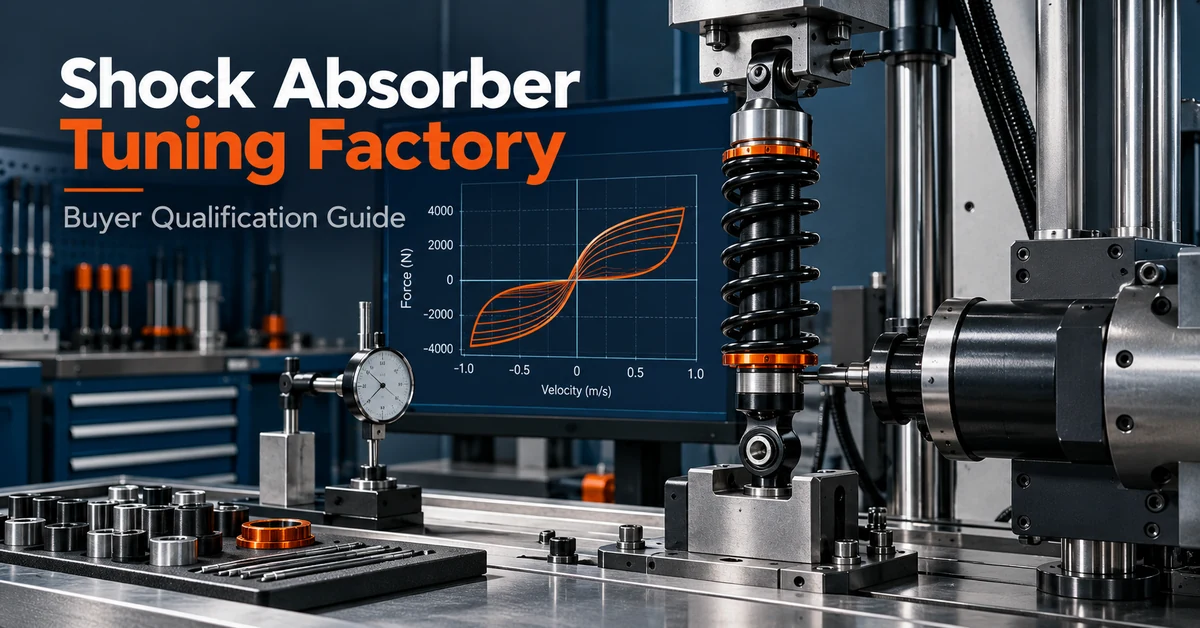

Direct answer: ISO 9001 is important because it gives a buyer a way to screen whether a supplier has a documented quality management system for controlling requirements, records, nonconforming product, corrective action, internal responsibilities, and continual improvement. It is useful supplier-qualification evidence, especially for OEM, private-label, fleet, and export programs. It is not, by itself, proof that a shock absorber fits a vehicle, that a spring has the required rate, that damping is correct, or that every production batch will meet the buyer's technical specification.
The practical decision is therefore not “ISO 9001 or no ISO 9001.” It is “What does the certificate support, and what product-specific evidence is still missing?” A serious buyer should verify the certificate scope and status, then audit how the supplier controls drawings, critical dimensions, materials, assembly, testing, changes, traceability, packaging, and complaints. ISO 9001 can reduce process risk, but it cannot replace prototype validation or a controlled production release.
This article answers a supplier-comparison and commercial-investigation question for OEM engineers, purchasing teams, aftermarket brands, distributors, and vehicle builders: how much weight should ISO 9001 carry when selecting a suspension supplier, and what should be checked beside the certificate? It focuses on shock absorbers, suspension springs, and related custom programs where fitment, spring support, damping, dimensions, and repeat production all affect the buyer's risk.
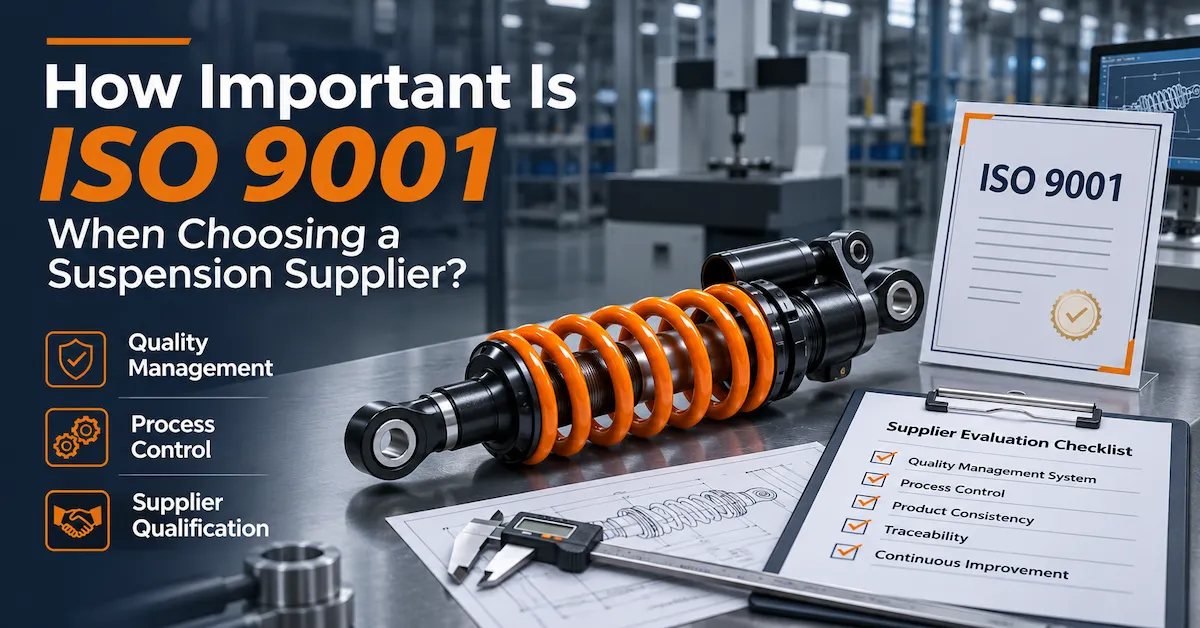
Evidence boundary: ISO 9001 is a management-system framework. It does not automatically certify every product, every material, every dimension, or every claimed performance value. Certificate scope, issuing body, validity, site, and covered activities must be checked against the actual supplier and project. Product evidence remains a separate requirement.
What ISO 9001 can tell a suspension buyer
A valid ISO 9001 certificate can indicate that an organization has established a quality management system with defined processes and responsibilities. For a suspension buyer, the value is indirect but practical. A documented system makes it more likely that the supplier has a controlled way to receive a drawing, review requirements, approve changes, handle nonconforming parts, record corrective actions, and retain evidence.
These controls matter because suspension products are sensitive to small changes. A different spring, bushing width, mount hole, rod finish, seal, assembly setting, or damping configuration may change fitment or behavior even when the product looks similar. If the supplier has no reliable document and change control, a successful sample can be followed by a different production configuration without a clear explanation.
| ISO 9001-related signal | Why it matters in suspension sourcing | What the buyer should still verify |
|---|---|---|
| Controlled documented information | Helps keep drawings, BOMs, work instructions and inspection records aligned. | Whether the actual shock, spring, hardware and package revisions are linked to the purchase order. |
| Defined responsibilities | Clarifies who reviews requirements, approves changes and releases product. | Who owns vehicle-level fitment, spring/damping targets, validation and final approval. |
| Nonconforming-product control | Reduces the chance that questionable parts are mixed into accepted stock. | Quarantine, disposition, rework authorization, traceability and customer notification. |
| Corrective-action process | Creates a route for investigating leaks, dimensional failures, inconsistent settings or complaints. | Whether the supplier uses evidence to close root causes rather than only replacing units. |
| Internal audit and review | Supports routine checking of process performance and unresolved risks. | Recent findings relevant to the product family and whether actions were actually closed. |
| Supplier and purchasing controls | Important when springs, seals, hardware or other components come from outside sources. | Incoming inspection, approved sources, lot identity and reaction to supplier changes. |
ISO 9001 is therefore a useful signal of organizational discipline. It is not a shortcut around engineering. A certificate cannot answer whether the supplier understood the vehicle's compressed length, shock stroke, motion ratio, passenger load, tire clearance, or expected terrain.
What ISO 9001 cannot prove by itself
Buyers should be careful with statements such as “ISO certified suspension” or “ISO 9001 shock absorber.” ISO 9001 is not normally a product-performance certification. It does not prove that a particular model has passed a specified durability cycle, that a valve setting is correct, or that a product complies with a vehicle regulation. The certificate covers an organization's quality-management scope, not every claim made in a catalog or sales email.
Several important suspension questions remain open after the certificate is verified:
- Does the proposed part fit the exact vehicle, model year, position and modification state?
- Are extended length, compressed length, stroke, mount width, hole size and clearances controlled?
- Does the spring support the empty, normal and upper intended load conditions?
- Are compression and rebound characteristics defined and tested under stated conditions?
- Are materials, finishes, seals, fasteners and purchased components specified and traceable?
- Can the supplier reproduce the approved prototype in pilot and later production?
- Are test reports tied to the same drawing, BOM, spring and damping revision that will be shipped?
- Are MOQ, lead time, packaging, service parts, warranty and change notification agreed in writing?
The existing BEDO article on ISO-oriented UTV suspension manufacturing is a useful adjacent reference, but a buyer should still separate general quality-system language from the evidence required for a specific UTV, ATV, motorcycle, electric motorcycle, golf cart, or specialty-vehicle program.
Check the certificate before treating it as evidence
A supplier should be able to provide enough information for a buyer to confirm the certificate rather than asking the buyer to trust a logo on a website. The exact verification route depends on the certificate and issuing organization, but the review should cover identity, site, scope, dates, status, and applicability.
| Certificate field | Buyer question | Reason for checking |
|---|---|---|
| Legal organization name | Does it match the company receiving the purchase order? | Prevents confusion between a trading company, factory, parent company and unrelated certificate holder. |
| Site address | Does it cover the facility that designs, assembles, inspects or ships the product? | A certificate for another location may not cover the actual production activity. |
| Scope wording | Does the scope include relevant manufacturing, assembly, design or service activities? | Scope affects the relevance of the management-system evidence. |
| Certificate number and dates | Is it current, and is the surveillance or renewal status clear? | An expired or suspended certificate should not be treated as current evidence. |
| Certification body | Who issued it, and can the record be checked through an appropriate channel? | Confirms the document is not merely an unverified marketing image. |
| Exclusions or limitations | Are any relevant activities excluded from the scope? | A supplier may have a quality system but not for the process the buyer assumes. |
| Multi-site arrangement | Which site is covered, and how are shared processes controlled? | Useful when design, production, warehouse and service activities are split. |
Do not infer that a supplier is unqualified because a public page does not display a certificate. Ask for current evidence through the normal procurement process. At the same time, do not accept an image as proof without checking scope and status. The article's central point is disciplined verification, not a universal preference for one supplier document.
Audit the quality system through a real suspension order
The strongest supplier audit follows one real product from inquiry to shipment. Use a controlled shock absorber or spring project as the thread. Ask the supplier to show how the buyer requirement entered the system, how the design was reviewed, which documents were released, how incoming parts were inspected, how assembly was controlled, how final inspection was recorded, and how the batch was traced.
Requirement and contract review
Start with the buyer's application. Does the supplier record vehicle model, year, front/rear position, expected load, use environment, tire or battery changes, installation data, sample/drawing identity and performance goal? Does someone identify missing information before quotation? A quality system is only useful when it captures the requirement that matters.
Design and document control
Ask how the supplier controls drawings, CAD, BOMs, spring specifications, damping settings, inspection instructions and revisions. A drawing with an uncontrolled file name is not enough. The approved prototype, purchase order, production traveler, inspection report and carton label should point to the same technical baseline.
Incoming and process control
For a suspension product, incoming controls may cover tube, rod, spring, seal, bushing, sleeve, hardware, finish and purchased subassemblies as applicable. The buyer should ask what is inspected, what is verified by certificate or supplier record, how lot identity is preserved, and what happens when a component does not meet requirements.
Final release
Ask who can release the lot, which characteristics are checked, how functional tests are performed, and how failed or reworked units are identified. “100% inspection” is not meaningful without the characteristic, method, instrument, condition and reaction plan. A documented system should make those details visible.
Complaint and corrective action
Ask for a redacted example of how a supplier investigated a nonconformity, if commercially available. The useful evidence is the logic: problem statement, containment, root-cause analysis, corrective action, verification, affected lots and customer communication. A replacement shipment without root-cause control may solve one complaint while leaving the process unchanged.
Compare ISO 9001 evidence with product evidence
Supplier selection is stronger when the buyer scores management-system evidence and product evidence separately. This prevents a well-presented certificate from outweighing weak fitment data, and it prevents an excellent sample from hiding a production system that cannot repeat it.
| Evidence family | Examples for a suspension buyer | Decision it supports |
|---|---|---|
| Organization identity | Legal company, factory location, public scope, responsible contacts. | Who is actually designing, manufacturing and supporting the program? |
| Management system | ISO 9001 certificate, scope, document control, audits, corrective action, training. | Does the supplier have a formal process for managing quality work? |
| Engineering capability | Sample/drawing review, geometry questions, spring/damping discussion, prototype process. | Can the supplier translate the application into a controlled specification? |
| Product fitment | Dimensions, mounts, full-bump/full-droop checks, vehicle and modification matrix. | Will the proposed configuration fit the defined application? |
| Performance validation | Agreed bench/vehicle tests, load states, route, settings, results and revision identity. | Does the product behave acceptably under the stated conditions? |
| Production repeatability | Pilot data, process checks, inspection plan, traceability and change records. | Can later orders match the approved sample? |
| Commercial readiness | MOQ, lead time basis, packaging, labels, service parts, warranty and change notice. | Can the buyer launch and support the product as planned? |
ISO 9001 belongs in the second row, but a capable sourcing decision uses the complete set. A supplier can be rejected for an unacceptable product even if the system certificate is valid. A supplier can also require development work even when its sample is promising, because the repeat-production evidence is not yet complete.
Use ISO 9001 correctly in an RFQ
Put the certificate request beside the technical requirements instead of treating it as a substitute for them. Ask the supplier to state the certificate status and scope, then answer the product questions in the same response. This creates a comparable record across suppliers.
- Legal supplier name, manufacturing site and quality contact.
- ISO 9001 certificate number, scope, validity, issuing body and any relevant exclusions.
- Vehicle/application, model/year, position, modification state, use environment and load cases.
- Available sample, drawing, CAD, OEM/reference number, photographs and revision.
- Extended/compressed dimensions, stroke, mounts, widths, holes, spring envelope and clearance data.
- Spring requirement, preload/seat condition, damping target or benchmark, adjustability and finish requirements.
- Prototype quantity, test responsibility, acceptance criteria and revision-control method.
- Incoming, process and final inspection records appropriate to critical characteristics.
- Nonconforming-product, corrective-action and customer-complaint process.
- Pilot-production plan, traceability, packaging, labels, service parts and change notification.
- Project-specific MOQ, lead time, price basis and forecast assumptions.
Request sample reports or redacted examples only when the supplier is permitted to share them. A buyer should not demand confidential customer data. It is enough to ask for evidence that demonstrates the process and to agree which project records will be created for the buyer's own order.
When ISO 9001 should carry more weight
The certificate becomes more important as the consequences of inconsistency increase. A one-time replacement part for a known, low-risk application may need a lighter supplier review than a new OEM platform, a private-label range, a fleet program, or a product that will be sold across many model years. Consider the size of the installed base, vehicle safety implications, volume, number of variants, service exposure, customer audit requirements, and cost of a field correction.
ISO 9001 also carries more practical value when the supplier's work is complex. Custom shock absorbers may involve controlled drawings, springs, damping settings, purchased components, prototypes, validation, packaging and engineering changes. A formal system can help coordinate those records. It still has to be demonstrated through the actual project.
When a certificate is only a starting screen
If the product is simple, the application is fully known, and the buyer has strong incoming inspection and validation, ISO 9001 may be one factor among several. It should not prevent the buyer from investigating a capable supplier that can provide equivalent process evidence through an audit, nor should it automatically approve a supplier whose product data is weak.
When the absence of a certificate is a serious concern
For a high-volume or safety-sensitive program, absence of a recognized quality system may increase the audit and monitoring burden. The buyer should ask how requirements, changes, nonconformities, records, suppliers and complaints are controlled. If the answers are informal, inconsistent or impossible to verify, the risk is higher regardless of product photographs.
Questions to ask during a supplier audit
| Audit area | Question | Evidence to look for |
|---|---|---|
| Scope | Which site and process does the quality system cover? | Certificate, organization information, process map and responsible personnel. |
| Requirements | How are customer requirements reviewed before quotation and production? | Requirement sheet, review record, open-question list and approved order. |
| Design changes | How does a spring, mount, damping or drawing change become effective? | Engineering-change record, approval, affected part list and revalidation decision. |
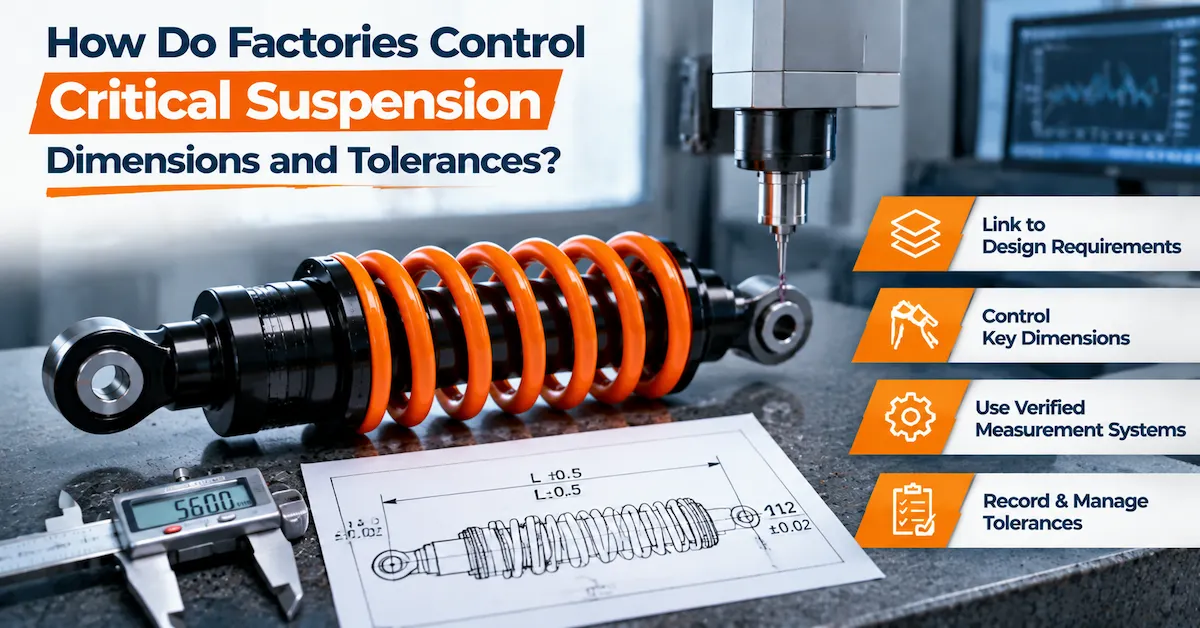
| Measurement | How are critical lengths, widths, holes, stroke and spring characteristics checked? | Drawing tolerances, instrument identity, calibration/verification and inspection record. |
| Assembly | How are cleaning, seals, oil/gas, torque, settings and functional checks controlled? | Work instruction, traveler, operator training and final-release record. |
| Nonconformity | What happens to a failed or questionable part? | Identification, quarantine, disposition authority and evidence of reinspection. |
| Traceability | Can the supplier trace a shipped unit to its batch and technical revision? | Labels, batch records, order history and retained inspection data. |
| Complaints | How are field reports connected to production and engineering? | Complaint log, root-cause analysis, corrective action and effectiveness check. |
Audit questions should be adapted to the project. Do not treat a tour, certificate, or polished presentation as a complete audit. Evidence should be relevant to the suspension product and the buyer's planned order.
Frequently asked questions about ISO 9001 and suspension suppliers
Is ISO 9001 mandatory for a suspension supplier?
Not for every project or market. The buyer should consider customer requirements, risk, volume, product complexity, vehicle application, compliance obligations and internal audit capability. ISO 9001 is often a valuable qualification factor, but the exact requirement is project-specific.
Does ISO 9001 certify a shock absorber?
No. ISO 9001 generally evaluates a quality management system. It does not by itself certify a particular shock absorber's fitment, damping, spring rate, materials, durability or regulatory compliance.
Can a non-certified supplier still make consistent suspension parts?
It may be possible, but the buyer must verify equivalent process controls through audits, records, inspections, samples, pilots and ongoing monitoring. The absence of a certificate increases the need to examine the system directly.
What should I verify on an ISO 9001 certificate?
Check the legal name, site, certificate number, scope, dates, status, issuing body, exclusions and any multi-site arrangements. Confirm that the scope relates to the manufacturing or design activity used for your order.
Does an ISO certificate prove the factory has good testing equipment?
No. Ask which dimensions and performance characteristics are tested, with what method, under what conditions, and how equipment suitability and records are controlled.
How does ISO 9001 relate to prototype development?
It can support document control, review, change management, nonconformity and records during development. Prototype fit and performance still require an application-specific validation plan.
Should ISO 9001 replace a factory audit?
No. A certificate may reduce some system-audit work, but a buyer still needs to assess the supplier's actual product, process, engineering and production controls for the program.
What is more important, ISO 9001 or a passed sample?
They answer different questions. ISO 9001 relates to the management system. A passed sample relates to one configuration under defined conditions. A production decision needs both appropriate system evidence and product-specific repeatability.
Can a certificate be used to claim “ISO-certified suspension” in marketing?
Use caution. Marketing should accurately describe the certified organization's scope and avoid implying that ISO 9001 is a product-performance certificate. Confirm wording with the certification holder and relevant compliance advisers.
What should I send to BEDO for a quality-focused RFQ?
Send the vehicle and application, sample or drawing, dimensions, load/use conditions, spring and damping targets, quantities, validation needs, packaging, requested quality records and any certificate or audit requirements. Unknown fields should be marked for review.
Conclusion
ISO 9001 is important when choosing a suspension supplier because it can show that the organization has a structured way to manage requirements, records, changes, nonconforming product and corrective action. It should improve the buyer's starting confidence, especially for complex OEM and repeat-production programs. It should never be treated as proof that a particular shock absorber or spring fits, performs, or remains consistent without product-specific evidence.
The sound qualification method is layered: verify the certificate and scope, audit the supplier's real process, review engineering and measurement controls, validate the prototype, and require pilot and production records tied to a controlled revision. Buyers who are comparing suspension suppliers can review the BEDO shock absorber range, confirm the manufacturer's public scope, and send their technical, quality and production requirements through the official BEDO contact page for project-specific review.