
How Should I Compare Suspension Manufacturer Quotations?
compare suspension manufacturer quotations correctly, first make sure every supplier is pricing the same technical product, development scope, testing requirements, quantity, packaging configuration, and delivery basis. A lower unit price is not meaningful if one manufacturer quotes a standard shock while another includes custom spring development, damping changes, prototypes, testing, or private-label packaging.
For OEM buyers, the correct sequence is:
Define Requirement → Normalize Technical Scope → Separate Development Costs → Normalize Commercial Terms → Identify Unconfirmed Items → Compare Total Supply Risk
This approach matters especially for ATV, UTV, off-road, and specialty-vehicle suspension, where two shock absorbers can look almost identical while differing significantly in stroke, mounting dimensions, spring characteristics, damping configuration, internal structure, testing scope, or production assumptions.
Before requesting prices, preparing consistent ATV suspension RFQ data gives each manufacturer the same technical starting point.
Why the Lowest Suspension Quotation May Not Be the Lowest-Cost Option
A quotation normally reflects what the supplier believes you are asking it to provide. If the RFQ is incomplete, different manufacturers can make different assumptions.
Supplier A may quote:
- an existing shock platform;
- standard spring;
- standard damping;
- basic packaging;
- no new prototype work.
Supplier B may quote:
- modified shock dimensions;
- application-specific spring;
- damping development;
- prototype manufacturing;
- testing;
- custom packaging.
If Supplier A quotes $X and Supplier B quotes a higher amount, this does not prove that Supplier A is less expensive. The quotations describe different scopes.
The objective is therefore not:
Supplier A Price vs Supplier B Price
It should be:
Same Specification + Same Development Scope + Same Testing + Same Packaging + Same Quantity + Same Delivery Basis
Only after normalizing those variables does the price comparison become useful.
BEDO's shock absorber factory RFQ questions can also help buyers define the information that should be clarified before asking factories for final pricing.
Start by Creating One Controlled RFQ
The strongest quotation comparison begins before the quotations arrive.
Send every shortlisted suspension manufacturer the same RFQ package. Avoid giving one supplier a detailed drawing and another only photographs.
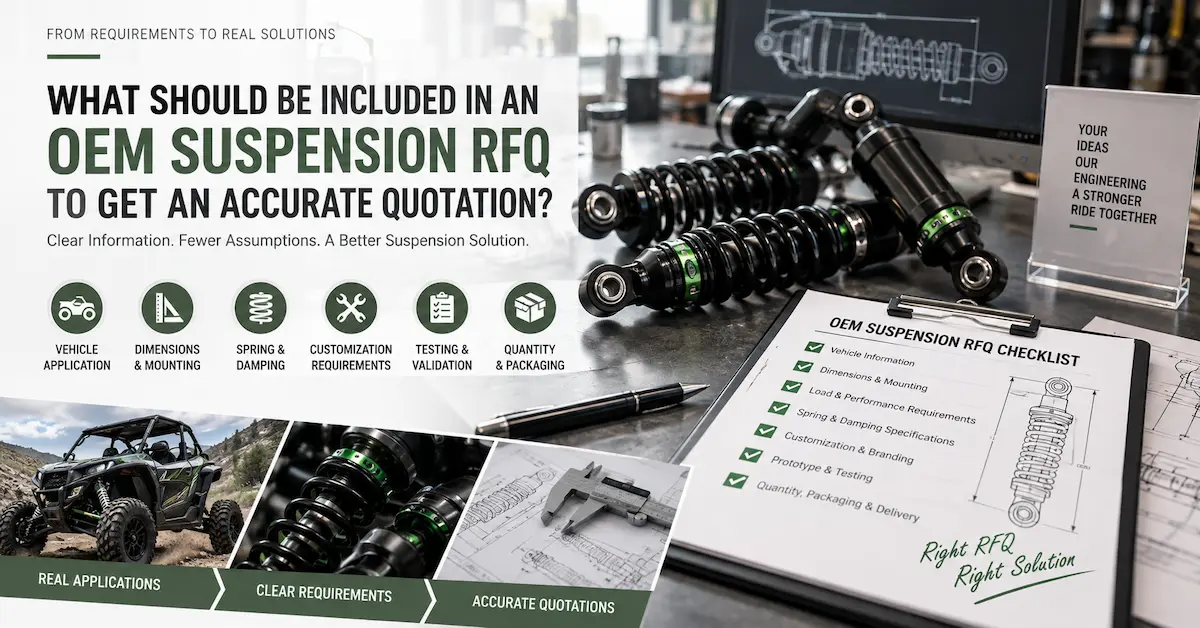
A practical suspension RFQ should identify:
| RFQ Area | Information to Define |
|---|---|
| Vehicle | ATV, UTV, specialty vehicle, application |
| Position | Front or rear |
| Current product | Existing shock, sample, drawing, CAD |
| Shock dimensions | Extended length, compressed length, stroke |
| Mounting | Hole diameter, sleeve, width, interface |
| Vehicle load | Vehicle, rider/passenger, cargo |
| Spring | Existing data or required performance |
| Damping | Existing setting or target behavior |
| Terrain | Utility, trail, rough terrain, mixed use |
| Modification | Tires, accessories, lift, cargo equipment |
| Development | Standard product or custom engineering |
| Sample | Prototype quantity and approval process |
| Production | Forecast quantity and expected SKU mix |
| Branding | Logo, finish, labels |
| Packaging | Bulk, individual, retail, kit |
| Testing | Required inspection or validation |
| Delivery | Requested commercial and logistics basis |
For complex projects, organize drawings, CAD, vehicle data, photographs, test targets, and approval requirements into one controlled package. The custom suspension development files guide provides a useful structure for this preparation.
Compare the Technical Specification Before the Unit Price
The first comparison column should not be price.
It should be technical compliance.
Check whether every quotation refers to the same:
- shock type;
- total or reference length;
- compressed length;
- stroke;
- cylinder configuration;
- mounting dimensions;
- bushings and sleeves;
- spring specification;
- damping configuration;
- reservoir type where applicable;
- finish;
- supplied hardware.
Create three possible statuses:
Confirmed
The supplier clearly agrees with the requirement.
Alternative Proposed
The supplier recommends another specification and explains why.
Unconfirmed
The quotation does not provide enough information.
Do not convert “unconfirmed” into “assumed compliant.” That creates hidden purchasing risk.
Separate Standard Products From Custom Suspension Development
One of the biggest quotation errors occurs when buyers compare a standard shock with a newly developed custom product.
A standard product may already have:
- established components;
- existing tooling;
- known assembly processes;
- standard packaging.
A custom suspension project may require:
- engineering review;
- new drawings;
- custom spring development;
- damping changes;
- prototype manufacturing;
- new components;
- testing;
- revisions.
Therefore, ask each manufacturer:
Is this quotation based on an existing product, a modified existing platform, or a new custom development?
These three answers should not be treated as equivalent.
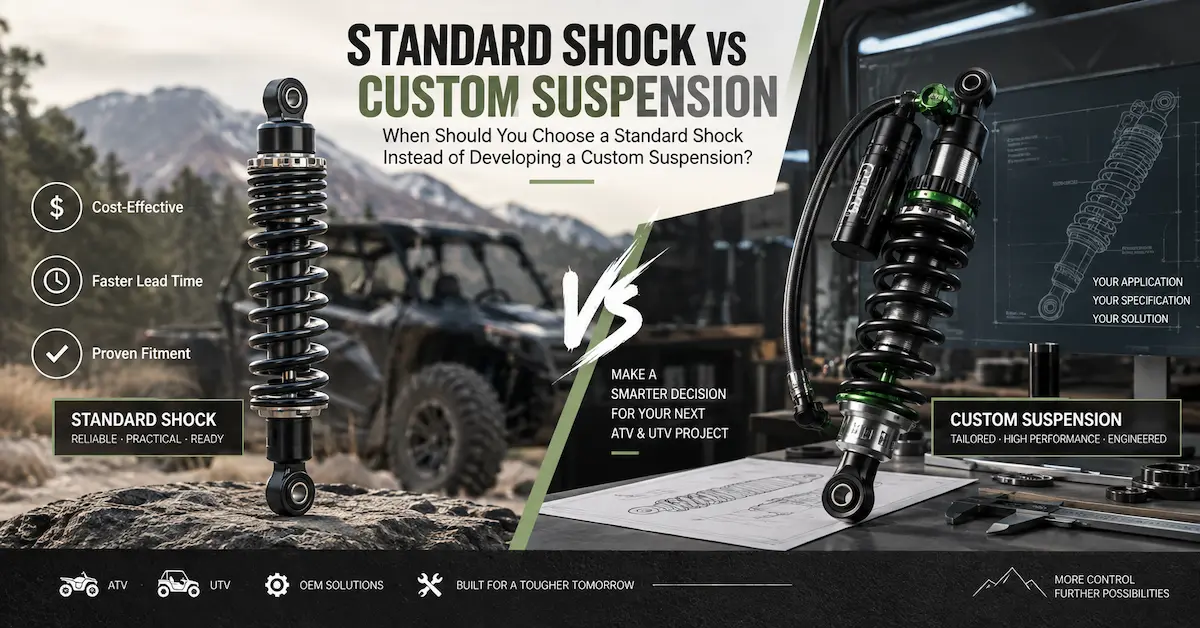
If you are still deciding whether customization is necessary, review the difference between a standard shock and custom suspension before comparing supplier prices.
Compare Spring Specifications Separately
A quotation that simply says “shock absorber with spring” is not detailed enough for a custom or performance project.
Check whether the supplier is quoting:
- the current spring;
- an existing alternative spring;
- a newly developed spring;
- multiple spring options.
Also clarify whether spring-related development, samples, or adjustments are included.
A low quotation may rely on an existing spring simply because it is available. Another supplier may have recognized that the target load requires a different spring.
These are different technical proposals.
For load-sensitive projects, spring selection should be reviewed against actual vehicle requirements rather than choosing whichever spring is already included in the cheapest quote.
Compare Damping Scope, Not Just “Adjustable” or “Fixed”
Damping descriptions can also hide large differences.
One quotation might include:
- an established fixed-damping configuration.
Another might involve:
- revised compression damping;
- revised rebound damping;
- adjustable damping;
- prototype tuning.
Ask suppliers to clearly identify whether the quoted damping specification is:
Existing / Modified / Newly Developed
If custom damping is required, also clarify whether initial tuning, prototype adjustments, and subsequent revisions are included or charged separately.
The purpose is not to demand the most complex shock. It is to understand what engineering work is actually included in the quotation.
Compare Materials and Components at the Required Level
Avoid comparing quotations only by generic claims such as:
- aluminum;
- steel;
- premium seal;
- high-quality spring.
Those descriptions may not define a controlled production specification.
Instead, identify which components are important to your project and determine whether they are:
- specified by drawing;
- proposed by the supplier;
- standard factory components;
- subject to buyer approval.
For repeat production, it is equally important to understand whether critical substitutions require approval.
A quotation based on an undefined component configuration can look attractive during sourcing but become difficult to control later.
Separate Prototype Cost From Production Cost
Prototype pricing should not automatically be treated as the future production price.
Custom shock samples may require:
- engineering time;
- low-volume machining;
- special springs;
- setup work;
- damping adjustments;
- testing;
- one-off components.
Create separate quotation columns for:
| Cost Type | What to Compare |
|---|---|
| Engineering | Development or drawing work |
| Prototype | Sample manufacturing |
| Tooling | Tool, mold, fixture, special setup |
| Testing | Project-specific validation |
| Pilot order | Small-batch production |
| Mass production | Recurring unit price |
| Packaging | Standard or private-label |
| Optional changes | Future revisions |
BEDO's shock absorber sample supplier guide explains why prototype cost can vary with product complexity, customization, materials, surface treatment, and testing requirements.
Compare Testing Scope Line by Line
The word “tested” is too vague for quotation comparison.
Ask what the quoted testing scope actually includes.
Depending on the project, relevant checks may involve:
- dimensional inspection;
- assembly inspection;
- damping verification;
- leakage inspection;
- spring verification;
- prototype evaluation;
- project-specific validation.
Supplier A may include certain production inspections in its unit price, while Supplier B may quote separate development testing.
Before concluding that one factory charges more, determine whether both suppliers are performing the same work.
For a deeper evaluation of testing responsibilities, see BEDO's shock absorber testing guide.
Check What the MOQ Actually Applies To
MOQ is frequently misunderstood.
A quotation may list “MOQ: 100,” but buyers should ask:
100 of what?
The minimum may apply to:
- one model;
- one spring specification;
- one damping version;
- one color;
- one logo;
- one package design;
- one component purchase.
Suppose you need four UTV shock configurations. A factory may accept a relatively small overall quantity but still require minimum quantities for each spring or customized component.
Therefore compare:
Prototype MOQ
Pilot MOQ
Production MOQ
MOQ per SKU
MOQ per customized component
MOQ per packaging version
BEDO's custom shock absorber MOQ guide can help buyers separate development quantities from repeat-production requirements.
Normalize Packaging Before Comparing Unit Prices
Packaging can create another false price difference.
One quotation may be based on:
- bulk cartons.
Another may include:
- individual boxes;
- printed labels;
- manuals;
- foam protection;
- mounting hardware;
- barcode labels;
- outer cartons.
Define exactly what is included in one saleable unit.
For example:
1 shock
or
1 pair of shocks
or
1 complete front/rear kit
Then require every supplier to quote the same package definition.
This is particularly important for distributors and private-label suspension brands because an apparently small packaging difference can affect warehousing, retail preparation, and final landed cost.
Compare Branding as a Separate Commercial Scope
Private-label requirements should also be normalized.
Ask whether the quotation includes:
- logo application;
- shock-body finish;
- spring color;
- labels;
- product identification;
- branded cartons;
- printed instructions.
Do not assume “OEM available” means all branding is included in the unit price.
Separating branding costs also allows you to determine whether a higher quotation reflects better technical content or simply more customized presentation.
Compare Lead Time From the Same Starting Point
A manufacturer might quote “30 days,” but what does the clock start from?
Possible starting points include:
- purchase order;
- deposit;
- final drawing approval;
- sample approval;
- material confirmation;
- packaging artwork approval.
A useful quotation separates:
Engineering Time
Prototype Time
Revision Time
Production Lead Time
Packaging Preparation
Shipment Preparation
This is especially important in custom suspension development because prototype revisions can affect the overall project schedule.
The custom shock development lead time guide provides additional planning considerations for projects involving engineering and prototypes.
Compare Delivery Terms and Logistics on the Same Basis
Unit prices cannot be compared correctly when delivery terms differ.
For example, one quote may include more logistics responsibility than another.
Your purchasing worksheet should record:
- quoted currency;
- delivery term;
- export packaging;
- inland transport responsibility;
- freight inclusion or exclusion;
- insurance where applicable;
- destination charges responsibility.
The objective is to compare landed commercial scope, not isolated factory numbers.
Separate Payment Terms From Product Price
Payment terms affect cash flow and commercial risk.
Record:
- deposit requirement;
- balance timing;
- sample payment;
- tooling payment;
- testing charges;
- production payment milestone.
A slightly lower unit price with significantly different payment requirements may not necessarily be the most useful arrangement for your business.
Keep these factors visible rather than hiding them inside a single “supplier score.”
Evaluate Engineering Capability Behind the Quotation
A custom suspension quotation is partly an engineering proposal.
Ask:
- Did the factory identify missing technical information?
- Did it notice conflicting dimensions?
- Did it ask about vehicle load?
- Did it question whether the spring is appropriate?
- Did it distinguish standard from custom requirements?
- Did it explain what must be tested?
- Did it identify unresolved risks?
A manufacturer that simply returns a price within minutes may be efficient for a proven catalog item. For a new suspension project, however, a technically useful quotation should demonstrate that the application has been understood.
BEDO's shock absorber factory engineering capability guide provides additional criteria for evaluating whether a supplier can support development rather than only manufacture existing parts.
Use a Quotation Normalization Matrix
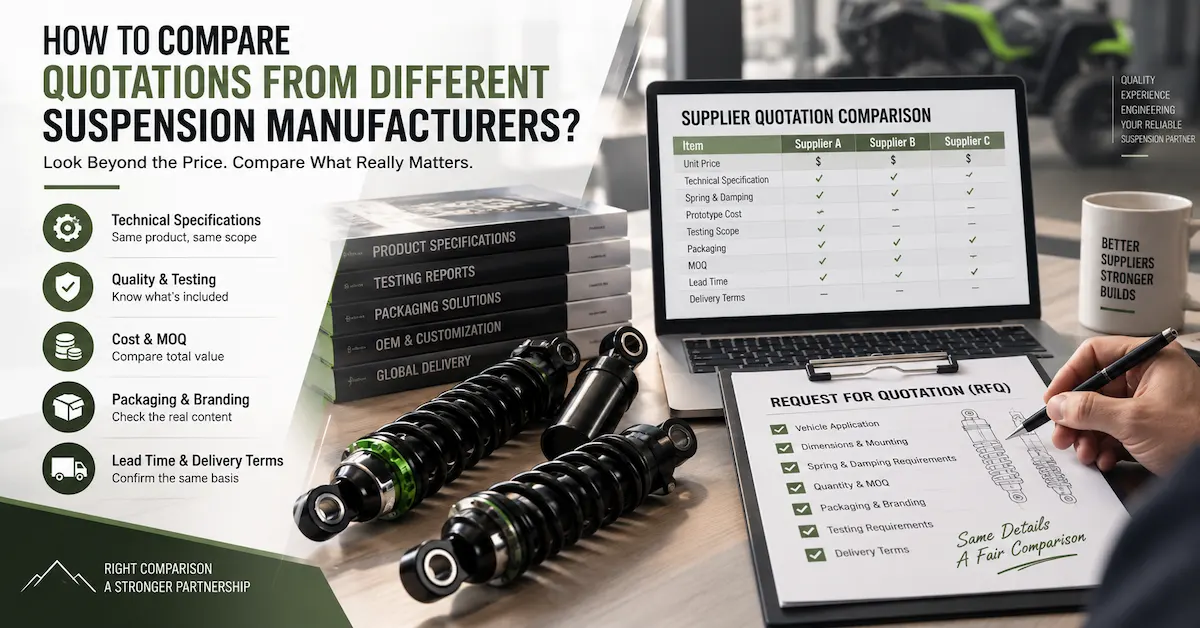
When you compare suspension manufacturer quotations, use one normalization matrix rather than reviewing each supplier’s quotation independently. This makes differences in technical scope, prototype costs, testing, MOQ, packaging, and delivery terms easier to identify.
A practical matrix can look like this:
| Comparison Item | Supplier A | Supplier B | Supplier C |
|---|---|---|---|
| Technical specification confirmed | Confirmed | Pending | Confirmed |
| Existing/custom platform | Existing | Custom | Modified |
| Spring included | Yes | Yes | Yes |
| Custom spring development | No | Included | Optional |
| Damping development | No | Included | Included |
| Prototype | Separate | Included | Separate |
| Testing | Basic scope | Project scope | To confirm |
| Tooling/fixtures | None stated | Included | To confirm |
| Production MOQ | Confirm | Confirm | Confirm |
| Packaging | Bulk | Retail | Bulk |
| Branding | Optional | Included | Optional |
| Lead-time basis | Production | After approval | Unclear |
| Delivery basis | Confirm | Confirm | Confirm |
| Revision cost | Not stated | Defined | Not stated |
The purpose is not to award points automatically. It is to expose where quotations are technically different or incomplete.
Use “Included, Excluded, Optional, Unconfirmed”
A particularly effective B2B purchasing method is to classify every quotation item into four states:
Included – clearly part of the quotation.
Excluded – clearly not included.
Optional – available for additional cost.
Unconfirmed – supplier has not defined it.
The fourth category is important.
Unconfirmed should never be interpreted as free.
Before selecting the supplier, reduce critical “unconfirmed” items as much as possible.
Compare Total Project Cost, Not Only Unit Price
For custom suspension, total project cost can be represented as:
Development + Prototype + Tooling + Testing + Product + Packaging + Logistics + Revision Risk
Not every project includes every item, but the framework helps prevent hidden costs.
Consider two simplified offers:
Quotation A
Low production unit price, but prototype, spring development, special packaging, and testing remain unconfirmed.
Quotation B
Higher unit price, but the quoted scope includes the approved spring, defined testing, private-label packaging, and specified mounting hardware.
Without normalization, Quotation A looks cheaper.
After normalization, the answer may be different.
Do Not Ignore Repeat-Order Risk
The first order is only one part of the sourcing decision.
Ask what controls the product configuration during repeat production.
Important questions include:
- Is there an approved drawing?
- Is there an approved sample?
- Is the spring configuration recorded?
- Is the damping configuration controlled?
- Are mounting components specified?
- Is packaging revision-controlled?
- How are future engineering changes communicated?
This matters because a supplier that can make a good sample but cannot consistently reproduce the approved specification creates long-term purchasing risk.
Separate Supplier Qualification From Quotation Comparison
Do not allow the cheapest quotation to automatically make a supplier “qualified.”
Supplier qualification should also consider:
- engineering capability;
- product experience;
- prototype support;
- quality processes;
- communication;
- documentation;
- production consistency;
- repeat-order support.
BEDO's ATV shock absorber supplier selection guide provides a broader framework for supplier evaluation beyond quotation price.
The quotation is one part of supplier selection—not the entire supplier-selection process.
What Are the Biggest Red Flags in a Suspension Quotation?
Pay additional attention when a quotation:
- gives a price without confirming the application;
- ignores missing dimensions;
- does not define whether the shock is standard or custom;
- lists only “heavy duty” without technical scope;
- does not clarify spring specification;
- does not define prototype costs;
- combines engineering and production charges without explanation;
- gives an MOQ without stating what it applies to;
- does not define packaging;
- leaves testing undefined;
- gives a lead time without identifying the start point.
One red flag does not automatically disqualify a manufacturer, but unresolved ambiguity should be closed before a purchase order is issued.
A Practical Five-Step Quotation Comparison Process
Step 1: Freeze the RFQ Baseline
Give all suppliers the same technical and commercial information.
Step 2: Review Technical Compliance
Identify confirmed, alternative, and unresolved specifications.
Step 3: Normalize Commercial Scope
Align quantities, packaging, branding, testing, prototype scope, and delivery terms.
Step 4: Separate Recurring and One-Time Costs
Keep engineering, tooling, samples, and testing separate from production unit price.
Step 5: Review Supply Risk Before Final Negotiation
Only negotiate the final commercial terms after technical differences are understood.
This process prevents buyers from negotiating a low price for the wrong product.
Frequently Asked Questions
1. Should I Always Choose the Lowest Suspension Manufacturer Quotation?
No. First confirm that every quotation covers the same specification, development work, testing, quantity, packaging, and delivery basis. Otherwise the prices are not directly comparable.
2. Why Can Two Suspension Manufacturers Quote Very Different Prices?
Differences can come from product architecture, spring configuration, damping, materials, components, development work, testing, MOQ, packaging, or commercial assumptions.
3. How Do I Compare Quotations From Different Suspension Manufacturers Fairly?
Use one RFQ and one comparison matrix. Normalize technical specifications, prototype work, testing, tooling, production quantity, packaging, branding, delivery scope, and payment terms before comparing final prices.
4. Should Prototype Cost Be Included in the Production Unit Price?
It is usually clearer to separate one-time development or prototype expenses from recurring production costs so future order economics can be evaluated independently.
5. What If One Supplier Recommends a Different Spring?
Ask why. The different spring may reflect a genuine load or performance requirement. Compare the engineering reasoning before forcing every factory to quote an identical component.
6. How Should I Compare MOQ Between Suppliers?
Determine whether the MOQ applies to the whole order, each model, each spring, each finish, or each private-label package. The headline MOQ alone can be misleading.
7. Should Testing Be Included in the Quotation?
The quotation should at least define what testing is included, excluded, optional, or project-specific. Avoid assuming every supplier uses the same validation scope.
8. How Important Is Engineering Support When Comparing Quotes?
It becomes increasingly important as customization increases. A standard replacement shock may require limited engineering, while a new vehicle or performance suspension project may require significant technical collaboration.
9. What Information Should I Send Before Asking for a Final Quote?
Provide vehicle information, shock dimensions, mounting interfaces, load conditions, spring and damping requirements, drawings or samples, terrain, desired changes, sample quantity, production volume, branding, packaging, and approval requirements.
10. Can BEDO Review a Suspension Project Before Quoting?
For OEM and custom projects, buyers can provide drawings, CAD, existing samples, vehicle information, dimensions, load requirements, performance targets, prototype quantities, and expected production requirements so the project scope can be reviewed before final commercial terms are established.
Conclusion
The safest way to compare suspension manufacturer quotations is to make every supplier quote the same project scope before comparing prices. Normalize the technical specification, confirm whether each proposal is based on a standard or custom shock, separate spring and damping development, define prototype and testing requirements, and clarify MOQ, packaging, branding, lead time, and delivery terms. A lower headline price does not necessarily represent lower total purchasing cost when important technical or commercial items remain excluded or unconfirmed. For ATV, UTV, off-road, or custom suspension projects, contact BEDO with your drawings, samples, vehicle data, load requirements, expected quantities, and purchasing requirements to establish a clearly defined quotation before making your final supplier comparison.