
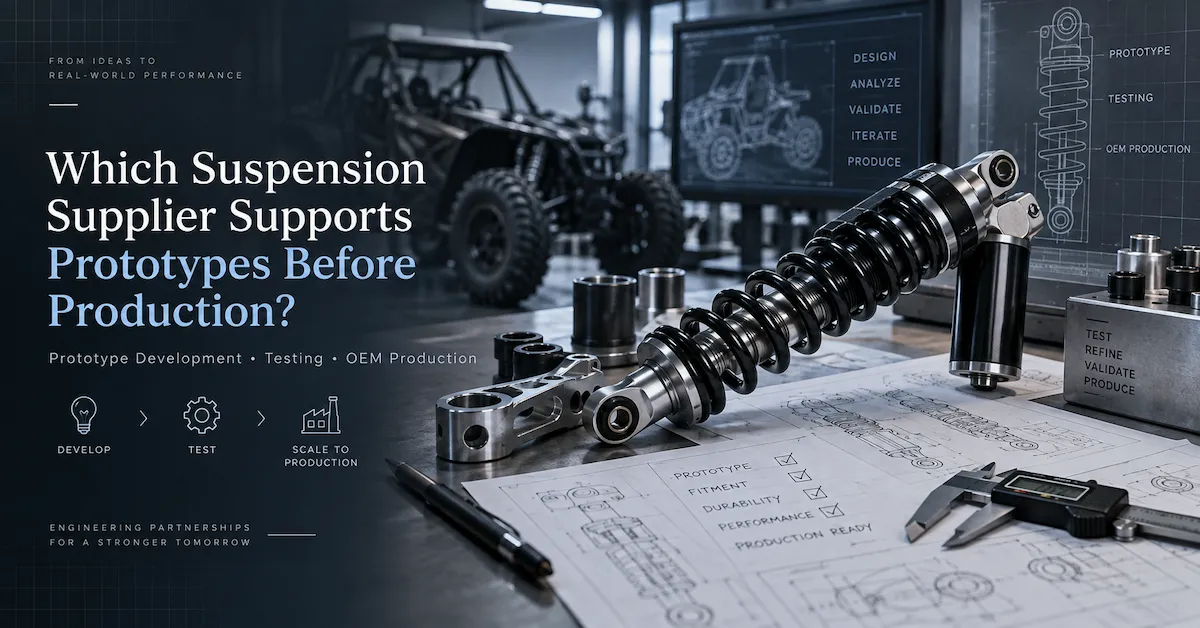
Which Suspension Supplier Supports Prototypes Before Production?
For OEM ATV, UTV, and off-road vehicle projects, choosing a supplier that supports suspension prototype development before production is an important factor when developing new suspension products. A professional supplier with suspension prototype development capability can help buyers verify design, performance, and manufacturing feasibility before mass production.A prototype allows buyers and manufacturers to verify whether the design, dimensions, spring specifications, damping characteristics, and manufacturing process meet the project requirements before committing to larger production quantities.
A suspension prototype is not simply an early sample.
It is a development tool used to confirm:
- installation compatibility;
- engineering assumptions;
- suspension performance;
- manufacturing feasibility;
- quality requirements.
A supplier that supports prototype development can help reduce risks caused by incorrect specifications, unclear requirements, or untested designs.
BEDO supports suspension development for ATV and off-road applications, including shock absorber and spring solutions. Buyers can review the available shock absorber products to understand different suspension configurations.
Why Prototypes Are Important Before Suspension Production
Moving directly from drawings to mass production creates risks.
Even when a design appears correct, problems may appear during real validation:
- mounting interference;
- incorrect suspension travel;
- unsuitable spring behavior;
- insufficient damping control;
- clearance issues;
- manufacturing difficulties.
A prototype allows these issues to be identified earlier.
A typical suspension development process includes:
Requirement Review
↓
Engineering Design
↓
Prototype Manufacturing
↓
Testing and Evaluation
↓
Revision
↓
Production Approval
For OEM buyers, prototype development provides confidence that the approved product is suitable before production investment.
What Should a Suspension Prototype Supplier Provide?
A capable supplier should support more than sample manufacturing.
Important capabilities include:
- technical requirement review;
- drawing interpretation;
- engineering recommendations;
- prototype production;
- testing support;
- revision management;
- production preparation.
A supplier should be able to explain:
- what information is needed before prototyping;
- what the prototype represents;
- what tests will be performed;
- how changes will be controlled;
- how the approved sample moves into production.
This separates a development partner from a supplier that only produces samples.
Start Prototype Development With Complete Technical Information
The quality of a prototype depends heavily on the information provided before manufacturing.
A suspension supplier should receive:
| Information | Purpose |
|---|---|
| Vehicle model | Defines application |
| Suspension position | Defines front/rear requirements |
| Existing shock | Provides reference |
| Drawings/CAD | Defines geometry |
| Mounting dimensions | Confirms fitment |
| Vehicle weight | Supports spring selection |
| Rider/cargo load | Defines operating conditions |
| Terrain | Defines performance requirements |
| Spring requirements | Supports suspension design |
| Damping requirements | Defines tuning direction |
| Prototype quantity | Defines development scope |
| Production forecast | Supports planning |
BEDO’s OEM suspension RFQ guide explains the information buyers should prepare before requesting suspension development support.
A Good Prototype Supplier Reviews Drawings Before Manufacturing
A professional suspension supplier should review technical files before producing prototypes.
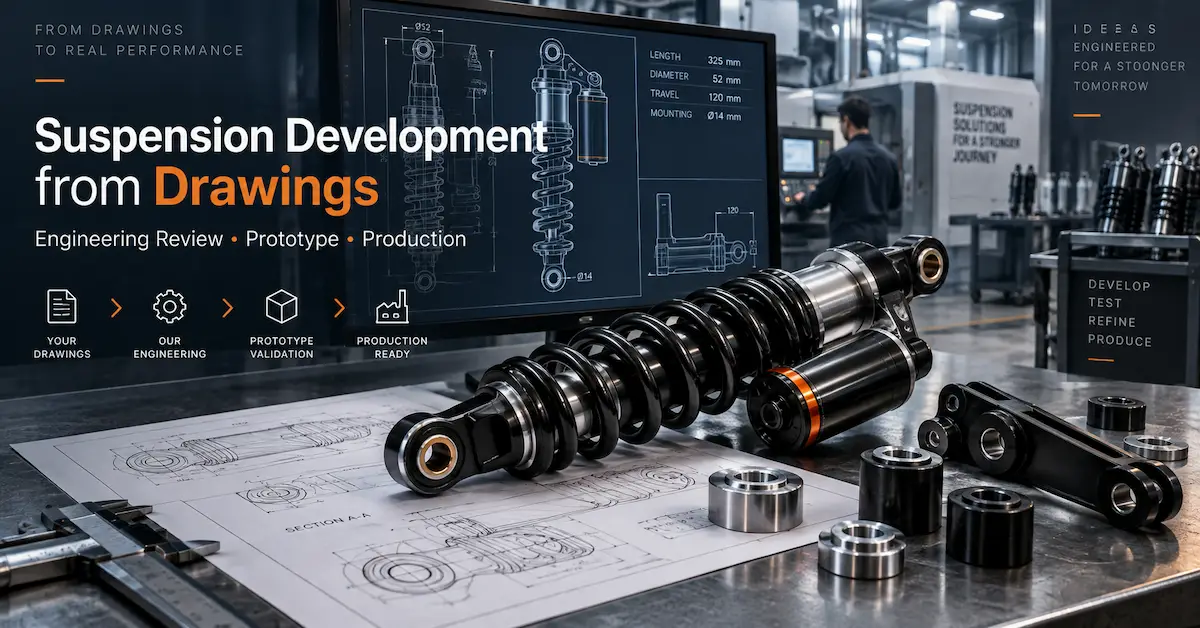
Drawing review may include:
- overall dimensions;
- extended length;
- compressed length;
- stroke;
- mounting interfaces;
- tolerances;
- component relationships.
The supplier should identify potential issues before manufacturing.
For example:
- Is the mounting design manufacturable?
- Is the stroke suitable for the application?
- Are the dimensions complete?
- Are additional specifications required?
BEDO’s shock absorber drawing service guide explains how technical drawings support suspension development and manufacturing communication.
Prototype Development Should Include Engineering Communication
Prototype projects often require communication between:
- buyer engineering teams;
- purchasing teams;
- supplier engineers;
- testing personnel.
Important discussions may include:
- design assumptions;
- performance targets;
- possible modifications;
- testing requirements;
- revision decisions.
A supplier that only accepts files without technical discussion may increase development risk.
For custom suspension projects, engineering communication is part of the development process.
What Suspension Components May Require Prototype Validation?
A prototype may be needed for different suspension elements.
Shock Absorber
Validation may include:
- dimensions;
- mounting;
- damping behavior;
- leakage performance;
- vehicle installation.
Spring
Validation may include:
- spring rate;
- load support;
- ride height;
- suspension balance.
Mounting Components
Validation may include:
- fitment;
- clearance;
- strength;
- installation process.
BEDO’s prototype shock absorber development guide explains why prototype validation is an important stage before mass production.
Spring and Damping Should Be Evaluated During Prototypes
A prototype is the opportunity to confirm whether the suspension system performs as expected.
Spring evaluation may consider:
- vehicle load;
- rider/passenger weight;
- cargo;
- accessories;
- intended use.
Damping evaluation may consider:
- compression response;
- rebound recovery;
- terrain conditions;
- suspension control.
BEDO’s custom spring rate guide explains why spring selection should be based on application requirements.
BEDO’s compression and rebound damping customization guide explains why damping development should match the vehicle application.
How Are Suspension Prototypes Tested Before Production?
Testing requirements depend on the project scope.
Possible validation areas include:
- dimensional inspection;
- installation verification;
- leakage testing;
- damping evaluation;
- spring inspection;
- prototype vehicle testing;
- production comparison.
The goal is to confirm that the prototype matches both technical requirements and application expectations.
BEDO’s shock absorber testing guide provides additional information about suspension validation.
A supplier should clearly define:
- which tests are included;
- which tests are optional;
- who performs evaluation;
- how results affect revisions.
Prototype Approval Should Be Controlled Carefully
One common problem in OEM development is unclear prototype approval.
A professional process should define:
- prototype version;
- drawing revision;
- test results;
- approved changes;
- final production specification.
Avoid situations where:
- multiple samples are considered “approved”;
- drawings are outdated;
- production uses a different configuration.
The approved prototype should become the reference for future production.
How Does a Supplier Move From Prototype to Production?
A reliable supplier should have a clear transition process.
Prototype Stage
Confirm:
- design;
- dimensions;
- performance;
- required modifications.
Approval Stage
Confirm:
- final drawing;
- approved sample;
- inspection requirements.
Production Stage
Control:
- materials;
- components;
- assembly;
- testing;
- packaging.
The purpose is to make production units consistent with the approved prototype.
Evaluate Suspension Suppliers by Prototype Capability
When selecting a suspension supplier, evaluate:
| Evaluation Area | Buyer Question |
|---|---|
| Engineering | Can they review and improve designs? |
| Prototype | Can they produce development samples? |
| Testing | Can they validate performance? |
| Communication | Can they manage revisions? |
| Production | Can they reproduce approved samples? |
| Quality | Are inspection processes defined? |
A supplier with prototype capability can help identify problems before they become production problems.
Standard Prototype or Custom Prototype?
Not every project requires completely new suspension development.
Existing Platform Prototype
Suitable when:
- an existing product is close to the requirement;
- only minor changes are needed;
- application is already known.
Custom Prototype
Suitable when:
- the vehicle is new;
- dimensions change;
- spring requirements change;
- damping needs adjustment;
- performance targets are different.
BEDO’s standard shock vs custom suspension guide explains how buyers can decide whether a standard platform or custom development route is more suitable.
Prototype Quantity and MOQ Considerations
Prototype quantities are different from production quantities.
A project may include:
- engineering samples;
- prototype pairs;
- pilot production;
- mass production.
Buyers should clarify:
- prototype quantity;
- sample cost;
- revision quantity;
- production MOQ.
BEDO’s custom shock absorber MOQ guide explains why quantities depend on customization, components, and project stage.
Lead Time Depends on Prototype Complexity
Prototype schedules depend on:
- drawing review;
- engineering workload;
- component availability;
- testing requirements;
- revision cycles.
A simple modification may require less time than a completely new suspension system.
BEDO’s custom shock development lead time guide explains factors that influence suspension development timing.
Common Mistakes When Choosing a Prototype Suspension Supplier
Choosing Based Only on Price
Low prototype cost may exclude engineering support or testing.
Skipping Technical Review
Producing samples without confirming requirements can create repeated revisions.
Not Defining Approval Criteria
Without clear acceptance requirements, prototype evaluation becomes subjective.
Moving to Production Too Quickly
A prototype should confirm the design before larger investment.
Ignoring Revision Control
Uncontrolled changes can create production inconsistencies.
How to Reduce Risk Before Mass Production
OEM buyers can reduce risk by:
Provide Complete Requirements
Share drawings, samples, vehicle data, and performance goals.
Define Prototype Objectives
Clarify what the prototype must verify.
Test Under Real Conditions
Evaluate the product in the intended application when possible.
Approve a Controlled Final Version
Maintain:
- drawings;
- samples;
- test results;
- revision records.
Confirm Production Transfer
Ensure the approved prototype becomes the production standard.
Frequently Asked Questions
1. Which Suspension Supplier Supports Prototypes Before Production?
A suitable supplier should provide engineering review, prototype manufacturing, testing support, revision management, and production preparation.
2. Why Are Suspension Prototypes Important?
Prototypes help verify fitment, performance, manufacturing feasibility, and design assumptions before mass production.
3. Can a Supplier Develop Suspension Prototypes From Drawings?
Yes. Many OEM projects begin with drawings, CAD files, or samples, followed by engineering review and prototype production.
4. How Many Prototype Samples Are Usually Needed?
The quantity depends on project complexity, testing requirements, and whether multiple configurations need evaluation.
5. Should Prototype Testing Be Done Before Production?
Yes. Testing helps identify issues before larger production commitments.
6. Can Spring and Damping Be Adjusted During Prototype Development?
Yes. Prototype stages are often used to validate spring rates and damping settings.
7. What Information Should I Provide Before Prototype Development?
Provide vehicle details, drawings, samples, dimensions, loads, performance targets, and expected production quantities.
8. How Long Does Suspension Prototype Development Take?
Timing depends on engineering scope, customization level, testing requirements, and revision cycles.
9. Is a Prototype the Same as a Production Sample?
Not always. A prototype is used for development and validation. Production samples confirm the final manufacturing configuration.
10. How Can I Start a Prototype Suspension Project With BEDO?
Prepare your vehicle information, drawings, samples, performance requirements, and production plans, then submit the project through BEDO Contact Us.
Conclusion
Choosing a suspension supplier prototypes before production capability is an important decision for OEM ATV, UTV, and off-road vehicle projects. A reliable supplier should support more than prototype manufacturing—it should provide engineering review, technical communication, testing validation, revision control, and a clear path from prototype approval to mass production. Prototypes help buyers verify suspension performance, reduce development risks, and establish a stable production specification before larger investments. BEDO supports suspension prototype development based on drawings, samples, and application requirements. To evaluate your project, contact BEDO with your vehicle information, technical drawings, performance goals, prototype requirements, and production plans to develop a reliable suspension solution.