
Can a Factory Customize Spring Rate for Different Vehicle Loads?
Yes. A suspension manufacturer with spring-development capability can create a custom spring rate for different vehicle loads, but the correct specification should be based on the complete application rather than a simple “lighter vehicle = soft spring, heavier vehicle = hard spring” rule.
Vehicle mass is only one input. Engineering should also consider front and rear load distribution, rider or passenger load, cargo location, permanent accessories, suspension geometry, shock installation position, available suspension travel, desired ride height, sag, operating terrain, and the damping characteristics of the shock absorber.
For OEM buyers, the real objective is not to order the stiffest spring that can support the highest load. It is to develop a spring that supports the intended operating load while preserving enough suspension movement, compliance, traction, and comfort across the required working range.
BEDO’s custom coil spring development guide is a useful starting point for projects involving spring-rate development, vehicle loads, samples, prototype validation, and OEM manufacturing.
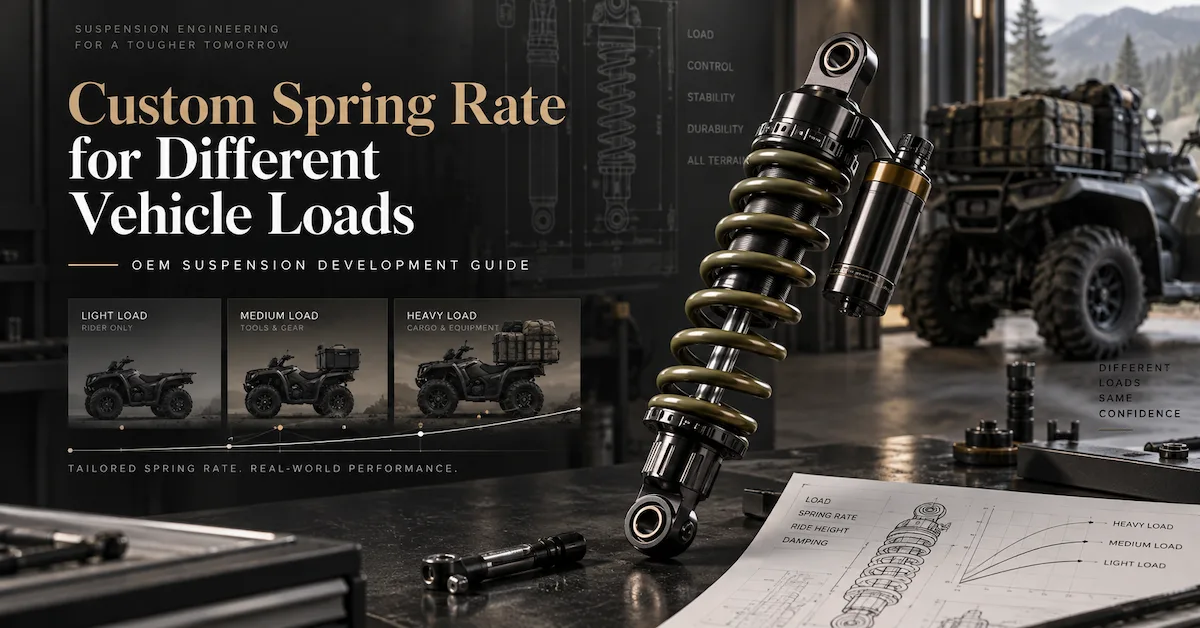
Why Total Vehicle Weight Alone Is Not Enough
Consider two ATVs that have the same total operating weight.
Vehicle A carries additional weight from a front winch and steel bumper.
Vehicle B carries the same amount of added weight in a rear cargo box.
Their total mass may be similar, but the suspension loads at the front and rear are different. A single spring specification selected only from total vehicle weight can therefore be misleading.
For spring development, it is more useful to understand:
| Vehicle data | Why it matters |
|---|---|
| Base vehicle weight | Establishes the starting load |
| Front/rear axle loads | Shows how mass is distributed |
| Rider/passenger load | Defines normal operating condition |
| Cargo weight | Changes required support |
| Cargo location | Determines which axle is affected most |
| Permanent accessories | Changes baseline load on every trip |
| Suspension position | Front and rear may require different springs |
| Suspension geometry | Changes the relationship between wheel and spring movement |
| Available travel | Determines usable movement before bottoming |
| Target ride height | Helps define the intended operating position |
| Terrain/use | Influences the required suspension behavior |
A buyer should therefore provide actual operating conditions rather than ask the supplier to choose a spring solely from a vehicle curb-weight figure.
How Is a Custom Spring Rate Defined?
For a linear spring, spring rate describes the additional force required to compress the spring by a given distance. It is commonly expressed using units such as N/mm or lb/in.
Conceptually:
Spring Rate = Change in Force ÷ Change in Spring Compression
A higher rate requires more force for the same additional compression. A lower rate allows the spring to compress more easily.
This does not mean that a higher number is automatically better for heavier-duty use. The spring still needs to work with suspension geometry, desired sag, available travel, damping, tire contact, and vehicle use.
BEDO’s ATV spring-rate performance guide discusses the relationship between spring rate, ride height, sag, load support, damping balance, and terrain.
What Happens When the Spring Is Too Soft?
An underspecified spring can allow the suspension to settle too deeply into its travel under normal operating load.
Possible results can include:
- excessive static or loaded sag;
- reduced ground clearance;
- less remaining compression travel;
- frequent bottoming;
- excessive chassis movement;
- poor cargo support;
- unsuitable ride height.
The correct response is not automatically to increase damping.
The spring primarily supports the load, while the damper controls how the suspension moves. If the static load support is fundamentally wrong, stronger compression damping does not turn the spring into a higher-rate spring.
That distinction is particularly important when developing utility ATV or cargo suspension.
For load-focused applications, BEDO’s heavy-duty ATV suspension guide provides a related framework for evaluating loaded and unloaded operating conditions.
What Happens When the Spring Is Too Stiff?
A spring can also provide too much resistance for the actual application.
Possible effects include reduced small-bump compliance, harsh ride behavior, limited suspension movement, poorer tire contact over irregular terrain, and an unnecessarily uncomfortable unloaded vehicle.
This can be particularly noticeable when a spring is selected only for the maximum cargo condition even though the vehicle spends most of its operating time lightly loaded.
A heavy-duty suspension therefore should not be defined as:
“Use the strongest spring available.”
A more useful engineering target is:
“Support the approved load range while preserving suitable suspension movement and vehicle behavior.”
This is one reason why the same ATV platform may need different spring specifications for recreational, utility, cargo, or specialist applications.
Front and Rear Loads Should Be Evaluated Separately
Spring development should normally consider where the load acts on the vehicle.
A front bumper, winch, plow mount, or front equipment rack may increase the front suspension requirement.
A rear cargo box, battery system, tools, agricultural equipment, or other rear-mounted accessories may affect the rear suspension more strongly.
Where practical, front and rear axle weights provide more useful engineering input than total vehicle weight alone.
For an OEM project, prepare several vehicle conditions:
Baseline Vehicle
Vehicle, fluids, permanent equipment, and normal configuration.
Normal Operating Load
Typical rider and cargo condition.
Maximum Intended Operating Load
Highest intended condition within the vehicle’s approved limits.
Special Configuration
Removable accessories or equipment that materially change load distribution.
The supplier can then evaluate whether one spring specification can cover the full range or whether separate versions are more appropriate.
Suspension Geometry Changes the Spring Requirement
The wheel does not always move the same distance as the spring.
Control-arm geometry, shock mounting position, installation angle, and the relationship between wheel movement and spring movement influence how the component-level spring rate is experienced at the wheel.
This is why copying the spring rate from another vehicle with similar weight can produce poor results.
Two ATVs may have:
- similar vehicle mass;
- similar tire size;
- similar shock length;
but different suspension geometry.
The same coil spring can therefore create different wheel-level behavior on each vehicle.
For new-platform or geometry-sensitive projects, combine load information with drawings or CAD rather than asking the factory to develop a spring from weight alone.
BEDO’s custom shock absorber dimensions, spring rate, and damping guide covers the connection between vehicle requirements, dimensions, spring rate, and damping.
Do Not Confuse Spring Rate With Preload
This is one of the most important distinctions in spring selection.
For a conventional linear spring, adding preload changes the installed starting condition of the spring, but it does not change the spring’s basic rate.
More preload can alter:
- static ride height;
- sag;
- the starting position within suspension travel.
It does not transform a 60 N/mm linear spring into an 80 N/mm spring.
This matters when buyers attempt to compensate for substantial cargo increases simply by tightening preload.
If the vehicle requires excessive preload just to achieve an acceptable operating position, the spring specification itself may need review.
Preload should therefore be treated as a setup variable within an approved range—not as an unlimited substitute for proper spring development.
Use Sag to Evaluate Whether the Spring Supports the Vehicle Correctly
Sag shows how far the suspension settles from a defined extended reference under vehicle load.
A controlled development process can measure suspension position under several conditions:
Vehicle-only condition
Vehicle plus rider
Typical operating load
Upper intended load condition
Use consistent measurement references and comparable vehicle conditions.
The objective is not to apply one universal sag percentage to every ATV. Vehicle geometry, suspension travel, application, and engineering targets differ.
Instead, use sag measurements to answer:
- Is too much travel already consumed before the vehicle encounters a bump?
- Does the vehicle sit too high when unloaded?
- Can the proposed spring cover both normal and loaded use?
- Does preload remain within an acceptable adjustment range?
- Is another spring specification required?
These measurements give the spring supplier real engineering information rather than a subjective comment such as “the rear feels soft.”
Linear or Progressive Spring: Which Is Better for Changing Loads?
Neither is universally better.
Linear Springs
A linear spring has an approximately consistent rate through its intended working range.
Potential advantages include predictable behavior and simpler suspension tuning.
It may suit applications where operating loads remain relatively stable or where engineering wants a clearly defined spring response.
Progressive Springs
A progressive design changes its effective resistance through compression.
Depending on design and application, this can provide softer initial movement while providing greater resistance later in the travel.
This may be useful for some vehicles that experience a wider load or operating range.
However, buyers should not automatically specify “progressive” whenever loads vary. The complete spring curve, geometry, shock damping, and required suspension behavior still need to be evaluated.
BEDO’s vehicle spring customization guide covers linear and progressive spring development for different vehicle applications.
Vehicle Load Changes Can Require Damping Changes Too
Spring rate and damping perform different functions, but they work together.
The spring supports load and stores energy.
The shock absorber controls suspension movement through compression and rebound damping.
If the custom spring rate changes significantly, the damping specification may also need review.
A higher-rate spring can change how much energy is returned as the suspension extends. Rebound damping that worked with the original spring may no longer provide the desired recovery behavior.
Compression behavior may also need evaluation depending on vehicle load, spring, terrain, and performance targets.
A professional development process is therefore:
Vehicle Load → Spring Requirement → Preload/Sag → Damping Review → Prototype → Vehicle Validation
not:
Vehicle Load → Install Stiffer Spring → Production
For damping-related projects, BEDO’s sample and technical-parameter customization guide provides additional context.
Different Rider Weights Can Also Require Different Spring Strategies
Vehicle load does not only mean cargo.
Rider weight can create a significant change in an ATV’s operating condition, particularly on lighter vehicles.
A recreational ATV brand may therefore want:
- standard rider configuration;
- heavier rider configuration;
- rider plus cargo configuration.
BEDO’s ATV rider-weight suspension guide discusses spring and damping development for defined rider-weight ranges.
For a product line, avoid publishing an unsupported statement such as “one spring fits all riders.”
If different spring versions are developed, each should have a clearly controlled product identity so assembly teams, warehouses, distributors, and customers can distinguish them.
Cargo Applications Need Loaded and Unloaded Validation
A cargo-focused spring can solve one problem while creating another.
Suppose a spring is developed exclusively around the vehicle’s maximum cargo condition. It may support that load well but produce an excessively harsh unloaded vehicle.
The development program should therefore evaluate the complete intended operating range.
A useful validation matrix might be:
| Load condition | What to review |
|---|---|
| Base vehicle | Ride height and available travel |
| Rider only | Normal sag and suspension response |
| Typical cargo | Daily operating behavior |
| High cargo condition | Load support and bottoming resistance |
| Cargo removed | Unloaded compliance and ride position |
This helps determine whether one custom spring rate provides a useful compromise or whether different springs or another spring strategy is needed.
Larger Batteries and EV Conversions Can Change Spring Requirements
Electric vehicles and converted vehicle platforms can experience substantial changes in mass and weight distribution when battery systems differ.
The same principle applies to specialized ATVs, golf carts, utility vehicles, and other platforms carrying permanently installed heavy components.
Spring development should consider:
- total added mass;
- battery location;
- front/rear distribution;
- suspension geometry;
- ride-height target;
- available travel;
- damping;
- operating environment.
Do not select a spring simply by adding the battery weight to the original vehicle mass.
Where the battery is positioned can be just as important as how much it weighs.
Larger Tires Affect Suspension Differently From Chassis-Mounted Cargo
Larger or heavier wheel-and-tire assemblies mainly change unsprung mass and clearance conditions.
A heavy bumper or cargo box changes sprung load.
These are not the same engineering problem.
If a vehicle receives both larger tires and heavy accessories, the supplier should distinguish the two changes when evaluating suspension requirements.
For this type of modified ATV, BEDO’s larger-tire and accessory suspension guide provides a useful related reference.
A spring change may address added chassis load while damping review may also be appropriate because the wheel-and-tire assembly has changed.
What Data Should Buyers Send for Spring Rate Development?
A useful OEM spring-development RFQ should include more than the existing coil spring dimensions.
Prepare:
| Information | Purpose |
|---|---|
| Vehicle/platform | Defines application |
| Front/rear position | Identifies suspension location |
| Vehicle weight | Establishes baseline |
| Front/rear axle load | Improves load distribution analysis |
| Rider/passenger load | Defines normal operating condition |
| Cargo | Defines variable load |
| Accessory weight/location | Defines permanent added load |
| Suspension geometry | Helps translate spring movement to vehicle behavior |
| Available travel | Defines usable operating range |
| Existing spring | Provides baseline |
| Current sag | Shows current load support |
| Current problem | Defines development target |
| Intended terrain | Supports system tuning |
| Existing damping | Helps evaluate spring/damper balance |
| Order quantity | Defines prototype/production scope |
Where possible, send drawings, CAD, measurements, and an existing spring or complete shock sample.
Can a Physical Spring Sample Be Used for Development?
Yes. A physical spring can provide useful information such as dimensions, coil geometry, and existing construction.
But dimensions alone do not necessarily reveal the complete intended performance specification.
A development program may also need to establish:
- actual spring rate;
- load-deflection behavior;
- material requirements;
- fatigue requirements;
- new load target;
- intended vehicle behavior.
The sample should therefore be combined with vehicle and load information.
If the new application differs substantially from the original, do not simply copy the old spring because it physically fits.
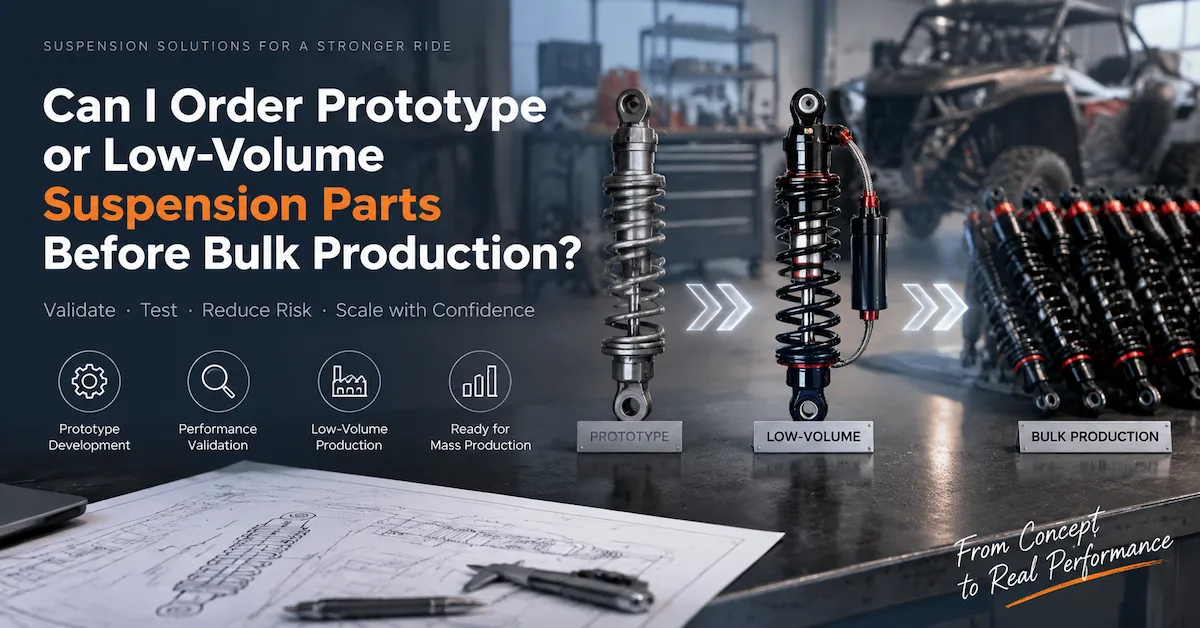
Prototype the Spring Before Mass Production
A newly developed spring should normally be validated as part of the complete suspension assembly.
BEDO’s suspension sample development process treats spring characteristics as one of the important areas to confirm during prototype development.
A spring prototype can be evaluated for:
- physical fit;
- seat compatibility;
- ride height;
- sag;
- load support;
- available compression;
- rebound movement;
- interaction with damping;
- vehicle behavior.
For a new load-specific product, also test the conditions under which the final product will actually be sold.
Use a Pilot Batch to Check Spring-Rate Consistency
One approved spring prototype does not automatically prove production consistency.
A pilot batch can help evaluate whether the factory can repeatedly manufacture the selected spring and assemble it with the correct shock version.
Potential checks include:
- spring dimensions;
- correct spring identification;
- spring-rate consistency where specified;
- finish;
- preload setup;
- installation;
- shock pairing;
- packaging.
This stage becomes particularly important when one product line contains several spring-rate variants.
Wrong-version assembly can create a customer complaint even when every individual component was manufactured correctly.
How Should Different Spring Versions Be Identified?
If a supplier manufactures several load configurations, do not rely on color alone.
Use a controlled system that can connect the finished product to:
- buyer SKU;
- supplier part number;
- spring specification;
- shock specification;
- vehicle application;
- damping version;
- packaging label.
Color can be part of identification, but it should not be the only technical control.
This helps prevent a spring intended for one load group from being assembled or shipped as another.
How Does Custom Spring Rate Affect Cost and MOQ?
A custom spring can create its own engineering and production requirements.
Cost or quantity may be affected by:
- new material requirement;
- new spring dimensions;
- new coil geometry;
- spring-rate development;
- prototype quantity;
- testing;
- heat treatment or finishing;
- color;
- multiple load variants;
- production volume.
Do not assume that the complete shock MOQ and spring manufacturing MOQ are always identical.
For procurement, request separate information for:
Prototype spring quantity
Pilot quantity
Production MOQ
Repeat-order quantity
If several spring rates use the same shock body, ask whether this can simplify the broader product program.
Can One Spring Cover a Wide Vehicle Load Range?
Sometimes one spring may serve an approved range, particularly when load variation is moderate and the suspension has suitable adjustment.
But a very wide load range can force compromise.
A spring selected around heavy cargo may be too firm unloaded. A spring optimized for the light condition may sag excessively at the upper load.
The supplier may evaluate alternatives such as:
- a different linear rate;
- preload adjustment;
- progressive spring characteristics;
- separate spring versions.
Which solution is appropriate depends on the vehicle and requires validation.
Do not advertise an unlimited load range simply because one spring can physically be installed at every condition.
What Should OEM Buyers Ask a Spring Supplier?
Before approving the project, ask:
- What vehicle/load data do you need?
- Can you develop spring rate from vehicle requirements?
- How do you use axle load and suspension geometry?
- Can you analyze our existing spring sample?
- Can several load versions use the same shock body?
- How will spring rate be validated?
- Will damping need reassessment?
- What prototype quantity is needed?
- What MOQ applies to each spring version?
- How will different spring configurations be identified during production?
The answers should be connected to the actual vehicle project rather than generic statements about producing “hard” or “soft” springs.
What Can BEDO Support for Load-Specific Spring Development?
BEDO manufactures suspension springs and shock absorbers for ATV and other vehicle applications. Buyers developing a load-specific suspension can begin with BEDO’s custom coil spring OEM guide and vehicle spring customization guide.
For a project review, prepare vehicle information, weight/load data, spring or shock samples, drawings, suspension geometry where available, current spring information, target ride height, operating conditions, and purchasing forecast.
The development route should then establish whether the project can use an existing spring, a revised custom spring rate, or a broader spring-and-damping configuration before samples are approved.
Frequently Asked Questions
1.Can a Suspension Factory Customize Spring Rate?
Yes, where the supplier supports spring development. The correct rate should be determined from vehicle weight, payload, geometry, travel, and intended use rather than chosen only as “harder” or “softer.”
2. Does a Heavier Vehicle Always Need a Higher Spring Rate?
Not based on total vehicle weight alone. Load distribution, suspension position, geometry, target sag, travel, and application also influence the correct spring.
3. Is Preload the Same as Spring Rate?
No. On a linear spring, preload changes the installed starting condition but does not change the spring's basic rate.
4. Can Spring Rate Be Customized for Different Rider Weights?
Yes, defined rider/load ranges can be evaluated. The complete vehicle load and intended operating conditions should still be considered.
5. Can Spring Rate Be Customized for Cargo Vehicles?
Yes. Provide typical and upper operating loads together with cargo location, axle-load information where available, geometry, and loaded/unloaded requirements.
6. Should Damping Change When Spring Rate Changes?
A significant spring change can justify compression and rebound damping review because spring and damper behavior work together.
7. Can an Existing Spring Sample Be Copied?
Its dimensions can provide a useful reference, but the actual spring performance and new application requirements should be evaluated rather than assuming physical duplication is sufficient.
8. Are Progressive Springs Better for Variable Loads?
Not universally. Linear and progressive springs offer different characteristics. Selection depends on vehicle geometry, load variation, ride target, and suspension requirements.
9. Does Custom Spring Development Increase MOQ?
It can create separate component, manufacturing, finishing, or testing requirements. Ask the supplier to confirm prototype, pilot, and production quantities for each spring specification.
10. What Should I Send BEDO for a Custom Spring Rate Project?
Send the vehicle platform, suspension position, vehicle and axle loads where available, rider/cargo data, geometry or drawings, existing spring or shock sample, sag information, intended terrain, current problem, target result, and expected order quantity through BEDO Contact Us.
Conclusion
A factory can develop a custom spring rate for different vehicle loads, but successful spring customization begins with understanding how the complete vehicle carries and transfers those loads. Total weight alone is not enough: axle distribution, rider and cargo conditions, accessory location, suspension geometry, travel, sag, preload, terrain, and shock damping all influence the final spring specification. The safest development route is Vehicle Load Data → Geometry Review → Spring Specification → Prototype → Sag and Load Validation → Damping Review → Pilot Batch → Production Control. BEDO supports suspension spring and shock absorber development for ATV and other vehicle applications. To evaluate a load-specific spring project, contact BEDO with your vehicle data, drawings or samples, load conditions, existing spring information, target ride height, current suspension problem, and future production quantity so the appropriate custom spring rate can be reviewed before prototype and production approval.