
When Should I Choose a Standard Shock Instead of Developing a Custom Suspension?
For OEM buyers comparing standard shock vs custom suspension, the key is to identify whether the existing shock already meets the vehicle’s fitment, load, spring, damping, and operating requirements before investing in new development.
Choose a standard shock when an existing, validated product already matches the vehicle’s mounting dimensions, installation range, operating load, spring requirements, damping behavior, and intended use. In that situation, custom engineering can add prototypes, testing, revisions, cost, and lead time without creating meaningful additional value.
Choose custom suspension when the existing product cannot satisfy an important requirement such as different mounting geometry, increased load, new suspension travel, larger tires, a different spring rate, application-specific compression or rebound damping, reservoir packaging, or another measurable performance target.
BEDO’s current suspension-customization guidance makes the same distinction: a standard suspension product can be appropriate when the application is already validated, mounting dimensions match, vehicle load remains unchanged, and the existing spring and damping characteristics are acceptable. Customization becomes more relevant when those assumptions no longer hold.
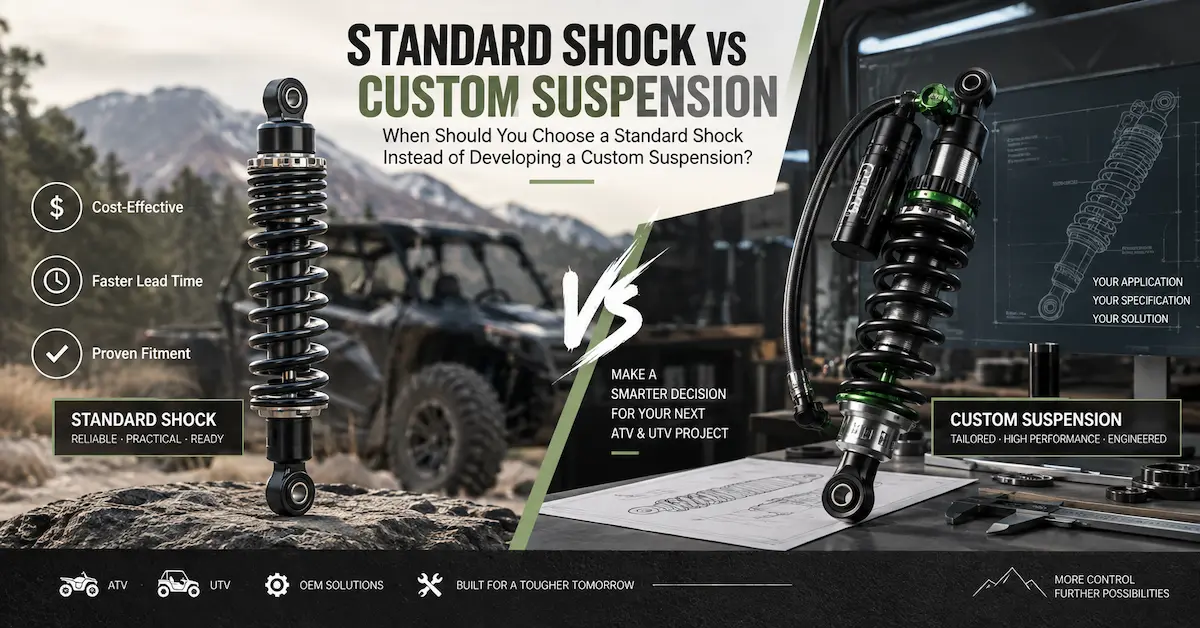
Standard Shock vs Custom Suspension: Quick Buyer Comparison
For purchasing teams, the decision should begin with the engineering gap between what already exists and what the project actually needs.
| Evaluation Area | Standard Shock | Custom Suspension |
|---|---|---|
| Vehicle fitment | Existing application already matches | Fitment needs modification or new development |
| Mounting dimensions | Existing interfaces are suitable | New eye, clevis, sleeve, width, or geometry required |
| Vehicle load | Within validated range | Load has materially changed |
| Spring requirement | Existing spring is suitable | New spring rate or load range required |
| Damping | Existing response is acceptable | Compression/rebound target needs development |
| Suspension travel | Existing dimensions are suitable | Stroke or geometry requires review |
| Tire/accessory changes | No meaningful effect | Modifications change load or clearance |
| Prototype work | May be limited | Usually more important |
| Development cost | Lower engineering exposure | Additional engineering/testing possible |
| Lead time | Usually simpler | Depends on prototype and revision scope |
| Product differentiation | Fitment/service value | Technical differentiation possible |
| Best fit | Replacement and established applications | New, modified, performance, or specialist projects |
A standard shock vs custom suspension comparison should therefore focus on the engineering gap, not simply on which option appears more advanced. If the standard platform already meets the required specifications, additional customization may increase cost and lead time without creating measurable application value.
Choose a Standard Shock When the Vehicle Application Is Already Proven
The strongest case for a standard shock is a known vehicle application where the important installation and operating requirements are already established.
For example, an aftermarket distributor may be sourcing a replacement component for an unmodified ATV with:
- confirmed vehicle model and year;
- known front or rear installation position;
- unchanged mounting brackets;
- standard wheel and tire configuration;
- normal rider/load conditions;
- no requirement to alter suspension behavior.
The purchasing objective is then primarily accurate replacement and repeatable supply, not a new suspension-development program.
BEDO’s aftermarket guidance separates OE-style replacement from heavy-duty, comfort, performance, modified-vehicle, and new-SKU projects because each has a different development objective.
Choose a Standard Shock When the Mounting Interfaces Already Match
If an existing shock matches the verified installation geometry, there may be little reason to create a new mounting structure.
Confirm:
- extended and compressed dimensions;
- effective stroke;
- upper mounting-hole diameter;
- lower mounting-hole diameter;
- upper and lower mounting widths;
- bushing and sleeve arrangement;
- body and spring clearance;
- mounting orientation.
A standard product should still be verified against the target vehicle before bulk ordering. “It looks similar” or “the bolt diameter matches” is not enough.
However, when those dimensions are already correct, creating a new eye, clevis, bracket, or bushing system can introduce machining work, drawings, tolerances, inspection requirements, prototype risk, and potentially separate component minimums without improving the application.
Choose a Standard Shock When Vehicle Load Has Not Changed
Vehicle load is one of the clearest dividing lines between standard and custom suspension.
If the vehicle remains in its original intended configuration, with normal rider/load conditions and no significant additional equipment, the existing spring-and-damper specification may already be appropriate.
A custom project becomes more useful when the vehicle has gained meaningful permanent or variable load from:
- cargo systems;
- toolboxes;
- heavy bumpers;
- winches;
- batteries;
- commercial equipment;
- specialty accessories.
BEDO’s customization guidance explicitly identifies increased passenger or cargo load as one of the situations where customization may become more valuable.
The key question is not whether the buyer wants a “heavy-duty” label. It is whether the actual vehicle load has moved outside the range the existing suspension was intended to support.
Keep the Standard Spring When It Already Supports the Application
A new spring rate should solve a load or suspension-position problem, not simply make the product more customized.
If the standard spring provides suitable:
- ride height;
- sag;
- available travel;
- rider/load support;
- vehicle behavior;
there may be no need to develop another rate.
Spring development becomes more appropriate when the buyer can identify a specific issue such as excessive loaded sag, frequent bottoming, a substantially different rider range, or changed vehicle mass.
Custom spring development can add another technical stream to the project because spring dimensions, rate, preload, load-deflection behavior, prototypes, and suspension damping may need to be evaluated together.
Use Standard Damping When the Existing Vehicle Behavior Is Acceptable
Custom compression and rebound damping is valuable when a buyer wants to change suspension behavior for a defined reason.
It is unnecessary when the existing shock already provides suitable movement control for the intended vehicle, spring, load, and terrain.
BEDO’s replacement-versus-performance guidance distinguishes the stable damping needs of replacement products from performance projects requiring application-specific compression and rebound development.
Avoid custom damping when the requirement is only:
“We want a more premium product.”
Instead, identify whether there is an actual problem:
- excessive bouncing;
- slow rebound recovery;
- harsh impact response;
- poor control under load;
- changed spring behavior;
- repeated rough-terrain performance issue.
Without a defined performance target, custom damping can become development work without a clear acceptance criterion.
A Fixed-Damping Standard Shock Can Still Be a High-Quality Solution
The absence of external adjustment does not make a shock technically inferior.
A fixed-damping product can be the better commercial choice when:
- the application is predictable;
- the spring specification is stable;
- customers do not need frequent tuning;
- simple installation matters;
- distributors want fewer setup errors;
- the factory setting already meets the target use.
BEDO’s premium suspension content similarly notes that premium suspension does not require every possible feature; a properly designed fixed-damping shock can be a better solution than an overcomplicated adjustable product that is poorly matched to the vehicle.
Do Not Customize Simply to Add a Reservoir
Piggyback and remote-reservoir architectures can be useful for suitable hydraulic, thermal, damping, or packaging requirements.
They should not be added merely because the product is being positioned above a standard replacement line.
A reservoir can introduce additional:
- components;
- fittings;
- hose routing;
- mounting brackets;
- sealing interfaces;
- assembly operations;
- packaging constraints;
- validation requirements.
If the standard shock maintains acceptable behavior in the intended duty cycle, the simpler architecture may offer better commercial value.
Standard Shocks Make Sense When Faster Market Entry Matters
A proven product platform can reduce the number of unknowns that need to be resolved before launch.
A standard-shock project may require:
Application Verification → Sample Approval → Commercial Terms → Production
A deeper custom project may require:
Requirement Definition → Drawing/CAD Review → Engineering → Prototype → Testing → Revision → Pilot Batch → Production
The second route is appropriate when the product genuinely requires engineering changes, but it can create more schedule dependencies.
BEDO’s customization content states that development time depends on project complexity, available engineering data, new components, prototype requirements, testing, revisions, and manufacturing preparation.
If an existing shock already satisfies the application, avoiding unnecessary engineering can shorten the path to market.
Standard Products Can Reduce Development Cost
A custom suspension program may involve:
- engineering review;
- CAD or technical drawing work;
- custom components;
- new springs;
- damping development;
- physical prototypes;
- testing;
- engineering revisions;
- pilot production.
Those activities can be appropriate investments when they create meaningful application value.
They are harder to justify when the proposed custom shock ultimately reproduces the same fitment and behavior as an existing product.
A useful purchasing rule is:
Do not pay for customization unless you can identify what technical or commercial problem the customization is intended to solve.
Choose a Standard Shock When You Need Broad Replacement Coverage
Aftermarket distributors frequently have a different commercial requirement from specialist performance brands.
A distributor may need coverage across many:
- vehicle models;
- years;
- front/rear positions;
- replacement applications.
In that situation, expanding a reliable standard product range can be more commercially useful than creating numerous performance configurations with narrower application ranges.
BEDO’s replacement-versus-performance content identifies repair, replacement, and broad aftermarket coverage as typical uses for replacement suspension, while performance products are more closely associated with specialist upgrades and differentiated private-label applications.
When Should You Move From a Standard Shock to Custom Suspension?
Custom suspension becomes worthwhile when the buyer can identify a requirement that the current platform cannot satisfy.
Different Mounting Geometry
Custom development may be necessary when the vehicle uses:
- another upper mount;
- another lower mount;
- different mounting width;
- different bolt/sleeve interface;
- another shock angle.
BEDO’s customization offering includes extended/compressed length, stroke, and upper/lower mounting-interface changes as deeper engineering customization.
Different Vehicle Load
A new spring or suspension configuration may be required for:
- cargo applications;
- heavier riders;
- new battery systems;
- additional equipment;
- permanent vehicle accessories.
Different Suspension Travel
Longer or shorter required travel should trigger geometry review rather than simply selecting the longest catalog shock.
Different Performance Target
A performance development program can be justified when the buyer needs measurable changes in:
- compression response;
- rebound recovery;
- terrain control;
- rider/load behavior.
Modified Vehicle Geometry
Larger tires, lift components, changed control arms, or another suspension layout may take the vehicle outside the assumptions of the standard product.
New Vehicle Development
A new ATV, UTV, electric vehicle, golf cart, utility vehicle, or specialty platform may not have an existing validated shock at all.
In these cases, custom suspension becomes an engineering requirement rather than an optional marketing feature.
Branding Alone Does Not Necessarily Require Custom Suspension Engineering
Private-label buyers should distinguish branding customization from technical customization.
BEDO’s customization content separates basic changes such as product color, spring color, logo, labels, and packaging from engineering changes involving shock dimensions, spring rate, preload, damping, reservoir configuration, and fitment.
If an existing shock is already technically suitable, a private-label brand may be able to create differentiated commercial presentation without redesigning the suspension.
This can be particularly useful for:
- new aftermarket brands;
- distributors testing a new product category;
- smaller launch programs.
The product still needs application verification and controlled quality, but the project does not automatically need new spring and damping engineering.
Use an Existing Platform as the Starting Point Before Designing From Zero
Custom does not always mean clean-sheet development.
A practical OEM strategy is:
Step 1: Review existing BEDO shock platforms through the product range.
Step 2: Compare their basic architecture and fitment with the target application.
Step 3: Identify the remaining gaps.
Step 4: Customize only what the vehicle or product strategy requires.
BEDO’s custom-development documentation states that the company can work from existing products, drawings, CAD files, samples, and vehicle requirements to determine whether an existing platform can be adapted or deeper development is required.
This approach can reduce unnecessary design variables.
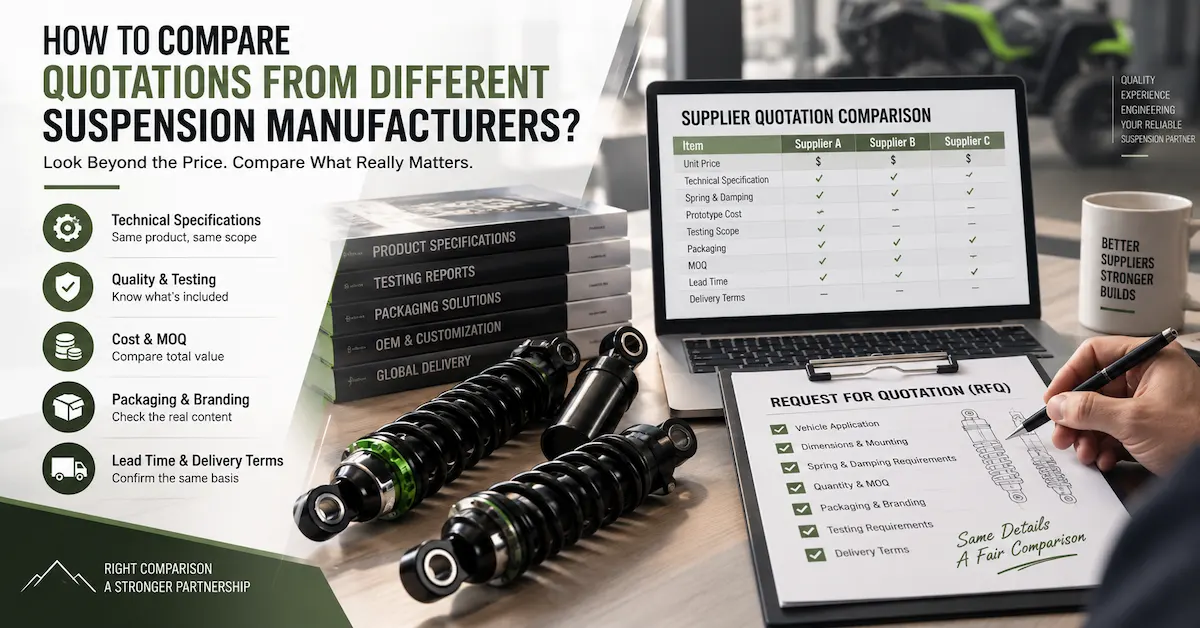
Standard vs Custom: Use a Gap Analysis Before RFQ
Before sending the project to a supplier, create a simple comparison.
| Requirement | Existing Standard Shock | Project Requirement | Custom Work Needed? |
|---|---|---|---|
| Mounting dimensions | Matches | Matches | No |
| Stroke | Matches | Matches | No |
| Vehicle load | Suitable | Suitable | No |
| Spring rate | Suitable | Suitable | No |
| Damping | Suitable | Suitable | No |
| Tire clearance | Confirmed | Standard vehicle | No |
| Reservoir | Not required | Not required | No |
| Branding | Standard | Private label | Commercial customization only |
In this example, full custom suspension engineering would provide little additional technical value.
Now consider:
| Requirement | Existing Standard Shock | Project Requirement | Custom Work Needed? |
|---|---|---|---|
| Upper mount | Existing eye | New clevis | Yes |
| Stroke | Standard | Longer travel | Yes |
| Vehicle load | Standard | Higher cargo load | Review |
| Spring | Standard | New load range | Yes |
| Damping | Standard | New performance target | Yes |
| Tire clearance | Standard | Larger tires | Review |
| Reservoir | Internal | Remote required | Yes |
This project clearly justifies deeper engineering.
Do Not Use Custom Suspension to Solve an Undefined Complaint
Some buyers begin with:
“The standard shock does not feel premium.”
That is difficult to engineer.
A better development request identifies the problem:
- too much sag at a defined load;
- repeated bottoming on a specified terrain;
- rebound too slow between repeated bumps;
- interference after a tire modification;
- insufficient available travel;
- customer requires rider-adjustable damping.
BEDO’s performance-shock guidance emphasizes that suspension development should be tied to vehicle weight, geometry, travel, spring, damping, terrain, and intended use rather than appearance or feature count.
If no measurable problem exists, staying with a validated standard shock may be the lower-risk decision.
Consider Inventory Complexity Before Adding Custom Versions
Every custom technical variant creates another item that may need separate:
- engineering documentation;
- SKU;
- spring specification;
- damping version;
- stock;
- labels;
- packaging;
- spare parts;
- dealer training;
- warranty investigation.
For a distributor, adding five technically different premium shocks can create more operational complexity than adding five verified standard-fitment SKUs.
Customization should therefore deliver enough customer value to justify the additional supply-chain burden.
Prototype and Testing Requirements Should Match the Level of Change
A standard shock for a verified application may need fitment confirmation and appropriate product-quality checks.
A new custom suspension setup can require additional validation of:
- dimensions;
- full bump/droop;
- spring behavior;
- sag;
- damping;
- leakage;
- reservoir packaging;
- vehicle performance;
- manufacturing repeatability.
This is one reason deeper customization can increase cost and development time.
Do not skip necessary testing to make a custom project look commercially similar to a standard product.
MOQ Can Also Favor the Standard Platform
Custom components can introduce separate purchasing minimums for:
- springs;
- machined mounts;
- bushings;
- finishes;
- reservoir parts;
- packaging.
A standard production platform may already have a supply chain established around those components.
For a lower-volume or market-validation project, this can make the standard route commercially attractive.
BEDO supports small-batch and customized projects, but the applicable quantity depends on the specific configuration rather than one universal MOQ. A detailed project package helps determine the appropriate route.
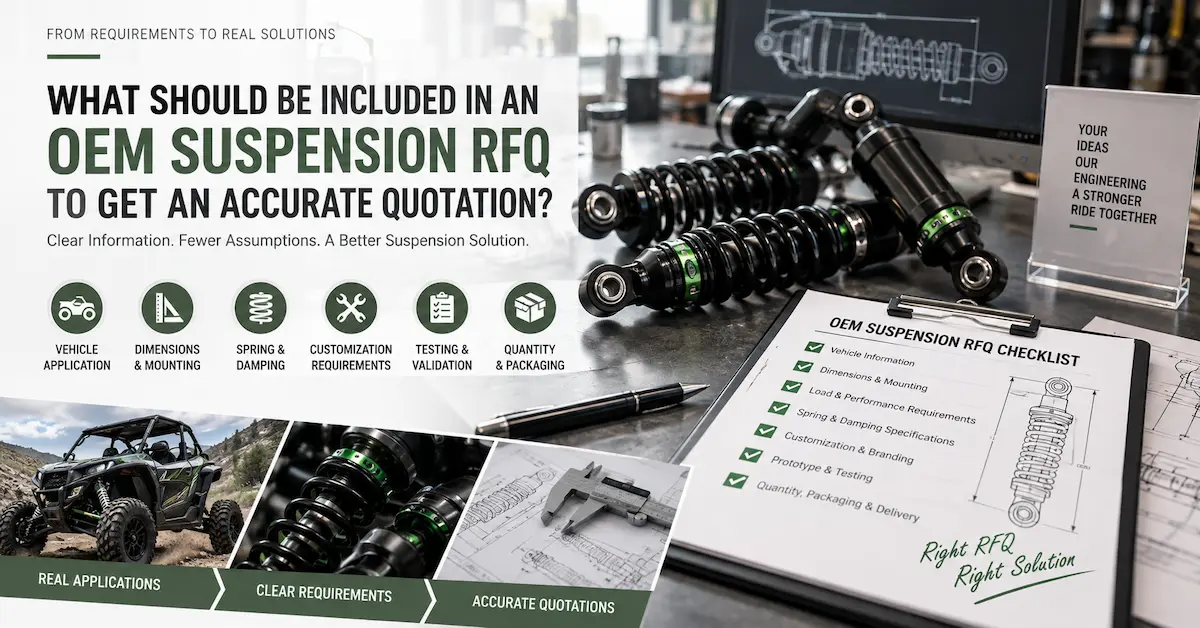
What Should You Send BEDO to Decide Between Standard and Custom?
A supplier should not make the decision from a product photo alone.
Prepare:
- vehicle make/model/year or project platform;
- front/rear installation position;
- existing shock or sample;
- extended/compressed dimensions;
- effective stroke;
- mounting dimensions;
- vehicle and rider load;
- cargo/accessories;
- wheel/tire configuration;
- existing spring information;
- current suspension behavior;
- intended terrain;
- required performance change, if any;
- prototype quantity;
- projected production quantity.
BEDO's ATV suspension RFQ guide recommends explicitly stating whether the objective is replacement or a deliberate performance change because those two sourcing routes should not use the same development assumptions.
Frequently Asked Questions
1. Is a Standard Shock Always Cheaper Than Custom Suspension?
It usually involves less new engineering when an existing platform already meets the requirement, but total purchasing cost still depends on product configuration, quantity, packaging, logistics, and validation needs. Compare the same commercial scope.
2. Is a Custom Shock Always Better Than a Standard Shock?
No. Customization is valuable when the standard product cannot satisfy a defined fitment, load, geometry, or performance requirement. Otherwise, added complexity may provide little practical benefit.
3. Can a Standard Shock Be Used for a Private-Label Product?
Potentially. Branding, labels, colors, and packaging are different from technical suspension customization. Confirm the exact OEM/private-label scope with the supplier before ordering.
4. When Does a New Spring Rate Justify Custom Development?
When the existing spring cannot provide appropriate support across the intended vehicle, rider, cargo, or accessory load range. Spring changes should be validated together with suspension behavior.
5. Do Larger Tires Automatically Require Custom Shocks?
No. They should trigger a review of clearance, unsprung mass, geometry, and vehicle modifications. Custom shock development is justified when the existing configuration no longer meets the resulting requirements.
6. Does Performance Suspension Always Need Adjustable Damping?
No. BEDO’s current guidance notes that fixed damping can still be appropriate when the vehicle configuration is predictable and the factory-set specification meets the application.
7. Should I Customize a Shock Only to Add a Remote Reservoir?
Not unless the reservoir supports a defined hydraulic, thermal, damping, or packaging requirement. Feature appearance alone is not a strong engineering reason.
8. Can an Existing Shock Sample Be Used as the Starting Point for Custom Development?
Yes. BEDO describes sample-based development as a practical route when original drawings or manufacturing information are unavailable, but the supplier still needs the target vehicle and required changes.
9. What Is the Safest Way to Decide Between Standard and Custom Suspension?
Compare the existing product with your project requirement field by field: fitment, load, spring, damping, geometry, travel, tire configuration, environment, and commercial positioning. Customize only the gaps that matter.
10. What Should I Ask BEDO Before Starting Custom Development?
Ask whether an existing product already meets the target application, which requirements remain unresolved, what needs technical customization, what prototype/testing work would be required, and how the standard and custom routes differ commercially.
Conclusion
The decision between a standard shock vs custom suspension should be based on the size of the actual engineering gap, not on the assumption that customization is automatically more premium. Choose a standard shock when vehicle fitment is already verified, loads remain within the intended range, the existing spring and damping characteristics are suitable, suspension geometry is unchanged, and no meaningful performance target requires modification. Move to custom suspension when the project introduces different mounting geometry, load requirements, spring behavior, damping targets, travel, tire/accessory changes, or a new vehicle platform that an existing product cannot satisfy. BEDO offers existing shock and suspension products as well as sample-, drawing-, CAD-, and vehicle-requirement-based customization routes. To determine which route is appropriate, contact BEDO with the target vehicle, existing shock or drawings, load conditions, intended use, and purchasing plan, then compare the standard-platform option against the additional engineering value a custom suspension project would actually create.