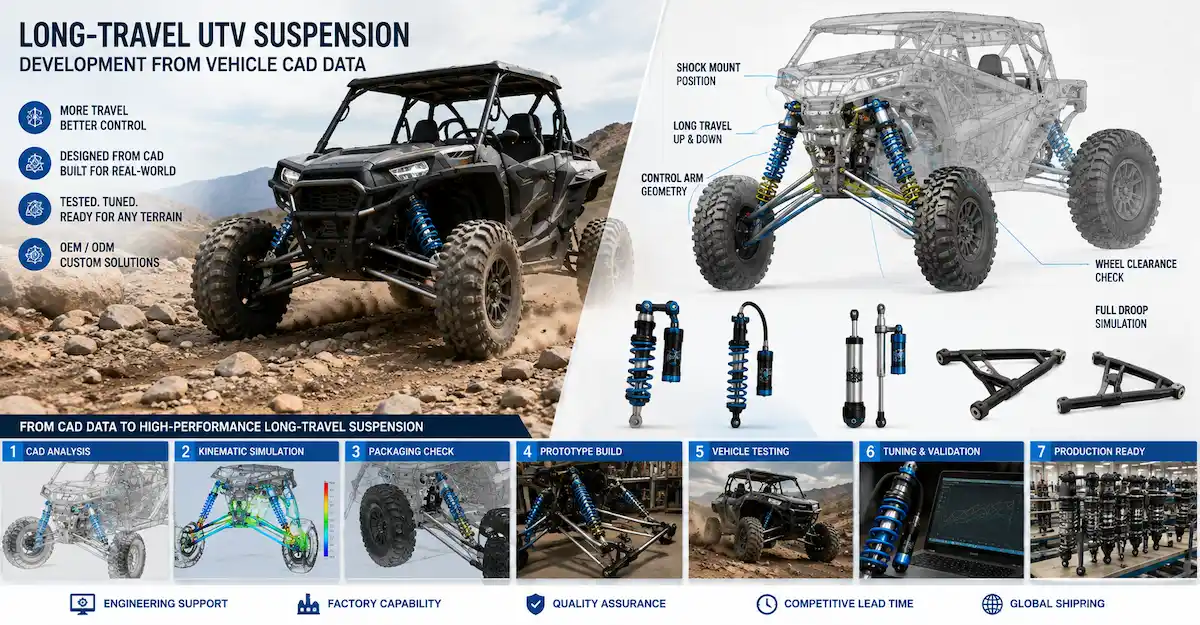

Finding a reliable shock absorber sample supplier is one of the most important steps in any OEM suspension project. Whether you are developing a new ATV, UTV, motorcycle, electric vehicle, or specialty vehicle, the sample stage determines whether the final product will meet your requirements for fitment, performance, durability, and production consistency.
A professional supplier does more than send a sample. The right partner should support engineering analysis, prototype validation, performance testing, design optimization, and the transition from sample approval to mass production.
For OEM buyers, the goal is not simply to obtain a sample—it's to reduce development risks before investing in tooling and large-scale manufacturing.
Why Do OEM Buyers Need Shock Absorber Samples?
Shock absorber samples help manufacturers verify whether a suspension system can meet real-world requirements before entering production.
Typical applications include:
- New ATV and UTV platforms
- Motorcycle suspension development
- Electric vehicle projects
- Golf carts and utility vehicles
- Off-road racing applications
- Aftermarket performance upgrades
- Private-label suspension brands
Without sample validation, buyers may face problems such as:
- Incorrect mounting dimensions
- Insufficient suspension travel
- Poor ride comfort
- Improper damping performance
- Spring mismatch
- Oil leakage
- Production inconsistencies
This is why experienced OEM manufacturers always start with prototype samples before mass production.
What Does a Shock Absorber Sample Supplier Actually Provide?
A professional shock absorber sample supplier should offer much more than basic manufacturing.
Engineering Consultation
Before production begins, the supplier should understand:
- Vehicle type
- Vehicle weight
- Payload
- Suspension geometry
- Installation space
- Required stroke
- Riding conditions
- Performance targets
Sample Analysis
If buyers already have reference samples, suppliers should analyze:
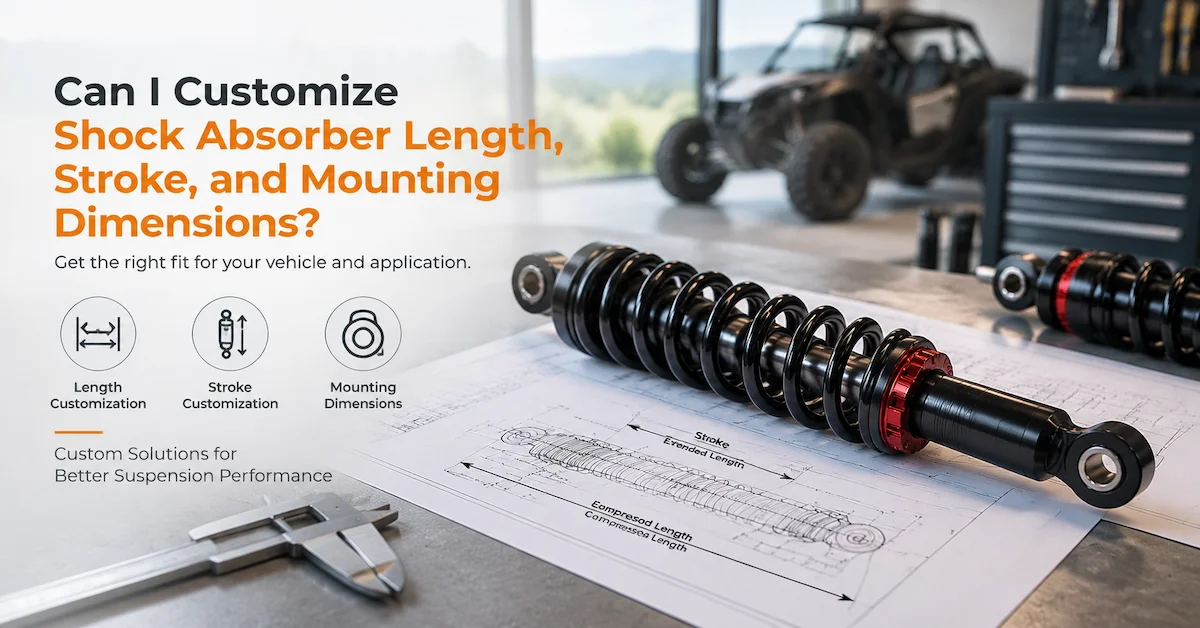
- Overall length
- Stroke
- Spring specifications
- Mounting structure
- Damper configuration
- Reservoir design
You can also explore Bedo's existing suspension products:
https://www.bedoauto.com/products/shock-absorber
Prototype Development
A qualified supplier should support:
- CAD review
- 2D and 3D drawings
- Spring customization
- Damping adjustment
- Structural optimization
- Surface treatment customization
Testing Support
Prototype validation may include:
- Dimension inspection
- Installation testing
- Compression testing
- Rebound testing
- Leakage inspection
- Durability testing
Learn more:
https://www.bedoauto.com/blog/shock-absorber-testing-service-guide
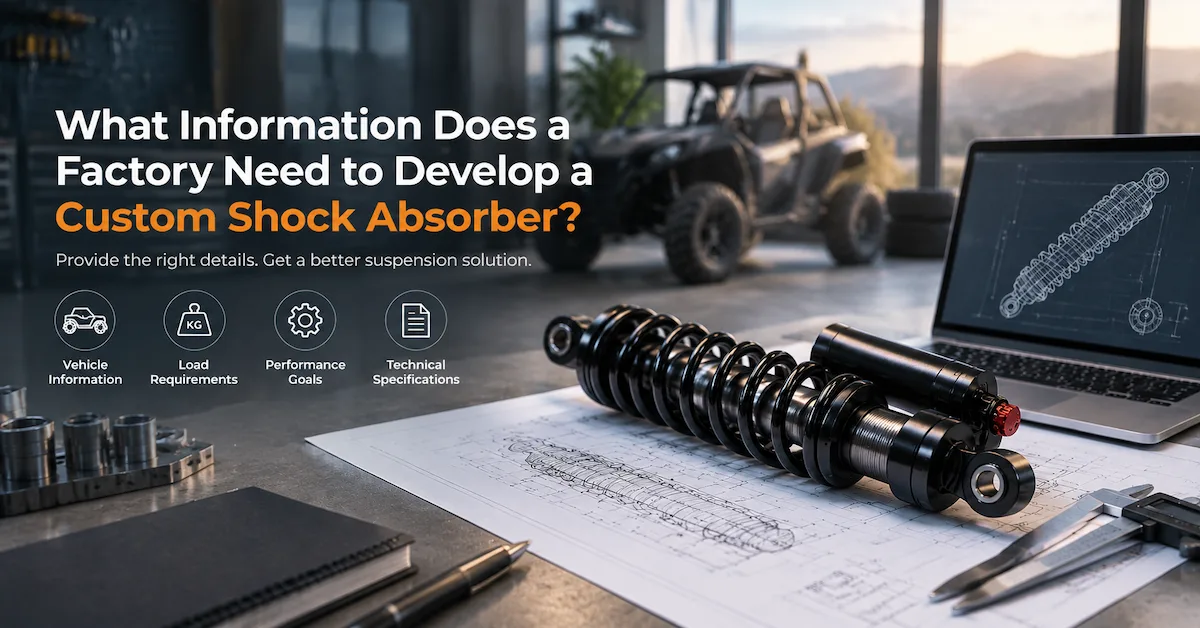
What Information Should Buyers Send to a Shock Absorber Sample Supplier?
The quality of the sample depends heavily on the quality of the information provided.
| Item | Details |
|---|---|
| Vehicle type | ATV, UTV, motorcycle, EV |
| Vehicle weight | Empty and loaded weight |
| Suspension position | Front or rear |
| Extended length | Maximum length |
| Compressed length | Minimum length |
| Stroke | Required travel |
| Mounting type | Eye or fork |
| Spring requirements | Spring rate, preload |
| Damping requirements | Compression and rebound |
| Reference sample | Existing shock absorber |
| Drawings | CAD or 2D drawings |
| Quantity | Prototype quantity |
Providing accurate data significantly reduces engineering risks.
Shock Absorber Sample vs Prototype vs Production Unit
| Type | Purpose | Customization Level | Production Readiness |
|---|---|---|---|
| Standard sample | Initial evaluation | Low | Low |
| Prototype sample | Engineering verification | High | Medium |
| Production sample | Final approval | High | High |
For OEM projects, prototype samples are usually the most critical stage because they validate both performance and manufacturability.
How Does the Sample Development Process Work?
Step 1: Requirement Analysis
The supplier reviews:
- Vehicle specifications
- Suspension requirements
- Target performance
- Application scenarios
Step 2: Drawing and Sample Review
Engineers evaluate:
- Installation dimensions
- Spring configuration
- Damper layout
- Structural design
Step 3: Prototype Manufacturing
The first prototype sample is manufactured according to the approved specifications.
Step 4: Performance Testing
The sample is tested for:
- Compression performance
- Rebound performance
- Ride comfort
- Durability
- Stability
Step 5: Optimization
If necessary, engineers adjust:
- Spring rate
- Damping force
- Stroke
- Mounting dimensions
Step 6: Production Preparation
After validation, the project moves to small-batch or mass production.
Learn more about the prototype process:
https://www.bedoauto.com/blog/shock-absorber-prototype-supplier-guide
How to Evaluate a Reliable Shock Absorber Sample Supplier
Engineering Capability
A supplier should support:
- CAD review
- Suspension calculations
- Spring matching
- Damping optimization
Prototype Experience
Ask whether the factory has experience with:
- ATV suspension
- UTV suspension
- Motorcycle suspension
- Electric vehicles
- Specialty vehicles
Testing Capability
A supplier should be able to provide:
- Inspection reports
- Test results
- Validation records
Manufacturing Capacity
Buyers should also evaluate:
- Production consistency
- Quality control
- Lead time
- OEM capability
OEM Support
An ideal supplier should support:
- Private label
- Custom branding
- Low-volume manufacturing
- Mass production
Learn more:
https://www.bedoauto.com/blog/low-volume-shock-absorber-oem-guide
Factors That Affect Shock Absorber Sample Costs
Sample costs vary depending on:
- Product complexity
- New tooling requirements
- Spring customization
- Damping adjustments
- Materials
- Surface treatment
- Testing requirements
- Quantity
There is no universal sample price because every suspension project has unique requirements.
Why Choose Bedo Auto as Your Shock Absorber Sample Supplier?
Bedo Auto supports complete OEM suspension development, including:
- Technical consultation
- Sample analysis
- Drawing review
- Prototype manufacturing
- Spring customization
- Damping tuning
- Testing and validation
- Small-batch production
- OEM manufacturing
Applications include:
- ATV
- UTV
- Motorcycles
- Electric vehicles
- Golf carts
- Utility vehicles
- Specialty vehicles
Explore our suspension solutions:
https://www.bedoauto.com/products/shock-absorber
Contact us:
https://www.bedoauto.com/contact-us
Frequently Asked Questions
What is a shock absorber sample supplier?
A shock absorber sample supplier provides prototype or evaluation samples for OEM suspension projects before mass production.
Can suppliers customize spring rates?
Yes. Professional suppliers can customize spring rates according to vehicle weight, payload, and suspension geometry.
Can damping be adjusted?
Yes. Compression and rebound damping can be tuned according to performance requirements.
How long does sample development take?
Lead time depends on design complexity, customization level, testing requirements, and production capacity.
What information should buyers provide?
Buyers should provide drawings, dimensions, vehicle specifications, spring requirements, and target performance data.
Can samples move directly into production?
Yes. After validation and testing, prototype samples can enter small-batch or mass production.
Is low-volume manufacturing available?
Many OEM suppliers support low-volume manufacturing before large-scale production.
Can suppliers work from existing samples?
Yes. Existing samples can be analyzed and optimized according to new requirements.
Conclusion
Choosing the right shock absorber sample supplier is not simply about purchasing a sample—it's about finding an engineering partner who can support your project from prototype development to production.
A reliable supplier should provide technical consultation, sample analysis, testing, customization, and manufacturing support. By validating suspension performance before mass production, OEM buyers can significantly reduce risks and improve product quality.
If you are looking for a custom suspension partner, Bedo Auto can support your project from sample development to OEM manufacturing. Contact our engineering team to discuss your requirements.