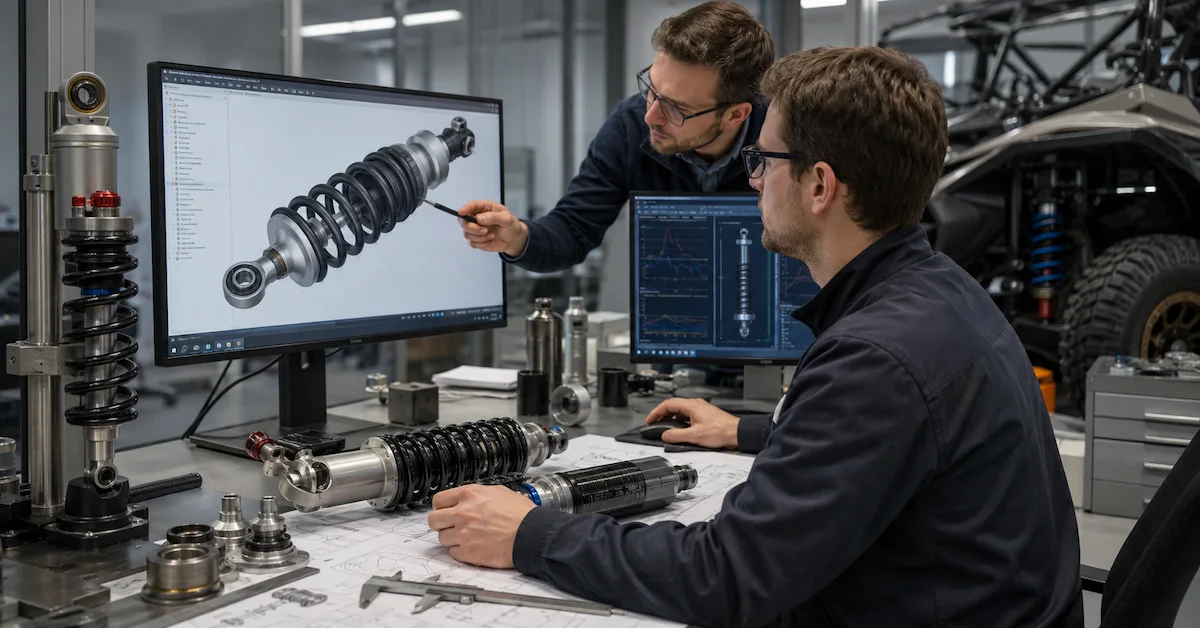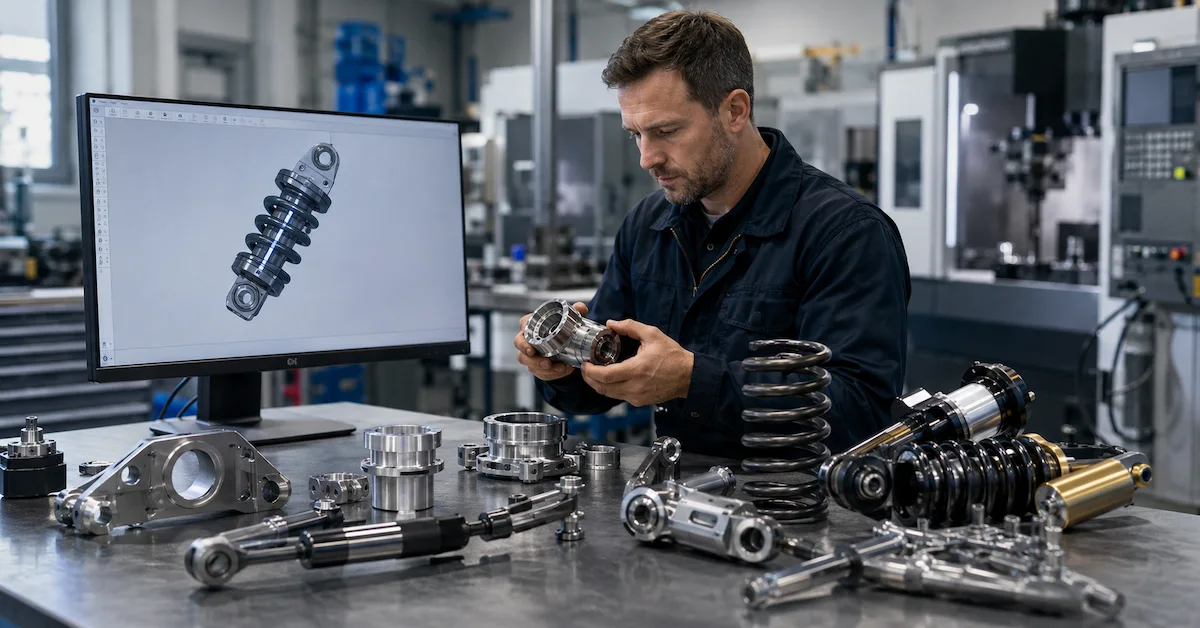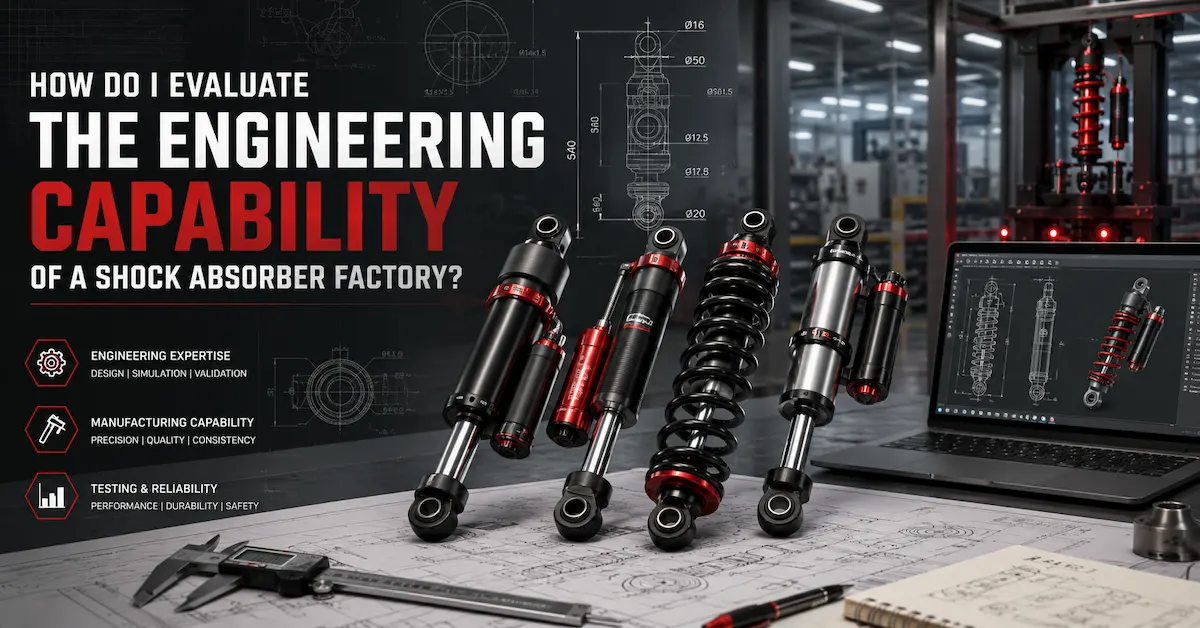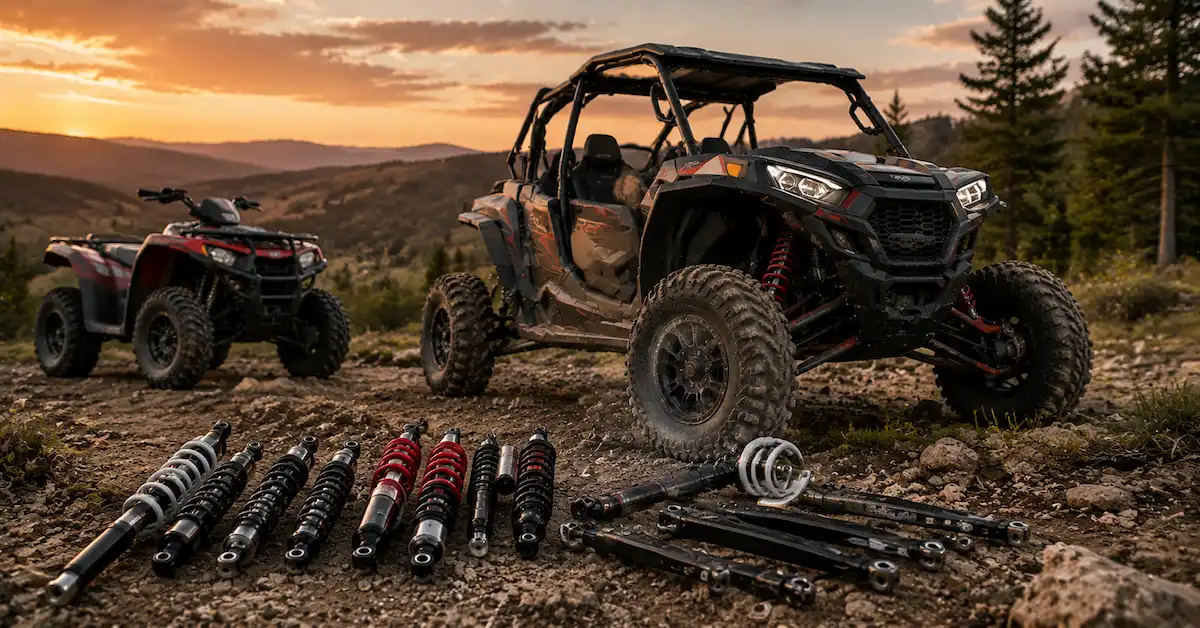

Choosing the right heavy-duty UTV shock absorber manufacturer in China requires more than finding a factory that can produce larger shocks or stiffer springs. Buyers should evaluate vehicle load analysis, spring and damping development, prototype validation, quality control, and repeatable production capability.
For a heavy-duty UTV application, the suspension specification should be developed around the actual vehicle and operating conditions, including:
- Vehicle weight
- Typical and maximum payload
- Front or rear suspension position
- Suspension geometry
- Shock travel
- Spring requirements
- Compression and rebound behavior
- Terrain
- Operating cycle
- Required durability
- Production volume
The right factory should therefore be able to connect:
Vehicle Requirements → Suspension Engineering → Prototype Development → Vehicle Validation → Controlled Production
For OEM vehicle manufacturers, aftermarket brands, UTV distributors, and private-label suspension companies,the most important question is not:
Which supplier offers the strongest-looking UTV shock?
It is:
Which factory can translate my vehicle load and application requirements into a repeatable suspension specification?
That distinction matters because heavy-duty performance must be engineered and validated, not judged by appearance alone.
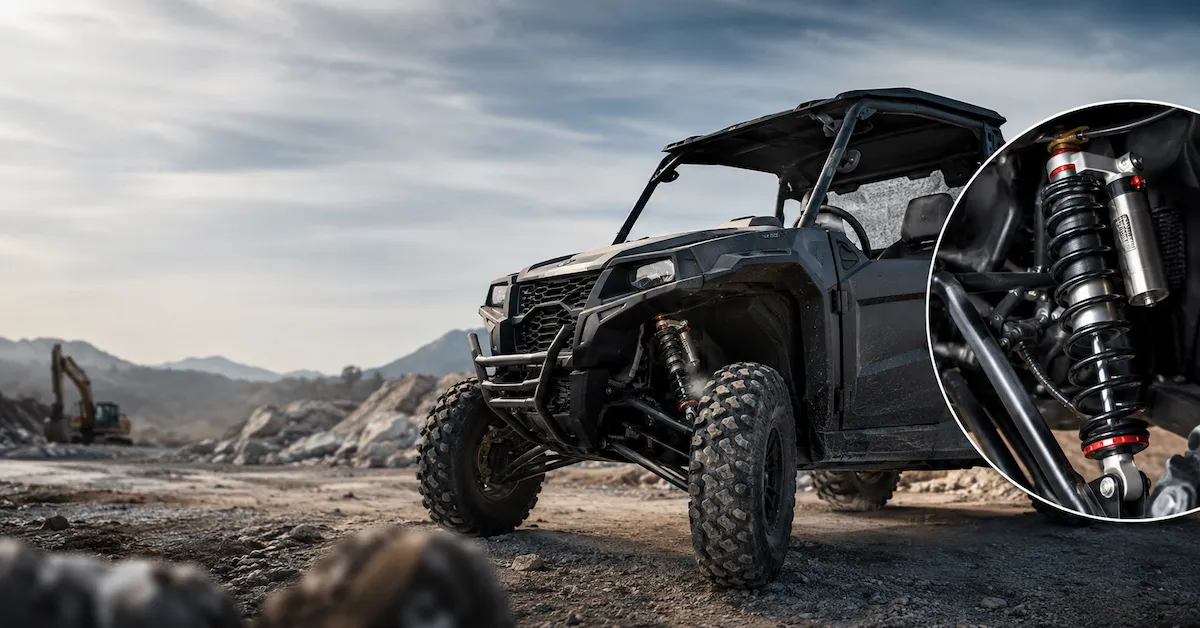
What Does “Heavy-Duty” Mean for a UTV Shock Absorber?
“Heavy-duty” should describe an application requirement, not simply a marketing label.
A UTV may need a heavy-duty suspension solution because it regularly experiences:
- Higher payloads
- Passenger and cargo loads
- Agricultural work
- Construction-site use
- Utility operation
- Added vehicle accessories
- Larger wheels or tires
- Rough terrain
- Frequent impact loading
- Long operating cycles
A visually larger shock absorber is not automatically better for these conditions.
Likewise, a very stiff spring does not automatically create a better heavy-duty suspension.
A professional manufacturer should first understand:
What changed on the vehicle, what load the suspension must support, and what performance problem needs to be solved?
That information determines the engineering direction.
Who Typically Needs Heavy-Duty UTV Shock Absorbers?
Different UTV applications place different demands on the suspension.
Utility UTV Manufacturers
Utility vehicles may be used for:
- Agriculture
- Property maintenance
- Ranch work
- Construction
- Industrial transport
These applications may require better support under repeated load and longer operating periods.
Cargo-Oriented UTVs
UTVs carrying:
- Tools
- Equipment
- Materials
- Cargo boxes
- Work accessories
may operate significantly heavier than an unloaded recreational vehicle.
The suspension therefore needs to be evaluated under realistic operating load.
Modified UTVs
Common modifications may include:
- Larger tires
- Winches
- Bumpers
- Protective structures
- Storage systems
- Additional accessories
Each added component can alter vehicle weight and suspension behavior.
Demanding Recreational Applications
Some recreational UTVs may require improved suspension control for:
- Rocky terrain
- Repeated bumps
- Trail impacts
- High suspension movement
In these projects, “heavy-duty” may be more about control and repeated use than simply carrying cargo.
If the vehicle is using an unchanged OEM configuration and the buyer only needs a standard replacement shock, a fully customized heavy-duty development project may not be necessary.
What Engineering Data Should a UTV Shock Absorber Factory Ask For?
One of the best ways to evaluate a factory is to see what information its engineers request before recommending a specification.
A professional supplier should need more than a photo and quantity.
| Engineering Information | Why It Matters |
|---|---|
| UTV model or platform | Defines the vehicle application |
| Front/rear position | Defines suspension function |
| Vehicle curb weight | Establishes baseline load |
| Typical operating weight | Reflects real use |
| Maximum payload | Supports load evaluation |
| Existing shock | Provides technical reference |
| Extended length | Controls fitment |
| Compressed length | Defines minimum shock length |
| Stroke | Defines usable shock movement |
| Mounting dimensions | Controls installation |
| Existing spring data | Provides spring baseline |
| Suspension geometry | Influences spring/shock behavior |
| Intended terrain | Defines use conditions |
| Current problem | Defines engineering direction |
If a supplier recommends a “heavy-duty” shock without asking about vehicle weight, payload, geometry, or actual use, buyers should ask how the proposed specification was selected.
Can a China Factory Customize Spring Rate for Heavy Loads?
Yes, a capable OEM suspension manufacturer can develop different spring specifications, but spring selection should be based on the vehicle application.
Important inputs can include:
- Vehicle mass
- Front/rear weight distribution
- Passenger load
- Cargo load
- Suspension geometry
- Shock mounting position
- Motion ratio where relevant
- Target ride height
- Intended usage
What Happens If the Spring Is Too Soft?
Possible problems include:
- Excessive sag
- Frequent bottoming
- Poor cargo support
- Reduced usable suspension travel
What Happens If the Spring Is Too Stiff?
Possible problems include:
- Harsh ride
- Reduced suspension compliance
- Poor traction
- Unnecessary stress on components
The objective is therefore not to install the stiffest spring possible.
Heavy-duty means selecting a spring that supports the intended operating load while preserving the suspension movement required for the vehicle.
Can Compression and Rebound Damping Be Customized?
Depending on the manufacturer's engineering capability and the project requirements, damping characteristics may also be developed or adjusted.
Spring rate and damping are related, but they perform different functions.
Compression Damping
Compression damping influences how quickly the shock absorber compresses.
It can affect:
- Impact control
- Bottoming resistance
- Vehicle body movement
- Suspension response over rough terrain
Rebound Damping
Rebound damping controls how quickly the suspension extends again.
It can influence:
- Wheel recovery
- Tire contact
- Suspension stability
- Repeated-bump behavior
A supplier should not reduce the engineering discussion to:
“We can make the damping harder.”
Instead, the factory should consider:
Vehicle + Load + Spring + Suspension Geometry + Terrain + Performance Target
before determining the development direction.
Does a Heavy-Duty UTV Shock Always Need an External Reservoir?
No.
An external reservoir can be useful in certain shock designs and operating conditions, but it is not automatically required for every heavy-duty UTV application.
Reservoir selection can depend on:
- Shock architecture
- Operating cycle
- Thermal requirements
- Packaging space
- Suspension travel
- Performance objectives
This is another reason buyers should avoid judging suspension capability only by appearance.
A large reservoir may look performance-oriented, but the overall suspension specification still needs to suit the actual vehicle.
What Structural Features Should Buyers Evaluate?
For custom UTV shocks, buyers may need to review the complete product architecture rather than one isolated component.
Relevant areas can include:
- Shock body construction
- Piston rod
- Mounting eyes or clevises
- Bushings
- Springs
- Sealing components
- Reservoir configuration where applicable
- Adjustment mechanisms where applicable
- Surface protection
- Assembly consistency
There is no single configuration that is universally best.
The appropriate design depends on:
- Vehicle load
- Shock architecture
- Operating environment
- Durability target
- Installation space
- Manufacturing requirements
A professional heavy-duty UTV shock absorber manufacturer should be able to explain why a particular configuration is suitable for the project.
Why Is Prototype Development Important?
Custom heavy-duty suspension should not normally move directly from a basic requirement into mass production.
A safer development process is:
Vehicle Data → Engineering Review → Prototype → Vehicle Validation → Engineering Revision → Approval
Prototype development helps verify whether the engineering assumptions work on the real vehicle.
Fitment Verification
Check:
- Mounting alignment
- Upper/lower interfaces
- Component clearance
- Full suspension movement
Travel Verification
Confirm:
- Extended length
- Compressed length
- Stroke
- Risk of topping out
- Risk of bottoming mechanically
Load Verification
Evaluate the suspension under realistic use, including the expected payload.
A UTV shock that performs well when unloaded may behave differently when the vehicle carries tools, passengers, or cargo.
Suspension Response
Depending on the project, the buyer may evaluate:
- Ride height
- Sag
- Load support
- Compression response
- Rebound response
Testing should represent the actual intended application as closely as practical.
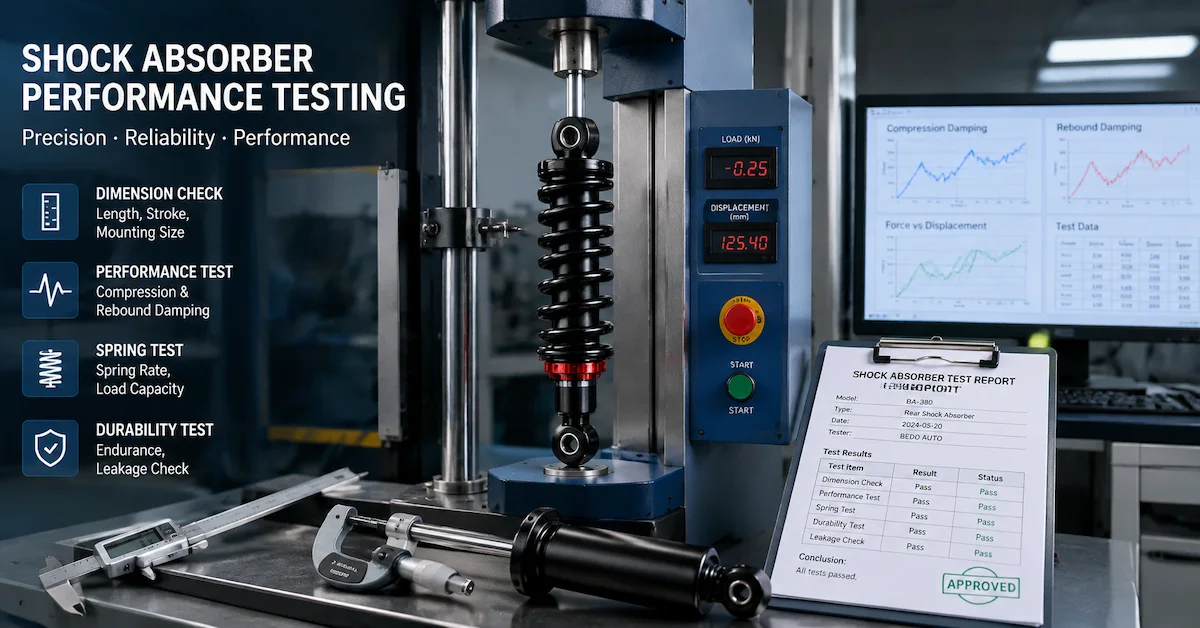
What Should Be Tested for Heavy-Duty UTV Shock Absorbers?
Testing requirements should be defined for the project rather than based on vague claims such as “100% tested.”
| Validation Area | What Buyers Should Confirm |
|---|---|
| Dimensions | Length, stroke, mounting dimensions |
| Fitment | Installation and clearance |
| Spring behavior | Sag, ride height,load support |
| Function | Smooth operation and leakage |
| Damping | Compression/rebound response where required |
| Vehicle load | Behavior under intended payload |
| Durability | Project-specific endurance requirements |
| Production consistency | Repeatability of approved specification |
Some checks may be completed by the factory, while vehicle-level performance validation may need to be performed on the actual UTV.
A trustworthy supplier should clearly explain:
- What it can test
- What the customer must validate
- What acceptance criteria are being used
How Do You Verify a China Factory's Heavy-Duty UTV Suspension Capability?
Buyers should evaluate several areas before approving an OEM project.
A professional heavy-duty UTV shock absorber manufacturer should be able to explain how vehicle weight, payload, suspension geometry, spring rate, damping, and operating conditions affect the final shock absorber specification.
Engineering Capability
Can the team discuss:
- Vehicle load
- Shock dimensions
- Spring rate
- Damping
- Suspension geometry
- Actual use conditions?
Drawing and CAD Support
Can the manufacturer work with:
- 2D drawings
- 3D CAD files
- Existing samples
- Vehicle specifications?
Prototype Development
Can it:
- Produce engineering samples
- Receive test feedback
- Revise the design
- Produce updated prototypes?
Testing Transparency
Can the supplier explain:
- Which tests are performed
- Which results are measured
- Which tests require vehicle validation
- How feedback is incorporated into the product?
Production Control
Ask how the factory manages:
- Final drawings
- Engineering revisions
- Spring specification
- Damping configuration
- Approved components
- Production quality standards
Quality Control
Review how the supplier controls:
- Incoming components
- Manufacturing processes
- Assembly
- Dimensions
- Final product checks
Technical Communication
Engineering-led projects usually require direct technical discussion.
If every question receives only a generic sales response, deeper factory evaluation may be necessary.
Heavy-Duty UTV Shock Factory vs Standard Replacement Supplier
| Capability | Engineering-Focused Factory | Standard Parts Supplier |
|---|---|---|
| Vehicle-load analysis | Supported | Limited |
| Custom dimensions | Supported | Usually limited |
| Spring development | Project-based | Usually fixed |
| Damping development | Project-based | Usually fixed |
| CAD/drawing review | Supported | Limited |
| Prototype revision | Supported | Limited |
| Pilot production | Project-dependent | Less relevant |
| OEM/private label | Project-based | More limited |
A standard supplier can still be the right choice for a validated replacement product.
For a new heavy-duty suspension specification, however, engineering capability becomes much more important.
How Should Buyers Compare Two China UTV Shock Absorber Factories?
Do not begin with price alone.
First compare whether both factories are actually quoting the same technical and commercial scope.
| Evaluation Factor | Supplier A | Supplier B |
|---|---|---|
| Vehicle-load analysis | ✓ / ✕ | ✓ / ✕ |
| Engineering review | ✓ / ✕ | ✓ / ✕ |
| Custom spring development | ✓ / ✕ | ✓ / ✕ |
| Damping development | ✓ / ✕ | ✓ / ✕ |
| Prototype revision | ✓ / ✕ | ✓ / ✕ |
| Testing scope defined | ✓ / ✕ | ✓ / ✕ |
| Small-batch support | ✓ / ✕ | ✓ / ✕ |
| Production consistency | ✓ / ✕ | ✓ / ✕ |
| Private-label support | ✓ / ✕ | ✓ / ✕ |
Only after confirming equivalent requirements should buyers compare unit prices.
Otherwise, a cheaper quotation may simply exclude:
- Development
- Testing
- Customized springs
- Special components
- Packaging
- Prototype costs
Can a Factory Support OEM and Private-Label Heavy-Duty UTV Shocks?
For UTV manufacturers, distributors, and aftermarket suspension brands, OEM/private-label projects may include both technical and commercial customization.
Engineering Customization
Depending on feasibility:
- Shock dimensions
- Stroke
- Mounting
- Spring specifications
- Damping characteristics
- Product configuration
Brand Customization
Depending on project scope:
- Logo
- Product labels
- Color
- Packaging
- Product identification
Buyers should distinguish:
Private Label Branding
from
Vehicle-Specific Engineering
Changing a logo or packaging does not automatically create a technically differentiated heavy-duty UTV shock.
Can Buyers Start With a Small Batch?
For a new suspension project, buyers may prefer to reduce risk through staged purchasing.
A practical path can be:
Prototype → Pilot Batch → Production
Ask the factory separately about:
- Prototype quantity
- Pilot-batch quantity
- Production MOQ
Minimum quantities can depend on:
- Custom components
- Springs
- Materials
- Tooling
- Surface finishes
- Packaging
- Engineering requirements
For this reason, a generic MOQ shown on a website may not apply to a customized heavy-duty project.
What Affects the Cost of Heavy-Duty UTV Shock Absorbers?
Several factors can influence the final quotation.
Shock Configuration
Such as:
- Architecture
- Dimensions
- Reservoir configuration
- Adjustment features
Spring Requirements
Custom springs may affect:
- Engineering
- Components
- Production quantities
Prototype Development
Costs can be affected by:
- Number of samples
- Custom components
- Revision rounds
Testing Scope
Project-specific validation can affect development cost and timing.
Branding and Packaging
Private-label requirements may add:
- Custom labels
- Packaging
- Product identification
- Special finish requirements
Order Quantity
Prototype, pilot, and production quantities may have different cost structures.
The correct comparison is therefore:
Same Specification → Same Development Scope → Same Testing Scope → Same Packaging → Compare Price
not simply:
Factory A unit price vs Factory B unit price.
What Should Buyers Include in a Heavy-Duty UTV Shock RFQ?
A detailed RFQ helps the factory evaluate the project accurately.
Vehicle Information
Provide:
- UTV brand/model or platform
- Front/rear application
- Vehicle weight
- Typical payload
- Maximum intended payload
Existing Suspension
Provide if available:
- Photos
- Existing shock sample
- Extended length
- Compressed length
- Stroke
- Mounting dimensions
- Spring data
Engineering Information
Provide:
- 2D drawings
- 3D CAD files
- Suspension geometry information
- Installation restrictions
Performance Requirements
Explain:
- Current suspension problem
- Desired improvement
- Typical terrain
- Normal operating load
- Special durability expectations
Do not simply write:
Need a stronger shock.
A more useful request is:
The rear suspension has excessive sag when the UTV carries its normal cargo load, and we need a suspension configuration suitable for this operating condition.
Commercial Information
Provide:
- Prototype quantity
- Pilot quantity
- Expected production volume
- Target market
- Private-label requirements
- Packaging requirements
This gives the manufacturer enough information to provide a more meaningful technical and commercial response.
How Bedo Auto Supports Heavy-Duty UTV Suspension Projects
Bedo Auto supports customized shock absorber and suspension projects for UTV, ATV, off-road, and specialty vehicle applications.
Project discussions can begin from:
- Vehicle information
- Existing shock absorber samples
- Technical drawings
- 3D CAD files
- Load requirements
- Performance targets
Depending on the project,support may include:
- Suspension requirement review
- Custom shock absorber development
- Shock dimension evaluation
- Suspension spring development
- Engineering communication
- Prototype development
- Testing support
- Engineering revisions
- Small-batch project evaluation
- OEM/private-label production preparation
Buyers can first review Shock Absorber Products for relevant product directions.
Related development resources include:
For a more useful technical evaluation, send your UTV model, vehicle weight, intended payload, existing shock specifications or sample, performance requirements, prototype quantity, and expected production volume.
FAQ
Which China factory can manufacture heavy-duty UTV shock absorbers?
Look for a factory with UTV suspension engineering capability, custom spring and damping development, prototype support, transparent testing, and controlled production.
What makes a UTV shock absorber heavy-duty?
Heavy-duty suitability depends on vehicle load, operating conditions, spring and damping requirements, shock design, and validation rather than appearance alone.
Can a China factory customize UTV shock absorbers for higher payloads?
A capable OEM manufacturer can develop suspension specifications around the intended vehicle load, subject to engineering feasibility and validation.
Can spring rate be customized for a utility UTV?
Yes. Spring development should consider vehicle weight, payload, suspension geometry, ride-height targets, and operating conditions.
Can damping be customized for heavy-duty UTV applications?
Depending on the supplier's engineering capability, compression and rebound characteristics can be developed around the vehicle, spring, load, and intended application.
Does a heavy-duty UTV shock need an external reservoir?
Not always. Reservoir selection should depend on shock design, operating cycle, thermal requirements, available installation space, and performance objectives.
Should I test prototypes before ordering heavy-duty UTV shocks?
Yes. Prototype validation helps confirm fitment, spring behavior, load support, suspension travel, damping response, and manufacturing feasibility before production.
Can a factory manufacture heavy-duty UTV shocks from CAD files?
Yes. Drawings and CAD files can support development, but vehicle weight, payload, suspension geometry, and performance requirements are also important.
Can I order a small batch before mass production?
Some OEM-focused manufacturers may support prototype or pilot quantities depending on product architecture, components, tooling, and customization requirements.
What should I send for a heavy-duty UTV shock absorber quotation?
Send the vehicle model, weight, payload, existing shock specifications or sample, drawings or CAD if available, operating conditions, performance targets, quantities, and branding requirements.
Conclusion
Choosing the right heavy-duty UTV shock absorber manufacturer in China requires more than identifying a factory that can produce large shocks or stiff springs.
A reliable development partner should be able to translate actual vehicle requirements into a controlled suspension specification through:
Vehicle Load Analysis + Suspension Engineering + Prototype Validation + Quality Control + Repeatable Manufacturing
The recommended development path is:
Vehicle Requirements → Engineering Review → Prototype → Load & Vehicle Validation → Revision → Pilot Batch → Production
For UTV manufacturers, aftermarket brands, distributors, and private-label companies, the strongest supplier is not simply the one offering the lowest initial quotation.
It is the factory that can explain why a particular spring, damping configuration, geometry, and product specification are appropriate for the intended UTV application—and then reproduce that approved specification consistently in production.