
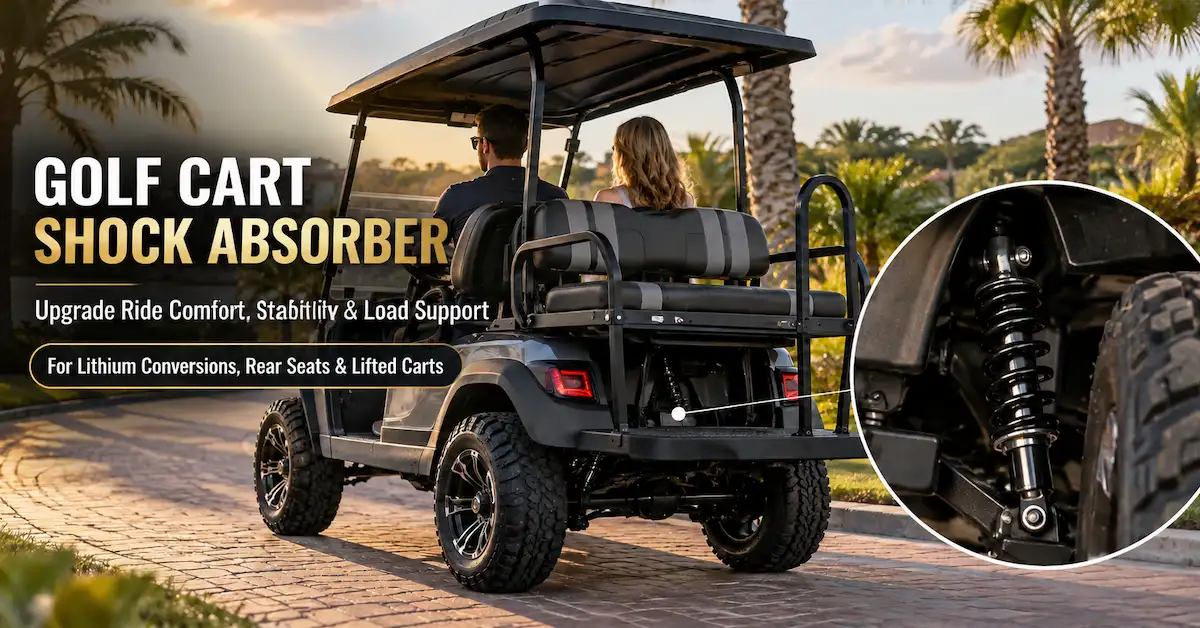
Why a Golf Cart Shock Absorber May Stop Matching the Vehicle After Modification
A Golf Cart Shock Absorber is often selected around the vehicle's original weight, suspension geometry, passenger configuration, tire size, and expected operating environment.
Once the golf cart is modified, those assumptions may no longer be valid.
A stock cart may later receive:
- lithium battery conversion;
- rear-facing passenger seat;
- cargo box;
- utility body;
- larger wheels and tires;
- lift kit;
- windshield and roof;
- tool storage;
- security or maintenance equipment;
- additional accessories.
Each modification can change one or more of the following:
- total vehicle mass;
- front/rear weight distribution;
- unsprung mass;
- ride height;
- suspension leverage;
- available shock travel;
- operating speed;
- daily duty cycle.
This is why a golf cart that originally felt smooth and stable can begin to:
- bounce;
- sag;
- bottom out;
- feel harsh;
- lean under passenger load;
- lose rear ride height;
- feel unstable over bumps.
The instinctive response is often to install "heavy-duty shocks."
That can help in some cases, but it can also create a new mismatch.
A more reliable approach is to identify what changed on the vehicle first, then determine whether the Golf Cart Shock Absorber, spring, mounting geometry, or complete suspension setup needs revision.
Buyers can review BEDO's existing suspension product range before deciding whether an existing configuration or a customized solution is the better starting point.
Modern Golf Carts Are No Longer Used Only on Golf Courses
The term "golf cart" now covers a much wider group of low-speed electric and utility vehicles.
Typical applications include:
- golf courses;
- hotels;
- resorts;
- residential communities;
- campuses;
- airports;
- amusement parks;
- security patrol;
- factories;
- warehouses;
- maintenance fleets;
- hospitality transportation;
- utility work.
BEDO's existing golf cart shock absorber OEM guide already highlights how passenger, utility, fleet, and electric-cart applications create different suspension requirements.
For B2B buyers, the key implication is simple:
A Golf Cart Shock Absorber should be matched to the vehicle's real job, not merely to the words "golf cart."
A two-passenger course cart and a six-passenger resort shuttle can have fundamentally different suspension priorities.
Start With the Modification That Changed the Suspension Requirement
When a golf cart develops ride problems after modification, do not begin by choosing a new shock.
Begin by identifying the change.
Common Modification Categories
| Modification | Main Suspension Effect |
|---|---|
| Lead-acid to lithium conversion | Changes battery mass and weight distribution |
| Rear seat installation | Adds rear passenger load |
| Cargo box | Adds variable rear load |
| Lift kit | Changes geometry and operating position |
| Larger tires | Adds unsprung mass and changes clearance |
| Utility body | Adds permanent sprung mass |
| Roof/windshield | Adds weight and changes center of mass |
| Fleet accessories | Adds permanent operating load |
| Higher-speed use | Increases suspension-control demand |
The correct shock strategy depends on which of these changes occurred.
Lithium Battery Conversion Can Change Suspension Balance in Both Directions
Lithium battery conversion is increasingly common in electric golf carts.
From a suspension perspective, the important issue is not simply that one battery type is "better" than another.
The important issue is:
How did the conversion change total mass and where is that mass located?
If the new battery system is significantly lighter than the previous system, the vehicle may sit higher or feel firmer with suspension originally designed around more battery mass.
If the lithium system is larger, differently positioned, or combined with additional accessories, axle loading may change in another direction.
What Buyers Should Record
Before changing the Golf Cart Shock Absorber, document:
- old battery system weight;
- new battery system weight;
- battery location;
- front axle load if available;
- rear axle load if available;
- vehicle ride height before conversion;
- ride height after conversion.
Why This Matters
A spring selected for the previous battery load may no longer operate in the intended portion of its travel.
Possible symptoms after a lighter conversion can include:
- reduced sag;
- harsher ride;
- less suspension movement over small bumps.
Possible symptoms after adding more total mass or changing battery position can include:
- excessive sag;
- reduced travel reserve;
- bottoming;
- changed front/rear balance.
The solution may involve spring selection, preload, damping, or a complete shock revision depending on the vehicle.
Rear Seats Change the Golf Cart From a Two-Passenger Vehicle Into a Different Load Case
A rear-seat kit may appear to be a simple accessory.
From a suspension perspective, it can create a major new operating condition.
The vehicle must now carry:
- the rear-seat structure;
- two additional passengers;
- sometimes additional grab bars or foot platforms.
Much of this mass is positioned near or behind the rear axle.
That can significantly increase rear suspension demand.
Common Rear Suspension Symptoms
After rear-seat conversion, buyers may observe:
- low rear ride height;
- excessive static sag;
- frequent bottoming;
- poor stability with passengers;
- reduced ground clearance;
- excessive body movement.
Why a Stronger Spring Alone May Not Be Enough
A stronger rear spring can improve load support.
However, it also stores and releases more energy during suspension movement.
If rebound damping is not matched appropriately, the vehicle may:
- bounce after compression;
- feel unsettled after speed bumps;
- recover too quickly.
This is why a Golf Cart Shock Absorber upgrade should consider spring rate and damping together.
Passenger Golf Carts Need Comfort Across Several Load Conditions
A resort cart may operate with:
- driver only;
- driver plus one passenger;
- four passengers;
- six passengers depending on vehicle design.
The suspension should not only work at maximum passenger capacity.
It must also remain acceptable when the vehicle is lightly loaded.
This creates a broad operating window.
Light-Load Risk
If suspension is optimized only for maximum load, the cart may feel:
- stiff;
- harsh;
- poorly compliant
when only one or two people are aboard.
Heavy-Load Risk
If suspension is optimized only for comfort when empty, the cart may:
- sag;
- bottom;
- lose ride height
when fully loaded.
The correct setup is usually a compromise around the cart's real operating pattern.
Cargo and Utility Carts Need a Defined Payload Case
Utility golf carts create another challenge because cargo weight changes constantly.
A maintenance vehicle may carry:
- tools;
- cleaning equipment;
- spare parts;
- landscaping supplies;
- security equipment.
For suspension development, the buyer should define at least three load conditions:
Light Condition
Vehicle with driver and little cargo.
Typical Working Condition
Normal tools and equipment.
Maximum Intended Condition
Highest realistic payload used in service.
This provides a much better engineering basis than requesting:
Heavy-duty Golf Cart Shock Absorber.
"Heavy-duty" is a marketing description.
Payload is an engineering input.
Build a Simple Golf Cart Suspension Load Matrix
A B2B buyer can organize the project using a table like this:
| Condition | Passengers | Cargo | Battery | Main Requirement |
|---|---|---|---|---|
| Empty | Driver only | Minimal | Final system | Comfort |
| Normal | 2–4 | Light | Final system | Balanced ride |
| Full passenger | Maximum seating | Minimal | Final system | Ride-height support |
| Utility | 1–2 | Normal work load | Final system | Stability + support |
| Maximum duty | Vehicle limit | High | Final system | Travel reserve |
This table helps an OEM or suspension supplier understand which condition matters most.
Lift Kits Change More Than Ride Height
Lifted golf carts are common in:
- recreational communities;
- resorts;
- modified street carts;
- off-road-style aftermarket markets.
A lift kit changes chassis position and may change:
- control-arm angle;
- shock operating angle;
- mounting position;
- available droop;
- available compression;
- steering geometry.
This is why simply installing a longer Golf Cart Shock Absorber can be risky.
Questions to Check After a Lift
- Has upper shock mounting position changed?
- Has lower mounting position changed?
- Is extended shock length still correct?
- Is compressed length still safe?
- Does the suspension reach mechanical limits before the shock?
- Does tire clearance change?
- Does the shock operate at a different angle?
A lifted cart should be evaluated as a modified suspension system, not as a stock cart with taller springs.
Shock Length Is Not the Same as Suspension Travel
One of the most common sourcing errors is using only eye-to-eye length.
A Golf Cart Shock Absorber must also be evaluated by:
- compressed length;
- extended length;
- stroke;
- mount type;
- mounting width;
- bolt diameter.
A shock can have the correct extended length and still create problems at full compression.
Why Compressed Length Matters
If the shock reaches its internal compression limit before the suspension reaches the intended mechanical stop, the shock can become the suspension stop.
This can increase loads on:
- mounts;
- bushings;
- internal components.
Why Stroke Matters
Stroke defines how far the damper itself can move.
It must work with the vehicle's suspension geometry.
Larger Tires Add Unsprung Mass
Larger wheels and tires are another common golf cart modification.
They can increase:
- unsprung mass;
- rotating mass;
- steering effort;
- impact load at the suspension.
This can change how quickly the wheel moves over:
- bumps;
- pavement joints;
- rough surfaces;
- curbs.
A heavier tire can require different damping control even if total chassis weight changes only slightly.
For modified carts, buyers should provide:
- original tire size;
- new tire size;
- wheel change;
- vehicle ride height;
- expected terrain.
Street-Use Golf Carts Can Need More Damping Control Than Low-Speed Course Carts
Many golf carts now operate in:
- gated communities;
- residential areas;
- resort roads;
- campus roads.
Some modified carts also travel at higher speeds than traditional course vehicles.
As operating speed increases, suspension-control demands can also increase.
The vehicle may encounter:
- pavement transitions;
- speed bumps;
- driveway entries;
- cornering;
- braking.
A shock setup developed only for low-speed turf operation may not provide the same control in a modified street-use cart.
This does not mean the shock should simply become stiffer.
It means compression and rebound behavior should be reviewed around the new use case.
Spring Rate Controls Load Support
The suspension spring supports vehicle mass.
Spring rate influences:
- ride height;
- sag;
- available travel;
- payload support.
If the spring is too soft after modification, the golf cart may:
- sit low;
- bottom frequently;
- lean more with passengers;
- lose clearance.
If the spring is too stiff, the cart may:
- feel harsh;
- transmit vibration;
- ride poorly when lightly loaded.
The ideal spring should match the vehicle's intended operating envelope, not only one extreme condition.
Preload Is Useful but Has Limits
Some suspension systems allow spring preload adjustment.
Preload can help fine-tune:
- static position;
- ride height.
However, preload should not be treated as a substitute for the correct spring rate.
If the cart needs excessive preload to support normal operation, that is a signal that spring specification may need revision.
Compression Damping Controls Movement Into the Shock
Compression damping influences how quickly the suspension compresses over:
- bumps;
- speed humps;
- potholes;
- curb transitions.
Too little compression control can contribute to:
- excessive chassis movement;
- bottoming;
- instability.
Too much compression damping can create:
- harshness;
- vibration;
- reduced comfort.
Passenger golf carts often prioritize comfort more than aggressive off-road vehicles.
Therefore, excessive compression damping can be especially noticeable to passengers.
Rebound Damping Controls Suspension Recovery
After the suspension compresses, the spring pushes the system back toward extension.
Rebound damping controls this movement.
If rebound damping is too low, the vehicle can:
- bounce;
- oscillate;
- feel loose.
If rebound damping is too strong, the suspension may:
- recover too slowly;
- remain compressed through repeated bumps.
For a multi-passenger golf cart, rebound should be reviewed after any major spring-rate change.
BEDO's custom damping shock absorber guide explains why damping should be matched to vehicle weight, spring characteristics, and intended use.
Golf Cart Comfort Is Different From Performance Suspension
Golf cart buyers often use the word "performance," but passenger-vehicle suspension goals are different from racing applications.
The primary goals may be:
- smooth ride;
- reduced vibration;
- stable cornering;
- predictable braking;
- low maintenance.
The best Golf Cart Shock Absorber is therefore not necessarily:
- the stiffest;
- the largest;
- the most adjustable.
The correct product is the one that meets the cart's actual passenger and duty requirements.
Front and Rear Suspension Should Be Evaluated Separately
Many modifications affect only one area strongly.
Rear-Heavy Modifications
Examples:
- rear seat;
- cargo box;
- rear battery location.
These mainly increase rear suspension demand.
Front-Heavy Modifications
Examples:
- front cargo system;
- heavy bumper;
- front accessories.
These may increase front suspension load.
Whole-Vehicle Modifications
Examples:
- larger wheels;
- lift kit;
- body conversion.
These can affect both ends.
A professional development project should not automatically change all four shocks if only one axle requires revision.
Weight Distribution Can Be More Important Than Total Weight
Two modified golf carts may weigh the same overall.
But one may carry most added weight in the rear while another distributes it more evenly.
This affects:
- front sag;
- rear sag;
- steering response;
- braking pitch.
Where possible, axle loads provide useful development data.
For fleets or OEM programs, this can help define front and rear shock specifications more accurately.
Passenger Comfort Should Be Evaluated With Real Occupants
A Golf Cart Shock Absorber prototype should not be tested only with the vehicle empty.
Passenger applications should be evaluated at:
- light load;
- normal load;
- full intended load.
Important observations include:
- ride height;
- suspension travel;
- vibration;
- pitch;
- bounce;
- bottoming.
A shock that feels excellent when driven alone may behave very differently with four passengers.
Commercial Fleets Need Durability and Consistency
Golf carts used by resorts, hotels, airports, factories, or campuses may operate many hours per day.
Fleet operators care about:
- ride quality;
- service life;
- replacement consistency;
- downtime.
This creates different requirements from low-use personal carts.
Fleet Duty Cycle
Buyers should consider:
- operating hours per day;
- passengers per trip;
- typical road surface;
- maintenance frequency.
Repeated daily use can generate more suspension cycles than occasional recreational use.
Heat Can Influence Damping During Long Operation
Repeated shock movement generates heat.
For passenger or industrial carts that operate continuously, buyers may want to evaluate whether damping remains consistent after extended use.
This does not require treating a golf cart like a racing vehicle.
It simply means testing should reflect the real duty cycle.
Corrosion Resistance Matters in Resorts and Coastal Locations
Golf carts are widely used in:
- seaside resorts;
- humid communities;
- outdoor properties.
Moisture and salt exposure can affect:
- shock body;
- spring;
- piston rod;
- mounting hardware.
For coastal applications, buyers should communicate the environment to the manufacturer.
Avoid vague requests such as:
Make it rust-proof.
A stronger RFQ defines:
- coastal operation;
- outdoor storage;
- washing frequency;
- water exposure.
This allows the manufacturer to discuss suitable surface treatment.
How to Diagnose Common Golf Cart Shock Absorber Problems
Rear Sag
Investigate:
- rear passenger load;
- cargo;
- battery location;
- spring rate.
Excessive Bouncing
Investigate:
- rebound damping;
- shock wear;
- leakage.
Harsh Ride
Investigate:
- spring stiffness;
- preload;
- compression damping;
- lighter battery conversion.
Bottoming
Investigate:
- load;
- spring rate;
- remaining travel;
- shock stroke.
Noise
Investigate:
- bushings;
- mounts;
- bolts;
- shock hardware.
Uneven Ride Height
Investigate:
- spring variation;
- asymmetric load;
- damaged components.
These symptoms should be treated as diagnostic directions rather than automatic failure conclusions.
Stock Replacement vs Custom Golf Cart Shock Absorber
A standard replacement shock can be the right solution when:
- cart remains stock;
- original suspension worked correctly;
- existing shock is simply worn.
Custom development becomes more valuable when:
- battery system changed;
- passenger capacity increased;
- utility load increased;
- lift kit changed geometry;
- larger tires were installed;
- ride target changed.
BEDO's standard shock vs custom suspension guide explains why buyers should only invest in custom development when a measurable requirement cannot be satisfied by an existing platform.
Sample-Based Golf Cart Shock Development
For discontinued parts or modified vehicles, a physical shock sample can provide useful information.
The manufacturer can measure:
- extended length;
- compressed length;
- mounts;
- body size;
- spring dimensions.
However, the buyer should also provide:
- vehicle modification;
- new battery weight;
- passenger/cargo configuration;
- ride complaint.
Copying the original sample exactly may reproduce the original problem.
Drawing and CAD Development for New Golf Cart Platforms
New electric golf carts may require more controlled development.
Drawings can define:
- shock interfaces;
- dimensions;
- tolerances.
CAD can help evaluate:
- packaging space;
- suspension travel;
- clearances.
BEDO's CAD-based suspension development guide explains how CAD can support geometry and packaging while physical prototypes still remain necessary for spring, damping, leakage, and vehicle-level validation.
A Practical Golf Cart Shock Absorber Development Process
Step 1 — Define Final Vehicle Configuration
Record:
- battery system;
- seats;
- cargo;
- accessories;
- lift;
- tires.
Step 2 — Record Vehicle Loads
Where possible, document:
- total weight;
- front load;
- rear load.
Step 3 — Confirm Shock Fitment
Record:
- extended length;
- compressed length;
- stroke;
- mounting interfaces.
Step 4 — Establish Spring Requirement
Match the spring to the realistic load range.
Step 5 — Establish Base Damping
Develop compression and rebound around passenger comfort and vehicle control.
Step 6 — Produce Prototype
Build the controlled configuration.
Step 7 — Test Multiple Load Cases
Evaluate:
- light;
- normal;
- full load.
Step 8 — Test Real Operating Surfaces
Use:
- pavement;
- speed bumps;
- community roads;
- worksite surfaces
as appropriate.
Step 9 — Revise
Adjust the parameter causing the actual problem.
Step 10 — Freeze Final Specification
Control:
- dimensions;
- spring;
- damping;
- finish;
- hardware.
Step 11 — Pilot Production
Confirm repeatability.
Step 12 — Mass Production
Release only after the pilot product matches the approved specification.
Prototype Testing Should Include Vehicle Attitude
For golf carts, chassis attitude is important because passengers immediately notice:
- leaning;
- front/rear pitch;
- uneven ride height.
A useful validation record can include:
| Condition | Front Height | Rear Height | Ride Comment |
|---|---|---|---|
| Empty | Record | Record | Comfort |
| 2 passengers | Record | Record | Normal operation |
| Full passengers | Record | Record | Load support |
| Cargo condition | Record | Record | Utility behavior |
The exact measurement points should be defined consistently.
Ride Comfort Should Not Be Evaluated Only by the Driver
In a passenger cart, rear-seat occupants may experience a different ride.
Rear passengers sit closer to:
- rear suspension;
- rear axle;
- cargo area.
A setup that feels comfortable from the driver's seat may feel harsh or bouncy at the rear.
For resort or shuttle vehicles, passenger feedback can be a useful part of prototype validation.
Pilot Production Is Valuable for Modified Golf Cart Programs
A successful single prototype does not prove production consistency.
A pilot batch can verify:
- shock dimensions;
- spring consistency;
- damping;
- mounts;
- finish;
- packaging.
BEDO's short-run suspension production guide explains why short-run production can help buyers transition from prototype to OEM manufacturing with lower inventory risk.
Quality Control for Golf Cart Shock Absorbers
Production QC can focus on:
Dimensions
- extended length;
- compressed length;
- stroke;
- mounting width;
- hole diameter.
Spring
- spring specification;
- coating;
- identification.
Assembly
- rod movement;
- correct components;
- hardware.
Function
- leakage;
- damping consistency where required.
Appearance
- finish;
- corrosion protection;
- branding.
Packaging
- correct SKU;
- application label.
For multi-model aftermarket programs, packaging errors can create the same customer dissatisfaction as technical defects.
Managing Multiple Golf Cart Applications
A supplier may support several cart categories:
- two-passenger;
- four-passenger;
- six-passenger;
- utility;
- lifted;
- lithium-converted.
Do not assume one Golf Cart Shock Absorber can cover every version.
Create an application matrix.
| SKU | Vehicle Type | Battery | Passenger Capacity | Lift | Shock Version |
|---|---|---|---|---|---|
| A | Standard passenger | Lead-acid | 2 | No | Standard |
| B | Passenger | Lithium | 4 | No | Revised |
| C | Utility | Lithium | 2 + cargo | No | Heavy-load |
| D | Modified | Lithium | 4 | Yes | Custom |
This reduces fitment confusion and helps distributors manage inventory.
When One Shock Can Cover Multiple Cart Variants
SKU consolidation can reduce inventory cost.
It should only be used when applications share compatible:
- fitment;
- spring requirement;
- damping range;
- operating load.
If two carts only share overall shock length but differ significantly in payload, they may not be good candidates for one SKU.
Custom Adjustable Golf Cart Shocks: Are They Necessary?
Adjustability may provide value for carts with widely changing:
- passengers;
- cargo;
- terrain.
However, most passenger-cart users want:
- simple operation;
- consistent comfort.
An overly complicated multi-adjustable shock may create:
- higher cost;
- setup confusion;
- customer-support burden.
For many golf cart applications, a well-matched fixed or simple adjustable configuration can be more practical.
Golf Cart Shock Absorber Cost Drivers
Pricing depends on technical scope.
Important factors include:
- shock size;
- spring;
- damping;
- adjustability;
- reservoir design;
- materials;
- surface finish;
- custom mounts;
- prototype work;
- testing;
- production quantity.
A standard replacement shock cannot be compared directly with a customized suspension product for a six-passenger lifted lithium cart.
Normalize specifications before comparing quotations.
What Should a Golf Cart Shock Absorber RFQ Include?
A professional inquiry should include:
- Golf cart model/project code
- Model year where relevant
- Front or rear position
- Stock or modified vehicle
- Battery type
- Old battery weight
- New battery weight
- Battery position
- Passenger capacity
- Typical passenger count
- Rear seat information
- Cargo configuration
- Typical cargo weight
- Lift-kit information
- Original tire size
- New tire size
- Shock extended length
- Compressed length
- Stroke
- Upper mount
- Lower mount
- Current spring information
- Current ride problem
- Target improvement
- Typical operating surface
- Daily duty cycle
- Coastal/wet exposure
- Existing sample
- Drawing/CAD availability
- Prototype quantity
- Expected production volume
- Private-label requirements
A detailed RFQ allows the manufacturer to determine whether the project needs:
- replacement;
- spring revision;
- damping revision;
- complete custom development.
Questions to Ask a Golf Cart Shock Absorber Manufacturer
Before approving development, ask:
Application Questions
- Do you need total vehicle weight or axle load?
- How do battery changes affect the specification?
- Can passenger and cargo load be included in development?
Engineering Questions
- Can you work from samples?
- Can shock length and stroke be changed?
- Can spring rate be customized?
- Can compression/rebound behavior be reviewed?
Production Questions
- Can a pilot batch be made?
- How are different applications identified?
- How are production revisions controlled?
Quality Questions
- What dimensions are inspected?
- How is leakage checked?
- How are spring specifications controlled?
The quality of the supplier's questions is often a useful indicator of engineering depth.
Who Benefits Most From Custom Golf Cart Shock Development?
Golf Cart OEMs
New vehicle platforms need production-ready specifications.
Conversion Companies
Lithium, lifted, or passenger conversions may require revised suspension.
Resort Vehicle Suppliers
Passenger comfort and long service duty are important.
Industrial Fleet Suppliers
Cargo and daily operating hours become key factors.
Aftermarket Brands
These buyers may need:
- replacement SKUs;
- heavy-duty versions;
- lifted-cart versions;
- private label.
Distributors
Distributors benefit from a clear application matrix that reduces fitment returns.
How BEDO Supports Golf Cart Suspension Projects
BEDO supports customized suspension development for golf carts, utility vehicles, electric vehicles, ATV, UTV, motorcycle, and other specialty-vehicle applications.
Depending on the project, buyers can begin with:
- existing shock samples;
- dimensional drawings;
- CAD;
- vehicle weight;
- battery information;
- passenger capacity;
- cargo requirements;
- suspension complaints.
The existing Golf Cart Shock Absorber OEM Development Guide provides a broader overview of golf cart OEM development, while the current Products page shows BEDO's suspension product scope.
For a customized cart, the most useful starting point is to document the vehicle after all planned modifications are installed.
FAQ
What is a Golf Cart Shock Absorber?
A Golf Cart Shock Absorber controls suspension movement as the vehicle travels over bumps, pavement transitions, rough surfaces, and load changes. It works together with the suspension spring to balance comfort, stability, and control.
Does lithium battery conversion require new golf cart shocks?
Not automatically. However, a battery conversion can change total vehicle mass and front/rear weight distribution. The suspension should be reviewed if ride height, comfort, or control changes after conversion.
Why does my golf cart sag after adding a rear seat?
The rear-seat structure and additional passengers increase rear axle load. The existing rear spring and shock setup may not have been designed for the new operating condition.
Can heavy-duty rear springs solve golf cart sag?
They can improve load support when the original spring rate is too low, but damping and unloaded ride quality should also be reviewed.
Do lifted golf carts need longer shock absorbers?
Not always. Lift kits can change suspension geometry, but shock length, compressed length, stroke, mounting position, and mechanical limits should all be checked before changing the shock.
Do larger tires affect Golf Cart Shock Absorber performance?
Yes. Larger or heavier tires can increase unsprung mass and change suspension response, clearance, and vehicle behavior.
Why is my golf cart harsh after changing to lithium batteries?
One possible reason is reduced vehicle mass, which can make the original suspension spring/damping setup feel firmer. The complete vehicle configuration should be checked before replacing parts.
Should golf cart shocks be tested with passengers?
Yes. Passenger carts should be tested under realistic light, normal, and full intended load conditions rather than only when empty.
Can a Golf Cart Shock Absorber be customized for utility vehicles?
Yes. Depending on the application, dimensions, spring rate, damping, mounts, finish, and other specifications can be developed around passenger, cargo, battery, and duty-cycle requirements.
What should I send BEDO for a custom golf cart shock project?
Provide the golf cart model, battery configuration, passenger capacity, cargo, modifications, shock dimensions, current suspension problem, target improvement, samples or drawings, prototype quantity, and expected production volume.
Conclusion
A Golf Cart Shock Absorber should be evaluated again whenever battery mass, passenger capacity, cargo, lift geometry, tire size, or vehicle duty changes. The right solution may involve spring rate, damping, shock travel, or fitment—not simply a "heavier-duty" replacement.
For OEM, fleet, aftermarket, or conversion projects, send your final vehicle configuration, shock sample, drawings, load data, and target performance through the BEDO Contact Us page for technical review and suspension development.