
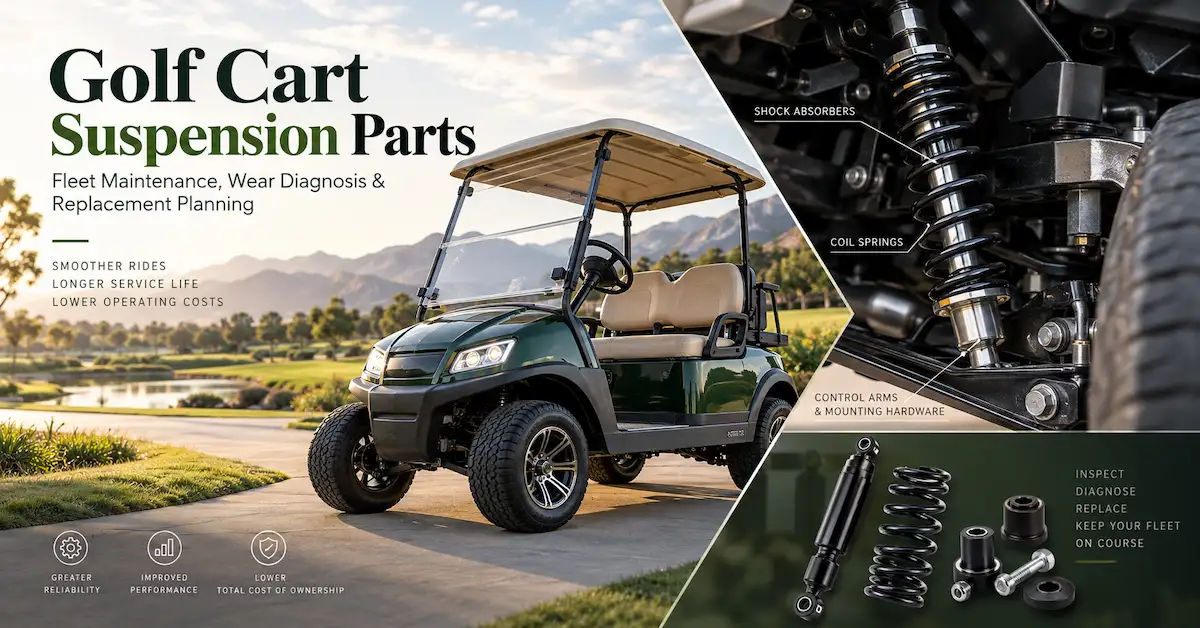
What Golf Cart Suspension Parts Matter Most in Fleet Maintenance?
Short answer: A golf cart suspension maintenance program should not treat every suspension component as a generic replacement item. The most important parts to monitor are the shock absorber, suspension spring, ball joint where used, bushings and mounting interfaces, with each component evaluated against the actual vehicle configuration, load condition, operating environment, and fitment requirement.
For B2B buyers, the goal is not simply to replace worn parts. The goal is to identify the correct component, confirm the correct application, maintain consistent replacement quality, and prevent the same fitment or wear problem from returning across the fleet.
Why Fleet Maintenance Changes the Way You Buy Golf Cart Suspension Parts
A private golf cart owner may purchase one replacement component when a problem becomes obvious. A commercial fleet cannot rely on the same approach.
A fleet may contain several vehicles that look similar but have different histories. One may remain in a standard passenger configuration. Another may carry maintenance equipment. Another may have additional seating. Another may have different battery equipment, wheels, tires, or other modifications.
That means a fleet manager should think in terms of vehicle configuration plus component application, not simply product category.
| Fleet Situation | Main Suspension Concern | Purchasing Priority |
|---|---|---|
| Standard passenger cart | Ride quality and consistent replacement | Verified fitment and repeatability |
| Resort transportation cart | Frequent passenger operation | Consistent behavior and replacement availability |
| Maintenance cart | Variable equipment and cargo load | Load-appropriate suspension configuration |
| Utility fleet | Repeated working loads | Application-specific replacement planning |
| Modified cart | Changed geometry or vehicle mass | Fitment review before ordering |
| Aftermarket fleet program | Multiple vehicle applications | SKU and application control |
The commercial implication is simple: the cheapest individual component is not necessarily the lowest-cost fleet solution. If a low-cost part causes repeated fitment issues, additional labor, vehicle downtime, or customer returns, its effective cost can become much higher.
The Fleet Cost Is Larger Than the Part Price
When procurement teams calculate suspension replacement cost, they often focus on the quoted unit price. A more useful calculation considers the total maintenance event.
The practical cost can include:
- Replacement component price
- Freight and handling
- Technician labor
- Vehicle downtime
- Emergency purchasing
- Incorrect-part returns
- Inventory carrying cost
- Packaging and relabeling
- Repeat repairs caused by an unresolved application problem
This is why a well-defined Golf Cart Suspension Parts program can create value even when the physical components themselves are relatively simple.
Start With a Suspension Inspection Record, Not a Replacement Order
One of the most common maintenance mistakes is ordering the replacement part before documenting the failed or worn component.
A better process begins with an inspection record.
The record should identify the vehicle, suspension position, observed symptom, component condition, current part information, and any recent vehicle modifications.
| Inspection Field | What to Record | Why It Matters |
|---|---|---|
| Vehicle identity | Fleet ID, vehicle model and configuration | Prevents application mix-ups |
| Suspension position | Front or rear, and side where relevant | Different positions may require different components |
| Current symptom | Bounce, sag, noise, leakage, play, harshness, etc. | Helps narrow the inspection scope |
| Current component | Part number, label, photograph or sample | Creates a reference for sourcing |
| Vehicle modifications | Battery, seat, tire, lift or cargo changes | May change the suspension requirement |
| Operating environment | Road, resort, campus, utility, mixed terrain | Provides application context |
| Maintenance history | Previous replacement or recurring problem | Identifies repeat failures |
This record becomes particularly valuable when the same issue appears on multiple vehicles. Instead of treating every repair as an isolated event, the fleet manager can identify patterns.
Why Repeated Symptoms Deserve a Root-Cause Review
Suppose several vehicles require the same suspension component replacement unusually close together. The first response should not automatically be to purchase a larger quantity of the same part.
Ask:
- Are the vehicles actually the same configuration?
- Are they operating on the same routes?
- Are they carrying similar loads?
- Was the replacement part the correct application?
- Did the vehicle receive a modification?
- Was the replacement component installed correctly?
- Is the problem isolated to one component or the wider suspension system?
This is the difference between replacement management and maintenance management.
How to Recognize Common Golf Cart Suspension Wear Symptoms
A symptom is not the same thing as a diagnosis. A bouncing vehicle, for example, may involve the shock absorber, spring, tire condition, mounting condition, or another suspension issue. For that reason, the following matrix should be used as an inspection framework rather than a substitute for vehicle-specific diagnosis.
| Observed Symptom | Components to Inspect | Procurement Question |
|---|---|---|
| Repeated bouncing after bumps | Shock absorber, spring, mounting points | Is the current damper and spring configuration still appropriate? |
| Visible shock leakage | Shock absorber and surrounding area | Is replacement required, and is the same specification still correct? |
| Vehicle sits lower than expected | Spring, load condition, suspension geometry | Has the vehicle load or spring requirement changed? |
| Noise from suspension area | Mounts, bushings, ball joints, fasteners | Is the issue a component, interface or installation condition? |
| Excessive movement under load | Spring, shock absorber, suspension geometry | Does the operating load exceed the original application? |
| Play at a joint | Ball joint or related joint components | Is the replacement interface correctly defined? |
| Uneven behavior left to right | Springs, shocks, mounting and geometry | Are both sides using the correct and matching application? |
| Repeated bottoming | Spring, shock travel, suspension geometry | Has vehicle load or suspension travel changed? |
The value of this matrix is that it prevents the maintenance team from jumping directly from symptom to product name.
For example, “golf cart is bouncing” is not a complete purchasing specification. “Rear suspension shows repeated excessive movement under the fleet's normal load, current shock has visible leakage, and vehicle configuration has not changed” is a much more useful starting point.
Shock Absorber Inspection: What Fleet Buyers Should Record
The shock absorber is one of the most important Golf Cart Suspension Parts to document because its physical fitment and functional role are closely connected.
When inspecting an existing shock, record the information that can be verified.
Physical Condition
- Visible leakage
- Corrosion or surface damage
- Rod condition
- Mounting damage
- Bushing or sleeve condition
- Abnormal deformation
- Loose or damaged hardware
Dimensional Reference
Where the information is available, record:
- Extended length
- Compressed length
- Effective stroke
- Mounting-hole diameter
- Mounting width
- Mounting configuration
- Body dimensions where relevant
These dimensions are more useful than simply photographing the component because photographs rarely establish all installation-critical measurements.
Application Reference
Also record:
- Vehicle model
- Front or rear position
- Vehicle load
- Passenger configuration
- Battery configuration
- Wheel and tire configuration
- Operating environment
For a new or customized project, a drawing can provide a controlled reference for these dimensions. Buyers developing a new product can also review BEDO's shock absorber drawing service as part of the technical documentation process.
Suspension Springs Need a Different Inspection Logic
Suspension springs and shock absorbers work together, but they should not be treated as the same type of component.
The spring provides the primary support for the vehicle load. Its specification influences ride height, sag, available travel and load behavior.
When a fleet vehicle is carrying additional passengers, cargo, equipment or a changed battery system, the spring requirement may no longer be identical to the original configuration.
What to Check on a Suspension Spring
- Visible cracks or damage
- Corrosion or surface deterioration
- Abnormal deformation
- Installed position
- Vehicle ride height
- Left-right height difference where relevant
- Current load condition
- Previous modifications
Do not define a spring only as “standard” or “heavy duty.” Those descriptions do not tell a manufacturer enough about the application.
A more useful request identifies the vehicle, load, spring dimensions where known, current spring behavior, and the intended operating condition.
Why Spring Replacement Can Affect the Rest of the Suspension
Changing a spring changes the force relationship within the suspension system. That means a spring replacement should not automatically be considered independent of the shock absorber.
If the spring specification changes substantially, the damping requirement may also need review.
For example, a fleet may install a stronger spring because a utility vehicle repeatedly carries equipment. If the shock absorber remains unchanged without evaluating the new spring behavior, the resulting system may not deliver the intended balance between load support and movement control.
This does not mean every spring change requires a new shock absorber. It means the two components should be considered as a system when the vehicle's operating requirements change.
When Ball Joints Become Part of a Golf Cart Suspension Replacement Program
Not every golf cart uses the same suspension architecture, so buyers should first identify whether ball joints are actually part of the vehicle's suspension configuration.
Where ball joints are used, wear can appear as looseness, abnormal movement, noise, or other symptoms that require inspection.
For procurement purposes, the important point is that a ball joint should be defined by its actual mounting and joint interface rather than by a generic product name.
Relevant information may include:
- Vehicle application
- Suspension position
- Mounting interface
- Joint dimensions where available
- Thread information where relevant
- Reference sample
- Existing part number
- Application-specific requirements
BEDO's current product center includes a Ball Joints product category. Buyers should still confirm the exact application and current product availability rather than assuming a catalog category represents universal golf cart compatibility.
Front and Rear Golf Cart Suspension Parts Should Be Managed Separately
One of the simplest ways to reduce procurement errors is to separate front and rear suspension requirements from the beginning.
A fleet database should not contain only “Golf Cart Suspension Parts.” It should identify the exact position and application.
| Record Level | Recommended Information |
|---|---|
| Vehicle | Model, configuration, fleet ID |
| Axle | Front or rear |
| Component | Shock, spring, ball joint or related part |
| Reference | Part number, sample, drawing or approved record |
| Fitment | Confirmed mounting and dimensional requirements |
| Condition | Stock, modified or utility configuration |
| Commercial SKU | Internal purchasing and warehouse code |
This structure becomes increasingly important when the same fleet contains several generations or configurations of vehicles.
Why “Front and Rear Set” Can Create Procurement Confusion
Some purchasing teams prefer to buy suspension parts as a set because it simplifies ordering.
That can work when the vehicle application and component configuration are clearly defined.
But “one set” can mean different things to different suppliers. It might mean two pieces, four pieces, a complete axle group, or a broader suspension kit.
Always define the commercial unit:
- One piece
- One pair
- One axle set
- One vehicle set
- One repair kit
This single clarification can prevent quotation comparisons from becoming misleading.
Build a Fleet Replacement Matrix for Golf Cart Suspension Parts
Once inspection records exist, the next step is to convert them into a replacement matrix.
A replacement matrix connects the fleet's vehicle applications with approved suspension components.
| Vehicle Group | Application | Position | Component | Replacement Status |
|---|---|---|---|---|
| Fleet A | Standard passenger | Rear | Shock absorber | Approved replacement |
| Fleet A | Standard passenger | Rear | Spring | Review condition |
| Fleet B | Utility configuration | Rear | Shock absorber | Application review |
| Fleet B | Utility configuration | Rear | Spring | Load-dependent review |
| Fleet C | Modified configuration | Front | Shock absorber | Fitment verification required |
The table above is an example structure only. It is not a BEDO product application chart and does not establish compatibility with any particular golf cart model.
That distinction is important in B2B content and procurement documentation. A planning framework can be generic, while product compatibility must remain evidence-based.
Do Not Create a New SKU Every Time a Vehicle Looks Slightly Different
Distributors can face the opposite problem: excessive SKU expansion.
If every minor variation becomes a separate product code, inventory becomes difficult to manage.
But aggressive SKU consolidation creates the opposite risk: a product may be sold for an application that has not been verified.
The right approach is verified SKU consolidation.
Consider Consolidation When
- The mounting interfaces are equivalent.
- The critical dimensions are equivalent.
- The suspension position is equivalent.
- The load range is compatible.
- The spring requirement is compatible.
- The damping requirement is compatible.
- The surrounding clearance is compatible.
- The vehicle application has been reviewed and approved.
Keep Separate SKUs When
- Mounting geometry differs.
- Shock length or stroke differs materially.
- Spring requirements differ.
- Vehicle load is substantially different.
- The vehicle has different suspension geometry.
- Wheel and tire changes affect the installation envelope.
- The product has a different approved application.
The objective is not to achieve the lowest possible SKU count. The objective is to achieve the lowest practical SKU count without compromising application accuracy.
Replacement Kits vs Individual Golf Cart Suspension Parts
Whether to purchase individual parts or a complete replacement kit depends on the maintenance strategy.
Individual Components Make Sense When
- Only one component is worn.
- The remaining suspension components are confirmed serviceable.
- The vehicle application is well documented.
- The fleet has technicians who can manage component-level replacement.
- Inventory flexibility is important.
Kits Can Make Sense When
- Several related components are normally replaced together.
- The fleet wants standardized repair packages.
- Technician time is more important than individual component flexibility.
- A distributor wants a clearly defined aftermarket repair product.
- The application has already been validated as a package.
However, a kit should never hide the individual component definitions.
The buyer should still know what the kit contains, which vehicle it fits, what position it serves, and whether the quantity represents one axle or one complete vehicle.
How to Create a Better Golf Cart Suspension Parts Inventory
Inventory planning should start from historical demand and application coverage rather than from a supplier's entire catalog.
For a distributor, useful inventory categories may include:
- High-frequency replacement SKUs
- Core fleet applications
- Seasonal applications
- Slow-moving but strategically important applications
- Prototype or development parts
- Private-label variants
- Special-order components
Each category can have a different stocking strategy.
Core Replacement SKUs
These are the applications with predictable recurring demand. The priority is supply continuity and accurate fitment.
Special Application SKUs
These may be needed for a smaller group of vehicles. Stocking decisions should consider demand, replacement urgency, and the consequences of downtime.
Development SKUs
Prototype and engineering parts should not automatically enter the normal replacement inventory. Their specification may still be under evaluation.
Keeping development parts separate from approved production SKUs reduces the risk of shipping an unapproved configuration to a maintenance customer.
Warehouse Labeling Is Part of Fitment Control
A technically correct product can still create a commercial problem if the warehouse cannot distinguish similar-looking components.
Suspension products often have similar shapes, especially when several vehicle applications use similar shock absorber architectures.
Warehouse labels should therefore communicate the information necessary for correct identification.
| Label Field | Recommended Purpose |
|---|---|
| Internal SKU | Warehouse identification |
| Manufacturer/reference code | Technical traceability |
| Vehicle application | Fitment control |
| Position | Front/rear identification |
| Quantity | Commercial unit clarity |
| Revision | Product-definition control where applicable |
This becomes particularly important for private-label and aftermarket programs where product packaging may be the main information available to the warehouse operator.
Receiving Inspection: What Buyers Should Check When Golf Cart Suspension Parts Arrive
Incoming inspection does not need to mean a full engineering test of every shipment. The inspection scope should reflect the critical characteristics already agreed with the supplier.
For a suspension shipment, receiving personnel can verify:
- Correct SKU
- Correct quantity
- Correct product type
- Correct application label
- Visible shipping damage
- Visible corrosion or surface damage
- Packaging condition
- Key dimensions where required
- Mounting interfaces where required
- Product identification against the purchase order
For higher-risk or newly developed components, the buyer may establish additional inspection requirements with the manufacturer.
The important principle is that incoming inspection should be based on a defined specification. It should not depend entirely on whether a component “looks right.”
Supplier Quality Questions for Golf Cart Suspension Parts
When sourcing replacement components from a manufacturer, the buyer should ask questions that connect product quality to the actual application.
Product Definition
- What is the approved product reference?
- Which dimensions are controlled?
- What mounting configuration is specified?
- Which vehicle application is being quoted?
Production Control
- How are product revisions identified?
- How is the approved sample controlled?
- How are critical dimensions inspected?
- How are packaging and labels matched to the correct SKU?
Application Control
- What vehicle information is needed to confirm fitment?
- Does the supplier need a sample?
- Can the supplier review a drawing?
- Can the supplier review CAD information?
For projects involving drawings or new component definitions, buyers can use BEDO's CAD-based suspension development information as a reference for organizing technical requirements.
Why Sample-Based Sourcing Can Be Useful for Replacement Programs
Many aftermarket suspension projects begin with a physical reference part.
A sample can provide useful information about:
- Overall construction
- Mounting configuration
- Dimensions
- Spring arrangement
- Surface treatment
- Packaging reference
But a sample does not necessarily reveal the complete functional specification.
For example, a physical shock absorber does not automatically tell the buyer everything about its internal damping behavior. Similarly, a spring's appearance does not fully define its load behavior.
Therefore, when a replacement program is being developed from a sample, the buyer should also provide vehicle information and describe the actual operating requirement.
This is especially important when the purpose is not simple reproduction but improvement.
If the original product created a recurring problem, blindly copying it may reproduce the same problem.
Use Failure History to Improve the Next Golf Cart Suspension Parts Order
One of the most valuable sources of procurement information is the fleet's own maintenance history.
Instead of recording only “replaced shock,” record:
- Vehicle ID
- Part SKU
- Vehicle configuration
- Operating environment
- Observed symptom
- Component condition
- Replacement date
- Replacement quantity
- Reason for replacement
- Whether the problem repeated
Over time, this information can show whether failures are associated with a particular vehicle group or operating condition.
Example: A Repeated Rear Suspension Problem
Imagine a maintenance department discovers that several utility carts repeatedly experience rear suspension issues.
A weak procurement response would be:
“Order more rear shocks.”
A stronger response is:
- Identify the affected vehicles.
- Confirm whether they share the same configuration.
- Record typical cargo loads.
- Check whether battery or accessory configurations differ.
- Inspect the existing springs.
- Inspect shock mounting interfaces.
- Review the current replacement specification.
- Determine whether the issue is component wear, incorrect application, or changed operating conditions.
- Only then define the next replacement order.
This approach may reveal that the problem is not simply “poor shock quality.” It could instead be an application mismatch, changed load, installation issue, or broader suspension condition.
Golf Cart Suspension Parts for Resort and Hospitality Fleets
Resort and hospitality fleets have a distinctive maintenance profile because passengers often experience the suspension directly.
These vehicles may be used for:
- Guest transportation
- Hotel movement
- Resort property transportation
- Facility maintenance
- Staff transportation
For passenger-oriented fleets, maintenance teams may prioritize consistent ride behavior and predictable vehicle condition.
A replacement program should therefore evaluate both technical and customer-facing consequences.
A vehicle that remains operational but develops excessive bouncing, noise, sag, or harshness may still create a poor user experience.
For this reason, a resort fleet should consider suspension condition as part of overall vehicle quality rather than treating it as a purely mechanical issue.
Golf Cart Suspension Parts for Utility and Maintenance Fleets
Utility carts introduce a different procurement problem because their load can vary significantly.
A maintenance vehicle may carry tools in the morning, equipment during the day, and return with a different load at the end of a shift.
This makes the phrase “vehicle weight” incomplete.
The fleet should distinguish:
- Base vehicle condition
- Typical working load
- Maximum intended working load
This load information can then be provided to the suspension supplier when replacement specifications are being reviewed.
If a fleet's working condition has changed since the original vehicle was purchased, the replacement part should not automatically be assumed to remain appropriate.
Battery Changes Should Be Recorded in the Suspension Maintenance Database
Electric golf carts can undergo battery-system changes during their service life.
From a suspension perspective, the important information is not the marketing name of the battery system. The important information is how the change affects vehicle mass and weight distribution.
When a fleet converts or replaces a battery system, maintenance teams should record:
- Previous battery configuration
- Current battery configuration
- Known battery weight
- Battery location
- Vehicle ride height before and after the change where relevant
- Observed suspension behavior after the change
If suspension behavior changes after a battery conversion, investigate the new vehicle condition before ordering replacement Golf Cart Suspension Parts.
This prevents the maintenance team from treating a configuration change as ordinary wear.
How Lifted or Modified Golf Carts Change Replacement Planning
Modified golf carts require additional fitment discipline.
A lift kit, larger wheels, changed tires, additional seats, cargo equipment, or body accessories can change the operating condition of the suspension.
For a modified vehicle, record:
- Original configuration
- Current configuration
- Lift information
- Wheel and tire changes
- Additional equipment
- Passenger configuration
- Cargo configuration
- Current ride height
- Existing shock dimensions
Do not create a new replacement SKU simply because the vehicle is modified. First determine whether the modification actually changes the component requirement.
BEDO's existing Golf Cart Shock Absorber upgrade guide covers modification-related suspension changes in greater detail. This article intentionally focuses on how those changes should be captured in a fleet replacement program.
Why Replacement Intervals Should Not Be Invented
A common request from fleet managers is:
“How many months or kilometers should we replace golf cart suspension parts?”
There is no responsible universal interval that can be applied to every golf cart, because suspension life depends on vehicle configuration, load, terrain, duty cycle, component specification, environmental exposure, maintenance condition, and other factors.
A fleet should instead establish its inspection and replacement criteria using:
- Vehicle manufacturer recommendations where available
- Actual operating conditions
- Fleet maintenance history
- Observed component condition
- Vehicle symptoms
- Approved replacement criteria
- Engineering guidance for customized applications
Procurement note: Do not publish a fixed “replace every X miles” or “replace every X months” rule unless the applicable vehicle or product documentation actually supports it. For B2B content, evidence-based replacement criteria are more useful than attractive but unsupported numbers.
How to Create a Preventive Suspension Inspection Workflow
A practical fleet workflow can be divided into four levels.
Level 1: Routine Visual Check
Look for obvious issues such as visible leakage, damaged components, abnormal corrosion, loose hardware, unusual ride height, or other visible changes.
Level 2: Maintenance Inspection
Inspect the relevant suspension components in greater detail according to the fleet's maintenance procedure.
This may include checking:
- Shock condition
- Spring condition
- Mounting interfaces
- Bushings
- Ball joints where used
- Fasteners
- Abnormal movement
Level 3: Event-Based Inspection
Perform an additional suspension review after events that may change component condition, such as:
- Impact
- Collision
- Severe road event
- Overload
- Major vehicle modification
- Wheel or tire change
- Battery-system change
Level 4: Replacement Approval
Use the inspection findings, vehicle application and approved product information to decide whether replacement is required.
This process creates a much stronger connection between maintenance and procurement.
How Distributors Can Turn Maintenance Data Into Better Aftermarket Products
Aftermarket distributors can use fleet feedback to improve product assortment.
For example, if customers repeatedly ask for the same replacement application, that application may deserve a dedicated product page, clearer packaging, and more inventory attention.
If customers repeatedly return a product because the application information is unclear, the solution may not be another product. The solution may be better fitment data.
This is why product information should include:
- Vehicle application
- Position
- Product type
- Key fitment dimensions
- Reference information
- Included quantity
- Known application boundaries
For distributors building a broader aftermarket program, the BEDO suspension product range provides a starting point for reviewing the company's publicly listed suspension categories.
How to Compare Two Golf Cart Suspension Parts Quotations
When two suppliers quote different prices, compare the scope before comparing the number.
| Comparison Item | Question to Ask |
|---|---|
| Application | Are both suppliers quoting the same vehicle application? |
| Position | Are both quoting the same front/rear position? |
| Quantity | Is the price per piece, pair, set or kit? |
| Dimensions | Are the critical dimensions equivalent? |
| Spring | Is the spring included and is the specification equivalent? |
| Damping | Is the damping configuration equivalent? |
| Mounting | Are mounting interfaces equivalent? |
| Packaging | Are packaging and labeling requirements included? |
| Prototype | Is development or sampling included? |
| Documentation | Are drawings or approved technical records included where required? |
This comparison is especially useful for OEM and private-label projects because engineering work can be hidden inside the quotation scope.
When a Fleet Should Consider Custom Golf Cart Suspension Parts
Custom development should not be the automatic answer to every maintenance problem.
A standard replacement may be appropriate when the vehicle remains within the original application conditions and the replacement specification is already verified.
Custom development becomes more relevant when the fleet has a measurable requirement that the existing configuration cannot address.
Examples of a Genuine Engineering Change
- Different mounting geometry
- Different shock length
- Different stroke requirement
- Different vehicle load
- Different spring requirement
- Different damping target
- Changed suspension geometry
- New vehicle platform
- Special utility configuration
- Private-label product requiring technical differentiation
The correct decision should come from the engineering gap, not from the assumption that a custom product is automatically better.
For a deeper engineering project, buyers can review BEDO's Golf Cart Shock Absorber OEM Development Guide.
Use Small-Batch Validation Before Expanding a New Replacement Range
Distributors sometimes want to launch a new Golf Cart Suspension Parts range covering several vehicle applications at once.
That can create unnecessary inventory risk if application data has not been validated.
A staged approach can be more controlled:
- Select the priority vehicle applications.
- Define the technical requirements.
- Review samples or drawings.
- Develop or confirm the replacement configuration.
- Validate the application.
- Run an initial controlled production quantity.
- Collect installation and customer feedback.
- Expand the range based on verified demand.
BEDO publicly discusses small-batch suspension production as a way to support prototype, limited-production, and market-validation projects. Buyers should confirm the specific commercial scope for their own project rather than assuming a standard quantity or lead time.
For more information on this sourcing model, see the short-run suspension production guide.
Documentation That Should Follow Every Approved Suspension SKU
For a professional B2B program, the physical product is only one part of the deliverable.
Each approved SKU should ideally have a controlled documentation package appropriate to the project.
| Document | Purpose |
|---|---|
| Product code | Commercial identification |
| Application record | Vehicle fitment control |
| Technical drawing | Dimensional definition |
| Approved sample reference | Physical comparison |
| Packaging specification | Warehouse and customer identification |
| Inspection criteria | Quality verification |
| Revision history | Change control |
| Purchase specification | Procurement consistency |
The exact documentation package will depend on the project. The principle is to make sure that the purchasing department, engineering team, warehouse, supplier, and end customer are all referring to the same product definition.
How BEDO Fits Into a Golf Cart Suspension Parts Sourcing Workflow
For buyers evaluating suspension components for golf carts and other specialty vehicles, the most useful starting point is to separate the commercial requirement from the engineering requirement.
A straightforward replacement project may begin with an existing component, dimensions, application information, and purchasing quantity.
A development project may require a broader technical package involving drawings, CAD, vehicle data, samples, spring requirements, suspension geometry, prototype evaluation, and production documentation.
BEDO's public website provides access to its current suspension product categories through the Products page. Buyers can also review the company's technical background on the About Us page.
For projects that require technical documentation, BEDO's Shock Absorber Drawing Service and CAD-Based Suspension Development resources can be used as supporting references.
Frequently Asked Questions About Golf Cart Suspension Parts
What are the most common Golf Cart Suspension Parts?
Depending on the vehicle design, common suspension components can include shock absorbers, suspension springs, ball joints, bushings, mounting components, and related hardware. The exact components required depend on the vehicle's suspension architecture.
How do I know whether a golf cart shock absorber needs replacement?
Look for symptoms such as visible leakage, abnormal suspension movement, damaged mounting components, unusual ride behavior, or other confirmed inspection findings. A symptom alone does not prove that the shock absorber is the only failed component.
Should I replace golf cart springs and shocks at the same time?
Not automatically. If only one component is worn and the remaining components are confirmed suitable, an individual replacement may be appropriate. If spring characteristics or vehicle loading have changed, the spring and shock should be reviewed together.
Can one Golf Cart Suspension Parts SKU fit multiple vehicle models?
Potentially, but compatibility should be verified rather than assumed. The relevant mounting interfaces, dimensions, suspension position, load condition, clearance, spring requirements, and damping requirements should be reviewed before applications are combined under one SKU.
Do modified golf carts need different suspension parts?
Not necessarily. A modification should first be evaluated to determine whether it changes vehicle mass, load distribution, suspension geometry, travel, mounting position, or other requirements. Only then should a replacement specification be changed.
Does a lithium battery conversion automatically require new suspension?
No. The important question is how the new battery configuration changes vehicle mass and weight distribution. If the suspension behavior or operating condition changes, the suspension specification should be reviewed.
Do larger wheels affect golf cart suspension replacement?
They can. Larger or heavier wheels and tires may change unsprung mass, clearance, suspension response, and operating conditions. The current configuration should be documented before selecting replacement parts.
How often should Golf Cart Suspension Parts be replaced?
There is no universal replacement interval that is appropriate for every golf cart. Inspection frequency and replacement decisions should be based on the vehicle manufacturer's guidance where available, actual duty cycle, operating environment, component condition, maintenance history, and application requirements.
What information should I provide to a Golf Cart Suspension Parts manufacturer?
Provide the vehicle model, suspension position, current configuration, load information, battery configuration, wheel and tire information, existing part or sample, available dimensions, current suspension problem, operating environment, expected quantity, and any drawings or CAD files.
Can Golf Cart Suspension Parts be customized for aftermarket brands?
Depending on the project, customization can involve product dimensions, spring requirements, mounting interfaces, technical configuration, branding, labeling, and packaging. The exact scope should be confirmed with the manufacturer based on the vehicle and commercial requirements.
Should a fleet buy individual suspension components or complete kits?
Either approach can be appropriate. Individual components provide flexibility when only one part requires replacement. Kits can simplify standardized repairs when several components are intentionally supplied together. In both cases, the contents and vehicle application should be clearly defined.
What should a distributor check before adding a new Golf Cart Suspension Parts SKU?
Confirm the application, position, critical dimensions, component definition, packaging, labeling, expected demand, and application boundaries. A new SKU should solve a verified market or technical requirement rather than simply increasing catalog size.
Conclusion
Effective Golf Cart Suspension Parts management starts with accurate vehicle data, condition-based inspection, verified fitment, controlled SKUs, and clear purchasing specifications. Fleet operators and aftermarket buyers should separate standard replacement needs from modified or engineering-driven applications and avoid replacing components based only on symptoms or generic “heavy-duty” descriptions.
If you are sourcing replacement shocks, suspension springs, ball joints, or customized suspension components for a golf cart program, review the BEDO suspension product range and send your vehicle, sample, drawing, load, and quantity requirements through the BEDO Contact Us page for project review.
Planning a Golf Cart Suspension Parts Project?
Send the vehicle application, suspension position, existing part or sample, available dimensions, load information, current problem, quantity requirement, and any drawing or CAD file you have.