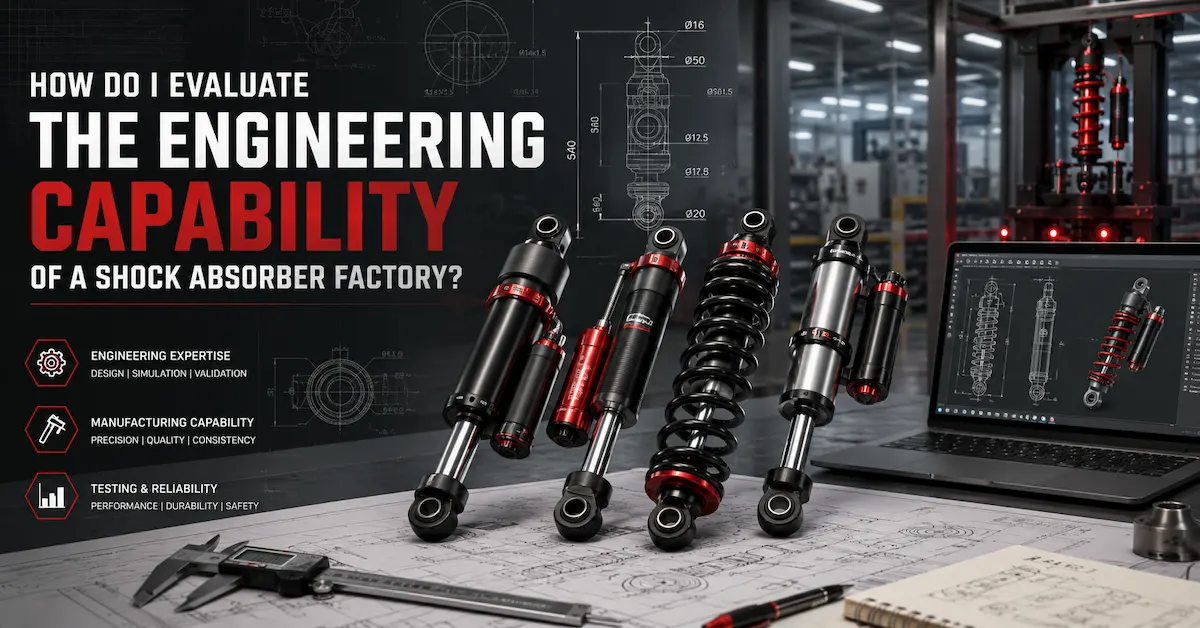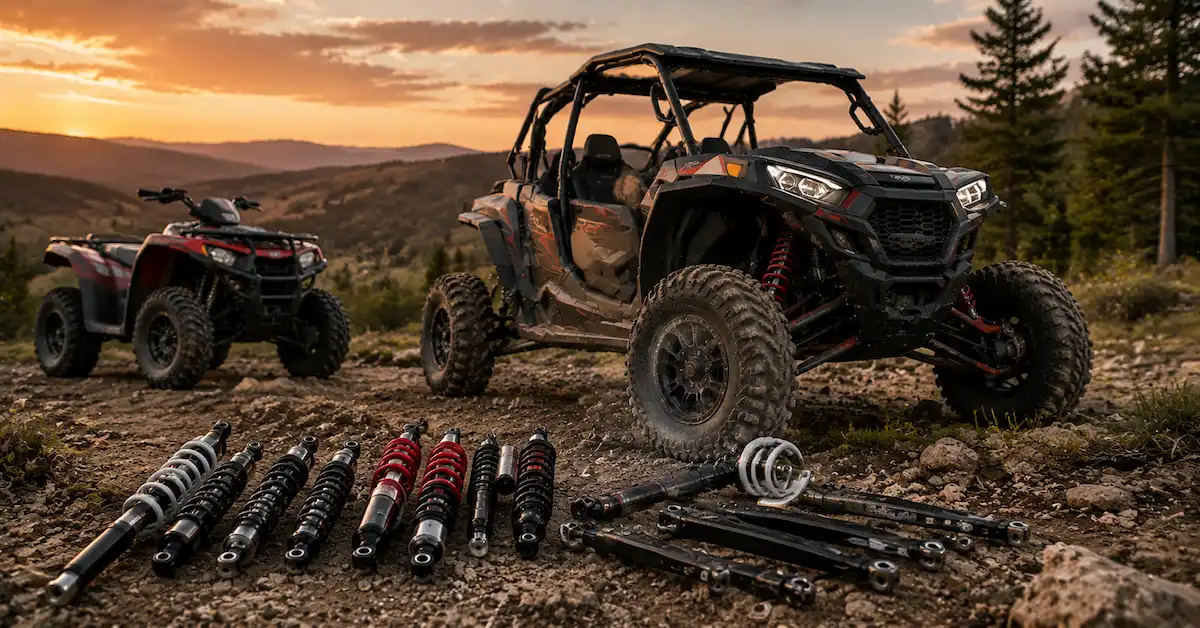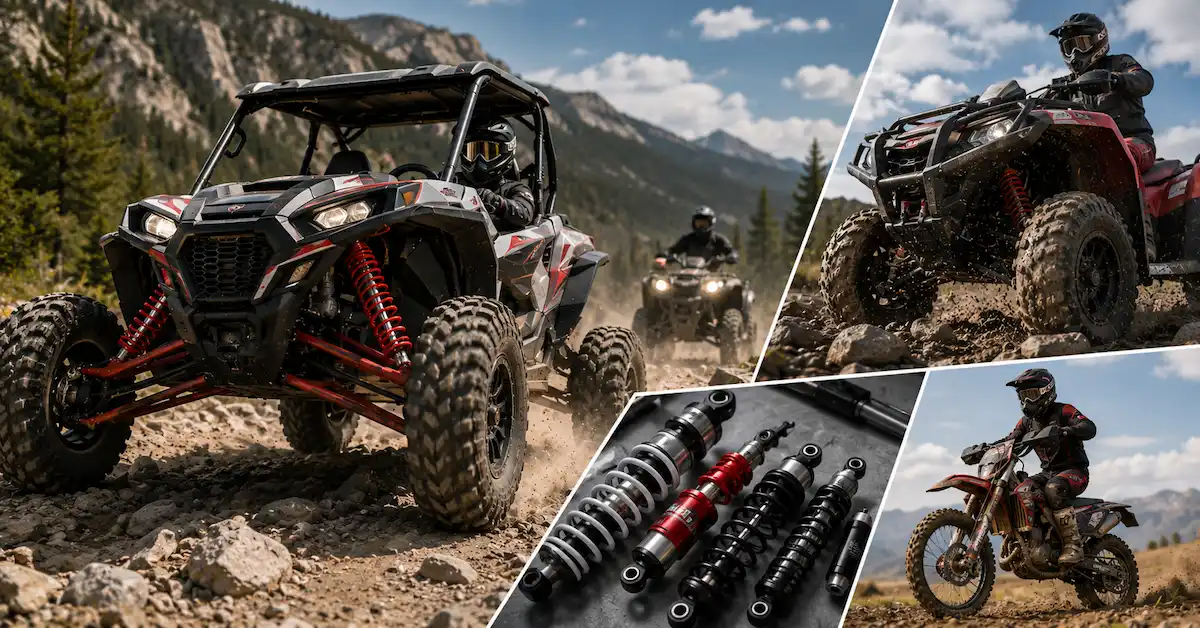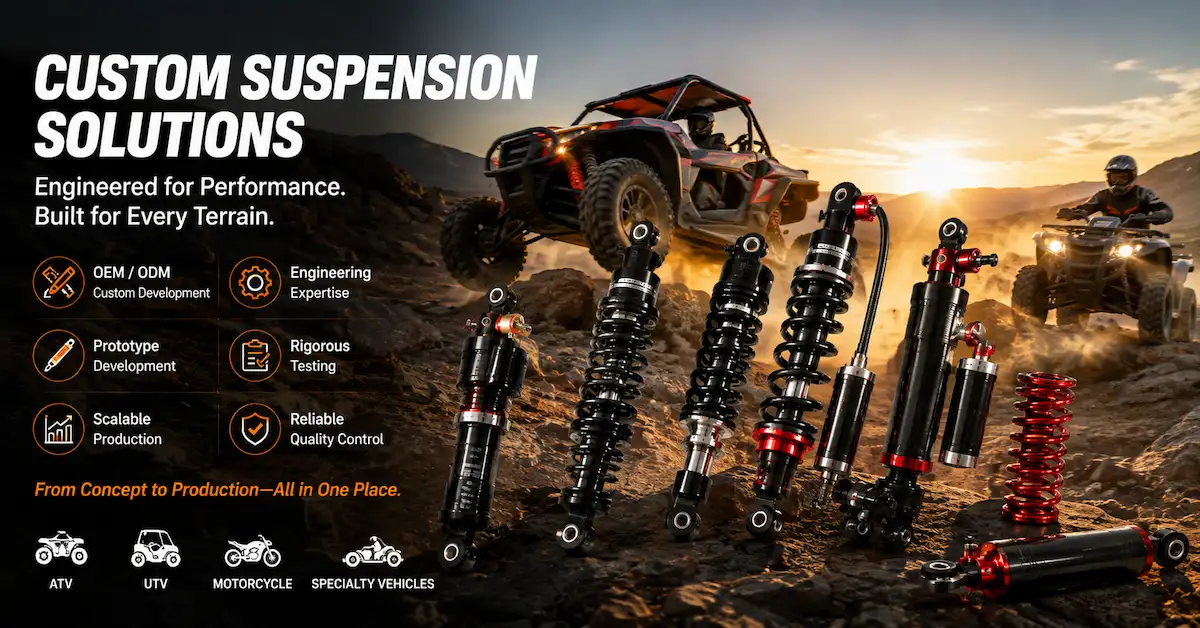

Yes, a capable shock absorber factory can customize dimensions, spring rate, and damping according to specific vehicle requirements. However, professional customization is not simply changing one component or copying an existing product.
A successful custom suspension project requires engineering evaluation of:
- Vehicle application
- Vehicle weight
- Payload requirements
- Suspension geometry
- Operating conditions
- Performance targets
For OEM and private-label projects, the goal is not only to produce a shock absorber that fits physically, but also to create a suspension solution that performs correctly on the vehicle.
The complete development process usually follows:
Vehicle Data → Engineering Review → Prototype → Testing → Optimization → Production
For ATV, UTV, off-road, and specialty vehicle applications, buyers should work with a manufacturer that combines suspension knowledge, customization capability, and production control.
Explore Bedo Auto's Shock Absorber Products for reference configurations and custom development possibilities.
What Parts of a Shock Absorber Can a Factory Customize?
A professional shock absorber manufacturer may customize several important parameters depending on the project requirements.
Shock Absorber Dimensions
Dimensions are often the first customization requirement.
Possible adjustments include:
- Extended length
- Compressed length
- Stroke
- Shock body dimensions
- Mounting dimensions
- Eye-to-eye length
- Mounting interfaces
These parameters directly affect:
- Suspension travel
- Vehicle fitment
- Installation clearance
- Operating range
A factory should review the complete suspension system rather than changing dimensions independently.
For example, increasing shock length may influence:
- Suspension geometry
- Ride height
- Available travel
- Component clearance
Therefore, dimensional customization requires engineering evaluation.
Spring Rate Customization
Spring rate is another critical area for vehicle-specific suspension development.
The correct spring specification depends on:
- Vehicle weight
- Payload
- Passenger capacity
- Suspension design
- Intended usage
Spring-related parameters may include:
- Spring rate
- Free length
- Wire diameter
- Coil diameter
- Preload range
A common misunderstanding is that a stiffer spring always creates better performance.
In reality:
A Spring That Is Too Soft May Cause
- Excessive sag
- Reduced load support
- Frequent bottoming
- Poor control under heavy loads
A Spring That Is Too Hard May Cause
- Reduced comfort
- Harsh response
- Less tire contact
- Poor ride quality
The goal is to match the spring to the vehicle application.
Damping Customization
Damping controls how the suspension moves after compression and rebound.
A factory with engineering capability should understand:
Compression Damping
Compression damping influences:
- Impact absorption
- Downward suspension movement
- Control during rough terrain
Rebound Damping
Rebound damping influences:
- Suspension recovery
- Tire contact
- Vehicle stability
Damping customization may involve:
- Internal valve configuration
- Oil flow characteristics
- Compression settings
- Rebound settings
A professional manufacturer should evaluate damping together with spring characteristics instead of treating them as separate adjustments.
Why Do Vehicles Need Custom Shock Absorbers?
Different vehicles create different suspension requirements.
A standard shock absorber may not provide the best solution when the vehicle changes in:
- Weight
- Load capacity
- Tire size
- Suspension geometry
- Intended usage
ATV Suspension Applications
ATV projects may require customization for:
- Trail riding
- Rough terrain
- Rider comfort
- Impact resistance
- Suspension travel
A recreational ATV and a utility-focused ATV may require different suspension characteristics.
UTV Suspension Applications
UTVs often experience higher and more variable loads.
Important factors include:
- Passenger weight
- Cargo capacity
- Work applications
- Long operating hours
A custom suspension solution may improve:
- Load support
- Stability
- Ride comfort
- Vehicle control
Modified Off-Road Vehicles
Vehicle modifications can change suspension requirements.
Examples include:
- Larger tires
- Added accessories
- Additional equipment
- Increased vehicle weight
In these cases, original suspension specifications may no longer match the vehicle.
How Does a Factory Determine the Right Shock Dimensions?
A professional development process begins with vehicle information.
Vehicle Data Analysis
The factory may review:
- Vehicle model
- Suspension position
- Existing shock absorber
- Installation space
- Weight conditions
Suspension Geometry Review
Engineers evaluate:
- Mounting locations
- Suspension movement
- Available clearance
- Travel requirements
Dimension Confirmation
Important measurements include:
- Extended length
- Compressed length
- Stroke
- Mounting dimensions
The purpose is to ensure:
- Correct fitment
- Proper suspension travel
- No interference during operation
How Is the Correct Spring Rate Selected?
Spring selection should be based on engineering data rather than general assumptions.
Important factors include:
| Factor | Impact |
|---|---|
| Vehicle weight | Determines basic load |
| Payload | Defines operating condition |
| Suspension geometry | Influences spring behavior |
| Shock position | Affects required spring force |
| Usage environment | Defines performance target |
A professional factory should ask:
- What is the vehicle application?
- What load does it normally carry?
- What problem needs improvement?
This approach produces a more accurate suspension solution.
Can a Shock Absorber Factory Adjust Damping for My Vehicle?
Yes, if the factory has appropriate engineering capability.
However, damping adjustment requires understanding the complete suspension system.
The development process may consider:
- Spring specification
- Vehicle weight
- Suspension travel
- Terrain
- Performance goals
Examples of performance goals include:
- Better impact control
- Improved load support
- More stable handling
- Reduced bottoming
Damping should be developed based on the vehicle's actual requirements rather than a simple “harder” or “softer” setting.
What Information Does a Factory Need Before Custom Development?
Before starting a custom shock absorber project, provide as much technical information as possible.
| Information | Purpose |
|---|---|
| Vehicle model | Defines application |
| Front/rear position | Defines suspension role |
| Vehicle weight | Supports spring selection |
| Payload | Defines working load |
| Existing shock | Provides reference |
| Drawings | Controls dimensions |
| CAD files | Supports engineering review |
| Stroke | Defines travel |
| Mounting dimensions | Confirms fitment |
| Terrain | Defines performance target |
| Current problem | Guides development |
The clearer the project requirements, the more accurate the engineering proposal will be.
Can a Shock Absorber Factory Develop Prototypes?
Yes.
Prototype development is an important step for custom suspension projects.
A typical process includes:
Requirement → Engineering Review → Prototype → Testing → Revision → Approval
Prototype validation can confirm:
- Product dimensions
- Installation compatibility
- Spring behavior
- Suspension response
- Manufacturing feasibility
A prototype allows problems to be identified before mass production.
For sample-based projects, see Suspension Sample Development.
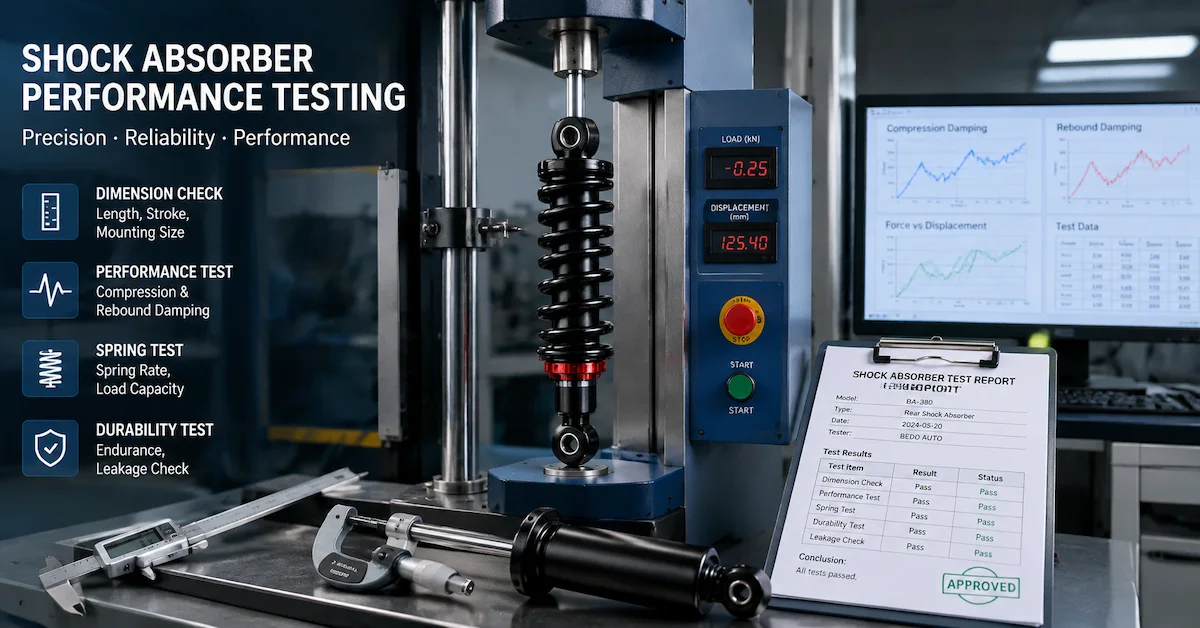
How Are Custom Shock Absorbers Tested?
Testing requirements depend on the project.
Dimensional Verification
Checks may include:
- Shock length
- Stroke
- Mounting dimensions
- Spring dimensions
Fitment Testing
Validation may include:
- Installation
- Suspension movement
- Clearance
- Component interference
Performance Evaluation
Depending on project requirements:
- Spring support
- Damping response
- Load behavior
Vehicle Validation
Some characteristics require real vehicle testing:
- Ride height
- Suspension travel
- Terrain response
- Load performance
A reliable factory should clearly explain which tests it performs internally and which require vehicle-level validation.
Custom Shock Absorber Factory vs Standard Supplier
| Factor | Custom Factory | Standard Supplier |
|---|---|---|
| Dimension changes | Supported | Limited |
| Spring customization | Supported | Limited |
| Damping adjustment | Possible | Limited |
| Prototype development | Available | Rare |
| Engineering support | Strong | Basic |
| OEM projects | Suitable | Less suitable |
For standard replacement products, a normal supplier may be enough.
For vehicle-specific suspension development, a custom engineering partner provides greater value.
How Does Bedo Auto Support Custom Shock Absorber Development?
Bedo Auto supports vehicle-specific suspension projects for:
- ATV
- UTV
- Off-road vehicles
- Specialty vehicles
Development support can include:
- Custom shock absorber development
- Dimension evaluation
- Spring specification development
- Suspension engineering support
- CAD and drawing review
- Prototype manufacturing
- Testing support
- Small-batch validation
- Production preparation
The process can start from:
- Product concepts
- Existing samples
- Technical drawings
- CAD files
- Vehicle requirements
Related resources:
- Shock Absorber Products
- CAD Based Suspension Development
- Suspension Sample Development
- Contact Bedo Auto
FAQ
Can a shock absorber factory customize dimensions?
Yes. A capable factory can customize shock length, stroke, mounting dimensions, and other structural requirements based on vehicle needs.
Can spring rate be customized?
Yes. Spring rate can be developed according to vehicle weight, payload, suspension geometry, and performance requirements.
Can damping be adjusted for my vehicle?
Yes. Depending on engineering capability, damping characteristics can be optimized for specific vehicle applications.
What information does a factory need for custom shock absorbers?
Provide vehicle information, drawings, CAD files, existing samples, dimensions, load requirements, and performance goals.
Are custom shock absorbers suitable for ATV and UTV vehicles?
Yes. ATV and UTV applications often require vehicle-specific suspension solutions because of different loads and operating environments.
Do custom shock absorbers require prototypes?
Yes. Prototypes help verify fitment, performance, and manufacturing feasibility before mass production.
How long does custom shock absorber development take?
The timeline depends on design complexity, prototype requirements, testing, and revision cycles.
Can a factory develop shocks from existing samples?
Yes. Existing samples can provide references, but vehicle requirements should also be evaluated.
Why choose a custom shock absorber instead of a standard product?
Custom shock absorbers can better match vehicle weight, load conditions, suspension geometry, and intended usage.
Can custom shock absorbers be produced in small batches?
Yes. OEM manufacturers may support prototypes, pilot production, and later mass production.
Conclusion
A capable shock absorber factory can customize dimensions, spring rate, and damping for vehicle-specific applications, but successful customization requires more than changing individual components.
The right development partner should provide:
Engineering Analysis + Custom Design + Prototype Validation + Production Control
For ATV, UTV, off-road, and specialty vehicles, the development process should connect:
Vehicle Requirements → Engineering Review → Prototype → Testing → Optimization → Production
Choosing a manufacturer with real suspension engineering capability helps reduce development risks and creates a stronger foundation for long-term OEM cooperation.