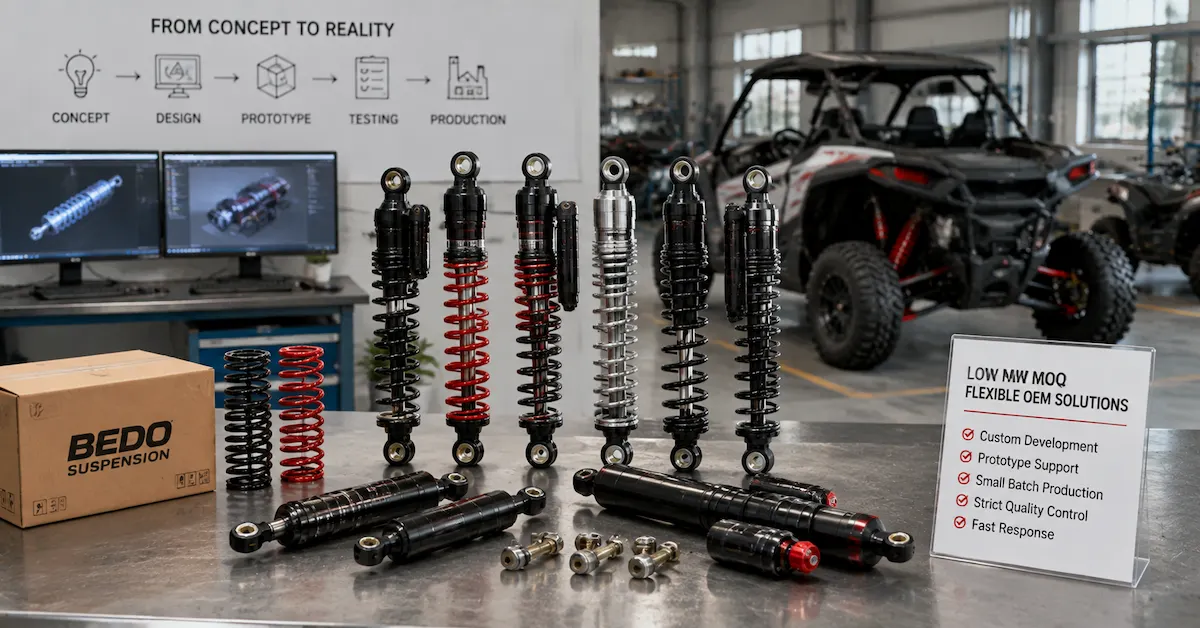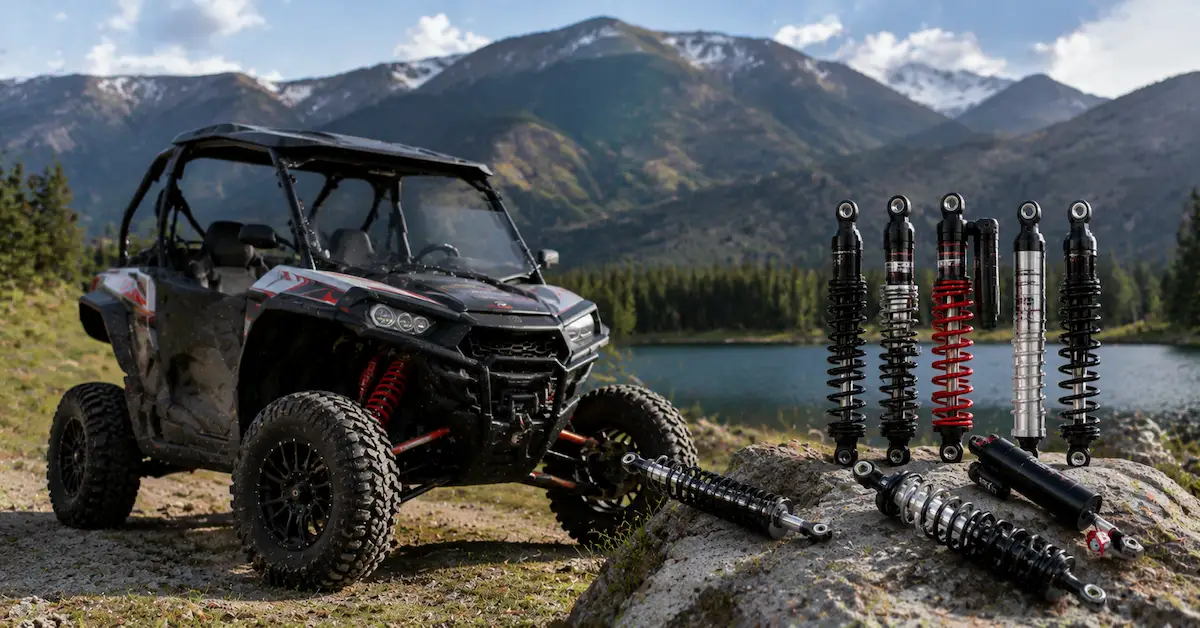

Choosing the right competition suspension supplier is essential for racing teams, motorsport brands, vehicle manufacturers, and performance aftermarket companies seeking suspension systems designed for competitive environments.
Competition vehicles operate under extreme conditions where suspension performance directly affects:
- Vehicle control
- Tire grip
- Cornering speed
- Braking stability
- Acceleration performance
- Driver confidence
Unlike standard suspension systems, competition suspension requires precise engineering and tuning based on:
- Track conditions
- Vehicle setup
- Driving style
- Tire characteristics
- Weight distribution
- Performance targets
A professional supplier does not simply manufacture stronger shock absorbers. It develops suspension systems that provide predictable and repeatable performance during demanding competition conditions.
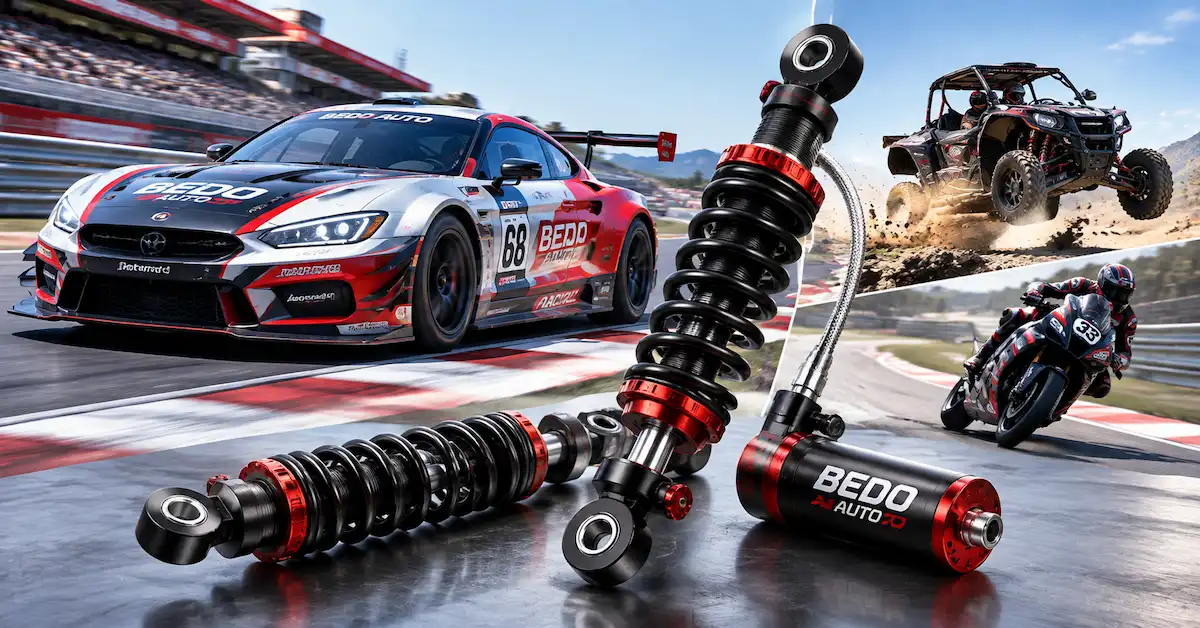
Bedo Auto supports customized suspension development including racing shock absorbers, adjustable damping systems, coil springs, and OEM suspension solutions for racing, off-road, ATV, UTV, motorcycle, and specialty vehicle applications.
What Does a Competition Suspension Supplier Provide?
A professional competition suspension supplier provides complete suspension development support.
Typical services include:
| Service | Purpose |
|---|---|
| Suspension analysis | Evaluate vehicle requirements |
| Shock absorber design | Develop performance components |
| Damping tuning | Optimize suspension response |
| Spring development | Match vehicle setup |
| Prototype manufacturing | Validate designs |
| Dyno testing | Measure damping performance |
| Track testing | Confirm real performance |
| OEM production | Support long-term supply |
Competition suspension requires close cooperation between engineers, drivers, and manufacturers.
Why Competition Suspension Requires Specialized Engineering
Racing environments create different demands compared with normal vehicles.
Competition suspension must handle:
- High-speed cornering
- Sudden weight transfer
- Hard braking
- Acceleration forces
- Repeated impacts
- Extreme temperatures
A standard shock absorber may not provide:
- Fast enough response
- Suitable damping control
- Sufficient durability
- Adjustable performance
Poor suspension setup may result in:
- Reduced traction
- Excessive body movement
- Poor corner exit performance
- Tire wear problems
- Driver instability
Professional engineering helps create a balanced suspension system.
Applications of Competition Suspension Systems
A professional supplier can support various motorsport applications.
Circuit Racing Suspension
Track vehicles require:
- Precise damping
- Fast response
- Stable cornering
- Adjustable setup
Engineering focuses on:
- Weight transfer control
- Brake dive reduction
- Body roll management
- Tire performance
Rally and Off-Road Competition Suspension
Rally and off-road racing require:
- Long suspension travel
- Impact resistance
- Heat control
- Strong components
Applications include:
- Rally vehicles
- Desert racing
- UTV racing
- ATV racing
Motorcycle Competition Suspension
Motorcycle racing requires:
- Precise rider feedback
- Lightweight design
- Fast response
- Stable handling
Performance Street Applications
High-performance street vehicles may require:
- Improved handling
- Adjustable suspension
- Premium ride quality
Key Factors in Competition Suspension Development
A professional competition suspension supplier evaluates multiple technical factors.
| Factor | Impact |
|---|---|
| Vehicle weight | Determines suspension load |
| Track surface | Influences damping settings |
| Tire characteristics | Affects suspension balance |
| Driving style | Guides tuning |
| Spring rate | Controls load support |
| Shock stroke | Determines suspension travel |
| Damping curve | Controls vehicle response |
| Heat generation | Influences durability |
Each competition vehicle requires a customized suspension strategy.
Racing Shock Absorber Development
Shock absorbers are the core components of competition suspension.
Important parameters include:
Compression Damping
Controls suspension movement during compression.
It affects:
- Impact absorption
- Vehicle support
- Bottoming resistance
Rebound Damping
Controls suspension recovery.
It affects:
- Tire contact
- Traction
- Vehicle balance
Adjustable Damping
Professional competition shocks may include:
- Compression adjustment
- Rebound adjustment
- High-speed adjustment
- Low-speed adjustment
Adjustability allows teams to optimize suspension according to different tracks.
Spring Optimization for Competition Vehicles
Spring selection strongly affects vehicle behavior.
Engineers evaluate:
- Spring rate
- Vehicle weight
- Tire setup
- Track requirements
- Suspension geometry
The correct spring helps improve:
- Cornering stability
- Weight control
- Traction
- Suspension response
A spring that is too stiff may reduce grip.
A spring that is too soft may create excessive movement.
The best setup depends on the complete vehicle system.
Damping Tuning for Competition Performance
Damping tuning determines how the suspension reacts during dynamic driving.
Engineers optimize:
Low-Speed Damping
Controls:
- Braking
- Acceleration
- Weight transfer
High-Speed Damping
Controls:
- Curbs
- Jumps
- Sharp impacts
Proper damping tuning helps achieve:
- Faster response
- Better tire contact
- More predictable handling
Shock Dyno Testing for Competition Suspension
Shock dyno testing provides objective performance data.
It measures:
- Compression force
- Rebound force
- Velocity response
- Adjustment range
Benefits include:
- Accurate tuning
- Setup comparison
- Production consistency verification
Dyno testing helps engineers optimize suspension performance before track testing.
Track Testing and Validation
Laboratory testing provides important data, but competition suspension requires real-world validation.
Track testing evaluates:
- Handling balance
- Driver feedback
- Tire behavior
- Suspension response
- Lap performance
Engineers may adjust:
- Damping settings
- Spring rates
- Ride height
- Suspension configuration
based on track results.
Prototype Development Process
Competition suspension development usually follows several stages.
Requirement Analysis
Engineers evaluate:
- Vehicle platform
- Competition category
- Performance goals
- Operating conditions
Suspension Design
Development includes:
- Shock absorber structure
- Spring specification
- Damping settings
- Mounting design
Prototype Production
Prototype units are produced for evaluation.
Testing and Optimization
Performance data is collected and improvements are made.
Production Preparation
Approved designs move into controlled manufacturing.
Materials Used in Competition Suspension
Performance applications require advanced materials.
Important components include:
Shock Body
Requires:
- Strength
- Lightweight structure
- Heat resistance
Piston Rod
Requires:
- Wear resistance
- Surface hardness
- Corrosion protection
Internal Components
Require:
- Precision manufacturing
- Stable performance
- Consistent response
Material selection directly affects reliability during competition use.
Quality Control for Competition Suspension Manufacturing
A professional supplier should control:
Material Quality
Verify:
- Metals
- Springs
- Seals
- Machined components
Manufacturing Accuracy
Check:
- Dimensions
- Tolerances
- Assembly precision
Performance Testing
Confirm:
- Damping consistency
- Leakage resistance
- Adjustment performance
Final Inspection
Check:
- Appearance
- Function
- Packaging
How to Choose a Competition Suspension Supplier
Buyers should evaluate:
Engineering Capability
The supplier should support:
- Suspension analysis
- Damping development
- Spring tuning
- Prototype improvement
Testing Capability
Confirm:
- Shock dyno testing
- Durability testing
- Vehicle validation
Manufacturing Capability
Evaluate:
- Production processes
- Quality systems
- Batch consistency
Motorsport Experience
A capable supplier should understand:
- Competition requirements
- Driver feedback
- Performance targets
How Bedo Auto Supports Competition Suspension Projects
As an experienced competition suspension supplier, Bedo Auto supports global customers with customized suspension development.
Services include:
- Shock absorber engineering
- Damping optimization
- Spring matching
- Prototype production
- Performance testing
- OEM manufacturing
Applications include:
- Racing vehicles
- ATV
- UTV
- Motorcycle
- Golf cart
- Utility vehicle
- Specialty vehicles
Buyers can review suspension solutions through the Bedo Auto Products page.
For competition suspension projects, samples, drawings, and technical requirements can be submitted through the Contact Us page.
FAQ
What does a competition suspension supplier provide?
A competition suspension supplier develops and manufactures racing suspension components with customized tuning and engineering support.
Why does competition suspension need customization?
Because racing vehicles have different weights, tracks, driving styles, and performance targets.
Can competition shocks be adjusted?
Yes. Many racing shocks provide compression, rebound, and preload adjustment options.
How is competition suspension tested?
Testing may include dyno testing, durability testing, prototype validation, and track testing.
What vehicles use competition suspension?
Applications include racing cars, motorcycles, ATV, UTV, rally vehicles, and performance vehicles.
Can Bedo Auto support OEM competition suspension?
Yes. Bedo Auto supports engineering development, prototypes, testing, and OEM manufacturing.
Conclusion
Choosing the right competition suspension supplier helps racing teams, performance brands, and vehicle manufacturers develop suspension systems with better control, reliability, and competitive performance.
Competition suspension requires precise coordination between shock absorbers, springs, damping settings, geometry, materials, and testing.
Through engineering development, prototype validation, performance tuning, and OEM manufacturing support, Bedo Auto helps global customers create advanced suspension solutions for demanding competition applications.