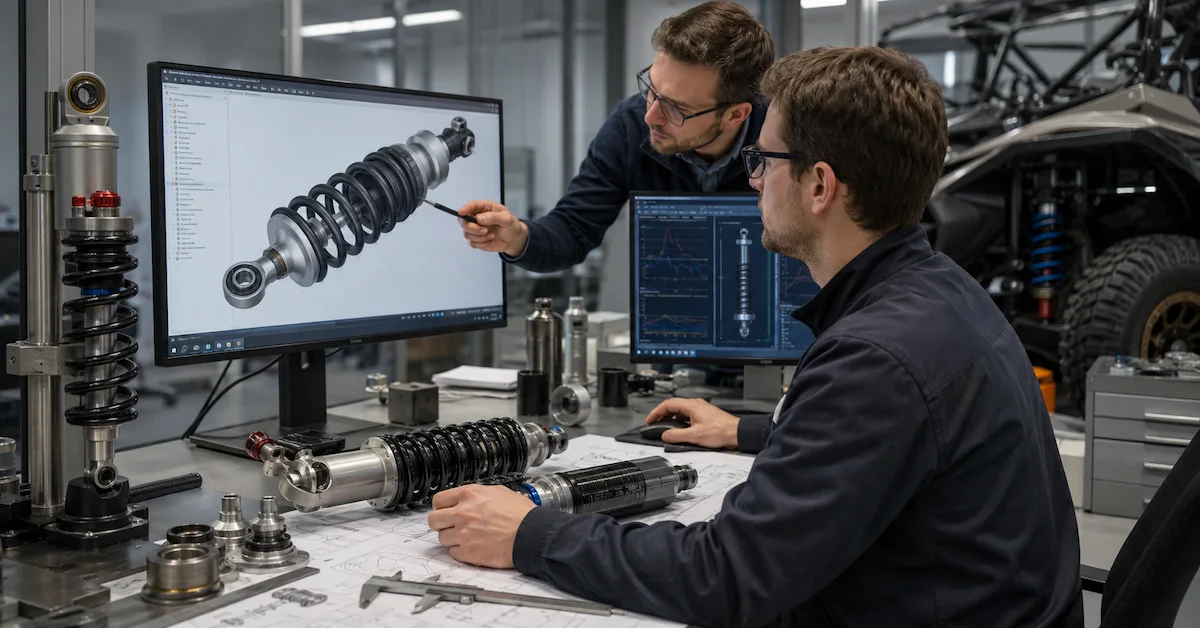

For many suspension buyers, finding a supplier is easy.
Finding a supplier that can support both aftermarket and OEM projects is much harder.
The requirements are different.
An aftermarket brand may need:
- Fast product customization
- Multiple vehicle fitments
- Retail packaging
- Dealer support
- Smaller production quantities
- Quick market response
An OEM customer may require:
- Engineering cooperation
- Vehicle-specific development
- Prototype testing
- Production documentation
- Strict quality control
- Long-term supply stability
A supplier that only focuses on one side may struggle when the project grows.
The ideal China suspension supplier should be able to support the complete product lifecycle:
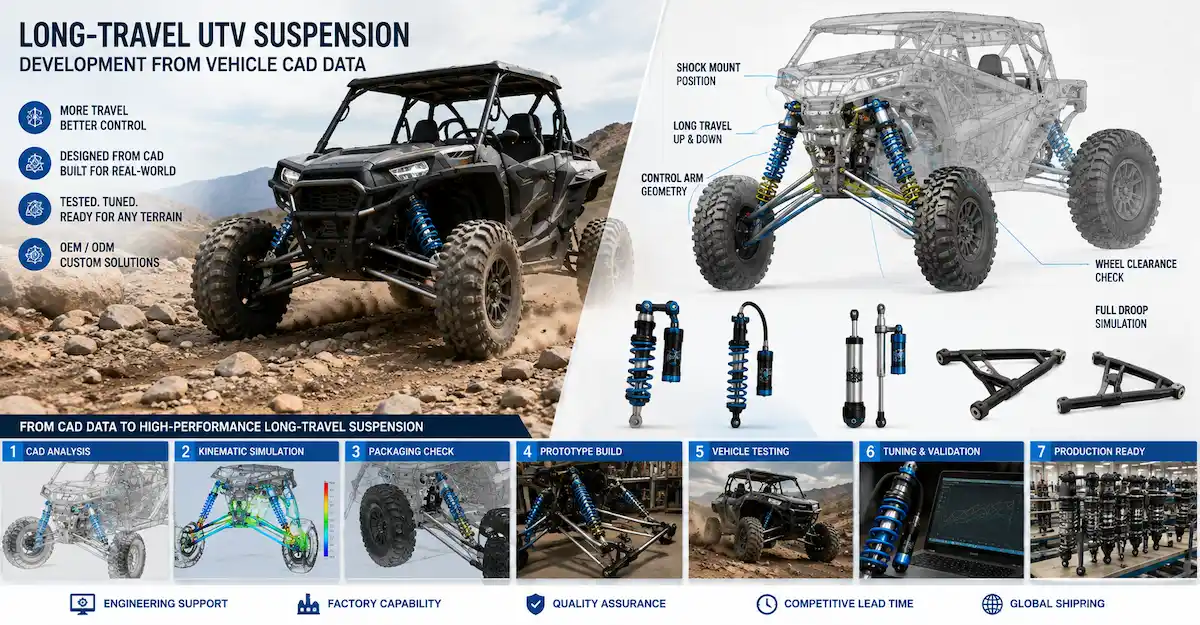
Concept → Engineering → Prototype → Validation → Production → Aftermarket/OEM Supply
That capability is what separates a component manufacturer from a long-term suspension partner.
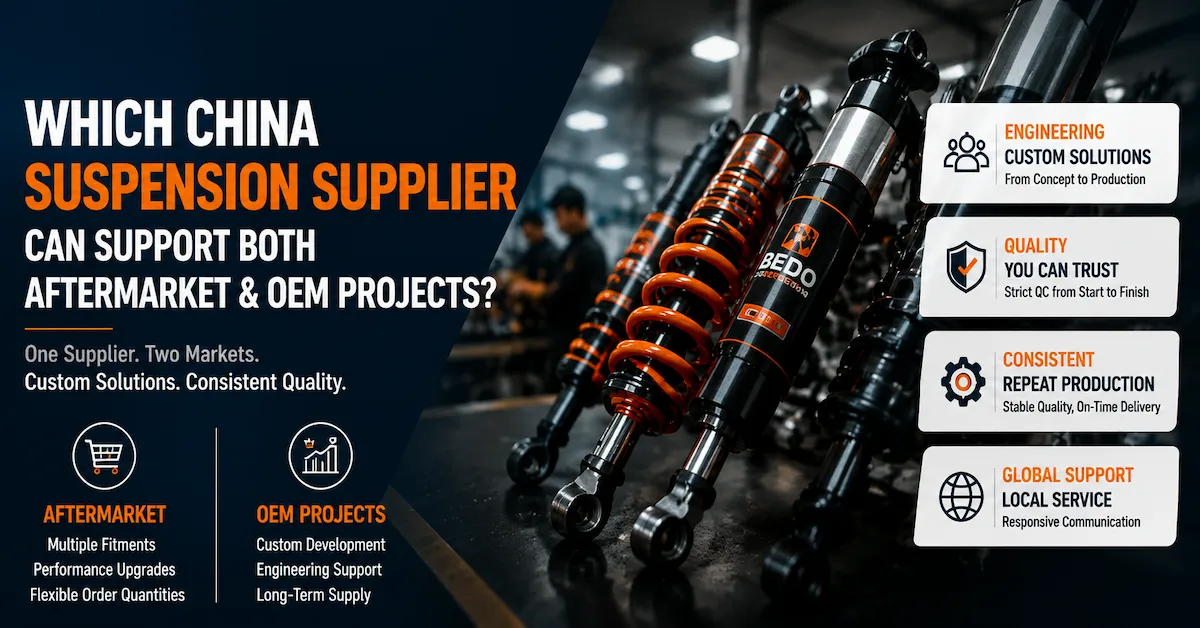
Why Do Buyers Choose China Suspension Suppliers for OEM and Aftermarket Projects?
China has become an important sourcing location for suspension components because many manufacturers can provide:
- Engineering resources
- Manufacturing capability
- Supply-chain integration
- Competitive production costs
- Custom development support
However, not every factory has the same capability.
Some suppliers specialize in standard products.
Others focus mainly on OEM development.
Some can handle both, but buyers need to verify whether their systems actually support different project types.
A supplier that can produce a shock absorber is not automatically a supplier that can develop a suspension solution.
What Is the Difference Between Aftermarket and OEM Suspension Projects?
Understanding the difference helps buyers choose the right partner.
| Project Type | Main Requirement |
|---|---|
| Aftermarket suspension | Fitment, performance improvement, packaging, market demand |
| OEM suspension | Vehicle integration, engineering validation, production consistency |
| Private label | Product + branding + commercial support |
| Distributor supply | Stable inventory and repeat ordering |
| Custom development | Engineering collaboration and testing |
A supplier supporting both markets must understand these different priorities.
What Capabilities Should a China Suspension Supplier Have?
A strong supplier should combine engineering, production, and commercial support.
Engineering Development Capability
OEM and advanced aftermarket projects require more than copying existing dimensions.
The supplier should understand:
- Vehicle application
- Suspension geometry
- Shock dimensions
- Spring requirements
- Damping requirements
- Load conditions
- Terrain usage
- Prototype testing
For custom UTV suspension projects, engineering input is especially important because the shock absorber works together with the complete suspension system.
Can the Supplier Support Custom Suspension Development?
A capable supplier should be able to move beyond standard catalog products.
Customization may include:
- Shock length
- Mounting design
- Spring specification
- Damping tuning
- Reservoir configuration
- Adjustment options
- Branding
- Packaging
However, customization quality depends on the supplier's development process.
A professional supplier should ask questions before quoting.
For example:
- What vehicle is this for?
- What load conditions are expected?
- What problem needs to be solved?
- Is the goal comfort, performance, payload support, or durability?
- Is the project aftermarket or OEM?
A supplier that immediately quotes without understanding the application may create problems later.
Why Does Production Capability Matter for OEM and Aftermarket Buyers?
The first sample is only the beginning.
Long-term customers need repeatable production.
A reliable supplier should control:
- Raw material quality
- Component consistency
- Assembly process
- Inspection standards
- Product specifications
- Revision management
This is especially important when a suspension product becomes successful.
A product sold in small quantities can sometimes be managed manually.
A product shipped globally requires a controlled system.
How Should Buyers Evaluate a Supplier's Factory Capability?
Do not evaluate only from product photos.
Ask about:
Manufacturing Process
Understand:
- Which processes are completed internally
- Which components are outsourced
- How suppliers are managed
- How production changes are controlled
Quality Control
Ask:
- What inspections are performed?
- When are products checked?
- How are problems recorded?
- How are production batches tracked?
Engineering Support
Ask:
- Can engineers review drawings?
- Can they support prototype revisions?
- Can they provide technical feedback?
Production Scalability
Ask:
- Can they support small pilot orders?
- Can they scale after approval?
- How do they maintain consistency during larger production?
Should OEM Buyers and Aftermarket Brands Choose the Same Supplier?
Sometimes yes.
A supplier capable of supporting both models can provide advantages.
For example:
An aftermarket company may discover that a supplier already understands OEM engineering requirements.
An OEM customer may benefit from a supplier that understands aftermarket product positioning and smaller-batch flexibility.
However, buyers should confirm that the supplier has actual experience with both.
A factory claiming:
“We do OEM and aftermarket”
should be able to explain:
- Previous project types
- Development process
- Production approach
- Quality management
- Customer communication method
How Does a Supplier Handle Different Order Quantities?
Aftermarket and OEM projects often have different purchasing patterns.
Aftermarket customers may require:
- Multiple SKUs
- Smaller quantities
- Frequent product updates
- Faster response
OEM customers may require:
- Larger annual volume
- Long-term planning
- Stable specifications
- Production forecasting
A suitable supplier should have flexibility without losing production control.
The question is not:
“Can you make 100 pieces?”
or:
“Can you make 10,000 pieces?”
The better question is:
“Can you maintain the same approved specification at different production scales?”
What Role Does Prototype Testing Play?
Prototype testing connects engineering and production.
Before commercial launch, buyers should validate:
- Installation
- Ride height
- Suspension travel
- Spring behavior
- Damping performance
- Vehicle clearance
- Real operating conditions
A supplier supporting OEM and aftermarket projects should understand that prototype approval is not just a sample confirmation.
It is the foundation of the production specification.
See:
How Do I Test a UTV Suspension Prototype Before Production?
Why Is Documentation Important for Long-Term Suspension Supply?
Documentation becomes increasingly important as projects grow.
Useful documents include:
- Product drawings
- Specifications
- Revision history
- Quality records
- Packaging information
- Inspection standards
Without documentation, repeat orders depend too much on personal communication.
That creates risk when:
- Teams change
- Orders increase
- Products are updated
- Multiple SKUs are managed
A professional supplier builds systems, not just products.
Can a China Suspension Supplier Support Private Label Projects?
Yes, many aftermarket brands use Chinese suspension manufacturers for private-label programs.
However, private label requires more than adding a logo.
A complete private-label solution may involve:
- Product customization
- Logo application
- Packaging design
- Product naming
- Instructions
- SKU management
- Dealer materials
The supplier should understand that your brand reputation depends on the final product.
What Questions Should I Ask Before Selecting a China Suspension Supplier?
Before cooperation, ask:
- Do you support OEM and aftermarket customers?
- Can you develop custom suspension products?
- How do you manage prototype approval?
- How do you control production consistency?
- Can you support private-label packaging?
- What quality checks are performed?
- How are product revisions controlled?
- Can you support small pilot orders?
- How do you handle repeat production?
- What information do you need before quotation?
The quality of the answers often reveals the supplier's real capability.
What Are the Warning Signs of a Weak Supplier?
Be careful if a supplier:
Only Talks About Price
Suspension is a performance product.
The lowest price does not always create the lowest total cost.
Cannot Explain Engineering
If the supplier cannot discuss application requirements, customization may become trial and error.
Has No Revision Control
Without clear specifications, repeat orders can become inconsistent.
Avoids Testing Discussion
A suspension supplier should understand validation.
Cannot Explain Production Quality
A factory should be able to describe how it maintains consistency.
How Does Supplier Location Affect Project Management?
Working with a China supplier can provide manufacturing advantages, but communication management matters.
Successful cooperation usually requires:
- Clear technical documents
- Defined approval stages
- Regular updates
- Sample tracking
- Revision confirmation
Distance is less of a problem when the supplier has professional project management.
How Can Buyers Compare Different China Suspension Suppliers?
Do not compare only unit price.
Compare:
| Evaluation Area | Questions |
|---|---|
| Engineering | Can they support development? |
| Production | Can they repeat quality? |
| Quality | How are products controlled? |
| Communication | Can issues be solved quickly? |
| Customization | Can they support your requirements? |
| Commercial support | Can they support growth? |
The best supplier is usually the one with the lowest overall project risk, not necessarily the lowest quotation.
What Information Should I Send a Suspension Supplier?
A good inquiry should include:
Vehicle Information
- Vehicle model
- Application
- Year/platform
- Passenger capacity
Suspension Information
- Current shock dimensions
- Mounting details
- Spring information
- Suspension layout
Performance Goal
Explain whether you need:
- More comfort
- More payload support
- More travel
- Better durability
- Different damping
Commercial Information
Include:
- Target market
- Estimated quantity
- Pilot order
- Annual forecast
- Branding requirements
A clear inquiry helps the supplier provide a realistic solution.
How Can Bedo Auto Support OEM and Aftermarket Suspension Projects?
For buyers looking for a China suspension supplier that can support both aftermarket and OEM projects, Bedo Auto can discuss suspension development, customization, production requirements, and long-term supply planning.
Before starting a project, buyers can review:
UTV suspension customization requirements
to prepare vehicle information, technical requirements, and project goals.
For buyers moving from development to commercial supply, the guide:
How Do I Find a UTV Suspension Supplier That Can Maintain Consistent Repeat Production?
explains how to evaluate production consistency and long-term supplier capability.
For OEM, aftermarket, and private-label inquiries, contact:
A useful project introduction should include:
- Vehicle application
- Suspension requirements
- Target market
- Expected quantity
- Customization needs
- Long-term supply expectations
FAQ
What should I look for in a China suspension supplier?
Look for engineering capability, stable production, quality control, customization experience, clear communication, and the ability to support repeat orders.
Can one suspension supplier support both OEM and aftermarket projects?
Yes, but buyers should verify whether the supplier has experience with both development requirements and commercial aftermarket supply.
Why is OEM suspension development different from aftermarket products?
OEM projects usually require deeper vehicle integration, validation, documentation, and production control, while aftermarket products often focus more on fitment, performance, packaging, and market flexibility.
How do I verify a suspension factory's quality?
Review their production process, inspection methods, documentation system, sample approval process, and ability to maintain consistent repeat production.
Should I choose a China factory or trading company?
For custom suspension projects, direct factory communication can provide better access to engineering and production decisions. However, the key factor is capability rather than company type alone.
Can a suspension supplier provide private-label products?
Yes. Private-label programs may include product customization, branding, packaging, documentation, and production support.
What information does a supplier need before quotation?
Provide vehicle details, current suspension information, target performance, customization requirements, expected quantity, and market application.
How important is prototype testing?
Prototype testing helps confirm that the suspension specification works on the actual vehicle before production scaling.
What causes suspension suppliers to fail long-term projects?
Common problems include poor communication, uncontrolled changes, weak quality systems, lack of engineering support, and inconsistent production.
How can I build a long-term relationship with a suspension supplier?
Use clear specifications, regular communication, defined approval stages, and a supplier evaluation process focused on quality and reliability.
Conclusion
Choosing a China suspension supplier for both aftermarket and OEM projects requires looking beyond manufacturing price.
The right partner should combine:
- Engineering capability
- Custom development experience
- Production stability
- Quality control
- Documentation
- Communication
- Long-term supply support
A supplier that can support only the first sample may help complete a project.
A supplier that can support development, production, and future growth can become a true manufacturing partner.
For aftermarket brands, distributors, and OEM customers, the goal is not simply finding a factory that can build suspension parts.
The goal is finding a supplier that can help turn a suspension idea into a reliable product line.