
What Makes a Reliable China Shock Absorber Factory for OEM Projects?
When OEM buyers search for a China shock absorber factory, they are usually not only looking for a supplier that can produce shock absorbers.
They are looking for a manufacturing partner that can support the complete development process:
- Product design review
- Technical communication
- Sample analysis
- Prototype production
- Testing validation
- Quality control
- Mass production
For ATV and UTV brands, suspension components directly affect vehicle performance, safety, comfort, and customer experience. A reliable factory must understand how shock absorbers work together with:
- Vehicle weight
- Payload requirements
- Suspension geometry
- Spring specifications
- Damping characteristics
- Driving environment
A qualified OEM suspension partner should be able to transform an idea, drawing, or sample into a production-ready product.
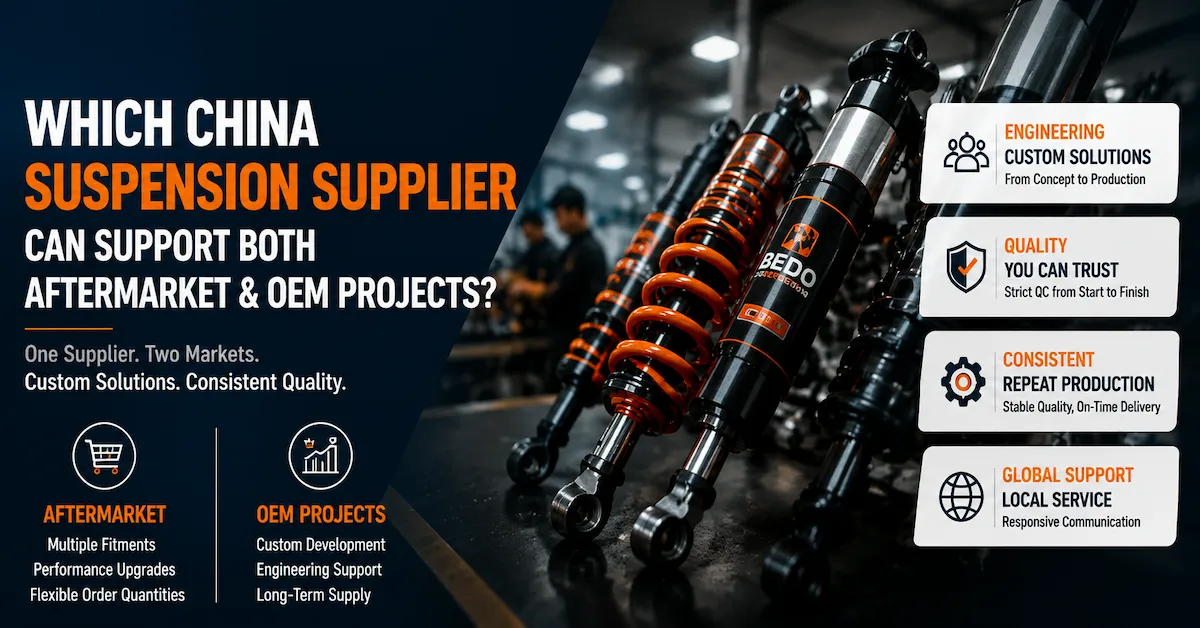
Bedo Auto focuses on customized suspension solutions including shock absorbers and suspension springs for ATV, UTV, motorcycle, electric vehicle, golf cart, and specialty vehicle applications.
Buyers can review the Shock Absorber Products to understand available suspension configurations.
Factory vs Trading Company: Which Supplier Is Better for OEM Suspension?
One of the first decisions OEM buyers need to make is whether to work directly with a factory or through a trading company.
Both models can have value, but their capabilities are different.
| Evaluation | Direct Factory | Trading Company |
|---|---|---|
| Engineering communication | Direct with technical team | Usually indirect |
| Prototype modification | Faster | Depends on supplier |
| Production control | Higher visibility | Depends on partner |
| Technical adjustment | More efficient | More communication steps |
| Cost structure | More transparent | May include additional margin |
| OEM development | Stronger capability | Depends on factory relationship |
For technically complex products such as customized ATV and UTV shock absorbers, direct communication with the manufacturer can reduce misunderstanding during development.
A reliable factory should be able to explain:
- Why a specification is selected
- How changes affect performance
- What testing is required
- How production consistency is maintained
What Capabilities Should an OEM Shock Absorber Factory Have?
A professional China shock absorber factory should combine manufacturing capability with engineering support.
Shock Absorber Manufacturing Capability
The factory should understand:
- Shock body production
- Piston rod processing
- Spring assembly
- Sealing systems
- Mounting components
- Surface treatment
- Final assembly
Suspension Engineering Capability
OEM projects often require more than following existing drawings.
Engineering support may include:
- Product structure review
- Dimension evaluation
- Sample comparison
- CAD analysis
- Spring selection
- Damping adjustment
Prototype Development Capability
Before mass production, OEM buyers usually need prototype verification.
A capable factory should support:
- Prototype manufacturing
- Sample modification
- Engineering feedback
- Final specification confirmation
This process reduces the risk of incorrect products entering production.
Can a China Shock Absorber Factory Develop Custom ATV and UTV Shocks?
Yes.
A qualified supplier can customize shock absorbers based on vehicle requirements, drawings, CAD files, or existing samples.
Customization may include:
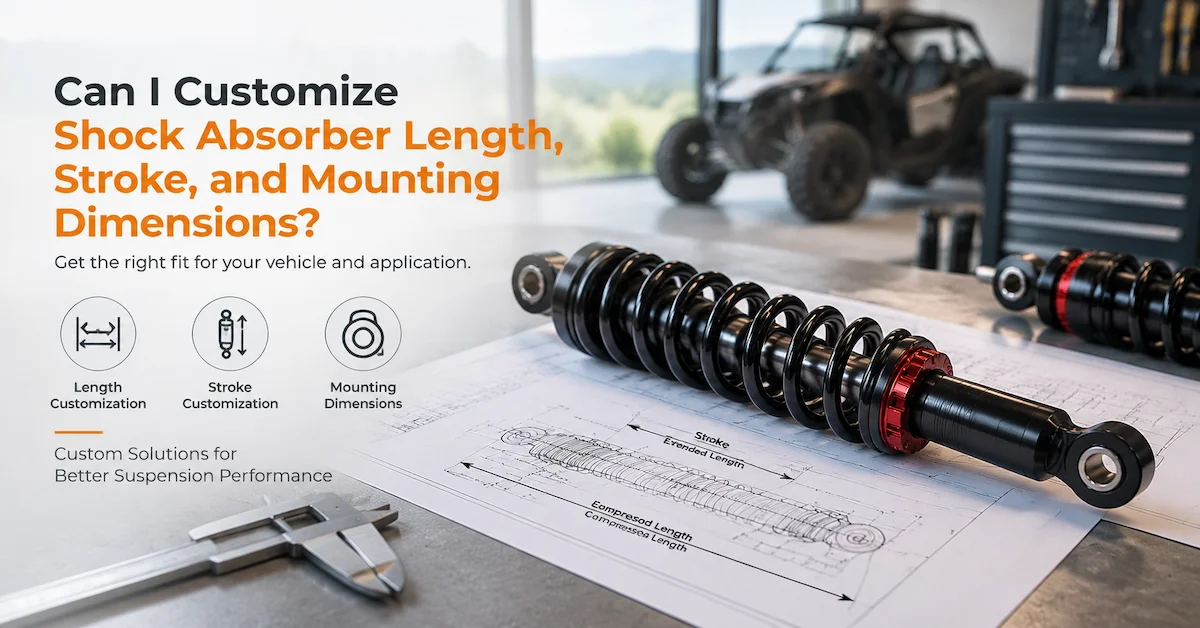
Shock Dimensions
Including:
- Extended length
- Compressed length
- Stroke
- Body dimensions
- Mounting width
- Mounting-hole size
Spring Specifications
Including:
- Spring rate
- Wire diameter
- Free length
- Coil diameter
- Preload range
Damping Characteristics
Including:
- Compression damping
- Rebound damping
- Internal valve configuration
Product Appearance
Including:
- Shock body color
- Spring color
- Logo
- Packaging
- Product labeling
However, a premium suspension product should not only focus on appearance.
The final specification should match:
- Vehicle application
- Load condition
- Terrain
- Performance target
How Does OEM Shock Absorber Development Work?
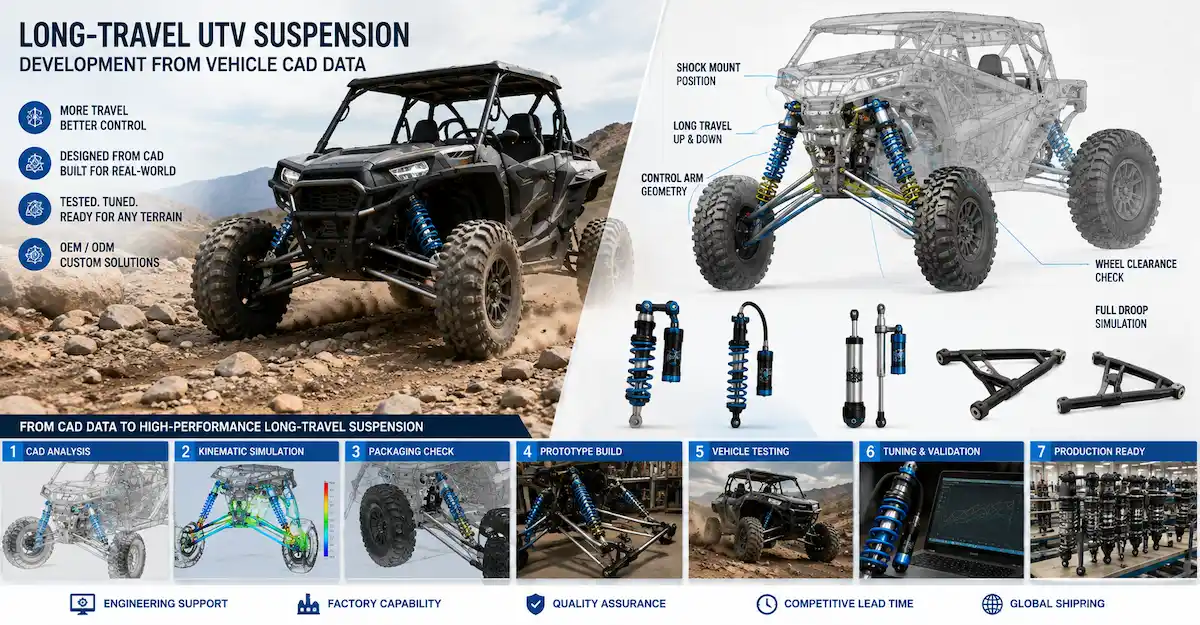
A reliable OEM development process usually follows several stages.
Step 1: Requirement Analysis
The factory reviews project requirements.
Important information includes:
- Vehicle model
- ATV or UTV application
- Suspension position
- Vehicle weight
- Maximum load
- Intended terrain
- Performance target
The clearer the requirements, the more accurate the development direction.
Step 2: Engineering Review
The engineering team evaluates:
- Technical drawings
- CAD files
- Existing samples
- Mounting dimensions
- Suspension space
This stage identifies possible manufacturing or fitment issues.
Step 3: Prototype Manufacturing
The factory produces samples based on the approved specifications.
Prototype evaluation usually checks:
- Installation
- Dimensions
- Clearance
- Spring behavior
- Basic suspension response
For buyers developing prototype shock absorbers, see:
Prototype Shock Absorber Factory Guide
Step 4: Testing and Adjustment
Based on prototype feedback, the product may require adjustments to:
- Spring rate
- Damping
- Dimensions
- Mounting structure
The goal is to achieve the required suspension performance before production.
Step 5: Production Approval
After validation:
- Drawings are finalized
- Specifications are locked
- Inspection standards are confirmed
- Production begins
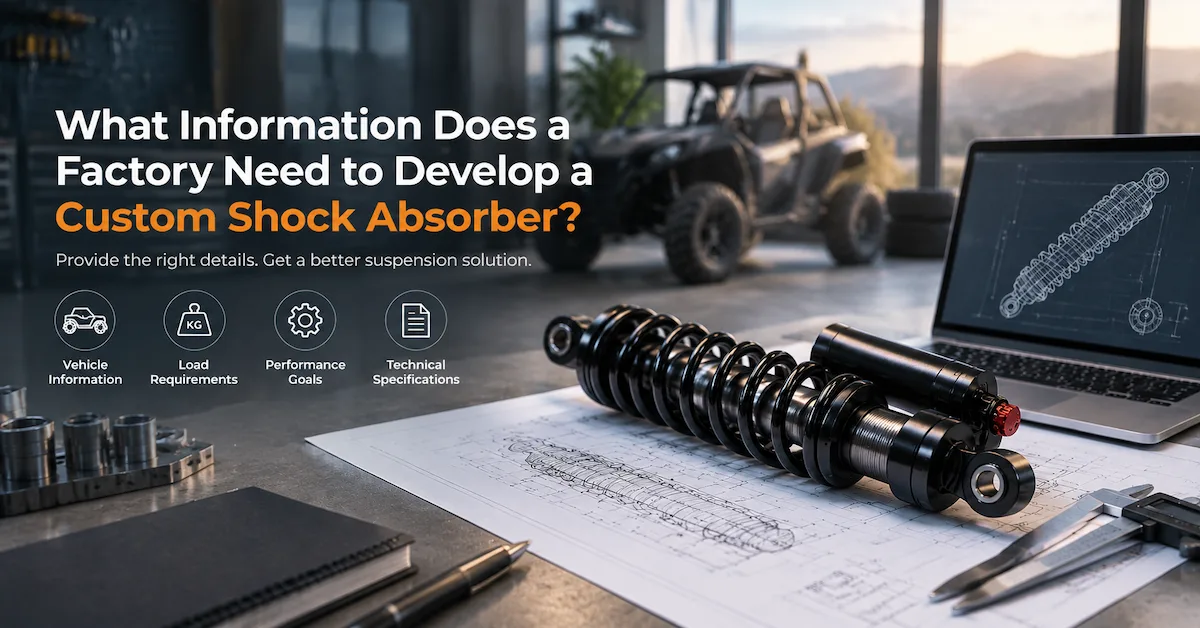
What Information Should OEM Buyers Provide to a Shock Absorber Factory?
A complete technical package helps the factory provide better recommendations.
| Information | Purpose |
|---|---|
| Vehicle type | Defines application |
| ATV/UTV model | Confirms platform |
| Front/rear position | Defines suspension role |
| Existing shock sample | Reference information |
| Technical drawing | Manufacturing accuracy |
| CAD file | Engineering analysis |
| Extended length | Fitment |
| Compressed length | Travel limitation |
| Stroke | Suspension movement |
| Mount dimensions | Installation |
| Vehicle weight | Spring selection |
| Payload | Load support |
| Terrain | Damping target |
| Production quantity | Manufacturing planning |
If the buyer does not have complete technical data, providing the actual application problem is still useful.
For example:
The rear suspension needs better support when carrying cargo.
is more valuable than:
Need stronger shocks.
Why Prototype Validation Matters Before Mass Production
For OEM suspension projects, prototypes reduce development risks.
Without prototype testing, problems may appear after bulk production:
- Incorrect installation
- Wrong spring rate
- Poor ride height
- Insufficient travel
- Incorrect damping response
A typical development path is:
Requirement Review → Engineering Design → Prototype → Testing → Revision → Production
For projects based on existing products or samples, see:
How Does a Shock Absorber Factory Control Quality?
Quality control is critical because suspension parts experience repeated loads and harsh operating conditions.
A reliable factory should control multiple stages.
Material Inspection
Check:
- Steel materials
- Springs
- Seals
- Purchased components
Manufacturing Process Control
Monitor:
- Machining accuracy
- Assembly process
- Welding quality
- Surface treatment
Final Inspection
Depending on product requirements:
- Dimension inspection
- Leakage testing
- Appearance inspection
- Functional verification
Production Consistency
For OEM customers, the goal is not only making one successful sample.
The factory must reproduce the approved specification consistently across future orders.
This requires:
- Controlled drawings
- Revision management
- Inspection standards
- Production records
What ATV and UTV Applications Can OEM Shock Factories Support?
A professional shock absorber manufacturer may support multiple vehicle applications.
ATV Applications
Including:
- Recreational riding
- Trail riding
- Utility work
- Off-road modification
Key requirements:
- Compact design
- Durability
- Proper spring support
- Terrain adaptability
UTV Applications
Including:
- Utility vehicles
- Agricultural applications
- Cargo transport
- Adventure vehicles
Key requirements:
- Higher payload support
- Passenger load consideration
- Long-term durability
Specialty Vehicles
Including:
- Golf carts
- Electric vehicles
- Small utility vehicles
- Custom platforms
Each application requires different suspension considerations.
How to Evaluate a China Shock Absorber Factory?
Before choosing a supplier, OEM buyers should evaluate several areas.
1. Product Experience
Ask:
- What vehicles does the factory support?
- Does it manufacture shock absorbers directly?
- Does it have OEM project experience?
2. Engineering Support
Confirm whether the supplier can work with:
- Drawings
- CAD
- Samples
- Vehicle specifications
3. Prototype Capability
Check whether the supplier supports:
- Sample production
- Engineering changes
- Testing feedback
4. Quality System
Review:
- Inspection process
- Production control
- Documentation management
5. Communication Ability
OEM projects require clear communication about:
- Requirements
- Changes
- Approvals
- Production schedules
Why Choose Bedo Auto as Your China Shock Absorber Manufacturing Partner?
Bedo Auto supports OEM customers with suspension development and manufacturing solutions.
The company provides support for:
- Shock absorber customization
- Suspension spring development
- Sample analysis
- Drawing review
- Prototype production
- Engineering improvement
- OEM production preparation
For ATV and UTV projects, Bedo Auto can support the development process from initial concept evaluation to production preparation.
Explore:
What Should Be Included in an OEM Shock Absorber RFQ?
Before contacting a factory, prepare:
- Vehicle model
- Suspension position
- Product application
- Existing sample
- Technical drawings
- CAD files
- Shock dimensions
- Spring requirements
- Vehicle weight
- Load requirements
- Terrain conditions
- Performance target
- Prototype quantity
- Production volume
- Branding requirements
- Packaging requirements
A detailed RFQ allows the supplier to provide more accurate engineering suggestions and quotations.
FAQ
Who is a reliable China shock absorber factory for OEM ATV and UTV projects?
A reliable China shock absorber factory should provide manufacturing capability, engineering support, prototype development, quality control, and stable production for OEM projects.
How do I verify whether a shock absorber factory is a real manufacturer?
Check production capability, engineering team, product range, factory information, prototype experience, and quality-control process.
Can a China shock absorber factory customize ATV and UTV shocks?
Yes. Customization may include dimensions, springs, damping, mounting structures, appearance, and branding.
Can a factory develop shock absorbers from drawings?
Yes. Professional suspension manufacturers can review technical drawings and CAD files for custom development.
Can a shock absorber factory develop products from samples?
Yes. Existing samples can be analyzed for dimensions, structure, and manufacturing reference.
How long does OEM shock absorber development take?
Development time depends on product complexity, prototype requirements, testing, revisions, and production preparation.
What MOQ is required for OEM shock absorbers?
MOQ depends on customization level, materials, production process, and packaging requirements.
Should OEM buyers test prototypes before mass production?
Yes. Prototype validation helps confirm fitment, performance, and production feasibility before larger orders.
Can UTV shock absorbers be customized for heavy loads?
Yes. Spring specifications and damping characteristics can be developed according to vehicle weight and payload requirements.
How do I start an OEM suspension project with Bedo Auto?
Prepare vehicle information, drawings, samples, technical requirements, and production expectations, then contact Bedo Auto for project evaluation.
Conclusion
Choosing a reliable China shock absorber factory for OEM ATV and UTV projects requires evaluating much more than production price.
The right manufacturing partner should provide:
Engineering Capability + Custom Development + Prototype Validation + Quality Control + Production Reliability
A professional suspension factory helps OEM buyers move from concept to production through:
Requirement Analysis → Engineering Review → Prototype → Testing → Production
For ATV, UTV, and specialty vehicle brands, working with an experienced shock absorber manufacturer can reduce development risks and improve long-term product consistency.
Bedo Auto supports customized suspension projects through shock absorber development, spring customization, prototype manufacturing, and OEM production preparation.
If you are developing a new ATV or UTV suspension product, prepare your technical requirements and contact Bedo Auto for project evaluation.