
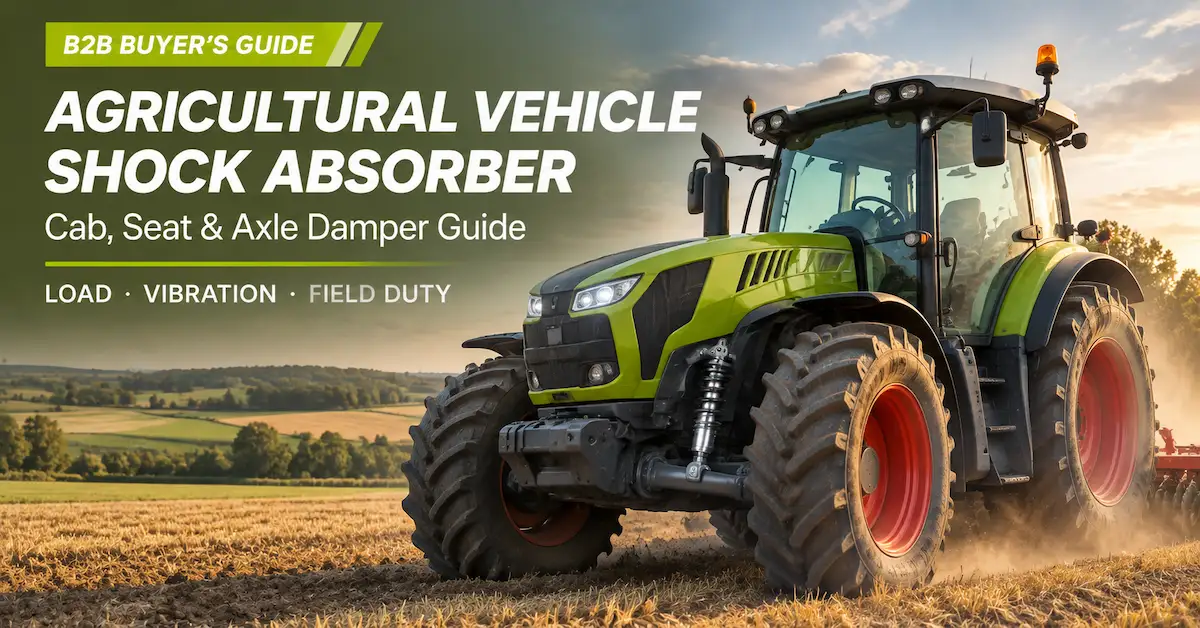
An agricultural vehicle shock absorber is a damper specified for a machine that works at low ground speed under high static load and continuous vibration exposure — a tractor, sprayer, harvester, telehandler or trailed implement — rather than for a passenger car. The specification must name the mounting position (cab, seat or axle), the laden and unladen mass at that corner, the available stroke, the spring rate, the damping force at a stated test speed, and the cleaning and chemical exposure the seal will see.
Most sourcing problems in this category start with a part number copied from a passenger-car catalogue. The dimensions look plausible, the price looks attractive, and the first season in the field exposes the gap. This guide is written for agricultural machinery OEMs, implement builders, dealers, fleet workshops and aftermarket brands that need to turn a machine duty cycle into a supplier-ready damper specification, and it explains what to ask an agricultural shock absorber supplier before any quotation is compared.
What an agricultural vehicle shock absorber has to do
Agricultural machinery suspension rarely uses one damper design across the whole machine. A tractor may carry a cab suspension, a seat suspension and, on some platforms, a front axle suspension. A self-propelled sprayer adds a boom ride system. A combine harvester adds header float and sieve control. A trailed implement may use only rubber buffers or a single damper per axle.
Three positions, three different jobs
| Mounting position | Primary job | Typical failure if under-specified |
|---|---|---|
| Cab suspension | Isolate the operator platform from axle and chassis inputs so whole body vibration stays tolerable | Operator fatigue and complaints, cracked cab mounts, failed isolators |
| Seat suspension | Absorb the residual vibration the cab lets through, at small amplitude | Bottoming, damaged seat frame, poor operator comfort |
| Axle or implement | Control wheel or implement motion, protect tyres, frame and linkage | Bottoming on ruts, oil leakage, bent rod, uneven tyre wear |
The same part number cannot serve all three positions. A cab suspension shock absorber is tuned for a small platform mass and low amplitude. An axle damper on a loaded sprayer may control several tonnes of sprung mass and a much larger unsprung mass. Treating them as interchangeable is the single most common engineering error in this category.
Why agricultural duty breaks passenger-car assumptions
Low speed, high load, long exposure
A field-working tractor may never exceed 40 km/h, yet it can run ten hours a day through a whole season. The damper does not see many high-velocity impacts. It sees millions of low-amplitude cycles at roughly 2 to 8 Hz, which is exactly the frequency band where whole body vibration is most uncomfortable for the operator.
That shifts the design emphasis away from peak force capacity and towards heat management, seal life, rod finish and consistency over time. A tractor shock absorber that survives a pothole at highway speed can still fail after one season of continuous field vibration, because the failure mode is different: oil degradation and seal wear rather than a single overload event.
Dust, slurry, fertiliser and wash-down
The working environment is chemically and mechanically aggressive in ways a road vehicle never sees. Dust abrades the rod. Slurry and fertiliser residue are corrosive. High-pressure wash-down pushes water past a worn wiper. Salt used on winter roads adds another attack path for machines that also do transport work.
Ask specifically which surface treatment is applied to the rod, the tube and the spring, how the wiper is retained, and which cleaning agents are approved. "Corrosion-resistant" is not a specification until the test method, the exposure condition and the acceptance criterion are written down.
The specification sheet to send before you ask for a price
A quotation is only as good as the brief behind it. Send the information below as one package. Where a value is unknown, write "to be confirmed" rather than guessing, because an honest gap is easier to close than a wrong number.
| RFQ section | Minimum information | Supporting file |
|---|---|---|
| Machine identity | Machine type, platform, model year, mounting position, annual volume, target market | Machine specification sheet and clear photographs |
| Installation | Extended and compressed length, stroke, bore, rod diameter, mounting hole diameter, mounting width, orientation, clearance to frame and tyre | Dimensioned 2D drawing, 3D CAD file, or a measured sample |
| Load states | Unladen, typical working, peak payload, attachment or trailer load, and axle distribution for each state | Mass table and photographs of the working configuration |
| Performance target | Ride height, bottoming limit, comfort target, stability concern, fixed or adjustable preference | Existing ride report, competitor sample, operator feedback |
| Environment | Dust, slurry, fertiliser, salt, wash-down method, temperature range, storage, service interval | Maintenance procedure and field photographs |
| Commercial plan | Sample quantity, pilot batch, expected annual demand, launch date, packaging and labelling needs | Forecast and purchase specification |
Ask the supplier to return an assumption list with the quotation. That list should state which dimensions came from you, which values were estimated, and which performance items remain open. It is usually more valuable than a glossy brochure because it makes the boundary between confirmed data and engineering judgement visible.
Spring rate and damping: convert adjectives into numbers
Spring rate and ride height
Spring rate is a number with units, not an adjective. It should be stated together with the load point at which it is measured, the free length, the installed length and the tolerance. "Heavy duty" tells a buyer nothing about whether the machine will hold ride height when a full spray tank sits behind the rear axle.
Preload can adjust installed height and initial support, but it cannot create stroke or correct a fundamentally under-rated spring. A sprayer suspension spring that is too soft leaves no reserve for the next rut, even after preload is added. A spring that is too stiff costs tyre contact on rough ground, and the operator feels every stone through the platform.
Compression and rebound at a stated speed
Damping force is meaningless without a test velocity and a direction. A single "2000 N" figure could describe rebound, compression, or a peak at an unspecified speed. A comparison between two harvester shock absorber designs is only valid when both suppliers quote the same speed and the same tolerance band.
Our published ATV/UTV reference AU_HSA_01 states damping at an inspection speed of 0.1 m/s, with rebound and compression given separately. That is the level of detail a buyer should demand from any agricultural vehicle shock absorber supplier, even when the eventual part is a different design.
| Published parameter | Reference value on AU_HSA_01 | Why it matters for a specification |
|---|---|---|
| Position and damping type | Rear, fixed damping, no adjustable levels | Tells the buyer that tuning must happen in the design, not at the machine |
| Total length and bore | 465 mm total length, 38 mm cylinder outer diameter | Defines the packaging envelope before stroke is considered |
| Effective stroke | 130 mm | Must be checked against bump-stop engagement, not assumed equal to wheel travel |
| Spring rate | 75 LBS | Meaningless without the load point and installed length |
| Maximum damping force | Rebound 2000 N, compression 650 N | Only comparable when the test speed is stated |
| Inspection speed | 0.1 m/s | The reference velocity that makes the force figures comparable |
| Mounting interface | 10 mm holes, 32 mm width, upper and lower | Prevents a correct-looking but non-fitting part |
| Mass | 3.2 kg | Relevant to unsprung mass and handling on light machines |
What ISO 5008 and EU 167/2013 do and do not cover
Whole-body vibration measurement
ISO 5008:1979 specifies methods for measuring and reporting the whole-body vibration to which the operator of an agricultural wheeled tractor or field machine is exposed. It is a measurement and reporting standard. It gives a buyer and a supplier a common way to compare machine behaviour, but it does not prescribe a spring rate, a damper force or a mounting position.
Use it to define how you will judge the result, then specify the damper separately. A supplier who can describe the test surface, the measurement point, the run speed and the reporting format is easier to hold to an acceptance criterion than one who simply claims "comfortable ride".
Type-approval scope
Regulation (EU) No 167/2013 sets the approval and market surveillance framework for agricultural and forestry vehicles. If the machine is going to a regulated market, the suspension component may sit inside a type-approval or conformity route that the machine manufacturer owns, not the damper supplier.
Clarify early who is responsible for which evidence. A damper supplier can provide dimensional reports, force-versus-velocity data, material records and inspection plans. It cannot approve a vehicle. Writing that boundary into the purchase specification prevents an expensive misunderstanding at launch.
Corrosion, sealing and the working environment
Seal life is usually the limiting factor in agricultural service, not strength. The rod moves through a wiper thousands of times per hour, dragging abrasive dust and dried slurry with it. Once the wiper lip is worn, water enters on the return stroke and the oil emulsifies.
Three questions separate a serious supplier from a catalogue seller. What is the rod surface finish and hardness? How is the wiper retained against pressure washing? What is the approved cleaning agent list? A supplier who can answer all three has thought about the field. A supplier who answers only the first has thought about the drawing.
Springs deserve the same scrutiny. Our published suspension spring reference describes a high-tensile, corrosion-resistant alloy coil with a coated finish. For an agricultural vehicle shock absorber programme, ask for the coating thickness, the salt-spray duration and the acceptance criterion, because a coating that survives a showroom is not the same as one that survives eight seasons of fertiliser dust.
Validation: bench, durability, vehicle
A credible programme separates four evidence types. Skipping one usually moves the failure into the field, where it is far more expensive.
| Evidence type | What it proves | What to request |
|---|---|---|
| Dimensional inspection | The part matches the drawing | First-article inspection report with measured values, not just pass marks |
| Bench performance | The damper produces the intended force at the intended speed | Force-versus-velocity curve at defined speeds, both directions, with tolerance |
| Durability | The seal and oil survive the cycle count | Cycle count, test rig description, failure criteria, post-test leak check |
| Vehicle validation | The machine behaves acceptably in real work | Test surface, speed, load states, measurement point, operator assessment |
Insist that the durability test states its failure criteria. "Passed" without a defined limit is not evidence. An agricultural vehicle shock absorber that leaks slightly at 200,000 cycles may be perfectly acceptable for a seasonal implement and completely unacceptable for a daily-driven telehandler.
Spare-part and small-batch supply for implements
Agricultural supply chains are seasonal and fragmented. An implement builder may need a few hundred units a year across several models, with a spare-part channel that must still work five years after the machine was sold. That has two consequences for sourcing.
First, the damper design should be documented well enough that a repeat batch matches the original. Revision control, drawing numbers and inspection records matter more than unit price when the second order arrives two seasons later.
Second, small-batch capability is a real purchasing criterion, not a marketing phrase. Ask for the actual minimum order quantity, the price break structure, the sample cost and the lead time for each stage separately: drawing review, sample production, sample revision, approval and repeat production. A single "fast delivery" claim is not a plan.
Our published shock absorber and spring references
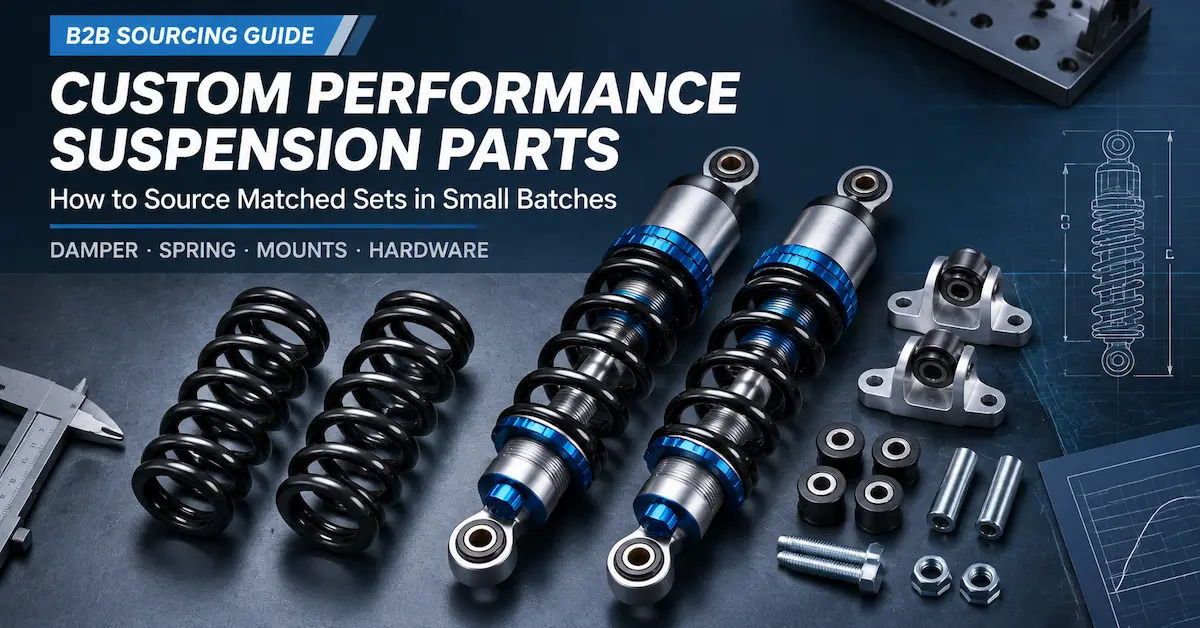
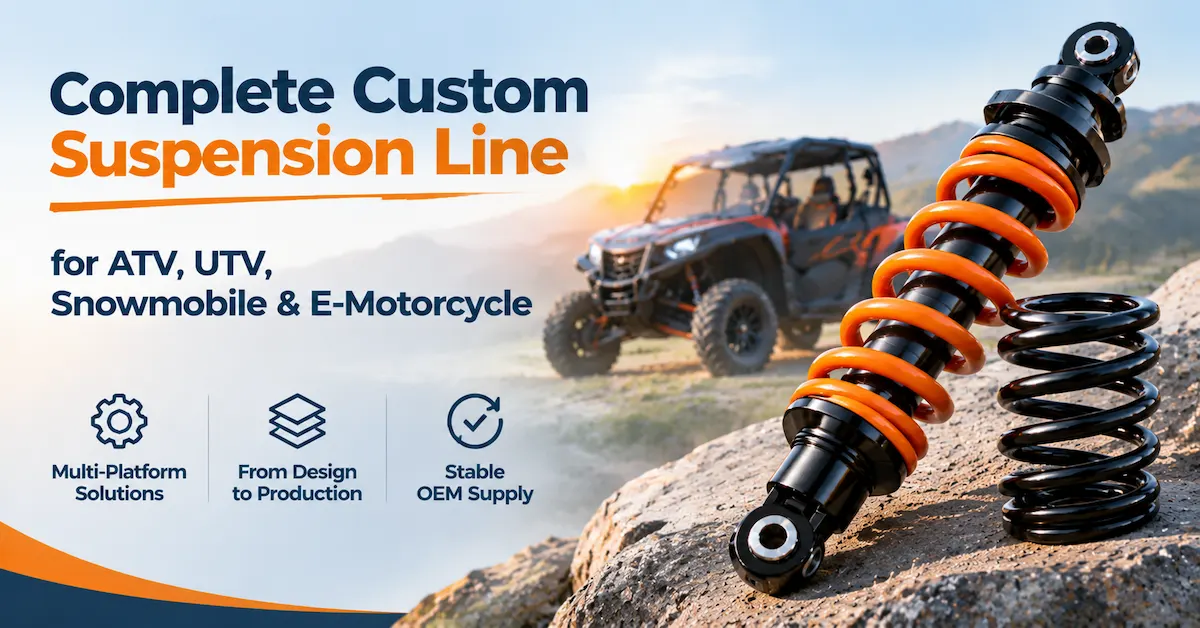
Ningbo Bedo Auto Parts Co., Ltd. manufactures shock absorbers and suspension springs, with published applications including ATV and UTV, motorcycles, electric motorcycles, beach buggies, snowmobiles and golf carts. Our company profile describes customised solutions, professional design support and small-batch ordering support.
We do not publish a dedicated agricultural machinery damper range, so we will not claim one. What we can offer an agricultural vehicle shock absorber buyer is a documented starting point and an engineering conversation. The table below lists published reference data from our ATV/UTV range. It is a reference for discussing stroke, spring rate and damping structure, not a statement that either part is suitable for a tractor, sprayer or harvester.
| Published reference | Listed data | Relevance to an agricultural project |
|---|---|---|
| ATV/UTV shock absorber AU_HSA_01 | Rear position; 465 mm total length; 38 mm cylinder outer diameter; 130 mm effective stroke; 75 LBS spring rate; rebound 2000 N and compression 650 N at 0.1 m/s inspection speed; internal gas chamber with oil-gas separation; aluminium alloy and steel pipe; 10 mm mounting holes and 32 mm mounting width at both ends; fixed damping; 3.2 kg; black, white, green and red options | Useful for discussing a long-stroke rear application and for showing what a complete published specification looks like |
| ATV/UTV shock absorber AU_HSA_02 | Rear position; 395 mm total length; 80 mm effective stroke; 250 LBS spring rate; rebound 3000 N and compression 550 N; 12 mm mounting holes; upper 40 mm and lower 32 mm mounting widths; fixed damping; 3.8 kg | Shows how much the spring rate and force balance change between two otherwise similar dampers |
| Suspension spring range | Precision-wound, load-tested coil springs positioned for consistent ride height, weight support and suspension tuning | Relevant when the agricultural requirement is spring support rather than damping |
If your machine needs a cab damper, a seat damper or an axle damper, the honest starting point is a project review. Send the machine data and ask us to confirm which published family is closest, what would have to change, and what evidence we can provide. Our shock absorber range shows the current catalogue structure.
Common mistakes in agricultural vehicle shock absorber sourcing
Specifying by model name only. A machine model does not describe the load state, the attachment or the duty cycle. Two machines of the same model can need different springs if one carries a front weight block and the other does not.
Comparing force figures without a test speed. A 3000 N claim at an unknown velocity cannot be compared with a 2000 N claim at 0.1 m/s. The numbers are not on the same axis.
Assuming stroke equals wheel travel. On a linkage or a lever arrangement, wheel travel and damper stroke differ by the motion ratio. A damper that is dimensionally correct can still bottom before the machine's bump stop.
Using preload as a substitute for spring rate. Preload changes installed height. It does not add stroke, and it does not fix a spring that is wrong for the loaded mass.
Ignoring the wash-down procedure. A seal that survives rain can fail after a season of high-pressure cleaning with an aggressive detergent. Ask what the supplier expects the machine to be cleaned with.
Accepting "passed" without a limit. Durability evidence needs a cycle count and a failure criterion. Otherwise it is an opinion.
Freezing the price before freezing the specification. Comparing three quotations with different spring rates, finishes and inspection plans produces a cheap part, not a good decision. An agricultural shock absorber supplier who resists that discipline is telling you something about how the programme will run.
Frequently asked questions
Do agricultural vehicles use shock absorbers at all?
Many do, but not everywhere. A basic tractor may rely on tyre deflection and a mechanical seat suspension. Machines with a suspended cab, a suspended front axle, a self-propelled sprayer chassis or a trailed implement axle usually do use dampers, and the specification differs by position.
Can I use an ATV or UTV shock absorber on a tractor?
Only after a full load and geometry review, and usually not. The mass at each corner, the stroke, the mounting interface and the duty cycle are all different. A published ATV reference is a starting point for a technical conversation, not a fitment approval.
What spring rate does an agricultural vehicle shock absorber need?
There is no universal number. The rate follows from the sprung mass at that corner, the motion ratio, the target ride height and the load range. It must be quoted with the load point, the free length and the tolerance to be meaningful.
Is a cab suspension damper the same as an axle damper?
No. A cab damper controls a small platform mass at low amplitude and is tuned for operator comfort. An axle damper controls a much larger mass and must survive impact loading. Sharing a part number between them usually compromises both.
How does ISO 5008 help me choose a damper?
It does not choose one. ISO 5008:1979 specifies how to measure and report whole-body vibration for an agricultural wheeled tractor or field machine. It gives you a comparable test method and reporting format, which you then pair with your own damper specification.
What is a realistic development lead time?
It depends on how much is new. A dimensional variant of an existing damper is fast. A new spring rate, new valving and a new mounting interface require drawing review, sample production, vehicle validation and approval, and each stage should be quoted separately rather than promised as one number.
How do I verify corrosion protection before ordering?
Ask for the surface treatment of each component, the coating thickness, the salt-spray duration and the acceptance criterion. Then confirm which cleaning agents are approved. A claim of corrosion resistance without a test method cannot be audited.
What should be in the first enquiry?
Machine type and platform, mounting position, measured or drawn dimensions, load states, working environment, annual volume, target date, and the specific questions you want answered about samples, minimum order quantity, lead time, test records and packaging. Send it as one document so the supplier can respond to the whole requirement.
Conclusion
Specifying an agricultural vehicle shock absorber comes down to replacing adjectives with numbers. Name the mounting position, the mass at that corner in every load state, the stroke available after the motion ratio, the spring rate with its load point, and the damping force with its test speed. Then define the environment, the cleaning method and the acceptance evidence before you compare prices.
That brief is also the fastest way to find out whether a supplier can actually help. If you are working on a tractor, sprayer, harvester or implement programme, send the machine data through our contact page and we will tell you which published reference is closest, what would have to change, and what evidence we can supply. You can also compare the current shock absorber range and our farm ATV suspension guide for the adjacent application.