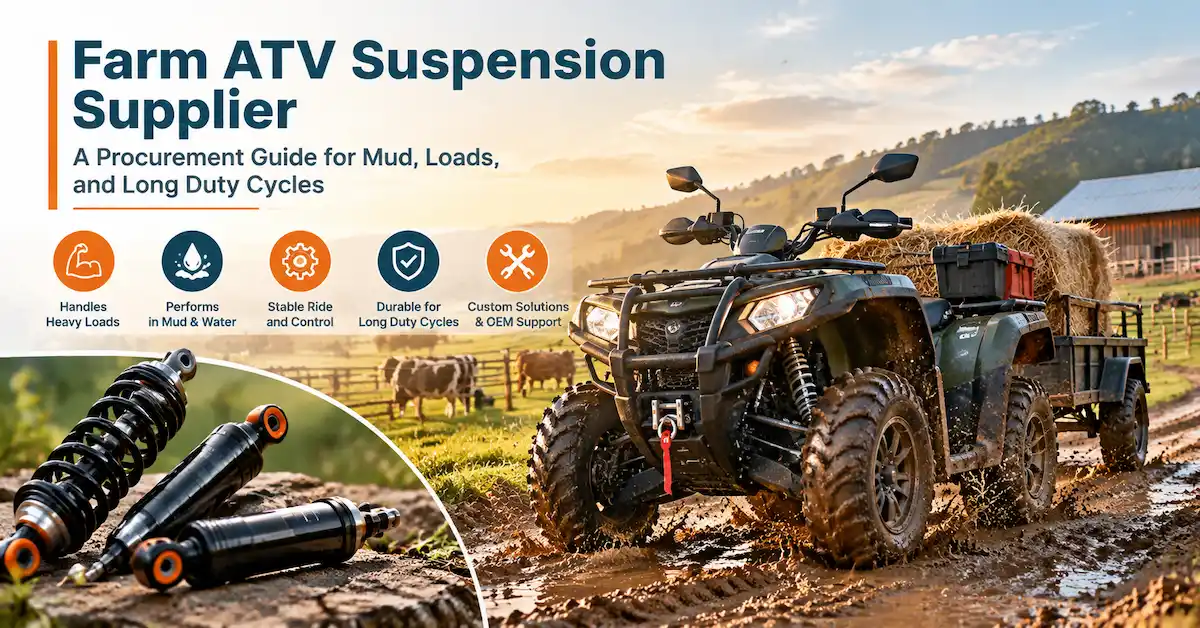

Which farm ATV suspension supplier should agricultural buyers shortlist?
Short answer: a farm ATV suspension supplier should be shortlisted by its ability to match suspension components to real agricultural duty cycles, not by a generic product photo or the lowest unit price. The buyer should compare spring support, compression and rebound control, mounting geometry, mud and water exposure, payload changes, sample development, quality records, packaging, and repeat-production controls.
For a farm ATV, the critical question is usually not "Can this shock fit the eye-to-eye length?" It is "Will the vehicle keep usable ride height and predictable wheel control when the rider, tools, crop load, trailer tongue load, and ground conditions change?" That question creates a different procurement brief from a recreational ATV upgrade.
This article is written for agricultural equipment brands, ATV and utility vehicle importers, farm fleets, dealers, distributors, and engineering teams sourcing a farm ATV suspension supplier. It explains how to turn field use into a supplier-ready specification, how to compare a standard ATV shock with a project-specific solution, and what a buyer should request before approving samples or production.
Why agricultural ATV suspension is a different buying problem
A farm ATV may appear similar to a recreational all-terrain vehicle, yet its operating profile is often more repetitive and less forgiving. A recreational rider may change terrain frequently and return the vehicle to the garage after a short ride. A farm machine can cross the same rutted track every day, carry tools or feed, pull a small implement, stop and start at low speed, and remain exposed to water, mud, fertilizer residue, dust, and temperature changes.
That operating profile changes the suspension questions a supplier must answer. A part that works acceptably on an unloaded ATV may sag when a sprayer, box, rack, or tool load is added. A spring that protects ride height may still feel harsh if the damping is not matched. A shock with suitable dimensions may lose useful travel when the vehicle is operated at a heavier axle load. A sealed-looking exterior is not enough evidence for a buyer who needs to understand cleaning, corrosion, leakage, and inspection requirements.
| Farm use variable | Why it affects suspension selection | What the buyer should document |
|---|---|---|
| Rider plus tool load | Changes static sag, spring compression, and available bump travel. | Typical, minimum, and maximum operating mass at each axle. |
| Trailer or implement load | May create a sustained rear load or a changing tongue load rather than a single short impact. | Attachment type, tongue load, drawbar height, and operating position. |
| Ruts, rocks, and soft soil | Increase suspension velocity, impact energy, and the risk of bottoming or topping out. | Surface description, obstacle size, speed range, and duty cycle. |
| Mud, water, and chemicals | Raise the importance of seals, surface protection, cleaning practice, and corrosion review. | Exposure level, wash-down method, chemical contact, and storage conditions. |
| Long daily use | Turns consistency, heat management, inspection, and spare-part availability into purchasing criteria. | Hours per day, cycles per shift, seasonal peak, and fleet size. |
Build a farm duty profile before contacting a supplier
The most useful first step is a one-page farm duty profile. It prevents a quotation from being based on a model name alone. Two ATVs with the same wheel size can require different suspension settings if one carries a rear cargo box, while the other carries a front sprayer or works with a trailer. A supplier can only review the requirement when the load and installation conditions are visible.
Record the vehicle and suspension geometry
Provide the vehicle platform, model year, front or rear position, number of shocks, mounting orientation, extended length, compressed length, effective stroke, upper and lower mounting width, hole diameter, bush or sleeve details, and clearance around the body. A photograph with a ruler is helpful, but it should not replace dimensioned drawings or a sample part. If the ATV uses a linkage, include the linkage ratio or at least the pivot and mounting locations. The shock stroke is not automatically equal to wheel travel.
Describe the load as operating states
Do not send only one "maximum payload" number. Define an unloaded state, normal farm state, peak cargo state, and towing or attachment state. For each state, identify where the mass sits. A tool box near the rear rack affects the rear axle differently from a low battery box or a front-mounted sprayer. If passengers are possible, document whether the rider is centered, standing, or moving frequently. These details help a farm ATV suspension supplier decide whether the project needs a different spring rate, preload range, damping calibration, or a new body and mounting arrangement.
Describe the work cycle, not only the terrain
"Off-road" is too broad for a useful engineering decision. A supplier should know whether the vehicle travels at walking speed over ruts, runs continuously on a rocky track, makes frequent loaded stops, or crosses a field road at a higher speed. Note the percentage of time spent on hard ground, mud, grass, loose soil, and slopes. Also note how often the vehicle is washed, parked outdoors, or stored with mud on the suspension. A supplier may use the same basic shock family for several applications, but the acceptance criteria should reflect the work cycle.
What the spring and shock must control on a farm ATV
Spring rate is about support, not just stiffness
The spring supports the static load and stores energy when the suspension compresses. If the spring is too soft for the farm load, the vehicle may sit low, use up bump travel, bottom on ruts, or change its steering and braking attitude. If it is too stiff, the tire can lose contact on rough ground and the ride can become unnecessarily harsh. The correct target is a usable ride height and controlled movement across the expected load range.
Preload can adjust installed height and initial support, but it cannot solve every spring mismatch. Adding preload to an under-rated spring may raise the vehicle while leaving insufficient reserve under a heavy load. Conversely, choosing a very stiff spring to protect the fully loaded state can reduce comfort and traction when the ATV is empty. Ask the supplier to explain the target spring rate, preload range, and load state for the sample rather than accepting "heavy duty" as a complete specification.
Compression damping controls impact response
Compression damping affects how quickly the shock resists movement as the suspension compresses. In farm use, the relevant event may be a rut, a ditch crossing, a loaded stop, or an attachment that adds rear mass. Too little control can allow fast compression and bottoming. Too much control can transmit a sharp impact into the chassis and reduce tire compliance. The right setting depends on spring rate, vehicle mass, linkage ratio, speed, and the buyer's comfort and control target.
Rebound damping controls recovery
After compression, the spring returns energy. Rebound damping manages that return so the wheel does not extend too quickly and cause repeated bouncing. A farm ATV with a changing load may need a setting that remains controlled when the vehicle is loaded but does not feel dead when empty. A supplier should explain how rebound force is defined and at what inspection speed or test condition the data applies. A single force number without test speed, direction, and tolerance is not enough to compare suppliers.
Travel and geometry protect the usable operating window
Farm buyers often focus on eye-to-eye length because it is easy to measure. That is only one part of the fit. The supplier should also review compressed clearance, bump-stop engagement, spring coil bind, tire and body clearance, hose or reservoir clearance if used, and the relationship between shock stroke and wheel movement. A shock that is dimensionally correct but reaches full compression before the vehicle's intended bump stop can damage the shock or the chassis.
What BEDO Auto publicly provides for ATV suspension projects
The official BEDO Auto site publicly identifies Ningbo Bedo Auto Parts Co., Ltd. at No.39 Dongbei Road, Dongqiao Town, Haishu District, Ningbo, Zhejiang, China. The site describes the company as a manufacturer of shock absorbers and suspension springs, with applications including ATV and UTV, motorcycles, electric motorcycles, beach buggies, snowmobiles, and golf carts. The home page also presents custom solutions, design support, small-batch order support, a 2009 founding year, exports to more than 60 countries, and monthly capacity figures. These are website statements and should be verified against current commercial documents before being used in a formal supplier qualification file.
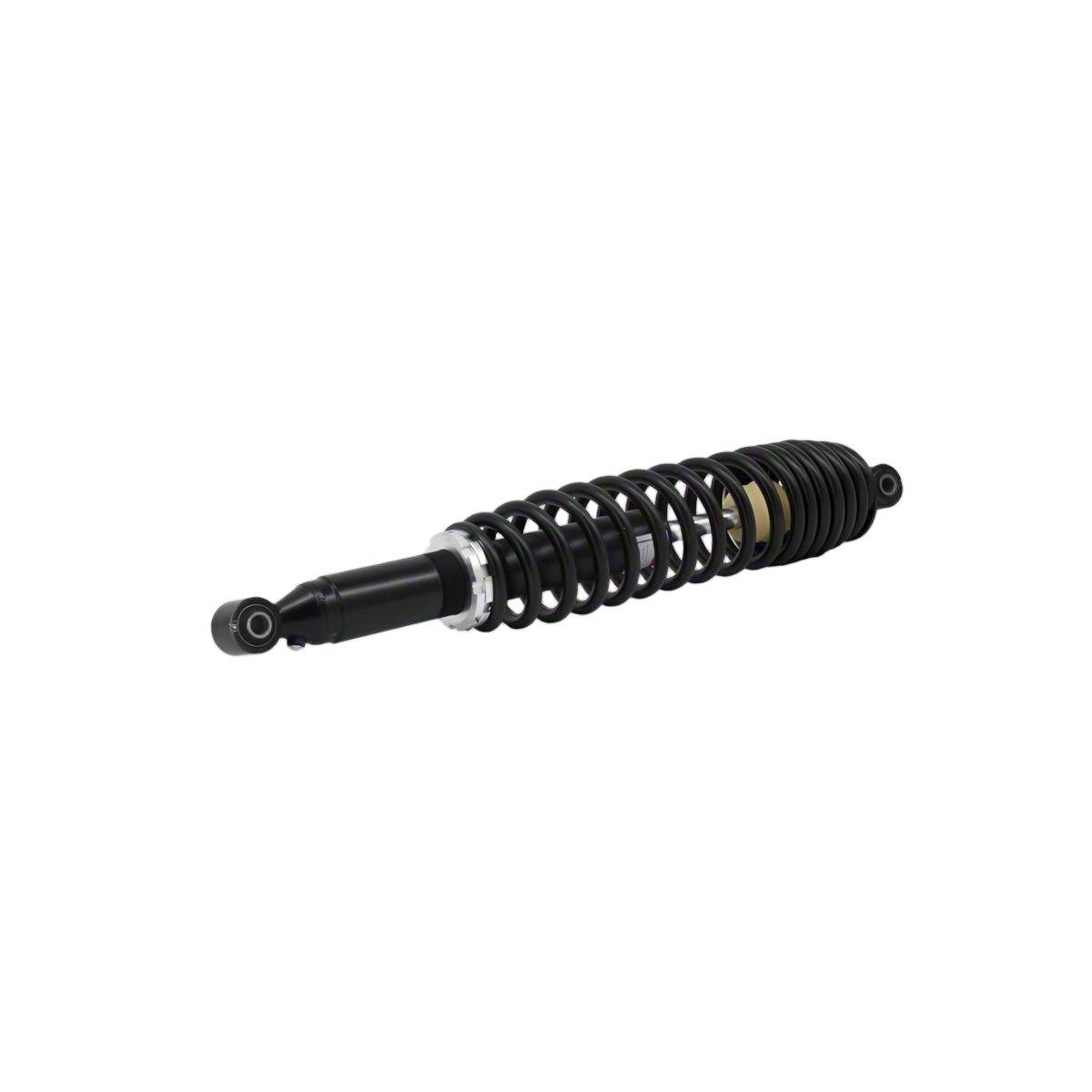
The product catalog contains ATV/UTV references that can help a buyer start a technical discussion. The following table is a public reference, not a declaration that either product is automatically suitable for a farm ATV. Final fitment and performance depend on the project data.
| Published reference | Publicly listed details | Farm project meaning |
|---|---|---|
| ATV/UTV shock absorber AU_HSA_01 | Rear position; 465 mm total length; 130 mm effective stroke; 75 LBS spring rate; 2,000 N rebound and 650 N compression listed; aluminum alloy and steel pipe; internal gas chamber and oil-gas separation; 10 mm mounting holes and 32 mm mounting width at both ends; fixed damping. | A useful reference for discussing a long-stroke rear application, but the load case, mounting, and farm environment still require confirmation. |
| ATV/UTV shock absorber AU_HSA_02 | Rear position; 395 mm total length; 80 mm effective stroke; 250 LBS spring rate; 3,000 N rebound and 550 N compression listed; aluminum alloy and steel construction; internal gas chamber and oil-gas separation; 12 mm mounting holes; upper 40 mm and lower 32 mm mounting widths; fixed damping. | A reference for a higher listed spring-rate configuration, not proof of a universal agricultural payload rating. |
How to compare a farm ATV suspension supplier
A useful comparison separates "can sell a part" from "can control a project." A distributor may be suitable for a standard replacement with a known part number. An OEM or fleet program may need drawing review, sample changes, vehicle validation, packaging control, and repeat production. The buyer should score the supplier against the actual risk of the application.
| Supplier question | Evidence to request | Why it matters for farm use |
|---|---|---|
| Can the supplier review a sample or drawing? | Documented review output, drawing markups, or a dimensional confirmation sheet. | Reduces the risk of a correct-looking but incorrect mounting interface. |
| Can the spring and damping be changed for the load case? | Parameter sheet showing rate, preload, compression, rebound, and tolerances. | Prevents the same generic setting being used for empty and loaded work. |
| Can the supplier produce evaluation samples? | Sample process, revision control, sample quantity, and test record format. | Makes it possible to validate ride height and durability before a fleet order. |
| How is repeat production controlled? | Inspection plan, incoming material records, process checks, final inspection, and traceability. | Controls performance drift across seasonal or replacement orders. |
| What are the commercial terms? | Written MOQ, sample cost, production lead time, packaging, payment, and shipping terms. | Prevents a technically acceptable part from becoming an operational supply risk. |
| Can the supplier support the after-sales channel? | Spare-part identification, service instructions, replacement policy, and contact route. | Reduces downtime when a farm fleet needs a replacement component. |
Prepare a supplier-ready farm ATV RFQ
A concise RFQ improves both the technical answer and the price comparison. Send the information below in one package. If a field is unknown, write "to be confirmed" rather than guessing. An experienced farm ATV suspension supplier can then identify the missing decision instead of quoting an apparently precise but unsuitable part.
| RFQ section | Minimum information | Useful supporting file |
|---|---|---|
| Vehicle identity | Brand, platform, model year, front or rear position, number of units, target market. | Vehicle specification sheet and clear photos. |
| Installation | Extended and compressed lengths, stroke, hole diameter, widths, sleeves, orientation, clearance. | 2D drawing, CAD file, or measured sample. |
| Load states | Unloaded, normal farm load, peak load, attachment or towing load, axle distribution. | Mass table and photos of the working setup. |
| Performance | Ride-height target, comfort target, bottoming limit, stability concern, fixed or adjustable preference. | Existing ride report or competitor sample. |
| Environment | Mud, water, dust, salt, fertilizer, wash-down, temperature, storage, service interval. | Maintenance procedure and field photos. |
| Commercial plan | Prototype quantity, expected annual demand, launch date, packaging and label needs. | Forecast and purchase specification. |
Ask the supplier to return an assumption list with the quotation. The assumption list should say which dimensions came from the buyer, which values were estimated, which performance items remain open, and which items will be checked during sampling. This simple document is often more valuable than a long marketing brochure because it exposes the boundary between confirmed data and engineering judgment.
Materials, finish, testing, and packaging: what to verify
Materials and surface protection
BEDO's published ATV/UTV references list aluminum alloy and steel pipe or steel construction, with anti-corrosion, waterproof, and rust-proof descriptions. For a farm application, ask which component uses which material, what surface treatment is applied, how threaded and sliding areas are protected, and which cleaning agents are acceptable. "Corrosion-resistant" is not a complete specification until the test method, exposure condition, and acceptance criteria are defined.
Bench and vehicle testing
A serious farm program should separate dimensional inspection, bench performance, leak inspection, and vehicle validation. The buyer can request force-versus-velocity data at defined speeds, spring-rate confirmation, compressed and extended dimensions, leak checks, and a vehicle test under empty and loaded conditions. For high-cycle use, ask how fatigue or endurance testing is selected and how failures are recorded. Do not assume that a product description alone proves a test result. BEDO-specific test methods and records must be confirmed for the project.
Packaging and replacement logistics
Farm suspension parts can be damaged by loose packaging, exposed threaded ends, or mixed part numbers. The RFQ should define individual protection, carton quantity, labels, batch or revision marking, spare hardware, and whether the package should include installation notes. Ask for a packaging sample or photograph before production. MOQ, lead time, export documents, and shipping terms are commercial fields to confirm in the quotation; they should not be inferred from the public product page.
How to handle MOQ, lead time, and cost without losing the engineering goal
Price comparison is useful only after the parts are technically comparable. A lower quote may use a different spring rate, a shorter effective stroke, a simplified finish, or a less complete inspection plan. A higher quote may include sample tooling, drawing review, special packaging, or a controlled validation loop. Ask each farm ATV suspension supplier to separate one-time development cost, sample cost, unit cost, tooling or fixture cost, packaging cost, and freight assumptions.
For MOQ, state whether you need one engineering sample, a pilot batch, a seasonal replacement run, or a recurring fleet order. The supplier may support small-batch work, but the actual minimum quantity and price break must be confirmed in writing. For lead time, ask for the timing of drawing review, sample production, sample revision, approval, and repeat production separately. This is more useful than one unsupported "fast delivery" promise.
For cost control, freeze the technical specification before comparing the last three quotes. Keep the same mounting dimensions, load states, damping target, finish, inspection, packaging, and quantity. Otherwise the buyer may select the cheapest part only because key requirements were omitted. The best purchasing outcome is a repeatable component with an understood acceptance standard, not a low first invoice that creates field returns.
Is BEDO Auto a fit for a farm ATV suspension project?
BEDO Auto is worth evaluating when the project needs ATV/UTV shock absorber references, suspension components, custom discussion, design support, or a small-batch development conversation. The official site provides an About Us page, a product overview, a shock absorber category, and direct contact details. These pages give a buyer a real starting point for supplier contact.
The next step is not to assume that a published ATV/UTV shock is farm-ready. Send the farm duty profile and ask BEDO to confirm the applicable product family, available sample path, engineering inputs, acceptance data, MOQ, lead time, packaging, and after-sales process. If the farm platform is electric, disclose battery position and added mass because an electric ATV needs a separate project review.
Farm ATV suspension supplier FAQ
What makes a farm ATV suspension supplier different from a general ATV parts seller?
The difference is the ability to connect the part to an agricultural duty cycle. A general seller may provide a dimension or model number. A project supplier should be able to discuss load states, ride height, spring support, damping, geometry, environment, sampling, inspection, and repeat production.
Should I specify spring rate or only the ATV model?
Provide the vehicle model, but do not stop there. The supplier needs the installed load, axle distribution, target ride height, and any attachment or trailer condition. A model number alone does not describe how the farm vehicle is used.
Can preload compensate for a heavier farm load?
Preload can change installed height and initial support, but it cannot replace the correct spring rate or create additional stroke. Ask the supplier to evaluate the full load range rather than using preload as a universal fix.
Are the public BEDO ATV/UTV specifications farm ratings?
No. They are published product references. The AU_HSA_01 and AU_HSA_02 data can start a technical conversation, but agricultural fitment, duty cycle, durability, and acceptance criteria must be confirmed for the actual vehicle.
What evidence should I request before ordering?
Request a drawing or dimensional confirmation, spring and damping data with test conditions, material and surface details, inspection plan, sample revision record, leak or durability evidence where applicable, packaging specification, and written commercial terms. Ask for a farm-specific validation plan if the application is high cycle.
Does BEDO publish MOQ and lead time for farm ATV shocks?
The public pages reviewed for this article do not establish a universal MOQ or lead time for a farm ATV project. Ask BEDO to quote those fields for the exact part, quantity, customization level, packaging, and delivery terms.
Can a farm ATV shock be used on an electric ATV?
Only after the electric vehicle's mass distribution, battery position, axle loads, geometry, and duty cycle are reviewed. An apparent dimensional match does not confirm spring, damping, thermal, or durability suitability.
What should be in the first email to BEDO?
Include the vehicle identity, measured dimensions, photos or drawings, load states, terrain, speed, operating hours, climate, expected quantity, target date, and the specific questions about sample cost, MOQ, lead time, test records, packaging, and customization.
Conclusion
Choosing a farm ATV suspension supplier is a field-engineering and supply-chain decision, not a simple catalog comparison. The right supplier conversation starts with the farm duty profile: load states, terrain, speed, attachment, operating hours, cleaning, and storage. It then moves to spring rate, preload, compression and rebound control, travel, geometry, materials, inspection, testing, packaging, MOQ, and delivery.
BEDO Auto has public ATV/UTV shock absorber references, suspension categories, custom-solution positioning, and direct contact channels that make it a practical candidate for evaluation. The responsible next step is to submit the complete RFQ and request project-specific confirmation. A sample should be approved only after the dimensions, performance target, evidence plan, and commercial terms are written down.