
How Do Manufacturers Check Suspension Parts for Manufacturability Before Production?
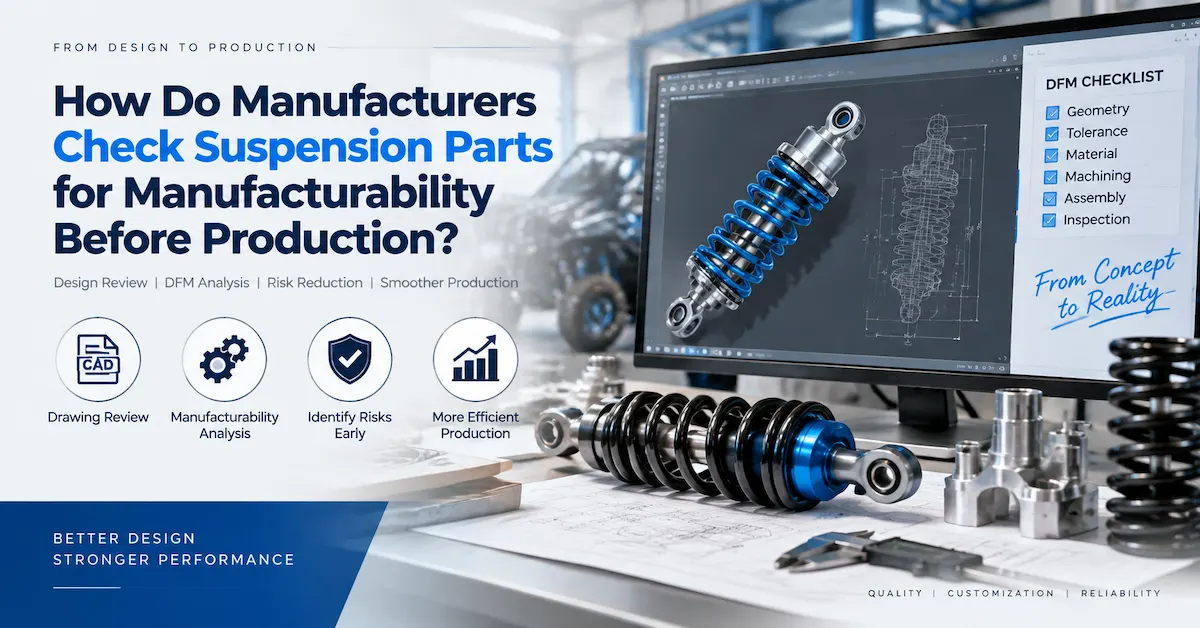
Manufacturers normally perform a suspension manufacturability review before production by checking whether the approved geometry can actually be machined, formed, assembled, inspected, and reproduced at the required quality level. For an ATV shock absorber project, this means looking beyond whether the CAD model fits the vehicle. Engineers also need to review mounting structures, material requirements, tolerances, machining access, spring and reservoir packaging, component interfaces, assembly sequence, inspection methods, and the effect of normal production variation.
BEDO’s ATV shock absorber production process places engineering review before material selection, component production, assembly, testing, inspection, and delivery. This is the correct purchasing logic: a design should be proven manufacturable before volume production is released, not after repeated workshop problems reveal that the drawing is difficult to build consistently.
What Is a Suspension Manufacturability Review?
A suspension manufacturability review is essentially a design-for-manufacturing assessment applied to shock absorbers, springs, mounting parts, reservoirs, bushings, and related suspension components. The supplier examines whether the proposed product can be manufactured repeatedly using the planned materials, processes, tooling, inspection methods, and assembly route.
This review is different from a fitment review. Fitment asks whether the component will install and move correctly in the ATV. Manufacturability asks whether the factory can repeatedly make that approved component without excessive scrap, uncontrolled variation, unnecessary operations, or ambiguous inspection requirements.
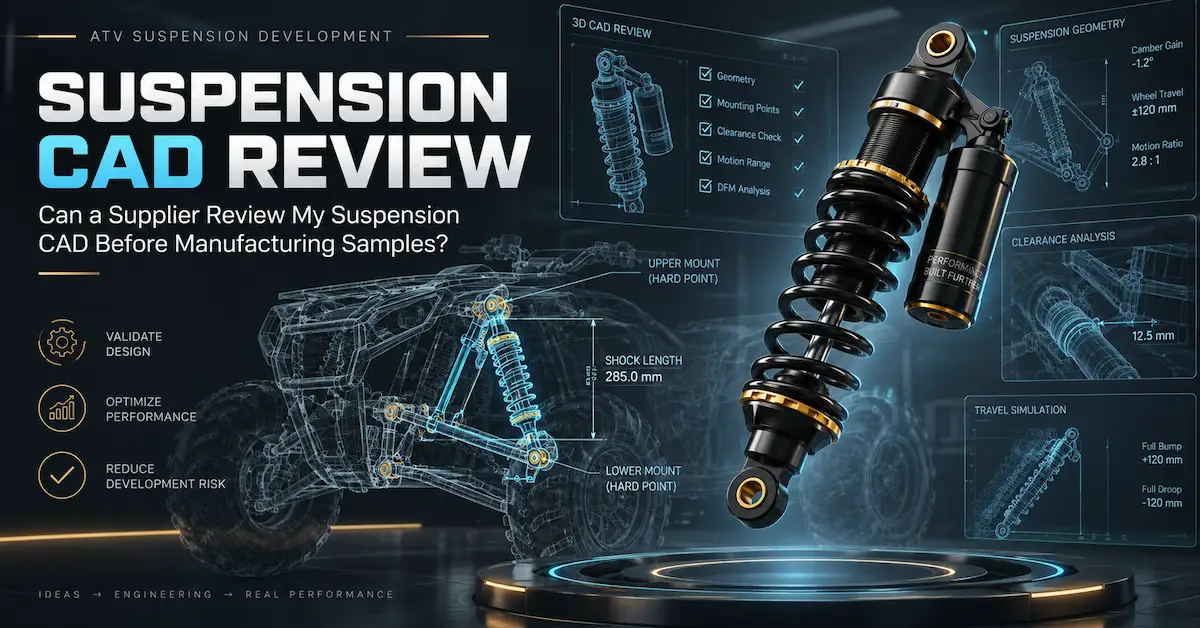
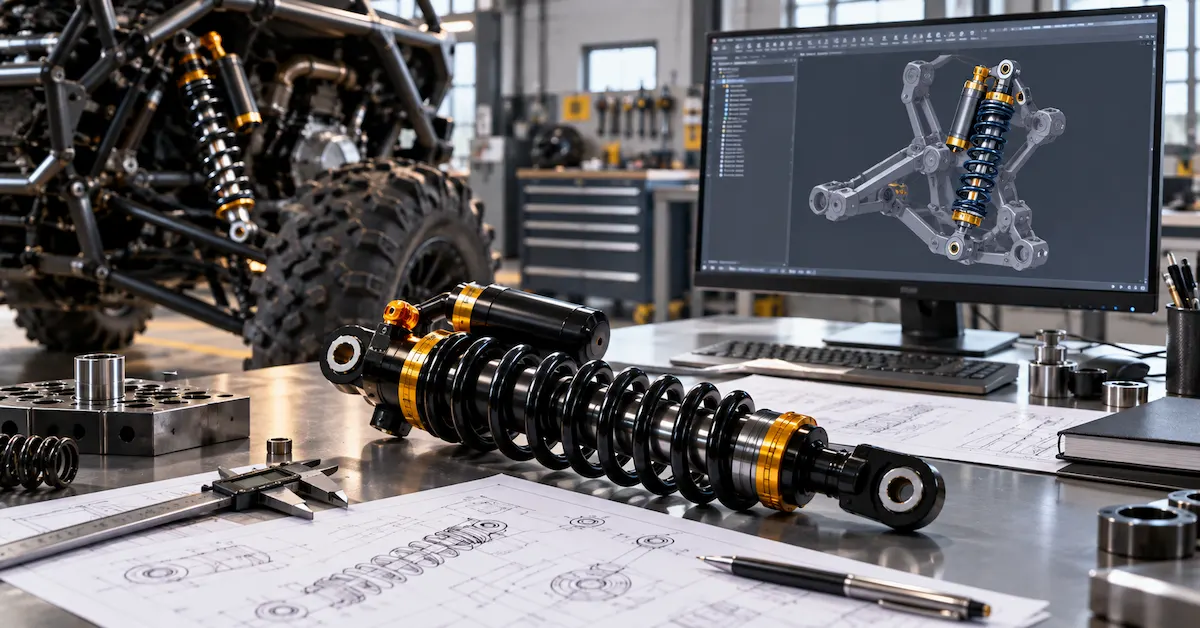
BEDO’s suspension CAD review process is useful before this stage because geometry and interference problems should ideally be resolved digitally. The manufacturability review then focuses more closely on turning that geometry into a repeatable physical product.
Which Buyers Need a Formal Manufacturability Review?
The review is most valuable for OEM vehicle manufacturers, private-label suspension brands, aftermarket companies launching a new SKU, engineering teams developing custom shock dimensions, and buyers moving from prototypes into repeated production.
It becomes particularly important when the project includes:
- new upper or lower mounts;
- custom shock length or stroke;
- larger body dimensions;
- non-standard bushings or sleeves;
- custom spring seats;
- remote or piggyback reservoirs;
- adjustable damping hardware;
- unusual finishes;
- low-volume prototypes expected to scale later;
- drawing-based products from a new supplier;
- reverse-engineered components from physical samples.
A direct replacement part based on an established production platform may require less redesign work, but the buyer should still confirm that the selected configuration, drawings, inspection requirements, and production route are controlled.
Start the Review with the Latest Drawing and CAD Revision
Manufacturability cannot be reviewed reliably when engineering and production are looking at different product definitions. The supplier should first confirm the active drawing, active CAD model, relevant spring or damping specification, prototype version, and any sample used as a reference.
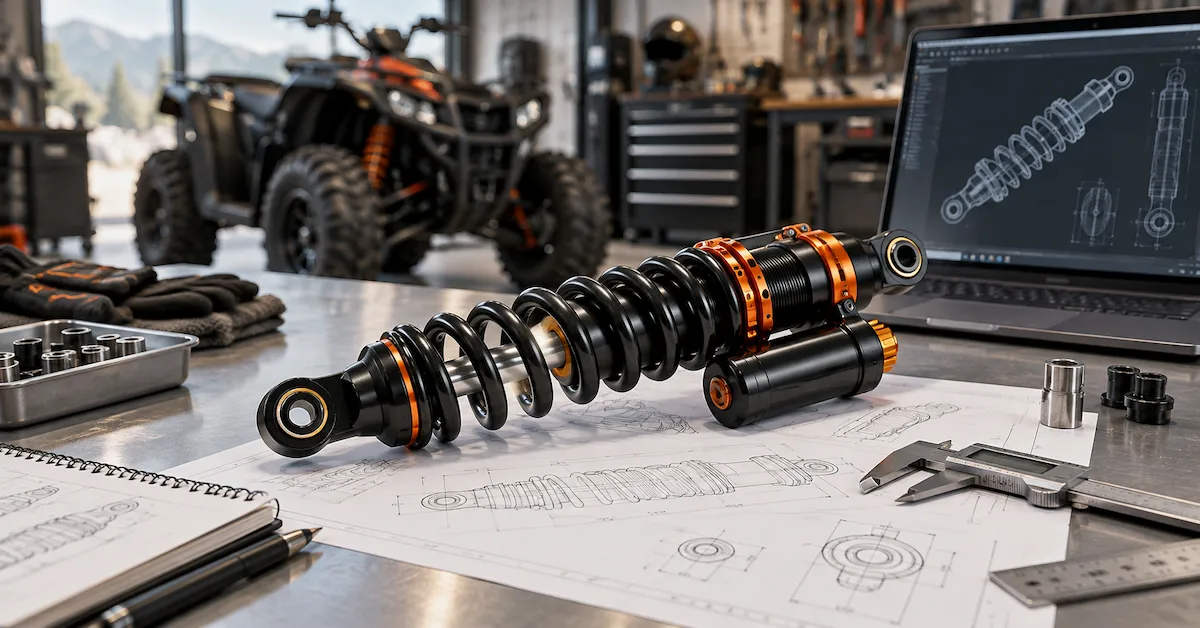
BEDO’s custom suspension development files guide emphasizes keeping drawings, CAD, samples, load data, and test requirements under revision control.
A useful release package should identify:
| Document | Manufacturing purpose |
|---|---|
| Controlled 2D drawing | Critical dimensions, interfaces, tolerances, notes |
| 3D CAD | Geometry, packaging, assembly relationships |
| Spring specification | Dimensions and approved performance reference |
| Damping specification | Approved configuration and test requirements |
| Material specification | Required material or supplier-approved alternative |
| Prototype report | Records validated product configuration |
| Inspection plan | Defines what production must verify |
| Product identification | Links technical version to SKU/part number |
If one file changes, engineering should decide whether any connected document must also be revised.
Review Critical Dimensions Before Reviewing Cosmetic Details
The manufacturer should identify which dimensions directly affect fitment, suspension movement, sealing, assembly, and component alignment. Those dimensions need clearer references and more deliberate control than purely cosmetic measurements.
For an ATV shock absorber, critical areas may include:
| Dimension group | Manufacturability question |
|---|---|
| Extended/compressed length | Can the finished assembly consistently achieve the required range? |
| Upper/lower mounts | Can holes, sleeves and widths be produced and inspected reliably? |
| Rod/body interfaces | Are machining and assembly requirements clearly defined? |
| Spring seats | Can the seat geometry be produced and assembled without interference? |
| Bushings/sleeves | Is the tolerance stack compatible with the vehicle bracket? |
| Reservoir features | Are fittings and mounting points accessible during assembly? |
| Threads | Is tool access sufficient and is required engagement defined? |
| Adjustment hardware | Can adjusters be assembled, indexed and inspected consistently? |
BEDO’s shock absorber technical drawing guide explains why dimensions should be organized around installation, movement, interfaces, and inspection rather than filling a drawing with uncontrolled measurements.
Manufacturers Should Review Tolerance Stacks, Not Individual Tolerances Alone
One of the most important manufacturability checks is how several dimensions interact after normal production variation is considered. A mount can look correct when every nominal dimension is compared separately while still creating interference at the worst-case tolerance condition.
For example, the supplier may need to examine:
Bracket opening → bushing width → sleeve width → washer/spacer stack → final clamped assembly
The objective is not automatically to make every tolerance tighter. Excessively tight tolerances can increase machining time, inspection effort, scrap, and unit cost without improving vehicle performance.
A better question is:
Which dimensions actually require tight control for fit, movement, sealing, or performance?
The supplier should propose a manufacturing range that satisfies function and can be verified using practical inspection methods.
Check Whether Machining Tools Can Reach the Designed Features
A CAD model may contain geometrically valid features that are awkward to machine. Deep internal shoulders, unusually narrow gaps, difficult thread locations, very small corner radii, or features requiring multiple setups can increase cost and dimensional variation.
During a suspension manufacturability review, engineering should consider:
- tool access;
- machining setup direction;
- clamping surfaces;
- required number of setups;
- achievable surface condition;
- thread access;
- drilling depth;
- internal-feature accessibility;
- deburring access;
- inspection-tool access.
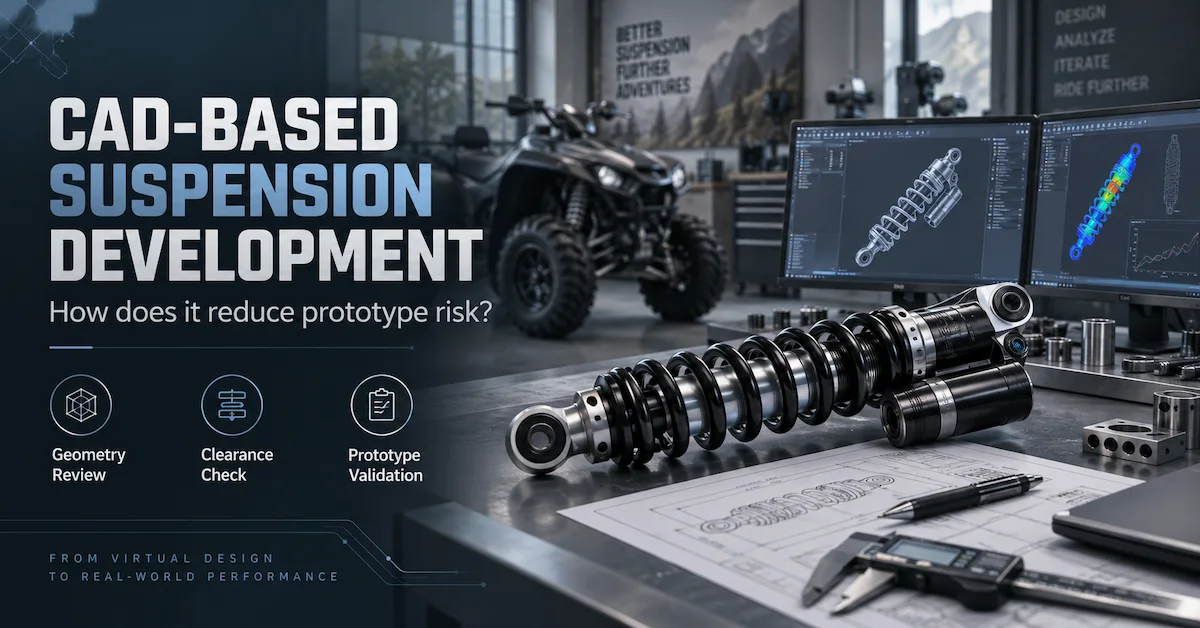
BEDO’s CAD-based suspension development guide shows why digital engineering should include more than fitment. Once the vehicle geometry is acceptable, the product geometry still needs to make sense for the intended manufacturing route.
Review Mounting Eyes, Clevises, Bushings, and Sleeves as an Assembly
A shock mount is not just one machined hole. The complete interface may include a mounting eye, elastomer or spherical bushing, metal sleeve, spacer, bolt, and vehicle bracket.
The supplier should review whether these elements can be assembled consistently and whether their accumulated dimensions maintain the intended fit.
Questions include:
- Can the bushing be installed without damage?
- Is sleeve insertion controlled?
- Does the mounting eye provide enough material around the bore?
- Can the finished assembly be inspected?
- Does the bushing articulate through the intended suspension angle?
- Are replacement parts identifiable?
- Does surface treatment alter a critical fit?
This is also why buyers should not approve a component solely because the mounting-hole diameter is correct.
Material Selection Must Match the Manufacturing Process
Material choice affects machinability, forming, heat treatment, surface finishing, corrosion protection, weight, cost, and availability. Manufacturers should therefore review material requirements before production rather than assuming that any specified grade can enter the planned process unchanged.
If a buyer specifies a particular material, the supplier should confirm whether it is suitable for the component and available in the required form. If the material is not yet fixed, the supplier can propose an option, but the proposal should remain clearly identified as such until engineering approval.
The manufacturability package should distinguish:
Buyer-specified material – fixed requirement.
Existing platform material – reference from a validated design.
Supplier proposal – subject to buyer approval.
Unknown from sample – must not be guessed from appearance.
This distinction is particularly important when a project begins from a physical sample. BEDO’s sample-based development content treats the sample as an engineering reference rather than proof of every original material and internal specification.
Spring Manufacturing Requires More Than Checking the Outer Diameter
For suspension springs, manufacturability review can include wire or section dimensions, coil geometry, free length, end design, available forming processes, heat treatment, surface treatment, and inspection requirements.
However, manufacturing geometry must remain separate from performance engineering. A spring that is easy to manufacture still needs to meet the required load–deflection behavior.
BEDO’s custom coil spring development guide discusses dimensions, material, spring characteristics, and vehicle application as connected factors.
For OEM buyers, the approved production package should therefore link the spring drawing to its performance specification instead of relying only on a visual spring model.
Reservoir and Hose Designs Need an Assembly Review
Remote-reservoir suspension introduces fittings, hoses, reservoir bodies, brackets, and routing requirements. A design may fit the CAD model but still create manufacturing or assembly problems if fittings cannot be tightened, hoses are difficult to route during assembly, or the reservoir bracket blocks service access.
The supplier should review:
- hose connection orientation;
- fitting access;
- reservoir mounting hardware;
- routing during assembly;
- repeatable hose positioning;
- protection from abrasion;
- identification of left/right versions;
- packaging after assembly.
BEDO’s remote-reservoir suspension guide explains why reservoir architecture brings additional packaging and production considerations beyond the main shock body.
Adjustable Shocks Add More Manufacturing Control Points
Compression and rebound adjusters can add meaningful tuning value, but they also introduce additional parts, assembly steps, inspection points, and possible configuration errors.
A manufacturability review for an adjustable shock should ask:
- Can adjustment components be assembled in only one correct orientation?
- Is a baseline setting clearly defined?
- Can click count or adjustment range be verified?
- Are components easy to identify?
- Can production avoid mixing different valve or adjuster versions?
- Does the product code distinguish technical configurations?
BEDO’s premium ATV adjustable-damping guide explains that adjustment should solve a real performance need. From a manufacturing perspective, buyers should also recognize that every additional function creates another characteristic that needs to remain controlled in production.
Manufacturers Should Review the Assembly Sequence Before Production
A product can have individually manufacturable components but still be difficult to assemble efficiently.
An assembly review considers the order in which components enter the finished shock and whether that sequence creates unnecessary rework or risk.
A simplified review can ask:
- Which components must be assembled first?
- Can later parts be installed without disassembling earlier work?
- Are special tools required?
- Can seals be protected during assembly?
- Can fasteners and fittings be accessed?
- Can orientation errors occur?
- Can the completed unit be functionally checked?
- Can failed units be diagnosed without excessive disassembly?
The purpose is not simply to make assembly faster. It is to create a process that is repeatable from the first pilot batch through later production orders.
Inspection Feasibility Is Part of Manufacturability
A dimension should not be specified without considering how production will verify it. If a feature is extremely difficult to measure after assembly, engineering may need to define an earlier process inspection or another practical control.
A useful manufacturability review therefore links:
Critical Feature → Manufacturing Operation → Inspection Stage → Measurement Method → Acceptance Requirement
For example, an internal component dimension may be inspected before assembly, while total length or mounting width can be checked on the finished product.
BEDO’s shock absorber production process places component inspection and final quality checks within the broader production workflow.
This is more meaningful than simply writing “100% inspection” without specifying what is being inspected.
Use Prototype Feedback to Update the Manufacturing Design
Manufacturability review should happen before the prototype, but the first physical sample provides another source of manufacturing information.
A prototype may reveal:
- assembly access is poor;
- one dimension is difficult to hold;
- a bushing installation method damages the component;
- a reservoir fitting needs another orientation;
- an adjuster is difficult to access;
- a spring seat needs a dimensional change;
- inspection is impractical after final assembly.
BEDO’s prototype shock absorber development guide connects sample analysis, engineering, prototype work, testing, revisions, and production preparation.
If a manufacturing issue leads to an approved design change, update the CAD and drawing. Do not allow the “prototype fix” to exist only as an informal workshop instruction.
Pilot Production Tests Whether the Process Is Repeatable
A single prototype demonstrates that one unit can be built. It does not prove that a production process can build the same result repeatedly.
For a new custom configuration, pilot production can help verify:
| Pilot check | Production question |
|---|---|
| Dimensions | Are critical dimensions repeatable? |
| Assembly | Can workers follow the planned sequence consistently? |
| Spring version | Is the correct spring installed every time? |
| Damping configuration | Are different technical versions controlled? |
| Reservoir/hose | Is installation repeatable? |
| Appearance | Is finish quality consistent? |
| Inspection | Can QC perform required checks efficiently? |
| Traceability | Can the batch be linked to the approved revision? |
| Packaging | Does the saleable configuration match approval? |
BEDO supports low-volume and pilot suspension development, which can be useful when buyers want to test production repeatability before committing to larger inventory.
How Does Manufacturability Affect Cost?
A complicated design does not necessarily deliver more customer value. Extra machining operations, unusually tight tolerances, custom hardware, multiple finishes, difficult assembly, and hard-to-inspect features can all increase production cost.
During review, ask the manufacturer to identify which features are major cost drivers.
A proposed change may fall into three categories:
Function-critical – should remain because it supports fit or performance.
Manufacturing improvement – change may reduce cost or variation without harming function.
Cosmetic/preference feature – buyer can decide whether its commercial value justifies the added manufacturing cost.
This creates a more useful cost conversation than simply asking the supplier to lower the price after the design has already been frozen.
Do Not Treat DFM as Permission to Change the Product Without Approval
Manufacturers often identify improvements during a suspension manufacturability review, but the factory should not silently change critical dimensions, materials, spring specifications, mounting geometry, or damping components because another version is easier to manufacture.
A controlled process is:
Supplier identifies issue → Engineering proposes change → Buyer reviews effect → CAD/drawing updated → Prototype/test repeated if necessary → New revision approved
This preserves the link between engineering intent and the actual production product.
Manufacturability Review Also Reduces Repeat-Order Risk
The value continues after the first production order. A product that has clear drawings, realistic tolerances, controlled components, practical assembly, inspection methods, and revision management is easier to reproduce on later batches.
For distributors and private-label brands, this matters because repeat-order inconsistency can create warranty claims even when the first samples performed correctly.
A repeat order should reference:
- approved part number;
- drawing revision;
- CAD revision if applicable;
- spring specification;
- damping configuration;
- hardware;
- finish;
- packaging;
- inspection requirements.
This converts “same as last order” into a controlled manufacturing instruction.
What Should an OEM Buyer Ask During a Suspension Manufacturability Review?
A useful supplier discussion can focus on eight questions:
| Buyer question | What a useful answer should explain |
|---|---|
| Which dimensions are difficult to manufacture? | Operation, tolerance and proposed solution |
| Which features drive cost? | Process or component causing the cost |
| Which tolerances are unnecessarily tight? | Functional justification for proposed change |
| Which materials create sourcing or process risk? | Availability and proposed alternatives |
| What special tooling is required? | Tooling purpose and development stage |
| What is difficult to assemble? | Specific assembly operation |
| What is difficult to inspect? | Measurement challenge and alternative control |
| What should be tested in the pilot batch? | Production risks the pilot is designed to verify |
A supplier that only replies “the design is manufacturable” gives purchasing less useful information than one that identifies assumptions, risks, and proposed controls.
How Should BEDO Fit Into the Review Process?
Ningbo Bedo Auto Parts Co., Ltd. manufactures shock absorbers and suspension springs and supports custom suspension projects. Buyers can use BEDO’s CAD-based development process to review geometry before sample release, then connect that work with shock absorber production planning.
For an efficient suspension manufacturability review, provide the current drawing and CAD revision, vehicle application, sample or reference product, critical dimensions, material requirements, spring and damping specifications where known, expected quantity, quality requirements, and the technical features that cannot be changed.
Ask the engineering and manufacturing teams to identify:
- unresolved geometry;
- hard-to-manufacture features;
- tolerance risks;
- proposed material or process changes;
- inspection requirements;
- prototype questions;
- pilot-production risks.
This turns manufacturability review into a documented engineering decision rather than an informal pre-production check.
Frequently Asked Questions
1. What Does Manufacturability Mean for Suspension Parts?
It means the component can be produced, assembled, inspected, and reproduced using a practical manufacturing process while still meeting its required fit and performance specifications.
2. Should Manufacturability Be Checked Before a Prototype?
Yes, important manufacturing risks should be reviewed before prototype release. The prototype can then validate remaining assumptions and reveal physical assembly or production issues that were not obvious digitally.
3. Is CAD Review the Same as Manufacturability Review?
No. CAD review often focuses on geometry and fitment. Manufacturability review extends into machining, material, tolerance, assembly, tooling, inspection, and production repeatability. See BEDO’s suspension CAD review guide.
4. Why Do Tight Tolerances Increase Suspension Cost?
Tighter limits can require more precise machining, additional process control, more inspection, and potentially greater scrap. They should be used where function requires them rather than applied uniformly to all dimensions.
5. Can the Manufacturer Change My Drawing to Improve Manufacturability?
The supplier can recommend changes, but buyer-approved dimensions and specifications should not be changed without documented engineering approval and revision control.
6. Does a Successful Prototype Prove Manufacturability?
No. One prototype proves that one unit can be built. Pilot production provides better evidence about process repeatability, assembly consistency, and production inspection.
7. What Should Be Reviewed for a Remote-Reservoir Shock?
Review the shock body, reservoir, fittings, hose routing, bracket, assembly access, clearance, identification, and required production checks. See BEDO’s remote-reservoir ATV shock guide.
8. What Should Be Reviewed for Adjustable Suspension?
Review adjuster components, assembly orientation, baseline settings, component identification, damping configuration, inspection requirements, and how technical versions will be distinguished.
9.Can Manufacturability Review Reduce Development Cost?
It can reduce avoidable redesign and production complexity by identifying difficult features before tooling, multiple prototypes, or volume production. The actual savings depend on the project and should not be assumed without cost data.
10. What Files Should I Send BEDO for a Manufacturability Review?
Send the current drawing, relevant CAD, vehicle/application information, prototype or sample data, known material and performance requirements, critical tolerances, expected production volume, and any features that cannot be changed. BEDO can then identify which additional engineering information is needed.
Conclusion
A suspension manufacturability review checks whether an approved suspension design can move from CAD and prototypes into a stable, inspectable, repeatable production process. Manufacturers should examine critical dimensions, tolerance stacks, material selection, machining access, mounting interfaces, spring and reservoir components, assembly sequence, inspection feasibility, and the controls required to reproduce the product across future batches. The review should happen before production release and continue through prototype feedback and pilot manufacturing rather than being treated as a final factory formality. BEDO supports custom shock absorber and suspension development from drawings, CAD files, samples, and vehicle requirements. To prepare a production-focused engineering review, contact BEDO with your current drawings, CAD, sample information, critical requirements, expected quantity, and unresolved manufacturing questions so the suspension manufacturability review can be completed before pilot and volume production.