
Does an ATV Really Need Remote-Reservoir Shock Absorbers?
Not every ATV needs remote-reservoir ATV shock absorbers. A reservoir becomes worth evaluating when the vehicle repeatedly works its suspension hard enough that additional hydraulic volume, thermal-management flexibility, reservoir placement, or more advanced damping architecture provides a measurable benefit. An ATV used intermittently at lower speeds on moderate terrain may be better served by a correctly specified conventional shock. BEDO makes the same engineering distinction in its remote-reservoir off-road shock guide: start with the vehicle problem and duty cycle instead of assuming that an external reservoir is automatically a premium upgrade. That BEDO article is written around UTV applications, so an ATV project should apply the principle through its own vehicle-specific validation rather than simply transferring a UTV specification.
What Does a Remote Reservoir Actually Do?
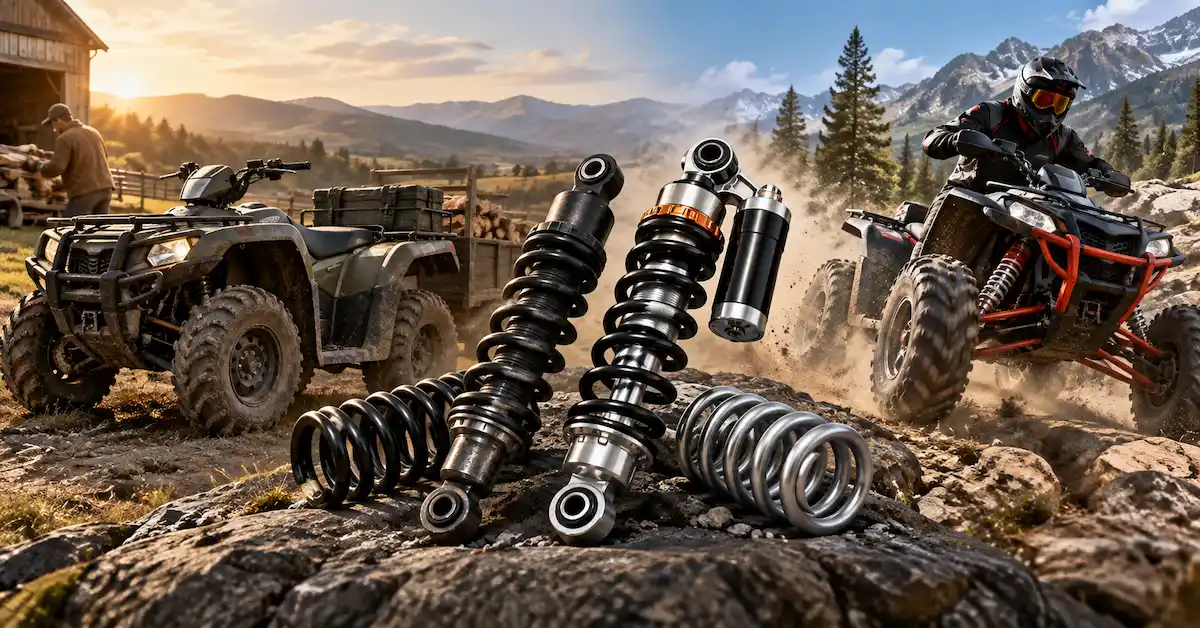
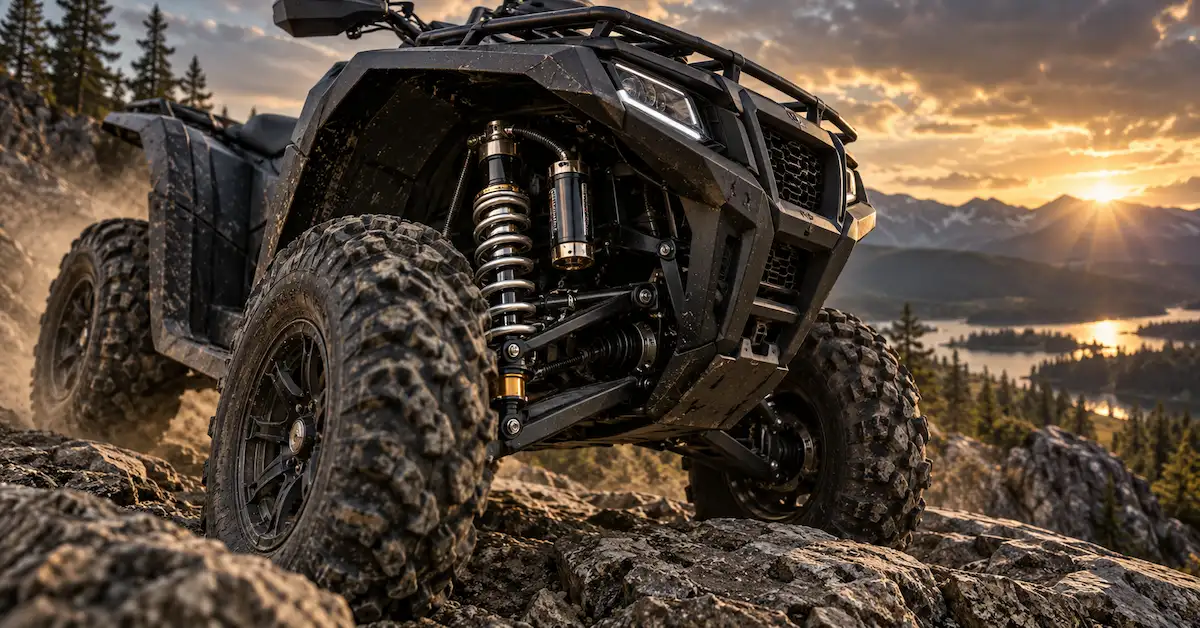
A remote-reservoir shock places an additional oil-and-gas chamber away from the main damper body and connects it through a hose. Depending on the internal design, that architecture can give engineers more room for hydraulic fluid and gas, greater packaging flexibility, and additional options for compression-control and thermal management. It does not automatically increase spring rate, shock stroke, wheel travel, load rating, or damping quality. BEDO’s technical explanation specifically notes that a large reservoir cannot correct an incorrect spring, mismatched damping, inadequate travel, wrong mounting dimensions, or unsuitable suspension geometry. For ATV buyers, the correct sequence is therefore Application → Load → Geometry → Spring → Damping → Duty Cycle → Reservoir Decision, rather than beginning the RFQ with “we need a reservoir shock.”
Why Does Repeated Suspension Cycling Make Reservoir Design More Relevant?
A hydraulic shock converts suspension movement into heat as fluid is forced through its damping system.One isolated bump rarely defines the architecture; repeated compression and rebound over rocks, washboard terrain, ruts, potholes, or rough trails is more important because the damper performs this work continuously. As operating temperature changes, hydraulic behavior can also change depending on fluid volume, gas management, valve design, vehicle mass, terrain, speed, and duty cycle. This is why a shock that feels controlled at the beginning of a rough run may need further evaluation if its behavior changes after prolonged use. A remote reservoir can provide useful design options in this situation, but it should not be marketed as a guaranteed cure for shock fade. The engineering process should reproduce the actual operating condition, identify the source of the problem, prototype an appropriate architecture, and verify the result on the vehicle.
Which ATV Applications Make the Strongest Case for a Reservoir?
Reservoir shocks become more relevant as suspension workload becomes longer, faster, more frequent, or harder to package inside the available shock envelope. A recreational ATV repeatedly crossing rocky or corrugated terrain at higher speeds creates a different damper duty from an ATV that occasionally crosses a rough section between low-speed farm tasks. A performance build, long-distance off-road application, modified vehicle, or specialist ATV that combines demanding terrain with extended operating time can therefore provide a stronger engineering case.Heavy-duty operation can also justify investigation when substantial load is combined with continuous suspension activity. BEDO’s current heavy-duty ATV guidance likewise states that not every heavy-duty ATV needs a reservoir; the architecture should match the duty cycle and product positioning. Review BEDO’s heavy-duty ATV shock guidance.
| ATV operating condition | Conventional shock | Remote-reservoir candidate |
|---|---|---|
| Lower-speed,intermittent utility use | Often worth evaluating first | Usually needs a specific reason |
| Moderate terrain with short rough sections | Often suitable if damping remains stable | Depends on observed duty |
| Long rough trails with repeated cycling | Requires careful validation | Stronger candidate |
| Higher-speed repeated off-road impacts | May reach architecture limits | Worth evaluating |
| Heavy load on moderate terrain | Spring/load matching comes first | Not automatically required |
| Heavy load plus long rough operation | Requires full suspension review | More relevant |
| Very tight space around shock body | May constrain design | Remote placement may help |
| Need for advanced compression-control architecture | Depends on shock design | May provide more design freedom |
Heavy Load Alone Does Not Mean the ATV Needs a Remote Reservoir
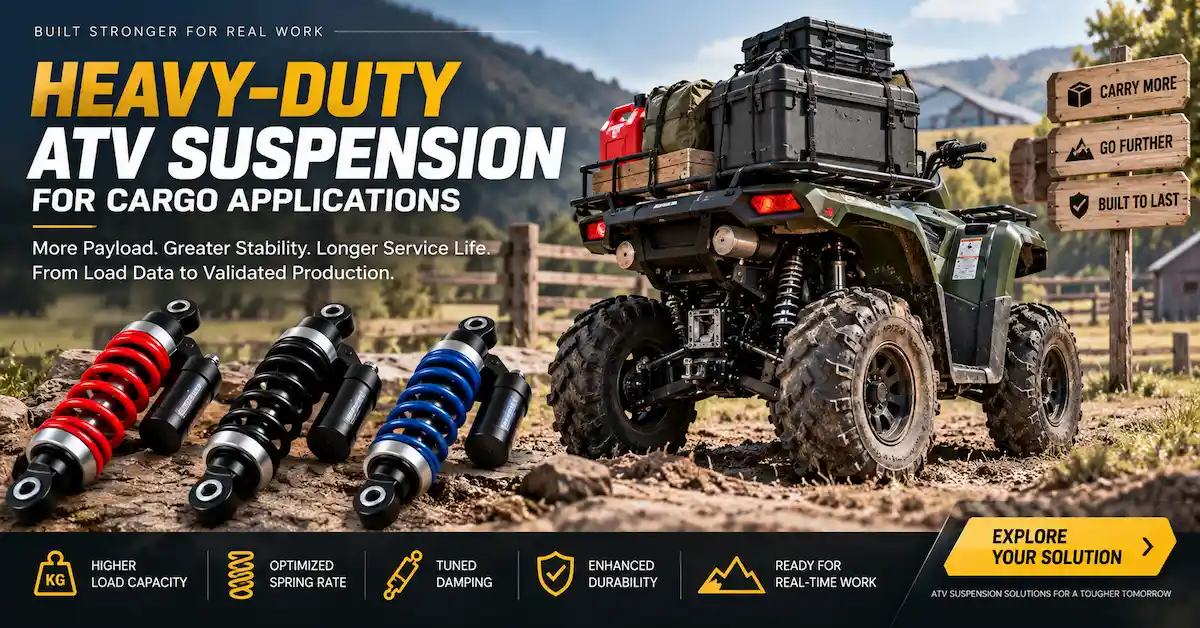
A heavy cargo box, winch, bumper, rack, tool system, or other accessory primarily changes the load that the suspension must support. The first engineering questions should therefore concern spring rate, sag, ride height, axle load, available compression travel, and damping—not reservoir size. A heavily loaded ATV operating slowly over predictable terrain may still work correctly with a properly developed conventional shock. A reservoir becomes more interesting when that load is combined with sustained rough-terrain use, repeated suspension cycling, demanding operating speed, or a packaging need.BEDO’s heavy-duty ATV suspension guidance explicitly separates load support from reservoir architecture, which prevents buyers from using reservoir appearance as a substitute for correct spring and damping development.
Spring Support Must Be Correct Before You Evaluate the Reservoir
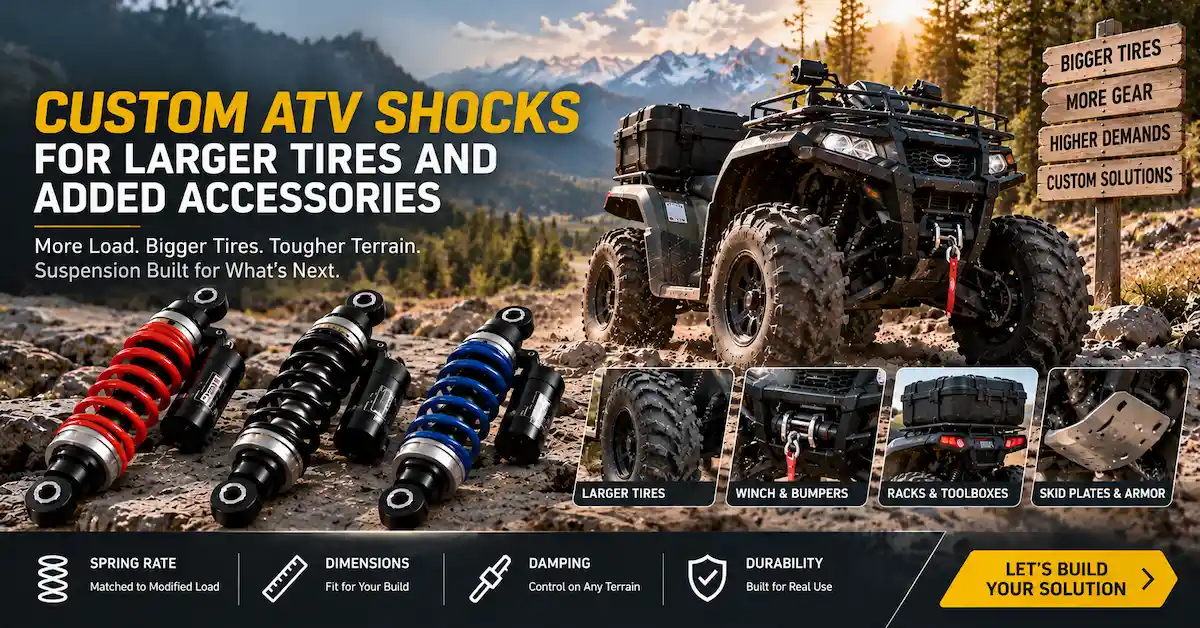
The spring supports the vehicle and operating load; the shock controls how that supported mass moves. If a rear ATV sags excessively after cargo is added, installing a remote reservoir does not restore the correct operating position by itself. Measure the loaded axle condition, spring specification, sag, preload setting, remaining compression travel, and intended load range first. If the spring is fundamentally unsuitable, address that requirement before attempting to solve the problem through damper architecture. This principle is especially important for distributors developing “heavy-duty reservoir shocks,” because a visually impressive reservoir product can still produce poor results when the spring is mismatched to the advertised load. Buyers working with modified or cargo ATVs can also review BEDO’s larger-tire and accessory shock development guide, which follows the same load-first approach.
Does a Remote Reservoir Improve Damping Consistency?
It can provide an architecture that supports more consistent damping under demanding conditions, but the reservoir itself does not guarantee the result. Oil specification, oil volume, gas pressure, piston and valve design, shock body dimensions, seals, spring selection, vehicle geometry, speed, terrain, and operating duration all affect the final behavior. If a buyer reports that damping changes only after 20 minutes of repeated rough running, the test procedure should be long enough to reproduce that condition. If the problem occurs immediately even when the shock is cold, adding more fluid volume may not address the root cause. For remote-reservoir ATV shock absorbers, the most credible performance claim is therefore one tied to a defined vehicle, configuration, test condition, and observed result—not a generic statement such as “never fades.”
Higher-Speed Riding Strengthens the Case, but Speed Alone Is Not the Specification
As terrain speed increases, the shock can experience more frequent and more severe suspension movements. A section of uneven trail that creates occasional compression at low speed may generate rapid repeated damper activity at a higher pace. This makes damping consistency, fluid capacity, rebound recovery, and thermal behavior more important. However, simply telling a supplier “the ATV goes fast” is not sufficient. Provide typical and maximum intended speed, terrain, vehicle weight, rider and cargo conditions, tire configuration, shock stroke, suspension geometry, and operating duration. A performance-oriented ATV running continuously over rough trail is a more meaningful development description than “racing shock required.”
Remote Reservoir vs Piggyback Reservoir: Which Layout Fits the ATV?
A remote reservoir and a piggyback reservoir can provide related hydraulic functions, but the packaging is different. A piggyback reservoir is attached directly to the shock body, while a remote reservoir is mounted elsewhere on the vehicle and connected through a hose. Neither layout is automatically superior.BEDO’s off-road reservoir guidance explains that a piggyback design can simplify installation where enough space exists beside the shock, while a remote reservoir offers more placement flexibility when the suspension package is crowded.
| Selection factor | Piggyback reservoir | Remote reservoir |
|---|---|---|
| Reservoir position | Attached to shock body | Mounted separately |
| External hose | Normally not required | Required |
| Space beside shock | More local clearance required | Reservoir can be moved elsewhere |
| Installation complexity | Generally lower | Generally higher |
| Reservoir placement flexibility | Lower | Higher |
| Hose routing requirement | None | Must be engineered |
| Full-travel clearance check | Shock and reservoir together | Shock, hose, and remote reservoir |
| Good starting point | Adequate space near damper | Crowded shock area with suitable remote mounting location |
Remote Hose Routing Is an Engineering Requirement,Not an Installation Detail
The external hose introduces additional failure and packaging considerations. It must maintain suitable clearance at full bump, full droop, and relevant steering positions; avoid abrasion against chassis edges; remain away from tires and hot surfaces; avoid excessive stretching or tight bending; and be protected from repeated stone or debris impact where necessary. The reservoir also requires a secure mounting location that remains accessible enough for assembly and service. BEDO’s UTV suspension design guidance shows how CAD can be used to review reservoir placement, hose length, mounting brackets, service access, wheel movement, and suspension clearance. For an ATV project, use the same packaging discipline but validate against the actual ATV geometry.
A Remote Reservoir Does Not Increase Shock Stroke or Wheel Travel
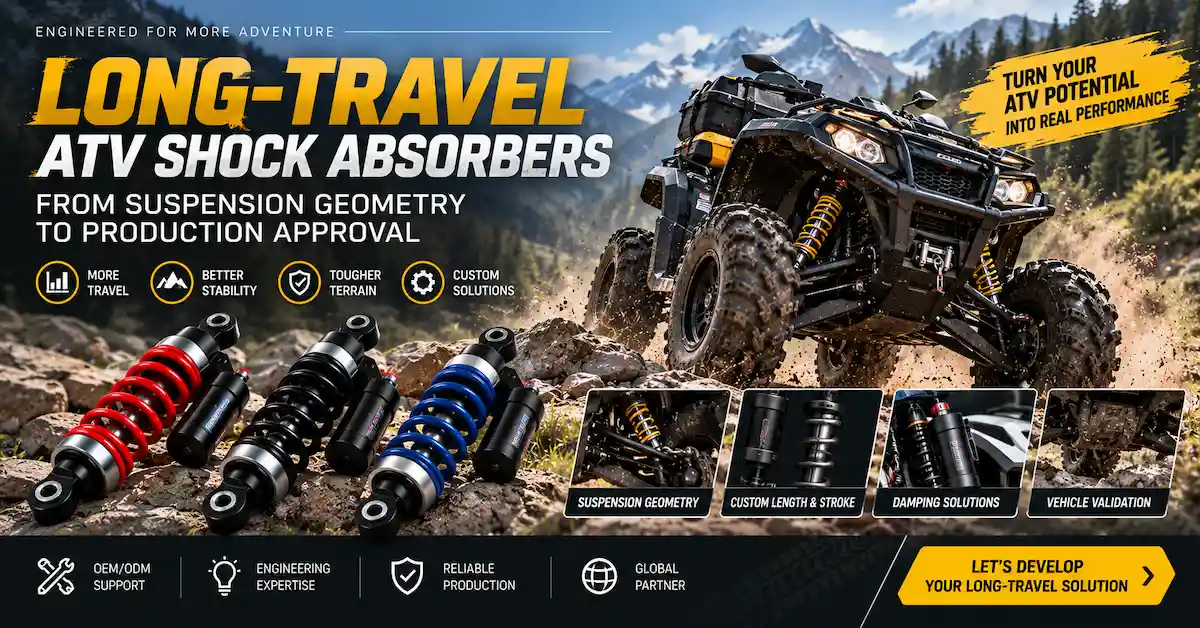
Reservoir size and suspension travel are separate design variables. Shock stroke is determined by the damper’s extended and compressed dimensions, while wheel travel also depends on mounting location and suspension geometry. Adding a remote reservoir therefore does not create more stroke and should not be used as a fix for bottoming caused by insufficient usable travel.If the project also involves a long-travel conversion, evaluate the extended length, compressed length, effective stroke, mounting interfaces, control-arm movement, steering, joints, tires, and surrounding clearance independently. BEDO’s long-travel ATV shock guide specifically warns against using reservoir architecture as a substitute for geometry and travel development.
Remote Reservoir Does Not Automatically Mean Adjustable Damping
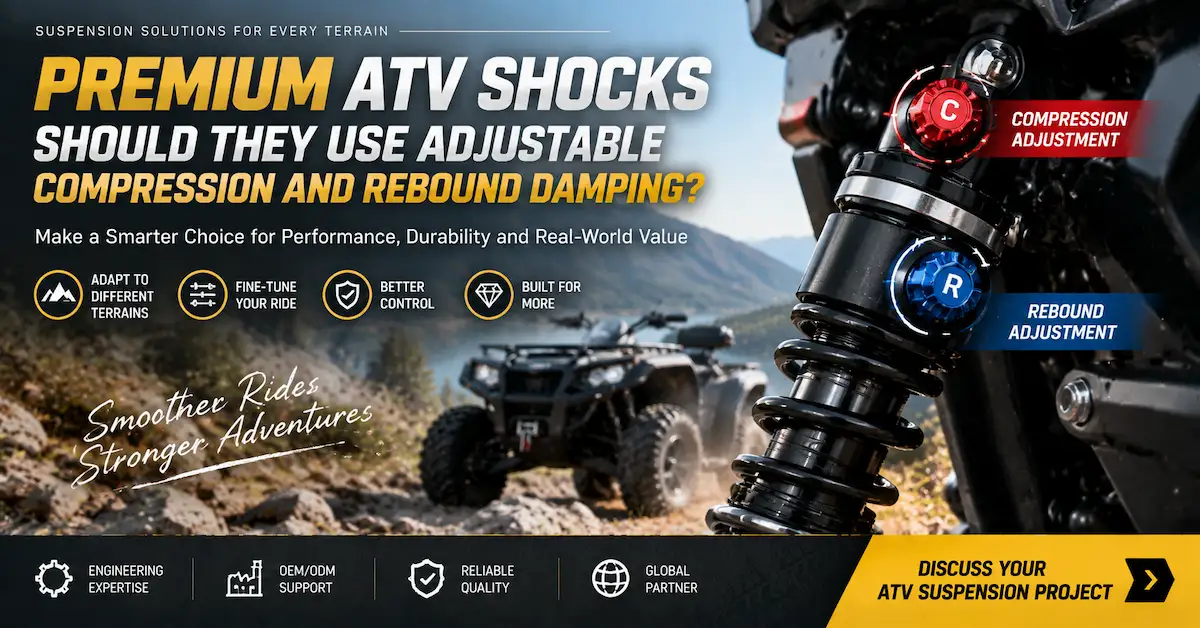
Reservoir configuration and damping adjustability are separate decisions. Depending on its internal architecture, a remote-reservoir shock can use fixed damping, compression adjustment, rebound adjustment, both compression and rebound adjustment, or more advanced control systems. An RFQ stating only “remote reservoir, fully adjustable” therefore leaves the engineering problem undefined. Tell the supplier why adjustment is needed. For example, an ATV that regularly switches between light recreational use and a defined cargo configuration may justify a broader tuning range, while a vehicle performing one predictable duty may benefit from a carefully developed fixed specification. Buyers comparing these choices can use BEDO’s fixed-versus-adjustable off-road shock guide as a technical reference, again validating the final specification for the ATV rather than transferring a UTV setup directly.
Current BEDO ATV Products Show Why Architecture Should Be Evaluated Separately
BEDO’s publicly listed AU_HSA_01 is a rear ATV/UTV shock using an internal gas chamber, oil-gas separation, fixed damping, a published 465 mm total length, and 130 mm effective stroke. It provides a useful reference for a conventional integrated architecture, but the page does not identify it as a remote-reservoir model. This matters because buyers should not assume every ATV shock in the catalog can simply be converted by adding an external canister. A custom reservoir project may require changes to body architecture, hydraulic volume, fittings, hose arrangement, damping design, mounting, spring specification, and validation. View the AU_HSA_01 rear ATV/UTV shock.
| Project item | Existing AU_HSA_01 reference | Custom remote-reservoir project |
|---|---|---|
| Reservoir architecture | Internal gas chamber | Separate reservoir and hose if developed |
| Damping | Fixed on published model | Fixed or adjustable depending on design |
| Effective stroke | Published 130 mm | Project-specific |
| Mounting dimensions | Published for existing model | Must match target ATV |
| Spring | Existing model specification | Must be reviewed for application |
| Hose routing | Not applicable | Required |
| Reservoir mount | Not applicable | Required |
| Vehicle validation | Application-specific | Essential before production |
How Should You Test Whether the Reservoir Is Actually Helping?
Begin with a baseline conventional shock or current vehicle configuration whenever possible. Define the problem to reproduce: loss of damping consistency after sustained use, packaging limitation, need for additional compression-control architecture, or another measurable issue. Then compare the reservoir prototype under the same vehicle load, terrain, tire configuration, operating duration, and relevant environmental conditions. The test should record the shock specification and reservoir configuration, because a different spring or damping setup can otherwise make the comparison meaningless. Where applicable, review damping behavior before and after sustained cycling rather than relying solely on a short test drive. BEDO’s general shock absorber testing guidance treats damping, leakage, durability, temperature, and vehicle testing as separate but connected validation areas.
What Should Quality Control Check on a Remote-Reservoir Shock?
A reservoir design introduces more components and interfaces than a simple integrated shock, so production control needs to reflect the approved architecture.In addition to dimensions, spring, stroke, damping, sealing, and mounting hardware, the buyer may need to control hose specification, hose length, fitting orientation, reservoir components, mounting brackets, routing requirements, gas and fluid processes where relevant, and adjustment functions if included. Keep the approved drawing, prototype revision, damping specification, reservoir configuration, hose layout, and installation instructions linked to one product code. A later change to fitting position or hose length can affect installation even if the shock body itself remains unchanged.
Who Should Not Pay Extra for Remote-Reservoir ATV Shocks?
A reservoir is difficult to justify when the ATV operates mostly at lower speed, encounters moderate terrain for short periods, maintains consistent damping throughout normal use, has a predictable load, does not need external tuning, and has no packaging reason for a separate reservoir. In this case, additional hoses, fittings, brackets, inspection steps, and assembly work may increase cost without solving a customer problem. BEDO’s aftermarket ATV suspension guide explicitly notes that reservoir shocks can be valuable in demanding applications but add cost and packaging complexity and should not be selected merely because they appear more premium.
When Does a Reservoir Support a Premium ATV Product Line?
For a private-label or performance brand, the strongest reservoir product is one where the hardware is connected to a documented use case. A performance line intended for sustained rough terrain can explain the operating conditions under which the architecture was developed; a specialist utility line can explain why a particular duty cycle or packaging restriction requires it. By contrast, selling an external reservoir purely as a visual sign of “premium suspension” creates a weak technical claim. BEDO’s premium ATV suspension buying guide defines premium suspension through correct fitment, appropriate spring characteristics, controlled damping, sealing, materials, useful adjustability where required, manufacturing consistency, documentation, and application validation—not reservoir size or price alone.
How Much More Complex Is a Remote-Reservoir Program?
The project can require additional reservoir components, hose and fittings, mounting brackets, routing design, packaging checks, assembly operations, inspection points, and testing.Adjustable versions may add still more components and production controls. This usually means a remote-reservoir project should not be compared with a conventional shock by unit price alone. Ask both quotations to identify the same spring, dimensions, damping targets, materials, mounting configuration, sample scope, testing requirements, branding, and packaging. Then separate development expenses from recurring unit cost. The commercial question is not “Which shock looks more expensive?” but “Does the additional architecture solve a technical or market requirement that justifies its lifecycle cost?”
Use Prototype and Small-Batch Validation Before Scaling Production
A reservoir project is particularly suitable for staged development because packaging and real-world suspension behavior may require revision after the first prototype. BEDO supports small-batch suspension projects in which buyers can confirm fitment, spring requirements, damping performance, and real operating conditions before moving into larger production. BEDO’s small-batch OEM/ODM suspension process describes this approach for off-road vehicle suspension.For a reservoir ATV project, a practical route is Vehicle Requirement → Architecture Review → Prototype → Hose/Reservoir Packaging Check → Dynamic Test → Revision → Pilot Batch → Production Approval. Exact sample quantity, MOQ, capacity allocation, and lead time should still be confirmed for the individual configuration.
What Should You Send BEDO for a Remote-Reservoir ATV Project?
BEDO manufactures shock absorbers and suspension springs and provides customization, design support, and small-batch production for off-road applications. BEDO’s company profile identifies shock absorber and spring manufacturing, customized solutions, and small-batch support among its capabilities. For remote-reservoir ATV shock absorbers, send the ATV make and model, installation position, existing shock dimensions or sample, rider and cargo loads, spring information, tire and accessory modifications, terrain, expected operating speed, duration of sustained rough use, current suspension problem, available packaging space, drawings or CAD where possible, and expected order quantity.The engineering review can then determine whether the project actually needs a reservoir, whether piggyback or remote packaging is more suitable, whether damping adjustment adds value, and what prototype testing should reproduce.
Frequently Asked Questions
1. Does every performance ATV need remote-reservoir shock absorbers?
No. Performance should be defined by the application and validated suspension behavior. If a conventional shock maintains the required damping and fits the packaging constraints, the added reservoir may provide little practical value.
2. Do remote reservoirs prevent shock fade?
Not automatically. They can provide additional hydraulic volume and thermal-management options, but damping consistency also depends on fluid, gas management, piston and valve design, seals, vehicle load, terrain, speed, and duty cycle.
3. Do heavy-duty ATVs always need reservoir shocks?
No. Heavy load should first be addressed through spring support, sag, travel, axle load, and damping.Reservoir architecture becomes more relevant when heavy loading is combined with sustained demanding suspension operation.
4. Does a remote reservoir increase ATV suspension travel?
No. The reservoir adds hydraulic-system packaging; shock stroke and wheel travel are determined separately by shock dimensions and suspension geometry. Read BEDO’s long-travel ATV shock guide.
5. Is a remote-reservoir shock always adjustable?
No. Remote-reservoir architecture can be combined with fixed or adjustable damping depending on the internal design. Adjustment functions should be selected according to actual tuning requirements.
6. What is the difference between piggyback and remote reservoirs?
A piggyback reservoir is attached directly to the shock body. A remote reservoir is mounted separately and connected through a hose, providing greater placement flexibility but requiring additional routing and mounting work.
7. Are remote-reservoir shocks useful for slow utility ATVs?
Sometimes, but a low-speed ATV with intermittent suspension cycling and predictable loading may not need the additional architecture unless there is a specific thermal, damping, or packaging requirement.
8. Do larger tires require remote-reservoir shocks?
Not by themselves. Larger tires can affect unsprung mass and clearance, while accessories may change sprung load. Review spring, damping, geometry, and duty cycle first. See BEDO’s modified ATV suspension guide.
9. What should be tested on a remote-reservoir ATV prototype?
Verify mounting, hose routing, reservoir mounting, full-bump and full-droop clearance, spring behavior, damping, leakage, fitting integrity, operating temperature where relevant, and representative vehicle performance under the intended load and terrain.
10.Can BEDO develop a remote-reservoir ATV shock from an existing sample?
BEDO supports custom shock development and low-volume OEM work using samples, drawings, technical requirements, and vehicle data. The existing sample can provide a starting reference, but the reservoir architecture and final specification should be developed around the target ATV and its operating conditions. Review BEDO’s low-volume OEM development capabilities.
Conclusion
An ATV does not automatically need remote-reservoir ATV shock absorbers simply because it is used off-road, sold as a premium model, carries cargo, or runs larger tires. The reservoir earns its place when sustained rough-terrain operation, repeated high-frequency suspension movement, demanding speed, thermal-management requirements, damping architecture, or vehicle packaging makes the additional hydraulic volume and remote placement useful.The correct selection sequence is Vehicle Use → Load → Spring → Geometry and Travel → Terrain → Duty Cycle → Existing Damping Behavior → Packaging → Reservoir Architecture → Prototype → Vehicle Validation → Production Control. If a simpler shock maintains the required performance, the simpler design may be the better product; if testing shows that additional oil/gas volume, remote packaging, or damping capability solves a real problem, the reservoir has a clear engineering purpose. To evaluate a project, contact BEDO with your ATV application, existing shock or drawings, vehicle and rider loads, terrain, duty cycle, suspension problem, available mounting space, and purchasing plan so the appropriate conventional, piggyback, or remote-reservoir ATV shock absorbers can be reviewed before prototype and production approval.