
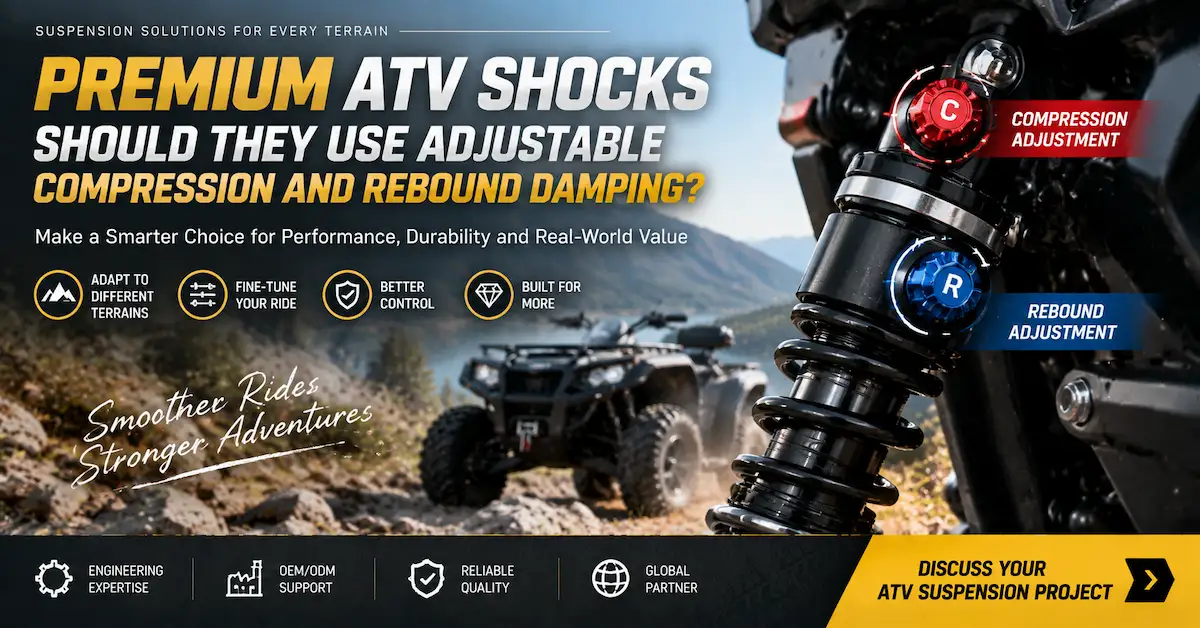
Should Premium ATV Shocks Use Adjustable Compression and Rebound Damping?
Not always. Premium ATV shocks should use adjustable compression and rebound damping when the target vehicle, terrain, rider or cargo range, and customer expectations create a real need for suspension tuning. For a performance ATV that moves between rocky trails, faster open terrain, different rider loads, or changing cargo conditions, separate adjustment can provide useful flexibility. For a replacement-oriented product used on a stable vehicle configuration, a properly developed fixed-damping shock may be simpler, more repeatable, and equally appropriate. BEDO’s premium ATV suspension guide makes the same distinction: premium quality should be defined by fitment, spring characteristics, damping control, manufacturing consistency, and application-specific validation rather than by the number of external adjusters.
Premium Should Describe the Engineering Package, Not the Adjuster Count
A shock with multiple knobs may look more sophisticated, but adjustability is only valuable if each control performs a defined function over a useful range. A premium suspension program should begin with correct mounting dimensions, an appropriate spring, controlled compression and rebound behavior, sealing, repeatable manufacturing, and clear application data. Only after those fundamentals are established should the buyer decide whether user adjustment improves the product. BEDO’s current ATV shock absorber supplier selection guide specifically warns against choosing adjustable products simply because they appear more premium.
For a private-label brand, this distinction affects positioning. A premium replacement line may emphasize verified fitment, stable damping, consistent production, straightforward installation, and reduced setup complexity. A premium performance line may add spring preload adjustment, compression adjustment, rebound adjustment, or other tuning functions because its customers deliberately change terrain, load, or riding style.Both can occupy a premium market position if the engineering and manufacturing evidence supports the claim.
What Does Compression Damping Adjustment Actually Change?
Compression damping controls resistance while the shock is shortening. Depending on the vehicle and shock architecture, it influences how the suspension responds to weight transfer, terrain inputs, bumps, and larger impacts. Increasing compression resistance can reduce excessive suspension movement in some conditions, while too much resistance can make the vehicle harsh and prevent it from using available travel effectively. The correct target is therefore controlled movement, not maximum stiffness.
Adjustable compression becomes especially useful when one ATV operates under substantially different conditions. A lightly loaded recreational vehicle on relatively smooth terrain may require a different response from the same platform carrying additional equipment across rough ground. BEDO’s fixed vs adjustable shock guide describes adjustable compression as a way to provide additional tuning flexibility when load or terrain changes. The same engineering principle can inform an ATV program, provided the actual ATV configuration is separately validated.
Where a more advanced design offers low-speed and high-speed compression adjustment, those terms refer to damper movement speed, not simply vehicle speed. A slowly driven ATV can generate rapid shock movement when a wheel encounters a sharp rock or rut. Buyers should therefore ask exactly what each adjuster controls rather than assuming that “high-speed compression” is only relevant to racing.
What Does Rebound Damping Adjustment Actually Change?
Rebound damping controls the shock as it extends after compression. Too little rebound control can allow the suspension to return too quickly and continue oscillating; too much can prevent it from recovering quickly enough before the next terrain input. Over repeated bumps, excessive rebound resistance can leave progressively less usable suspension travel available.
Adjustable rebound can add value when the spring specification, rider load, cargo condition, or terrain changes within an approved product range. For example, a private-label product offered with two validated spring configurations may benefit from an appropriate rebound-adjustment range if engineering confirms that both versions can be accommodated. The objective is not to give the rider the maximum possible number of clicks.It is to provide a controlled adjustment window in which meaningful changes can be made without moving the suspension outside the intended operating behavior. BEDO’s damping guidance consistently describes the goal as controlled suspension recovery rather than maximum rebound resistance.
When Should Premium ATV Shocks Have Both Adjustments?
Separate adjustable compression and rebound damping makes the strongest case when the customer needs to tune two different aspects of suspension behavior independently. A serious trail or performance rider may want to change impact response without substantially changing recovery behavior, or refine rebound after selecting another approved spring or rider-load setup. An OEM development team may also need adjustment during prototype work so several damping directions can be evaluated before the final production specification is frozen.
For a distributor selling to customers who rarely tune suspension, however, additional adjustment can create more setup errors, technical-support questions, and inconsistent user experiences. In that market, the supplier may achieve a better product by engineering a suitable fixed setting or offering only the adjustment function customers can realistically use. Premium product design should reduce the buyer’s problem, not add controls merely to justify a higher price.
Compare Fixed and Adjustable ATV Shock Strategies Before Development
The following comparison is a purchasing framework rather than a claim that one architecture is universally superior.
| Suspension strategy | Main advantage | Main limitation | Suitable product direction |
|---|---|---|---|
| Fixed compression and rebound | Simple setup and repeatable user experience | Limited end-user tuning | Replacement ranges and predictable applications |
| Adjustable preload only | Allows defined changes to installed spring position | Does not change linear spring rate or damping | Moderate load variation within an approved spring range |
| Adjustable rebound | Allows recovery behavior to be refined | Compression behavior remains factory-set | Products where rebound tuning provides a clear customer benefit |
| Adjustable compression | Allows compression response to be refined | Recovery remains factory-set | Defined terrain or load applications |
| Separate compression and rebound | Greater tuning flexibility | More complexity, cost, validation,and customer education | Performance-oriented premium ATV shocks |
| Advanced compression plus rebound | Wider tuning architecture where technically justified | Highest setup and validation complexity | Specialist performance projects with experienced users |
BEDO’s aftermarket ATV suspension guidance also recognizes both fixed and adjustable configurations as valid options and notes that adjustable products should match the target customer rather than being chosen for appearance alone.
Build the Damping Specification Before Choosing the Adjuster Hardware
Before asking for “24 clicks of compression and 24 clicks of rebound,” define what the shock needs to accomplish. The number of adjustment positions alone says little about the usable tuning range, consistency between clicks, or the effect on the damping curve.The development brief should first define the vehicle, spring, load, terrain, mounting geometry, and target behavior.
| Development item | What the buyer should define or confirm |
|---|---|
| Vehicle application | ATV model, year, variant, front/rear position |
| Vehicle condition | Standard, lifted, larger tires, accessories, or other modifications |
| Rider/loading range | Ready-to-ride rider weight, equipment, cargo, permanent accessories |
| Spring specification | Rate with complete units, dimensions,preload range |
| Shock dimensions | Extended/compressed dimensions, effective stroke, mounting interfaces |
| Compression target | Behavior to control and representative terrain |
| Rebound target | Recovery behavior with the selected spring and load |
| Adjustment requirement | Compression, rebound, combined, or other architecture |
| Baseline setting | Defined production or delivery position |
| Validation | Test conditions, acceptance criteria,configuration identification |
This type of controlled specification is more useful than telling a supplier that the brand wants “fully adjustable premium suspension.”
Spring Rate and Preload Must Be Correct Before Damping Adjustment Can Help
The spring supports the vehicle load; the damper controls suspension movement. An adjustable damper cannot fully compensate for an incorrectly selected spring. If the spring is substantially too soft for the vehicle and rider load, increasing compression damping may make the ATV feel more resistant temporarily but does not correct the underlying load-support requirement. Likewise, excessive preload cannot transform an unsuitable linear spring into a different spring rate.
BEDO’s ATV spring-rate guide connects spring selection with load, ride height, damping, and terrain, while its adjustable-shock guidance explicitly notes that adjustment cannot compensate for an incorrect spring specification. For premium ATV shocks, spring and damping should therefore be developed as one package.
Actual BEDO ATV Models Show Why Fixed Damping Can Still Be a Valid Starting Point
BEDO currently lists several rear ATV/UTV shock absorbers with fixed damping. AU_HSA_02 and AU_HSA_03 provide useful dimensional examples. These products should not automatically be described as “premium” simply because they appear in this article, but they demonstrate that a technically defined fixed-damping platform can serve as a starting point for application screening or further OEM development.
| Published specification | AU_HSA_02 | AU_HSA_03 |
|---|---|---|
| Installation position | Rear | Rear |
| Total length | 395 mm | 445 mm |
| Cylinder outer diameter | 38 mm | 42 mm |
| Effective stroke | 80 mm | 130 mm |
| Upper/lower mounting-hole diameter | 12 / 12 mm | 10 / 10 mm |
| Upper/lower mounting width | 40 / 32 mm | 30 / 35 mm |
| Published rebound force | 3000 N | 2700 N |
| Published compression force | 550 N | 350 N |
| External damping adjustment | None | None |
These values do not prove which model offers better performance. Damping-force numbers only become meaningful when the test conditions, spring, geometry, and application are understood. The pages publish an inspection speed of 0.1 m/s, but one operating point is not a complete damping curve. Buyers developing adjustable versions should request the relevant test method and compare damping across the adjustment range rather than simply comparing maximum catalog numbers.
An Adjustable Shock Needs a Defined Baseline Setting
A production shock should have a clear reference position even when the user can adjust it. The factory and buyer should agree how the adjuster is counted, which direction increases or decreases damping, where the baseline position is located, and whether the shock should be shipped at that setting. Instructions should use the same terminology as the product itself.
This matters especially for private-label programs. If a customer receives two shocks at different settings, the vehicle may behave inconsistently even though both products meet the manufacturing specification. A premium product should therefore make adjustment repeatable: the user needs to know where to start, how much to change at one time, and how to return to the baseline.
Adjustment Range Matters More Than the Number of Clicks
A larger click count can look attractive in a catalog, but useful adjustment depends on the actual damping change across the available range. Two designs with the same number of positions can behave differently if their internal valving and adjuster architecture differ. During development, request damping measurements at representative positions such as minimum, baseline, and maximum adjustment rather than relying on a knob-count claim.
The buyer should also determine whether changes are sufficiently progressive for practical tuning. If most of the measurable change occurs in only the last few positions, a large nominal adjustment count may not provide the intuitive control expected by customers. Conversely, an excessively broad adjustment range may allow inexperienced users to select settings that compromise ride quality. This is one reason product positioning and customer type need to be established before finalizing adjuster design.
Test Compression and Rebound with the Actual Spring and Vehicle Load
A damper dynamometer can show how the shock produces force across different shaft speeds and settings, while vehicle testing shows how those characteristics interact with suspension geometry, tires, springs, rider mass, and terrain. A premium development program should connect the two rather than relying on a single bench number or subjective test ride.
BEDO’s shock absorber testing guidance discusses damping, dimensional, leakage, durability, temperature, and vehicle-related evaluation. For an adjustable product, the test plan should identify the precise configuration and adjuster setting being measured.If one report represents the baseline position, it should not automatically be presented as proof of behavior at every other setting.
For a performance-oriented ATV project, useful validation also includes representative lower and upper rider/load conditions and relevant terrain. A setup that works well for one rider on moderate trails may not automatically support another rider carrying cargo on repeated rough terrain. Define the intended operating range before approving the marketing claim.
Quality Control Becomes More Important as Adjustability Increases
An adjustable shock adds components and control points that fixed-damping products may not require. Production control should verify the approved dimensions, spring, damping specification, sealing, mounting components, adjuster operation, baseline position, and identification. Where the adjustment mechanism is a key performance feature, confirm how the factory verifies its function and how out-of-spec products are handled.
BEDO’s small-batch OEM/ODM guidance emphasizes dimensional inspection, stroke verification, assembly quality, leakage checking, and batch consistency during custom suspension production. Buyers developing adjustable premium ATV shocks should extend the production specification to include the approved adjustment functions and any relevant performance limits.
Current quality-system certificates can support factory qualification, but certificate status should be checked separately from product-specific performance evidence. A quality-management document does not by itself prove that an individual adjustable shock meets its intended damping range.
Materials and Reservoirs Should Support the Application, Not the Marketing Image
External reservoirs, anodized adjusters, larger bodies, and colored springs often appear on premium suspension products, but visible hardware should correspond to an engineering requirement. Reservoirs can be useful where hydraulic volume, thermal behavior, packaging, or particular damping architectures justify them. They do not automatically make a shock better, nor do they automatically increase travel.
The same principle applies to materials and surface treatments. Ask which specifications apply to the actual design, which components are critical to sealing and repeatability, and how the chosen finish will be verified. “CNC,” “aircraft aluminum,” “racing grade,” and similar phrases provide little purchasing value without a defined material, component, process, or performance requirement.
Private-Label Brands Also Need a Customer Tuning Strategy
If distributors sell fully adjustable suspension, the technical product is only part of the offer. Decide how customers will understand the controls. Dealer material should identify the baseline setting, adjustment direction, intended use of each control, and situations where another spring or product configuration is required instead of additional adjustment.
For a private-label line, keep three records connected but separate: the technical specification defines vehicle function, the brand specification controls colors and markings, and the packaging/instruction specification controls what the customer receives. BEDO’s private-label ATV suspension guide follows the same approach of separating technical differentiation from visual differentiation.
Adjustability Changes Cost, MOQ, and Production Complexity
Separate compression and rebound adjustment generally introduces additional components, machining, assembly requirements, testing, and customer documentation compared with a simpler fixed-damping configuration.That does not mean every adjustable product will have the same cost increase. The actual commercial difference depends on the architecture, spring, materials, reservoir configuration, finishing, sample work, and validation required.
BEDO supports prototypes and small-batch suspension development, which can help buyers validate a new configuration before committing to larger production. Exact sample quantity, MOQ, available capacity, development lead time, and repeat-order lead time should still be confirmed for the specific project.
Ask the quotation to separate development samples, testing, tooling or fixtures where applicable, pilot production, recurring unit price, branding, and packaging. This prevents a buyer from comparing a fixed replacement shock with a separately adjustable performance shock as if the two quotations represented the same development scope.
When Is Fixed Damping the Better Premium Choice?
Fixed damping can be the stronger product decision when the vehicle configuration and customer use are predictable, the engineering team can establish an appropriate factory setting, and users do not need regular tuning. This may apply to replacement-oriented products, rental fleets, work vehicles with relatively stable configurations, or distributor ranges where simple installation and fewer setup errors matter more than tuning freedom.
The key word is appropriate, not basic. A fixed shock still needs a properly selected spring, application-specific damping, accurate fitment, controlled manufacturing, validation, and repeat-order consistency. BEDO’s premium suspension content explicitly recognizes that a correctly engineered fixed-damping product can still qualify as a premium solution.
When Is Separate Compression and Rebound Adjustment Worth Developing?
Separate adjustment becomes more compelling when customers intentionally tune their vehicles, riding conditions change considerably, multiple validated loads are expected, or the brand wants a genuine performance product rather than a visually upgraded replacement shock. It can also be valuable during OEM development because engineers can explore suspension behavior before deciding on the final production setup.
A useful decision rule is:
Stable application + predictable customer → evaluate fixed damping first.
Meaningful load/terrain variation + tuning-oriented customer → evaluate adjustable damping.
Specialist performance program + clear engineering targets → evaluate separate compression and rebound control.
This is not a universal rule for every ATV platform; it is a way to align product complexity with buyer value.
How Can BEDO Support an Adjustable ATV Shock Project?
Ningbo Bedo Auto Parts Co., Ltd. manufactures shock absorbers and suspension springs for ATV and other off-road applications and describes design support and small-batch production among its capabilities. BEDO’s custom ATV shock development service covers drawings, CAD files, samples, vehicle requirements, spring development, damping work, prototype production, and testing support. Its broader off-road suspension guidance also lists compression and rebound adjustment among the areas that can be evaluated for suitable custom designs.
For an adjustable project, submit the vehicle application, front/rear position, existing shock or drawing, rider and cargo range, spring information, terrain, current problem, required adjustment functions, target market, sample plan, and expected production quantity.Ask BEDO to confirm whether an existing architecture can be adapted or a different shock design is required before fixing the private-label appearance.
Frequently Asked Questions
1. Are premium ATV shocks always adjustable?
No. A properly engineered fixed-damping product can still be premium when it provides correct fitment, suitable spring and damping characteristics, consistent production, and reliable application performance.
2. Is compression adjustment more important than rebound adjustment?
Neither is universally more important. Compression and rebound control different directions of suspension movement. The appropriate adjustment functions depend on the vehicle, spring, terrain, load range, and product objective.
3. Can a premium shock have only rebound adjustment?
Yes, if rebound tuning solves a meaningful requirement while factory-set compression remains appropriate for the intended application. The architecture should follow the performance target rather than a checklist of premium features.
4. Does more compression damping prevent bottoming?
Additional compression control can influence bottoming resistance, but spring selection, preload, available travel, geometry, load, and bump-stop strategy also matter. Maximum compression damping should not be used as a substitute for diagnosing the complete suspension.
5. Can rebound adjustment compensate for a stiffer spring?
Rebound may need to be reevaluated after a spring change, but an adjuster should not be assumed to cover any spring specification. Validate the intended spring and rebound-adjustment range together.
6. Do adjustable ATV shocks need external reservoirs?
No. Reservoir architecture and external damping adjustment are separate design decisions. A reservoir should be selected where hydraulic, thermal, packaging, or damping requirements justify it.
7. Are more damping clicks always better?
No. The useful damping change, consistency, adjustment range, and customer usability matter more than the nominal number of clicks.
8. Should adjustable shocks be tested at every setting?
The test strategy should represent the adjustment range sufficiently to establish its behavior and production requirements. At minimum, buyers should identify what is verified at minimum, baseline, maximum, and other technically important positions rather than assuming one setting represents all positions.
9. Can BEDO develop adjustable premium ATV shocks from an existing sample?
BEDO supports sample-based development and custom damping work. An existing shock can provide a dimensional and structural reference, but the target vehicle, spring, load, terrain, and desired adjustment functions should also be supplied. Review BEDO’s sample-based development service.
10.What should I send before requesting an adjustable-shock quotation?
Provide the ATV model, installation position, current shock or drawing, dimensions, spring information, ready-to-ride load range, cargo and accessories, terrain, performance issue, required adjustment functions, prototype requirement, branding needs, and expected production quantity.
Conclusion
Premium ATV shocks should use adjustable compression and rebound damping when those controls solve a defined customer or vehicle requirement—not simply because adjusters make a product look more advanced. Separate damping adjustment is especially valuable for performance-oriented ATVs, meaningful terrain changes, variable loads, and customers who understand suspension tuning. Fixed damping can remain the better premium solution for predictable applications where simplicity, repeatability, and a carefully developed factory setting matter more than user adjustment. The correct development sequence is Vehicle Application → Load and Spring Specification → Damping Targets → Adjustment Architecture → Prototype Testing → Baseline Setup → Production Control. BEDO supports custom shock absorbers, spring development, damping customization, prototypes, and small-batch off-road suspension projects.To evaluate whether your product should use fixed damping or adjustable compression and rebound damping, contact BEDO with your vehicle data, reference shock or drawings, rider and cargo range, terrain, performance target, and purchasing plan so the appropriate premium ATV shocks configuration can be reviewed before sample and production approval.