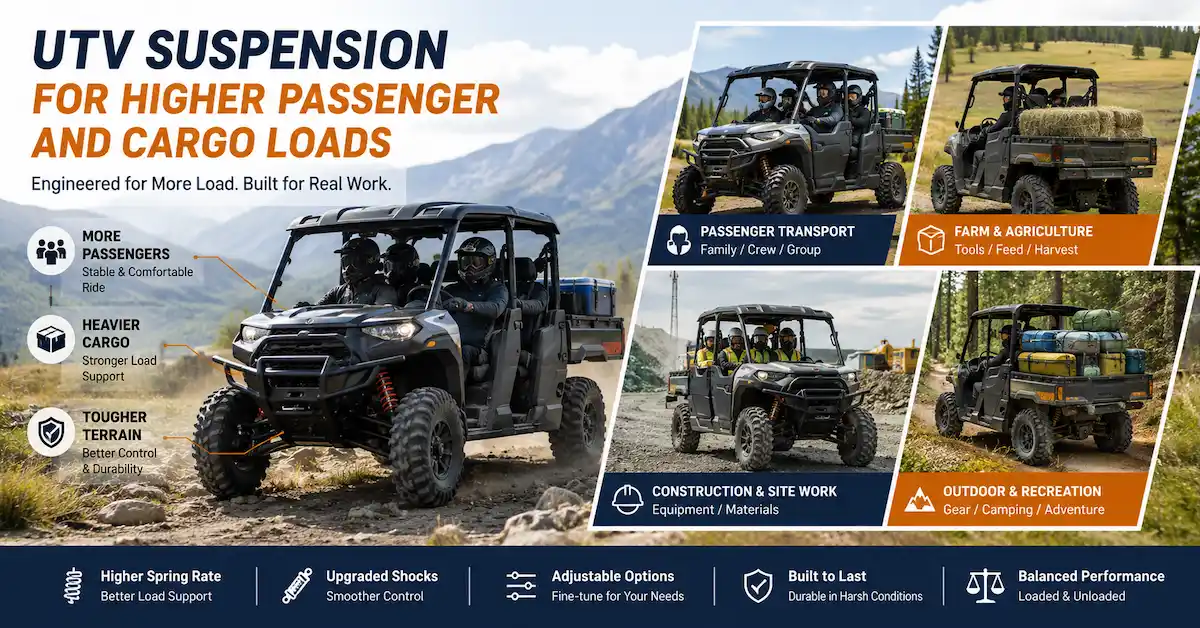

A UTV should consider remote reservoir UTV shocks when the suspension faces sustained rough-terrain operation, repeated high-frequency movement, demanding speeds, heavy working conditions, or packaging limitations that make additional oil and gas volume useful.
That does not mean every off-road UTV needs a remote reservoir.
A utility vehicle moving slowly around a farm may encounter rocks, holes, and uneven ground without placing continuous thermal demand on its dampers. A recreational UTV traveling quickly over a long section of repeated bumps is working its shocks in a very different way.
The better buying question is therefore not:
“Are remote-reservoir shocks better?”
It is:
“Does this UTV have a suspension problem that a remote reservoir can actually help solve?”
For a new OEM vehicle, buyers should evaluate the reservoir as part of the complete suspension architecture rather than as an isolated upgrade. Bedo Auto's UTV suspension design service explains how vehicle mass, suspension geometry, shock stroke, spring characteristics, reservoir packaging, terrain, and duty cycle interact during development.
What Is a Remote-Reservoir UTV Shock?
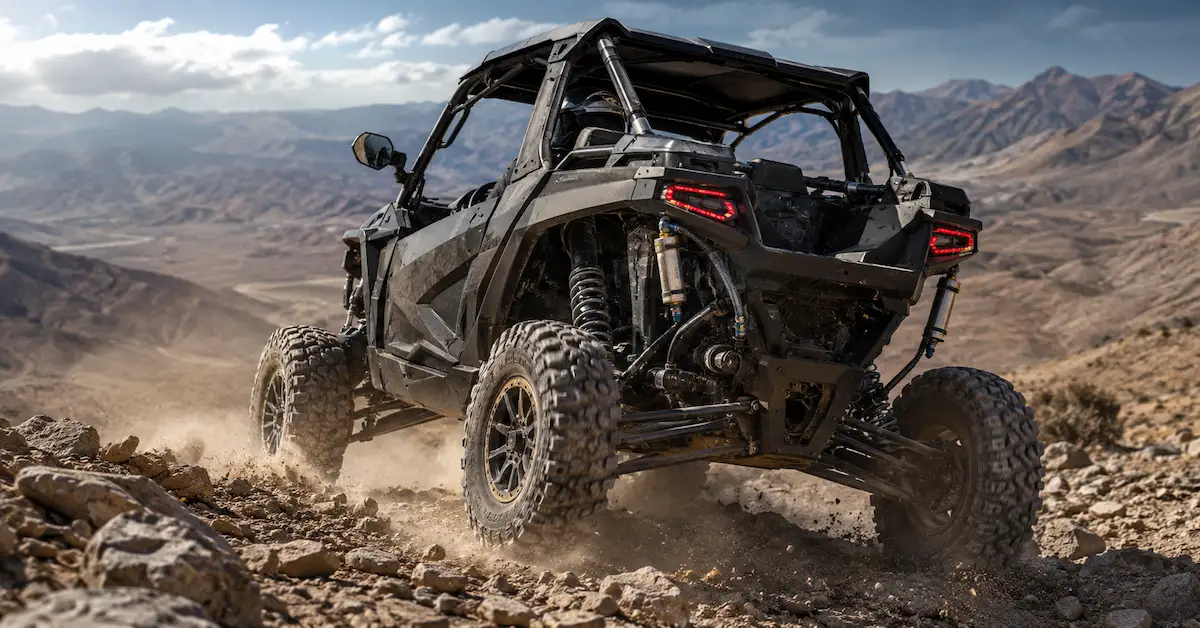
A remote-reservoir shock uses a separate reservoir connected to the main shock body through a hose.
The reservoir creates additional space for hydraulic fluid and gas outside the main damper body. Depending on the internal architecture, this can give the shock designer more flexibility in managing oil volume, gas volume, damping behavior, and installation packaging.
Potential advantages include:
- Additional hydraulic fluid volume
- Additional gas volume
- Better packaging flexibility
- More options for thermal management
- Greater design freedom for compression-control systems
- The ability to position the reservoir away from a crowded shock location
But the reservoir is only one part of the suspension.
A shock can have a large remote reservoir and still perform poorly if its:
- Spring rate is wrong
- Damping is mismatched
- Shock travel is insufficient
- Mounting dimensions are incorrect
- Suspension geometry is unsuitable
- Vehicle load has not been considered
The reservoir should support the suspension design. It should not substitute for it.
Why Does Shock Heat Matter?
A shock absorber controls suspension movement by converting mechanical energy into heat within its hydraulic system.
One bump is not usually the problem.
The challenge develops when the damper repeats this job continuously.
Consider a UTV traveling over:
- Washboard roads
- Rocky trails
- Repeated potholes
- Long uneven work roads
- Fast off-road tracks
- Repeated dips and ruts
The shocks may compress and rebound continuously for an extended period.
As temperature rises, the operating behavior of the hydraulic system can change. How much this affects damping depends on the shock design, fluid, gas management, vehicle load, terrain, speed, and duty cycle.
This is why a vehicle may feel controlled during the first part of a run but less controlled after extended rough-terrain use.
That type of repeatable change is a useful reason to investigate whether the current damper architecture is appropriate.
Do Remote Reservoirs Prevent Shock Fade?
A remote reservoir can help create conditions that support more consistent damping during demanding operation, but it is not a guarantee against shock fade.
Damping consistency is influenced by many variables,including:
- Oil volume
- Oil specification
- Shock-body dimensions
- Piston design
- Valve configuration
- Gas pressure
- Seal condition
- Vehicle mass
- Suspension leverage
- Terrain
- Operating speed
- Duty cycle
The correct engineering approach is not:
Shock Fade → Add Reservoir
It is:
Identify the Cause → Review Shock Architecture → Prototype the Solution → Test It on the Vehicle
If the problem appears only after sustained rough operation, the test procedure should be long enough to reproduce that same condition.
When Does Rough Terrain Justify Remote Reservoir UTV Shocks?
Repeated rough terrain is one of the strongest reasons to evaluate a reservoir design.
Two UTVs can both be classified as off-road vehicles while placing completely different demands on their dampers.
UTV A
- Low operating speed
- Occasional ruts
- Short trips
- Predictable agricultural terrain
UTV B
- Repeated rocky sections
- Continuous suspension cycling
- Longer routes
- Higher operating speed
UTV B creates a much stronger case for remote reservoir shocks.
Potential applications include:
- Recreational trail vehicles
- Fast utility UTVs
- Rough industrial work vehicles
- Long-distance off-road vehicles
- Mining or construction-site utility vehicles
- Vehicles used on washboard roads
- Performance-oriented UTVs
The important factor is not simply how rough the terrain looks.
It is how frequently and how long the suspension must work.
Do Heavy-Load UTVs Need Remote Reservoir Shocks?
Not automatically.
Heavy load primarily changes the amount of weight the suspension must support.
That first affects:
- Spring rate
- Suspension sag
- Ride height
- Available compression travel
- Front/rear axle load
- Damping requirements
A heavily loaded UTV that moves slowly across relatively predictable terrain may still perform well with a properly engineered conventional shock.
A remote reservoir becomes more relevant when heavy load is combined with a demanding duty cycle.
For example:
Heavy Load + Low Speed + Moderate Terrain
may not justify the extra hardware.
But:
Heavy Load + Rough Terrain + Long Operating Periods
creates a stronger engineering case.
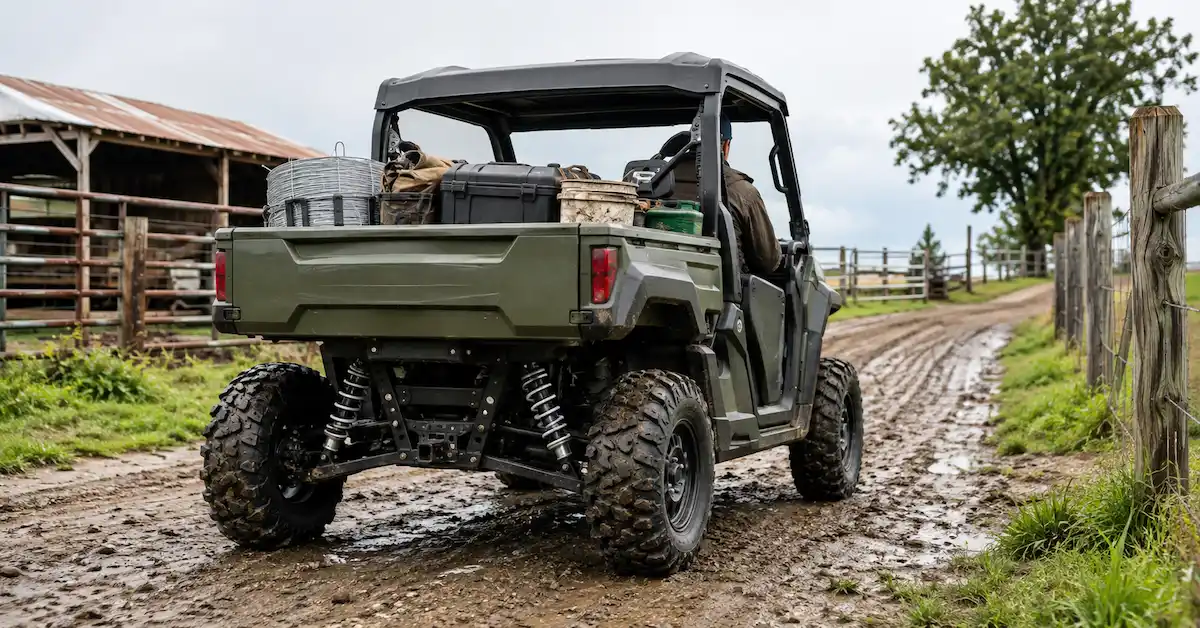
For buyers dealing primarily with payload rather than thermal demand, the UTV suspension for heavy payload applications guide explains how operating weight, axle distribution, spring rate, sag, travel, and damping should be evaluated before choosing a shock architecture.
Spring Support Comes Before Reservoir Selection
A remote reservoir does not solve an incorrect spring specification.
This distinction is especially important for utility vehicles.
Suppose the rear suspension sags badly when a cargo box is loaded.
Adding a remote reservoir does not automatically restore the correct ride height.
The first questions should be:
- What is the loaded rear axle weight?
- What is the current spring rate?
- How much sag occurs?
- How much compression travel remains?
- Is preload already near its practical adjustment limit?
A useful engineering principle is:
The spring supports the load; the shock controls how that supported load moves.
Only after the spring and load requirements are understood should the buyer decide whether the damper needs a conventional, piggyback, or remote-reservoir architecture.
Are Remote Reservoir Shocks Better for Higher-Speed UTVs?
They often become more relevant as operating speed and terrain severity increase.
Higher speed can expose the suspension to more frequent and more demanding movement.
A section of uneven trail that produces occasional shock movement at low speed may produce rapid repeated compression and rebound at a higher speed.
This can increase the importance of:
- Damping consistency
- Fluid capacity
- Appropriate compression control
- Rebound recovery
- Heat management
However, “high-speed UTV” is still too vague for engineering development.
A supplier should understand:
- Typical speed
- Maximum intended speed
- Terrain
- Vehicle weight
- Passenger and cargo load
- Suspension geometry
- Shock travel
- Duty cycle
Those inputs are far more useful than simply requesting “racing-style reservoir shocks.”
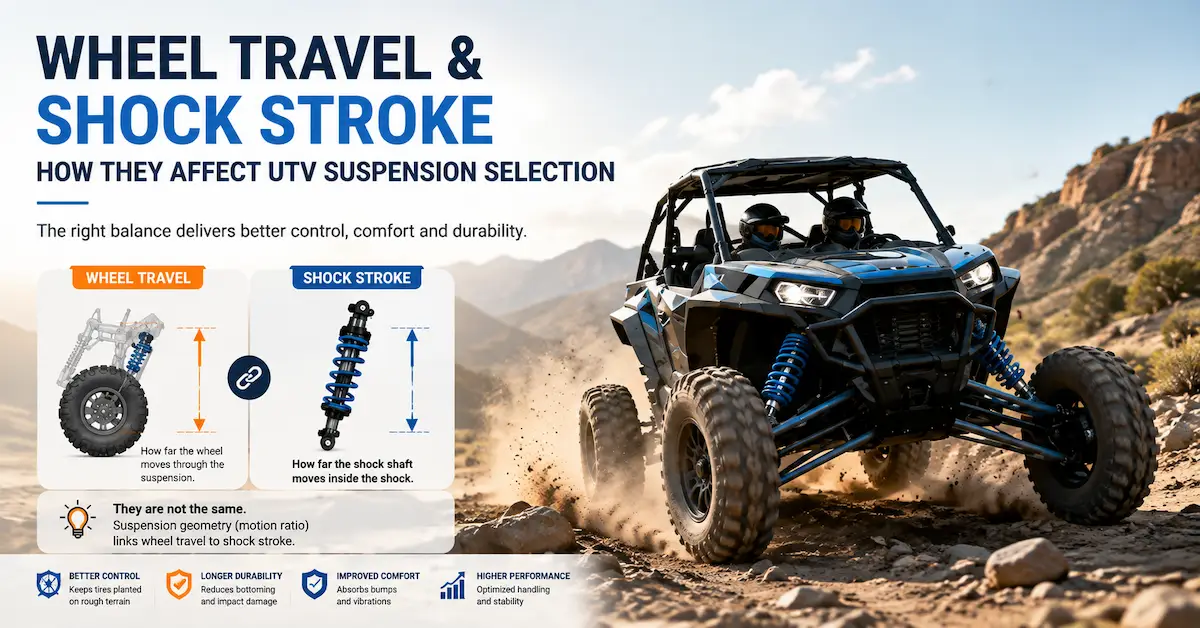
Does a Remote Reservoir Increase Suspension Travel?
No.
A remote reservoir provides additional hydraulic-system packaging. It does not automatically increase shock stroke or wheel travel.
Shock travel depends on:
- Extended shock length
- Compressed shock length
- Effective stroke
- Mounting position
- Control-arm geometry
- Wheel travel
- Mechanical clearance
If a vehicle bottoms because there is insufficient usable compression travel, adding a reservoir does not create additional stroke.
The shock dimensions and suspension geometry must be reviewed separately.
This is one reason replacement buyers should not select shocks by appearance alone. The UTV replacement shock absorber buying guide covers extended length, compressed length, stroke, spring rate, damping, mounting dimensions, reservoir position, and other fitment factors that should be checked together.
Remote Reservoir vs Piggyback Reservoir
Remote and piggyback reservoirs can serve similar hydraulic purposes, but their physical arrangement is different.
A piggyback reservoir is attached directly to the shock body.
A remote reservoir is separated from the shock and connected through a hose.
| Selection Factor | Piggyback Reservoir | Remote Reservoir |
|---|---|---|
| Reservoir location | Attached to shock body | Mounted separately |
| External hose | Usually not required | Required |
| Space near shock | More space needed | Can reduce local packaging pressure |
| Mounting flexibility | Lower | Higher |
| Hose routing | Not applicable | Must be engineered |
| Installation complexity | Lower | Higher |
| Best fit | Space available beside shock | Separate reservoir location preferred |
Neither system is automatically better.
A UTV may have plenty of room around the shock but no protected path for a remote hose. Piggyback may then be the cleaner solution.
Another platform may have a narrow suspension package but plenty of protected chassis space nearby. A remote reservoir may fit more easily.
When Does Vehicle Packaging Favor a Remote Reservoir?
Packaging can be the deciding factor even when thermal performance is not the main problem.
Space around a UTV shock may be restricted by:
- Chassis tubes
- Control arms
- Tires
- Brake components
- Body panels
- Cargo structures
- Battery packaging
- Powertrain components
A remote reservoir allows some of the hydraulic-system volume to be located away from the main shock body.
This can be particularly useful during development of:
- New UTV platforms
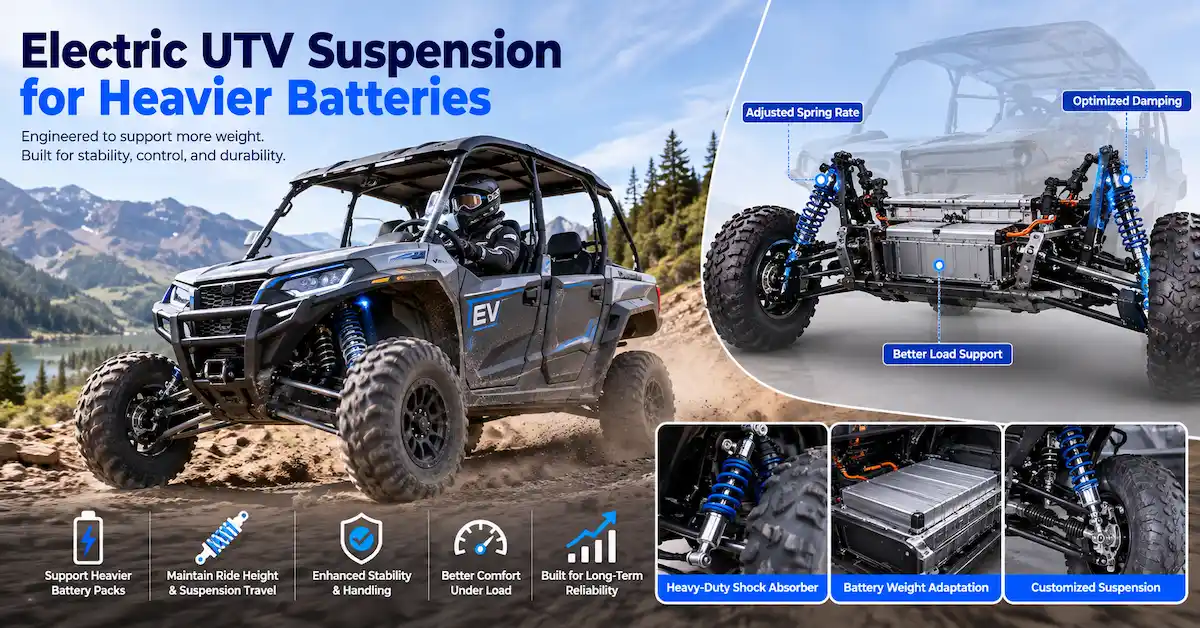
- Electric UTVs
- Vehicles with larger tires
- Modified suspension layouts
- Specialty utility vehicles
- Platforms where chassis hard points cannot easily move
For a new platform, CAD drawings can help identify both the available shock envelope and possible reservoir mounting locations before prototypes are produced.
What Installation Risks Come With Remote Reservoirs?
Remote mounting adds flexibility, but it also adds a hose, fittings, and a separate mounting point.
These components need to be considered throughout suspension movement.
A poorly routed hose can potentially:
- Rub against chassis edges
- Contact a tire
- Become pinched
- Stretch at full droop
- Contact hot components
- Receive repeated stone impact
The reservoir itself should also be positioned where it can be securely mounted and protected.
For an OEM project, buyers should therefore review:
- Hose length
- Hose bend radius
- Full compression clearance
- Full droop clearance
- Tire movement
- Steering movement where relevant
- Heat sources
- Reservoir mounting structure
Hose routing should not be treated as an afterthought after the shock specification has already been approved.
Does a Remote Reservoir Mean the Shock Is Adjustable?
No.
Reservoir architecture and external damping adjustment are separate decisions.
A remote-reservoir shock may use:
- Fixed damping
- Compression adjustment
- Rebound adjustment
- Compression and rebound adjustment
- More advanced multi-adjustment systems
That means an RFQ saying:
“We need an adjustable reservoir shock.”
still leaves several important questions unanswered.
A better inquiry explains the problem first:
“Our UTV experiences changing loads and long rough-terrain operation. We want to evaluate a remote-reservoir design and determine whether external compression adjustment would add useful tuning flexibility.”
That gives the supplier a reason for each requested feature.
When Is Compression Adjustment Useful?
Compression adjustment can be worth considering when one vehicle has to perform across meaningfully different conditions.
Examples include:
- Light and heavy cargo
- Smooth and rough terrain
- Recreational and utility operation
- Different driver requirements
However, adjustability creates value only when users or technicians actually need to change the setting.
A fleet vehicle performing one repetitive task may benefit more from a properly developed fixed damping specification.
A recreational or performance-oriented vehicle experiencing large terrain changes may gain more from external adjustment.
More adjustment is not automatically better.
The adjustment should solve a defined operating need.
When Is a Conventional Non-Reservoir Shock Enough?
Many UTVs do not need a remote reservoir.
A conventional shock may be the better choice when:
- Vehicle speeds are relatively low
- Terrain is moderate
- Suspension cycling is intermittent
- Operating load is predictable
- Current damping remains consistent
- Packaging is not restrictive
- External tuning is unnecessary
- Simpler service is preferred
- Project cost matters
A reservoir should earn its place on the vehicle.
If prototype testing shows that a conventional shock maintains the required control throughout the intended operating condition, increasing complexity may provide little practical benefit.
Standard Shock vs Remote Reservoir Shock
| Buyer Question | Standard Shock | Remote Reservoir Shock |
|---|---|---|
| Light-duty utility operation | Often suitable | Usually unnecessary |
| Short rough-terrain periods | Often suitable | Depends on duty |
| Sustained rough terrain | Must be evaluated | Stronger candidate |
| High repeated damper activity | May reach design limits | Worth evaluating |
| Heavy load alone | Depends on spring/damping | Not automatically needed |
| Heavy load + rough duty | Requires careful review | More relevant |
| Tight shock packaging | Conventional envelope | Remote placement may help |
| External hose | No | Yes |
| Installation complexity | Lower | Higher |
| Cost structure | Usually simpler | Usually higher |
This is not a comparison between “cheap” and “premium.”
It is a comparison between two architectures intended for different operating requirements.
What Symptoms Suggest a Reservoir Shock Should Be Evaluated?
During prototype or field testing, investigate the shock architecture when repeatable symptoms appear.
Examples include:
- Suspension feels controlled when cold but less controlled after extended use
- Damping changes noticeably during a long rough-terrain run
- Shock temperatures become a recurring development concern
- Vehicle duty becomes significantly more demanding than the original shock specification
- Packaging prevents use of the required damper body or piggyback reservoir
- A higher level of damping adjustment is required
- Existing shocks are repeatedly pushed beyond their intended working condition
These symptoms do not prove that a remote reservoir is required.
They tell the engineering team that the current design deserves investigation.
How Should Remote Reservoir UTV Shocks Be Prototype Tested?
Testing should reproduce the real application.
A short drive on smooth ground is not useful if the original problem appears only after 30 minutes of repeated rough operation.
Establish the Vehicle Baseline
Record:
- Curb weight
- Front axle load
- Rear axle load
- Spring specification
- Static sag
- Existing shock dimensions
Add the Real Operating Load
Include the conditions that matter in normal use:
- Driver
- Passengers
- Cargo
- Tools
- Permanent accessories
Reproduce the Target Terrain
The test environment should resemble the vehicle's intended duty.
Reproduce the Duty Cycle
If the problem appears only after extended operation, testing should be long enough to reveal the same behavior.
Record the Setup
Document:
- Shock specification
- Spring
- Vehicle load
- Adjustment settings
- Test route
- Tire setup
- Driver feedback
- Observed suspension behavior
A prototype-based development process is especially valuable when the application cannot be resolved reliably from dimensions alone. Buyers evaluating sample development can also review Bedo Auto's shock absorber sample supplier guide, which outlines prototype and OEM suspension development considerations.
What Should Buyers Evaluate During Testing?
Focus on vehicle behavior rather than whether the reservoir “looks more professional.”
Check:
- Initial damping behavior
- Damping behavior after sustained use
- Suspension bottoming
- Rebound recovery
- Body movement
- Wheel control
- Available compression travel
- Loaded ride behavior
- Unloaded ride behavior
- Hose clearance
- Reservoir mounting clearance
For an adjustable shock, record the setting before every test.
Avoid changing several settings at once.
A better process is:
Baseline Setting → Test → One Controlled Change → Re-Test → Record Result
This makes it much easier to understand whether an adjustment actually improved the vehicle.
What Adds Cost to a Remote-Reservoir Shock?
The reservoir is not the only additional component.
Depending on the design, a remote-reservoir assembly can add:
- Reservoir body
- Hose
- Fittings
- Mounting hardware
- Additional seals
- Additional machining
- More assembly operations
- Adjustment hardware
- Additional inspection points
- Additional installation work
That is why buyers should not compare a conventional shock and a remote-reservoir shock by unit price alone.
First confirm that both quotations are based on the required:
- Dimensions
- Spring
- Damping
- Materials
- Mounting configuration
- Reservoir arrangement
- Adjustment system
- Prototype scope
- Testing scope
- Branding and packaging
The commercial question is:
Does the more complex shock solve a performance, packaging, or market requirement that matters enough to justify it?
When Does a Remote Reservoir Make Sense for an OEM UTV Program?
A remote reservoir becomes a strong candidate when one or more of the following conditions are present.
Sustained Rough-Terrain Use
The shock cycles continuously for long periods.
Higher-Speed Off-Road Operation
Repeated impacts create more demanding damping conditions.
Heavy-Duty Operation With Long Duty Cycles
The UTV combines substantial operating weight with continuous rough-terrain work.
Restricted Shock Packaging
A separate reservoir location solves space limitations around the damper.
Genuine Tuning Requirements
The application benefits from an external compression or other damping adjustment.
Prototype Testing Identifies a Need
This is the strongest reason.
If testing shows a repeatable suspension problem and a reservoir configuration solves that problem, the architecture has a clear technical purpose.
What Should Distributors Consider?
Aftermarket distributors face a slightly different decision from an OEM vehicle manufacturer.
A distributor should evaluate:
- Target UTV models
- Replacement versus upgrade positioning
- Customer terrain
- Customer load requirements
- Installation complexity
- Reservoir mounting hardware
- Instructions
- Private-label positioning
- Repeat availability
A premium-looking reservoir shock may attract customers, but compatibility and useful performance still matter more than appearance.
Distributors developing private-label suspension can review the aftermarket UTV suspension supplier guide for additional guidance on replacement, upgrade, heavy-duty, and private-label UTV suspension sourcing.
What Should an OEM Buyer Send in an RFQ?
Avoid sending only:
“Please quote remote reservoir UTV shocks.”
That gives the supplier almost no engineering context.
A stronger RFQ includes the following.
Vehicle Information
- UTV type or platform
- Vehicle curb weight
- Wheelbase
- Front axle load
- Rear axle load
Existing Suspension
- Shock extended length
- Compressed length
- Effective stroke
- Mounting type
- Mounting dimensions
- Spring data
- Shock photographs
- Existing sample if available
Operating Conditions
Describe:
- Typical terrain
- Typical speed
- Duty-cycle duration
- Passenger load
- Cargo load
- Permanent accessories
- Frequency of rough-terrain operation
Current Suspension Problem
Instead of:
“We need stronger shocks.”
write:
“The rear suspension becomes noticeably less controlled after extended loaded operation over repeated rough work roads.”
That gives the supplier a technical problem to investigate.
Reservoir Packaging
If a remote reservoir is being considered,provide:
- Available mounting areas
- Chassis photographs
- CAD files if available
- Nearby moving components
- Tire clearance
- Heat sources
- Preferred reservoir location if one already exists
Commercial Requirements
Include:
- Prototype quantity
- Pilot quantity
- Estimated production volume
- OEM or private-label requirements
- Branding
- Packaging
- Target market
What Questions Should I Ask the Supplier?
Before approving a reservoir-shock project, ask:
- Why is a remote reservoir recommended?
- What vehicle condition is it intended to solve?
- Would a conventional or piggyback design also work?
- Is the damping fixed or adjustable?
- What does each adjuster control?
- Does the spring specification also need to change?
- What reservoir location is recommended?
- How should the hose be routed?
- What conditions should prototype testing reproduce?
- How will the approved prototype specification be controlled during production?
These questions move the supplier discussion away from feature selling and toward vehicle engineering.
How Can Bedo Auto Support a UTV Shock Project?
Buyers beginning a reservoir or custom UTV suspension project can first review Bedo Auto's shock absorber product range to understand the general product direction available for off-road applications.
For a project-specific evaluation, provide vehicle weight, axle loads, shock dimensions, spring information, terrain, operating conditions, drawings, CAD files where available, and the suspension behavior you want to improve.
The engineering discussion can then focus on the relevant questions:
- Is a reservoir actually required?
- Piggyback or remote?
- Fixed or adjustable damping?
- What spring is appropriate?
- How much shock travel is available?
- Where can the reservoir be mounted?
- How should the hose be routed?
- What should the prototype test reproduce?
Buyers ready to submit a project can use the Bedo Auto contact page to send vehicle and suspension information for further discussion.
A useful inquiry might read:
“Our utility UTV carries a high rear load and operates continuously over rough work roads.The existing shocks become less controlled after extended use. We can provide axle-load information, current shocks, vehicle drawings, terrain details, and expected production quantity. We would like to evaluate whether a remote-reservoir design is appropriate.”
That is much more useful than simply asking for a price.
FAQ
When should a UTV use remote-reservoir shocks?
A UTV should consider remote-reservoir shocks when sustained rough-terrain operation, repeated suspension cycling, demanding speed, heat-management requirements, or vehicle packaging make additional hydraulic volume and remote mounting useful.
Does every off-road UTV need remote-reservoir shocks?
No. A correctly specified conventional shock may be sufficient for lower-speed, moderate-terrain, or predictable utility applications.
Are remote reservoir UTV shocks better for heavy loads?
Not automatically. Heavy loads first require appropriate spring support, sag, travel, and damping. A reservoir becomes more relevant when heavy load is combined with demanding or sustained suspension cycling.
Can a remote reservoir increase shock travel?
No. Shock stroke is determined by shock dimensions and suspension geometry. Adding a reservoir does not create additional suspension travel.
Are remote-reservoir shocks always adjustable?
No. A remote-reservoir shock can use fixed or externally adjustable damping depending on its design.
What is the difference between piggyback and remote-reservoir shocks?
A piggyback reservoir is attached to the shock body. A remote reservoir is mounted separately and connected to the shock through a hose.
Do remote reservoirs prevent shock fade?
They can support better thermal and hydraulic management in demanding conditions, but damping consistency still depends on the complete shock design and vehicle application.
Are remote-reservoir shocks useful for slow utility UTVs?
Sometimes, but many slow and predictable utility applications do not require them unless there is a specific packaging, heat, damping, or duty-cycle reason.
What are the disadvantages of a remote-reservoir shock?
Potential disadvantages include additional cost, hose routing, fittings, mounting hardware, installation complexity, and more components that must be packaged correctly.
What information should I send for a custom remote-reservoir shock quotation?
Provide vehicle weight, axle loads, shock dimensions, spring information, passenger and cargo conditions, terrain, operating speed, duty cycle, current suspension problem, packaging drawings or CAD, prototype needs, and expected production quantity.
Conclusion
Remote reservoir UTV shocks are worth using when the reservoir solves a real suspension or packaging problem.
They become more relevant when a UTV operates continuously over rough terrain, travels at more demanding speeds, combines substantial load with sustained suspension movement, or lacks enough space around the shock for the required damper architecture.
They may provide little practical benefit when the vehicle moves slowly, sees moderate terrain, carries predictable loads, and already maintains consistent suspension behavior throughout normal operation.
A better selection process is:
Vehicle Use → Load → Terrain → Duty Cycle → Existing Shock Behavior → Spring & Travel → Packaging → Reservoir Need → Prototype → Vehicle Test → Production
For OEM buyers, start with the vehicle problem rather than the reservoir.
If the problem can be solved with a simpler shock, use the simpler shock.
If repeated testing shows that additional hydraulic volume, remote packaging, or damping capability provides meaningful value, then a remote-reservoir shock has earned its place in the suspension system.