
What Is a Custom Suspension Drawing Supplier?
A custom suspension drawing supplier helps vehicle manufacturers and suspension brands convert vehicle requirements, existing samples, sketches, dimensional data, or CAD information into technical suspension documentation that can support prototype development and later manufacturing.
For an OEM buyer, this service is more valuable than simply hiring someone to create an attractive 3D model.
A qualified supplier should understand how the drawing relates to:
- Vehicle installation geometry
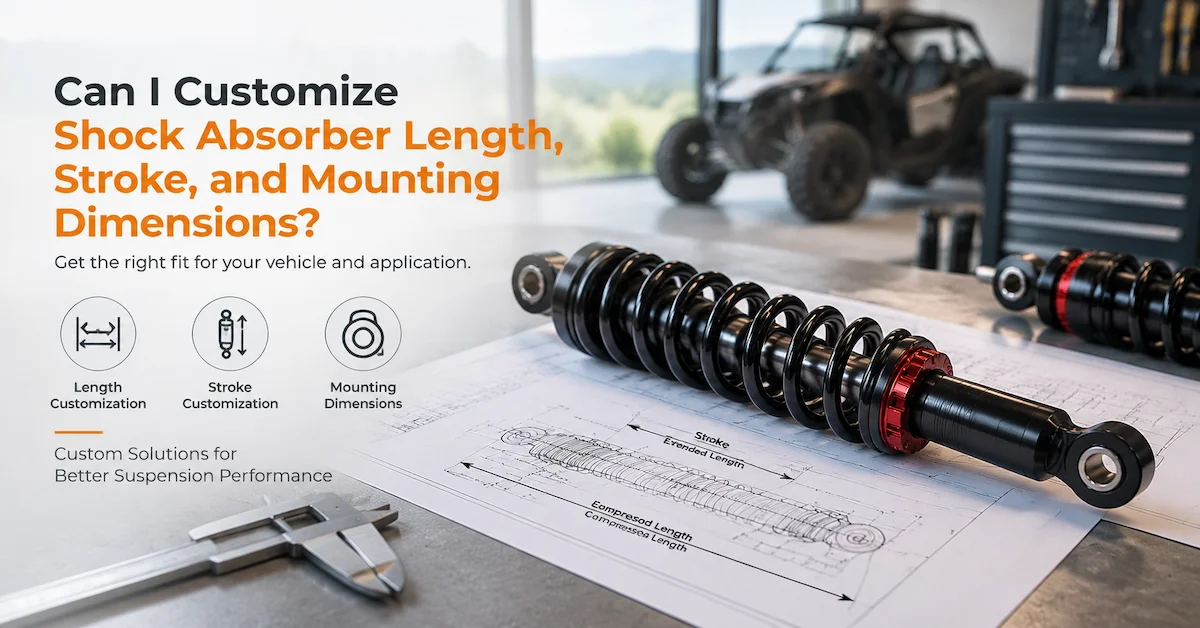
- Shock absorber extended and compressed length
- Suspension stroke
- Upper and lower mounting interfaces
- Spring packaging
- Reservoir clearance
- Vehicle weight and payload
- Prototype manufacturing
- Engineering revisions
- Production inspection
The drawing therefore becomes an engineering communication tool connecting the buyer, suspension engineer, prototype team, purchasing department, quality team, and production supplier.
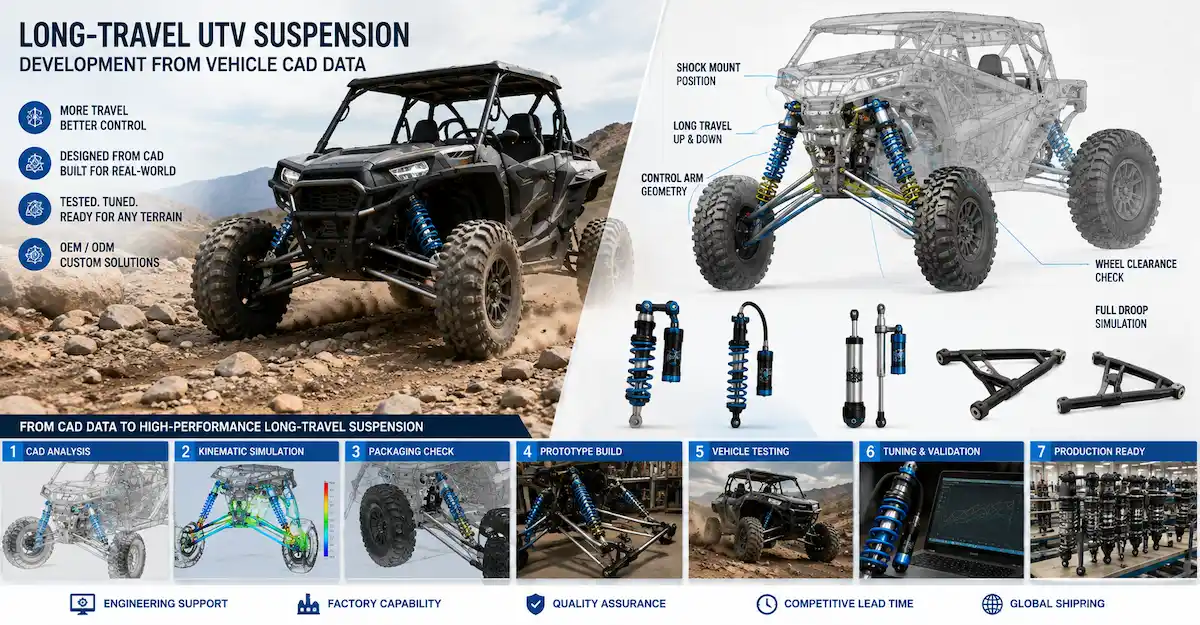
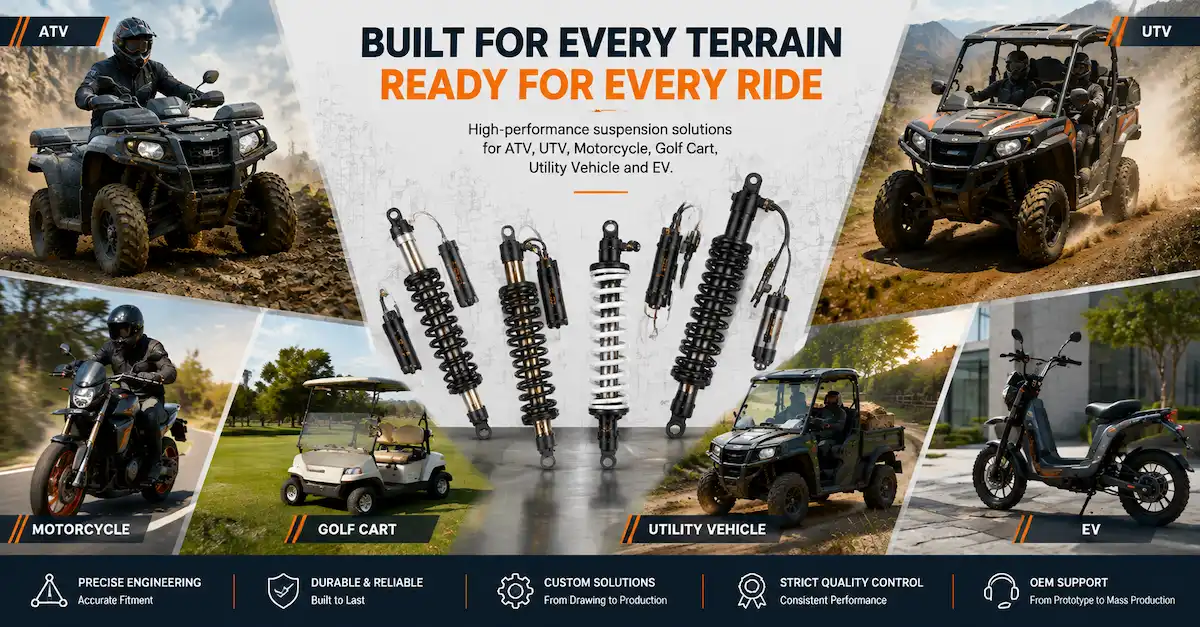
Bedo Auto currently describes its suspension-development approach as combining engineering analysis, CAD design support, prototype development, validation testing, and OEM production support for applications including ATV, UTV, motorcycles, golf carts, utility vehicles, EVs, and specialty vehicles.
Buyers who are still defining their first technical documentation can first review Bedo's Shock Absorber Drawing Service.
When Do You Need a Custom Suspension Drawing Supplier?
Not every suspension purchasing project requires new drawings.
If a validated catalog shock absorber already meets your dimensions and performance requirements, selecting an existing model may be faster and more economical.
A drawing supplier becomes more valuable when the project involves a new or modified suspension configuration.
Typical situations include:
- A new ATV or UTV platform
- A new motorcycle or electric motorcycle
- A specialty or utility vehicle
- Modification of an existing chassis
- Replacement of a discontinued suspension component
- A physical sample without reliable drawings
- A customer-owned design requiring manufacturability review
- Different mounting dimensions from an existing shock
- A custom spring or reservoir package
- Proprietary OEM suspension development
In these situations, drawings can reduce ambiguity before money is committed to prototypes, tooling, materials, and production.
Drawing Supplier vs CAD Drafting Company: What Is the Difference?
This distinction matters for OEM buyers.
A CAD drafting company may be able to reproduce dimensions in software.
A suspension engineering supplier should understand what those dimensions mean for the vehicle.
| Capability | CAD Drafting Provider | Suspension Drawing Supplier |
|---|---|---|
| Create 2D drawings | Usually | Yes |
| Create 3D CAD | Usually | Yes, depending on project |
| Understand shock mounting | Not necessarily | Expected |
| Review stroke requirements | Limited | Engineering consideration |
| Review spring packaging | Limited | Expected |
| Analyze reference samples | Not always | Often required |
| Connect drawings to prototypes | Not necessarily | Important |
| Support suspension testing | Rare | Valuable |
| Support production transition | Rare | Important for OEM projects |
The correct supplier depends on your objective.
If you only need a clean drawing from already-approved engineering data, drafting capability may be sufficient.
If you need to move from vehicle requirement → drawing → prototype → validation → production, suspension-specific engineering experience becomes much more important.
What Information Should You Send to a Suspension Drawing Supplier?
A supplier cannot produce a reliable suspension drawing from the keyword “custom shock absorber” alone.
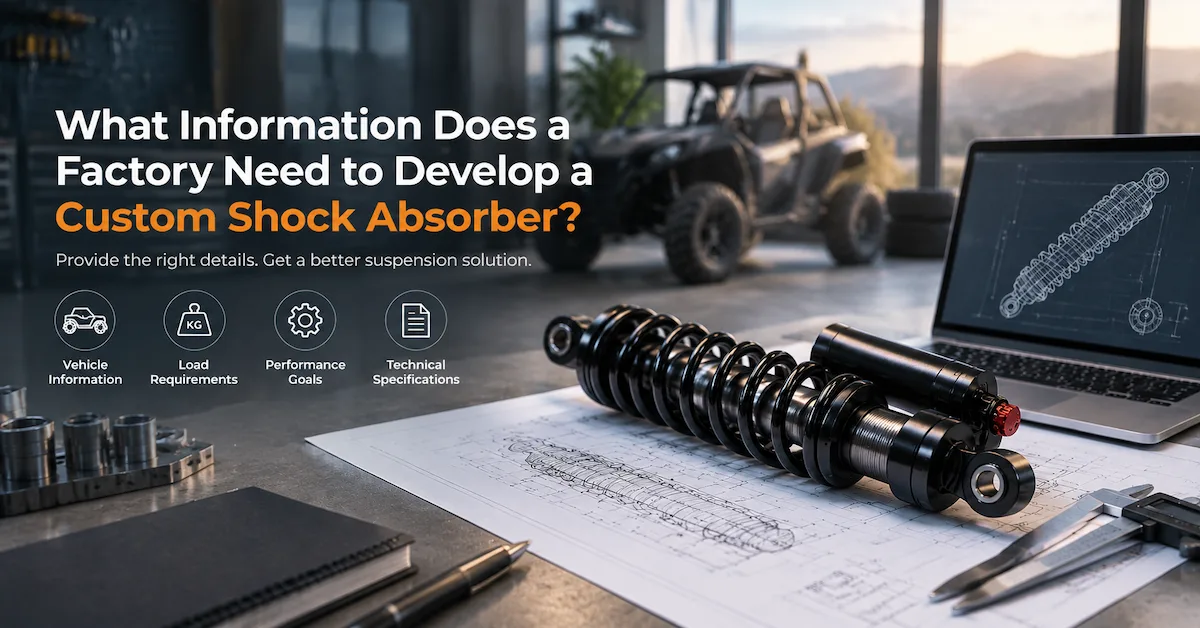
The development package should contain as much verified information as possible.
| Project Input | Typical Data | Why It Matters |
| Vehicle type | ATV, UTV, motorcycle, EV, utility vehicle | Defines application context |
| Suspension position | Front or rear | Defines installation environment |
| Vehicle weight | Empty and loaded | Supports engineering review |
| Payload | Rider, cargo, equipment | Helps define operating conditions |
| Extended length | Mount-center to mount-center | Controls full extension |
| Compressed length | Minimum shock length | Controls compression limit |
| Stroke | Required piston movement | Defines shock travel |
| Upper mount | Eye, fork, clevis, etc. | Defines vehicle interface |
| Lower mount | Eye, fork, clevis, etc. | Defines vehicle interface |
| Mount dimensions | Hole diameter, width, bush size | Determines fitment |
| Spring data | Rate, free length, OD if known | Supports spring packaging |
| Reservoir data | Position or space restriction | Supports packaging |
| Existing drawing | Current 2D documentation | Provides design reference |
| CAD model | Part or vehicle model | Supports geometry review |
| Physical sample | Existing shock absorber | Supports dimensional analysis |
| Performance target | Utility, comfort, trail, racing, etc. | Guides later validation |
If some values are unknown, mark them clearly as TBC—To Be Confirmed.
Guessing an engineering dimension simply to complete a drawing can create more risk than leaving the item open for technical review.
What Should a Custom Suspension Drawing Include?
The exact content depends on whether the document is intended for conceptual review, prototype approval, manufacturing, or quality inspection.
Overall Shock Absorber Geometry
For a complete shock absorber, useful dimensions may include:
- Extended length
- Compressed length
- Stroke
- Shock body diameter
- Spring outside diameter
- Spring installation envelope
- Upper mounting dimensions
- Lower mounting dimensions
- Reservoir location
- Hose position where applicable
The reference points need to be unambiguous.
For example, “total shock length” is not enough if one party measures overall physical length while another uses eye-center-to-eye-center length.
Mounting Interfaces
Mounting dimensions are often among the most important fitment characteristics.
A drawing may need to specify:
- Eye diameter
- Bushing inner diameter
- Bushing width
- Fork opening
- Clevis width
- Bolt location
- Mounting-center position
Incorrect interface information can result in a shock absorber that cannot be installed even if its overall length appears correct.
Critical Dimensions and Tolerances
Not all dimensions deserve the same tolerance.
ISO 129-1:2018 establishes general principles for presenting dimensions and associated tolerances in technical product documentation.
For OEM buyers, the practical objective is to identify which dimensions are genuinely critical to:
- Fit
- Alignment
- Assembly
- Motion
- Inspection
- Repeatability
Specifying unnecessarily tight tolerances everywhere may increase manufacturing and inspection difficulty without adding useful product performance.
Geometrical Requirements
Some components may require control of geometrical characteristics rather than simple linear dimensions.
ISO 1101:2017 defines the symbol language and interpretation rules used for geometrical specification of workpieces.
Whether such tolerancing is required depends on the component and manufacturing process. Buyers should not add complex GD&T merely to make a drawing appear more professional.
Materials and Finishes
Depending on drawing purpose, technical notes may also define:
- Material
- Surface treatment
- Coating
- Heat treatment where required
- Appearance requirements
- Inspection notes
- Customer-specific markings
These requirements should be agreed rather than assumed.
2D Drawing, 3D CAD, or Both?
For many custom suspension projects, the strongest engineering package combines both.
Why Use 3D CAD?
3D CAD can help engineers review:
- Available packaging space
- Component geometry
- Reservoir positioning
- Assembly relationships
- Vehicle interference
- Spring clearance
- Mounting orientation
ISO 16792:2021 addresses the preparation, revision, and presentation of digital product definition data and supports both a 3D-model-only approach and a 3D model combined with a 2D drawing.
For more detail on this development stage, see Bedo's CAD-Based Suspension Development.
Why Use 2D Drawings?
2D drawings remain useful for communicating:
- Critical dimensions
- Tolerances
- Materials
- Surface specifications
- Notes
- Revision information
- Inspection requirements
For many OEM projects, it is therefore not a question of 2D vs 3D.
The better question is:
Which information needs to be controlled in the 3D model, and which information must be clearly communicated for prototype, production, and inspection?
Can a Custom Suspension Drawing Be Developed From a Physical Sample?
Yes. A physical shock absorber or suspension component can provide valuable reference information when original engineering data is missing.
The supplier may review measurable characteristics such as:
- Overall length
- Stroke
- Mount structure
- Spring dimensions
- Body dimensions
- Reservoir configuration
- Adjustment location
- Interface dimensions
Bedo currently lists sample analysis and drawing review as part of its broader prototype-development support.
However, measuring an existing part is not the same as proving that the same specification is appropriate for another vehicle.
If the new application changes vehicle weight, payload, suspension geometry, mounting angle, terrain, or intended performance, the supplier may need to review the engineering requirements rather than simply copy the reference unit.
How Does a Custom Suspension Drawing Project Work?
A well-controlled project can follow a sequence such as the following.
1. Application and Requirement Review
The supplier first determines:
- Which vehicle is involved
- Where the suspension is installed
- What information already exists
- Which parameters are confirmed
- Which items remain unknown
This prevents the drawing process from beginning with unverified assumptions.
2. Existing Drawing, CAD, or Sample Review
The supplier evaluates the customer's available:
- 2D drawings
- 3D CAD
- Physical samples
- Photos
- Vehicle dimensions
- Previous specifications
This stage identifies missing or contradictory information.
3. Preliminary Suspension Drawing
The first technical drawing establishes the fundamental geometry and interfaces.
This should be treated as a review document rather than automatically released for production.
4. Customer Engineering Review
The customer checks critical factors such as:
- Mounting dimensions
- Shock length
- Stroke
- Packaging
- Interfaces
- Material
- Surface requirements
Any unresolved items should remain clearly identified.
5. Drawing Revision and Approval
Changes should be controlled through drawing revision rather than scattered across emails and chat messages.
The latest approved document should clearly identify its revision status.
6. Prototype Manufacturing
Once the design reaches an appropriate engineering stage, the next step is physical validation.
Bedo's current prototype workflow includes sample analysis, drawing review, suspension design support, prototype manufacturing, spring development, damping adjustment, validation, and OEM production preparation.
Read the related Shock Absorber Prototype Supplier Guide.
7. Fitment and Performance Testing
Prototype evaluation may identify changes that could not be confirmed digitally.
These can include:
- Installation interference
- Mounting alignment
- Spring clearance
- Stroke limitations
- Damping changes
- Spring changes
8. Final Drawing Update
Any approved prototype changes should be reflected in the controlled engineering documentation.
9. Pilot or OEM Production
Once the design has been validated, the approved drawing becomes part of the technical reference used for repeated manufacturing and inspection.
Why Drawing Revision Control Matters
A common OEM risk is manufacturing from the wrong file.
Imagine this sequence:
Revision A
Initial prototype drawing
Revision B
Mounting width changed after vehicle testing
Revision C
Final production version
If purchasing sends a new order but the supplier accidentally manufactures Revision A, dimensional accuracy does not help—the wrong design has been produced accurately.
Before releasing production, buyers should therefore verify:
- Current drawing number
- Current revision
- Release date
- Approval status
- Matching CAD revision
- Matching purchase order reference
This is one of the practical differences between professional OEM engineering control and informal sample copying.
What Can Drawings Validate—and What Can They Not?
A professional custom suspension drawing supplier should be transparent about this distinction.
| Drawings Can Define | Drawings Cannot Prove Alone |
| Dimensions | Ride comfort |
| Mounting interfaces | Compression damping |
| Stroke geometry | Rebound damping |
| Component envelope | Dynamic handling |
| Reservoir location | Durability |
| Materials and finishes | Leakage resistance |
| Tolerances | Real vehicle performance |
| Revision status | Production consistency |
This is especially important for complete shock absorber development.
Bedo's published engineering workflow separates drawing review from spring matching, damping tuning, prototype development, testing, and production preparation.
A technically detailed CAD model should therefore not be presented as proof of suspension performance.
How to Evaluate a Custom Suspension Drawing Supplier
When comparing suppliers, OEM buyers should ask questions that reveal engineering capability rather than simply comparing drawing prices.
Can the Supplier Understand Vehicle Requirements?
Ask whether the supplier requests:
- Vehicle weight
- Payload
- Suspension position
- Mounting data
- Application
- Terrain
- Required travel
If the supplier starts drawing without understanding the application, important assumptions may go unnoticed.
Can the Supplier Work With Multiple Input Types?
A flexible engineering supplier should be able to review some combination of:
- Customer drawings
- CAD files
- Existing samples
- Dimensional sketches
- Vehicle specifications
Does the Supplier Understand Manufacturing?
Drawings should eventually be manufacturable.
The supplier should be able to identify:
- Difficult dimensions
- Unrealistic tolerances
- Material constraints
- Inspection challenges
- Assembly concerns
This becomes especially important when the project is moving toward suspension parts from drawings.
Can the Supplier Build the Prototype?
A major advantage of working with an integrated suspension supplier is continuity.
The same engineering intent can move from:
Drawing → Prototype → Test → Revision → Production
rather than requiring the buyer to translate the project repeatedly between unrelated vendors.
Can the Supplier Support Testing?
Digital geometry cannot verify actual suspension behavior.
Testing and prototype validation remain important before final OEM approval.
Can the Supplier Scale Beyond One Sample?
For commercial projects, ask whether the supplier can support:
- Prototype quantities
- Engineering revisions
- Pilot batches
- Low-volume manufacturing
- Repeat OEM production
Bedo currently states that its custom suspension workflow can progress from prototypes and small batches into OEM production.
Common Risks When Outsourcing Suspension Drawings
Risk 1: Copying a Reference Sample Without Application Review
The old sample may belong to a different vehicle or load case.
Better approach: provide the reference sample together with new vehicle requirements.
Risk 2: Incomplete Mounting Information
A correct shock body cannot compensate for an incorrect mounting interface.
Better approach: confirm upper and lower mounting references before prototype release.
Risk 3: Excessively Tight Tolerances
Tight tolerances can increase cost without improving fit or function.
Better approach: identify critical-to-fit and critical-to-function features.
Risk 4: Uncontrolled Drawing Revisions
Different teams may unknowingly use different versions.
Better approach: establish revision control before sample production.
Risk 5: Treating CAD Approval as Performance Approval
Geometry approval does not prove damping, spring behavior, durability, or handling.
Better approach: follow CAD approval with appropriate prototype validation.
How Bedo Auto Supports Custom Suspension Drawing Development
Bedo Auto's published engineering capabilities connect drawing review with a larger suspension-development workflow rather than presenting drawing creation as the final engineering stage.
Current Bedo content describes support that can include:
- Application analysis
- Sample evaluation
- Drawing review
- Suspension design
- Spring matching
- Damping tuning
- Prototype development
- Testing support
- Production preparation
For buyers beginning with technical drawings or CAD files, the development path can continue through prototype manufacturing, validation, engineering revision, and production.
You can explore Bedo's Suspension Design Partner Guide for the broader engineering workflow.
If you already have approved component drawings and need to understand the next manufacturing stage, see Suspension Parts From Drawings.
For physical verification, continue to the Suspension Sample Development Guide.
What Should You Include in a Suspension Drawing RFQ?
Before contacting a supplier, organize the available project information.
A useful RFQ package can include:
- Vehicle type and application
- Front or rear suspension position
- Empty and maximum loaded weight
- Existing shock absorber sample
- Current 2D drawing
- Existing 3D CAD file
- Extended length
- Compressed length
- Required stroke
- Upper mounting dimensions
- Lower mounting dimensions
- Spring data if available
- Installation photographs
- Vehicle CAD if available
- Material and finish requirements
- Prototype quantity
- Expected future production volume
- Known performance requirements
Do not invent missing values simply to make the RFQ appear complete.
Clearly identify open engineering questions and ask the supplier to review them.
OEM buyers can submit available drawings, samples, CAD files, and technical requirements through the Bedo Auto Contact Page.
FAQ
What is a custom suspension drawing supplier?
A custom suspension drawing supplier develops or reviews technical suspension documentation based on customer drawings, samples, CAD files, dimensions, and vehicle requirements. The service can support prototype and later production development.
Can a supplier create suspension drawings from an existing sample?
Yes. A physical sample can provide dimensional and structural reference information. If the new application differs from the original vehicle, the design should also be reviewed against the new vehicle requirements.
Can I send only a 3D CAD file?
A 3D CAD file can be useful, but additional information may still be required, including tolerances, material, finish, application data, and inspection requirements.
Do I need a 2D drawing if I already have 3D CAD?
Not necessarily for every project. ISO 16792:2021 supports both 3D-model-only and combined 3D-model-plus-2D-drawing digital product-definition approaches. The appropriate documentation depends on the manufacturing and approval workflow.
Can a suspension supplier modify my existing drawing?
Yes, when engineering review identifies a required change. Any modification should be reviewed and recorded through controlled drawing revisions before prototype or production release.
What dimensions are most important for a custom shock absorber?
Common critical parameters include extended length, compressed length, stroke, upper and lower mount geometry, mounting-hole dimensions, spring packaging, and reservoir clearance. Project-specific requirements can vary.
Does a suspension drawing specify spring rate?
Spring specifications can be included in technical documentation, but the appropriate spring rate depends on the vehicle and suspension application. It should not be selected only from the visual geometry of the drawing.
Can CAD drawings prove shock absorber damping performance?
No. Compression and rebound damping are dynamic characteristics that require engineering definition and physical validation. A CAD drawing alone cannot prove them.
What happens after the suspension drawing is approved?
For a new custom project, the typical next steps are prototype manufacturing, installation verification, testing, engineering revision where necessary, and preparation for pilot or OEM production.
How do I choose between a drawing company and a suspension engineering supplier?
If your design is already fully validated and you only need drafting work, a CAD provider may be enough. If the drawing needs to connect with vehicle requirements, prototypes, testing, revisions, and production, a suspension engineering supplier is usually the more appropriate project partner.
Conclusion
Choosing a custom suspension drawing supplier is not simply a matter of finding someone who can operate CAD software.
For OEM vehicle projects, the supplier needs to understand how digital geometry connects with mounting interfaces, suspension travel, vehicle packaging, technical tolerances, prototype manufacturing, engineering revisions, testing, and repeat production.
Standards such as ISO 129-1 provide established principles for presenting dimensions and tolerances, while ISO 16792 provides a framework for digital product-definition data. These standards improve technical communication, but they do not replace vehicle-specific suspension engineering and physical validation.
The most useful development process therefore connects:
Vehicle Requirements → Drawing/CAD → Engineering Review → Prototype → Testing → Revision → Approved Production Data → Manufacturing
Bedo Auto currently connects drawing review with suspension design, sample analysis, prototype development, spring and damping work, testing, and production preparation.
If you have an existing shock absorber sample, incomplete drawing, 2D technical file, 3D CAD model, or a new vehicle suspension requirement, submit your available engineering information through the Bedo Auto Contact Page for project review.