
Direct answer: audit a custom suspension manufacturer by verifying whether the approved design can move from sample to pilot and then to repeat production without losing the vehicle application, spring and damping definition, critical dimensions, inspection method, package identity, or change history. The audit should review the manufacturer entity, engineering process, sample records, drawing and BOM control, prototype validation, production inspection, nonconformance handling, packaging, and response to engineering changes.
A factory visit or certificate alone does not prove production-transfer capability. The buyer needs a controlled record showing what was approved, how it was built, what was checked, which assumptions remain open, and how the next order will be made against the same revision. This guide is for OEMs, aftermarket brands, distributors, vehicle developers, and procurement teams evaluating a custom suspension manufacturer for shock absorbers, suspension springs, and related off-road applications.
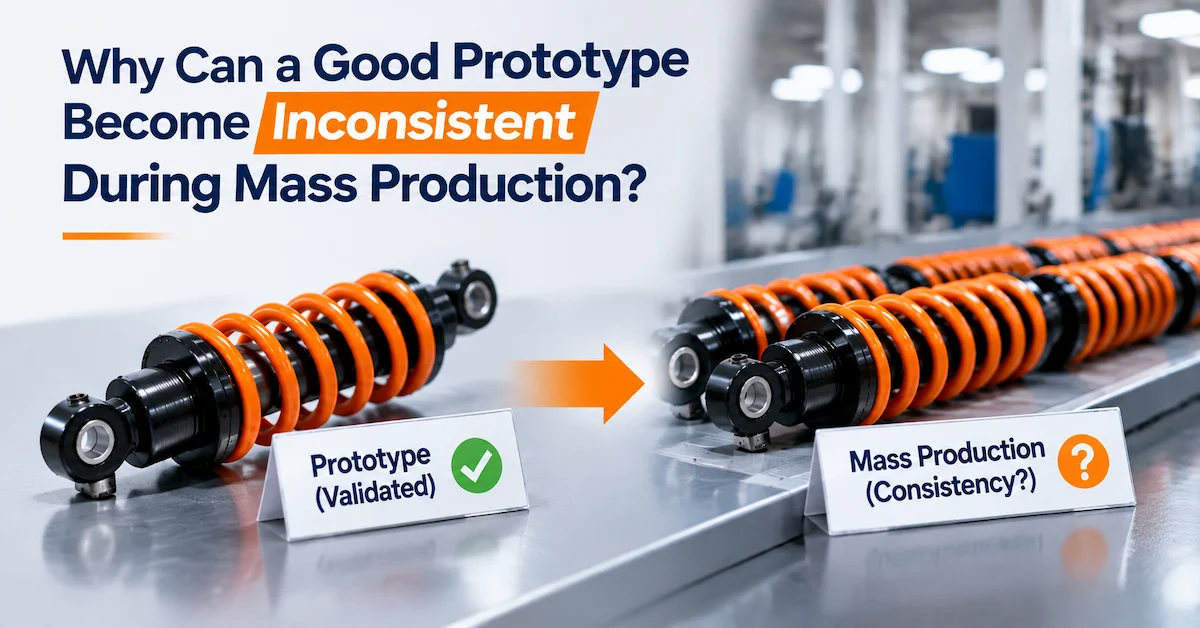
Custom suspension projects often fail after the prototype appears successful. The first sample may be measured carefully, assembled by experienced staff, tuned directly on the buyer's vehicle, and shipped with personal explanations. Repeat production is different. Purchasing needs an exact part identity, production needs a defined process, quality needs acceptance criteria, and customer service needs a fitment record. The manufacturer's real value is the bridge between those functions.
Start with the production-transfer question
The central question is not whether the supplier can make one custom shock. It is whether the supplier can make the approved shock again, with the same interfaces and application boundary, after the people and attention of the development stage have changed. Ask the manufacturer to show how information moves between engineering, purchasing, production, quality, packaging, and after-sales.
| Transfer stage | Buyer question | Evidence to request | Release concern |
|---|---|---|---|
| Requirement review | Did the supplier understand the vehicle, position, loads, terrain, and target? | Requirement record, open-item list, assumptions, application ID. | A hidden assumption becomes a production specification. |
| Prototype definition | What exact sample was built? | Drawing, BOM, spring and damping identity, sample ID, revision. | A prototype is approved by appearance only. |
| Vehicle validation | What was tested and under which condition? | Vehicle, load, route, settings, measurements, observations, approval. | One successful ride is extended to other applications. |
| Pilot transfer | Can several units be made from the released definition? | Pilot inspection, functional checks, deviations, package review. | Hand-built sample quality is mistaken for process capability. |
| Repeat order | How is the same revision ordered and recognized? | Purchase specification, part number, BOM, label, change rule. | A later substitute is shipped without approval. |
A responsible custom suspension manufacturer should be able to identify what is already controlled and what still depends on buyer approval. If the drawing is incomplete, the supplier can propose a development route. If the test data is preliminary, it should be labeled accordingly. Clear uncertainty is safer than confident but unsupported completeness.
Audit the manufacturer's engineering intake
The quality of the first technical review predicts the quality of the quotation and the prototype. A weak intake asks only for model name, length, and quantity. A useful intake asks how the suspension is installed, what it carries, what the buyer wants to change, which dimensions cannot move, and how the result will be judged.
Vehicle and application information
Check whether the manufacturer records vehicle make, model, year, market, position, stock or modified state, tire and wheel package, accessories, payload, passengers, terrain, speed, duty cycle, and environment. For electric or heavily modified vehicles, check whether battery, motor, winch, cargo, or frame changes are included. A product name is not a load case.
Geometry and interface information
Check whether the intake captures extended and compressed length, effective stroke, upper and lower mounts, hole or thread, installation width, sleeve and bushing, angle, motion ratio, spring and body envelope, reservoir or adjuster clearance, and full-bump and full-droop limits. Confirm that measurements have defined datums and conditions.
Spring and damping information
Check whether the supplier distinguishes spring support from damping control. The spring needs load states, installed length, rate or load points, free length, seat, preload, and tolerance. Damping needs direction, speed, temperature, setting, target behavior, and test context. Words such as “heavy duty” or “performance” should trigger technical questions rather than close the review.
The OEM suspension RFQ guide can help buyers prepare the input package. A custom suspension manufacturer should return missing fields and assumptions instead of silently filling them with generic values.
Verify drawing, BOM, and revision discipline
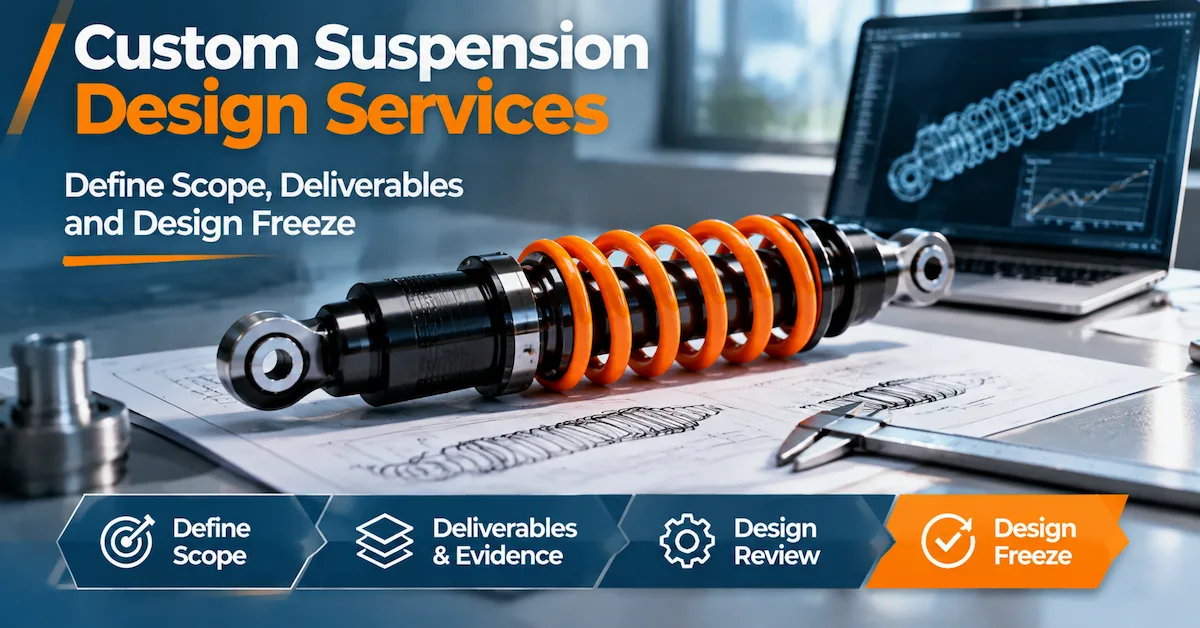
Production transfer depends on document control. The buyer should be able to ask for the approved drawing, BOM, sample identity, validation configuration, inspection plan, packaging, and change history and receive documents that refer to the same revision. If the drawing says one spring while the sample uses another, the project is not ready for repeat production.
| Control document | Minimum content | Audit question |
|---|---|---|
| Requirement record | Vehicle, application, loads, terrain, environment, target, open items. | Can the team explain what the product is intended to do? |
| 2D drawing | Datums, dimensions, tolerances, threads, materials or proposals, finish, revision. | Can quality inspect the critical interfaces? |
| 3D CAD or package model | Hard points, envelope, orientation, movement, clearance, file revision. | Can the team review packaging and assembly relationships? |
| BOM | Shock, spring, mounts, bushings, sleeves, fasteners, labels, packaging. | Can purchasing identify every item that affects fitment? |
| Validation report | Vehicle, load, route, temperature, settings, measurements, observations, approval. | Does the evidence apply to the requested market and configuration? |
| Inspection plan | Critical features, methods, sampling, limits, records, nonconformance route. | Can repeat production be checked consistently? |
| Change log | Reason, affected parts, old/new revision, validation, approval. | Can the buyer see what changed and why? |
Ask how prototype-only items are marked. A temporary spacer, tuning shim, spring, valve setting, or hand-finished part must not enter the production BOM unnoticed. The suspension drawing approval guide is a useful related resource for this gate.
Audit prototype validation instead of accepting a fitment photo
A photograph of a shock installed on a vehicle proves that the part was present in one configuration. It does not prove that the spring supports the intended load, that the shock has reserve travel, that the damping matches the target, or that the part can be reproduced. Review prototype validation as a chain of evidence.
Static checks
Confirm ride height, sag, extended and compressed length, stroke, bump and droop, spring seating, mount alignment, body and tire clearance, reservoir and hose routing, steering or articulation, fastener engagement, and left-right consistency. Record the measurement points and load condition.
Dynamic checks
Use representative surfaces and speeds. Record small-bump compliance, larger impacts, repeated bumps, braking, acceleration, turns, slopes, cargo or passenger states, temperature, tire pressure, and settings where relevant. Separate observed vehicle behavior from subjective labels such as “soft” or “hard.”
Post-test checks
Inspect leakage, rod marks, spring seats, bushings, mounts, coating, fasteners, contact marks, noise, and ride-height change. Link photos and observations to sample ID and revision. A good manufacturer can explain which findings are design changes, vehicle conditions, installation problems, or manufacturing nonconformities.
| Validation evidence | What it can prove | What it cannot prove alone |
|---|---|---|
| Dimensional fit check | Measured geometry in a defined installation. | Performance, durability, or other model-year fitment. |
| Bench damping result | Force behavior under stated speed, temperature, and setting. | Vehicle comfort, load support, or all-terrain suitability. |
| Vehicle route test | Observed behavior under a defined vehicle and use condition. | Universal fitment or production consistency. |
| Pilot inspection | Variation within the sampled pilot and agreed features. | All future batches without a continuing control plan. |
| Factory photograph | Visual evidence of a place, product, or process claim. | Specific material, tolerance, test, or customer result. |
Review manufacturing and quality capability
The buyer does not need an impressive list of equipment; the buyer needs evidence that the relevant characteristics are controlled. Ask which processes are in the manufacturer's scope and which are subcontracted. Review how incoming materials, springs, seals, mounts, coatings, and hardware are identified and how nonconforming items are contained.
Critical-characteristic inspection
Identify the dimensions that control installation, sealing, alignment, spring location, travel, load path, and adjustment. The inspection method should match the feature. A critical mount width should not be accepted only by visual comparison. A damping result should identify test speed, temperature, setting, and sample or batch.
Functional checks
Depending on the project, functional checks may include movement, leakage, pressure retention, spring load points, damping, adjustment action, assembly torque or configuration, and packaging verification. The exact checks must be agreed; do not claim a test simply because it is common in the industry.
Nonconformance and corrective action
Ask what happens when a unit is outside the approved definition. The process should identify the lot, contain affected units, describe the deviation, determine disposition, identify root cause where appropriate, and record buyer approval for any use-as-is or deviation. A replacement shipment without investigation may leave the same problem in the next batch.
Change notification
Define which changes require approval: material, spring, valve, seal, mount, coating, supplier, process, tooling, packaging, label, and test method. The change record should show old and new revision, reason, risk, validation repeated, and effective order date.
BEDO's public blog includes manufacturing and quality-control content and presents shock absorber and spring categories. Buyers should use the manufacturer checklist as a screening aid, then request evidence specific to the custom project.
Compare a custom suspension manufacturer with a weighted audit
Price and catalog breadth are not enough to compare suppliers. Use one technical brief and score the evidence supplied for the same project. Keep “not provided” different from “failed.” A missing record is a commercial risk; a failed sample or inspection is a technical risk.
| Audit area | Suggested question | Strong evidence | Risk signal |
|---|---|---|---|
| Entity | Who will quote, manufacture, and support the part? | Clear company profile, contacts, scope, and responsibility. | Unclear contracting or manufacturing entity. |
| Engineering | Can the team convert vehicle data into a controlled baseline? | Open-item review, drawing/BOM, assumptions, sample plan. | Model name and length are treated as sufficient. |
| Prototype | Can samples be measured, revised, and validated? | Sample ID, report, change record, approval gate. | Only photographs or subjective comments. |
| Production transfer | Can pilot and repeat batches use the approved definition? | Inspection plan, pilot records, batch traceability, change rules. | Prototype and production are priced as the same undefined item. |
| Quality response | What happens when a critical feature fails? | Containment, deviation, corrective action, customer approval. | Replacement without cause analysis or records. |
| Commercial | Are stage costs and dependencies clear? | Separate sample, pilot, tooling, production, packaging, MOQ, lead time. | Low price with exclusions hidden. |
For an international project, add communication, language, document revision, package, and after-sales requirements. A supplier can be technically capable but still unsuitable if the buyer cannot maintain the product identity across warehouses, markets, and reorder cycles.
Prepare a custom suspension manufacturer RFQ
Send a controlled package rather than a keyword. Include vehicle and application, position, stock or modified condition, load states, terrain, temperature, dimensions, mounts, stroke, spring, damping, sample or drawing, quantities by stage, forecast, destination, packaging, validation responsibility, and required records. Mark all unknowns.
Ask the manufacturer to return existing/adaptable/new-development status, missing data, assumptions, proposed technical baseline, sample and pilot scope, inspection and test evidence, packaging, MOQ by stage, lead-time basis, change-control terms, and quotation exclusions. This response makes suppliers comparable and gives the buyer a decision path.
Buyers can review the BEDO shock absorber products, identify a relevant public reference, and send the application package through the official contact page for project-specific engineering and commercial review. The public catalog should start the discussion, not replace the RFQ.
Use a release checklist that production can understand
A useful audit ends with a release checklist, not a meeting impression. The checklist should be readable by the buyer, supplier engineer, production supervisor, quality inspector, warehouse team, and customer service representative. Each line needs an owner, a revision, a status, and an evidence reference. This is especially important when the buyer works across time zones and the person who approved the prototype is not the person who places the repeat order.
| Release item | Owner | Evidence or decision | Status example |
|---|---|---|---|
| Application baseline | Buyer engineering | Vehicle, position, load, terrain, environment and modification record. | Approved, open, or not applicable. |
| Product identity | Supplier engineering | Part number, drawing, BOM, spring and damping revision. | Released or pending change. |
| Validation | Buyer and supplier | Fitment, functional, route or rig evidence with acceptance decision. | Passed, conditional, or repeat required. |
| Inspection | Supplier quality | Critical characteristics, method, limits, sampling and reaction. | Ready for pilot or production. |
| Packaging | Supplier operations | Contents, label, carton, protection and pair/set definition. | Approved or artwork pending. |
| Change control | Commercial and engineering | Notification period, approval owner and affected revision rule. | Agreed or contract review required. |
Use a red or open status for unknowns rather than allowing a buyer or supplier to infer approval from silence. A controlled exception can be managed. An undocumented assumption can be repeated for years. Ask the manufacturer to return the checklist with its quotation or sample package so the decision remains traceable.
What a buyer should see before the first repeat order
Before a repeat purchase, the buyer should be able to locate the approved product definition, the prototype or pilot approval, the relevant inspection records, the package and label, the purchase quantity basis, and the route for technical changes. If any of those items exists only in a personal chat, rebuild it as a controlled project record. This does not require unnecessary paperwork; it requires the minimum information needed to make the next order unambiguous.
Ask for a short “what changed since the approved sample” statement. If nothing changed, the supplier should say so against the same revision. If something changed, identify the component, process, source, setting, package, or document affected. This simple question often reveals whether the custom suspension manufacturer treats the prototype as a real baseline or as a one-time demonstration.
Also confirm how the supplier handles a repeat order that is technically identical but commercially different. A new destination, carton language, barcode, finish, or compliance label may not change the damper itself, but it can change the released package. Keep those differences in the purchase specification so the production team does not create a second unofficial version of the same part.
Finally, assign a person to maintain the controlled baseline after launch. Engineering should own technical changes, quality should own acceptance records, and purchasing should prevent an obsolete revision from being ordered. This division can be simple, but it should be visible to both parties. A production-transfer audit is complete only when the process can survive a handoff.
Frequently asked questions
What does a custom suspension manufacturer do?
A custom suspension manufacturer reviews a vehicle application and develops, adapts, prototypes, produces, and supports a defined shock, spring, or related suspension assembly. The exact scope must be confirmed for each project.
How can I tell whether a manufacturer can support repeat production?
Ask for the link between approved drawings, BOM, prototype validation, pilot inspection, production testing, batch identity, packaging, and change notification. One good sample is not enough evidence.
Should I audit the factory before requesting a prototype?
At minimum, complete a document and capability review before committing to a large program. A physical audit may be useful depending on project risk, quantity, confidentiality, and quality requirements.
What is more important, ISO certification or a production record?
Both may be relevant, but a certificate alone does not prove that the requested shock is controlled. Review the specific drawing, inspection, test, and change records for the product.
Can a supplier use its standard shock as the custom design?
It may be a useful starting platform if dimensions, loads, spring, damping, environment, and fitment are suitable. The supplier should identify what is standard, what changes, and what must be revalidated.
How should MOQ and lead time be evaluated?
Separate engineering, sample, pilot, production, packaging, finish, and unique-component quantities. Ask when the lead-time clock starts and which approvals are dependencies.
What evidence should be requested before a production order?
Request the released drawing, BOM, sample or pilot approval, critical inspection, functional or test records, package, label, part revision, and change-control method appropriate to the project.
Does a custom suspension manufacturer guarantee fitment?
Fitment should be stated only for the vehicle, position, revision, load, and modifications that were reviewed and validated. A general product category is not a universal fitment guarantee.
Can BEDO support custom suspension manufacturer projects?
The public BEDO website presents shock absorbers, suspension springs, customization, and B2B product content. Buyers should submit the project data so BEDO can confirm whether the request is existing, adaptable, or new development.
What is the first step in supplier qualification?
Create one controlled RFQ and ask each manufacturer to respond to the same technical, quality, commercial, and production-transfer fields. Compare evidence before comparing unit price.
Conclusion
Choosing a custom suspension manufacturer is a production-transfer decision, not only a prototype decision. A qualified partner should be able to connect vehicle requirements, drawings, BOM, spring and damping identity, validation, pilot inspection, production controls, packaging, and change management. The buyer should audit evidence at each gate and keep unknowns visible until they are resolved.
Review the BEDO product center, prepare the custom suspension RFQ, and use the contact route below for a project-specific review of samples, drawings, production stages, and supply requirements.