
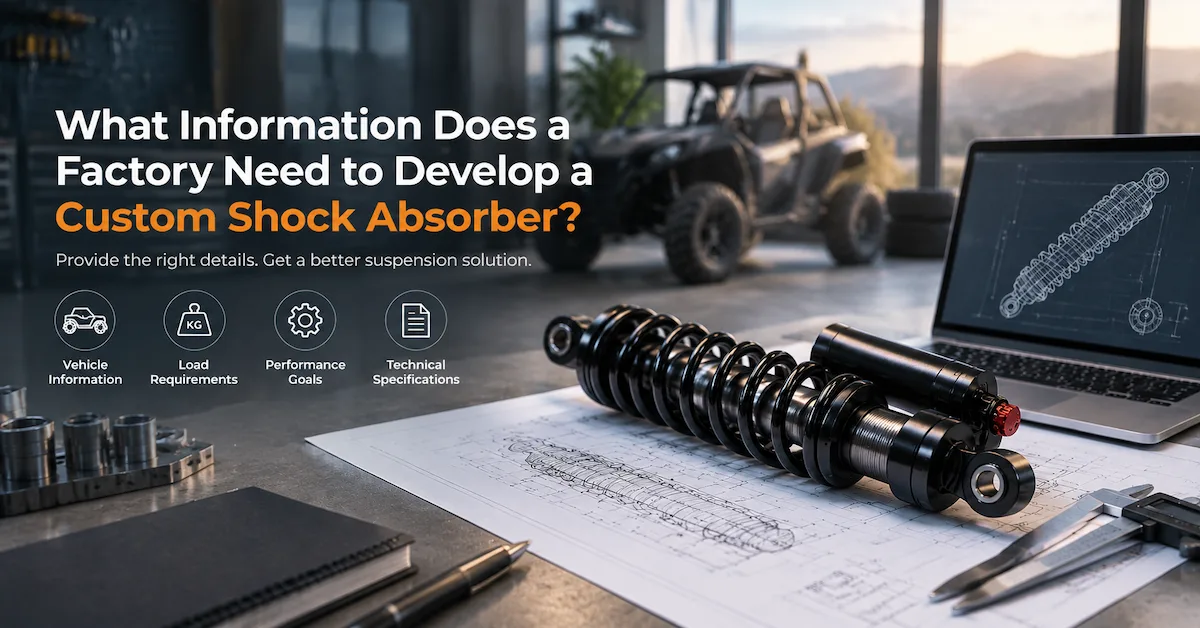
What Information Does a Factory Need to Develop a Custom Shock Absorber?
Developing a custom shock absorber is not simply changing the size or appearance of an existing product.
A professional shock absorber factory needs to understand the vehicle, suspension system, operating conditions, and performance goals before creating a suitable solution.
Many buyers start a project with basic information:
- Product photos
- Existing shock absorber dimensions
- Vehicle model
However, these details are usually not enough for accurate development.
To create a reliable suspension solution, a factory needs complete engineering input, including:
- Vehicle specifications
- Suspension geometry
- Load requirements
- Usage environment
- Performance expectations
- Testing requirements
- Production goals
The more complete the project information is, the faster the development process can move from concept to prototype and final production.
Why Does a Factory Need Detailed Information for Custom Shock Development?
A shock absorber does not work independently.
Its performance depends on the relationship between:
- Vehicle weight
- Suspension structure
- Spring rate
- Shock damping
- Wheel travel
- Driver/passenger load
- Operating environment
A shock absorber that performs well on one vehicle may not deliver the same result on another vehicle.
For example:
A lightweight recreational UTV may require responsive handling and comfort.
A heavy-duty utility vehicle may require stronger load support and durability.
An electric UTV with additional battery weight may require different spring and damping characteristics.
Without understanding the application, a factory can only make assumptions, which often leads to:
- Multiple prototype revisions
- Longer development cycles
- Higher testing costs
- Unsuitable final performance
A reliable OEM shock absorber supplier should first understand the application before recommending a design.
What Vehicle Information Should Be Provided to a Shock Absorber Factory?
The first step in any custom shock absorber development project is providing accurate vehicle information.
A buyer should prepare:
| Information | Purpose |
|---|---|
| Vehicle model | Identify application platform |
| Vehicle year/version | Confirm compatibility |
| Vehicle weight | Estimate suspension load |
| Passenger capacity | Define normal operating conditions |
| Cargo capacity | Understand payload requirements |
| Front/rear axle weight | Evaluate load distribution |
| Tire size | Understand suspension behavior |
| Usage environment | Define durability requirements |
For aftermarket products, this information helps ensure correct fitment.
For OEM projects, it becomes the foundation for engineering development.
Does a Factory Need Existing Shock Absorber Data?
Yes.
If a replacement or upgraded shock absorber is being developed, existing product information is extremely valuable.
Provide:
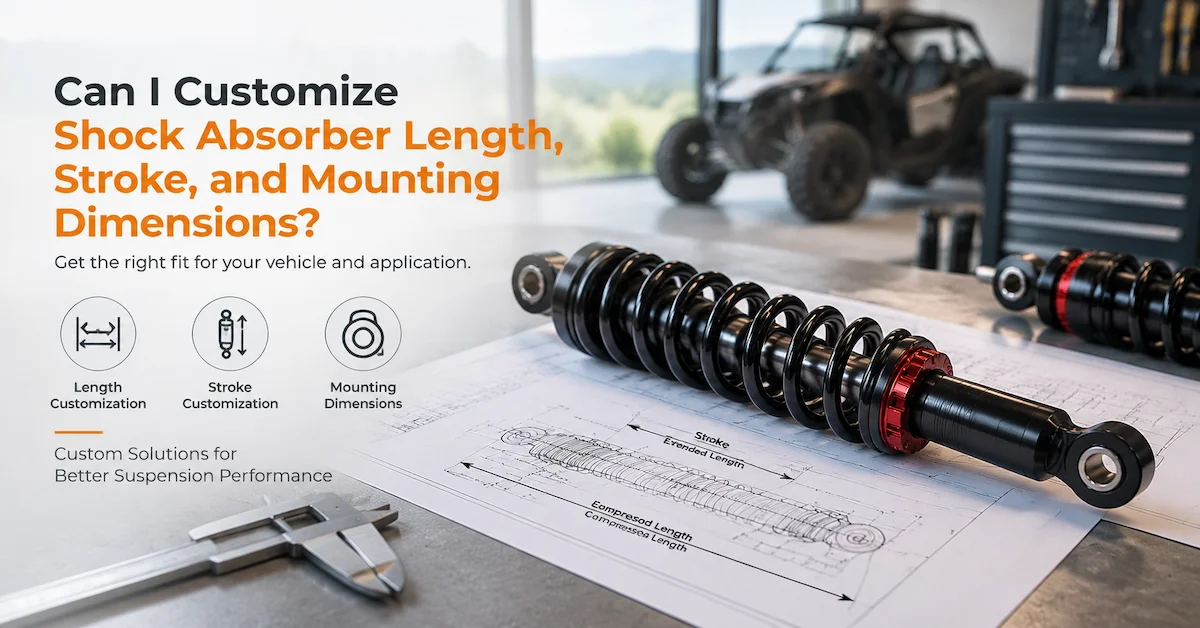
- Current shock length
- Extended length
- Compressed length
- Stroke
- Mounting dimensions
- Spring specifications
- Reservoir configuration
- Adjustment options
Existing data helps engineers understand:
- Current suspension limitations
- Available installation space
- Possible upgrade directions
- Required changes
If the goal is improving an existing suspension system, the factory needs to understand what is already working and what needs improvement.
Why Are CAD Drawings Important for Custom Shock Absorbers?
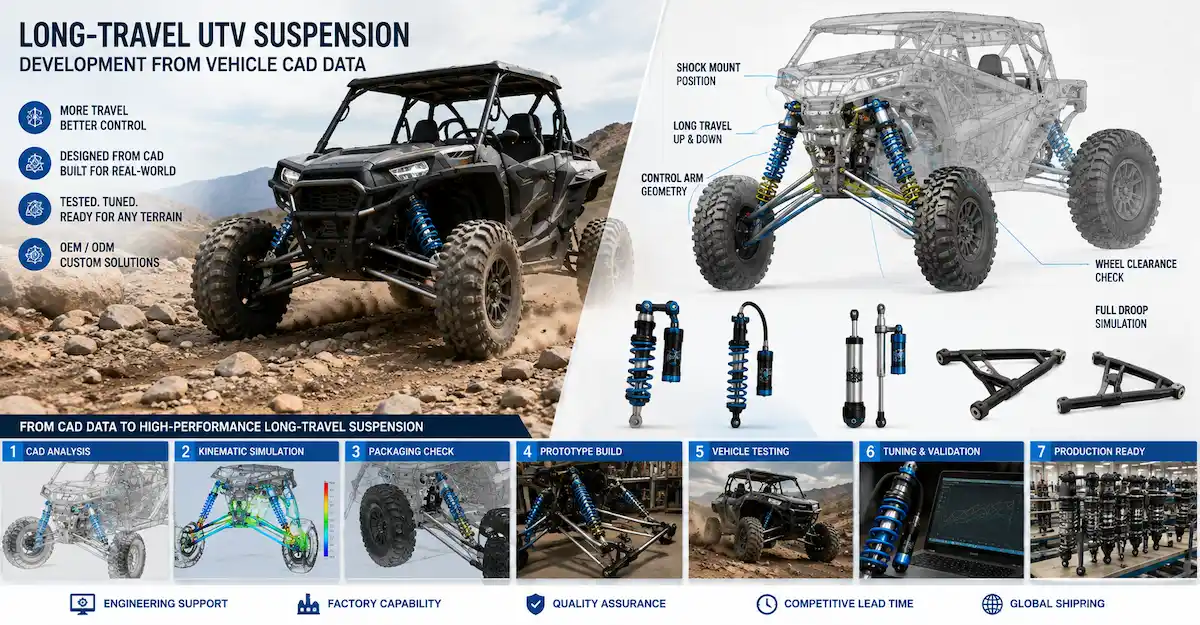
CAD data is one of the most useful resources for complex suspension projects.
When available, provide:
- Vehicle CAD files
- Suspension assembly drawings
- Shock mounting locations
- Control arm information
- Wheel movement data
CAD information allows engineers to evaluate:
- Shock installation position
- Compression clearance
- Extension limits
- Tire interference
- Reservoir placement
- Suspension travel
For vehicles with limited installation space, CAD analysis can significantly reduce prototype errors.
What Load Information Does a Factory Need?
Load conditions directly influence shock absorber design.
A factory should understand how the vehicle will actually be used.
Important information includes:
Passenger Load
Provide:
- Number of passengers
- Typical passenger weight
- Seating configuration
Cargo Load
Explain:
- Normal cargo weight
- Maximum working load
- Cargo location
Additional Equipment
Include extra weight from:
- Battery packs
- Toolboxes
- Roof accessories
- Winches
- Storage systems
A suspension designed without considering real operating loads may perform well when empty but fail under actual working conditions.
For buyers developing heavy-duty applications, the load requirements discussed in:
UTV suspension for passenger and cargo loads
should be considered during the initial engineering discussion.
What Performance Goals Should Be Explained?
A factory needs to know what the customer wants to achieve.
Avoid saying only:
“We need a better shock.”
Explain the actual target.
Improve Comfort
Possible goals:
- Reduce harsh impact
- Improve small bump response
- Increase ride comfort
Increase Load Capacity
Possible goals:
- Maintain ride height under cargo
- Reduce bottoming
- Improve working durability
Improve Off-Road Performance
Possible goals:
- Better wheel control
- More consistent damping
- Improved terrain response
Performance Applications
Possible goals:
- Faster rebound recovery
- Adjustable damping
- Higher heat resistance
Different goals require different shock absorber designs.
What Existing Suspension Problems Should Be Explained?
The factory can develop a better solution when it understands the current problem.
Examples:
“The rear suspension drops too much with cargo.”
Possible causes:
- Incorrect spring rate
- Insufficient preload
- Limited suspension support
“The vehicle feels too harsh.”
Possible causes:
- Damping setting
- Spring balance
- Tire pressure
- Suspension friction
“The shock bottoms during rough driving.”
Possible causes:
- Insufficient travel
- Incorrect spring selection
- Poor damping balance
Specific feedback is much more useful than general comments.
What Testing Information Should Be Provided?
A custom shock absorber should be designed around real operating conditions.
Provide:
- Test terrain
- Driving speed
- Usage frequency
- Operating temperature
- Expected duty cycle
Examples:
Agricultural UTV
May require:
- Heavy payload
- Long working hours
- Uneven roads
Recreational UTV
May require:
- Comfort
- Handling
- Off-road performance
Rental Fleet Vehicle
May require:
- Durability
- Consistent performance
- Easy maintenance
The factory needs to understand the real environment, not only laboratory conditions.
What Information Is Needed for OEM Shock Absorber Projects?
OEM projects usually require deeper cooperation.
A complete OEM development package may include:
Engineering Information
- Vehicle drawings
- Suspension specifications
- Performance targets
- Testing requirements
Production Information
- Expected annual quantity
- Quality standards
- Packaging requirements
- Delivery expectations
Commercial Information
- Market positioning
- Product lifecycle
- Branding requirements
An experienced OEM supplier should be able to support the project from engineering discussion to production delivery.
What Information Is Needed for Aftermarket Shock Absorber Projects?
Aftermarket projects usually focus more on:
- Vehicle compatibility
- Performance improvement
- Customer expectations
- Installation experience
Important information includes:
- Target vehicle models
- Market positioning
- Upgrade purpose
- Packaging requirements
- Dealer needs
For aftermarket brands, the product must not only perform well but also be easy to sell and install.
How Does a Factory Develop a Custom Shock Absorber?
A professional development process usually includes several stages.
Requirement Review
The factory evaluates:
- Vehicle information
- Load conditions
- Performance targets
Engineering Design
Engineers determine:
- Shock dimensions
- Spring requirements
- Damping direction
- Manufacturing feasibility
Prototype Development
A sample is produced based on approved requirements.
Vehicle Testing
Testing may include:
- Installation check
- Ride height
- Suspension travel
- Load testing
- Real-world driving
Revision
Engineering feedback is used to optimize:
- Spring specification
- Damping
- Dimensions
- Components
Production Approval
The final specification becomes the production reference.
For buyers who need to understand the validation stage, refer to:
How Do I Test a UTV Suspension Prototype Before Production?
What Mistakes Slow Down Custom Shock Development?
Several common mistakes increase development time.
Only Providing Product Photos
Photos cannot replace:
- Dimensions
- Load information
- Vehicle data
No Clear Performance Target
Without a defined goal, engineers cannot determine the correct direction.
Changing Requirements Frequently
Unclear requirements create repeated prototype revisions.
Choosing Only Based on Price
Low development cost does not always create the correct solution.
Poor Testing Feedback
Feedback should explain:
- What happened
- Under what condition
- What improvement is expected
What Should Buyers Prepare Before Contacting a Factory?
A professional inquiry should include:
Vehicle Information
- Vehicle model
- Application
- Year
- Passenger capacity
Technical Information
- Existing shock dimensions
- Suspension drawings
- CAD data if available
Performance Requirements
- Load conditions
- Terrain
- Comfort/performance target
Commercial Requirements
- Expected quantity
- Market
- Branding requirements
- Development timeline
A detailed project brief helps the factory provide a more accurate solution.
How Can Bedo Auto Support Custom Shock Absorber Development?
For OEM customers, aftermarket brands, and distributors, Bedo Auto supports custom shock absorber projects from engineering discussion to production planning.
Before starting development, buyers can review:
UTV suspension customization requirements
to prepare vehicle data, load conditions, CAD information, and project requirements.
For buyers evaluating long-term manufacturing capability:
How Do I Find a UTV Suspension Supplier That Can Maintain Consistent Repeat Production?
explains how to evaluate production consistency and supplier capability.
For OEM, aftermarket, and private-label cooperation:
Provide:
- Vehicle application
- Suspension requirements
- Performance targets
- Estimated quantity
- Customization expectations
A complete project brief helps create a faster and more accurate development process.
FAQ
What information does a factory need to develop a custom shock absorber?
A factory needs vehicle information, suspension dimensions, load conditions, performance goals, testing requirements, and production expectations.
Can a factory develop a custom shock absorber from photos?
Photos are useful references but are usually not enough. Engineering development requires accurate dimensions and vehicle information.
Why does vehicle weight matter for custom shocks?
Vehicle weight affects spring selection, damping requirements, ride height, and suspension performance.
Do I need CAD data for custom shock absorber development?
CAD data is not always required, but it can improve accuracy and reduce prototype adjustments.
How long does custom shock absorber development take?
The timeline depends on project complexity, testing requirements, prototype revisions, and the completeness of technical information.
Can factories customize shocks for aftermarket products?
Yes. Many factories support aftermarket customization for specific vehicles and performance goals.
What makes a good shock absorber supplier?
A good supplier combines engineering capability, testing experience, production control, communication, and long-term support.
Should I provide competitor products?
Reference products can help, but the final design should be based on your vehicle requirements and performance objectives.
How many prototypes are needed?
The number depends on the complexity of the project and the testing results.
What is the first step before developing a custom shock absorber?
The first step is preparing complete vehicle, suspension, load, and performance information.
Conclusion
Developing a custom shock absorber is not only about manufacturing a new suspension component. It is about creating a solution that matches your vehicle application, performance targets, market requirements, and long-term production goals.
A reliable suspension partner should help you move through every stage:
- Requirement analysis
- Engineering evaluation
- Prototype development
- Vehicle testing
- Production optimization
- Repeat manufacturing
For buyers preparing a customized suspension project, having complete vehicle information, load requirements, CAD data, and performance targets is essential. You can learn more about the required preparation process in our guide on UTV suspension customization requirements.
At Bedo Auto, we work with OEM customers, aftermarket brands, and distributors to develop customized shock absorber solutions based on real application requirements.
Whether you need:
- A new UTV shock absorber design
- A replacement suspension upgrade
- A private-label aftermarket product
- A long-term OEM supply partner
- A custom shock absorber for specific load or terrain conditions
our engineering team can help evaluate your project requirements and recommend a suitable development path.
During development, prototype validation is an important step to confirm fitment, suspension travel, damping performance, and real-world vehicle behavior. Learn how to properly validate suspension samples in our guide on UTV suspension prototype testing before production.
To start your custom shock absorber project, send us:
- Vehicle model and application
- Existing shock specifications or drawings
- CAD data (if available)
- Load requirements
- Performance goals
- Expected order quantity
Our team will review your requirements and provide feedback on feasibility, development direction, and production options.
For customers planning long-term supply or aftermarket product launches, maintaining consistent repeat production is also critical. Read more about supplier capability and production stability in how to choose a UTV suspension supplier for repeat production.
Contact Bedo Auto today to discuss your custom suspension project and turn your shock absorber concept into a production-ready solution.