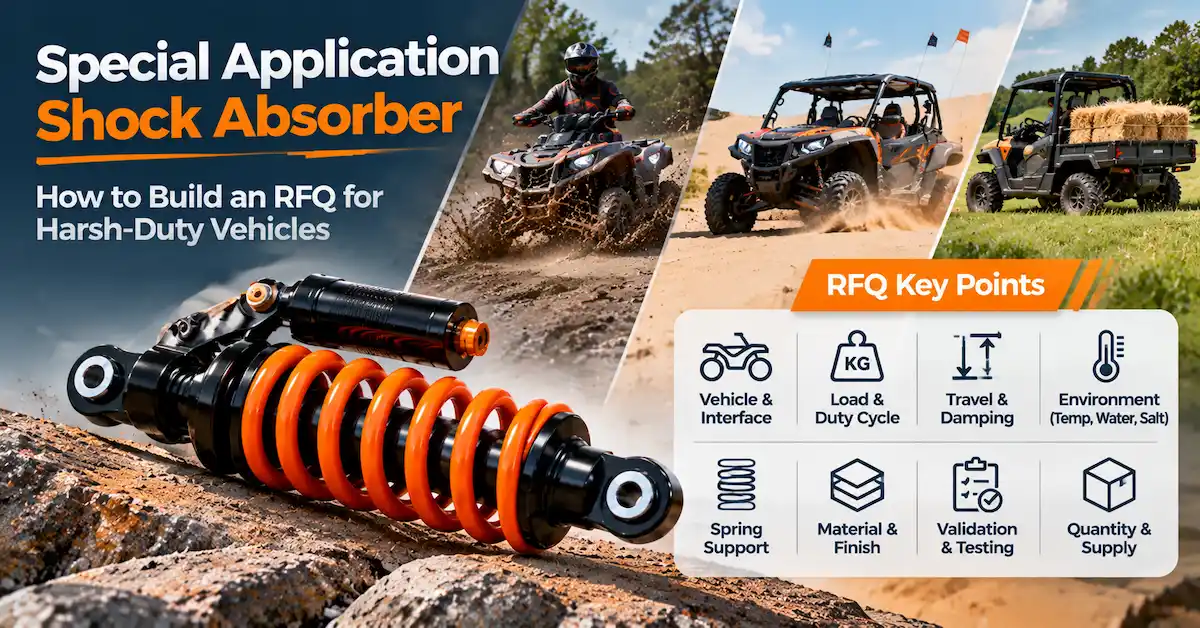

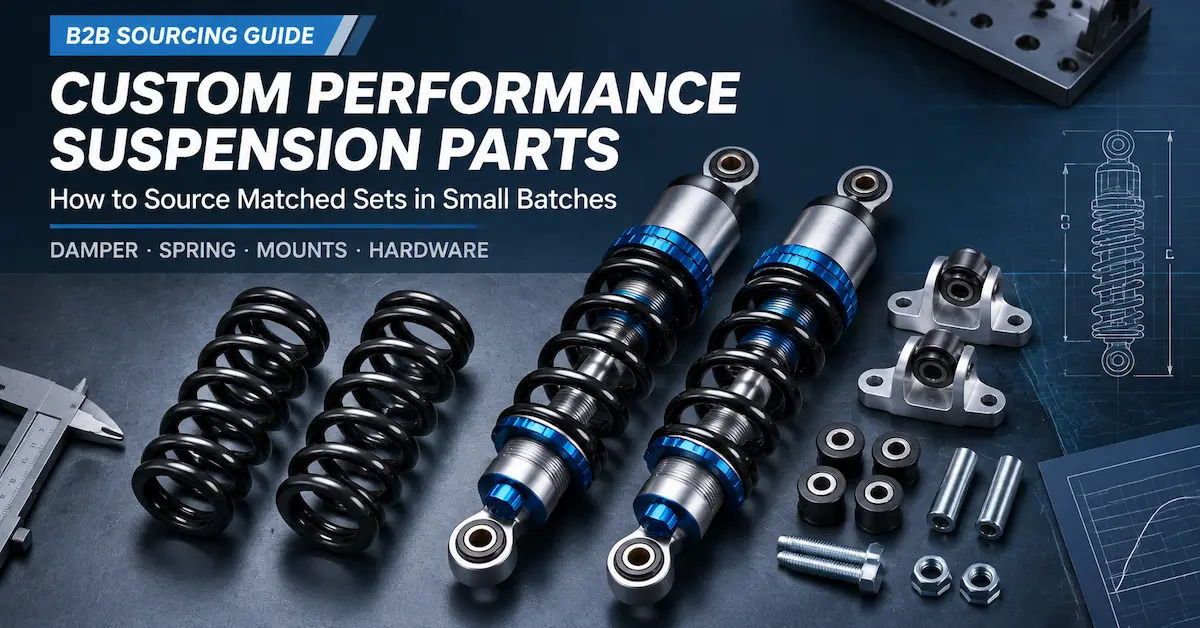
Custom performance suspension parts are specified rather than selected: the damper valving, spring rate, travel, mounting geometry and finish are defined around one vehicle and one duty cycle, then produced in a batch small enough to justify the change. This guide shows OEM product teams, aftermarket brands, distributors and vehicle builders how to assemble a matched parts set, what to put in the specification, how small-batch production changes cost and lead time, and how to verify the first batch with real evidence before scaling up.
What custom performance suspension parts actually covers
Buyers use the same phrase for three very different jobs, and the price, lead time and evidence required differ by an order of magnitude. Decide which level you are actually buying before you request a quotation, because no supplier can quote responsibly against a vague brief.
| Level | What changes | Data you must supply | Evidence to request |
|---|---|---|---|
| 1. Appearance and branding | Colour, coating, laser marking, label, packaging | Colour reference, logo files, packaging artwork | Coating sample, marking position drawing |
| 2. Tuning | Valving (compression and rebound force), spring rate, preload, gas pressure | Vehicle mass, load cases, target behaviour, travel | Damping force curve, spring rate certificate, bench report |
| 3. Geometry and interfaces | Length, stroke, mounting hole diameter and width, reservoir position, linkage ratio | 3D model or drawing, suspension geometry, clearance envelope | Dimensional report, fitment check, vehicle validation |
Most projects start at level 1 or 2 and drift into level 3 only when the first sample will not fit. That drift is what turns a four-week order into a four-month programme, so it is worth deciding early. A supplier that asks for the level before quoting is doing you a favour.
Who this guide is for, and who it is not for
This guide is written for buyers who are changing something real about the suspension, not buyers who are choosing between catalog numbers.
- OEM product teams building a new platform in volumes too low for dedicated tooling.
- Aftermarket and private-label brands that need a differentiated performance line rather than a rebadged catalog item.
- Distributors assembling a performance range for one vehicle family across several model years.
- Vehicle builders and modifiers who change loads, ride height or tyre size and need the suspension to follow.
It is not a guide to buying one replacement shock absorber, and it will not help a buyer whose only decision criterion is unit price. If you need a single off-the-shelf damper, a catalog part is cheaper and faster; custom work only pays back when the change is worth repeating.
The parts set: what has to be matched
A performance suspension is a set, not a part. The damper controls energy that the spring stores, the mounts transfer that load into the chassis, and the bushings decide how much of it reaches the driver. Specify one item in isolation and the mismatch shows up somewhere else.
| Item | Function | What to specify | What goes wrong when it is left out |
|---|---|---|---|
| Damper | Controls spring energy | Compression and rebound force at defined speeds, gas type and pressure, stroke | Harshness, wheel patter, oil overheating and seal failure |
| Spring | Carries static and dynamic load | Rate, free length, installed length, wire diameter, finish | Wrong ride height, coil bind, topping out |
| Top and bottom mounts | Transfers load into the chassis | Hole diameter, mounting width, material, forged or welded | Noise, cracking, misalignment |
| Bushings | Isolates vibration, allows articulation | Material, hardness, axial and radial stiffness | Harshness, or excess compliance that changes geometry |
| Hardware | Clamps the joint | Grade, coating, torque, thread locking | Loosening, corrosion, joint slip |
| Linkage, where used | Sets the motion ratio | Pivot positions, bearing type, ratio curve | Wrong wheel rate and wrong travel at the wheel |
Damper and spring must be specified together
The spring carries the load; the damper controls how fast that load is released. Change one without the other and the damping ratio moves even though the damper itself is unchanged. A stiffer spring with the original valving feels over-damped in rebound and skips over small bumps; a softer spring with the original valving bottoms out and feels under-controlled.
This is why a usable specification states damping force at defined velocities, not just "sport" or "comfort". Damping force is speed dependent, so the inspection speed matters as much as the number. A published example from the site's own range shows how complete the data should be: the ATV/UTV rear unit in the AU_HSA_01 listing quotes a maximum rebound force of 2000 N and compression force of 650 N, measured at an inspection speed of 0.1 m/s, against a 75 LBS spring rate and a 130 mm effective stroke. Those four numbers together describe behaviour; any one of them alone does not.
Mounts, bushings and hardware are part of the performance
Mounting detail is where most first samples fail. The same listing gives a mounting hole diameter of 10 mm upper and lower, and a mounting width of 32 mm upper and lower, on a 465 mm total length with a 38 mm cylinder outer diameter. A 2 mm error in any of those dimensions is the difference between a bolt-on part and a machining operation in the customer's workshop.
Bushings deserve the same treatment. Ask for material and hardness, and for axial and radial stiffness if the vehicle is sensitive to compliance. On a modified vehicle, a soft bushing can absorb 10 mm of the travel you just paid for.
Write the performance target before you ask for a quote
The single biggest cause of a wasted prototype is a brief that describes a feeling instead of a measurement. Convert the requirement into numbers first; the quotation then becomes comparable between suppliers.
Load cases
List every load state the vehicle will see, not just the kerb weight:
- Kerb mass with full fluid and standard equipment.
- Rider, passenger and their gear.
- Cargo, tools, implements or a service body, including the worst realistic combination.
- Permanent accessories: winch, bumper, roof rack, audio, lighting bar.
- Battery mass and its position, which matters most on electric platforms.
- Towing or tongue load where the vehicle is rated for it.
For each case, record the axle load and the wheel rate you need. If the linkage ratio is not 1:1, state the motion ratio, because spring rate and wheel rate are not the same number.
Turn adjectives into numbers
| What buyers write | What the specification should say |
|---|---|
| "Sporty but comfortable" | Target rebound and compression force at three or more defined velocities, plus an acceptable ride frequency band |
| "Must not bottom out" | Minimum remaining bump travel at the highest specified load, and the load at which the bump stop is first contacted |
| "Must not sag when loaded" | Maximum ride height loss at a stated payload, measured at a stated reference point |
| "Handles rough ground" | Duty cycle: amplitude, frequency, duration and surface type for the durability test |
| "Corrosion resistant" | Coating system, coating thickness and the salt spray duration the finish must survive |
Duty cycle and environment
Two vehicles with identical geometry can need different parts because one runs on a farm and the other on a weekend trail. Record the temperature range, the exposure to mud, standing water, salt, dust and wash chemicals, and the expected hours per season. Those inputs decide seal material, rod finish, coating and gas pressure far more than the vehicle category does.
Small-batch production: what changes at low volume
Custom performance suspension parts are usually bought in quantities that do not justify dedicated tooling. That is not a problem, but it does change the economics, and buyers who understand why get better quotations.
Tooling and setup
Much of the custom work sits inside an existing family of bodies and tubes: the change is in the valving shim stack, the spring winding, the machining of eyelets and mounts, and the finish. Setup and programming cost is fixed per batch, so the per-unit price falls as quantity rises. Ask for the setup cost and the unit price separately; a supplier that shows both is usually also the one that will explain which quantity breaks are worth taking.
MOQ, sampling and the pilot batch
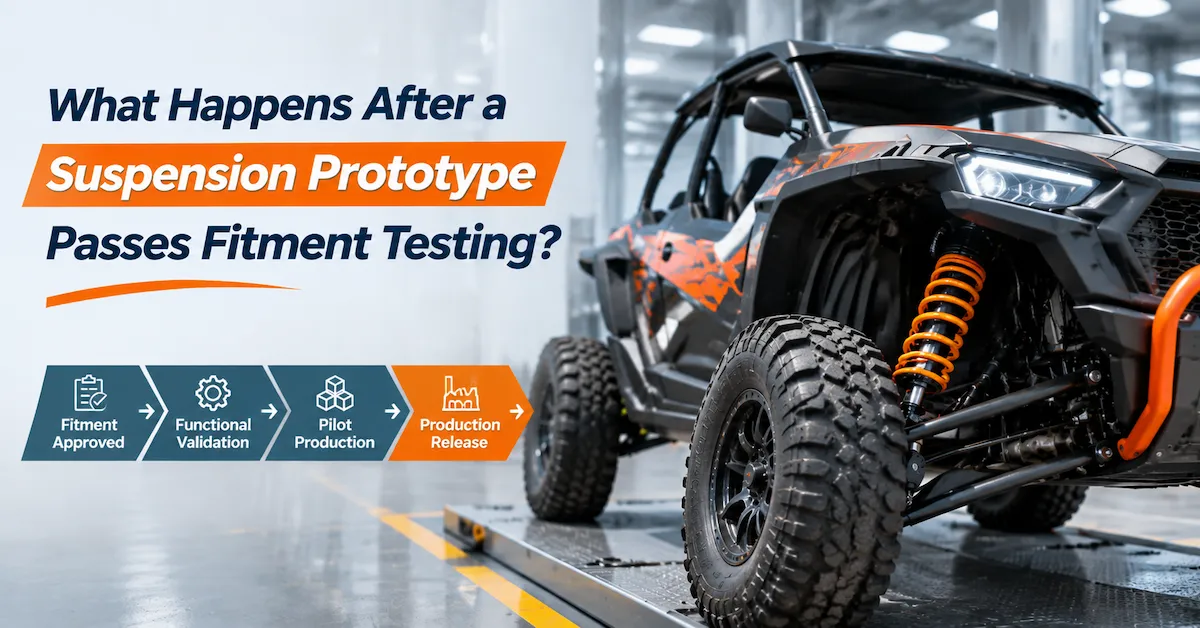
Minimum order quantity is driven by real constraints: minimum spring wire order, minimum plating or coating batch, machining setup and test time. A realistic programme runs sample, then pilot batch, then repeat production, with the drawing frozen between pilot and repeat. Small-batch ordering is a stated capability of this site's own manufacturing operation, which is why the sequence above is practical rather than theoretical.
Ask three questions about the pilot batch: how many units, which characteristics are measured on every unit versus sampled, and what happens to the parts if the pilot fails. A supplier with a clear answer to the third question has usually run the process before.
Lead time
Lead time is a chain, not a number. Drawing approval, spring winding, machining, coating, assembly, bench testing and packing each consume calendar time, and coating is often the longest single step because it runs in batches. Request a stage-by-stage schedule with the quotation so you can see which stage your changes affect.
Verification: proving the parts set performs
A sample that fits is not a sample that works. Verification has three layers, and the acceptance criteria for each should be agreed before the first part is made.
Bench checks
- Damping force in compression and rebound at the agreed velocities, compared with the target curve rather than a single point.
- Spring rate from a load-deflection test at defined installed lengths, with the test speed and preload recorded.
- Dimensions: total length, cylinder outer diameter, stroke, mounting hole diameter and width, reservoir position.
- Gas pressure retention and leak check after a settling period, not immediately after assembly.
- Finish: coating thickness and appearance against the approved sample.
Vehicle checks
Bench data does not prove the vehicle behaves. Fit the set and measure static ride height at each specified load, travel used, and clearance to the bump stop, tyre, chain or belt, and frame at both full compression and full extension. Run a duty cycle and check damper temperature afterwards; a part that runs hot has the wrong valving or the wrong gas pressure for the application.
Durability and corrosion
Durability testing is only meaningful when the cycle is defined. Agree amplitude, frequency, duration and the acceptance criterion, then check force fade and leakage after the run rather than only at the start. Corrosion is a separate test: salt spray or humidity exposure on finished parts, including the areas that are masked during coating.
| Record | Method | Sample size | Acceptance |
|---|---|---|---|
| Damping force, rebound and compression | Shock dynamometer at agreed velocities | Agreed with supplier | Within the tolerance band on the approved curve |
| Spring rate | Load-deflection at defined lengths | Agreed with supplier | Within the rate tolerance on the drawing |
| Critical dimensions | Gauge or CMM against the released drawing | Every unit on critical characteristics | Inside the stated tolerance |
| Leak and pressure retention | Hold period, then inspect | Per agreed sampling plan | No loss beyond the agreed limit |
| Coating | Thickness measurement and visual | Per batch | Meets the specified coating system |
Quality system and change control
A quality certificate is a starting point, not a result. ISO 9001 certifies that a quality management system exists and is audited; it does not certify the damping curve of your part. Read the certificate scope, check that the scope covers shock absorbers and springs rather than a trading activity, and then ask for the product evidence separately.
Change control matters more than the certificate for a performance part. Ask how the supplier notifies you when the valving shim stack, spring wire supplier, coating process or a sub-supplier changes, and get that notification route written into the agreement. A silent change to a shim or a wire source can move the damping curve outside the band you validated, and no certificate will catch it.
For a deeper look at how to structure that supplier review, see how to choose a custom shock absorber manufacturer and what a factory needs in order to manufacture custom suspension parts from drawings.
Cost drivers and lead time
Unit price for a custom set is built from a small number of drivers, and knowing them makes quotations comparable:
- Material: aluminium alloy versus steel tube, and the grade of each.
- Spring: wire diameter, rate, free length and finish, which set the winding cost.
- Machining complexity: eyelet and mount geometry, tolerances and surface finish.
- Coating: system, thickness and colour, including masking.
- Batch size: setup amortisation, which is the largest single lever at low volume.
- Testing: how many characteristics are measured per unit and how often the dyno runs.
- Branding and packaging: marking, labels, retail packaging, carton strength.
The classic trap is a cheap sample followed by an expensive production order, because the sample was made by hand and the production route was never costed. Ask what changes between sample and repeat production, and get the answer before the sample is approved.
Our custom performance parts platform
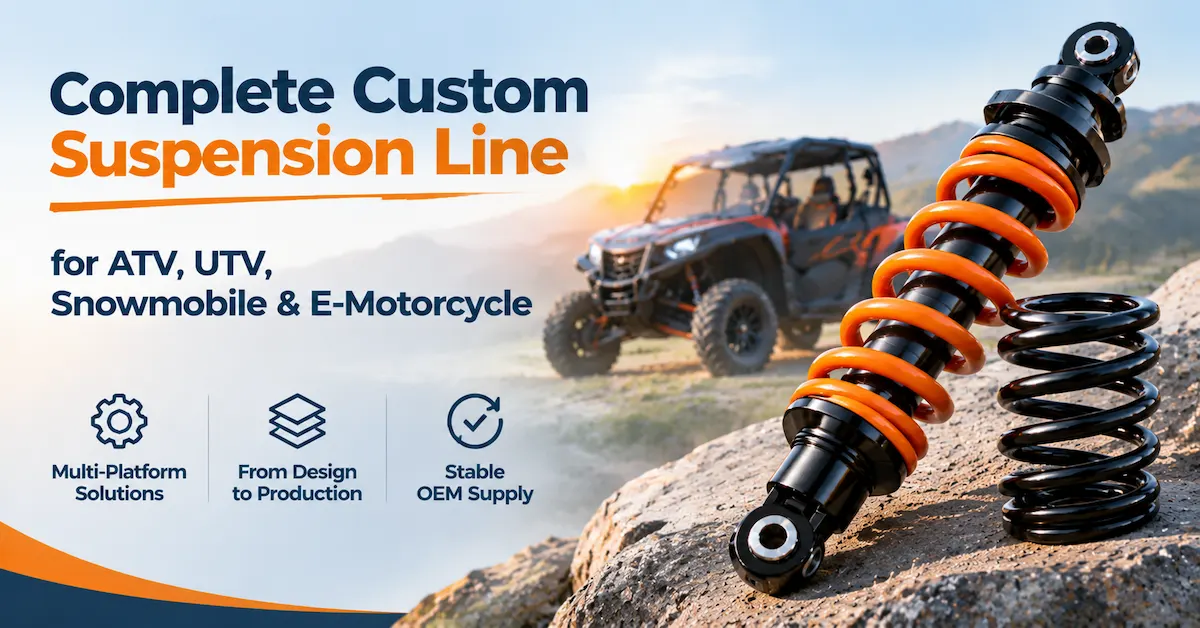
Our own range is built around the same principle: a defined platform, then customization inside it. The OEM ATV shock absorber series is described as OEM-grade and direct bolt-on, with options for valving, spring rates, finishes and branding, and it is offered to OEM manufacturers, aftermarket distributors and custom vehicle builders working across Can-Am, Honda, Kawasaki, Polaris, Suzuki and Yamaha ATV platforms.
Where a fixed specification is the better answer, the AU_HSA_01 rear ATV/UTV shock uses an internal gas chamber with oil-gas separation, aluminium alloy and steel construction, a 465 mm total length, 38 mm cylinder outer diameter, 130 mm effective stroke, 75 LBS spring rate and 3.2 kg weight, with fixed damping and four colour options. For two-wheel applications, the M_HSA_01 motorcycle rear shock offers 25 damping levels and an external airbag at 3.8 kg, and the EM_HSA_01 electric motorcycle unit pairs 25 damping levels with a 70 mm stroke and 65 LBS spring rate at 1.9 kg. Springs are supplied separately as precision-wound, load-tested items in the suspension spring range.
Read those listings as an example of the data a specification should contain, not as a substitute for your own load cases. A part that suits one platform rarely suits the next without a change to spring rate or valving.
Common mistakes in custom performance suspension sourcing
- Buying the damper and the spring from different specifications. The set is only as good as the pairing.
- Quoting from a photo. Without dimensions, mounting detail and load cases, the quotation is a guess.
- Approving a hand-built sample as if it were production. Ask what the production route changes.
- Ignoring the motion ratio. Spring rate and wheel rate are different numbers, and the linkage decides the difference.
- Treating the certificate as product evidence. A quality system does not prove a damping curve.
- Skipping the pilot batch. The pilot is where dimensional and process drift is found cheaply.
- Forgetting the finish. Corrosion is the most common field failure on off-road parts, and the cheapest to specify correctly.
- No change notification route. Without it, a shim or wire change reaches the customer as a complaint.
Frequently asked questions
What is the minimum order for custom performance suspension parts?
It depends on which level of customization you need. Appearance changes usually need only a coating batch; tuning changes need a spring winding run and a dyno session; geometry changes need machining setup. Ask for the MOQ per level rather than one number, because the constraints are different.
Can custom performance suspension parts be made from a drawing or a sample?
Yes, and both routes work, but they need different inputs. A drawing supplies geometry and tolerances; a sample supplies geometry only and leaves the internal valving and material to be reverse engineered. Expect to confirm spring rate, damping targets and load cases either way.
How long does a custom performance suspension parts project take?
It runs in stages: specification and drawing approval, sample, bench and vehicle validation, pilot batch, then repeat production. Coating and spring winding usually dominate the calendar. Ask for a stage-by-stage schedule with the quotation so the critical path is visible.
Do I need to revalve if I change the spring rate?
Usually yes, or at least re-check. Damping force is matched to the spring and the sprung mass; a significant rate change moves the damping ratio even though the damper is untouched. Verify on the dyno and on the vehicle rather than assuming.
What is the difference between a performance shock absorber and a standard one?
A performance part is specified against a target behaviour and validated against it, while a standard part is specified against a fitment and a price. In practice the difference shows up as documented damping force at defined velocities, a stated spring rate, tighter dimensional control and a defined durability cycle.
How do I verify damping force claims?
Ask for the curve, not the peak number, and ask at which velocities it was measured. Then confirm the inspection speed and the test temperature, because both move the result. A supplier that can produce a curve at three or more velocities is showing real data.
Can I brand custom suspension parts for my own label?
Branding is normally the simplest customization: colour, marking, label and packaging. Confirm the marking method and position on a drawing, and check that the packaging meets your retail or distributor requirements before the batch is packed.
What information do I need before requesting a quotation?
Vehicle and model year, the level of customization, load cases with axle loads, target damping and spring rate or the behaviour you want, the mounting envelope with dimensions, the duty cycle and environment, expected annual quantity, and the branding and packaging requirement. With those, quotations become comparable.
Conclusion
Custom performance suspension parts pay back when the specification is treated as a set: damper, spring, mounts, bushings and hardware defined together against real load cases, produced in a batch that matches your volume, and verified on the bench and on the vehicle before repeat production. The three levels of customization, the target sheet and the acceptance records described above are what make a quotation comparable and a first batch predictable.
If you are planning a performance parts set for a specific platform, send the vehicle data, load cases and mounting envelope through the contact page and the team can review the specification against the range before any tooling decision is made.