
Can a Supplier Review My Suspension CAD Before Manufacturing Samples?
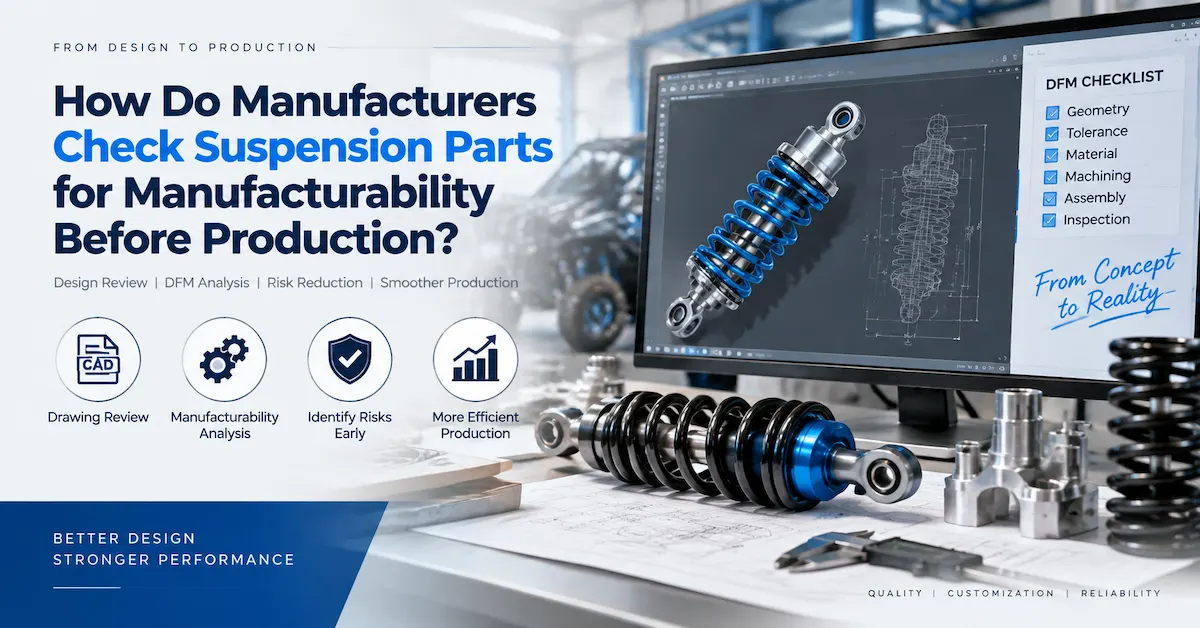
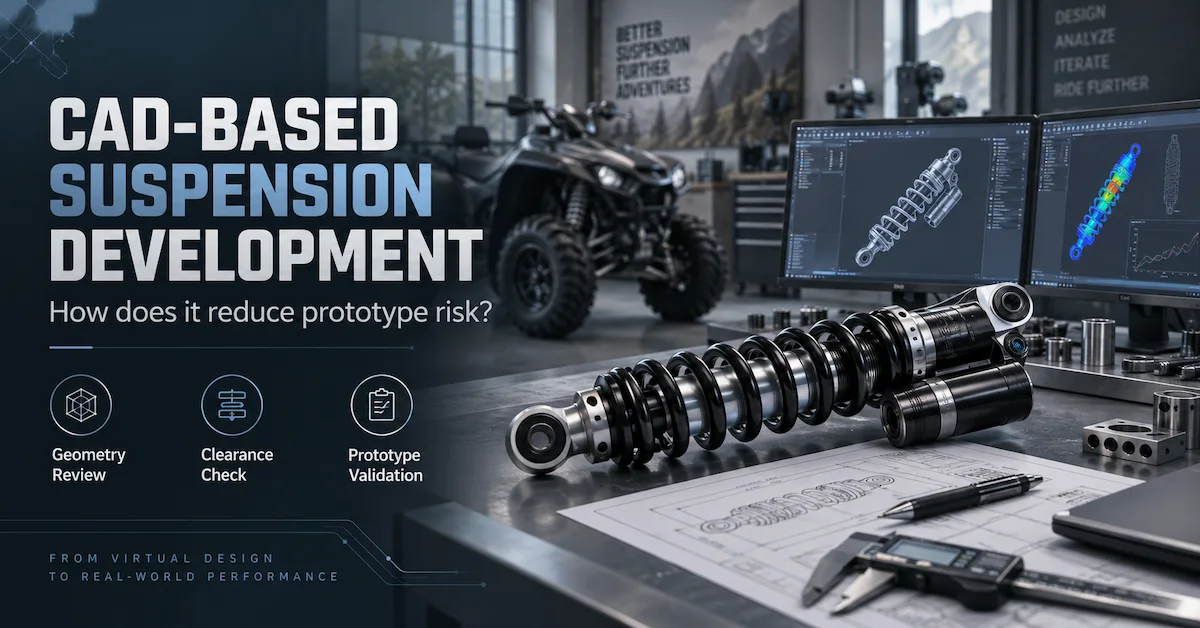
Yes. A capable suspension supplier can perform a suspension CAD review before manufacturing physical samples, and doing so can reduce avoidable prototype revisions. The review can examine shock mounting positions, component envelopes, suspension travel, tire and chassis clearance, reservoir packaging, interface dimensions, and whether the proposed shock geometry appears practical to manufacture. BEDO’s CAD-based suspension development process follows this type of digital-first workflow by connecting vehicle data, drawings, CAD, and later prototype validation.
However, CAD review is not the same as final product approval. A digital model cannot prove damping performance, spring behavior, seal reliability, assembly variation, leakage resistance, or real vehicle ride quality. The correct purchasing expectation is therefore: use CAD to eliminate predictable geometry and packaging problems before paying to manufacture samples, then use prototypes to verify the physical and dynamic requirements that CAD cannot prove.
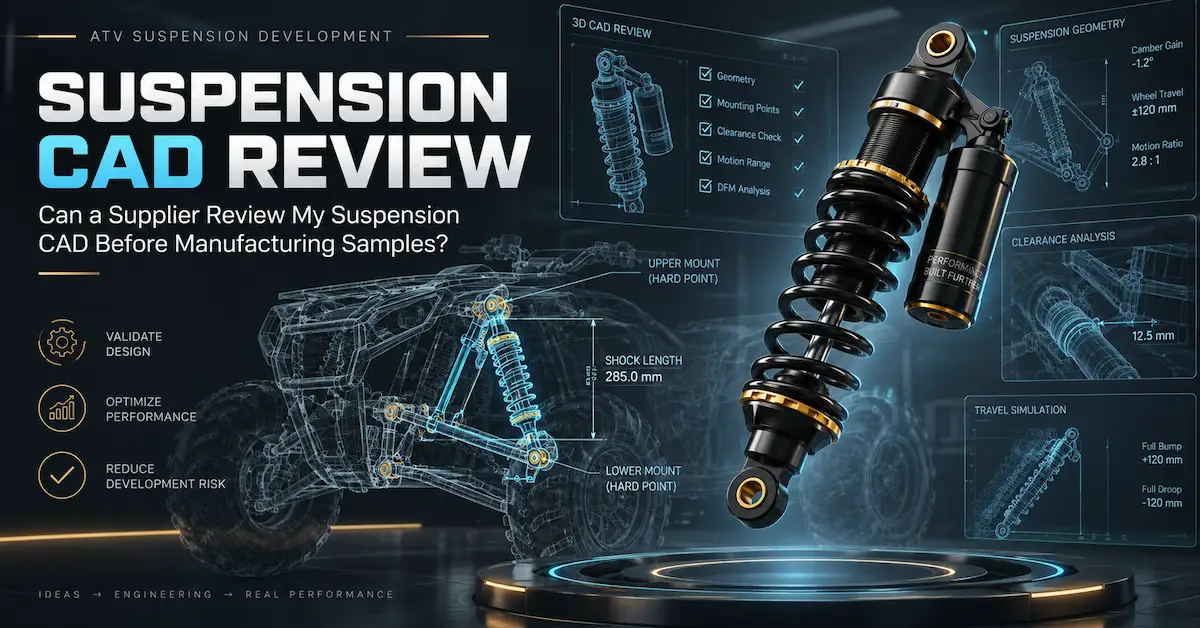
What Should a Suspension Supplier Check Before Releasing a Prototype?
The review should have a defined scope. Sending a STEP file and asking “Is this OK?” leaves too much room for interpretation. Instead, specify which engineering questions the supplier is expected to answer.
| CAD review area | What the supplier should examine | Main prototype risk reduced |
|---|---|---|
| Shock mounting | Upper/lower hard points, widths, bolt interfaces, orientation | Sample cannot be installed |
| Extended/compressed positions | Required movement and dimensional limits | Shock reaches mechanical limit too early |
| Shock-body envelope | Body, spring, collars, adjusters | Interference with chassis or arms |
| Tire envelope | Compression and steering positions | Tire contacts spring or suspension parts |
| Reservoir layout | Piggyback/remote reservoir position | Reservoir cannot be packaged |
| Hose routing | Length, route and moving-component clearance | Hose abrasion or stretching |
| Control-arm movement | Relationship between mount and suspension movement | Incorrect shock stroke assumption |
| Bump/droop condition | Component positions at travel limits | Binding or insufficient travel |
| Manufacturability | Critical features and assembly access | Design is difficult or costly to manufacture |
| CAD/drawing consistency | Model vs controlled dimensions | Wrong revision reaches prototype production |
BEDO’s custom suspension development from drawings combines customer drawings, CAD files, existing samples, and vehicle requirements. For a buyer, the practical advantage is that questions can be resolved digitally before they become machined parts.
Which Buyers Benefit Most From a Pre-Prototype CAD Review?
A full digital engineering review is particularly valuable when the project changes something about the original vehicle rather than simply replacing an existing shock. New ATV platforms, long-travel suspension, larger tires, revised control arms, heavy-duty utility configurations, remote reservoirs, non-standard mounting points, and performance-oriented private-label products all create more opportunities for one component to interfere with another.
A standard replacement shock for a well-documented vehicle may require less CAD analysis. If the mounting geometry is already proven, a controlled drawing, measurements, and reference sample may be sufficient for initial review. The key is to match the engineering process to the project risk.
For a new product line, CAD review also helps purchasing distinguish between a supplier that simply manufactures to submitted dimensions and one that can identify missing engineering information before sample production.
What CAD Data Should You Send the Supplier?
Do not automatically send the entire vehicle assembly. Send the geometry required to answer the engineering questions in your project. BEDO’s custom suspension development files guide follows this principle by separating project briefs, vehicle data, drawings, CAD, samples, spring/damping information, and test requirements.
A practical CAD package may contain:
| File/data group | Recommended content |
|---|---|
| Shock model | Existing or proposed complete shock geometry |
| Chassis interface | Relevant upper/lower mounting structures |
| Suspension geometry | Control arms and key pivots where movement analysis is required |
| Wheel/tire envelope | Actual target tire and wheel configuration |
| Ride positions | Ride height, full bump, full droop where available |
| Reservoir space | Intended area for piggyback or remote reservoir |
| Surrounding components | Parts that may create clearance constraints |
| Controlled 2D drawing | Critical dimensions, tolerances and revision |
| Vehicle/load data | Vehicle, rider, accessories and cargo conditions |
| Project brief | Current problem, intended change and prototype objective |
The CAD file should also clearly identify units and revision. A model named final-new-v3-latest.step is much harder to control than a file tied to a project number and revision.
Should You Send Both 2D Drawings and 3D CAD?
Often, yes—but they perform different jobs. The 3D model is particularly useful for geometry, installation and interference review, while the 2D technical drawing can define controlled dimensions, interfaces, tolerances, materials or finishes, and inspection requirements.
BEDO’s 2D drawing and 3D CAD guide explains that the two formats are complementary. A model can show where the shock sits inside the suspension, while the drawing states exactly which mounting width or hole diameter production must hold.
A supplier can sometimes start from one format. But before prototype release, both sides should agree what document controls each requirement. If CAD says the lower mount is 32 mm wide while the drawing says 30 mm, prototype manufacturing should stop until engineering resolves the discrepancy.
How Can CAD Review Catch Fitment Problems Before the Sample Exists?
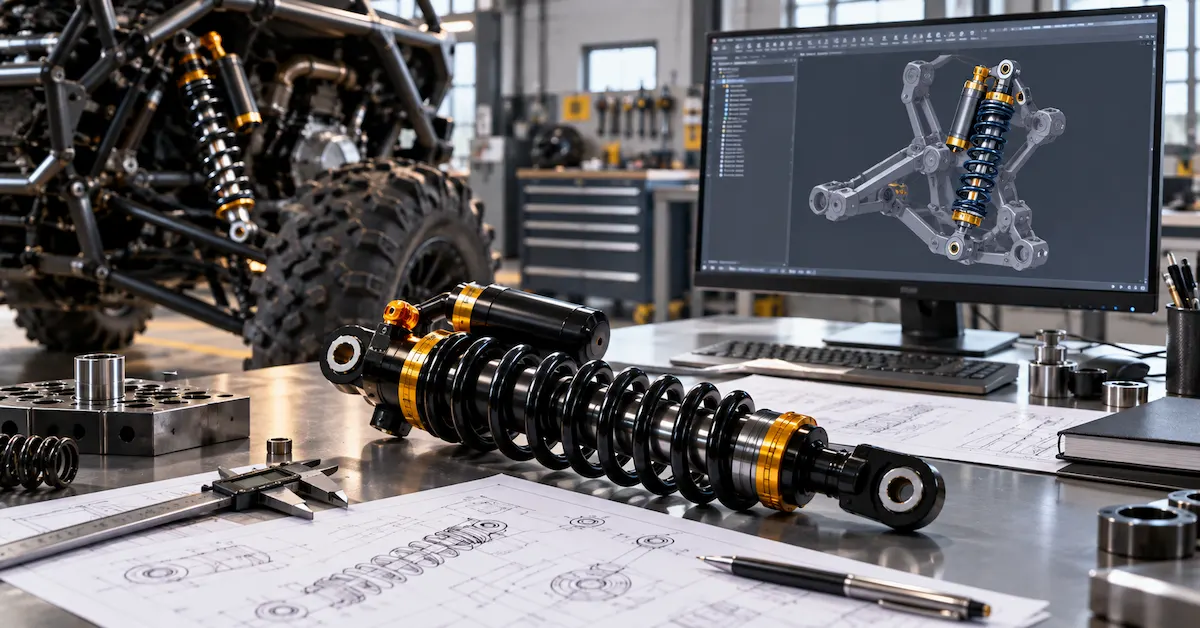
Fitment is more than checking whether a bolt can pass through a mounting eye. A complete digital fitment review can consider upper and lower mounting widths, bushing or sleeve arrangement, shock angle, body diameter, spring envelope, and the relationship between the damper and surrounding vehicle parts.
BEDO’s public AU_HSA_01 and AU_HSA_03 products illustrate why matching only one or two numbers is insufficient.
Both publish a 130 mm stroke and 10 mm mounting holes, yet their length, body diameter and mounting widths differ. That does not mean either product is wrong—it demonstrates why an isolated catalog field cannot prove interchangeability. A suspension CAD review can place the proposed geometry into the actual vehicle environment before the buyer commits to a sample.
Why Should Full Bump and Full Droop Be Reviewed Digitally?
A shock can look perfectly positioned at static ride height yet create a problem at the travel limits. At full compression, the tire may contact the spring, the shock body may approach a control arm, or the damper may reach its mechanical compression limit before the intended bump stop. At full droop, joint articulation, hose length, shock extension, or another vehicle component may become the limiting factor.
For this reason, ask the supplier to review at least the meaningful movement positions defined by the vehicle project rather than only a static assembly.
BEDO’s long-travel development guide uses full droop, ride height and compression positions during CAD review. That article is framed around UTV development, but the same geometry-checking principle can be applied to an ATV when its own suspension data is supplied.
How Does CAD Review Help With Long-Travel Suspension?
Long-travel projects are among the highest-value applications for a pre-prototype review because wheel travel and shock stroke are not the same measurement. The relationship is determined by the suspension geometry and the shock mounting position.
A buyer who simply asks for “30 mm more shock stroke” can unintentionally create excessive control-arm movement, tire interference, unsuitable joint angles or incorrect bump/droop limits.
For a long-travel project, the supplier may need to review:
Target Wheel Path → Suspension Hard Points → Shock Motion → Required Stroke → Full Bump/Droop → Tire Clearance → Spring Package → Damping Development
BEDO’s long-travel ATV shock absorber guide explains why increasing shock length alone does not safely create additional vehicle travel.
Can a Supplier Review Reservoir Packaging Before Samples Are Built?
Yes, and this is another area where CAD can prevent expensive rework. A piggyback reservoir adds volume directly beside the shock body, while a remote reservoir requires a separate mounting position and hose route.
Digital review can check whether the proposed reservoir clears surrounding suspension parts and whether a remote reservoir has an appropriate mounting location. The hose route can also be reviewed against tire movement, chassis edges and moving components.
BEDO’s remote-reservoir shock guide describes reservoir position and hose routing as packaging considerations. For an ATV project, those checks should be repeated against the actual ATV geometry rather than transferred from another vehicle.
Can CAD Review Determine the Correct Spring Rate?
Not by itself. CAD can show spring space, shock angle and suspension geometry, but correct spring selection also depends on the vehicle load and performance target.
Provide the supplier with relevant information such as vehicle weight, front/rear distribution where available, rider weight, cargo, permanent accessories, target ride height and intended terrain. When applicable, suspension geometry can help engineers understand the relationship between wheel movement and spring movement.
If an approved spring already exists, provide the controlled specification. If not, clearly identify spring selection as part of the development scope rather than inventing a rate to make the CAD package appear complete.
Can CAD Review Determine Compression and Rebound Damping?
No. CAD can define the damper packaging and movement, but damping is a hydraulic performance characteristic.
A supplier still needs vehicle/load data, spring information, performance objectives and testing. Compression damping controls resistance as the shock compresses; rebound damping controls extension afterward. Those requirements cannot be validated simply because the shock fits the CAD assembly.
BEDO’s custom shock absorber development guide treats geometry, spring, damping and vehicle requirements as connected but distinct development inputs.
The correct sequence is therefore:
CAD Fitment Review → Prototype Configuration → Damping Test → Vehicle Evaluation → Revision
not:
CAD Approved → Dynamic Performance Automatically Approved.
Ask the Supplier to Review Manufacturability as Well as Fitment
A digital design can fit perfectly inside the vehicle and still be unnecessarily difficult to manufacture. Ask the supplier to review critical machining features, mounting structures, threaded components, adjustment access, assembly sequence and inspection feasibility.
BEDO’s ATV shock absorber production process connects engineering review with material selection, component manufacturing, assembly and inspection.
If the factory proposes a dimensional or structural change for manufacturability, that change should return to the engineering documents. Do not allow the shop floor to make an undocumented modification that leaves the CAD model and production product different.
Use a CAD Review Report Instead of a Verbal “Looks Fine”
Before authorizing samples, ask for a structured review result. It does not need to be a complicated engineering report, but it should make the open issues visible.
A useful release table can look like this:
| Review item | Status | Required action |
|---|---|---|
| Upper mounting interface | Approved | None |
| Lower mounting width | Pending | Buyer to confirm bracket dimension |
| Shock-body clearance | Approved in supplied CAD | Verify on physical prototype |
| Full compression position | Pending | Bump-stop data required |
| Tire clearance | Approved with specified tire | Recheck if tire size changes |
| Reservoir position | Revision required | Move mounting bracket |
| Spring specification | Open engineering item | Load data required |
| Damping | Open engineering item | Develop after spring selection |
| Prototype release | Hold | Close critical geometry items |
This creates a clear decision between approved, pending, and requires revision instead of allowing uncertainty to disappear into email threads.
Revision Control Is Part of Prototype Risk Management
A suspension CAD review is only useful when the prototype is manufactured from the reviewed version.
The buyer and supplier should identify the CAD revision, technical drawing revision, spring version, damping configuration and any reference sample used. When the CAD is changed after review, decide whether the associated drawing or test requirements must also change.
Avoid file names such as final.step, new-final.step and final-revised2.step. Use controlled project naming and keep superseded revisions out of the active production package.
The most important question after a prototype arrives should be easy to answer:
Which exact CAD and drawing revisions were used to build this sample?
Does CAD Approval Mean the Supplier Can Start Mass Production?
No. Digital review should normally release the project to a clearly defined next stage, such as prototype manufacturing.
A useful approval structure separates:
CAD/Geometry Approval
The digital configuration is suitable for prototype development.
Prototype Approval
The manufactured sample satisfies the agreed fitment and performance requirements.
Pilot/Production Approval
The manufacturing process can reproduce the approved product.
BEDO’s suspension sample development process connects engineering review, prototypes, testing and production preparation. This is especially important for performance suspension, where geometry approval cannot prove damping or vehicle behavior.
What Should the Prototype Verify After CAD Review?
The first physical sample should verify the assumptions that could not be proven digitally. Depending on the project, that may include mounting fit, full movement, real component clearance, spring seating, sag, damping, leakage, adjuster function and representative vehicle performance.
A strong development process therefore uses CAD and prototypes for different purposes:
| Development stage | Main question |
|---|---|
| CAD review | Does the proposed geometry appear compatible and manufacturable? |
| Drawing review | Are manufacturing and inspection requirements defined? |
| Prototype | Does the actual component fit and function as intended? |
| Vehicle test | Does suspension behavior meet the application target? |
| Pilot batch | Can production reproduce the approved configuration? |
This separation prevents buyers from expecting one engineering tool to answer every question.
How Does Pre-Prototype Review Affect Cost and Lead Time?
Digital review adds engineering work before samples are manufactured, but it can prevent avoidable physical revisions. Every prototype remake may involve new components, machining, assembly, international freight, vehicle installation, testing and another buyer approval cycle.
The economic question is therefore not simply whether CAD review adds cost. It is whether unresolved digital issues are likely to become more expensive physical issues later.
Ask suppliers to separate the quotation into engineering review, prototype parts, testing, tooling or fixtures where applicable, pilot production and recurring unit cost. This allows purchasing to see what is being paid for rather than comparing a manufacturing-only quotation against a broader engineering package.
Should CAD Review Be Used for Low-Volume Projects?
It can be especially useful when the batch is small but the application is technically complex. A custom racing ATV, specialty utility vehicle or new private-label performance product may have low initial volume while still requiring accurate geometry.
BEDO supports low-volume shock absorber OEM development, allowing technical review, prototypes and small batches to be used before larger orders.
Exact prototype quantity, MOQ, available production allocation and lead time still need confirmation for the individual project. CAD completeness should not be interpreted as a fixed promise of development time.
What Should You Send BEDO for a Suspension CAD Review?
For an efficient initial review, send the data that explains both the component and the vehicle environment. That commonly includes the relevant shock model or drawing, upper and lower mount data, suspension hard points where needed, surrounding chassis geometry, wheel/tire envelope, ride-height information, intended bump/droop movement, vehicle/rider/cargo loads, existing suspension problem and target result.
BEDO’s custom suspension development files guide provides a useful structure for organizing CAD, 2D drawings, samples, measurement sheets, load information and testing requirements.
Before sending proprietary files, also confirm confidentiality, data access and intended use. The buyer should not automatically provide an entire unreleased vehicle model when a smaller suspension subassembly contains everything needed for review.
Frequently Asked Questions
1. Can BEDO Review Suspension CAD Before Producing a Prototype?
BEDO describes CAD, drawings, physical samples and vehicle requirements as inputs to its custom suspension development process. Send the available project data so the engineering scope and missing information can be identified before sample manufacture. Review BEDO’s CAD development approach.
2. Is a STEP File Enough for a Suspension CAD Review?
It may be sufficient for some geometry checks, but the supplier may also require controlled dimensions, vehicle/load data, suspension interfaces and performance requirements. Confirm file compatibility and what information is missing before prototype release.
3. Do I Need to Send the Entire ATV CAD Model?
Usually not unless the engineering scope requires it. Send the suspension interfaces and surrounding geometry needed to evaluate the actual problem, and ask the supplier what additional assemblies are necessary.
4. Should I Include the Tire Model in the CAD Review?
Include the actual target tire/wheel envelope when tire clearance matters, particularly for modified ATVs, larger tires or long-travel projects.
5. Can a Supplier Approve Shock Stroke from CAD Alone?
CAD can help determine the movement required by geometry, but final approval should consider full bump/droop limits, vehicle constraints and prototype validation.
6. Can CAD Review Confirm Spring Rate?
No. Spring selection also requires load, geometry, ride-height, sag and application information. CAD can support the geometric analysis but does not replace load-based spring development.
7. Can CAD Review Confirm Damping Performance?
No. Damping requires hydraulic and vehicle testing. CAD can define packaging and movement, but it cannot prove compression or rebound behavior.
8. Should the Supplier Provide a CAD Review Report?
For a meaningful custom project, a documented list of approved items, open questions and required revisions is more useful than a verbal “looks okay.” Agree on the review deliverable before engineering begins.
9. Do I Still Need a Prototype After CAD Is Approved?
Yes for a new or significantly modified suspension configuration. The prototype verifies physical manufacturing, fitment and performance characteristics that digital geometry alone cannot establish.
10. What Happens If CAD Changes After the Prototype Is Ordered?
Determine whether the change affects the sample being manufactured. If it does, update the controlled revision and decide whether production should pause. Do not allow different teams to work from conflicting file versions.
Conclusion
Yes, a supplier can—and for geometry-sensitive projects often should—perform a suspension CAD review before manufacturing samples. The most valuable review checks mounting interfaces, shock envelope, bump and droop movement, tire and chassis clearance, reservoir packaging, surrounding suspension geometry and manufacturability while changes are still inexpensive to make digitally. It should not be mistaken for proof of spring, damping, sealing or real-world vehicle performance, which still require physical validation. A lower-risk development path is Project Data → Suspension CAD Review → Controlled Drawing → Prototype → Vehicle Testing → Engineering Revision → Pilot Production. BEDO supports development from CAD files, technical drawings, physical samples and vehicle requirements. To prepare a pre-prototype engineering review, contact BEDO with the relevant CAD, suspension interfaces, wheel/tire information, load conditions, target changes and expected order quantity so the review scope and prototype release requirements can be defined before manufacturing begins.