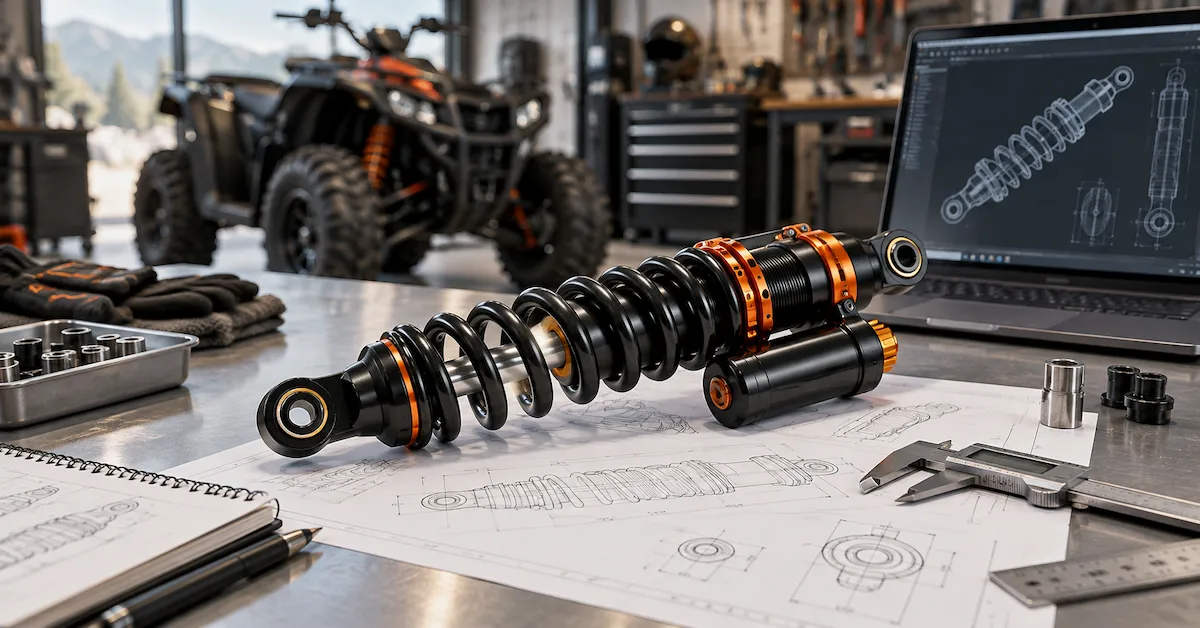

Do You Need Both 2D Drawings and 3D CAD for Custom Suspension Development?
Not always. You do not necessarily need both 2D drawings and 3D CAD before contacting a suspension manufacturer. A detailed drawing, reliable measurements, or a physical reference sample can support an initial review. When the project involves new mounting locations, limited installation space, remote reservoirs, or changed suspension geometry, relevant 3D vehicle data becomes more valuable. BEDO’s drawing-based suspension development service accepts customer drawings, CAD files, existing samples, and vehicle requirements as development inputs. The practical distinction is between having enough information to begin engineering and having an approved technical definition ready for production. Those are different milestones.
What Do 2D Drawings and 3D CAD Each Contribute?
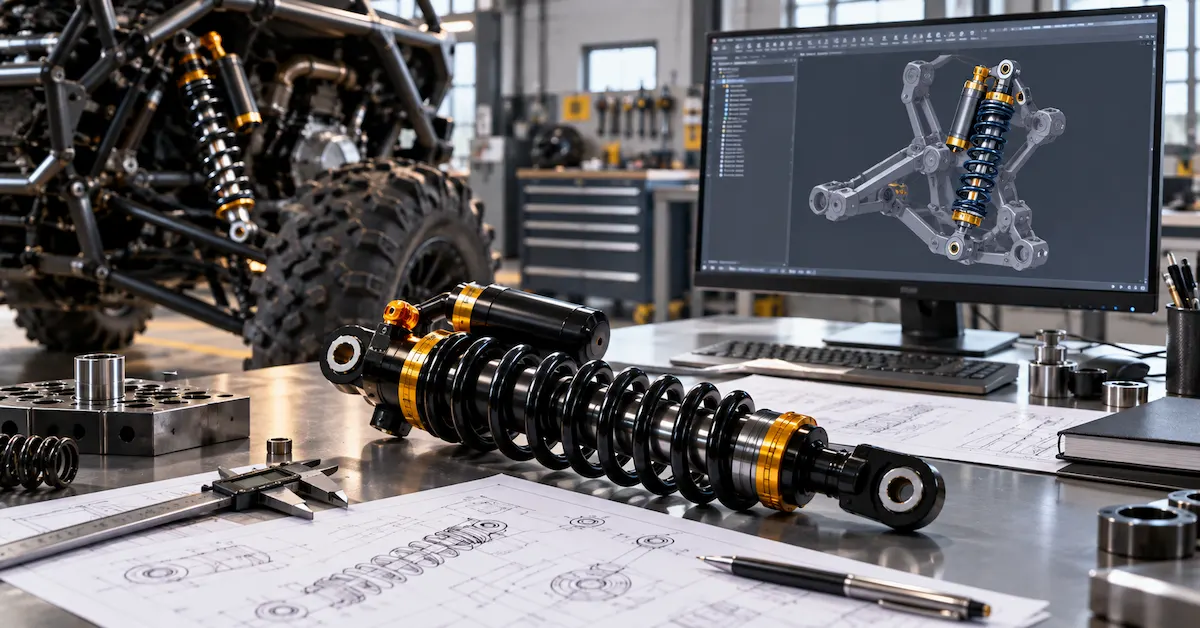
In a conventional drawing-based workflow, 2D drawings communicate controlled dimensions, tolerances, manufacturing notes, and approval status. A 3D model helps engineers examine component shape, installation space, and relationships between surrounding parts. BEDO’s shock absorber drawing guide presents the two as complementary tools rather than competing alternatives. The question is not which format looks more advanced; it is which information the manufacturer needs to make the next engineering decision.
| Engineering task | Role of a 2D drawing | Role of 3D CAD |
|---|---|---|
| Define mounting interfaces | Communicates hole sizes, widths, references, and tolerances | Shows spatial orientation and component relationships |
| Specify installation dimensions | Records extended and compressed dimensions and stroke | Represents the component within the installation |
| Review available space | Provides sections and clearance dimensions | Helps examine the complete installation envelope |
| Define manufacturing requirements | Records materials, finishes, notes, and inspection references | Supplies geometry for the agreed engineering workflow |
| Review suspension movement | Documents important positions and limits | Supports movement analysis when the necessary assembly information is provided |
| Approve a configuration | Identifies the released drawing revision | Identifies the corresponding released model |
When Can You Start Without a 3D Model?
A replacement-oriented project with unchanged mounting geometry may begin with a reference shock, a complete measurement sheet, vehicle identification, and photographs of the installation. Similarly, a spring or damping revision may not initially require a complete vehicle model when the existing installation is already understood. BEDO’s suspension sample development process includes sample analysis and drawing review as starting activities. This route is useful for aftermarket distributors and private-label brands that have a physical product but lack its original engineering files. However, beginning without CAD does not remove the need to document critical dimensions, resolve uncertainty, and validate the resulting configuration before production.
When Is Providing Both Formats the Better Choice?
Providing 2D drawings and 3D CAD is particularly useful when the manufacturer must define a component and evaluate how it fits a changing vehicle. Examples include a larger shock body inside a narrow chassis opening, a remote reservoir requiring a separate mounting location, or a long-travel project with revised shock mounts. BEDO’s CAD-based long-travel development guide examines mounting points, wheel and tire clearance, and suspension positions from full extension to full compression. That guide uses UTV examples; an ATV project requires its own geometry and validation. A component model alone cannot answer vehicle-clearance questions when the surrounding chassis, tire, or suspension interfaces are missing.
What Should the 2D Shock Absorber Drawing Define?
The drawing should identify the dimensions and requirements that must be manufactured and inspected, not merely display a side view of the shock. Use clearly defined measurement references and distinguish the upper mounting interface from the lower one. BEDO’s shock absorber measurement guide treats length, stroke, mounting dimensions, spring information, and installation conditions as separate inputs. The following is a proposed drawing checklist; project-specific tolerances and acceptance limits must still be agreed rather than invented to complete the document.
| Drawing requirement | Information to define |
|---|---|
| Product identity | Part number, drawing number, revision, and release status |
| Extended and compressed dimensions | Measurement references and the condition represented |
| Effective stroke | Required usable damper movement |
| Upper mounting interface | Mount type, hole diameter, width, sleeve or bushing arrangement, and orientation |
| Lower mounting interface | The corresponding lower-mount requirements |
| Installation envelope | Relevant body, spring, adjuster, and reservoir dimensions |
| Materials and finish | Approved requirements or references to controlled specifications |
| Critical tolerances | Limits associated with the relevant functional features |
| Performance references | Linked spring, damping, and test specifications where applicable |
| Approval information | Who approved the document and for which development stage |
A BEDO Model Comparison Shows Why Defined Dimensions Matter
The published AU_HSA_01 and AU_HSA_03 specifications illustrate why a recognizable product shape is not enough. Both are rear ATV/UTV shocks with a listed effective stroke of 130 mm and 10 mm upper and lower mounting holes, but other dimensions differ. These are catalog screening values, not manufacturing drawings or proof of compatibility with a particular vehicle.
The shared stroke and hole diameter do not establish interchangeability. Request the applicable drawing before choosing a starting platform, and preserve the published term “total length” until its reference points are confirmed. Do not automatically substitute “eye-to-eye length.” For a custom project, the drawing must define the required installation dimensions, while the relevant vehicle model or physical review checks whether the complete assembly fits its surroundings.
Can a Complete 3D Model Replace a Separate 2D Drawing?
Potentially, but distinguish a bare geometric model from an agreed digital product definition. BEDO’s CAD-based suspension development guide discusses both 3D-only and combined 3D/2D workflows. For a proposed model-based project, ask how dimensions, tolerances, materials, notes, revision status, and inspection requirements will be communicated and retained. Confirm that the receiving team can interpret the required information in the transferred files. Do not assume that an exported solid model contains every requirement needed for production, or that a separate PDF is compulsory when a complete model-based workflow has been explicitly agreed. The deliverable should follow the approved information workflow, not a blanket file-count rule.
Send the Right CAD Scope, Not Automatically the Entire Vehicle
Before transferring files, ask what the engineering review actually needs. A component drawing may be sufficient for an initial replacement assessment, while a geometry-sensitive project may require the suspension mounts, nearby chassis structure, control arms, and wheel or tire envelope. BEDO’s custom suspension development files guide recommends providing the relevant data rather than assuming the complete vehicle assembly is necessary. Confirm file format, software compatibility, units, and revision identification before export. Request confirmation that the supplier can open the package and see the intended components. Treat a successful file upload as delivery confirmation—not confirmation that the engineering data is complete or usable.
Neither Format Replaces Vehicle Loads and Performance Requirements
Even accurate 2D drawings and 3D CAD do not independently establish the correct spring and damping specification. The manufacturer still needs to understand the vehicle, rider and equipment loads, cargo locations, permanent accessories, terrain, and intended behavior. BEDO’s custom shock absorber development requirements connect these operating inputs with geometry and performance targets. Supply an approved spring or damping specification where one exists; otherwise, identify it as an engineering task. A model showing a coil spring does not prove its load–deflection behavior, and a drawing showing an adjuster does not prove its useful damping range. Link those requirements to separate specifications and test criteria rather than assuming they can be read from the shape.
Keep 2D Drawings and 3D CAD Aligned Through Revisions
Use a release register to identify which drawing, model, performance specification, and sample belong together. As an illustrative coordination problem, suppose the drawing states one mounting width while the CAD model shows another. Do not let the manufacturer choose the newer-looking file or resolve the discrepancy through an undocumented workshop change. Ask the responsible engineer to confirm the intended value, update the affected documents, and release the corrected set. Define which document controls each requirement and how conflicts are escalated. The drawing and model do not need identical revision labels if they are managed separately, but their approved relationship must be explicit. Keep superseded files out of the active manufacturing package.
Review Materials and Manufacturing Requirements Before Sample Release
A detailed geometry package still needs manufacturing review. Ask whether critical dimensions are practical to produce and inspect, which material specifications apply, and how surface treatment, component assembly, and functional checks will be controlled. BEDO’s ATV shock absorber production guide describes engineering review, material selection, component manufacturing, assembly, testing, and final inspection. For your drawing package, distinguish confirmed requirements from supplier proposals. Do not infer an alloy grade from a metallic CAD appearance or accept an undefined finish description as a corrosion-test result. If the manufacturer recommends a material or dimensional change, review its implications and update the approved technical documents before implementation.
Separate Drawing Approval from Prototype and Production Approval
Approve documents for a stated purpose: quotation, prototype manufacture, or production. A geometry approval should not silently become authorization for bulk manufacturing. BEDO’s shock absorber testing guide covers dimensional, damping, leakage, load, durability, temperature, and vehicle-related evaluations, with the selection depending on the project. Agree which checks apply, their conditions, acceptance criteria, and responsible parties. Keep prototype results linked to the tested revision, then update drawings and models when accepted changes affect the design. Review current quality-system certificates separately for supplier qualification; do not use them as substitutes for evidence that the particular prototype meets its requirements.
Compare the Cost of Missing Information with the Cost of Preparing Files
Ask for a quotation that separates document preparation, engineering review, prototypes, testing, and recurring product cost. For your purchasing comparison, distinguish a drawing-only review from component-model creation, vehicle installation analysis, and development of a new performance specification. Do not request a full vehicle model merely to make the submission appear complete; identify which unresolved decision the additional work will support. Equally, do not omit necessary geometry and expect the quoted scope to remain unchanged if interference is discovered later. List assumptions and exclusions before comparing suppliers. Two prices are not directly comparable when one covers manufacturing to supplied dimensions and the other includes reconstructing and validating the design.
Confirm Quantities and Timing by Development Stage
BEDO describes prototype and small-batch support in its low-volume shock absorber OEM guide. For your project, request separate quantities and timing for data review, document preparation, prototypes, revisions, pilot production, and repeat orders. Ask what starts each quoted period and which buyer approvals are prerequisites. Confirm minimum quantities and available production allocation for the actual configuration rather than assuming one universal requirement. Having both file formats ready may remove some information gaps, but it does not establish a guaranteed development schedule. Specify whether the quotation includes creating missing documents, updating them after testing, and supplying the agreed final deliverables.
Prepare a Minimum Useful Package for BEDO
Ningbo Bedo Auto Parts Co., Ltd. manufactures shock absorbers and springs and describes customization, design support, and small-batch ordering in its company profile. Begin with the vehicle application, installation position, available drawing or sample, important dimensions, load conditions, current problem, intended result, and purchasing plan. Add relevant CAD when the project requires spatial or movement review. Ask BEDO to identify missing information and confirm the engineering deliverables before work begins. For private-label projects, keep artwork and packaging approval separate from the technical specification, and agree the permitted use of confidential files and ownership of newly created documents before sharing sensitive material.
Frequently Asked Questions
1. Do I Need Both File Types Before Asking for a Quotation?
Not necessarily. BEDO can review available drawings, samples, CAD, and vehicle requirements. Ask whether the initial information supports a firm quotation or only a preliminary estimate with engineering assumptions still to be resolved.
2. What Should I Do When I Have Only a Physical Shock?
Identify the source vehicle, sample condition, mounting position, and changes required. BEDO’s sample-development process includes physical sample analysis and drawing review. A sample can establish useful references, but its dimensions and condition still need evaluation.
3. Is a PDF Drawing Enough for Initial Review?
It may be, when it clearly communicates the necessary dimensions, interfaces, notes, and application requirements. Confirm what additional data is needed for the next stage rather than assuming that initial review acceptance also means production readiness.
4. Can I Submit Only a 3D Model?
Ask whether the proposed model and supporting specifications contain the full information required for the task. A 3D-only workflow can be considered, but geometry, manufacturing annotations, revision control, and acceptance requirements must be agreed with the receiving team.
5. Must I Send Native CAD or Is a Neutral Format Acceptable?
Confirm the receiver’s accepted formats and required information before export. Do not assume native files are always necessary or that a neutral export will meet every project requirement. Request an import check before relying on the transferred model.
6. Should the CAD Show Only the Shock at Ride Height?
For a movement or interference review, provide the relevant suspension positions and surrounding geometry, not only a static shock model. BEDO’s long-travel guidance considers full compression, full extension, and relevant steering combinations.
7. What Happens When the Drawing and Model Disagree?
Keep the affected work on hold while the discrepancy is resolved. Obtain a written engineering decision, revise the relevant documents, and confirm the released set. Avoid silently selecting whichever value appears easier to manufacture.
8. Do Complete Drawings Eliminate Prototype Testing?
No. Documents define requirements, while prototype evaluation checks the resulting product. Fitment, damping, leakage, and other project-specific tests still need agreed methods and acceptance criteria; geometric completeness is not proof of dynamic performance.
9. Does Preparing Both Formats Guarantee a Faster Project?
No. Ask which engineering tasks the existing files eliminate and which remain. Clarify data completeness, review responsibilities, revision allowances, testing work, and approval milestones before accepting a schedule or comparing development quotations.
10. Who Should Own the Drawings Created During Development?
Agree ownership, delivery formats, access, permitted use, and revision responsibilities in writing before commissioning the work. Do not assume that the terms OEM or ODM automatically determine who receives editable files or controls later design changes.
Conclusion
You do not always need both 2D drawings and 3D CAD to begin custom suspension development. Use the information that reliably defines the immediate task, then complete the technical package as the project progresses. Drawings can establish dimensions and manufacturing requirements; CAD can support geometry and installation review; operating data and testing establish what the suspension must achieve. When both formats are used, keep their revisions aligned and make approval status explicit. To start a BEDO review, submit your available suspension drawings, CAD, or reference-sample information together with the vehicle application, loads, target changes, and expected quantities. Request confirmation of the missing data, development scope, and documents required before prototype or production release.