
What Tests Should a Shock Absorber Factory Perform Before Mass Production?
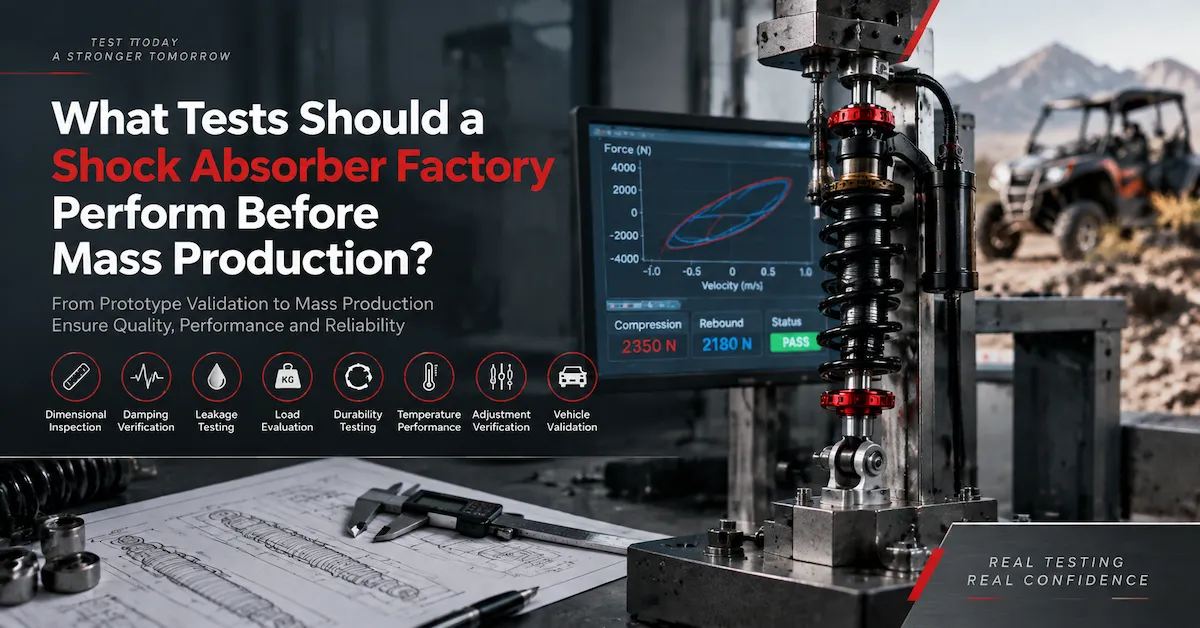
A reliable shock absorber testing before mass production program should normally cover dimensional inspection, compression and rebound damping verification, leakage and sealing checks, load evaluation, durability testing, temperature-related performance where the application requires it, adjustment verification for adjustable products, and vehicle-level validation. The exact combination should follow the vehicle application and approved specification rather than one universal checklist. BEDO’s Shock Absorber Testing Service Guide identifies these same areas and emphasizes that different applications require different validation programs.
The more important purchasing question is not simply, “Does your factory test shocks?” It is: Which configuration is tested, under what conditions, against which acceptance criteria, and which tests are repeated during production? A prototype test proves a design under defined conditions; a pilot batch checks production consistency; routine mass-production QC confirms that later units continue to match the approved specification. These stages should not be treated as interchangeable.
Start With a Controlled Production Reference
Testing becomes meaningful only when the factory knows exactly which shock absorber is being evaluated. Before release, link the test plan to the approved product code, drawing revision, spring specification, damping configuration, mounting hardware, reservoir version where applicable, and adjustment baseline.
If testing is performed on Prototype V2 but production later follows an earlier drawing, even excellent test results become poor evidence for the manufactured product. BEDO’s Prototype Shock Absorber Factory Guide treats engineering, prototype testing, revision, and production preparation as one connected process rather than independent steps.
A buyer-side release record can use the following structure:
| Controlled item | What should be identified before testing |
|---|---|
| Product/SKU | Exact supplier and buyer reference |
| Drawing | Approved drawing number and revision |
| Prototype | Sample or prototype ID |
| Spring | Approved specification/version |
| Damping | Valve or damping configuration |
| Adjustment | Baseline setting where applicable |
| Mounting hardware | Sleeves, bushings, spacers and interfaces |
| Reservoir | Fixed, piggyback or remote configuration |
| Test plan | Applicable test revision |
| Acceptance status | Approved, pending or revision required |
Dimensional Inspection Should Come Before Performance Testing
Dimensional inspection establishes whether the physical shock matches the approved engineering definition. BEDO’s published testing guidance lists extended length, compressed length, stroke, mounting width, mounting-hole diameter, body diameter, and rod diameter among the relevant dimensional checks.
For an ATV or off-road project, dimensional verification should also consider the actual mounting interfaces and component envelope. A shock can produce acceptable dyno numbers and still be commercially unusable if the mounting width is wrong or the spring interferes with the chassis.
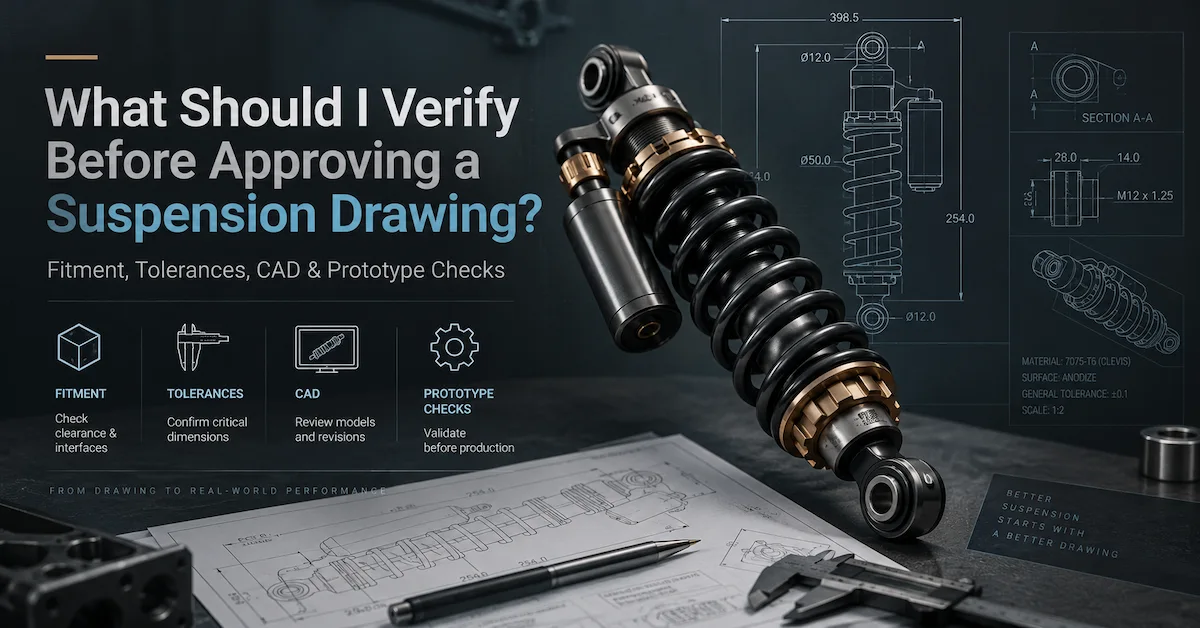
The factory should compare measurements with the controlled shock absorber technical drawing, not with an old sample photograph or an informal dimension from a quotation.
Verify Compression and Rebound Damping on a Defined Test Basis
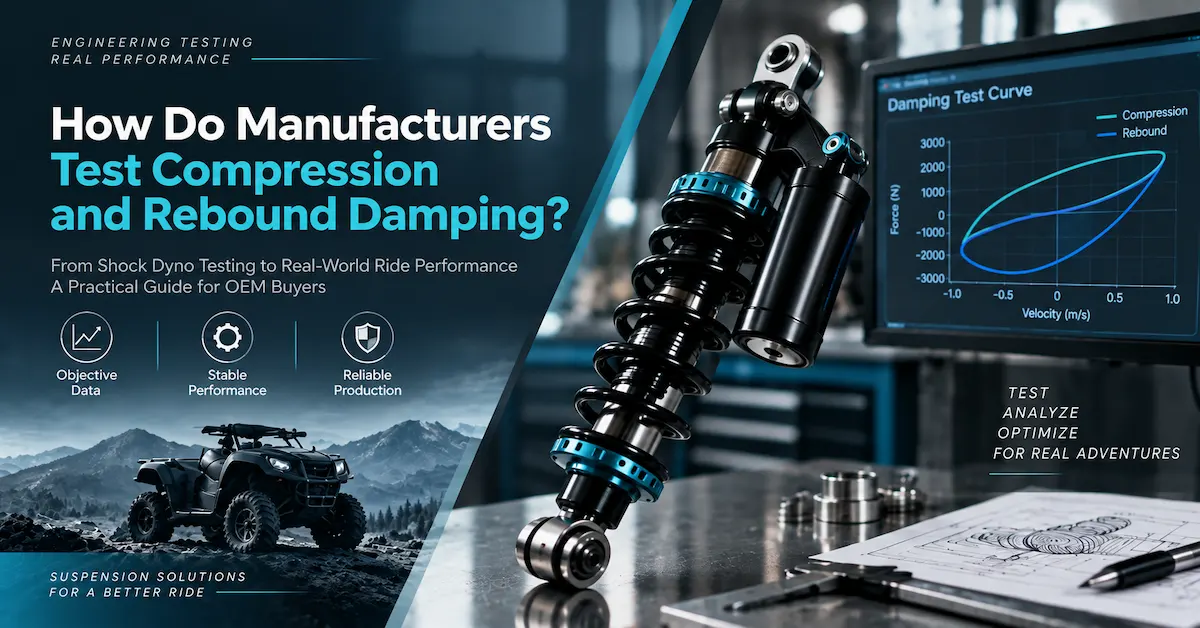
Damping verification is one of the core performance checks because a shock absorber must control movement in both compression and rebound. BEDO’s testing guide identifies compression force, rebound force, force-speed relationships, and adjustment range as relevant damping-test outputs, and notes that a shock dyno can be used to compare prototypes and production behavior.
OEM buyers should avoid approving a product from a single unexplained force value. Request enough context to understand what the number represents, including the configuration, test condition, and applicable acceptance range.
A useful report should make clear:
| Damping information | Why buyers need it |
|---|---|
| Tested product revision | Links data to the approved shock |
| Compression result | Evaluates compression behavior |
| Rebound result | Evaluates recovery control |
| Relevant test speed/condition | Makes results comparable |
| Adjustment position | Essential for adjustable shocks |
| Acceptance range | Distinguishes measurement from approval |
| Test result | Pass/fail or engineering disposition |
The goal is production repeatability, not simply the highest damping number.
Use Shock Dyno Data to Compare Production With the Approved Prototype
During development, dyno data can help engineering compare changes in damping configuration. Before mass production, the same type of objective reference can also help determine whether the production configuration remains consistent with the approved product.
This is particularly important when a private-label brand sells shocks based on a specific performance position. If the approved prototype has one damping characteristic and production batches gradually drift, the external appearance may remain identical while the customer experience changes.
BEDO’s ATV Shock Absorber Supplier Selection Guide recommends asking for test evidence tied to the exact ordered configuration rather than assuming one report covers every spring or damping variant.
Leakage Testing Should Verify the Complete Sealing System
Oil or gas leakage can reduce damping performance and create early field complaints. BEDO identifies oil sealing, pressure retention, connection reliability, and general seal performance as areas relevant to leakage validation.
For a conventional shock, inspection may focus on the main sealing system and assembled interfaces. A remote-reservoir design introduces additional hose, fitting, and reservoir connections that also need appropriate control.
The buyer should ask whether leakage evaluation occurs only during prototype development or whether a defined sealing check is also incorporated into production QC. Do not invent a universal leak-test pressure or hold time; those conditions should come from the approved product and manufacturing test plan.
Load Testing Should Match the Intended Vehicle Application
Load evaluation becomes especially important for ATV, UTV, utility, and heavy-duty suspension because operating loads can vary significantly between applications. BEDO’s testing guidance lists static, compression, repeated, and maximum-force conditions as possible load-test areas, while also noting that the relevant program depends on the product.
A utility ATV shock developed for defined cargo conditions should not be validated solely because a recreational shock of similar dimensions survived another test. Likewise, a larger spring does not automatically prove that the complete shock assembly has been validated for a higher vehicle load.
For cargo-oriented programs, connect load testing with the actual requirements defined in BEDO’s Heavy-Duty ATV Suspension Guide, including rider, cargo, accessories, spring behavior, travel, and damping.
Durability Testing Should Reproduce the Relevant Failure Risks
Durability testing is intended to determine whether repeated suspension operation creates unacceptable structural, sealing, or performance changes. BEDO describes durability evaluation around repeated suspension cycles, high-frequency movement, heavy loading, harsh conditions, component strength, seal durability, damping stability, and structural reliability.
That does not mean every ATV shock should use the same cycle count or test profile. A performance trail product, a low-speed farm ATV, and a specialty vehicle can place very different demands on the suspension.
A meaningful durability plan should therefore answer three questions:
What operating condition is being simulated?
What constitutes unacceptable degradation?
Which configuration does the result cover?
Without those answers, a statement such as “passed durability testing” tells the buyer very little.
Temperature-Related Testing Matters When Heat Can Change Performance
Shock absorbers generate heat as suspension movement forces hydraulic fluid through the damping system. BEDO notes that temperature can influence oil viscosity, damping consistency, seals, and internal components, and identifies temperature-related checks as particularly relevant to demanding off-road and continuous-use applications.
A short workshop test cannot automatically represent a long rough-terrain duty cycle. If the product is intended for sustained trail use, repeated impacts, higher operating speeds, or another thermally demanding application, buyers should ask how temperature-related behavior is evaluated.
Again, the correct temperature range and duration are project-specific. Do not adopt an arbitrary test temperature simply because another suspension product uses it.
Adjustable Shocks Need Additional Functional Verification
An adjustable shock requires more than proving that its knob rotates. BEDO’s test guidance identifies compression adjustment, rebound adjustment, preload adjustment, and repeatability as possible validation areas for adjustable suspension.
For adjustable products, buyers should confirm that the approved production specification defines the relevant baseline position and that adjustment creates a predictable response.
Useful checks can include:
| Adjustable feature | What needs verification |
|---|---|
| Compression adjuster | Correct operation and meaningful response |
| Rebound adjuster | Correct operation and repeatable response |
| Preload system | Adjustment range and mechanical security |
| Click/position mechanism | Consistent indexing where applicable |
| Baseline setting | Defined shipping/reference position |
| Repeatability | Similar response after repeated adjustment |
| Version control | Correct adjuster/valving combination installed |
BEDO’s Premium ATV Shocks Damping Guide also emphasizes that more adjustment positions do not automatically mean better suspension; the range must be useful and controllable.
Vehicle Testing Confirms What the Laboratory Cannot
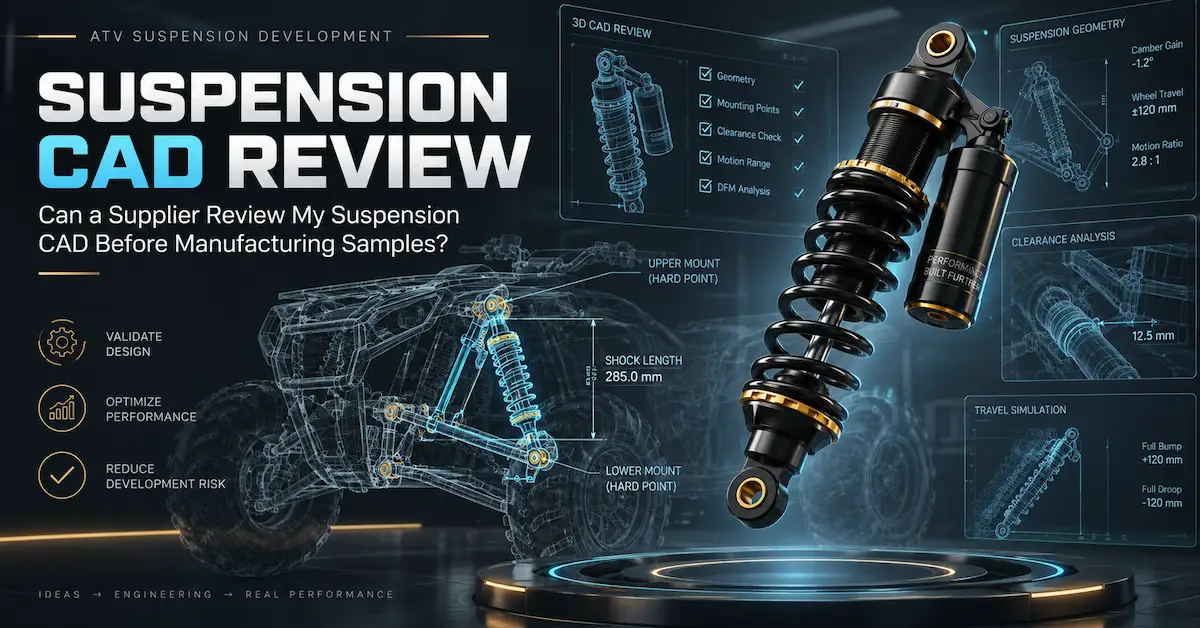
Laboratory testing provides controlled measurements, but the target vehicle determines whether the shock actually works in its intended application. BEDO’s testing guide identifies vehicle-level checks such as suspension response, handling, traction, noise, stability, and application-specific behavior. For ATV testing, it specifically highlights off-road impacts, suspension travel, and rider control.
The vehicle test should reproduce the relevant configuration. A cargo shock should be assessed with representative load conditions; a larger-tire product should use the intended wheel/tire setup; a performance trail shock should be evaluated on representative terrain.
A physically installable product is not automatically a validated suspension product.
Prototype Validation and Mass-Production QC Are Different
One of the most important distinctions for OEM buyers is that not every development test belongs on every mass-produced unit.
A destructive durability test, for example, may be part of prototype or periodic validation rather than an end-of-line test on every product. Routine production inspection may instead emphasize dimensions, assembly, leakage, performance checks, appearance, and other controls defined by the production quality plan.
BEDO’s testing guide separates incoming inspection, production inspection, and final testing, while its prototype guide positions durability, temperature, load, and vehicle evaluation within the broader development program.
| Stage | Primary purpose | Typical focus |
|---|---|---|
| Prototype validation | Prove the engineering concept | Fitment, damping, load, durability, temperature, vehicle behavior as required |
| Engineering revision | Correct deficiencies | Spring, damping, dimensions, seals, structure |
| Pilot/small batch | Prove manufacturing repeatability | Dimensional variation, leakage, damping variation, assembly, appearance |
| Mass-production QC | Maintain approved specification | Incoming, in-process and final controls defined by quality plan |
| Periodic validation | Check continuing product/process capability where required | Project-specific repeat validation |
Use a Pilot Batch to Test the Manufacturing Process
A successful prototype proves that one unit can meet the requirement. It does not prove that the factory can reproduce the same product consistently.
Before scaling a new custom program, a pilot batch can reveal dimensional variation, spring differences, damping variation, leakage issues, adjustment inconsistencies, coating defects, packaging errors, or assembly problems. BEDO’s performance and prototype guidance specifically identifies small-batch validation as a bridge between one-off development and production consistency.
This makes pilot production particularly valuable for a new OEM design, private-label performance shock, reservoir product, or newly revised spring/damping configuration.
Require Test Reports That Identify Exactly What Was Tested
A professional test report should be traceable. Buyers should be able to determine which sample or batch was evaluated and under which specification.
A useful test record can identify:
| Report field | Purchasing value |
|---|---|
| Product/SKU | Prevents test-result mix-ups |
| Drawing/revision | Connects evidence to engineering definition |
| Sample/batch ID | Enables traceability |
| Spring/damping version | Identifies technical configuration |
| Test method | Explains what was actually evaluated |
| Test conditions | Allows meaningful interpretation |
| Acceptance criteria | Defines what “pass” means |
| Result | Records measured outcome |
| Date/status | Supports approval history |
| Engineering disposition | Records any required revision |
A glossy certificate saying “quality tested” is much less useful than configuration-specific evidence.
Check Incoming Materials and Components Before Final Assembly
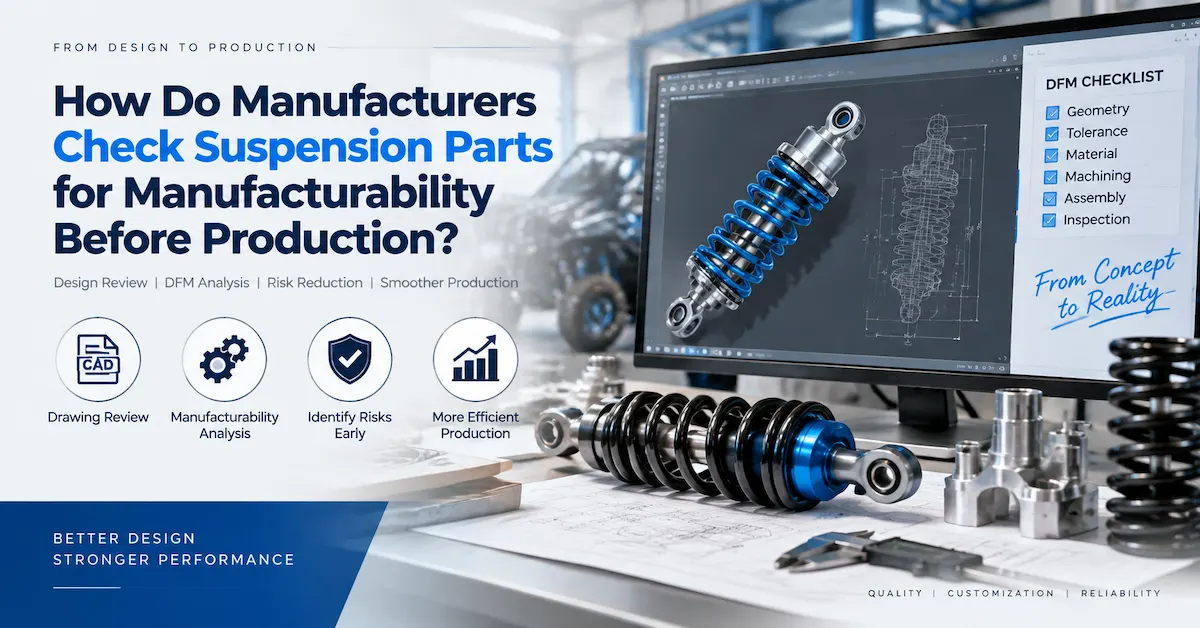
Shock absorber testing before mass production should not begin only after the complete shock is assembled. BEDO’s quality-control framework includes incoming inspection of materials, springs, seals, machined parts, and other components before assembly.
This matters because later final testing may not easily identify every component problem. A wrong spring version, incorrect machined dimension, unsuitable seal, or mixed component can create performance variation even when the final product appears visually correct.
The production control plan should therefore identify which characteristics are checked at incoming, in-process, and final stages.
Verify Assembly and Process Controls During Production
BEDO’s testing guidance identifies assembly accuracy, torque control, alignment, and oil filling among manufacturing-stage inspection concerns. The exact process controls will vary by shock architecture, but the principle is important: final performance is influenced by how the product is assembled, not only by the dimensions of its individual parts.
For a custom OEM program, ask how the factory controls the approved spring, damping configuration, reservoir components, seals, fittings, adjusters, and identification through assembly.
This is particularly important when visually similar products use different internal specifications.
Do Not Release Production with Unresolved Test Failures
A failed test should create an engineering decision, not an informal exception.
A disciplined process is:
Test Failure → Root-Cause Review → Engineering Change → Updated Drawing/Specification → Revised Prototype → Required Retest → Approval
If spring rate, damping, mounting dimension, seal arrangement, or structural details are changed, update the corresponding controlled documents.
BEDO’s prototype process explicitly recognizes that first samples can lead to revisions in spring rate, preload, damping, stroke, mounting dimensions, seals, structural components, or surface treatment before production approval.
Ask What Will Be Tested on Every Batch
Before placing a volume order, buyers should ask the supplier to define the production quality plan rather than simply requesting “all tests.”
Questions should include which characteristics are inspected on incoming parts, which are controlled during assembly, what final checks apply to completed shocks, which tests are sampling-based, and which validation tests are periodic or development-only.
This creates a more realistic and useful quality discussion than demanding that every mass-produced shock undergo every possible development test.
BEDO’s ATV Shock Absorber Production Guide provides related context on engineering review, component manufacturing, assembly and quality control.
How Does Testing Affect Cost and Lead Time?
More testing is not automatically better if it is unrelated to the actual application. Testing adds engineering time, samples, equipment use, reporting, and in some cases destructive units.
The goal is to build a test plan around the major technical and commercial risks.
A performance suspension project may justify more damping and vehicle validation. A utility cargo product may prioritize load and durability evaluation. An adjustable shock may require additional adjustment-repeatability checks.
Ask the quotation to separate development testing from routine production inspection so purchasing understands which costs are one-time and which recur with every order.
What Should You Send BEDO Before Defining the Test Plan?
BEDO supports customized shock absorber development, prototype validation, testing, small-batch manufacturing, and OEM production. Its Shock Absorber Testing Service Guide covers dimensional, damping, leakage, load, durability, temperature-related, adjustment, and vehicle testing.
For a project-specific testing discussion, prepare the vehicle application, current drawing and revision, reference sample if available, shock dimensions, spring and damping configuration, rider or cargo loads, operating terrain, current suspension problem, intended improvement, prototype quantity, and production forecast.
Then ask BEDO to classify each test as:
Required for prototype approval
Required for pilot-batch validation
Required as routine production QC
Periodic/project-specific validation
Not required for this application
That structure prevents both under-testing and unnecessary testing.
Frequently Asked Questions
1. What Is the Minimum Testing a Shock Absorber Factory Should Perform?
There is no universal minimum for every vehicle application. Dimensional, functional and sealing verification are fundamental areas, while damping, load, durability, temperature, adjustment and vehicle tests should be selected according to the product and approved requirements. BEDO’s testing guide describes these categories in more detail.
2. Should Every Shock Be Tested on a Dyno?
The production test strategy depends on the agreed quality plan, configuration, equipment, volumes and risk. Buyers should ask which damping checks apply to prototypes, pilot batches and routine production instead of assuming one universal inspection frequency.
3. Is a Leakage Test Enough to Approve a Shock?
No. A sealed shock may still have incorrect dimensions, spring support or damping. Leakage testing verifies one reliability area; it does not replace dimensional and performance validation.
4. When Should Durability Testing Be Performed?
Durability is particularly relevant during new-product development, significant engineering changes and other project-defined validation stages. The appropriate test profile should represent the intended application rather than using an arbitrary universal cycle count.
5. Do ATV Shocks Need Temperature Testing?
Temperature-related evaluation becomes more relevant when sustained suspension work and heat can affect damping consistency or sealing. The requirement and conditions should be defined around the actual ATV duty cycle.
6. What Should Be Tested on Adjustable Shocks?
Depending on the design, verify compression and/or rebound adjustment, preload mechanisms where applicable, repeatability, baseline settings, and whether adjustment creates a predictable response.
7. Is Laboratory Testing Enough Before Mass Production?
Not always. Vehicle-level validation may be needed to confirm fitment, travel, suspension response and real application performance, particularly for a new or substantially modified suspension configuration.
8. Why Use a Pilot Batch After the Prototype Passes?
A prototype verifies the design; a pilot batch helps determine whether the manufacturing process can reproduce it consistently. It may expose dimensional, damping, leakage, assembly or packaging variation before a large order.
9. What Information Should a Shock Absorber Test Report Include?
The report should let buyers identify the tested configuration, sample or batch, relevant conditions, acceptance criteria and result. For custom programs, connect the report to the controlled drawing and technical revision.
10. When Is Shock Absorber Testing Before Mass Production Complete?
Shock absorber testing before mass production is complete only when the required development tests have been accepted, engineering changes are incorporated into controlled documents, the production configuration is clearly identified, and any pilot or production-release requirements specified by the project have been satisfied. It should be an engineering release decision, not simply the date on which the last laboratory test was run.
Conclusion
A shock absorber factory should not move directly from a visually acceptable prototype into volume production. Effective shock absorber testing before mass production combines dimensional verification, compression and rebound testing, leakage checks, load and durability evaluation, temperature-related validation where relevant, adjustment testing for tunable products, and representative vehicle testing according to the actual application. Just as importantly, OEM buyers should distinguish development validation from pilot-batch checks and routine production QC, because not every destructive or vehicle-level test belongs on every finished unit. BEDO supports prototype development, testing validation, small-batch manufacturing and OEM production for ATV and other suspension projects. To build a project-specific test plan, contact BEDO with your approved drawing, suspension configuration, vehicle/load data, application conditions, prototype status and expected order quantity so the required tests and production-release evidence can be defined before mass production.